Introduction to
Higher Education
June 2014
Welcome and Introductions
Matthew Andrews
• Oxford Brookes University
• Academic Registrar
• AUA Chair
Kenton Lewis
• AUA Trustee
Understanding Higher Education: The One Day Nutshell
Pauline Morgan
• University of Manchester
• Head of Faculty Finance
for Faculty of Engineering
and Physical Science
(EPS)
• Director of Operations for
National Graphene
Institute (NGI)
Programme
10.10 – 11.25 The Higher Education Sector
11.25 – 11.45 Refreshments
11.45 – 1.00 Business-like but not a Business
1.00 – 1.45 Lunch
1.45 – 3.00 Academic Enterprise
3.00 – 3.20 Refreshments
3.20 – 4.20 The VC’s Dilemma
4.20 – 4.30 Wrap-up and depart
THE HIGHER EDUCATION
SECTOR
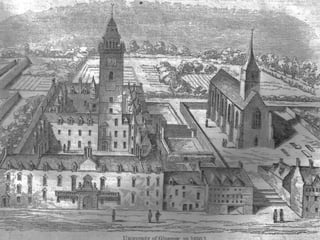
The historical development of higher education
Understanding Higher Education: The One Day Nutshell
• Oxford
• Cambridg
e
Understanding Higher Education: The One Day Nutshell
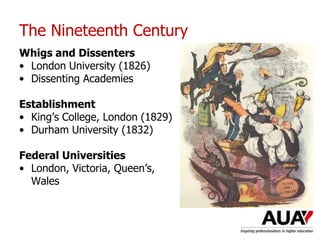
The Nineteenth Century
Whigs and Dissenters
• London University (1826)
• Dissenting Academies
Establishment
• King’s College, London (1829)
• Durham University (1832)
Federal Universities
• London, Victoria, Queen’s,
Wales
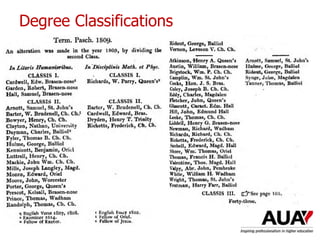
Degree Classifications
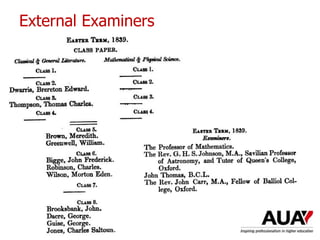
External Examiners
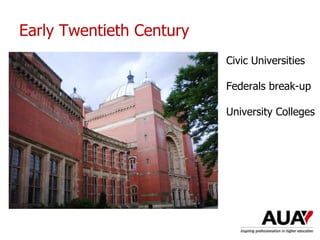
Early Twentieth Century
Civic Universities
Federals break-up
University Colleges
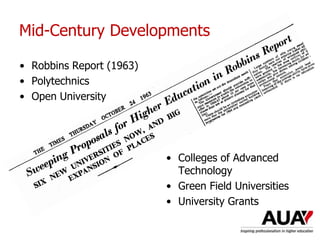
Mid-Century Developments
• Robbins Report (1963)
• Polytechnics
• Open University
• Colleges of Advanced
Technology
• Green Field Universities
• University Grants
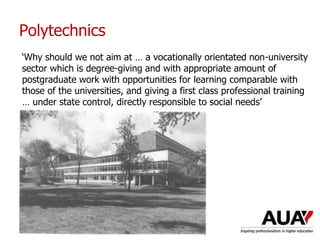
Polytechnics
‘Why should we not aim at … a vocationally orientated non-university
sector which is degree-giving and with appropriate amount of
postgraduate work with opportunities for learning comparable with
those of the universities, and giving a first class professional training
… under state control, directly responsible to social needs’
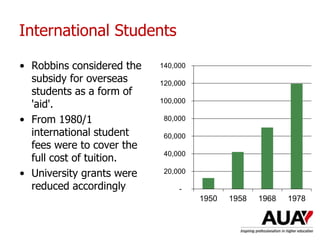
International Students
• Robbins considered the
subsidy for overseas
students as a form of
'aid'.
• From 1980/1
international student
fees were to cover the
full cost of tuition.
• University grants were
reduced accordingly -
20,000
40,000
60,000
80,000
100,000
120,000
140,000
1950 1958 1968 1978
1992… and on…
1992 Further and Higher Education Act
• Converted all polytechnics and Scottish
Central Institutions into Universities
• Created the funding councils in the
devolved administrations
Since 1992 some colleges of HE have
become universities, e.g. Edge Hill
University (formerly Edge Hill College) and
University of Wales, Newport (formerly
Gwent College of HE)
Understanding Higher Education: The One Day Nutshell
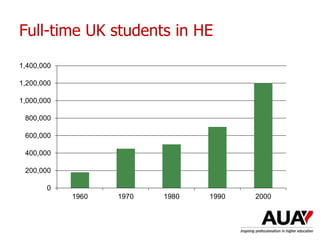
Full-time UK students in HE
0
200,000
400,000
600,000
800,000
1,000,000
1,200,000
1,400,000
1960 1970 1980 1990 2000
THE HIGHER EDUCATION
SECTOR
The structure and organisation of contemporary UK higher
education
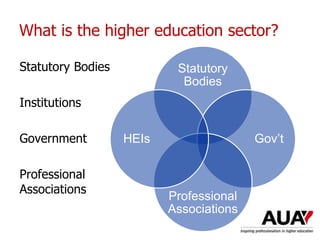
What is the higher education sector?
Statutory Bodies
Institutions
Government
Professional
Associations
Statutory
Bodies
Gov’t
Professional
Associations
HEIs
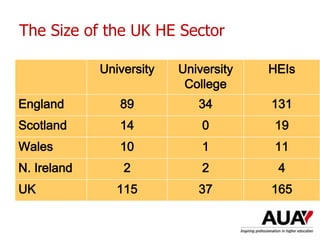
The Size of the UK HE Sector
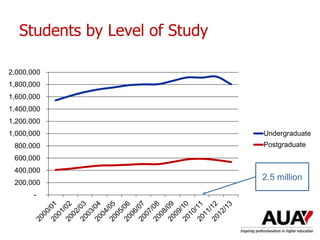
Students by Level of Study
-
200,000
400,000
600,000
800,000
1,000,000
1,200,000
1,400,000
1,600,000
1,800,000
2,000,000
Undergraduate
Postgraduate
2.5 million
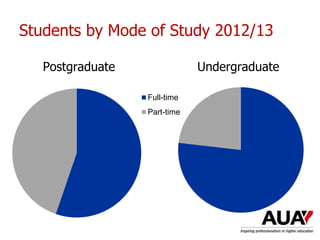
Students by Mode of Study 2012/13
Postgraduate Undergraduate
Full-time
Part-time
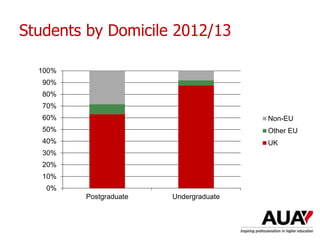
Students by Domicile 2012/13
0%
10%
20%
30%
40%
50%
60%
70%
80%
90%
100%
Postgraduate Undergraduate
Non-EU
Other EU
UK
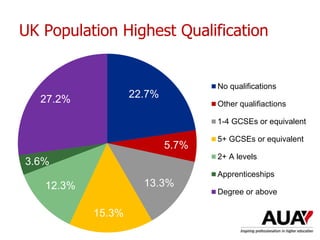
UK Population Highest Qualification
22.7%
5.7%
13.3%
15.3%
12.3%
3.6%
27.2%
No qualifications
Other qualifiactions
1-4 GCSEs or equivalent
5+ GCSEs or equivalent
2+ A levels
Apprenticeships
Degree or above
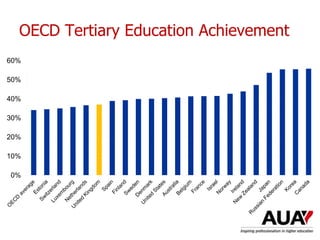
OECD Tertiary Education Achievement
Understanding Higher Education: The One Day Nutshell
0%
10%
20%
30%
40%
50%
60%
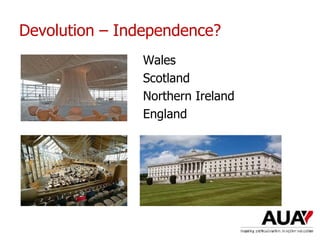
Devolution – Independence?
Wales
Scotland
Northern Ireland
England
Understanding Higher Education: The One Day Nutshell
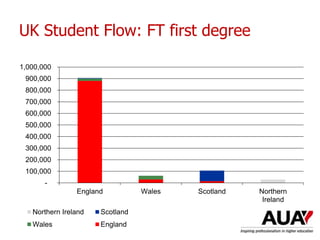
UK Student Flow: FT first degree
-
100,000
200,000
300,000
400,000
500,000
600,000
700,000
800,000
900,000
1,000,000
England Wales Scotland Northern
Ireland
Northern Ireland Scotland
Wales England
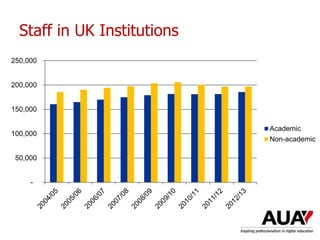
Staff in UK Institutions
-
50,000
100,000
150,000
200,000
250,000
Academic
Non-academic
Private Higher Education
The University of Buckingham (not-for-profit)
BPP University (for-profit, subsidiary of the Apollo Group
in the USA)
The University of Law (charity)
Ashridge Business School (charity)
IFS University College (charity)
Regents University (charity)
Understanding Higher Education: The One Day Nutshell
Massification = Specialisation
Universities UK (UUK)
• Founded in 1918
• 134 members
• Universities UK is the major representative body and
membership organisation for the higher education
sector
• UUK members are the executive heads of UK
universities
• Together with Higher Education Wales and
Universities Scotland, UUK works to advance the
interests of universities and to spread good practice
throughout the higher education sector
Mission Groups
Million Plus – 17 members
The University Think-Tank.
University Alliance – 22 members
Innovative and entrepreneurial universities working together to tackle
big issues facing universities, people and the economy.
Russell Group – 24 members
Leading Universities committed to maintaining the very best research,
an outstanding teaching and learning experience and unrivalled links
with business and the public sector.
Other organisations…
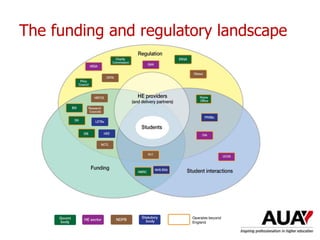
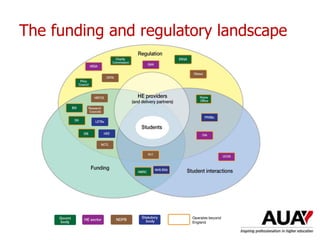
The funding and regulatory landscape
• The Higher Education Funding Council for England
(HEFCE) distributes public money to universities and
colleges in England that provide higher education
• All universities and colleges that provide higher
education in the UK are autonomous
• Institutions are not owned by the state, but most receive
government funding distributed by the separate higher
education funding councils
• HEFCE is a go-between, between DBIS and the sector,
neither Government nor part of the HE Sector
Understanding Higher Education: The One Day Nutshell
• OFFA’s role is to promote and safeguard fair access to
higher education for lower-income students and other
under-represented groups following the introduction of
higher tuition fees in 2006-07.
• The main way it does this is by approving and
monitoring Access Agreements. All English higher
education providers that want to charge higher fees
must have an Access Agreement with OFFA.
• The Office of the Independent Adjudicator for Higher
Education’s (OIA’s) role is to review individual and group
complaints by students against higher education
providers, once internal processes have been exhausted,
and to promote good practice in handling complaints and
appeals.
• While the OIA has no regulatory power over higher
education providers and cannot fine them, higher
education institutions are required by law to join the OIA
scheme. The OIA recommends remedies or
compensation for students where complaints are
justified or partly justified.
• QAA’s mission is to safeguard academic standards and
improve the quality of UK higher education.
• QAA offers advice, guidance and support to help UK
higher education providers (universities, colleges and
other organisations, both public and private) to offer the
best possible student experience of higher education.
• It conducts peer-based reviews and publishes reports
detailing the findings. QAA works in consultation with
the higher education sector in developing policy and
frameworks for academic standards.
REFRESHMENTS
11.25-11.45
BUSINESS-LIKE BUT NOT A
BUSINESS
The legal framework of higher education
Degree Awarding Powers
• Universities are autonomous, self-governing institutions
which operate within a regulated environment for higher
education.
• The power to award degrees is regulated by law.
• To be able to award a recognised higher education
degree in the UK an organisation must be authorised,
either by Royal Charter or Act of Parliament – as
recommended by the QAA.
Types of Degree Awarding Power
Foundation Degrees (England and Wales only)
• Further education institutions offering higher education
provision in England or Wales.
Taught Degrees
• HEIs with a proven track record of successful validated
provision.
Research Degrees
• HEIs with existing taught degree awarding powers.
Understanding Higher Education: The One Day Nutshell
Some Relevant Legislation
• The Education Reform Act 1988 makes it an offence
to offer a ‘degree’, ‘bachelor’, ‘master’ or ‘doctor’ award
unless offered by a degree-awarding body as recognised
by Secretary of State, Act of Parliament or Royal Charter.
• The Business Names Act 1985 states only bodies
properly approved can use the name ‘university’.
• Under the Further and Higher Education Act 1992,
the Privy Council was also responsible for approving the
use of the word 'university' (including 'university
college') in the title of a higher education institution.
Understanding Higher Education: The One Day Nutshell
What is a University?
An organisation wishing to apply for approval to use the
title ‘university’ must:
• have been granted powers to award taught degrees
• normally have at least 1,000 full time equivalent higher
education students, of whom at least 750 are registered
on degree courses (including foundation degree
programmes), and the number of full time equivalent
higher education students must exceed 55% of the total
number of full time equivalent students
• be able to demonstrate that it has regard to the
principles of good governance as are relevant to its
sector
BUSINESS-LIKE BUT NOT A
BUSINESS
The activity and business of HE - Funding
What is a Business?
Wikipedia
• A business, also known as an enterprise or a firm, is an
organisation involved in the trade of goods, services, or
both to consumers.
• Businesses are prevalent in capitalist economies, where
most of them are privately owned and provide goods
and services to customers in exchange of other goods,
services, or money.
• Businesses may also be not-for-profit or state owned.
• A business owned by multiple individuals may be
referred to as a company.
Is a University a Business?
• A business, also known as an enterprise or a firm, is an
organisation involved in the trade of goods,
services, or both to consumers.
• Businesses are prevalent in capitalist economies, where
most of them are privately owned and provide goods
and services to customers in exchange of other
goods, services, or money.
• Businesses may also be not-for-profit or state owned.
• A business owned by multiple individuals may be
referred to as a company.
• Universities straddle the public/private sector. They
must try to operate like a business, such as having
business processes , whilst remaining loyal to what a
University actually is
• The word "university" is derived from the Latin
universitas magistrorum et scholarium, which roughly
means "community of teachers and scholars.“
What does business-like mean to
Universities?
What do you think the role of an academic
is within a university?
• Teacher
• Researcher
• Consultant
• Leader
• Senior Manager
What do you think the role of an academic
is within a university?
What does business-like mean to
Universities?
• Universities are business-like in that we need to produce
a ‘surplus’ each year in order to remain sustainable.
– HEFCE says so!
– Recommends 4-5% surplus
– Surplus is turned into cash
– Funds working capital and capital expenditure
What does business-like mean to
Universities?
• Universities have become much more business like in
recent years, for example, adopting more commercial
processes and techniques, including
– P2P
– O2C
– Workflow systems
Business Like – changes in personnel
• The sector has seen a move over the last few years to
professional finance staff running the business rather
than academics.
– Director of Finance, rather than an academic bursar
• This leads to more clarity of what is required and allows
the business like industry processes to be introduced.
• Better understanding of funding and cost control
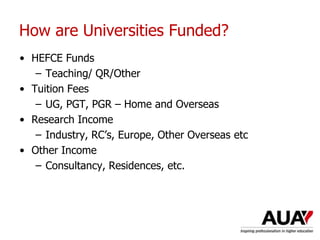
How are Universities Funded?
• HEFCE Funds
– Teaching/ QR/Other
• Tuition Fees
– UG, PGT, PGR – Home and Overseas
• Research Income
– Industry, RC’s, Europe, Other Overseas etc
• Other Income
– Consultancy, Residences, etc.
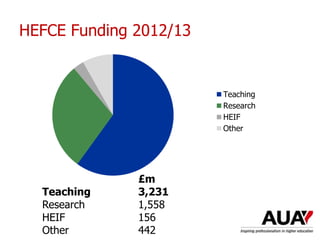
Teaching
Research
HEIF
Other
£m
Teaching 3,231
Research 1,558
HEIF 156
Other 442
HEFCE Funding 2012/13
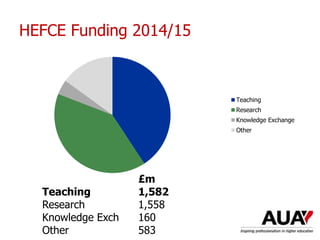
HEFCE Funding 2014/15
Teaching
Research
Knowledge Exchange
Other
£m
Teaching 1,582
Research 1,558
Knowledge Exch 160
Other 583
HEFCE Teaching Funding
• HEFCE’s Teaching funding allocation methodology
₋ Student numbers in subject groupings
₋ Various rates of grant by subject
₋ Scaling factors to keep within budget
₋ ‘old regime’ and ‘new regime’ categories
HEFCE Research Funding (QR)
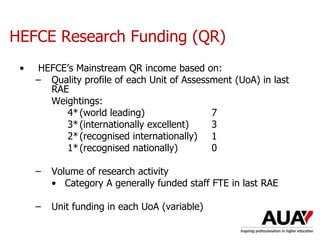
• HEFCE’s Mainstream QR income based on:
– Quality profile of each Unit of Assessment (UoA) in last
RAE
Weightings:
4*(world leading) 7
3*(internationally excellent) 3
2*(recognised internationally) 1
1*(recognised nationally) 0
– Volume of research activity
• Category A generally funded staff FTE in last RAE
– Unit funding in each UoA (variable)
HEFCE Research Funding (QR)
• Charities funding
– Unweighted for quality
– Based on HESA returns
– Normally averaged over 2 years
• Business Research Element (BRE) – introduced in 2007-08
– Unweighted for quality
– Based on HESA returns
– 2014-15 allocations based on average of 2011-12 and 2012-13
Research Income from UK industry, commerce and public
corporations
• Research Degree Programme student supervision funding
– Home/EU students in years 1-3 only
– Returned annually in RAS
• The major costs of any university are the
pay costs (that is the cost of staffing)
– These are often the hardest costs to manage!
• Non Pay
– Difficult to forecast
• Deprecation
– Cost of investing in equipment and buildings
• Interest and Charges
The costs of running a University
• Cost Control is different from Cost Cutting!
– Ongoing process
– Strategic focus
– Long term efficiency
– Investment in the future
• Decisions made now affect future cash
and operating results
Cost Control is vital to the running of any
institution!
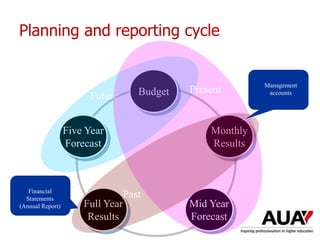
Planning and reporting cycle
Budget
Mid Year
Forecast
Monthly
Results
Five Year
Forecast
Full Year
Results
Future
Present
PastFinancial
Statements
(Annual Report)
Management
accounts
Accounting policies
• Normally set by Finance Director and approved by
Board of Governors
• Comply with UK Generally Accepted Accounting
Practice (GAAP)
• True and Fair view
• UoM uses ‘Historical cost convention’
• Institution should judge the appropriateness of
accounting policies to its particular circumstances
against the objectives of:
– Relevance
– Reliability
– Comparability
– Understandability
Accounting Concepts
Going
Concern
Accountants assume, unless there is evidence to the contrary,
that a company is not going broke. This has important
implications for the valuation of assets and liabilities.
Consistency Transactions and valuation methods are treated the same way
from year to year, or period to period. Users of accounts can,
therefore, make more meaningful comparisons of financial
performance from year to year. Where accounting policies are
changed, companies are required to disclose this fact and
explain the impact of any change.
Prudence Profits are not recognised until a sale has been completed. In
addition, a cautious view is taken for future problems and
costs of the business (the are "provided for" in the accounts"
as soon as their is a reasonable chance that such costs will be
incurred in the future.
Matching (or
"Accruals")
Income should be properly "matched" with the expenses of a
given accounting period.
Financial statements
• Income and expenditure account
– Results of operations for year ending 31 July
• Balance sheet
– Financial position as at 31 July
– Shows assets and liabilities of institution
– ‘Snapshot’
• Cashflow statement
– Movements in cash during year ending 31 July
Differences between financial statements
and management accounts
Financial Statements
• Used for external reporting
• Reporting to External
stakeholders and Board of
• Formats strictly controlled by
law, accounting requirements
(Statement of Recommended
Practice – SORP)
• Prepared at institutional level –
include items which are only
considered at that level, eg
pension liabilities
• Used for internal reporting and
decision-making
• Reporting to Heads of School,
Deans, Senior Management
Team, Finance Committee
• Formats more flexible and
management led
• Prepared at school/faculty level
Management Accounts
Business-like Financial Processes
• Government Funding cuts increase pressure to
understand finances
• Prepare Financial Statements but follow sector specific
guidance
• Better Management Accounting information
• Understand the academic roles
Social Value!
• Not everything that is profitable is of social value and
not everything of social value is profitable
• HE’s are important to the UK Economy, working in
Research, SME engagement etc.
LUNCH
1.00-1.45
ACADEMIC ENTERPRISE
Culture and values of HE and its staff
Exploring the academic enterprise
• Academic enterprise is central to Universities’ missions
• AND it is an important element of all HE providers’
missions (noting the variety in the sector)
Innovative activities and partnerships that result in the
exploitation (and transfer) of knowledge and expertise, and
therefore enhance the relevance of teaching and research
activities within a subject area
• The academic enterprise can be best explored through
definitions of ‘scholarship’
Understanding Higher Education: The One Day Nutshell
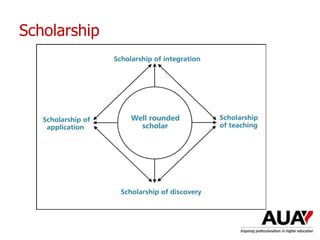
Scholarship
• Not just ‘blue-sky thinking’
• Ernest Boyer expanded our understanding of scholarship
to help shape the (research) mission of HEIs:
- Discovery
- Integration
- Application
- Scholarship of teaching and learning
Understanding Higher Education: The One Day Nutshell
Scholarship
• Discovery – original research that advances
knowledge
• Integration – synthesis of information across
disciplines, across topics within disciplines, or across
time
• Application – engaging communities inside and
outside the university to advance the public good
• Scholarship of teaching and learning –
advancing the practice of teaching by making
research findings public and engaging learners in
scholarly activity
Understanding Higher Education: The One Day Nutshell
Scholarship
Understanding Higher Education: The One Day Nutshell
Where do we fit?
• Who are ‘we’?
• Our professional role in developing,
promoting, facilitating scholarship
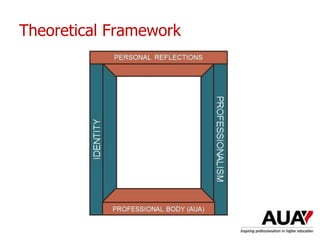
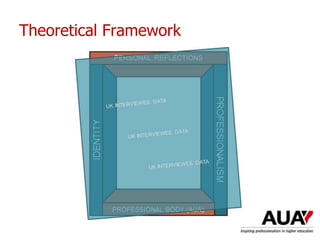
• A model to explore professional identity
• A model to explain professional identity
Understanding Higher Education: The One Day Nutshell
Simple show of hands
• Are you professional in your work?
• Are you a professional?
• Are you part of a profession?
Understanding Higher Education: The One Day Nutshell
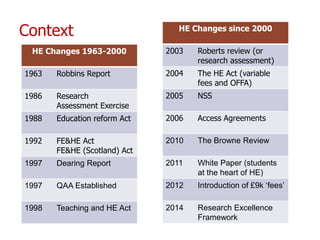
Context
“The role of professional administrative and support
staff is becoming more pivotal as the sector becomes
more competitive, more business and market
focussed, and more international…the old divide
between academic and “non-academic” is starting to
change.”
(Wild and Wooldridge, 2009)
Understanding Higher Education: The One Day Nutshell
Context
Understanding Higher Education: The One Day Nutshell
HE Changes 1963-2000
1963 Robbins Report
1986 Research
Assessment Exercise
1988 Education reform Act
1992 FE&HE Act
FE&HE (Scotland) Act
1997 Dearing Report
1997 QAA Established
1998 Teaching and HE Act
HE Changes since 2000
2003 Roberts review (or
research assessment)
2004 The HE Act (variable
fees and OFFA)
2005 NSS
2006 Access Agreements
2010 The Browne Review
2011 White Paper (students
at the heart of HE)
2012 Introduction of £9k ‘fees’
2014 Research Excellence
Framework
The funding and regulatory landscape
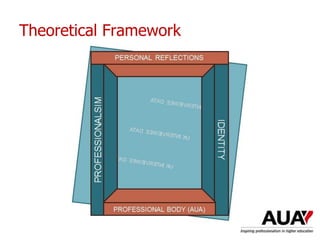
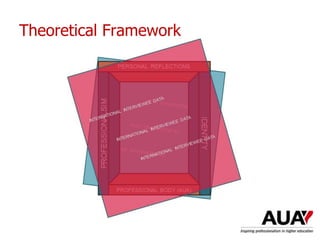
Theoretical Framework
Understanding Higher Education: The One Day Nutshell
Theoretical Framework
Understanding Higher Education: The One Day Nutshell
Theoretical Framework
Understanding Higher Education: The One Day Nutshell
Theoretical Framework
On professionalism
• There are differences between the traditional definitions
and experienced understandings
• Contemporary professionals face multiple, concurrent
drivers:
-gaining and managing expert knowledge
-operating entrepreneurially
-managing limited resources
-navigating regulatory guidelines
-meeting clients needs and expectations
• Professionals are:
-losing autonomy / authority
-no longer sole owners of knowledge
-experiencing increased levels of regulation
On professionalism
• ‘trust’, ‘integrity’, ‘service’ and ‘authority’
being replaced by
• ‘quality assurance’, ‘performance indicators’,
‘standards’, and ‘efficiency’
“professionalism is witnessing a lurch from an
ethic of service to an ethic of performance”
(Barnett, 2008)
On identity
• Considerations of ‘sameness’
• Demonstrated through the affiliations we choose, and
have chosen for us, with different groups
• Inherent link with the verb to ‘identify’; something that
needs to be established
• Through identification, one’s identity is open to change
and reconceptualisation over time
• Identity is therefore a socially constructed entity which is
constantly being reconfigured and reformed
On identity
• We are not limited to a single ‘identity’; we all
experience multiplicity
• We all constantly reassert, reconsider and
reconceptualise our identities
• Therefore any actuality, expectation or threat of
change is very likely to provoke concerns about
who or what we are
• BUT, it also provides a freedom to create new,
or redefine existing, identities and to ‘straddle
boundaries’
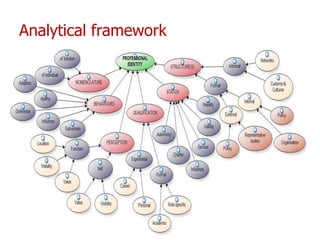
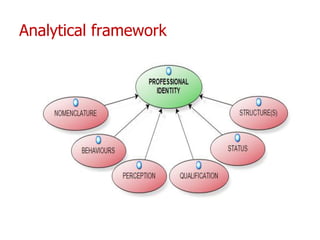
Analytical framework
• Nomenclature – the descriptors individuals
and collectives choose, and the labels applied to
them by others
• The behaviours we (un)consciously choose in
order to shape our working lives
• How perceptions of ‘professional’ staff are
ascribed and (re)negotiated
Analytical framework
• The relevance of acquired skills, experience and
qualifications in enacting one’s duties and in
engaging with (academic) colleagues
• The influence of perceived and formal (relative)
status
• The formal and informal structures that shape
the environment in which HE ‘professionals’
(re)construct their identity
In your groups
Consider a single theme from the framework
making use of the hand-out
• What do you collectively understand by
this theme?
• Do you recognise it? If so, how and
where?
• How might awareness of this theme
enhance your own professional
practice?
Collective self confidence
• The loss, or absence, of professional self-
confidence makes it disproportionately harder to
operate as a professional
• lack of assurance and self-confidence prevent a
unified and proud claim of professional status
• We need the self-confidence to champion and
promote our work as a desirable and rewarding
career that contributes to the greater good of
scholarship, of higher education and of society.
Simple show of hands
• Are you professional in your work?
YES
• Are you a professional?
YES
• Are you part of a profession?
YOU ARE IF YOU WANT TO BE!
Understanding Higher Education: The One Day Nutshell
REFRESHMENTS
3.00-3.20
THE VICE-CHANCELLOR’S
DILEMMA
Group exercise
The VC’s Dilemma
The VC of the University of Poppleton has been invited to
sit on four national working groups – she only has time to
attend one… but which one?!
1. Growth of alternative providers and the extension of
degree awarding powers.
2. The student funding regime.
3. Internationalisation and student visa issues.
4. Student complaints and appeals.
The Format
• We will briefly introduce each topic.
• After we’ve each said our piece you will have
small group discussion for twenty minutes or so
to discuss which is the biggest issue and why.
• Each group then briefly explains to the others
why they made their selection.
• We vote! The issue picked by the most
delegates is the winner.
Understanding Higher Education: The One Day Nutshell
Dilemma 1 – alternative providers & DAP
• Discuss changes and challenges to the very
foundation of the Higher Education sector
• Cuts to the chase on the fundamental discussion
of “what is a university and what is it for”
• New providers will likely lead to a thinner spread
of funding – you need to be in that discussion
• Central to managing the quality and reputation
of the sector as a whole
• Ties to your interest in Widening Access – price
variation, segmentation, opportunity, hierarchy.
Understanding Higher Education: The One Day Nutshell
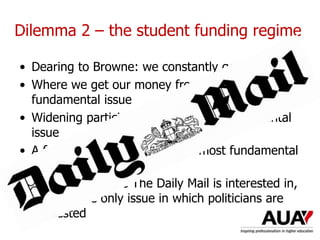
Dilemma 2 – the student funding regime
• Dearing to Browne: we constantly get it wrong
• Where we get our money from is the most
fundamental issue
• Widening participation is the most fundamental
issue
• A fair and equal system is the most fundamental
issue
• It’s the only issue The Daily Mail is interested in,
ergo it’s the only issue in which politicians are
interested
Dilemma 3 – internationalisation and visas
• “Show me the money!” – opportunities to
increase income and help UK PLC
• Embedding global scholarship – more partners
leads to greater opportunities to discover,
integrate and apply knowledge for real impact
• You’ll be at the centre of managing and
enhancing UK HE’s reputation overseas
• This is your chance to stick it to the UK Govt. on
their over-zealous definitions of immigration
• PS Who doesn’t fancy a ‘fact finding mission’ in
the Bahamas?
Dilemma 4 – complaints and appeals
• Dissatisfaction rates, as judged by OIA cases,
are at an all-time high (okay, except they’re not)
• When the impact of £9k fees is felt more we will
see the number of complaints and appeals swell
• Complaints are time-consuming we should make
our processes light-touch
• Complaints can damage an institution’s
reputation and need to be managed effectively
Understanding Higher Education: The One Day Nutshell
WRAP UP AND DEPART
Group exercise
Introduction to
Higher Education
June 2014

Introduction to Higher Education (June 2014)

  • 1.
  • 2.
    Welcome and Introductions MatthewAndrews • Oxford Brookes University • Academic Registrar • AUA Chair Kenton Lewis • AUA Trustee Understanding Higher Education: The One Day Nutshell Pauline Morgan • University of Manchester • Head of Faculty Finance for Faculty of Engineering and Physical Science (EPS) • Director of Operations for National Graphene Institute (NGI)
  • 3.
    Programme 10.10 – 11.25The Higher Education Sector 11.25 – 11.45 Refreshments 11.45 – 1.00 Business-like but not a Business 1.00 – 1.45 Lunch 1.45 – 3.00 Academic Enterprise 3.00 – 3.20 Refreshments 3.20 – 4.20 The VC’s Dilemma 4.20 – 4.30 Wrap-up and depart
  • 4.
    THE HIGHER EDUCATION SECTOR Thehistorical development of higher education
  • 5.
    Understanding Higher Education:The One Day Nutshell • Oxford • Cambridg e
  • 6.
    Understanding Higher Education:The One Day Nutshell
  • 8.
    Understanding Higher Education:The One Day Nutshell
  • 9.
    The Nineteenth Century Whigsand Dissenters • London University (1826) • Dissenting Academies Establishment • King’s College, London (1829) • Durham University (1832) Federal Universities • London, Victoria, Queen’s, Wales
  • 10.
  • 11.
  • 12.
    Early Twentieth Century CivicUniversities Federals break-up University Colleges
  • 13.
    Mid-Century Developments • RobbinsReport (1963) • Polytechnics • Open University • Colleges of Advanced Technology • Green Field Universities • University Grants
  • 14.
    Polytechnics ‘Why should wenot aim at … a vocationally orientated non-university sector which is degree-giving and with appropriate amount of postgraduate work with opportunities for learning comparable with those of the universities, and giving a first class professional training … under state control, directly responsible to social needs’
  • 15.
    International Students • Robbinsconsidered the subsidy for overseas students as a form of 'aid'. • From 1980/1 international student fees were to cover the full cost of tuition. • University grants were reduced accordingly - 20,000 40,000 60,000 80,000 100,000 120,000 140,000 1950 1958 1968 1978
  • 16.
    1992… and on… 1992Further and Higher Education Act • Converted all polytechnics and Scottish Central Institutions into Universities • Created the funding councils in the devolved administrations Since 1992 some colleges of HE have become universities, e.g. Edge Hill University (formerly Edge Hill College) and University of Wales, Newport (formerly Gwent College of HE) Understanding Higher Education: The One Day Nutshell
  • 17.
    Full-time UK studentsin HE 0 200,000 400,000 600,000 800,000 1,000,000 1,200,000 1,400,000 1960 1970 1980 1990 2000
  • 18.
    THE HIGHER EDUCATION SECTOR Thestructure and organisation of contemporary UK higher education
  • 19.
    What is thehigher education sector? Statutory Bodies Institutions Government Professional Associations Statutory Bodies Gov’t Professional Associations HEIs
  • 20.
    The Size ofthe UK HE Sector
  • 21.
    Students by Levelof Study - 200,000 400,000 600,000 800,000 1,000,000 1,200,000 1,400,000 1,600,000 1,800,000 2,000,000 Undergraduate Postgraduate 2.5 million
  • 22.
    Students by Modeof Study 2012/13 Postgraduate Undergraduate Full-time Part-time
  • 23.
    Students by Domicile2012/13 0% 10% 20% 30% 40% 50% 60% 70% 80% 90% 100% Postgraduate Undergraduate Non-EU Other EU UK
  • 24.
    UK Population HighestQualification 22.7% 5.7% 13.3% 15.3% 12.3% 3.6% 27.2% No qualifications Other qualifiactions 1-4 GCSEs or equivalent 5+ GCSEs or equivalent 2+ A levels Apprenticeships Degree or above
  • 25.
    OECD Tertiary EducationAchievement Understanding Higher Education: The One Day Nutshell 0% 10% 20% 30% 40% 50% 60%
  • 26.
    Devolution – Independence? Wales Scotland NorthernIreland England Understanding Higher Education: The One Day Nutshell
  • 27.
    UK Student Flow:FT first degree - 100,000 200,000 300,000 400,000 500,000 600,000 700,000 800,000 900,000 1,000,000 England Wales Scotland Northern Ireland Northern Ireland Scotland Wales England
  • 28.
    Staff in UKInstitutions - 50,000 100,000 150,000 200,000 250,000 Academic Non-academic
  • 29.
    Private Higher Education TheUniversity of Buckingham (not-for-profit) BPP University (for-profit, subsidiary of the Apollo Group in the USA) The University of Law (charity) Ashridge Business School (charity) IFS University College (charity) Regents University (charity) Understanding Higher Education: The One Day Nutshell
  • 30.
  • 31.
    Universities UK (UUK) •Founded in 1918 • 134 members • Universities UK is the major representative body and membership organisation for the higher education sector • UUK members are the executive heads of UK universities • Together with Higher Education Wales and Universities Scotland, UUK works to advance the interests of universities and to spread good practice throughout the higher education sector
  • 32.
    Mission Groups Million Plus– 17 members The University Think-Tank. University Alliance – 22 members Innovative and entrepreneurial universities working together to tackle big issues facing universities, people and the economy. Russell Group – 24 members Leading Universities committed to maintaining the very best research, an outstanding teaching and learning experience and unrivalled links with business and the public sector.
  • 33.
  • 34.
    The funding andregulatory landscape
  • 35.
    • The HigherEducation Funding Council for England (HEFCE) distributes public money to universities and colleges in England that provide higher education • All universities and colleges that provide higher education in the UK are autonomous • Institutions are not owned by the state, but most receive government funding distributed by the separate higher education funding councils • HEFCE is a go-between, between DBIS and the sector, neither Government nor part of the HE Sector Understanding Higher Education: The One Day Nutshell
  • 36.
    • OFFA’s roleis to promote and safeguard fair access to higher education for lower-income students and other under-represented groups following the introduction of higher tuition fees in 2006-07. • The main way it does this is by approving and monitoring Access Agreements. All English higher education providers that want to charge higher fees must have an Access Agreement with OFFA.
  • 37.
    • The Officeof the Independent Adjudicator for Higher Education’s (OIA’s) role is to review individual and group complaints by students against higher education providers, once internal processes have been exhausted, and to promote good practice in handling complaints and appeals. • While the OIA has no regulatory power over higher education providers and cannot fine them, higher education institutions are required by law to join the OIA scheme. The OIA recommends remedies or compensation for students where complaints are justified or partly justified.
  • 38.
    • QAA’s missionis to safeguard academic standards and improve the quality of UK higher education. • QAA offers advice, guidance and support to help UK higher education providers (universities, colleges and other organisations, both public and private) to offer the best possible student experience of higher education. • It conducts peer-based reviews and publishes reports detailing the findings. QAA works in consultation with the higher education sector in developing policy and frameworks for academic standards.
  • 39.
  • 40.
    BUSINESS-LIKE BUT NOTA BUSINESS The legal framework of higher education
  • 41.
    Degree Awarding Powers •Universities are autonomous, self-governing institutions which operate within a regulated environment for higher education. • The power to award degrees is regulated by law. • To be able to award a recognised higher education degree in the UK an organisation must be authorised, either by Royal Charter or Act of Parliament – as recommended by the QAA.
  • 42.
    Types of DegreeAwarding Power Foundation Degrees (England and Wales only) • Further education institutions offering higher education provision in England or Wales. Taught Degrees • HEIs with a proven track record of successful validated provision. Research Degrees • HEIs with existing taught degree awarding powers. Understanding Higher Education: The One Day Nutshell
  • 43.
    Some Relevant Legislation •The Education Reform Act 1988 makes it an offence to offer a ‘degree’, ‘bachelor’, ‘master’ or ‘doctor’ award unless offered by a degree-awarding body as recognised by Secretary of State, Act of Parliament or Royal Charter. • The Business Names Act 1985 states only bodies properly approved can use the name ‘university’. • Under the Further and Higher Education Act 1992, the Privy Council was also responsible for approving the use of the word 'university' (including 'university college') in the title of a higher education institution. Understanding Higher Education: The One Day Nutshell
  • 44.
    What is aUniversity? An organisation wishing to apply for approval to use the title ‘university’ must: • have been granted powers to award taught degrees • normally have at least 1,000 full time equivalent higher education students, of whom at least 750 are registered on degree courses (including foundation degree programmes), and the number of full time equivalent higher education students must exceed 55% of the total number of full time equivalent students • be able to demonstrate that it has regard to the principles of good governance as are relevant to its sector
  • 45.
    BUSINESS-LIKE BUT NOTA BUSINESS The activity and business of HE - Funding
  • 46.
    What is aBusiness? Wikipedia • A business, also known as an enterprise or a firm, is an organisation involved in the trade of goods, services, or both to consumers. • Businesses are prevalent in capitalist economies, where most of them are privately owned and provide goods and services to customers in exchange of other goods, services, or money. • Businesses may also be not-for-profit or state owned. • A business owned by multiple individuals may be referred to as a company.
  • 47.
    Is a Universitya Business? • A business, also known as an enterprise or a firm, is an organisation involved in the trade of goods, services, or both to consumers. • Businesses are prevalent in capitalist economies, where most of them are privately owned and provide goods and services to customers in exchange of other goods, services, or money. • Businesses may also be not-for-profit or state owned. • A business owned by multiple individuals may be referred to as a company.
  • 48.
    • Universities straddlethe public/private sector. They must try to operate like a business, such as having business processes , whilst remaining loyal to what a University actually is • The word "university" is derived from the Latin universitas magistrorum et scholarium, which roughly means "community of teachers and scholars.“ What does business-like mean to Universities?
  • 49.
    What do youthink the role of an academic is within a university?
  • 50.
    • Teacher • Researcher •Consultant • Leader • Senior Manager What do you think the role of an academic is within a university?
  • 51.
    What does business-likemean to Universities? • Universities are business-like in that we need to produce a ‘surplus’ each year in order to remain sustainable. – HEFCE says so! – Recommends 4-5% surplus – Surplus is turned into cash – Funds working capital and capital expenditure
  • 52.
    What does business-likemean to Universities? • Universities have become much more business like in recent years, for example, adopting more commercial processes and techniques, including – P2P – O2C – Workflow systems
  • 53.
    Business Like –changes in personnel • The sector has seen a move over the last few years to professional finance staff running the business rather than academics. – Director of Finance, rather than an academic bursar • This leads to more clarity of what is required and allows the business like industry processes to be introduced. • Better understanding of funding and cost control
  • 54.
    How are UniversitiesFunded? • HEFCE Funds – Teaching/ QR/Other • Tuition Fees – UG, PGT, PGR – Home and Overseas • Research Income – Industry, RC’s, Europe, Other Overseas etc • Other Income – Consultancy, Residences, etc.
  • 55.
  • 56.
    HEFCE Funding 2014/15 Teaching Research KnowledgeExchange Other £m Teaching 1,582 Research 1,558 Knowledge Exch 160 Other 583
  • 57.
    HEFCE Teaching Funding •HEFCE’s Teaching funding allocation methodology ₋ Student numbers in subject groupings ₋ Various rates of grant by subject ₋ Scaling factors to keep within budget ₋ ‘old regime’ and ‘new regime’ categories
  • 58.
    HEFCE Research Funding(QR) • HEFCE’s Mainstream QR income based on: – Quality profile of each Unit of Assessment (UoA) in last RAE Weightings: 4*(world leading) 7 3*(internationally excellent) 3 2*(recognised internationally) 1 1*(recognised nationally) 0 – Volume of research activity • Category A generally funded staff FTE in last RAE – Unit funding in each UoA (variable)
  • 59.
    HEFCE Research Funding(QR) • Charities funding – Unweighted for quality – Based on HESA returns – Normally averaged over 2 years • Business Research Element (BRE) – introduced in 2007-08 – Unweighted for quality – Based on HESA returns – 2014-15 allocations based on average of 2011-12 and 2012-13 Research Income from UK industry, commerce and public corporations • Research Degree Programme student supervision funding – Home/EU students in years 1-3 only – Returned annually in RAS
  • 60.
    • The majorcosts of any university are the pay costs (that is the cost of staffing) – These are often the hardest costs to manage! • Non Pay – Difficult to forecast • Deprecation – Cost of investing in equipment and buildings • Interest and Charges The costs of running a University
  • 61.
    • Cost Controlis different from Cost Cutting! – Ongoing process – Strategic focus – Long term efficiency – Investment in the future • Decisions made now affect future cash and operating results Cost Control is vital to the running of any institution!
  • 62.
    Planning and reportingcycle Budget Mid Year Forecast Monthly Results Five Year Forecast Full Year Results Future Present PastFinancial Statements (Annual Report) Management accounts
  • 63.
    Accounting policies • Normallyset by Finance Director and approved by Board of Governors • Comply with UK Generally Accepted Accounting Practice (GAAP) • True and Fair view • UoM uses ‘Historical cost convention’ • Institution should judge the appropriateness of accounting policies to its particular circumstances against the objectives of: – Relevance – Reliability – Comparability – Understandability
  • 64.
    Accounting Concepts Going Concern Accountants assume,unless there is evidence to the contrary, that a company is not going broke. This has important implications for the valuation of assets and liabilities. Consistency Transactions and valuation methods are treated the same way from year to year, or period to period. Users of accounts can, therefore, make more meaningful comparisons of financial performance from year to year. Where accounting policies are changed, companies are required to disclose this fact and explain the impact of any change. Prudence Profits are not recognised until a sale has been completed. In addition, a cautious view is taken for future problems and costs of the business (the are "provided for" in the accounts" as soon as their is a reasonable chance that such costs will be incurred in the future. Matching (or "Accruals") Income should be properly "matched" with the expenses of a given accounting period.
  • 65.
    Financial statements • Incomeand expenditure account – Results of operations for year ending 31 July • Balance sheet – Financial position as at 31 July – Shows assets and liabilities of institution – ‘Snapshot’ • Cashflow statement – Movements in cash during year ending 31 July
  • 66.
    Differences between financialstatements and management accounts Financial Statements • Used for external reporting • Reporting to External stakeholders and Board of • Formats strictly controlled by law, accounting requirements (Statement of Recommended Practice – SORP) • Prepared at institutional level – include items which are only considered at that level, eg pension liabilities • Used for internal reporting and decision-making • Reporting to Heads of School, Deans, Senior Management Team, Finance Committee • Formats more flexible and management led • Prepared at school/faculty level Management Accounts
  • 67.
    Business-like Financial Processes •Government Funding cuts increase pressure to understand finances • Prepare Financial Statements but follow sector specific guidance • Better Management Accounting information • Understand the academic roles
  • 68.
    Social Value! • Noteverything that is profitable is of social value and not everything of social value is profitable • HE’s are important to the UK Economy, working in Research, SME engagement etc.
  • 69.
  • 70.
    ACADEMIC ENTERPRISE Culture andvalues of HE and its staff
  • 71.
    Exploring the academicenterprise • Academic enterprise is central to Universities’ missions • AND it is an important element of all HE providers’ missions (noting the variety in the sector) Innovative activities and partnerships that result in the exploitation (and transfer) of knowledge and expertise, and therefore enhance the relevance of teaching and research activities within a subject area • The academic enterprise can be best explored through definitions of ‘scholarship’ Understanding Higher Education: The One Day Nutshell
  • 72.
    Scholarship • Not just‘blue-sky thinking’ • Ernest Boyer expanded our understanding of scholarship to help shape the (research) mission of HEIs: - Discovery - Integration - Application - Scholarship of teaching and learning Understanding Higher Education: The One Day Nutshell
  • 73.
    Scholarship • Discovery –original research that advances knowledge • Integration – synthesis of information across disciplines, across topics within disciplines, or across time • Application – engaging communities inside and outside the university to advance the public good • Scholarship of teaching and learning – advancing the practice of teaching by making research findings public and engaging learners in scholarly activity Understanding Higher Education: The One Day Nutshell
  • 74.
  • 75.
    Where do wefit? • Who are ‘we’? • Our professional role in developing, promoting, facilitating scholarship • A model to explore professional identity • A model to explain professional identity Understanding Higher Education: The One Day Nutshell
  • 76.
    Simple show ofhands • Are you professional in your work? • Are you a professional? • Are you part of a profession? Understanding Higher Education: The One Day Nutshell
  • 77.
    Context “The role ofprofessional administrative and support staff is becoming more pivotal as the sector becomes more competitive, more business and market focussed, and more international…the old divide between academic and “non-academic” is starting to change.” (Wild and Wooldridge, 2009) Understanding Higher Education: The One Day Nutshell
  • 78.
    Context Understanding Higher Education:The One Day Nutshell HE Changes 1963-2000 1963 Robbins Report 1986 Research Assessment Exercise 1988 Education reform Act 1992 FE&HE Act FE&HE (Scotland) Act 1997 Dearing Report 1997 QAA Established 1998 Teaching and HE Act HE Changes since 2000 2003 Roberts review (or research assessment) 2004 The HE Act (variable fees and OFFA) 2005 NSS 2006 Access Agreements 2010 The Browne Review 2011 White Paper (students at the heart of HE) 2012 Introduction of £9k ‘fees’ 2014 Research Excellence Framework
  • 79.
    The funding andregulatory landscape
  • 80.
    Theoretical Framework Understanding HigherEducation: The One Day Nutshell
  • 81.
    Theoretical Framework Understanding HigherEducation: The One Day Nutshell
  • 82.
    Theoretical Framework Understanding HigherEducation: The One Day Nutshell
  • 83.
  • 84.
    On professionalism • Thereare differences between the traditional definitions and experienced understandings • Contemporary professionals face multiple, concurrent drivers: -gaining and managing expert knowledge -operating entrepreneurially -managing limited resources -navigating regulatory guidelines -meeting clients needs and expectations • Professionals are: -losing autonomy / authority -no longer sole owners of knowledge -experiencing increased levels of regulation
  • 85.
    On professionalism • ‘trust’,‘integrity’, ‘service’ and ‘authority’ being replaced by • ‘quality assurance’, ‘performance indicators’, ‘standards’, and ‘efficiency’ “professionalism is witnessing a lurch from an ethic of service to an ethic of performance” (Barnett, 2008)
  • 86.
    On identity • Considerationsof ‘sameness’ • Demonstrated through the affiliations we choose, and have chosen for us, with different groups • Inherent link with the verb to ‘identify’; something that needs to be established • Through identification, one’s identity is open to change and reconceptualisation over time • Identity is therefore a socially constructed entity which is constantly being reconfigured and reformed
  • 87.
    On identity • Weare not limited to a single ‘identity’; we all experience multiplicity • We all constantly reassert, reconsider and reconceptualise our identities • Therefore any actuality, expectation or threat of change is very likely to provoke concerns about who or what we are • BUT, it also provides a freedom to create new, or redefine existing, identities and to ‘straddle boundaries’
  • 88.
  • 89.
  • 90.
    Analytical framework • Nomenclature– the descriptors individuals and collectives choose, and the labels applied to them by others • The behaviours we (un)consciously choose in order to shape our working lives • How perceptions of ‘professional’ staff are ascribed and (re)negotiated
  • 91.
    Analytical framework • Therelevance of acquired skills, experience and qualifications in enacting one’s duties and in engaging with (academic) colleagues • The influence of perceived and formal (relative) status • The formal and informal structures that shape the environment in which HE ‘professionals’ (re)construct their identity
  • 92.
    In your groups Considera single theme from the framework making use of the hand-out • What do you collectively understand by this theme? • Do you recognise it? If so, how and where? • How might awareness of this theme enhance your own professional practice?
  • 93.
    Collective self confidence •The loss, or absence, of professional self- confidence makes it disproportionately harder to operate as a professional • lack of assurance and self-confidence prevent a unified and proud claim of professional status • We need the self-confidence to champion and promote our work as a desirable and rewarding career that contributes to the greater good of scholarship, of higher education and of society.
  • 94.
    Simple show ofhands • Are you professional in your work? YES • Are you a professional? YES • Are you part of a profession? YOU ARE IF YOU WANT TO BE! Understanding Higher Education: The One Day Nutshell
  • 95.
  • 96.
  • 97.
    The VC’s Dilemma TheVC of the University of Poppleton has been invited to sit on four national working groups – she only has time to attend one… but which one?! 1. Growth of alternative providers and the extension of degree awarding powers. 2. The student funding regime. 3. Internationalisation and student visa issues. 4. Student complaints and appeals.
  • 98.
    The Format • Wewill briefly introduce each topic. • After we’ve each said our piece you will have small group discussion for twenty minutes or so to discuss which is the biggest issue and why. • Each group then briefly explains to the others why they made their selection. • We vote! The issue picked by the most delegates is the winner. Understanding Higher Education: The One Day Nutshell
  • 99.
    Dilemma 1 –alternative providers & DAP • Discuss changes and challenges to the very foundation of the Higher Education sector • Cuts to the chase on the fundamental discussion of “what is a university and what is it for” • New providers will likely lead to a thinner spread of funding – you need to be in that discussion • Central to managing the quality and reputation of the sector as a whole • Ties to your interest in Widening Access – price variation, segmentation, opportunity, hierarchy. Understanding Higher Education: The One Day Nutshell
  • 100.
    Dilemma 2 –the student funding regime • Dearing to Browne: we constantly get it wrong • Where we get our money from is the most fundamental issue • Widening participation is the most fundamental issue • A fair and equal system is the most fundamental issue • It’s the only issue The Daily Mail is interested in, ergo it’s the only issue in which politicians are interested
  • 101.
    Dilemma 3 –internationalisation and visas • “Show me the money!” – opportunities to increase income and help UK PLC • Embedding global scholarship – more partners leads to greater opportunities to discover, integrate and apply knowledge for real impact • You’ll be at the centre of managing and enhancing UK HE’s reputation overseas • This is your chance to stick it to the UK Govt. on their over-zealous definitions of immigration • PS Who doesn’t fancy a ‘fact finding mission’ in the Bahamas?
  • 102.
    Dilemma 4 –complaints and appeals • Dissatisfaction rates, as judged by OIA cases, are at an all-time high (okay, except they’re not) • When the impact of £9k fees is felt more we will see the number of complaints and appeals swell • Complaints are time-consuming we should make our processes light-touch • Complaints can damage an institution’s reputation and need to be managed effectively Understanding Higher Education: The One Day Nutshell
  • 103.
    WRAP UP ANDDEPART Group exercise
  • 104.