Transaction or Transformation? 
How does a modern university 
respond to an increasingly 
consumerist student body. 
Dr Michael G Hamlyn 
Prof Rune Todnem By 
Staffordshire University
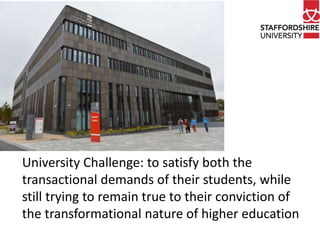
University Challenge: to satisfy both the 
transactional demands of their students, while 
still trying to remain true to their conviction of 
the transformational nature of higher education
• changing environment in which a modern 
university has to operate 
• reducing the value of a degree to being viewed 
as simply a passport to employability 
• student satisfaction becomes a key institutional 
motivator, changing the role of university? 
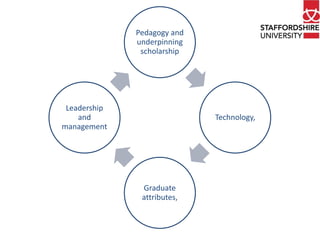
• roles of pedagogy and underpinning scholarship, 
technology, graduate attributes, and leadership
The new university environment 
• New fees for undergraduates 
• Increased charges for part time students 
• Increased use of external metrics
What is a university for 
– John Henry Newman 
The University [...] has this 
object and this mission; it 
contemplates neither moral 
impression nor mechanical 
production; it professes to 
exercise the mind neither in art 
nor in duty; its function is 
intellectual culture; here it may 
leave its scholars, and it has 
done its work when it has done 
as much as this. It educates the 
intellect to reason well in all 
matters, to reach out towards 
truth, and to grasp it 
John Everett Millais [Public domain], via 
Wikimedia Commons
What are universities for? 
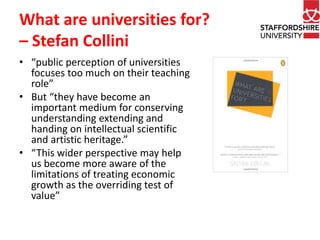
– Stefan Collini 
• “public perception of universities 
focuses too much on their teaching 
role” 
• But “they have become an 
important medium for conserving 
understanding extending and 
handing on intellectual scientific 
and artistic heritage.” 
• “This wider perspective may help 
us become more aware of the 
limitations of treating economic 
growth as the overriding test of 
value”
What are universities for? 
• O’Byrne and Bond 
– 3 paradigms 
• Academic 
• Managerial 
• Consumerist 
– Tensions between these pairs 
• Wend Byrne and By 
– Renewal of collegiality 
Darren O’Byrne and Christopher Bond (2014): Back to the future: the idea of a university revisited, Journal of Higher Education Policy and Management, 2014, Vol. 36, 
No. 6, 571–584, 
Bernard Burnes , Petra Wend & Rune Todnem By (2013): The changing face of English universities: reinventing collegiality for the twenty-first century, Studies in Higher 
Education, DOI:10.1080/03075079.2012.754858
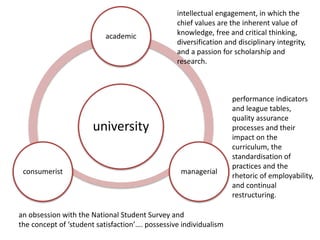
academic 
university 
intellectual engagement, in which the 
chief values are the inherent value of 
knowledge, free and critical thinking, 
diversification and disciplinary integrity, 
and a passion for scholarship and 
research. 
consumerist managerial 
performance indicators 
and league tables, 
quality assurance 
processes and their 
impact on the 
curriculum, the 
standardisation of 
practices and the 
rhetoric of employability, 
and continual 
restructuring. 
an obsession with the National Student Survey and 
the concept of ‘student satisfaction’…. possessive individualism
The rise of the 
student consumer 
• Browne Review of Higher Education 
– “Students need access to high quality information, 
advice and guidance in order to make the best 
choices.” 
• Increased focus on NSS 
• Which? report – Degrees of Value 
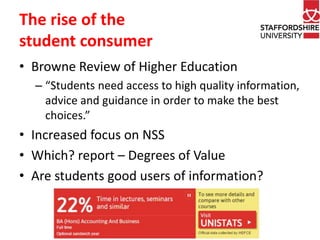
• Are students good users of information?
Impact of the Student 
as consumer 
• Initiatives on improving student satisfaction – NSS 
• Increased focus on University employability and 
enterprise initiatives 
• Focus on short term graduate employability – 
DLHE 
• All outcomes reinforced through KIS, league 
table, Which? 
• Does this reduce Higher Education to a service or 
product that can be bought?
Transactional view 
• Education as training 
• As preparation for the world of work 
• Reductive view of higher education 
• But….are our students really that easily 
fooled? 
• Still interesting, still challenging, still exploring 
ideas and creating their own view of the world
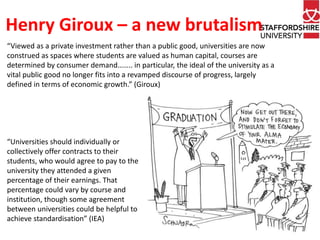
Henry Giroux – a new brutalism 
“Viewed as a private investment rather than a public good, universities are now 
construed as spaces where students are valued as human capital, courses are 
determined by consumer demand…….. in particular, the ideal of the university as a 
vital public good no longer fits into a revamped discourse of progress, largely 
defined in terms of economic growth.” (Giroux) 
“Universities should individually or 
collectively offer contracts to their 
students, who would agree to pay to the 
university they attended a given 
percentage of their earnings. That 
percentage could vary by course and 
institution, though some agreement 
between universities could be helpful to 
achieve standardisation” (IEA)
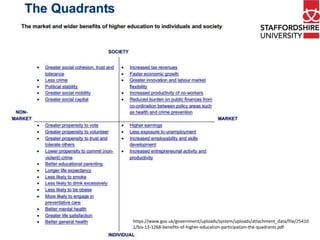
Market and non Market 
Benefits of HE 
• HE is broader than transactional – it always 
has been transformational 
• Danger of focussing just on satisfying the 
transactional consumerist view is that we 
could lose the transformational part 
• BIS review of benefits of HE 
– Market vs non market 
– Individual vs society
https://www.gov.uk/government/uploads/system/uploads/attachment_data/file/25410 
1/bis-13-1268-benefits-of-higher-education-participation-the-quadrants.pdf
A Balancing act 
• What students want – or at least what 
they have been told that they want 
• What universities want 
• How do we bridge the gap?
Pedagogy and 
underpinning 
scholarship 
Technology, 
Graduate 
attributes, 
Leadership 
and 
management
Pedagogy 
• Student engagement in learning and teaching 
design 
• Problem and practice based learning 
– Teamworking and communication 
– Solving real world dilemmas 
– Authentic learning experiences 
– Underpinned by scholarship 
– Student led research 
• Better management of student centred learning 
and expectations
Technology 
• Not a solution in and of itself 
• To support new forms of student led and staff 
supported pedagogy 
• Wireless, always-on access to information 
• Collaboration and creation of learning 
• Use tech to move from information 
transmission to curation of knowledge
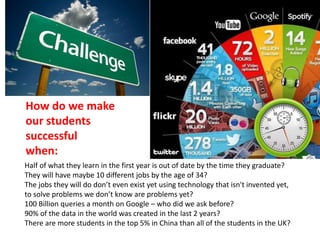
How do we make 
our students 
successful 
when: 
Half of what they learn in the first year is out of date by the time they graduate? 
They will have maybe 10 different jobs by the age of 34? 
The jobs they will do don’t even exist yet using technology that isn't invented yet, 
to solve problems we don’t know are problems yet? 
100 Billion queries a month on Google – who did we ask before? 
90% of the data in the world was created in the last 2 years? 
There are more students in the top 5% in China than all of the students in the UK?
Graduate Attributes 
• Previously driven by managerial paradigm, to 
ensure consistency, and respond to perceived 
employer needs 
• Academic body can use attributes to 
demonstrate wider HE benefit – hacking or 
subverting the university? 
• Employability outcomes will satisfy 
consumerist paradigm
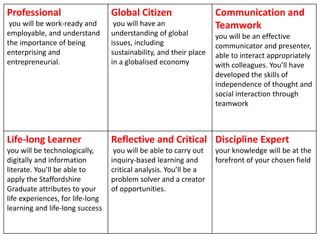
Professional 
you will be work-ready and 
employable, and understand 
the importance of being 
enterprising and 
entrepreneurial. 
Global Citizen 
you will have an 
understanding of global 
issues, including 
sustainability, and their place 
in a globalised economy 
Communication and 
Teamwork 
you will be an effective 
communicator and presenter, 
able to interact appropriately 
with colleagues. You’ll have 
developed the skills of 
independence of thought and 
social interaction through 
teamwork 
Life-long Learner 
you will be technologically, 
digitally and information 
literate. You’ll be able to 
apply the Staffordshire 
Graduate attributes to your 
life experiences, for life-long 
learning and life-long success 
Reflective and Critical 
you will be able to carry out 
inquiry-based learning and 
critical analysis. You’ll be a 
problem solver and a creator 
of opportunities. 
Discipline Expert 
your knowledge will be at the 
forefront of your chosen field
Leadership 
“it may be argued that the actions of many senior 
managers in universities are not as strategic, 
transformational and as well thought out as they 
maintain. Instead, research seems to show that 
many are still unprepared and untrained for their 
posts, quickly lose touch with the day-to-day 
reality of university life, tend to act in a short-term, 
transactional and inconsistent fashion, and 
over-focus on boxticking exercises designed to 
appease funding bodies”. 
Bernard Burnes , Petra Wend & Rune Todnem By (2013): The changing face 
of English universities: reinventing collegiality for the twenty-first century, Studies in Higher 
Education, DOI:10.1080/03075079.2012.754858
A return to collegiality 
• allow senior managers the flexibility to 
respond to changing circumstances whilst 
creating a new form of local/departmental 
collegiality. 
• senior managers to work with staff to develop 
a ‘commonly understood strategic intent’. 
• involve all staff in re-establishing and re-affirming 
their rationale and purpose
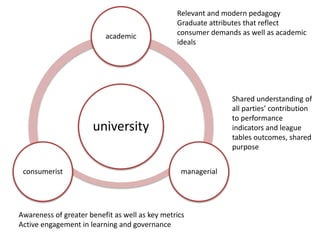
academic 
university 
Relevant and modern pedagogy 
Graduate attributes that reflect 
consumer demands as well as academic 
ideals 
consumerist managerial 
Shared understanding of 
all parties’ contribution 
to performance 
indicators and league 
tables outcomes, shared 
purpose 
Awareness of greater benefit as well as key metrics 
Active engagement in learning and governance
References 
• Darren O’Byrne and Christopher Bond (2014): Back to the future: 
the idea of a university revisited, Journal of Higher Education Policy 
and Management, 2014, Vol. 36, No. 6, 571–584, 
• Bernard Burnes , Petra Wend & Rune Todnem By (2013): The 
changing face of English universities: reinventing collegiality for the 
twenty-first century, Studies in Higher Education, 
DOI:10.1080/03075079.2012.754858 
• https://www.gov.uk/government/uploads/system/uploads/attach 
ment_data/file/254101/bis-13-1268-benefits-of-higher-education-participation- 
the-quadrants.pdf 
• Henry A Giroux: Higher Education and the New Brutalism, via 
http://truth-out.org/news/item/27082-henry-a-giroux-higher-education- 
and-the-new-brutalism accessed 5-12-14 
• Stefan Colini: What are Universities for? Publisher: Penguin (2012) 
ISBN-13: 978-1846144820
@mikehamlyn 
blogs.staffs.ac.uk/mikehamlyn/

Transaction or transformation

  • 1.
    Transaction or Transformation? How does a modern university respond to an increasingly consumerist student body. Dr Michael G Hamlyn Prof Rune Todnem By Staffordshire University
  • 2.
    University Challenge: tosatisfy both the transactional demands of their students, while still trying to remain true to their conviction of the transformational nature of higher education
  • 3.
    • changing environmentin which a modern university has to operate • reducing the value of a degree to being viewed as simply a passport to employability • student satisfaction becomes a key institutional motivator, changing the role of university? • roles of pedagogy and underpinning scholarship, technology, graduate attributes, and leadership
  • 5.
    The new universityenvironment • New fees for undergraduates • Increased charges for part time students • Increased use of external metrics
  • 6.
    What is auniversity for – John Henry Newman The University [...] has this object and this mission; it contemplates neither moral impression nor mechanical production; it professes to exercise the mind neither in art nor in duty; its function is intellectual culture; here it may leave its scholars, and it has done its work when it has done as much as this. It educates the intellect to reason well in all matters, to reach out towards truth, and to grasp it John Everett Millais [Public domain], via Wikimedia Commons
  • 7.
    What are universitiesfor? – Stefan Collini • “public perception of universities focuses too much on their teaching role” • But “they have become an important medium for conserving understanding extending and handing on intellectual scientific and artistic heritage.” • “This wider perspective may help us become more aware of the limitations of treating economic growth as the overriding test of value”
  • 8.
    What are universitiesfor? • O’Byrne and Bond – 3 paradigms • Academic • Managerial • Consumerist – Tensions between these pairs • Wend Byrne and By – Renewal of collegiality Darren O’Byrne and Christopher Bond (2014): Back to the future: the idea of a university revisited, Journal of Higher Education Policy and Management, 2014, Vol. 36, No. 6, 571–584, Bernard Burnes , Petra Wend & Rune Todnem By (2013): The changing face of English universities: reinventing collegiality for the twenty-first century, Studies in Higher Education, DOI:10.1080/03075079.2012.754858
  • 9.
    academic university intellectualengagement, in which the chief values are the inherent value of knowledge, free and critical thinking, diversification and disciplinary integrity, and a passion for scholarship and research. consumerist managerial performance indicators and league tables, quality assurance processes and their impact on the curriculum, the standardisation of practices and the rhetoric of employability, and continual restructuring. an obsession with the National Student Survey and the concept of ‘student satisfaction’…. possessive individualism
  • 10.
    The rise ofthe student consumer • Browne Review of Higher Education – “Students need access to high quality information, advice and guidance in order to make the best choices.” • Increased focus on NSS • Which? report – Degrees of Value • Are students good users of information?
  • 11.
    Impact of theStudent as consumer • Initiatives on improving student satisfaction – NSS • Increased focus on University employability and enterprise initiatives • Focus on short term graduate employability – DLHE • All outcomes reinforced through KIS, league table, Which? • Does this reduce Higher Education to a service or product that can be bought?
  • 12.
    Transactional view •Education as training • As preparation for the world of work • Reductive view of higher education • But….are our students really that easily fooled? • Still interesting, still challenging, still exploring ideas and creating their own view of the world
  • 13.
    Henry Giroux –a new brutalism “Viewed as a private investment rather than a public good, universities are now construed as spaces where students are valued as human capital, courses are determined by consumer demand…….. in particular, the ideal of the university as a vital public good no longer fits into a revamped discourse of progress, largely defined in terms of economic growth.” (Giroux) “Universities should individually or collectively offer contracts to their students, who would agree to pay to the university they attended a given percentage of their earnings. That percentage could vary by course and institution, though some agreement between universities could be helpful to achieve standardisation” (IEA)
  • 14.
    Market and nonMarket Benefits of HE • HE is broader than transactional – it always has been transformational • Danger of focussing just on satisfying the transactional consumerist view is that we could lose the transformational part • BIS review of benefits of HE – Market vs non market – Individual vs society
  • 15.
  • 16.
    A Balancing act • What students want – or at least what they have been told that they want • What universities want • How do we bridge the gap?
  • 17.
    Pedagogy and underpinning scholarship Technology, Graduate attributes, Leadership and management
  • 18.
    Pedagogy • Studentengagement in learning and teaching design • Problem and practice based learning – Teamworking and communication – Solving real world dilemmas – Authentic learning experiences – Underpinned by scholarship – Student led research • Better management of student centred learning and expectations
  • 19.
    Technology • Nota solution in and of itself • To support new forms of student led and staff supported pedagogy • Wireless, always-on access to information • Collaboration and creation of learning • Use tech to move from information transmission to curation of knowledge
  • 20.
    How do wemake our students successful when: Half of what they learn in the first year is out of date by the time they graduate? They will have maybe 10 different jobs by the age of 34? The jobs they will do don’t even exist yet using technology that isn't invented yet, to solve problems we don’t know are problems yet? 100 Billion queries a month on Google – who did we ask before? 90% of the data in the world was created in the last 2 years? There are more students in the top 5% in China than all of the students in the UK?
  • 21.
    Graduate Attributes •Previously driven by managerial paradigm, to ensure consistency, and respond to perceived employer needs • Academic body can use attributes to demonstrate wider HE benefit – hacking or subverting the university? • Employability outcomes will satisfy consumerist paradigm
  • 22.
    Professional you willbe work-ready and employable, and understand the importance of being enterprising and entrepreneurial. Global Citizen you will have an understanding of global issues, including sustainability, and their place in a globalised economy Communication and Teamwork you will be an effective communicator and presenter, able to interact appropriately with colleagues. You’ll have developed the skills of independence of thought and social interaction through teamwork Life-long Learner you will be technologically, digitally and information literate. You’ll be able to apply the Staffordshire Graduate attributes to your life experiences, for life-long learning and life-long success Reflective and Critical you will be able to carry out inquiry-based learning and critical analysis. You’ll be a problem solver and a creator of opportunities. Discipline Expert your knowledge will be at the forefront of your chosen field
  • 23.
    Leadership “it maybe argued that the actions of many senior managers in universities are not as strategic, transformational and as well thought out as they maintain. Instead, research seems to show that many are still unprepared and untrained for their posts, quickly lose touch with the day-to-day reality of university life, tend to act in a short-term, transactional and inconsistent fashion, and over-focus on boxticking exercises designed to appease funding bodies”. Bernard Burnes , Petra Wend & Rune Todnem By (2013): The changing face of English universities: reinventing collegiality for the twenty-first century, Studies in Higher Education, DOI:10.1080/03075079.2012.754858
  • 24.
    A return tocollegiality • allow senior managers the flexibility to respond to changing circumstances whilst creating a new form of local/departmental collegiality. • senior managers to work with staff to develop a ‘commonly understood strategic intent’. • involve all staff in re-establishing and re-affirming their rationale and purpose
  • 25.
    academic university Relevantand modern pedagogy Graduate attributes that reflect consumer demands as well as academic ideals consumerist managerial Shared understanding of all parties’ contribution to performance indicators and league tables outcomes, shared purpose Awareness of greater benefit as well as key metrics Active engagement in learning and governance
  • 26.
    References • DarrenO’Byrne and Christopher Bond (2014): Back to the future: the idea of a university revisited, Journal of Higher Education Policy and Management, 2014, Vol. 36, No. 6, 571–584, • Bernard Burnes , Petra Wend & Rune Todnem By (2013): The changing face of English universities: reinventing collegiality for the twenty-first century, Studies in Higher Education, DOI:10.1080/03075079.2012.754858 • https://www.gov.uk/government/uploads/system/uploads/attach ment_data/file/254101/bis-13-1268-benefits-of-higher-education-participation- the-quadrants.pdf • Henry A Giroux: Higher Education and the New Brutalism, via http://truth-out.org/news/item/27082-henry-a-giroux-higher-education- and-the-new-brutalism accessed 5-12-14 • Stefan Colini: What are Universities for? Publisher: Penguin (2012) ISBN-13: 978-1846144820
  • 27.