AUA
Networking
“Brief Encounters”
Jim McCarten 30th November 2017
jamesm2111@outlook.com
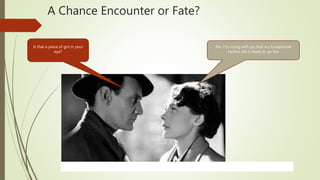
A Chance Encounter or Fate?
Is that a piece of grit in your
eye?
No, I’m crying with joy that my Exceptional
Factors DB is ready to go live
“Brutus:
There is a tide in the affairs of men. Which, taken at the
flood, leads on to fortune;
Omitted, all the voyage of their life Is bound in shallows and
in miseries.
On such a full sea are we now afloat, And we must take the
current when it serves, Or lose our ventures.
Julius Caesar Act 4, scene 3,
218–224
 Horace Walpole - ‘Serendipity' = “a certain kind of happy accident: the kind that
can only be exploited by a “’’sagacious’ or clever person”.
Be Prepared for Chance Encounters
In science it often happens that scientists say, 'You
know that's a really good argument; my position is
mistaken,' and then they would actually change their
minds and you never hear that old view from them
again. They really do it. It doesn't happen as often as
it should, because scientists are human and change is
sometimes painful. But it happens every day. I cannot
recall the last time something like that happened in
politics or religion.
(1987) -- Carl Sagan
 We all would like to be the sole creative genius at times but most of the time we could do
with a little help from our friends:
 Tim Smit and the Eden project
 Penzias and Wilson – CMB
 Crick and Watson – DNA
 Lennon and McCartney 
 Einstein – lone genius or….
“If Einstein had understood 19th-century geometry, he would have got his two
theories of relativity sorted out a lot sooner. “
https://www.newscientist.com/article/mg13718543-900-pay-attention-albert-einstein/
Fortune Favours the Connected
A Friend in Deed…..
 Arno Penzias and Robert Wilson 1965
 CMB and Nobel prize ‘by accident’.
 Noise mucked up their investigations, cleaned the telescope, hunted
the pigeons down and then……
 One conversation later…….
 Tim Smit and Eden project -
 http://www.richardsandbrooksplace.org/tim-smit/eden-project
 And the point is…………
 Lucky encounters – but luck favours the keen with the ideas waiting to happen
Does This Matter to us? ‘Knowledge Workers’?
 “Knowledge workers engage in ‘’peer-to-peer’’ knowledge sharing across
organizational and company boundaries, forming networks of expertise.”#1
 Do we facilitate that?
 How – self-help, and organisation design
1. Design office for conversation
2. Encourage different types of knowledge sharing
3. Incentivise knowledge sharing
4. Revamp training and ‘onboarding’
5. Knowledge Management Systems
https://bloomfire.com/blog/522359-5-ways-to-encourage-knowledge-sharing-within-your-organization/
1. Tapscott, Don; Williams, Anthony D. (2006). Wikinomics: How Mass Collaboration Changes Everything. New York: Penguin. ISBN 1-59184-138-0.
With a Little Help from My Friends?
If you don’t know the answer then do you know someone who does?
 And are they available, will they text back?
 Will they tell you anything useful?
 Will they tell you that you are wrong or sadly misguided?
 Are they right?
 Have they got a different idea?
 Is it really better?
 Who’s reliable?
 So how effective and reliable are the formal, and informal, channels and can we improve
on them a bit?
Ignoring the Structure Charts for a Minute….
 Do you really know your own organisation, your own sector, etc?
 Do you know who really knows what about things work currently?
 Making changes – how much is new, how much new to you, how much has happened before,
happened elsewhere etc
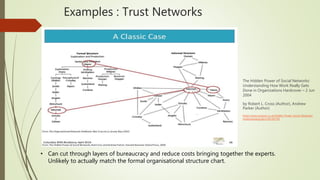
 Trust Networks: the formal vs the informal
 Turning it from weakness to strength
 How can we facilitate this?
 Who sorts it? Organisational memories – cultural traditions – how recorded and utlised?
 Blinded by [Management] Science?
 Where are the people/expertise lost in the process maps?
 People as dynamic agents of change
Examples : Trust Networks
The Hidden Power of Social Networks:
Understanding How Work Really Gets
Done in Organizations Hardcover – 2 Jun
2004
by Robert L. Cross (Author), Andrew
Parker (Author)
https://www.amazon.co.uk/Hidden-Power-Social-Networks-
Understanding/dp/1591392705
• Can cut through layers of bureaucracy and reduce costs bringing together the experts.
Unlikely to actually match the formal organisational structure chart.
Self Evaluation Questions
 HR policies – what does it profit you to share knowledge and your expertise?
 Q - Anything in place?
 Learning systems, reward, development, etc
 Q - Anything in place?
 Support and mentorship
 Q - Anything in place?
 Innovation – ‘’practise or just preaching’’
 Q – Anyone had their idea taken forward?
 Is networking in your job description?
 Maybe, but what does it mean, how measured, how supported?
 Not just limited to formal training
http://jarche.com/2015/12/learning-in-the-network-era/
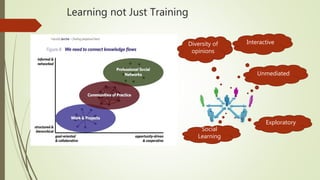
Learning not Just Training
InteractiveDiversity of
opinions
Exploratory
Unmediated
Social
Learning
How Can Others Help You Become The Expert
 Get Help: Find a mentor who can help you develop that image in your head of the best way to
do something.
 It’s Not “Try Harder”, It’s “Try Different”: Design specific activities to address your weak
points.
 It’s About Doing, Not Knowing: Remember the three F’s: Focus, Feedback, Fix it.
 Study The Past To Have A Better Future: Find examples that have been judged and quiz
yourself.
 Anders Ericsson, Peak: Secrets from the New Science of Expertise
 You are aiming to acquire expertise not just knowledge
 https://www.theguardian.com/lifeandstyle/2010/may/08/working-hands-happiness-
burkeman
What Can You Do?
And How Can the organisation Help?
 There aren’t enough hours for you to
practise everything
 How do you get to practise – not the
same as doing the same job for a long
time
 Practise lets you make mistakes,
experiment
 So how do you do that?
 Learn from others – and I suggest - pool
expertise and pool experience of failure
“…it is much easier to present knowledge to a large group
of people than it is to set up conditions under which
individuals can develop skills through practice.”
Anders Ericsson, professor of psychology at Florida State University, with
Robert Pool, Secrets from the New Science of Expertise.
http://time.com/4461455/how-to-become-expert-at-anything/
Challenges and Risks
 Collaboration vs ‘Old boys network’ – openness and inclusiveness
 Assess Effectiveness
 Resistance to change or Wise Counsel
 Extroverts vs Introverts –
Quiet: The Power of Introverts in a World That Can't Stop Talking by Susan Cain
 And in case you’ve had enough
 "a vision of the future in which we somehow take leave of material reality and glide about in a pure
information economy." This is the vision peddled by numerous commentators on the future of the
internet: an ethereal, anchorless world in which all we do is exchange ideas, where everything is funded
by advertisements for everything else, and in which all that matters is the production of knowledge
 https://www.theguardian.com/lifeandstyle/2010/may/08/working-hands-happiness-burkeman
 The Case for Working with Your Hands: Or Why Office Work is Bad for Us and Fixing Things Feels
Good by Matthew Crawford
Summary
 What can you do?
 What can your institution do?
 Make the contacts and make it happen!

AUA Networking

  • 1.
    AUA Networking “Brief Encounters” Jim McCarten30th November 2017 jamesm2111@outlook.com
  • 2.
    A Chance Encounteror Fate? Is that a piece of grit in your eye? No, I’m crying with joy that my Exceptional Factors DB is ready to go live
  • 3.
    “Brutus: There is atide in the affairs of men. Which, taken at the flood, leads on to fortune; Omitted, all the voyage of their life Is bound in shallows and in miseries. On such a full sea are we now afloat, And we must take the current when it serves, Or lose our ventures. Julius Caesar Act 4, scene 3, 218–224  Horace Walpole - ‘Serendipity' = “a certain kind of happy accident: the kind that can only be exploited by a “’’sagacious’ or clever person”. Be Prepared for Chance Encounters In science it often happens that scientists say, 'You know that's a really good argument; my position is mistaken,' and then they would actually change their minds and you never hear that old view from them again. They really do it. It doesn't happen as often as it should, because scientists are human and change is sometimes painful. But it happens every day. I cannot recall the last time something like that happened in politics or religion. (1987) -- Carl Sagan
  • 4.
     We allwould like to be the sole creative genius at times but most of the time we could do with a little help from our friends:  Tim Smit and the Eden project  Penzias and Wilson – CMB  Crick and Watson – DNA  Lennon and McCartney   Einstein – lone genius or…. “If Einstein had understood 19th-century geometry, he would have got his two theories of relativity sorted out a lot sooner. “ https://www.newscientist.com/article/mg13718543-900-pay-attention-albert-einstein/ Fortune Favours the Connected
  • 5.
    A Friend inDeed…..  Arno Penzias and Robert Wilson 1965  CMB and Nobel prize ‘by accident’.  Noise mucked up their investigations, cleaned the telescope, hunted the pigeons down and then……  One conversation later…….  Tim Smit and Eden project -  http://www.richardsandbrooksplace.org/tim-smit/eden-project  And the point is…………  Lucky encounters – but luck favours the keen with the ideas waiting to happen
  • 6.
    Does This Matterto us? ‘Knowledge Workers’?  “Knowledge workers engage in ‘’peer-to-peer’’ knowledge sharing across organizational and company boundaries, forming networks of expertise.”#1  Do we facilitate that?  How – self-help, and organisation design 1. Design office for conversation 2. Encourage different types of knowledge sharing 3. Incentivise knowledge sharing 4. Revamp training and ‘onboarding’ 5. Knowledge Management Systems https://bloomfire.com/blog/522359-5-ways-to-encourage-knowledge-sharing-within-your-organization/ 1. Tapscott, Don; Williams, Anthony D. (2006). Wikinomics: How Mass Collaboration Changes Everything. New York: Penguin. ISBN 1-59184-138-0.
  • 7.
    With a LittleHelp from My Friends? If you don’t know the answer then do you know someone who does?  And are they available, will they text back?  Will they tell you anything useful?  Will they tell you that you are wrong or sadly misguided?  Are they right?  Have they got a different idea?  Is it really better?  Who’s reliable?  So how effective and reliable are the formal, and informal, channels and can we improve on them a bit?
  • 8.
    Ignoring the StructureCharts for a Minute….  Do you really know your own organisation, your own sector, etc?  Do you know who really knows what about things work currently?  Making changes – how much is new, how much new to you, how much has happened before, happened elsewhere etc  Trust Networks: the formal vs the informal  Turning it from weakness to strength  How can we facilitate this?  Who sorts it? Organisational memories – cultural traditions – how recorded and utlised?  Blinded by [Management] Science?  Where are the people/expertise lost in the process maps?  People as dynamic agents of change
  • 9.
    Examples : TrustNetworks The Hidden Power of Social Networks: Understanding How Work Really Gets Done in Organizations Hardcover – 2 Jun 2004 by Robert L. Cross (Author), Andrew Parker (Author) https://www.amazon.co.uk/Hidden-Power-Social-Networks- Understanding/dp/1591392705 • Can cut through layers of bureaucracy and reduce costs bringing together the experts. Unlikely to actually match the formal organisational structure chart.
  • 10.
    Self Evaluation Questions HR policies – what does it profit you to share knowledge and your expertise?  Q - Anything in place?  Learning systems, reward, development, etc  Q - Anything in place?  Support and mentorship  Q - Anything in place?  Innovation – ‘’practise or just preaching’’  Q – Anyone had their idea taken forward?  Is networking in your job description?  Maybe, but what does it mean, how measured, how supported?  Not just limited to formal training http://jarche.com/2015/12/learning-in-the-network-era/
  • 11.
    Learning not JustTraining InteractiveDiversity of opinions Exploratory Unmediated Social Learning
  • 12.
    How Can OthersHelp You Become The Expert  Get Help: Find a mentor who can help you develop that image in your head of the best way to do something.  It’s Not “Try Harder”, It’s “Try Different”: Design specific activities to address your weak points.  It’s About Doing, Not Knowing: Remember the three F’s: Focus, Feedback, Fix it.  Study The Past To Have A Better Future: Find examples that have been judged and quiz yourself.  Anders Ericsson, Peak: Secrets from the New Science of Expertise  You are aiming to acquire expertise not just knowledge  https://www.theguardian.com/lifeandstyle/2010/may/08/working-hands-happiness- burkeman
  • 13.
    What Can YouDo? And How Can the organisation Help?  There aren’t enough hours for you to practise everything  How do you get to practise – not the same as doing the same job for a long time  Practise lets you make mistakes, experiment  So how do you do that?  Learn from others – and I suggest - pool expertise and pool experience of failure “…it is much easier to present knowledge to a large group of people than it is to set up conditions under which individuals can develop skills through practice.” Anders Ericsson, professor of psychology at Florida State University, with Robert Pool, Secrets from the New Science of Expertise. http://time.com/4461455/how-to-become-expert-at-anything/
  • 14.
    Challenges and Risks Collaboration vs ‘Old boys network’ – openness and inclusiveness  Assess Effectiveness  Resistance to change or Wise Counsel  Extroverts vs Introverts – Quiet: The Power of Introverts in a World That Can't Stop Talking by Susan Cain  And in case you’ve had enough  "a vision of the future in which we somehow take leave of material reality and glide about in a pure information economy." This is the vision peddled by numerous commentators on the future of the internet: an ethereal, anchorless world in which all we do is exchange ideas, where everything is funded by advertisements for everything else, and in which all that matters is the production of knowledge  https://www.theguardian.com/lifeandstyle/2010/may/08/working-hands-happiness-burkeman  The Case for Working with Your Hands: Or Why Office Work is Bad for Us and Fixing Things Feels Good by Matthew Crawford
  • 15.
    Summary  What canyou do?  What can your institution do?  Make the contacts and make it happen!