Overview of Hadoop and MapReduce
                         Ganesh Neelakanta Iyer
      Research Scholar, National University of Singapore
About Me


I have 3 years of Industry work experience
   - Sasken Communication Technologies Ltd, Bangalore
   - NXP Semiconductors Pvt Ltd (Formerly Philips Semiconductors), Bangalore
I have finished my Masters in Electrical and Computer Engineering from NUS (National
    University of Singapore) in 2008.
Currently Research Scholar in NUS under the guidance of A/P. Bharadwaj Veeravalli.


Research Interests: Cloud computing, Game theory, Resource Allocation and Pricing
Personal Interests: Kathakali, Teaching, Travelling, Photography
Agenda
• Introduction to Hadoop

• Introduction to HDFS

• MapReduce Paradigm

• Some practical MapReduce examples

• MapReduce in Hadoop

• Concluding remarks
Introduction to Hadoop
Data!
• Facebook hosts approximately 10 billion photos, taking up one
  petabyte of storage

• The New York Stock Exchange generates about one terabyte of
  new trade data per day

• In last one week, I personally took 15 GB photos while I was
  travelling. So imagine the memory requirements for all photos
  taken in a day all over the world!
Hadoop
• Open source Cloud supported by Apache

• Reliable shared storage and analysis system

• Uses distributed file system (Called as HDFS) like GFS

• Can be used for a variety of applications
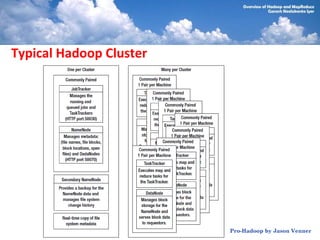
Typical Hadoop Cluster


                         Pro-Hadoop by Jason Venner
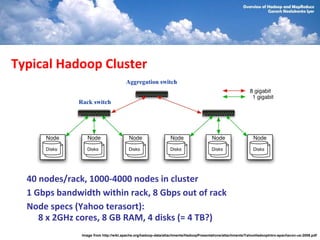
Typical Hadoop Cluster
                                       Aggregation switch


              Rack switch


  40 nodes/rack, 1000-4000 nodes in cluster
  1 Gbps bandwidth within rack, 8 Gbps out of rack
  Node specs (Yahoo terasort):
     8 x 2GHz cores, 8 GB RAM, 4 disks (= 4 TB?)
               Image from http://wiki.apache.org/hadoop-data/attachments/HadoopPresentations/attachments/YahooHadoopIntro-apachecon-us-2008.pdf
mage from http://wiki.apache.org/hadoop-data/attachments/HadoopPresentations/attachments/aw-apachecon-eu-2009.pdf
Introduction to HDFS
HDFS – Hadoop Distributed File System
Very Large Distributed File System
   – 10K nodes, 100 million files, 10 PB
Assumes Commodity Hardware
   – Files are replicated to handle hardware failure
   – Detect failures and recover from them
Optimized for Batch Processing
   – Data locations exposed so that computations can move to where data
   resides
   – Provides very high aggregate bandwidth
User Space, runs on heterogeneous OS


                                          http://www.gartner.com/it/page.jsp?id=1447613
Distributed File System
   Data Coherency
      – Write-once-read-many access model
      – Client can only append to existing files

   Files are broken up into blocks
       – Typically 128 MB block size
       – Each block replicated on multiple DataNodes

   Intelligent Client
      – Client can find location of blocks
      – Client accesses data directly from DataNode
MapReduce Paradigm
MapReduce
Simple data-parallel programming model designed for scalability and
   fault-tolerance

Framework for distributed processing of large data sets

Originally designed by Google

Pluggable user code runs in generic framework

Pioneered by Google - Processes 20 petabytes of data per day
What is MapReduce used for?
At Google:
    Index construction for Google Search
    Article clustering for Google News
    Statistical machine translation
At Yahoo!:
    “Web map” powering Yahoo! Search
    Spam detection for Yahoo! Mail
At Facebook:
    Data mining
    Ad optimization
    Spam detection
What is MapReduce used for?
In research:
    Astronomical image analysis (Washington)
    Bioinformatics (Maryland)
    Analyzing Wikipedia conflicts (PARC)
    Natural language processing (CMU)
    Particle physics (Nebraska)
    Ocean climate simulation (Washington)
    <Your application here>
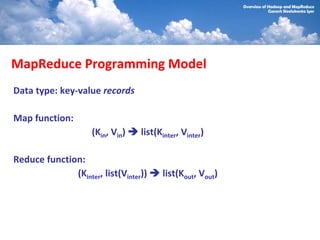
MapReduce Programming Model
Data type: key-value records

Map function:
                     (Kin, Vin)   list(Kinter, Vinter)

Reduce function:
              (Kinter, list(Vinter))    list(Kout, Vout)
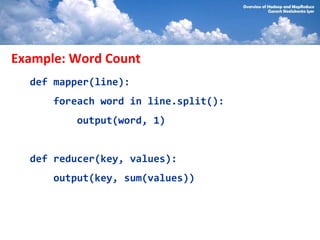
Example: Word Count
  def mapper(line):
      foreach word in line.split():
         output(word, 1)


  def reducer(key, values):
      output(key, sum(values))
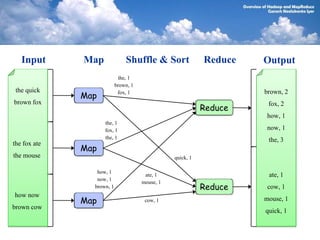
Input      Map              Shuffle & Sort               Reduce   Output
                            the, 1
                           brown, 1
 the quick
              Map
                            fox, 1                                   brown, 2
brown fox                                                             fox, 2
                                                            Reduce
                                                                     how, 1
                    the, 1
                    fox, 1                                           now, 1
                    the, 1                                            the, 3
the fox ate
              Map
the mouse                                        quick, 1

                 how, 1
                                       ate, 1                         ate, 1
                 now, 1
                                      mouse, 1
                brown, 1                                    Reduce    cow, 1
how now
              Map                      cow, 1                        mouse, 1
brown cow
                                                                     quick, 1
MapReduce Execution Details
Single master controls job execution on multiple slaves

Mappers preferentially placed on same node or same rack as their
  input block
   Minimizes network usage

Mappers save outputs to local disk before serving them to reducers
  Allows recovery if a reducer crashes
  Allows having more reducers than nodes
Fault Tolerance in MapReduce
1. If a task crashes:
     Retry on another node
          OK for a map because it has no dependencies
          OK for reduce because map outputs are on disk
     If the same task fails repeatedly, fail the job or ignore that input
   block (user-controlled)
Fault Tolerance in MapReduce

2. If a node crashes:
     Re-launch its current tasks on other nodes
     Re-run any maps the node previously ran
         Necessary because their output files were lost along with the
       crashed node
Fault Tolerance in MapReduce
3. If a task is going slowly (straggler):
     Launch second copy of task on another node (“speculative
   execution”)
     Take the output of whichever copy finishes first, and kill the other

  Surprisingly important in large clusters
   Stragglers occur frequently due to failing hardware, software bugs,
  misconfiguration, etc
   Single straggler may noticeably slow down a job
Takeaways
By providing a data-parallel programming model, MapReduce can
   control job execution in useful ways:
    Automatic division of job into tasks
    Automatic placement of computation near data
    Automatic load balancing
    Recovery from failures & stragglers

User focuses on application, not on complexities of distributed
  computing
Some practical MapReduce
examples
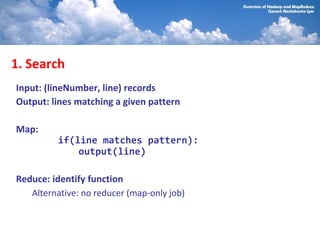
1. Search
Input: (lineNumber, line) records
Output: lines matching a given pattern

Map:
          if(line matches pattern):
              output(line)

Reduce: identify function
   Alternative: no reducer (map-only job)
2. Sort
Input: (key, value) records
Output: same records, sorted by key   Map
                                                    ant, bee
                                                                 Reduce [A-M]
                                            zebra
                                                                    aardvark
Map: identity function                                                 ant
                                             cow                       bee
Reduce: identify function                                              cow
                                      Map
                                                                    elephant
                                              pig

Trick: Pick partitioning                                         Reduce [N-Z]
                                      aardvark,
                                                                     pig
   function h such that               elephant
                                                                    sheep
   k1<k2 => h(k1)<h(k2)               Map           sheep, yak       yak
                                                                    zebra
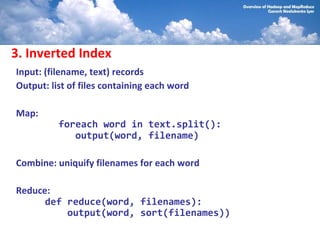
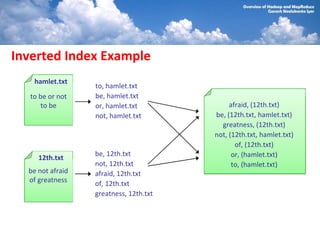
3. Inverted Index
Input: (filename, text) records
Output: list of files containing each word

Map:
          foreach word in text.split():
             output(word, filename)

Combine: uniquify filenames for each word

Reduce:
      def reduce(word, filenames):
          output(word, sort(filenames))
Inverted Index Example
    hamlet.txt
                  to, hamlet.txt
   to be or not   be, hamlet.txt
       to be      or, hamlet.txt             afraid, (12th.txt)
                  not, hamlet.txt       be, (12th.txt, hamlet.txt)
                                          greatness, (12th.txt)
                                        not, (12th.txt, hamlet.txt)
                                               of, (12th.txt)
                  be, 12th.txt                or, (hamlet.txt)
     12th.txt
                  not, 12th.txt               to, (hamlet.txt)
  be not afraid   afraid, 12th.txt
  of greatness    of, 12th.txt
                  greatness, 12th.txt
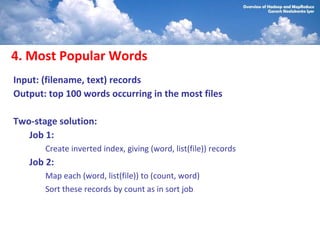
4. Most Popular Words
Input: (filename, text) records
Output: top 100 words occurring in the most files

Two-stage solution:
   Job 1:
       Create inverted index, giving (word, list(file)) records
   Job 2:
       Map each (word, list(file)) to (count, word)
       Sort these records by count as in sort job
MapReduce in Hadoop
MapReduce in Hadoop

Three ways to write jobs in Hadoop:
   Java API
   Hadoop Streaming (for Python, Perl, etc)
   Pipes API (C++)
Word Count in Python with Hadoop Streaming
              import sys
Mapper.py:    for line in sys.stdin:
               for word in line.split():
                 print(word.lower() + "t" + 1)


Reducer.py:    import sys
               counts = {}
               for line in sys.stdin:
                 word, count = line.split("t”)
                 dict[word] = dict.get(word, 0) +
                 int(count)
               for word, count in counts:
                 print(word.lower() + "t" + 1)
Concluding remarks
Conclusions
MapReduce programming model hides the complexity of work
  distribution and fault tolerance

Principal design philosophies:
    Make it scalable, so you can throw hardware at problems
    Make it cheap, lowering hardware, programming and admin costs

MapReduce is not suitable for all problems, but when it works, it may
  save you quite a bit of time

Cloud computing makes it straightforward to start using Hadoop (or
   other parallel software) at scale
What next?
MapReduce has limitations – Applications are limited

Some developments:
  • Pig started at Yahoo research
  • Hive developed at Facebook
  • Amazon Elastic MapReduce
Resources
Hadoop: http://hadoop.apache.org/core/
Pig: http://hadoop.apache.org/pig
Hive: http://hadoop.apache.org/hive
Video tutorials: http://www.cloudera.com/hadoop-training

Amazon Web Services: http://aws.amazon.com/
Amazon Elastic MapReduce guide:
  http://docs.amazonwebservices.com/ElasticMapReduce/latest/Getti
  ngStartedGuide/

Slides of the talk delivered by Matei Zaharia, EECS, University of
   California, Berkeley
Thank you!
ganesh.iyer@nus.edu.sg
http://ganeshniyer.com

Introduction to Hadoop and MapReduce

  • 1.
    Overview of Hadoopand MapReduce Ganesh Neelakanta Iyer Research Scholar, National University of Singapore
  • 2.
    About Me I have3 years of Industry work experience - Sasken Communication Technologies Ltd, Bangalore - NXP Semiconductors Pvt Ltd (Formerly Philips Semiconductors), Bangalore I have finished my Masters in Electrical and Computer Engineering from NUS (National University of Singapore) in 2008. Currently Research Scholar in NUS under the guidance of A/P. Bharadwaj Veeravalli. Research Interests: Cloud computing, Game theory, Resource Allocation and Pricing Personal Interests: Kathakali, Teaching, Travelling, Photography
  • 3.
    Agenda • Introduction toHadoop • Introduction to HDFS • MapReduce Paradigm • Some practical MapReduce examples • MapReduce in Hadoop • Concluding remarks
  • 4.
  • 5.
    Data! • Facebook hostsapproximately 10 billion photos, taking up one petabyte of storage • The New York Stock Exchange generates about one terabyte of new trade data per day • In last one week, I personally took 15 GB photos while I was travelling. So imagine the memory requirements for all photos taken in a day all over the world!
  • 6.
    Hadoop • Open sourceCloud supported by Apache • Reliable shared storage and analysis system • Uses distributed file system (Called as HDFS) like GFS • Can be used for a variety of applications
  • 7.
    Typical Hadoop Cluster Pro-Hadoop by Jason Venner
  • 8.
    Typical Hadoop Cluster Aggregation switch Rack switch 40 nodes/rack, 1000-4000 nodes in cluster 1 Gbps bandwidth within rack, 8 Gbps out of rack Node specs (Yahoo terasort): 8 x 2GHz cores, 8 GB RAM, 4 disks (= 4 TB?) Image from http://wiki.apache.org/hadoop-data/attachments/HadoopPresentations/attachments/YahooHadoopIntro-apachecon-us-2008.pdf
  • 9.
  • 10.
  • 11.
    HDFS – HadoopDistributed File System Very Large Distributed File System – 10K nodes, 100 million files, 10 PB Assumes Commodity Hardware – Files are replicated to handle hardware failure – Detect failures and recover from them Optimized for Batch Processing – Data locations exposed so that computations can move to where data resides – Provides very high aggregate bandwidth User Space, runs on heterogeneous OS http://www.gartner.com/it/page.jsp?id=1447613
  • 12.
    Distributed File System Data Coherency – Write-once-read-many access model – Client can only append to existing files Files are broken up into blocks – Typically 128 MB block size – Each block replicated on multiple DataNodes Intelligent Client – Client can find location of blocks – Client accesses data directly from DataNode
  • 13.
  • 14.
    MapReduce Simple data-parallel programmingmodel designed for scalability and fault-tolerance Framework for distributed processing of large data sets Originally designed by Google Pluggable user code runs in generic framework Pioneered by Google - Processes 20 petabytes of data per day
  • 15.
    What is MapReduceused for? At Google: Index construction for Google Search Article clustering for Google News Statistical machine translation At Yahoo!: “Web map” powering Yahoo! Search Spam detection for Yahoo! Mail At Facebook: Data mining Ad optimization Spam detection
  • 16.
    What is MapReduceused for? In research: Astronomical image analysis (Washington) Bioinformatics (Maryland) Analyzing Wikipedia conflicts (PARC) Natural language processing (CMU) Particle physics (Nebraska) Ocean climate simulation (Washington) <Your application here>
  • 17.
    MapReduce Programming Model Datatype: key-value records Map function: (Kin, Vin) list(Kinter, Vinter) Reduce function: (Kinter, list(Vinter)) list(Kout, Vout)
  • 18.
    Example: Word Count def mapper(line): foreach word in line.split(): output(word, 1) def reducer(key, values): output(key, sum(values))
  • 19.
    Input Map Shuffle & Sort Reduce Output the, 1 brown, 1 the quick Map fox, 1 brown, 2 brown fox fox, 2 Reduce how, 1 the, 1 fox, 1 now, 1 the, 1 the, 3 the fox ate Map the mouse quick, 1 how, 1 ate, 1 ate, 1 now, 1 mouse, 1 brown, 1 Reduce cow, 1 how now Map cow, 1 mouse, 1 brown cow quick, 1
  • 20.
    MapReduce Execution Details Singlemaster controls job execution on multiple slaves Mappers preferentially placed on same node or same rack as their input block Minimizes network usage Mappers save outputs to local disk before serving them to reducers Allows recovery if a reducer crashes Allows having more reducers than nodes
  • 21.
    Fault Tolerance inMapReduce 1. If a task crashes: Retry on another node OK for a map because it has no dependencies OK for reduce because map outputs are on disk If the same task fails repeatedly, fail the job or ignore that input block (user-controlled)
  • 22.
    Fault Tolerance inMapReduce 2. If a node crashes: Re-launch its current tasks on other nodes Re-run any maps the node previously ran Necessary because their output files were lost along with the crashed node
  • 23.
    Fault Tolerance inMapReduce 3. If a task is going slowly (straggler): Launch second copy of task on another node (“speculative execution”) Take the output of whichever copy finishes first, and kill the other Surprisingly important in large clusters Stragglers occur frequently due to failing hardware, software bugs, misconfiguration, etc Single straggler may noticeably slow down a job
  • 24.
    Takeaways By providing adata-parallel programming model, MapReduce can control job execution in useful ways: Automatic division of job into tasks Automatic placement of computation near data Automatic load balancing Recovery from failures & stragglers User focuses on application, not on complexities of distributed computing
  • 25.
  • 26.
    1. Search Input: (lineNumber,line) records Output: lines matching a given pattern Map: if(line matches pattern): output(line) Reduce: identify function Alternative: no reducer (map-only job)
  • 27.
    2. Sort Input: (key,value) records Output: same records, sorted by key Map ant, bee Reduce [A-M] zebra aardvark Map: identity function ant cow bee Reduce: identify function cow Map elephant pig Trick: Pick partitioning Reduce [N-Z] aardvark, pig function h such that elephant sheep k1<k2 => h(k1)<h(k2) Map sheep, yak yak zebra
  • 28.
    3. Inverted Index Input:(filename, text) records Output: list of files containing each word Map: foreach word in text.split(): output(word, filename) Combine: uniquify filenames for each word Reduce: def reduce(word, filenames): output(word, sort(filenames))
  • 29.
    Inverted Index Example hamlet.txt to, hamlet.txt to be or not be, hamlet.txt to be or, hamlet.txt afraid, (12th.txt) not, hamlet.txt be, (12th.txt, hamlet.txt) greatness, (12th.txt) not, (12th.txt, hamlet.txt) of, (12th.txt) be, 12th.txt or, (hamlet.txt) 12th.txt not, 12th.txt to, (hamlet.txt) be not afraid afraid, 12th.txt of greatness of, 12th.txt greatness, 12th.txt
  • 30.
    4. Most PopularWords Input: (filename, text) records Output: top 100 words occurring in the most files Two-stage solution: Job 1: Create inverted index, giving (word, list(file)) records Job 2: Map each (word, list(file)) to (count, word) Sort these records by count as in sort job
  • 31.
  • 32.
    MapReduce in Hadoop Threeways to write jobs in Hadoop: Java API Hadoop Streaming (for Python, Perl, etc) Pipes API (C++)
  • 33.
    Word Count inPython with Hadoop Streaming import sys Mapper.py: for line in sys.stdin: for word in line.split(): print(word.lower() + "t" + 1) Reducer.py: import sys counts = {} for line in sys.stdin: word, count = line.split("t”) dict[word] = dict.get(word, 0) + int(count) for word, count in counts: print(word.lower() + "t" + 1)
  • 34.
  • 35.
    Conclusions MapReduce programming modelhides the complexity of work distribution and fault tolerance Principal design philosophies: Make it scalable, so you can throw hardware at problems Make it cheap, lowering hardware, programming and admin costs MapReduce is not suitable for all problems, but when it works, it may save you quite a bit of time Cloud computing makes it straightforward to start using Hadoop (or other parallel software) at scale
  • 36.
    What next? MapReduce haslimitations – Applications are limited Some developments: • Pig started at Yahoo research • Hive developed at Facebook • Amazon Elastic MapReduce
  • 37.
    Resources Hadoop: http://hadoop.apache.org/core/ Pig: http://hadoop.apache.org/pig Hive:http://hadoop.apache.org/hive Video tutorials: http://www.cloudera.com/hadoop-training Amazon Web Services: http://aws.amazon.com/ Amazon Elastic MapReduce guide: http://docs.amazonwebservices.com/ElasticMapReduce/latest/Getti ngStartedGuide/ Slides of the talk delivered by Matei Zaharia, EECS, University of California, Berkeley
  • 38.