Shark: SQL and Rich Analytics
at Scale
Motivation
• Shark is a new data analysis system that marries query processing
with complex analytics on large clusters. It leverages a novel distributed
memory abstraction to provide a unified engine that can run SQL
queries and sophisticated analytics functions (e.g., iterative machine
learning) at scale, and efficiently recovers from failures mid-query
• Support both SQL and complex analytics efficiently, and to provide
fine-grained fault recovery across both types of operations.
In memory computations
• Shark builds on RDDs to perform most computations in memory
while offering fine-grained fault tolerance
• In-memory computing is increasingly important in large-scale
analytics
---many complex analytics functions, such as machine learning and graph algorithms, are
iterative, going over the data multiple times;
---even traditional SQL warehouse workloads exhibit strong temporal and spatial locality, because
more-recent fact table data and small dimension tables are read disproportionately often
Example:
• A study of Facebook’s Hive warehouse and Microsoft’s Bing analytics cluster showed that over
95% of queries in both systems could be served out of memory using just 64 GB/node as a cache,
even though each system manages more than 100 PB of total data
Shark
Use Spark as execution engine
•in-memory columnar storage and columnar compression
•extended Spark with Partial DAG Execution (PDE) to optimize SQL
queries based on the data characteristics
•control over data partitioning
•compatible with Apache Hive, supporting all of Hive’s SQL dialect and
UDFs and allowing execution over unmodified Hive data warehouses
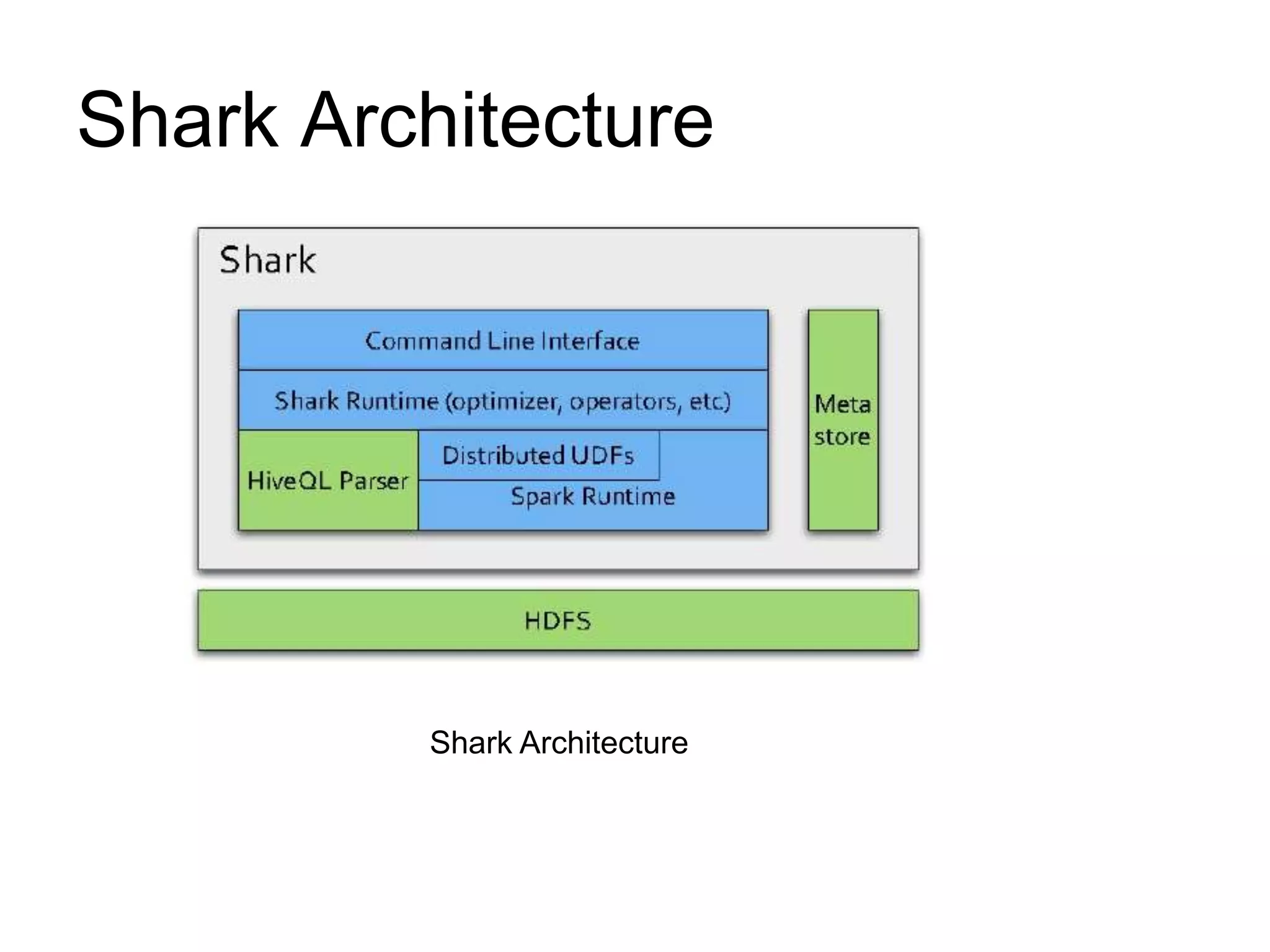
Shark Architecture
Shark Architecture
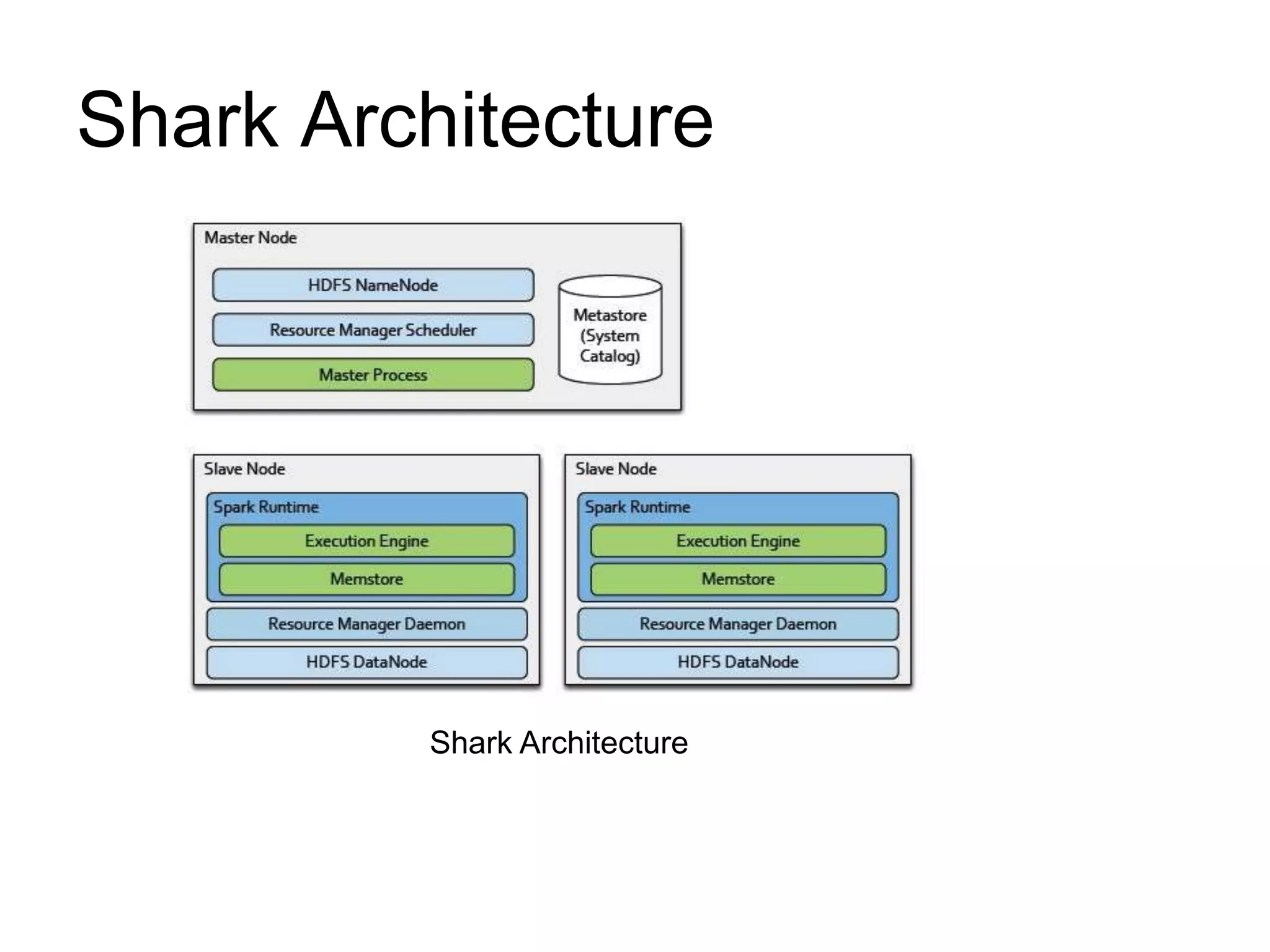
Shark Architecture
Shark Architecture
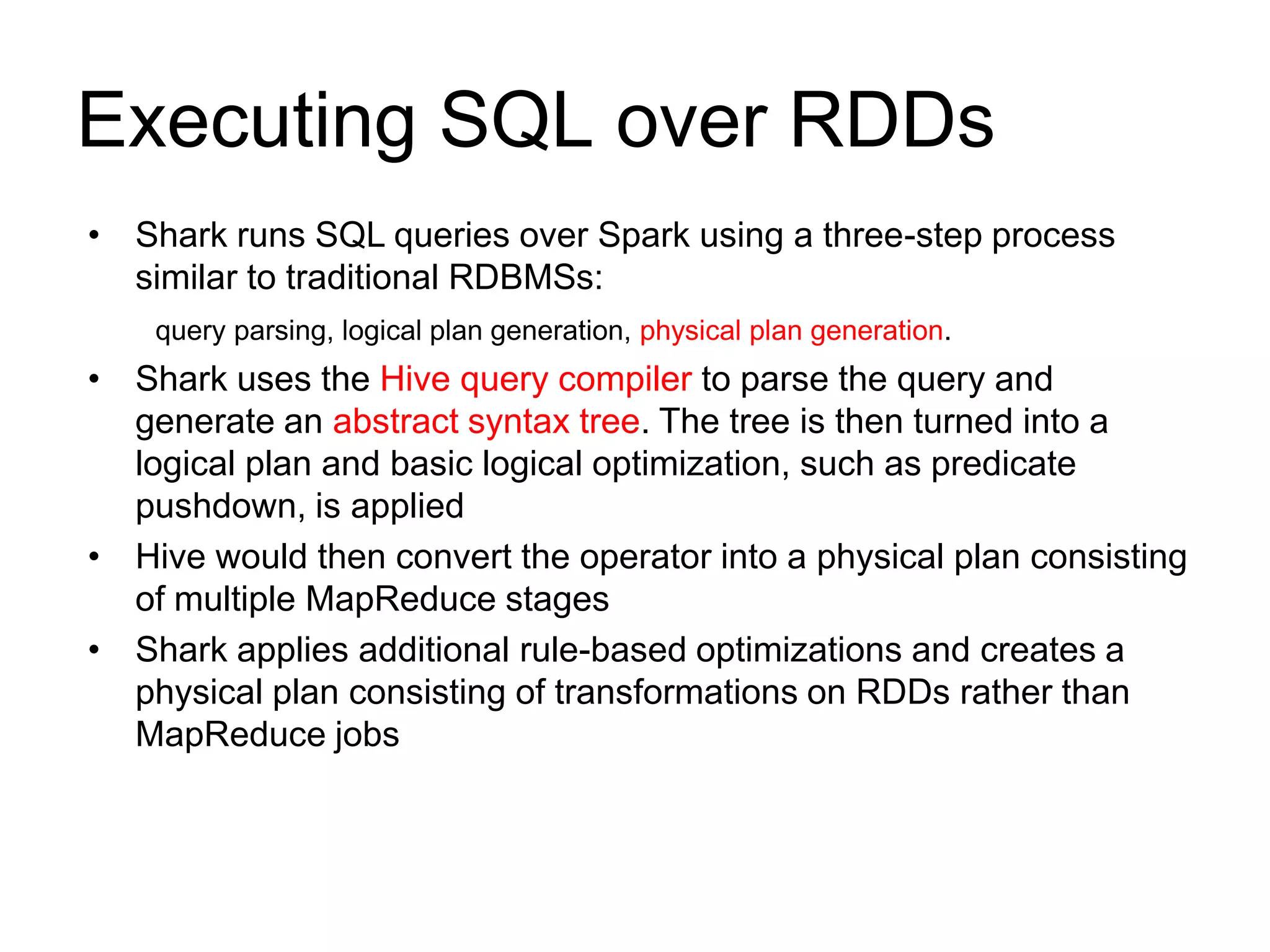
Executing SQL over RDDs
• Shark runs SQL queries over Spark using a three-step process
similar to traditional RDBMSs:
query parsing, logical plan generation, physical plan generation.
• Shark uses the Hive query compiler to parse the query and
generate an abstract syntax tree. The tree is then turned into a
logical plan and basic logical optimization, such as predicate
pushdown, is applied
• Hive would then convert the operator into a physical plan consisting
of multiple MapReduce stages
• Shark applies additional rule-based optimizations and creates a
physical plan consisting of transformations on RDDs rather than
MapReduce jobs
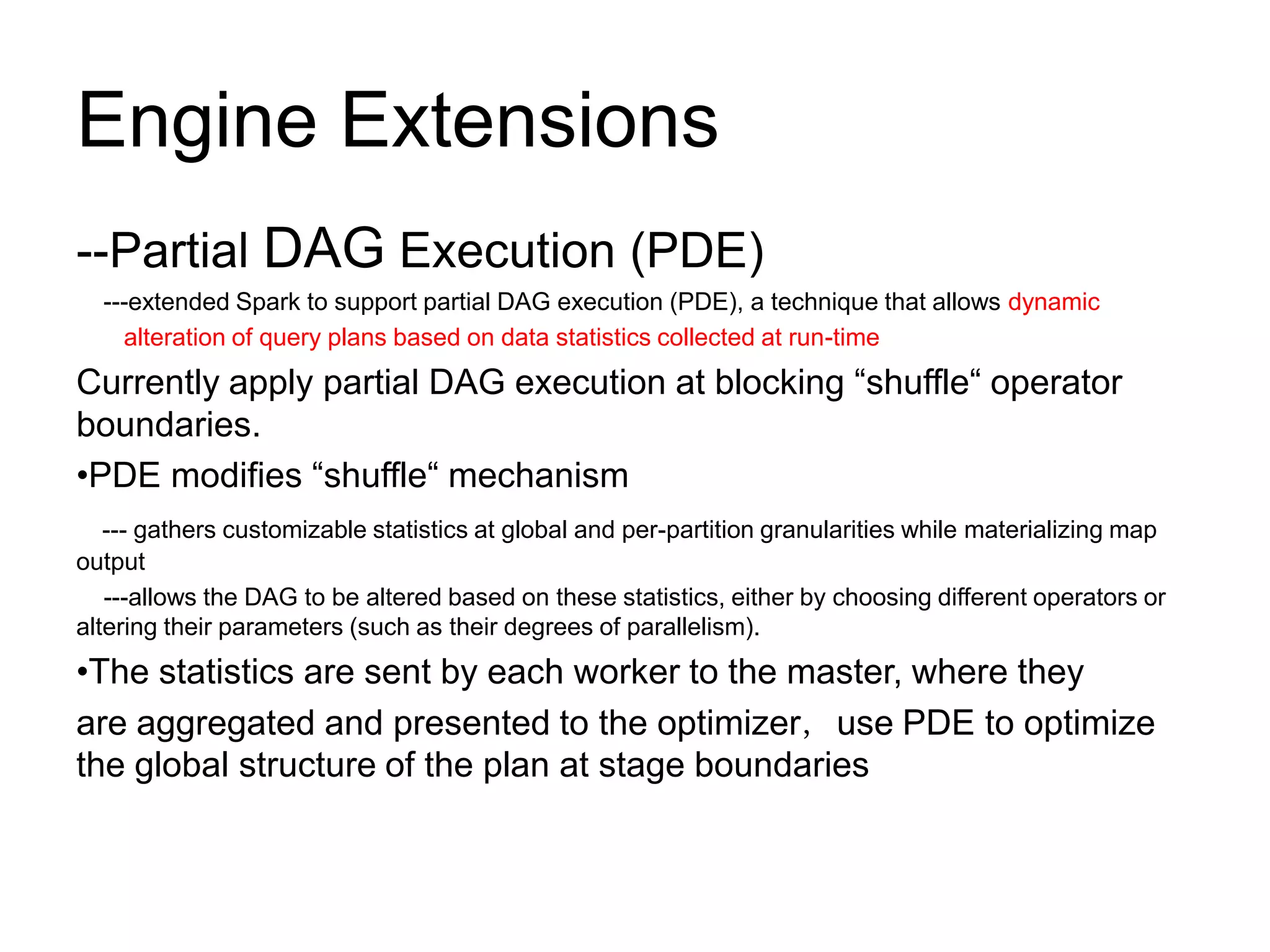
Engine Extensions
--Partial DAG Execution (PDE)
---extended Spark to support partial DAG execution (PDE), a technique that allows dynamic
alteration of query plans based on data statistics collected at run-time
Currently apply partial DAG execution at blocking “shuffle“ operator
boundaries.
•PDE modifies “shuffle“ mechanism
--- gathers customizable statistics at global and per-partition granularities while materializing map
output
---allows the DAG to be altered based on these statistics, either by choosing different operators or
altering their parameters (such as their degrees of parallelism).
•The statistics are sent by each worker to the master, where they
are aggregated and presented to the optimizer,use PDE to optimize
the global structure of the plan at stage boundaries
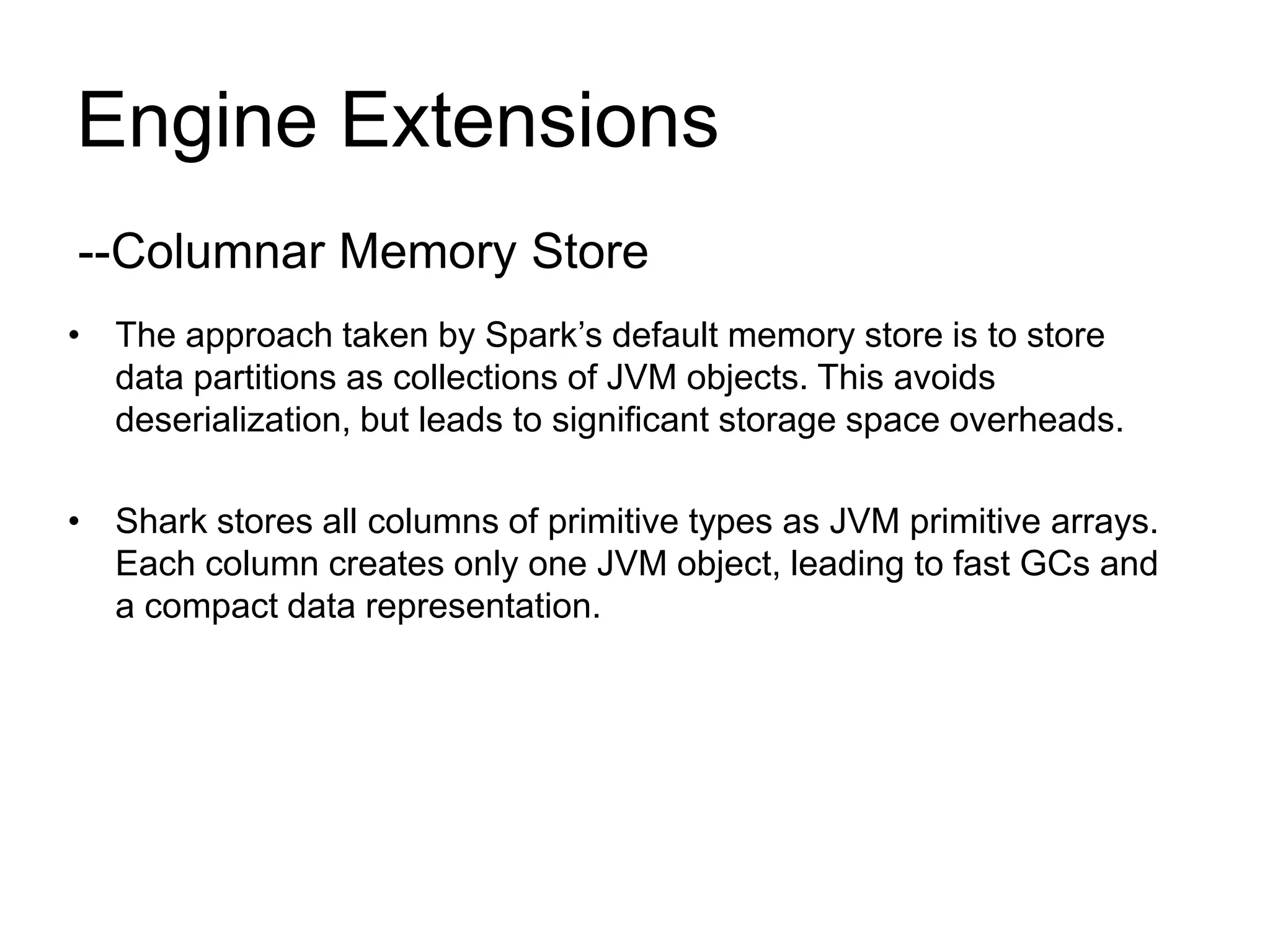
Engine Extensions
• The approach taken by Spark’s default memory store is to store
data partitions as collections of JVM objects. This avoids
deserialization, but leads to significant storage space overheads.
• Shark stores all columns of primitive types as JVM primitive arrays.
Each column creates only one JVM object, leading to fast GCs and
a compact data representation.
--Columnar Memory Store
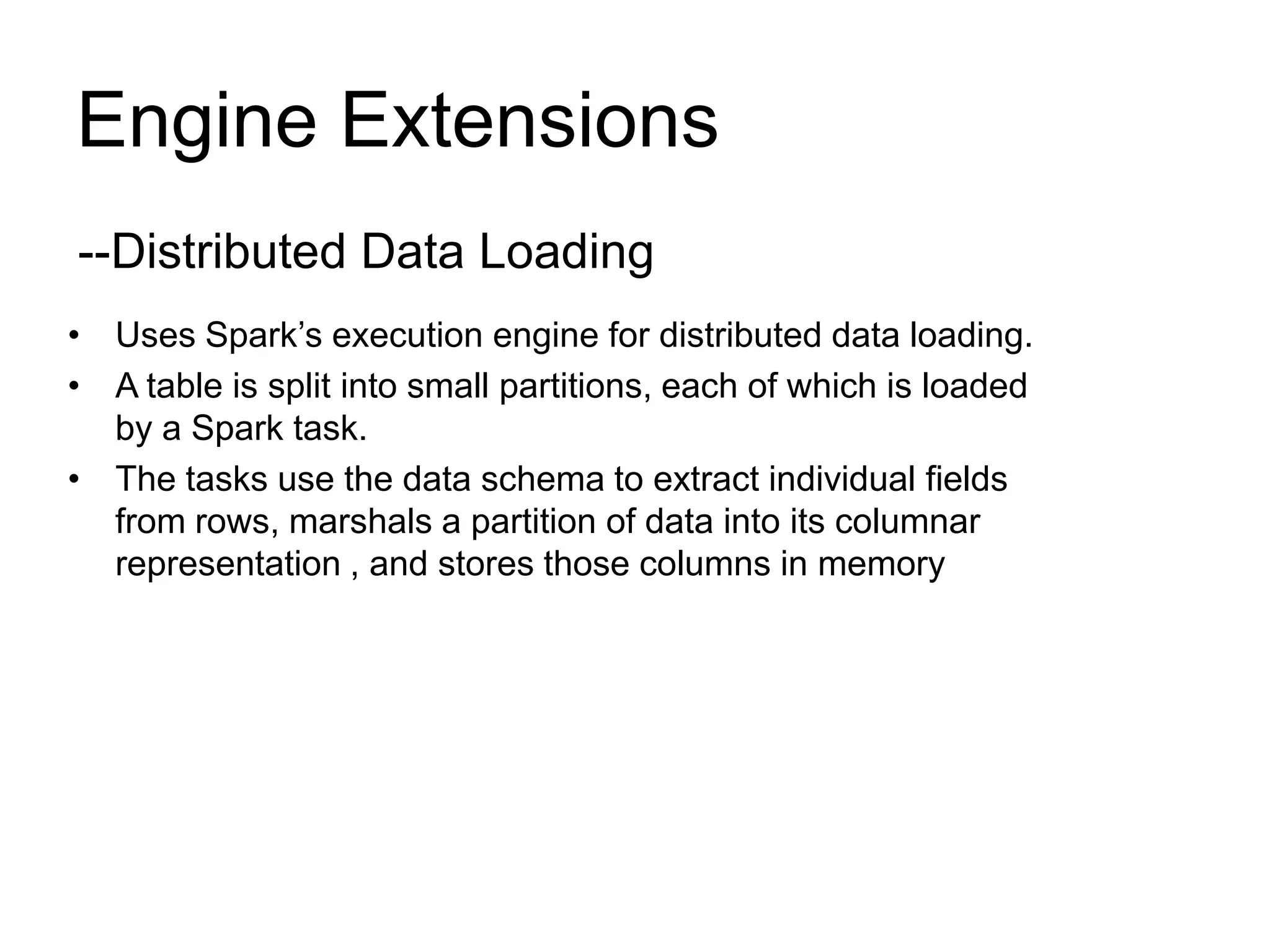
Engine Extensions
• Uses Spark’s execution engine for distributed data loading.
• A table is split into small partitions, each of which is loaded
by a Spark task.
• The tasks use the data schema to extract individual fields
from rows, marshals a partition of data into its columnar
representation , and stores those columns in memory
--Distributed Data Loading
Engine Extensions
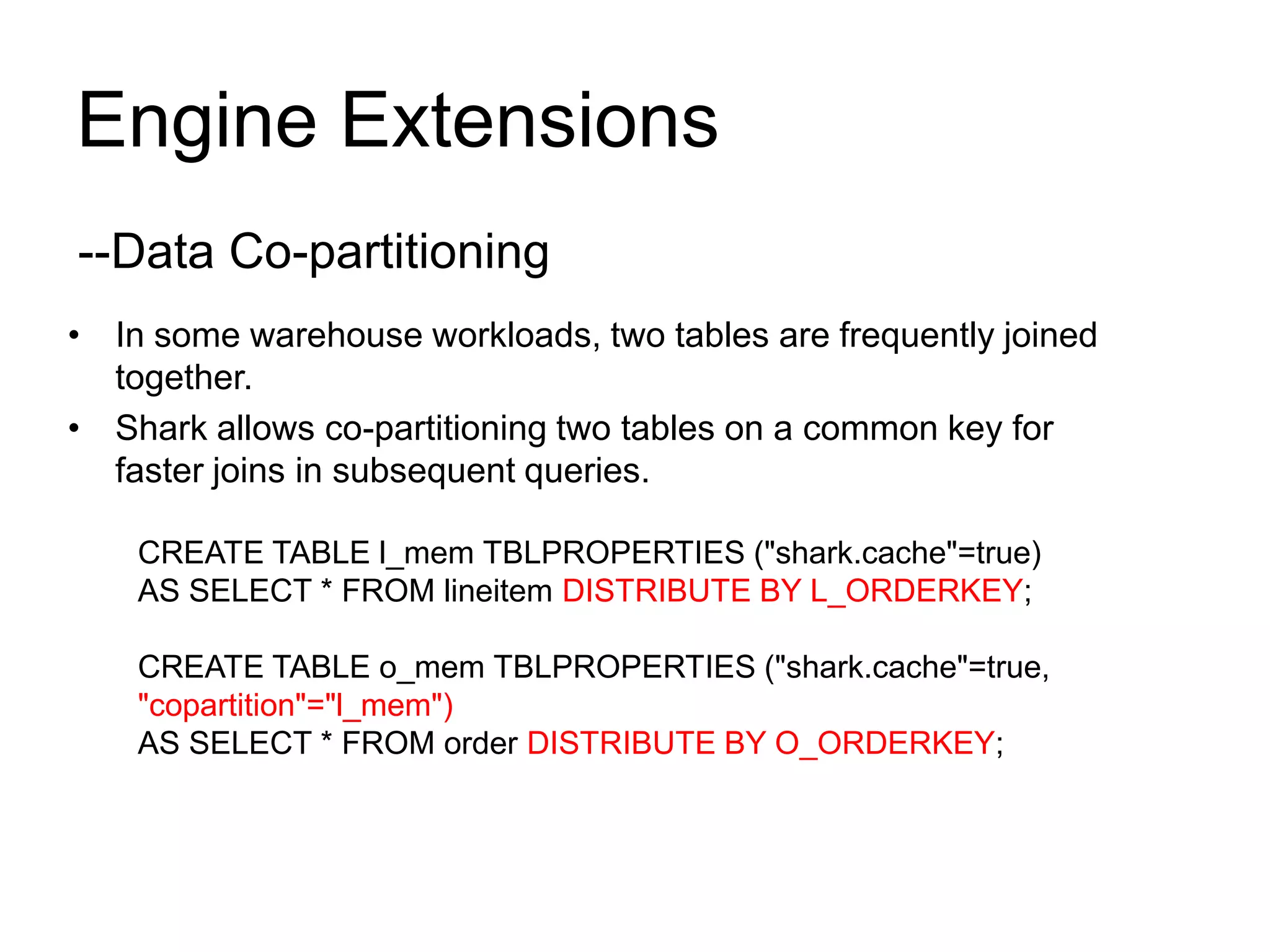
• In some warehouse workloads, two tables are frequently joined
together.
• Shark allows co-partitioning two tables on a common key for
faster joins in subsequent queries.
CREATE TABLE l_mem TBLPROPERTIES ("shark.cache"=true)
AS SELECT * FROM lineitem DISTRIBUTE BY L_ORDERKEY;
CREATE TABLE o_mem TBLPROPERTIES ("shark.cache"=true,
"copartition"="l_mem")
AS SELECT * FROM order DISTRIBUTE BY O_ORDERKEY;
--Data Co-partitioning
Engine Extensions
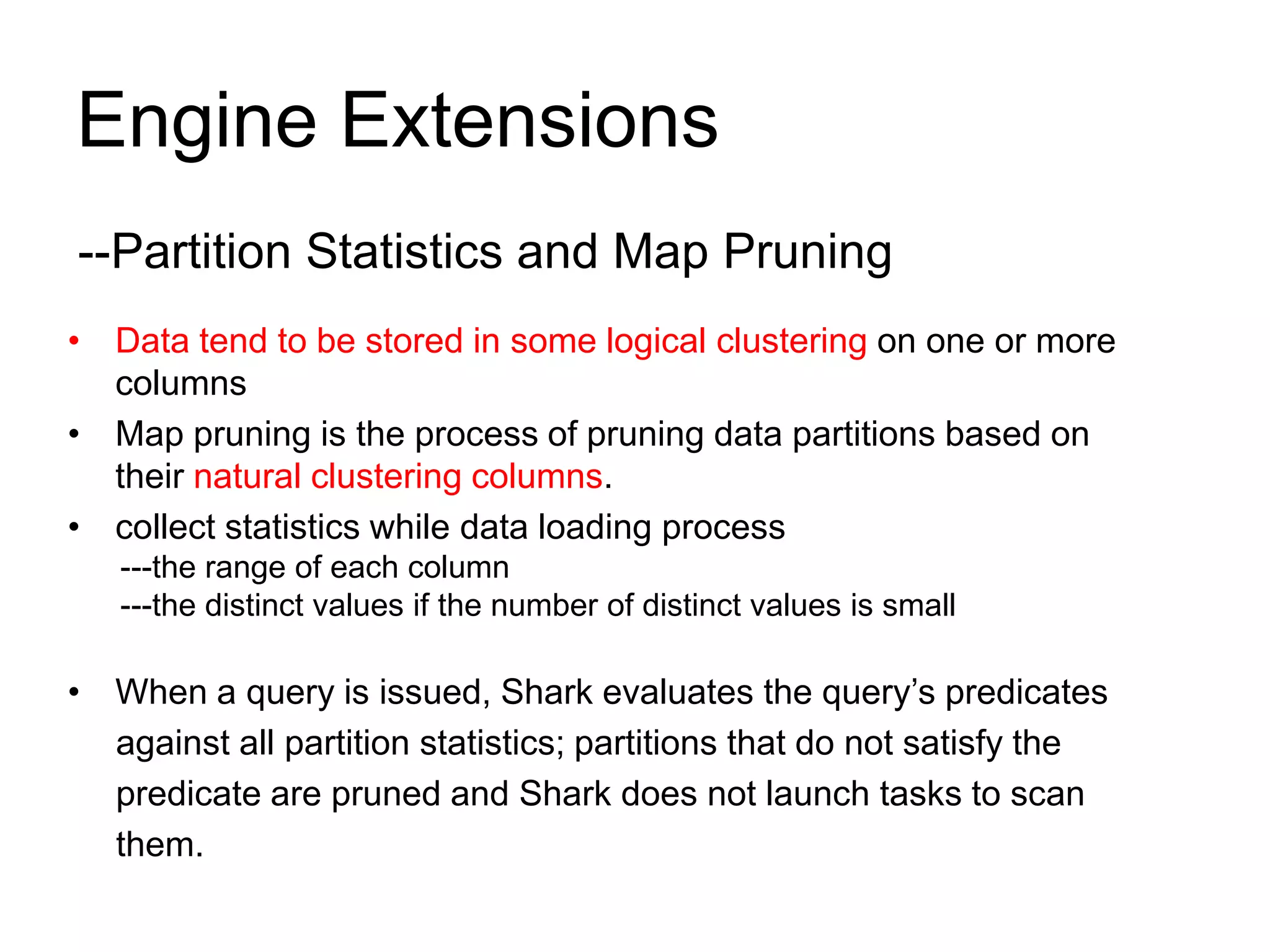
--Partition Statistics and Map Pruning
• Data tend to be stored in some logical clustering on one or more
columns
• Map pruning is the process of pruning data partitions based on
their natural clustering columns.
• collect statistics while data loading process
---the range of each column
---the distinct values if the number of distinct values is small
• When a query is issued, Shark evaluates the query’s predicates
against all partition statistics; partitions that do not satisfy the
predicate are pruned and Shark does not launch tasks to scan
them.
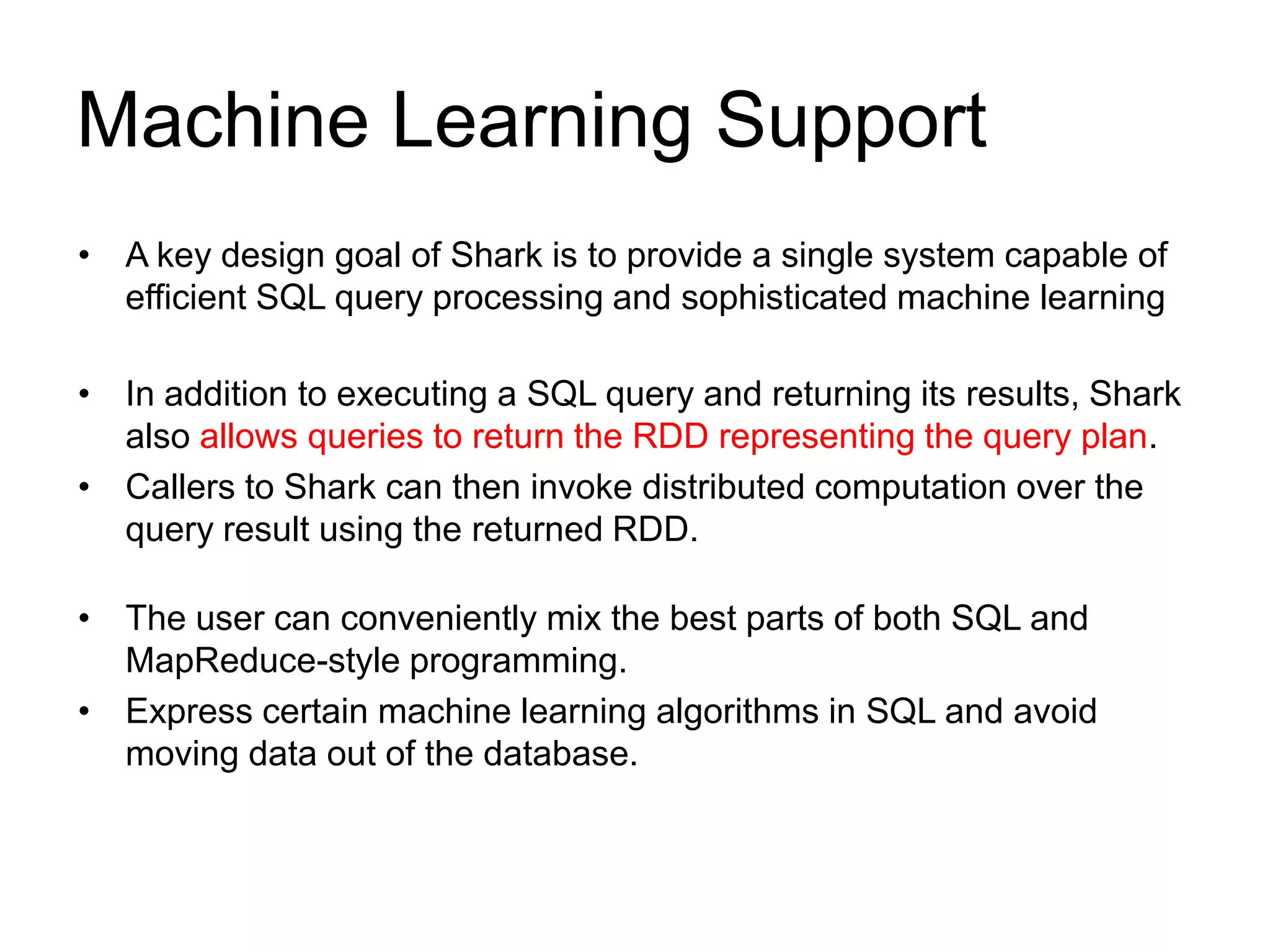
Machine Learning Support
• A key design goal of Shark is to provide a single system capable of
efficient SQL query processing and sophisticated machine learning
• In addition to executing a SQL query and returning its results, Shark
also allows queries to return the RDD representing the query plan.
• Callers to Shark can then invoke distributed computation over the
query result using the returned RDD.
• The user can conveniently mix the best parts of both SQL and
MapReduce-style programming.
• Express certain machine learning algorithms in SQL and avoid
moving data out of the database.
Machine Learning Support
def logRegress(points: RDD[Point]): Vector {
var w = Vector(D, _ => 2 * rand.nextDouble - 1)
for (i <- 1 to ITERATIONS) {
val gradient = points.map { p =>
val denom = 1 + exp(-p.y * (w dot p.x))
(1 / denom - 1) * p.y * p.x
}.reduce(_ + _)
w -= gradient
}
w
}
val users = sql2rdd("SELECT * FROM user u
JOIN comment c ON c.uid=u.uid")
val features = users.mapRows { row =>
new Vector(extractFeature1(row.getInt("age")),
extractFeature2(row.getStr("country")),
...)}
val trainedVector = logRegress(features.cache())
Logistic Regression Example
Others
• users can choose to load high-value data into Shark’s memory store
for fast analytics
CREATE TABLE latest_logs
TBLPROPERTIES ("shark.cache"=true)
AS SELECT * FROM logs WHERE date > now()-3600;
• Memory-based Shuffle
---modified the shuffle phase to materialize map outputs in memory,
with the option to spill them to disk
Conclusion
• Support both SQL and complex analytics efficiently
• User can conveniently mix the best parts of both SQL and
MapReduce-style programming and avoid moving data.
• Provide fine-grained fault recovery across both types of
operations.
• In memory coputation,users can choose to load high-value
data into Shark’s memory store for fast analytics
• Engine Extensions for rational data
--- PDE,Columnar Memory Store,Data Co-partitioning,Partition Statistics and Map
Pruning...
• Compatible with Apache Hive, supporting all of Hive’s SQL
dialect and UDFs
• Can achieve comparable performance with MPP database
while retaining a MapReduce-like engine, and the fine-grained
fault recovery features that such engines provide

BDAS Shark study report 03 v1.1

  • 1.
    Shark: SQL andRich Analytics at Scale
  • 2.
    Motivation • Shark isa new data analysis system that marries query processing with complex analytics on large clusters. It leverages a novel distributed memory abstraction to provide a unified engine that can run SQL queries and sophisticated analytics functions (e.g., iterative machine learning) at scale, and efficiently recovers from failures mid-query • Support both SQL and complex analytics efficiently, and to provide fine-grained fault recovery across both types of operations.
  • 3.
    In memory computations •Shark builds on RDDs to perform most computations in memory while offering fine-grained fault tolerance • In-memory computing is increasingly important in large-scale analytics ---many complex analytics functions, such as machine learning and graph algorithms, are iterative, going over the data multiple times; ---even traditional SQL warehouse workloads exhibit strong temporal and spatial locality, because more-recent fact table data and small dimension tables are read disproportionately often Example: • A study of Facebook’s Hive warehouse and Microsoft’s Bing analytics cluster showed that over 95% of queries in both systems could be served out of memory using just 64 GB/node as a cache, even though each system manages more than 100 PB of total data
  • 4.
    Shark Use Spark asexecution engine •in-memory columnar storage and columnar compression •extended Spark with Partial DAG Execution (PDE) to optimize SQL queries based on the data characteristics •control over data partitioning •compatible with Apache Hive, supporting all of Hive’s SQL dialect and UDFs and allowing execution over unmodified Hive data warehouses
  • 5.
  • 6.
  • 7.
    Executing SQL overRDDs • Shark runs SQL queries over Spark using a three-step process similar to traditional RDBMSs: query parsing, logical plan generation, physical plan generation. • Shark uses the Hive query compiler to parse the query and generate an abstract syntax tree. The tree is then turned into a logical plan and basic logical optimization, such as predicate pushdown, is applied • Hive would then convert the operator into a physical plan consisting of multiple MapReduce stages • Shark applies additional rule-based optimizations and creates a physical plan consisting of transformations on RDDs rather than MapReduce jobs
  • 8.
    Engine Extensions --Partial DAGExecution (PDE) ---extended Spark to support partial DAG execution (PDE), a technique that allows dynamic alteration of query plans based on data statistics collected at run-time Currently apply partial DAG execution at blocking “shuffle“ operator boundaries. •PDE modifies “shuffle“ mechanism --- gathers customizable statistics at global and per-partition granularities while materializing map output ---allows the DAG to be altered based on these statistics, either by choosing different operators or altering their parameters (such as their degrees of parallelism). •The statistics are sent by each worker to the master, where they are aggregated and presented to the optimizer,use PDE to optimize the global structure of the plan at stage boundaries
  • 9.
    Engine Extensions • Theapproach taken by Spark’s default memory store is to store data partitions as collections of JVM objects. This avoids deserialization, but leads to significant storage space overheads. • Shark stores all columns of primitive types as JVM primitive arrays. Each column creates only one JVM object, leading to fast GCs and a compact data representation. --Columnar Memory Store
  • 10.
    Engine Extensions • UsesSpark’s execution engine for distributed data loading. • A table is split into small partitions, each of which is loaded by a Spark task. • The tasks use the data schema to extract individual fields from rows, marshals a partition of data into its columnar representation , and stores those columns in memory --Distributed Data Loading
  • 11.
    Engine Extensions • Insome warehouse workloads, two tables are frequently joined together. • Shark allows co-partitioning two tables on a common key for faster joins in subsequent queries. CREATE TABLE l_mem TBLPROPERTIES ("shark.cache"=true) AS SELECT * FROM lineitem DISTRIBUTE BY L_ORDERKEY; CREATE TABLE o_mem TBLPROPERTIES ("shark.cache"=true, "copartition"="l_mem") AS SELECT * FROM order DISTRIBUTE BY O_ORDERKEY; --Data Co-partitioning
  • 12.
    Engine Extensions --Partition Statisticsand Map Pruning • Data tend to be stored in some logical clustering on one or more columns • Map pruning is the process of pruning data partitions based on their natural clustering columns. • collect statistics while data loading process ---the range of each column ---the distinct values if the number of distinct values is small • When a query is issued, Shark evaluates the query’s predicates against all partition statistics; partitions that do not satisfy the predicate are pruned and Shark does not launch tasks to scan them.
  • 13.
    Machine Learning Support •A key design goal of Shark is to provide a single system capable of efficient SQL query processing and sophisticated machine learning • In addition to executing a SQL query and returning its results, Shark also allows queries to return the RDD representing the query plan. • Callers to Shark can then invoke distributed computation over the query result using the returned RDD. • The user can conveniently mix the best parts of both SQL and MapReduce-style programming. • Express certain machine learning algorithms in SQL and avoid moving data out of the database.
  • 14.
    Machine Learning Support deflogRegress(points: RDD[Point]): Vector { var w = Vector(D, _ => 2 * rand.nextDouble - 1) for (i <- 1 to ITERATIONS) { val gradient = points.map { p => val denom = 1 + exp(-p.y * (w dot p.x)) (1 / denom - 1) * p.y * p.x }.reduce(_ + _) w -= gradient } w } val users = sql2rdd("SELECT * FROM user u JOIN comment c ON c.uid=u.uid") val features = users.mapRows { row => new Vector(extractFeature1(row.getInt("age")), extractFeature2(row.getStr("country")), ...)} val trainedVector = logRegress(features.cache()) Logistic Regression Example
  • 15.
    Others • users canchoose to load high-value data into Shark’s memory store for fast analytics CREATE TABLE latest_logs TBLPROPERTIES ("shark.cache"=true) AS SELECT * FROM logs WHERE date > now()-3600; • Memory-based Shuffle ---modified the shuffle phase to materialize map outputs in memory, with the option to spill them to disk
  • 16.
    Conclusion • Support bothSQL and complex analytics efficiently • User can conveniently mix the best parts of both SQL and MapReduce-style programming and avoid moving data. • Provide fine-grained fault recovery across both types of operations. • In memory coputation,users can choose to load high-value data into Shark’s memory store for fast analytics • Engine Extensions for rational data --- PDE,Columnar Memory Store,Data Co-partitioning,Partition Statistics and Map Pruning... • Compatible with Apache Hive, supporting all of Hive’s SQL dialect and UDFs • Can achieve comparable performance with MPP database while retaining a MapReduce-like engine, and the fine-grained fault recovery features that such engines provide