













Large Scale Data Processing and
Storage

           Ilayaraja Prabakaran
                Product Engineer

              ilayaraja@rediff.co.in
Agenda
 Introduction to large data problem
 MapReduce programming model
 Web mining using MapReduce
 MapReduce with Hadoop
 Hadoop Distributed File System
 Elastic MapReduce
 Scalable storage architecture
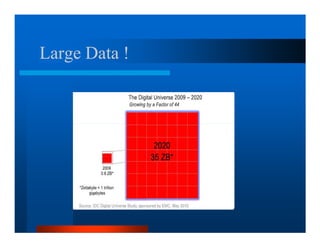
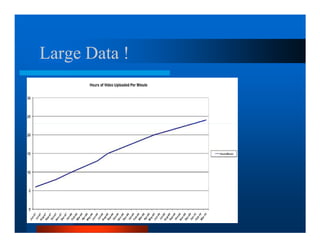
Large Data !
Large Data !
Large Data !
Large Data !
Internet 2009 !
 Websites
   234 million - The number of websites by December 2009.
   47 million - Added websites in 2009


 Social Media
   126 million – The number of blogs on the Internet (as
   tracked by BlogPulse).
   27.3 million – Number of tweets on Twitter per day
   (November, 2009)
   350 million – People on Facebook.
Internet 2009 !
 Images
   4 billion – Photos hosted by Flickr (October 2009).
   2.5 billion – Photos uploaded each month to Facebook.


 Videos
   1 billion – The total number of videos YouTube serves in
   one day.
   924 million – Videos viewed per month on Hulu in the US
   (November 2009).
The good news is that “Big Data” is here.

Bad news is that we are struggling to store and
                   analyze it.

    Anyways, Should you worry about it?
3 papers ..
 Sanjay Ghemawat, Howard Gobioff, and Shun-Tak Leung, The
 Google File System, 19th ACM Symposium on Operating
 Systems Principles, Lake George, NY, October, 2003.
 Jeffrey Dean and Sanjay Ghemawat,
 MapReduce: Simplified Data Processing on Large Clusters,
 OSDI'04: Sixth Symposium on Operating System Design and
 Implementation, San Francisco, CA, December, 2004.
 Fay Chang, Jeffrey Dean, Sanjay Ghemawat, Wilson C. Hsieh,
 Deborah A. Wallach, Mike Burrows, Tushar Chandra, Andrew
 Fikes, and Robert E. Gruber, Bigtable: A Distributed Storage
 System for Structured Data, OSDI'06: Seventh Symposium on
 Operating System Design and Implementation, Seattle, WA,
 November, 2006.
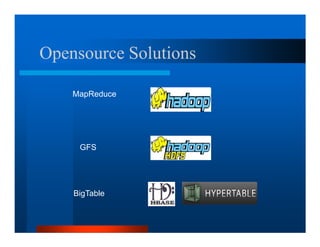
Opensource Solutions

    MapReduce


     GFS


    BigTable
MapReduce
Programming model for processing multi
terabyte data on hundreds of CPUs in
parallel.
MapReduce provides:
- Automatic parallelization and distribution
- Fault tolerance
- I/O scheduling
- Status and Monitoring
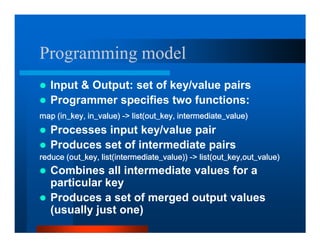
Programming model
  Input & Output: set of key/value pairs
  Programmer specifies two functions:
PDS LQBNH LQBYDOXH ! OLVW RXWBNH LQWHUPHGLDWHBYDOXH
  Processes input key/value pair
  Produces set of intermediate pairs
UHGXFH RXWBNH OLVW LQWHUPHGLDWHBYDOXH ! OLVW RXWBNH RXWBYDOXH
  Combines all intermediate values for a
  particular key
  Produces a set of merged output values
  (usually just one)
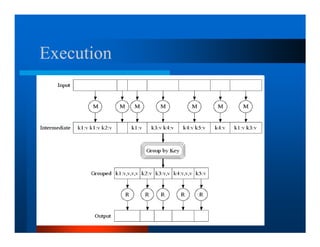
Execution
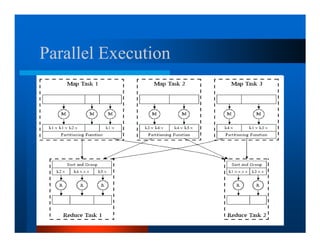
Parallel Execution
Example


     Thinking in MapReduce
Sam’s Mother
        Believed “an apple a day keeps a
        doctor away”

     Mother
                                                          Sam


                                               An Apple


Ref. SALSA HPC Group at Community Grids Labs
One day
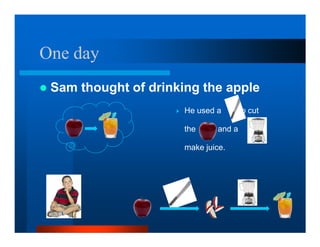
 Sam thought of drinking the apple
                      He used a        to cut

                      the      and a            to

                      make juice.
Next Day
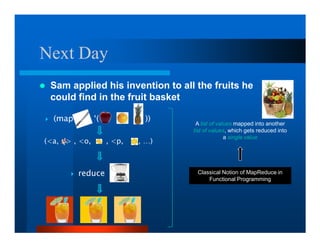
 Sam applied his invention to all the fruits he
 could find in the fruit basket

  (map      ‘(           ))
                                   A list of values mapped into another
                                 list of values, which gets reduced into
                                                a single value
(a,  , o,  , p,  , …)


         reduce                   Classical Notion of MapReduce in
                                      Functional Programming
18 Years Later
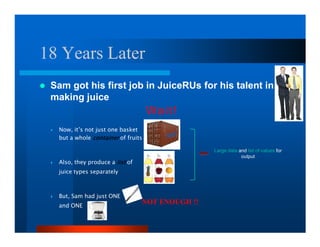
 Sam got his first job in JuiceRUs for his talent in
 making juice
                                    Wa i t !
  Now, it’s not just one basket
  but a whole container of fruits

                                                 Large data and list of values for
                                                             output
  Also, they produce a list of
  juice types separately


  But, Sam had just ONE
  and ONE
                                 NOT ENOUGH !!
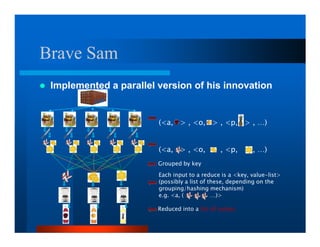
Brave Sam
 Implemented a parallel version of his innovation


                        (a,  , o,  , p,  , …)


                        (a,  , o,  , p,  , …)
                        Grouped by key
                        Each input to a reduce is a key, value-list
                        (possibly a list of these, depending on the
                        grouping/hashing mechanism)
                        e.g. a, (           …)

                        Reduced into a list of values
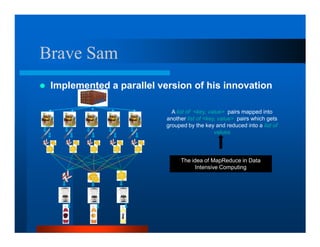
Brave Sam
 Implemented a parallel version of his innovation

                            A list of key, value pairs mapped into
                          another list of key, value pairs which gets
                          grouped by the key and reduced into a list of
                                              values


                               The idea of MapReduce in Data
                                     Intensive Computing
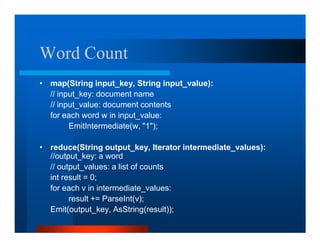
Word Count
• map(String input_key, String input_value):
  // input_key: document name
  // input_value: document contents
  for each word w in input_value:
        EmitIntermediate(w, 1);

• reduce(String output_key, Iterator intermediate_values):
  //output_key: a word
  // output_values: a list of counts
  int result = 0;
  for each v in intermediate_values:
        result += ParseInt(v);
  Emit(output_key, AsString(result));
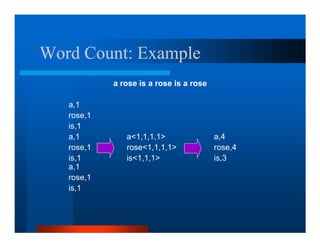
Word Count: Example
            a rose is a rose is a rose

   a,1
   rose,1
   is,1
   a,1         a1,1,1,1                a,4
   rose,1      rose1,1,1,1             rose,4
   is,1        is1,1,1                 is,3
   a,1
   rose,1
   is,1
Demo Time

Lets have some fun ☺
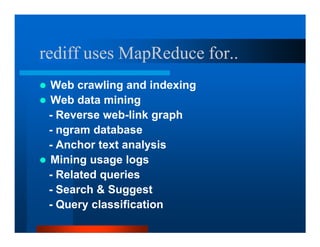
rediff uses MapReduce for..
 Web crawling and indexing
 Web data mining
 - Reverse web-link graph
 - ngram database
 - Anchor text analysis
 Mining usage logs
 - Related queries
 - Search  Suggest
 - Query classification
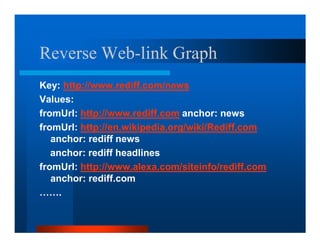
Reverse Web-link Graph
        Web-
Key: http://www.rediff.com/news
Values:
fromUrl: http://www.rediff.com anchor: news
fromUrl: http://en.wikipedia.org/wiki/Rediff.com
   anchor: rediff news
   anchor: rediff headlines
fromUrl: http://www.alexa.com/siteinfo/rediff.com
   anchor: rediff.com
…….
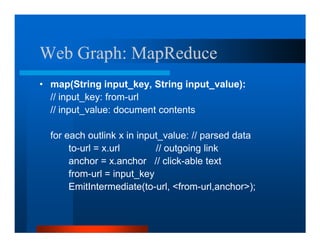
Web Graph: MapReduce
• map(String input_key, String input_value):
  // input_key: from-url
  // input_value: document contents

  for each outlink x in input_value: // parsed data
       to-url = x.url       // outgoing link
       anchor = x.anchor // click-able text
       from-url = input_key
       EmitIntermediate(to-url, from-url,anchor);
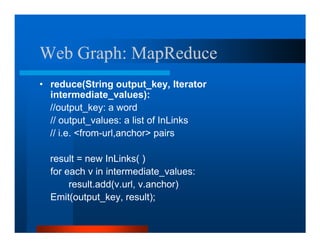
Web Graph: MapReduce
• reduce(String output_key, Iterator
  intermediate_values):
  //output_key: a word
  // output_values: a list of InLinks
  // i.e. from-url,anchor pairs

  result = new InLinks( )
  for each v in intermediate_values:
       result.add(v.url, v.anchor)
  Emit(output_key, result);
Navigational Search
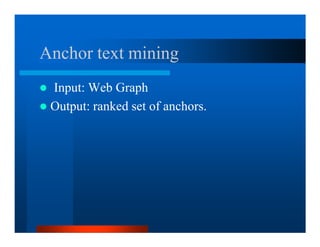
Anchor text mining
 Input: Web Graph
 Output: ranked set of anchors.
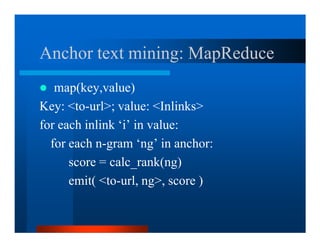
Anchor text mining: MapReduce
   map(key,value)
Key: to-url; value: Inlinks
for each inlink ‘i’ in value:
  for each n-gram ‘ng’ in anchor:
      score = calc_rank(ng)
      emit( to-url, ng, score )
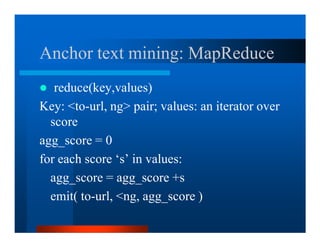
Anchor text mining: MapReduce
   reduce(key,values)
Key: to-url, ng pair; values: an iterator over
  score
agg_score = 0
for each score ‘s’ in values:
  agg_score = agg_score +s
  emit( to-url, ng, agg_score )
Hadoop
Opensource implementation of
        MapReduce
Hadoop
 Created by Doug Cutting
 Originated for Apache Nutch
Why hadoop?
Doug cutting - The name my kid gave a stuffed yellow
  elephant. Short, relatively easy to spell and pronounce,
  meaningless, and not used elsewhere: those are my naming
  criteria. Kids are good at generating such.
Implementation
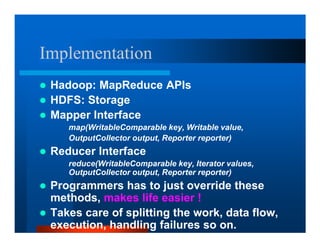
 Hadoop: MapReduce APIs
 HDFS: Storage
 Mapper Interface
    map(WritableComparable key, Writable value,
    OutputCollector output, Reporter reporter)
 Reducer Interface
    reduce(WritableComparable key, Iterator values,
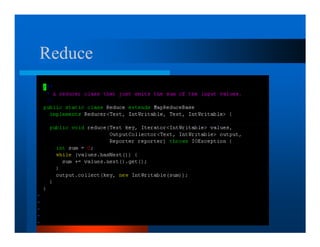
    OutputCollector output, Reporter reporter)
 Programmers has to just override these
 methods, makes life easier !
 Takes care of splitting the work, data flow,
 execution, handling failures so on.
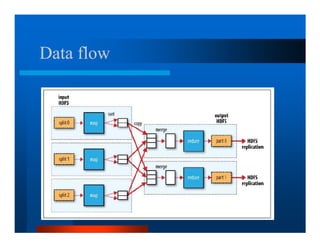
Data flow
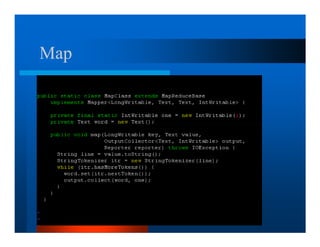
Map
Reduce
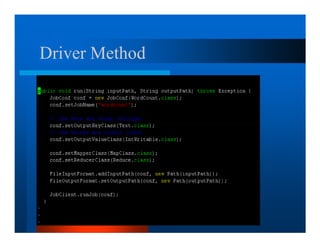
Driver Method
Combiner
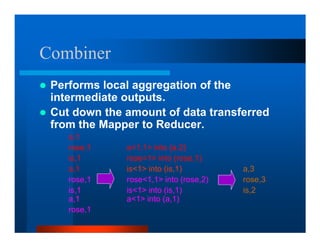
 Performs local aggregation of the
 intermediate outputs.
 Cut down the amount of data transferred
 from the Mapper to Reducer.
    a,1
    rose,1    a1,1 into (a,2)
    is,1      rose1 into (rose,1)
    a,1       is1 into (is,1)         a,3
    rose,1    rose1,1 into (rose,2)   rose,3
    is,1      is1 into (is,1)         is,2
    a,1       a1 into (a,1)
    rose,1
Variations
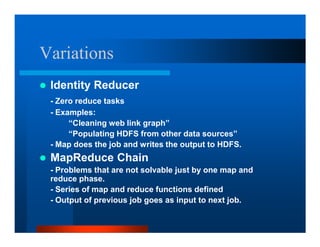
 Identity Reducer
 - Zero reduce tasks
 - Examples:
      “Cleaning web link graph”
      “Populating HDFS from other data sources”
 - Map does the job and writes the output to HDFS.
 MapReduce Chain
 - Problems that are not solvable just by one map and
 reduce phase.
 - Series of map and reduce functions defined
 - Output of previous job goes as input to next job.
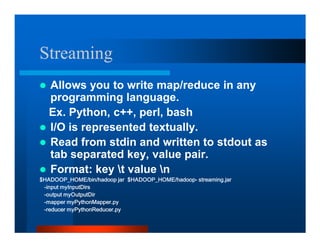
Streaming
  Allows you to write map/reduce in any
  programming language.
  Ex. Python, c++, perl, bash
  I/O is represented textually.
  Read from stdin and written to stdout as
  tab separated key, value pair.
  Format: key t value n
+$'223B+20(ELQKDGRRS MDU    +$'223B+20(KDGRRS VWUHDPLQJMDU
LQSXW P,QSXW'LUV
RXWSXW P2XWSXW'LU
PDSSHU P3WKRQ0DSSHUS
UHGXFHU P3WKRQ5HGXFHUS
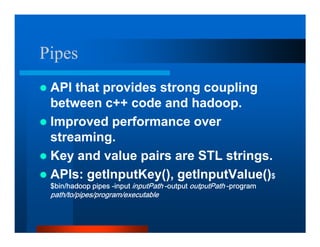
Pipes
 API that provides strong coupling
 between c++ code and hadoop.
 Improved performance over
 streaming.
 Key and value pairs are STL strings.
 APIs: getInputKey(), getInputValue()
  ELQKDGRRS SLSHV LQSXW LQSXW3DWK RXWSXW RXWSXW3DWK SURJUDP
 SDWKWRSLSHVSURJUDPH[HFXWDEOH
Hadoop Distributed File System
            (HDFS)
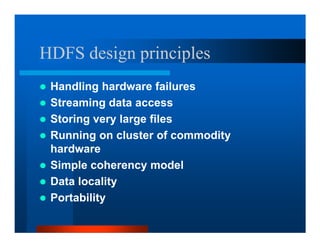
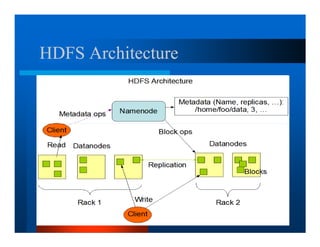
HDFS design principles
 Handling hardware failures
 Streaming data access
 Storing very large files
 Running on cluster of commodity
 hardware
 Simple coherency model
 Data locality
 Portability
HDFS Architecture
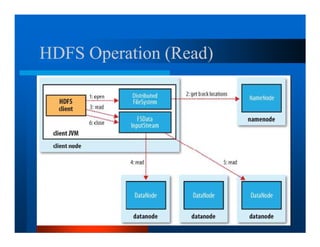
HDFS Operation (Read)
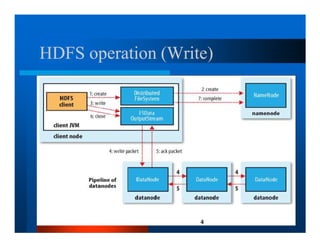
HDFS operation (Write)
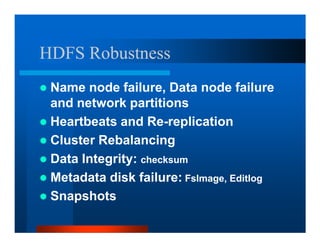
HDFS Robustness
 Name node failure, Data node failure
 and network partitions
 Heartbeats and Re-replication
 Cluster Rebalancing
 Data Integrity: checksum
 Metadata disk failure: FsImage, Editlog
 Snapshots
Anatomy of Hadoop MapReduce
      Job run on HDFS
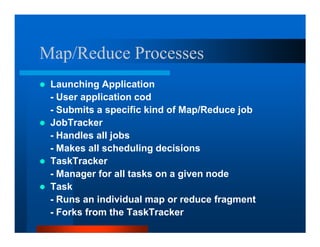
Map/Reduce Processes
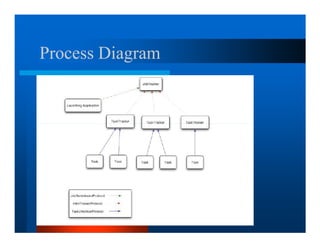
 Launching Application
 - User application cod
 - Submits a specific kind of Map/Reduce job
 JobTracker
 - Handles all jobs
 - Makes all scheduling decisions
 TaskTracker
 - Manager for all tasks on a given node
 Task
 - Runs an individual map or reduce fragment
 - Forks from the TaskTracker
Process Diagram
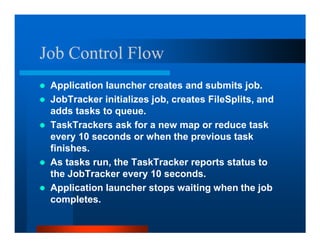
Job Control Flow
 Application launcher creates and submits job.
 JobTracker initializes job, creates FileSplits, and
 adds tasks to queue.
 TaskTrackers ask for a new map or reduce task
 every 10 seconds or when the previous task
 finishes.
 As tasks run, the TaskTracker reports status to
 the JobTracker every 10 seconds.
 Application launcher stops waiting when the job
 completes.
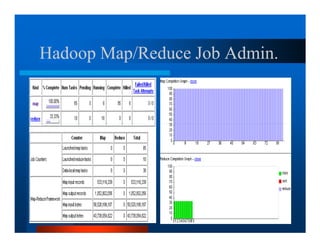
Hadoop Map/Reduce Job Admin.
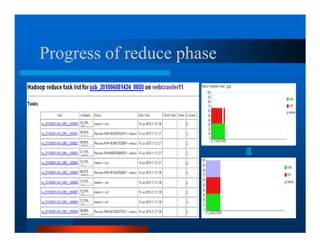
Progress of reduce phase
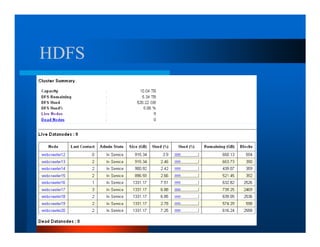
HDFS
Hadoop Benchmarking
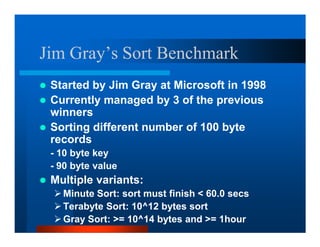
Jim Gray’s Sort Benchmark
 Started by Jim Gray at Microsoft in 1998
 Currently managed by 3 of the previous
 winners
 Sorting different number of 100 byte
 records
 - 10 byte key
 - 90 byte value
 Multiple variants:
   Minute Sort: sort must finish  60.0 secs
   Terabyte Sort: 10^12 bytes sort
   Gray Sort: = 10^14 bytes and = 1hour
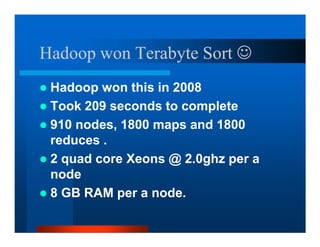
Hadoop won Terabyte Sort ☺
 Hadoop won this in 2008
 Took 209 seconds to complete
 910 nodes, 1800 maps and 1800
 reduces .
 2 quad core Xeons @ 2.0ghz per a
 node
 8 GB RAM per a node.
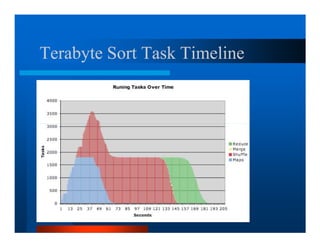
Terabyte Sort Task Timeline
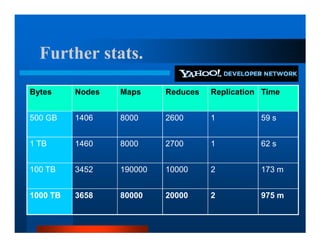
Further stats.

Bytes     Nodes   Maps     Reduces   Replication Time


500 GB    1406    8000     2600      1          59 s


1 TB      1460    8000     2700      1          62 s


100 TB    3452    190000   10000     2          173 m


1000 TB   3658    80000    20000     2          975 m
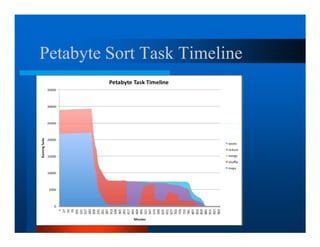
Petabyte Sort Task Timeline
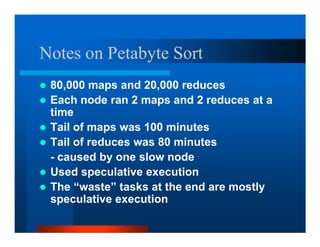
Notes on Petabyte Sort
 80,000 maps and 20,000 reduces
 Each node ran 2 maps and 2 reduces at a
 time
 Tail of maps was 100 minutes
 Tail of reduces was 80 minutes
 - caused by one slow node
 Used speculative execution
 The “waste” tasks at the end are mostly
 speculative execution
Cloud Computing  Elastic
MapReduce
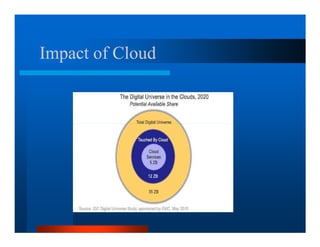
Impact of Cloud
Definition  Characteristics
     “A pool of highly scalable, abstracted infrastructure,
        capable of hosting end-customer applications,
                that is billed by consumption”

Characteristics:
  Dynamic computing infrastructure
  Service-centric approach
  Self service based usage model
  Minimally or self-managed platform
  Consumption based billing
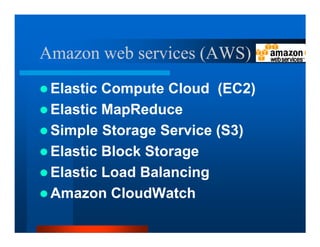
Amazon web services (AWS)
 Elastic Compute Cloud (EC2)
 Elastic MapReduce
 Simple Storage Service (S3)
 Elastic Block Storage
 Elastic Load Balancing
 Amazon CloudWatch
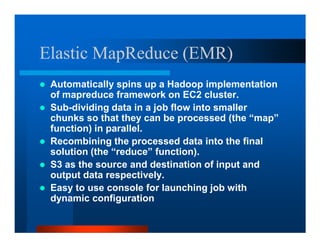
Elastic MapReduce (EMR)
 Automatically spins up a Hadoop implementation
 of mapreduce framework on EC2 cluster.
 Sub-dividing data in a job flow into smaller
 chunks so that they can be processed (the “map”
 function) in parallel.
 Recombining the processed data into the final
 solution (the “reduce” function).
 S3 as the source and destination of input and
 output data respectively.
 Easy to use console for launching job with
 dynamic configuration
BigTable
Motivation
 Lots of (semi-)structured data
  – URLs:
      • Contents, crawl metadata, links, anchors,
        pagerank, …
  – Per-user Data:
      • User preference settings, recent queries/search
        results, …
  – Geographic locations:
      • Physical entities (shops, restaurants, etc.). roads,
        satellite image data..
 Scale is large
  – Billions of URLs, many versions/page(~20K/version)
  – Hundreds of millions of users, thousands of q/sec
  – 100TB+ of satellite image data
Why not just use commercial DB?

 Scale is too large for most commercial databases
 Even if it weren’t, cost would be very high
  – Building internally means system can be
    applied across many projects for low
    incremental cost
 Low-level storage optimizations help
 performance significantly
  – Much harder to do when running on top of a
    database layer

  – Also fun and challenging to build large-scale
    systems ☺
Goals
 Want asynchronous processes to be
 continuously updating different pieces of data
  – Want access to most current data at any time
 Need to support
  – Very high read/write rates (millions of ops per
    second)
  – Efficient scans over all or interesting subsets
    of data
 Often want to examine data changes over time
  – E.g. Contents of a web page over multiple
    crawls
BigTable
 Distributed multi-level map
 – With an interesting data model
 Fault-tolerant, persistent
 Scalable
 –   Thousands of servers
 –   Terabytes of in-memory data
 –   Petabytes of disk-based data
 –   Millions of reads/writes per second, efficient
     scans
 Self-managing
 – Servers can be added/removed dynamically
 – Servers adjust to load imbalance
Hbase  Hypertable
 Use data model similar to BigTable
 Sparse, distributed, persistent multi-
 dimensional sorted map
 Map is indexed by
 - row key
 - column key
 - timestamp
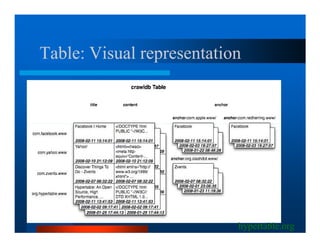
Table: Visual representation


                           hypertable.org
Table: Actual Representation


                           hypertable.org
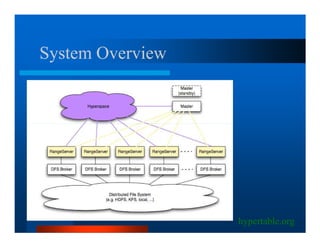
System Overview


                  hypertable.org
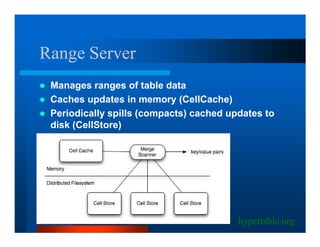
Range Server
 Manages ranges of table data
 Caches updates in memory (CellCache)
 Periodically spills (compacts) cached updates to
 disk (CellStore)


                                         hypertable.org
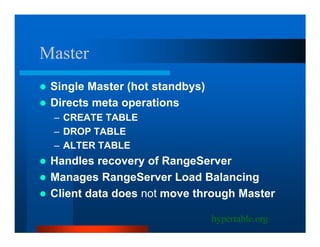
Master
 Single Master (hot standbys)
 Directs meta operations
 – CREATE TABLE
 – DROP TABLE
 – ALTER TABLE
 Handles recovery of RangeServer
 Manages RangeServer Load Balancing
 Client data does not move through Master

                                hypertable.org
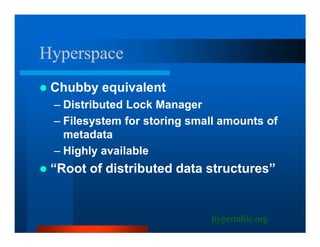
Hyperspace
 Chubby equivalent
 – Distributed Lock Manager
 – Filesystem for storing small amounts of
   metadata
 – Highly available
 “Root of distributed data structures”


                             hypertable.org
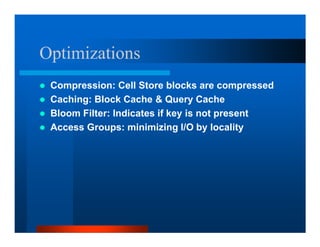
Optimizations
 Compression: Cell Store blocks are compressed
 Caching: Block Cache  Query Cache
 Bloom Filter: Indicates if key is not present
 Access Groups: minimizing I/O by locality
QA
Thanks Much !
References
 Jeffery Dean and Sanjay Ghemawat, MapReduce: Simplified
 Data Processing on Large Clusters
 SALSA HPC Group at Community Grids Labs
 http://code.google.com/edu/parallel/mapreduce-tutorial.html
 http://developer.yahoo.net/blogs/hadoop/2009/05/hadoop_s
 orts_a_petabyte_in_162.html
 http://hadoop.apache.org/
 http://aws.amazon.com
 http://www.emc.com
 http://pingdom.com/

Large Scale Data Processing & Storage

  • 1.
    Large Scale DataProcessing and Storage Ilayaraja Prabakaran Product Engineer ilayaraja@rediff.co.in
  • 2.
    Agenda Introduction tolarge data problem MapReduce programming model Web mining using MapReduce MapReduce with Hadoop Hadoop Distributed File System Elastic MapReduce Scalable storage architecture
  • 3.
  • 4.
  • 5.
  • 6.
  • 7.
    Internet 2009 ! Websites 234 million - The number of websites by December 2009. 47 million - Added websites in 2009 Social Media 126 million – The number of blogs on the Internet (as tracked by BlogPulse). 27.3 million – Number of tweets on Twitter per day (November, 2009) 350 million – People on Facebook.
  • 8.
    Internet 2009 ! Images 4 billion – Photos hosted by Flickr (October 2009). 2.5 billion – Photos uploaded each month to Facebook. Videos 1 billion – The total number of videos YouTube serves in one day. 924 million – Videos viewed per month on Hulu in the US (November 2009).
  • 9.
    The good newsis that “Big Data” is here. Bad news is that we are struggling to store and analyze it. Anyways, Should you worry about it?
  • 10.
    3 papers .. Sanjay Ghemawat, Howard Gobioff, and Shun-Tak Leung, The Google File System, 19th ACM Symposium on Operating Systems Principles, Lake George, NY, October, 2003. Jeffrey Dean and Sanjay Ghemawat, MapReduce: Simplified Data Processing on Large Clusters, OSDI'04: Sixth Symposium on Operating System Design and Implementation, San Francisco, CA, December, 2004. Fay Chang, Jeffrey Dean, Sanjay Ghemawat, Wilson C. Hsieh, Deborah A. Wallach, Mike Burrows, Tushar Chandra, Andrew Fikes, and Robert E. Gruber, Bigtable: A Distributed Storage System for Structured Data, OSDI'06: Seventh Symposium on Operating System Design and Implementation, Seattle, WA, November, 2006.
  • 11.
    Opensource Solutions MapReduce GFS BigTable
  • 12.
    MapReduce Programming model forprocessing multi terabyte data on hundreds of CPUs in parallel. MapReduce provides: - Automatic parallelization and distribution - Fault tolerance - I/O scheduling - Status and Monitoring
  • 13.
    Programming model Input & Output: set of key/value pairs Programmer specifies two functions: PDS LQBNH LQBYDOXH ! OLVW RXWBNH LQWHUPHGLDWHBYDOXH Processes input key/value pair Produces set of intermediate pairs UHGXFH RXWBNH OLVW LQWHUPHGLDWHBYDOXH ! OLVW RXWBNH RXWBYDOXH Combines all intermediate values for a particular key Produces a set of merged output values (usually just one)
  • 14.
  • 15.
  • 16.
    Example Thinking in MapReduce
  • 17.
    Sam’s Mother Believed “an apple a day keeps a doctor away” Mother Sam An Apple Ref. SALSA HPC Group at Community Grids Labs
  • 18.
    One day Samthought of drinking the apple He used a to cut the and a to make juice.
  • 19.
    Next Day Samapplied his invention to all the fruits he could find in the fruit basket (map ‘( )) A list of values mapped into another list of values, which gets reduced into a single value (a, , o, , p, , …) reduce Classical Notion of MapReduce in Functional Programming
  • 20.
    18 Years Later Sam got his first job in JuiceRUs for his talent in making juice Wa i t ! Now, it’s not just one basket but a whole container of fruits Large data and list of values for output Also, they produce a list of juice types separately But, Sam had just ONE and ONE NOT ENOUGH !!
  • 21.
    Brave Sam Implementeda parallel version of his innovation (a, , o, , p, , …) (a, , o, , p, , …) Grouped by key Each input to a reduce is a key, value-list (possibly a list of these, depending on the grouping/hashing mechanism) e.g. a, ( …) Reduced into a list of values
  • 22.
    Brave Sam Implementeda parallel version of his innovation A list of key, value pairs mapped into another list of key, value pairs which gets grouped by the key and reduced into a list of values The idea of MapReduce in Data Intensive Computing
  • 23.
    Word Count • map(Stringinput_key, String input_value): // input_key: document name // input_value: document contents for each word w in input_value: EmitIntermediate(w, 1); • reduce(String output_key, Iterator intermediate_values): //output_key: a word // output_values: a list of counts int result = 0; for each v in intermediate_values: result += ParseInt(v); Emit(output_key, AsString(result));
  • 24.
    Word Count: Example a rose is a rose is a rose a,1 rose,1 is,1 a,1 a1,1,1,1 a,4 rose,1 rose1,1,1,1 rose,4 is,1 is1,1,1 is,3 a,1 rose,1 is,1
  • 25.
    Demo Time Lets havesome fun ☺
  • 26.
    rediff uses MapReducefor.. Web crawling and indexing Web data mining - Reverse web-link graph - ngram database - Anchor text analysis Mining usage logs - Related queries - Search Suggest - Query classification
  • 27.
    Reverse Web-link Graph Web- Key: http://www.rediff.com/news Values: fromUrl: http://www.rediff.com anchor: news fromUrl: http://en.wikipedia.org/wiki/Rediff.com anchor: rediff news anchor: rediff headlines fromUrl: http://www.alexa.com/siteinfo/rediff.com anchor: rediff.com …….
  • 28.
    Web Graph: MapReduce •map(String input_key, String input_value): // input_key: from-url // input_value: document contents for each outlink x in input_value: // parsed data to-url = x.url // outgoing link anchor = x.anchor // click-able text from-url = input_key EmitIntermediate(to-url, from-url,anchor);
  • 29.
    Web Graph: MapReduce •reduce(String output_key, Iterator intermediate_values): //output_key: a word // output_values: a list of InLinks // i.e. from-url,anchor pairs result = new InLinks( ) for each v in intermediate_values: result.add(v.url, v.anchor) Emit(output_key, result);
  • 30.
  • 31.
    Anchor text mining Input: Web Graph Output: ranked set of anchors.
  • 32.
    Anchor text mining:MapReduce map(key,value) Key: to-url; value: Inlinks for each inlink ‘i’ in value: for each n-gram ‘ng’ in anchor: score = calc_rank(ng) emit( to-url, ng, score )
  • 33.
    Anchor text mining:MapReduce reduce(key,values) Key: to-url, ng pair; values: an iterator over score agg_score = 0 for each score ‘s’ in values: agg_score = agg_score +s emit( to-url, ng, agg_score )
  • 34.
  • 35.
    Hadoop Created byDoug Cutting Originated for Apache Nutch Why hadoop? Doug cutting - The name my kid gave a stuffed yellow elephant. Short, relatively easy to spell and pronounce, meaningless, and not used elsewhere: those are my naming criteria. Kids are good at generating such.
  • 36.
    Implementation Hadoop: MapReduceAPIs HDFS: Storage Mapper Interface map(WritableComparable key, Writable value, OutputCollector output, Reporter reporter) Reducer Interface reduce(WritableComparable key, Iterator values, OutputCollector output, Reporter reporter) Programmers has to just override these methods, makes life easier ! Takes care of splitting the work, data flow, execution, handling failures so on.
  • 37.
  • 38.
  • 39.
  • 40.
  • 41.
    Combiner Performs localaggregation of the intermediate outputs. Cut down the amount of data transferred from the Mapper to Reducer. a,1 rose,1 a1,1 into (a,2) is,1 rose1 into (rose,1) a,1 is1 into (is,1) a,3 rose,1 rose1,1 into (rose,2) rose,3 is,1 is1 into (is,1) is,2 a,1 a1 into (a,1) rose,1
  • 42.
    Variations Identity Reducer - Zero reduce tasks - Examples: “Cleaning web link graph” “Populating HDFS from other data sources” - Map does the job and writes the output to HDFS. MapReduce Chain - Problems that are not solvable just by one map and reduce phase. - Series of map and reduce functions defined - Output of previous job goes as input to next job.
  • 43.
    Streaming Allowsyou to write map/reduce in any programming language. Ex. Python, c++, perl, bash I/O is represented textually. Read from stdin and written to stdout as tab separated key, value pair. Format: key t value n +$'223B+20(ELQKDGRRS MDU +$'223B+20(KDGRRS VWUHDPLQJMDU LQSXW P,QSXW'LUV RXWSXW P2XWSXW'LU PDSSHU P3WKRQ0DSSHUS UHGXFHU P3WKRQ5HGXFHUS
  • 44.
    Pipes API thatprovides strong coupling between c++ code and hadoop. Improved performance over streaming. Key and value pairs are STL strings. APIs: getInputKey(), getInputValue() ELQKDGRRS SLSHV LQSXW LQSXW3DWK RXWSXW RXWSXW3DWK SURJUDP SDWKWRSLSHVSURJUDPH[HFXWDEOH
  • 45.
  • 46.
    HDFS design principles Handling hardware failures Streaming data access Storing very large files Running on cluster of commodity hardware Simple coherency model Data locality Portability
  • 47.
  • 48.
  • 49.
  • 50.
    HDFS Robustness Namenode failure, Data node failure and network partitions Heartbeats and Re-replication Cluster Rebalancing Data Integrity: checksum Metadata disk failure: FsImage, Editlog Snapshots
  • 51.
    Anatomy of HadoopMapReduce Job run on HDFS
  • 52.
    Map/Reduce Processes LaunchingApplication - User application cod - Submits a specific kind of Map/Reduce job JobTracker - Handles all jobs - Makes all scheduling decisions TaskTracker - Manager for all tasks on a given node Task - Runs an individual map or reduce fragment - Forks from the TaskTracker
  • 53.
  • 54.
    Job Control Flow Application launcher creates and submits job. JobTracker initializes job, creates FileSplits, and adds tasks to queue. TaskTrackers ask for a new map or reduce task every 10 seconds or when the previous task finishes. As tasks run, the TaskTracker reports status to the JobTracker every 10 seconds. Application launcher stops waiting when the job completes.
  • 55.
  • 56.
  • 57.
  • 58.
  • 59.
    Jim Gray’s SortBenchmark Started by Jim Gray at Microsoft in 1998 Currently managed by 3 of the previous winners Sorting different number of 100 byte records - 10 byte key - 90 byte value Multiple variants: Minute Sort: sort must finish 60.0 secs Terabyte Sort: 10^12 bytes sort Gray Sort: = 10^14 bytes and = 1hour
  • 60.
    Hadoop won TerabyteSort ☺ Hadoop won this in 2008 Took 209 seconds to complete 910 nodes, 1800 maps and 1800 reduces . 2 quad core Xeons @ 2.0ghz per a node 8 GB RAM per a node.
  • 61.
  • 62.
    Further stats. Bytes Nodes Maps Reduces Replication Time 500 GB 1406 8000 2600 1 59 s 1 TB 1460 8000 2700 1 62 s 100 TB 3452 190000 10000 2 173 m 1000 TB 3658 80000 20000 2 975 m
  • 63.
  • 64.
    Notes on PetabyteSort 80,000 maps and 20,000 reduces Each node ran 2 maps and 2 reduces at a time Tail of maps was 100 minutes Tail of reduces was 80 minutes - caused by one slow node Used speculative execution The “waste” tasks at the end are mostly speculative execution
  • 65.
    Cloud Computing Elastic MapReduce
  • 66.
  • 67.
    Definition Characteristics “A pool of highly scalable, abstracted infrastructure, capable of hosting end-customer applications, that is billed by consumption” Characteristics: Dynamic computing infrastructure Service-centric approach Self service based usage model Minimally or self-managed platform Consumption based billing
  • 68.
    Amazon web services(AWS) Elastic Compute Cloud (EC2) Elastic MapReduce Simple Storage Service (S3) Elastic Block Storage Elastic Load Balancing Amazon CloudWatch
  • 69.
    Elastic MapReduce (EMR) Automatically spins up a Hadoop implementation of mapreduce framework on EC2 cluster. Sub-dividing data in a job flow into smaller chunks so that they can be processed (the “map” function) in parallel. Recombining the processed data into the final solution (the “reduce” function). S3 as the source and destination of input and output data respectively. Easy to use console for launching job with dynamic configuration
  • 70.
  • 71.
    Motivation Lots of(semi-)structured data – URLs: • Contents, crawl metadata, links, anchors, pagerank, … – Per-user Data: • User preference settings, recent queries/search results, … – Geographic locations: • Physical entities (shops, restaurants, etc.). roads, satellite image data.. Scale is large – Billions of URLs, many versions/page(~20K/version) – Hundreds of millions of users, thousands of q/sec – 100TB+ of satellite image data
  • 72.
    Why not justuse commercial DB? Scale is too large for most commercial databases Even if it weren’t, cost would be very high – Building internally means system can be applied across many projects for low incremental cost Low-level storage optimizations help performance significantly – Much harder to do when running on top of a database layer – Also fun and challenging to build large-scale systems ☺
  • 73.
    Goals Want asynchronousprocesses to be continuously updating different pieces of data – Want access to most current data at any time Need to support – Very high read/write rates (millions of ops per second) – Efficient scans over all or interesting subsets of data Often want to examine data changes over time – E.g. Contents of a web page over multiple crawls
  • 74.
    BigTable Distributed multi-levelmap – With an interesting data model Fault-tolerant, persistent Scalable – Thousands of servers – Terabytes of in-memory data – Petabytes of disk-based data – Millions of reads/writes per second, efficient scans Self-managing – Servers can be added/removed dynamically – Servers adjust to load imbalance
  • 75.
    Hbase Hypertable Use data model similar to BigTable Sparse, distributed, persistent multi- dimensional sorted map Map is indexed by - row key - column key - timestamp
  • 76.
  • 77.
  • 78.
    System Overview hypertable.org
  • 79.
    Range Server Managesranges of table data Caches updates in memory (CellCache) Periodically spills (compacts) cached updates to disk (CellStore) hypertable.org
  • 80.
    Master Single Master(hot standbys) Directs meta operations – CREATE TABLE – DROP TABLE – ALTER TABLE Handles recovery of RangeServer Manages RangeServer Load Balancing Client data does not move through Master hypertable.org
  • 81.
    Hyperspace Chubby equivalent – Distributed Lock Manager – Filesystem for storing small amounts of metadata – Highly available “Root of distributed data structures” hypertable.org
  • 82.
    Optimizations Compression: CellStore blocks are compressed Caching: Block Cache Query Cache Bloom Filter: Indicates if key is not present Access Groups: minimizing I/O by locality
  • 83.
  • 84.
  • 85.
    References Jeffery Deanand Sanjay Ghemawat, MapReduce: Simplified Data Processing on Large Clusters SALSA HPC Group at Community Grids Labs http://code.google.com/edu/parallel/mapreduce-tutorial.html http://developer.yahoo.net/blogs/hadoop/2009/05/hadoop_s orts_a_petabyte_in_162.html http://hadoop.apache.org/ http://aws.amazon.com http://www.emc.com http://pingdom.com/