Communicating
State Machines
sriram srinivasan!
sriram@malhar.net
www.malhar.net/sriram
Programming Languages Meetup, San Francisco, June 10, 2014
• Fundamental building block of computation
• Communicating State Machines model
• Synchronous and Asynchronous composition
• Hierarchical State Machines specification
• (Edward A. Lee and Pravin Varaiya, Structure and Interpretation of Signals
and Systems, LeeVaraiya.org)
State machines
• Distributed Systems
• Hardware interfaces
• Components of a memory hierarchy
• Stream producers and consumers
• Parsers and Lexers
• Filesystem and tree walker.
• Networking stack and Socket consumer
• Bidirectional communication
CSMs are Ubiquitous
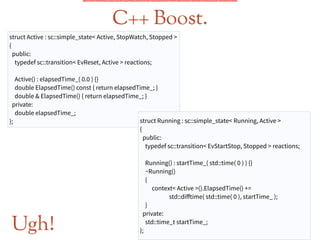
C++ Boost.
struct Active : sc::simple_state< Active, StopWatch, Stopped >
{
public:
typedef sc::transition< EvReset, Active > reactions;
!
Active() : elapsedTime_( 0.0 ) {}
double ElapsedTime() const { return elapsedTime_; }
double & ElapsedTime() { return elapsedTime_; }
private:
double elapsedTime_;
}; struct Running : sc::simple_state< Running, Active >
{
public:
typedef sc::transition< EvStartStop, Stopped > reactions;
!
Running() : startTime_( std::time( 0 ) ) {}
~Running()
{
context< Active >().ElapsedTime() +=
std::difftime( std::time( 0 ), startTime_ );
}
private:
std::time_t startTime_;
};Ugh!
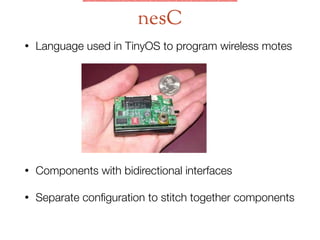
• Language used in TinyOS to program wireless motes
nesC
• Components with bidirectional interfaces
• Separate configuration to stitch together components
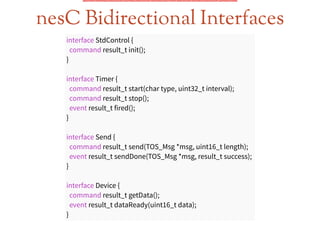
nesC Bidirectional Interfaces
interface StdControl {
command result_t init();
}
!
interface Timer {
command result_t start(char type, uint32_t interval);
command result_t stop();
event result_t fired();
}
!
interface Send {
command result_t send(TOS_Msg *msg, uint16_t length);
event result_t sendDone(TOS_Msg *msg, result_t success);
}
!
interface Device {
command result_t getData();
event result_t dataReady(uint16_t data);
}
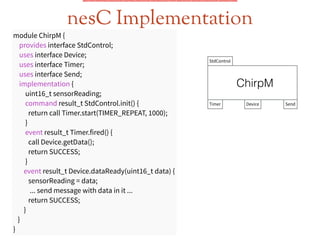
nesC Implementation
module ChirpM {
provides interface StdControl;
uses interface Device;
uses interface Timer;
uses interface Send;
implementation {
uint16_t sensorReading;
command result_t StdControl.init() {
return call Timer.start(TIMER_REPEAT, 1000);
}
event result_t Timer.fired() {
call Device.getData();
return SUCCESS;
}
event result_t Device.dataReady(uint16_t data) {
sensorReading = data;
... send message with data in it ...
return SUCCESS;
}
}
}
StdControl
ChirpM
Timer Device Send
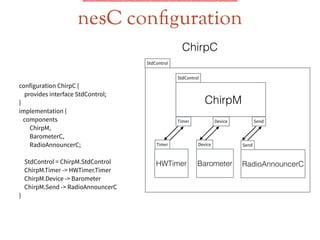
nesC configuration
ChirpC
configuration ChirpC {
provides interface StdControl;
}
implementation {
components 

ChirpM, 

BarometerC,
RadioAnnouncerC;
!
StdControl = ChirpM.StdControl
ChirpM.Timer -> HWTimer.Timer
ChirpM.Device -> Barometer
ChirpM.Send -> RadioAnnouncerC
}
StdControl
ChirpM
Timer Device Send
StdControl
Timer
HWTimer
Device
Barometer
Send
RadioAnnouncerC
Why aren’t more systems
structured this way?
Synchronous
Communication
Stacks as State Machines
void readMsgs( socket) {
numMsgsRead = 0
while (true) {
msg = readMsg(socket)
dispatch(msg)
log(numMsgsRead++)
}
}
void readMsg(socket) {
len := readLen(socket)
readBody(len)
}
void readLen(socket) {
byte[4] len
for i = 0 .. 4 {
len[i] = readByte(socket)
}
return len
}
• Thread of control
• Control plane = Call Chain (each frame
remembers its pc)
• Sequential flow of control defines hidden states
• Functions define major states
• Data plane = Vars local in each frame
• Blocking semantics == synchronous (lock-
step) communication
• readByte and dispatch interact with network
• Easy API; that’s why Posix and most db
calls are synchronous
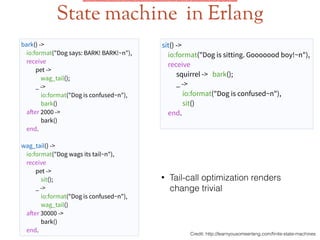
State machine in Erlang
bark() ->
io:format("Dog says: BARK! BARK!~n"),
receive
pet ->
wag_tail();
_ ->
io:format("Dog is confused~n"),
bark()
after 2000 ->
bark()
end.
!
wag_tail() ->
io:format("Dog wags its tail~n"),
receive
pet ->
sit();
_ ->
io:format("Dog is confused~n"),
wag_tail()
after 30000 ->
bark()
end.
sit() ->
io:format("Dog is sitting. Gooooood boy!~n"),
receive
squirrel -> bark();
_ ->
io:format("Dog is confused~n"),
sit()
end.
• Tail-call optimization renders

change trivial
Credit: http://learnyousomeerlang.com/finite-state-machines
• Problem: Obtain leaves from a tree one at a time
Leaves from a Tree
• Problem: Obtain leaves from a tree one at a time
Leaves from a Tree
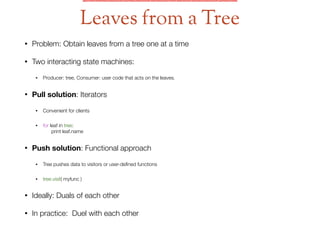
• Problem: Obtain leaves from a tree one at a time
• Two interacting state machines:
• Producer: tree, Consumer: user code that acts on the leaves.
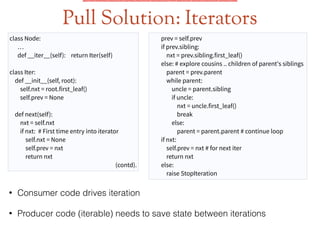
• Pull solution: Iterators
• Convenient for clients
• for leaf in tree: 

print leaf.name
• Push solution: Functional approach
• Tree pushes data to visitors or user-defined functions
• tree.visit( myfunc )
• Ideally: Duals of each other
• In practice: Duel with each other
Leaves from a Tree
Pull Solution: Iterators
class Node:
…
def __iter__(self): return Iter(self)
!
class Iter:
def __init__(self, root):
self.nxt = root.first_leaf()
self.prev = None
def next(self):
nxt = self.nxt
if nxt: # First time entry into iterator
self.nxt = None
self.prev = nxt
return nxt
(contd).
prev = self.prev
if prev.sibling:
nxt = prev.sibling.first_leaf()
else: # explore cousins .. children of parent's siblings
parent = prev.parent
while parent:
uncle = parent.sibling
if uncle:
nxt = uncle.first_leaf()
break
else:
parent = parent.parent # continue loop
if nxt:
self.prev = nxt # for next iter
return nxt
else:
raise StopIteration
• Consumer code drives iteration
• Producer code (iterable) needs to save state between iterations
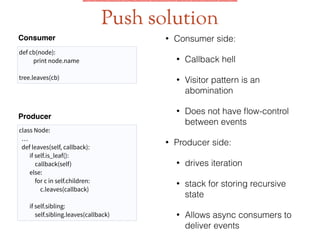
Push solution
class Node:
…
def leaves(self, callback):
if self.is_leaf():
callback(self)
else:
for c in self.children:
c.leaves(callback)
!
if self.sibling:
self.sibling.leaves(callback)
def cb(node):
print node.name
!
tree.leaves(cb)
• Consumer side:
• Callback hell
• Visitor pattern is an
abomination
• Does not have flow-control
between events
• Producer side:
• drives iteration
• stack for storing recursive
state
• Allows async consumers to
deliver events
Consumer
Producer
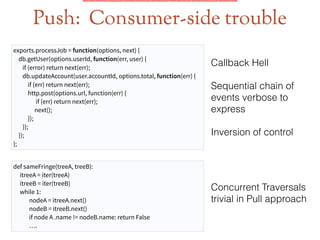
Push: Consumer-side trouble
exports.processJob = function(options, next) {
db.getUser(options.userId, function(err, user) {
if (error) return next(err);
db.updateAccount(user.accountId, options.total, function(err) {
if (err) return next(err);
http.post(options.url, function(err) {
if (err) return next(err);
next();
});
}); 
});
};
def sameFringe(treeA, treeB):
itreeA = iter(treeA)
itreeB = iter(treeB)
while 1:
nodeA = itreeA.next()
nodeB = itreeB.next()
if node A .name != nodeB.name: return False
….
Callback Hell
!
Sequential chain of 

events verbose to 

express
!
Inversion of control
Concurrent Traversals 

trivial in Pull approach
Generators/Coroutines
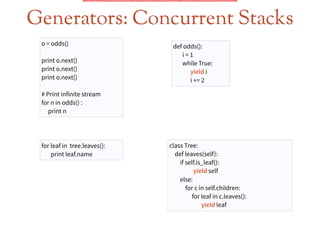
Generators: Concurrent Stacks
o = odds()
!
print o.next()
print o.next()
print o.next()
!
# Print infinite stream
for n in odds() :
print n
def odds():
i = 1
while True:
yield i
i += 2
for leaf in tree.leaves():
print leaf.name
class Tree:
def leaves(self):
if self.is_leaf():
yield self
else:
for c in self.children:
for leaf in c.leaves():
yield leaf
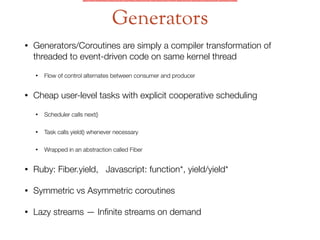
• Generators/Coroutines are simply a compiler transformation of
threaded to event-driven code on same kernel thread
• Flow of control alternates between consumer and producer
• Cheap user-level tasks with explicit cooperative scheduling
• Scheduler calls next()
• Task calls yield() whenever necessary
• Wrapped in an abstraction called Fiber
• Ruby: Fiber.yield, Javascript: function*, yield/yield*
• Symmetric vs Asymmetric coroutines
• Lazy streams — Infinite streams on demand
Generators
Asynchrony and Multiprocessing
• All threads have the same fixed size set at creation time:
usually set to worst case 


• Kernel Thread context switching is expensive (in μs)
• Preemption at any time ==> Save all registers: 16 general purpose registers, PC, SP,
segment registers, 16 XMM registers, FP coprocessor state, X AVX registers, all MSRs
• TLB flushes, cache invalidation, crossing kernel protection boundary
• Even cooperative yields are expensive.
• A kernel thread is a precious resource. Can’t block it.
• No, not for IO-bound code, says Paul Tyma
Why can’t we just use Kernel Threads?
> ulimit –s
8192
Threads vs Events Debate
• But horrible user-programming model
• libuv, libasync, EventMachine (Ruby), netty (Java)
• User-code must not block, not call other I/O
operations
Event-driven I/O is faster
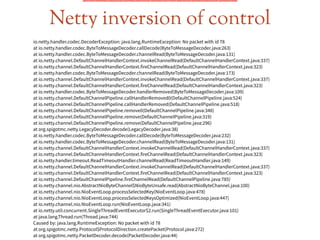
Netty inversion of control
io.netty.handler.codec.DecoderException: java.lang.RuntimeException: No packet with id 78
at io.netty.handler.codec.ByteToMessageDecoder.callDecode(ByteToMessageDecoder.java:263)
at io.netty.handler.codec.ByteToMessageDecoder.channelRead(ByteToMessageDecoder.java:131)
at io.netty.channel.DefaultChannelHandlerContext.invokeChannelRead(DefaultChannelHandlerContext.java:337)
at io.netty.channel.DefaultChannelHandlerContext.fireChannelRead(DefaultChannelHandlerContext.java:323)
at io.netty.handler.codec.ByteToMessageDecoder.channelRead(ByteToMessageDecoder.java:173)
at io.netty.channel.DefaultChannelHandlerContext.invokeChannelRead(DefaultChannelHandlerContext.java:337)
at io.netty.channel.DefaultChannelHandlerContext.fireChannelRead(DefaultChannelHandlerContext.java:323)
at io.netty.handler.codec.ByteToMessageDecoder.handlerRemoved(ByteToMessageDecoder.java:109)
at io.netty.channel.DefaultChannelPipeline.callHandlerRemoved0(DefaultChannelPipeline.java:524)
at io.netty.channel.DefaultChannelPipeline.callHandlerRemoved(DefaultChannelPipeline.java:518)
at io.netty.channel.DefaultChannelPipeline.remove0(DefaultChannelPipeline.java:348)
at io.netty.channel.DefaultChannelPipeline.remove(DefaultChannelPipeline.java:319)
at io.netty.channel.DefaultChannelPipeline.remove(DefaultChannelPipeline.java:296)
at org.spigotmc.netty.LegacyDecoder.decode(LegacyDecoder.java:38)
at io.netty.handler.codec.ByteToMessageDecoder.callDecode(ByteToMessageDecoder.java:232)
at io.netty.handler.codec.ByteToMessageDecoder.channelRead(ByteToMessageDecoder.java:131)
at io.netty.channel.DefaultChannelHandlerContext.invokeChannelRead(DefaultChannelHandlerContext.java:337)
at io.netty.channel.DefaultChannelHandlerContext.fireChannelRead(DefaultChannelHandlerContext.java:323)
at io.netty.handler.timeout.ReadTimeoutHandler.channelRead(ReadTimeoutHandler.java:149)
at io.netty.channel.DefaultChannelHandlerContext.invokeChannelRead(DefaultChannelHandlerContext.java:337)
at io.netty.channel.DefaultChannelHandlerContext.fireChannelRead(DefaultChannelHandlerContext.java:323)
at io.netty.channel.DefaultChannelPipeline.fireChannelRead(DefaultChannelPipeline.java:785)
at io.netty.channel.nio.AbstractNioByteChannel$NioByteUnsafe.read(AbstractNioByteChannel.java:100)
at io.netty.channel.nio.NioEventLoop.processSelectedKey(NioEventLoop.java:478)
at io.netty.channel.nio.NioEventLoop.processSelectedKeysOptimized(NioEventLoop.java:447)
at io.netty.channel.nio.NioEventLoop.run(NioEventLoop.java:341)
at io.netty.util.concurrent.SingleThreadEventExecutor$2.run(SingleThreadEventExecutor.java:101)
at java.lang.Thread.run(Thread.java:744)
Caused by: java.lang.RuntimeException: No packet with id 78
at org.spigotmc.netty.Protocol$ProtocolDirection.createPacket(Protocol.java:272)
at org.spigotmc.netty.PacketDecoder.decode(PacketDecoder.java:44)
Let’s compromise. Let’s both be
unhappy.
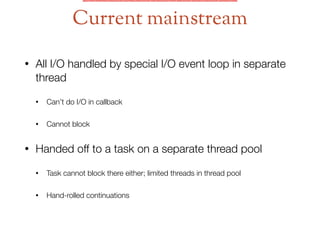
• All I/O handled by special I/O event loop in separate
thread
• Can’t do I/O in callback
• Cannot block
• Handed off to a task on a separate thread pool
• Task cannot block there either; limited threads in thread pool
• Hand-rolled continuations
Current mainstream
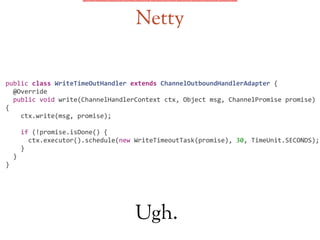
Netty
public	
  class	
  WriteTimeOutHandler	
  extends	
  ChannelOutboundHandlerAdapter	
  {	


  @Override	


  public	
  void	
  write(ChannelHandlerContext	
  ctx,	
  Object	
  msg,	
  ChannelPromise	
  promise)	
  
{	


  ctx.write(msg,	
  promise);	
  
!


  if	
  (!promise.isDone()	
  {	


  ctx.executor().schedule(new	
  WriteTimeoutTask(promise),	
  30,	
  TimeUnit.SECONDS);	


  }	


  }	
  
}	
  
Ugh.
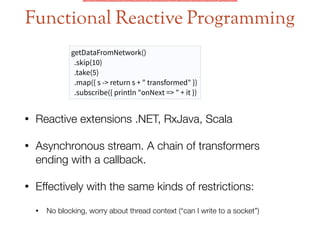
Functional Reactive Programming
getDataFromNetwork()
.skip(10)
.take(5)
.map({ s -> return s + " transformed" })
.subscribe({ println "onNext => " + it })
• Reactive extensions .NET, RxJava, Scala
• Asynchronous stream. A chain of transformers
ending with a callback.
• Effectively with the same kinds of restrictions:
• No blocking, worry about thread context (“can I write to a socket”)
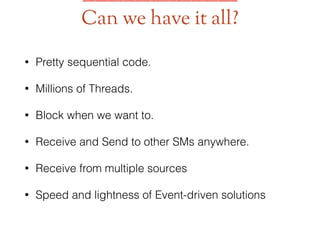
• Pretty sequential code.
• Millions of Threads.
• Block when we want to.
• Receive and Send to other SMs anywhere.
• Receive from multiple sources
• Speed and lightness of Event-driven solutions
Can we have it all?
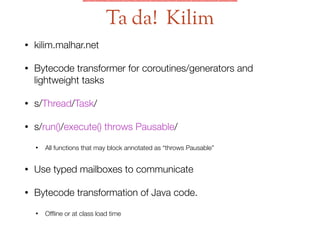
• kilim.malhar.net
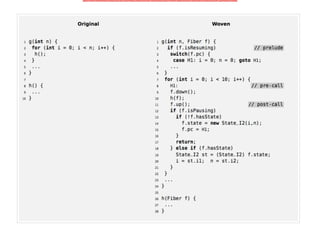
• Bytecode transformer for coroutines/generators and
lightweight tasks
• s/Thread/Task/
• s/run()/execute() throws Pausable/
• All functions that may block annotated as “throws Pausable”
• Use typed mailboxes to communicate
• Bytecode transformation of Java code.
• Offline or at class load time
Ta da! Kilim
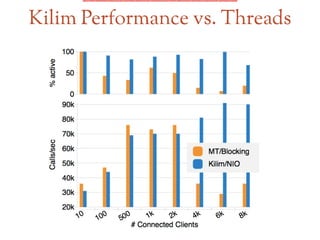
Kilim Performance vs. Threads
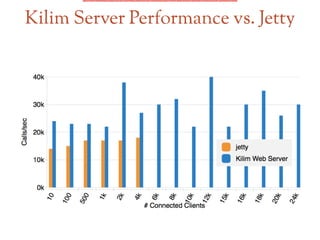
Kilim Server Performance vs. Jetty
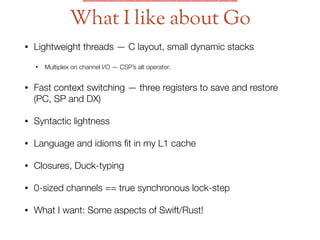
• Lightweight threads — C layout, small dynamic stacks
• Multiplex on channel I/O — CSP’s alt operator.
• Fast context switching — three registers to save and restore
(PC, SP and DX)
• Syntactic lightness
• Language and idioms fit in my L1 cache
• Closures, Duck-typing
• 0-sized channels == true synchronous lock-step
• What I want: Some aspects of Swift/Rust!
What I like about Go
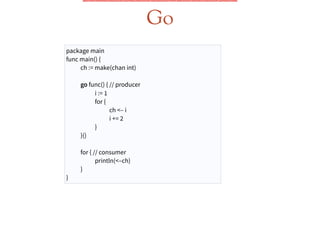
Go
package main
func main() {
ch := make(chan int)
!
go func() { // producer
i := 1
for {
ch <– i
i += 2
}
}()
!
for { // consumer
println(<–ch)
}
}
Go
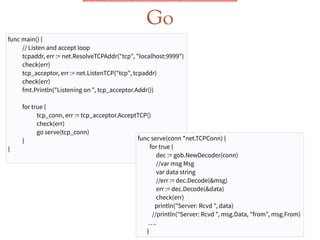
func main() {
// Listen and accept loop
tcpaddr, err := net.ResolveTCPAddr("tcp", "localhost:9999")
check(err)
tcp_acceptor, err := net.ListenTCP("tcp", tcpaddr)
check(err)
fmt.Println("Listening on ", tcp_acceptor.Addr())
!
for true {
tcp_conn, err := tcp_acceptor.AcceptTCP()
check(err)
go serve(tcp_conn)
}
}
func serve(conn *net.TCPConn) {
for true {
dec := gob.NewDecoder(conn)
//var msg Msg
var data string
//err := dec.Decode(&msg)
err := dec.Decode(&data)
check(err)
println("Server: Rcvd ", data)
//println("Server: Rcvd ", msg.Data, "from", msg.From)
….
}
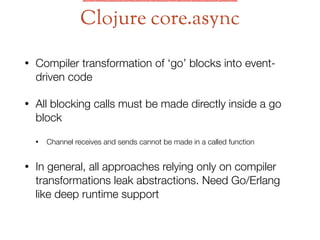
• Compiler transformation of ‘go’ blocks into event-
driven code
• All blocking calls must be made directly inside a go
block
• Channel receives and sends cannot be made in a called function
• In general, all approaches relying only on compiler
transformations leak abstractions. Need Go/Erlang
like deep runtime support
Clojure core.async
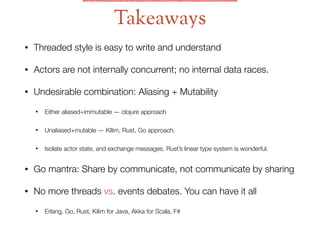
• Threaded style is easy to write and understand
• Actors are not internally concurrent; no internal data races.
• Undesirable combination: Aliasing + Mutability
• Either aliased+immutable — clojure approach
• Unaliased+mutable — KIlim, Rust, Go approach.
• Isolate actor state, and exchange messages. Rust’s linear type system is wonderful.
• Go mantra: Share by communicate, not communicate by sharing
• No more threads vs. events debates. You can have it all
• Erlang, Go, Rust, Kilim for Java, Akka for Scala, F#
Takeaways

Communicating State Machines

  • 1.
  • 2.
    • Fundamental buildingblock of computation • Communicating State Machines model • Synchronous and Asynchronous composition • Hierarchical State Machines specification • (Edward A. Lee and Pravin Varaiya, Structure and Interpretation of Signals and Systems, LeeVaraiya.org) State machines
  • 3.
    • Distributed Systems •Hardware interfaces • Components of a memory hierarchy • Stream producers and consumers • Parsers and Lexers • Filesystem and tree walker. • Networking stack and Socket consumer • Bidirectional communication CSMs are Ubiquitous
  • 4.
    C++ Boost. struct Active: sc::simple_state< Active, StopWatch, Stopped > { public: typedef sc::transition< EvReset, Active > reactions; ! Active() : elapsedTime_( 0.0 ) {} double ElapsedTime() const { return elapsedTime_; } double & ElapsedTime() { return elapsedTime_; } private: double elapsedTime_; }; struct Running : sc::simple_state< Running, Active > { public: typedef sc::transition< EvStartStop, Stopped > reactions; ! Running() : startTime_( std::time( 0 ) ) {} ~Running() { context< Active >().ElapsedTime() += std::difftime( std::time( 0 ), startTime_ ); } private: std::time_t startTime_; };Ugh!
  • 5.
    • Language usedin TinyOS to program wireless motes nesC • Components with bidirectional interfaces • Separate configuration to stitch together components
  • 6.
    nesC Bidirectional Interfaces interfaceStdControl { command result_t init(); } ! interface Timer { command result_t start(char type, uint32_t interval); command result_t stop(); event result_t fired(); } ! interface Send { command result_t send(TOS_Msg *msg, uint16_t length); event result_t sendDone(TOS_Msg *msg, result_t success); } ! interface Device { command result_t getData(); event result_t dataReady(uint16_t data); }
  • 7.
    nesC Implementation module ChirpM{ provides interface StdControl; uses interface Device; uses interface Timer; uses interface Send; implementation { uint16_t sensorReading; command result_t StdControl.init() { return call Timer.start(TIMER_REPEAT, 1000); } event result_t Timer.fired() { call Device.getData(); return SUCCESS; } event result_t Device.dataReady(uint16_t data) { sensorReading = data; ... send message with data in it ... return SUCCESS; } } } StdControl ChirpM Timer Device Send
  • 8.
    nesC configuration ChirpC configuration ChirpC{ provides interface StdControl; } implementation { components 
 ChirpM, 
 BarometerC, RadioAnnouncerC; ! StdControl = ChirpM.StdControl ChirpM.Timer -> HWTimer.Timer ChirpM.Device -> Barometer ChirpM.Send -> RadioAnnouncerC } StdControl ChirpM Timer Device Send StdControl Timer HWTimer Device Barometer Send RadioAnnouncerC
  • 9.
    Why aren’t moresystems structured this way?
  • 10.
  • 11.
    Stacks as StateMachines void readMsgs( socket) { numMsgsRead = 0 while (true) { msg = readMsg(socket) dispatch(msg) log(numMsgsRead++) } } void readMsg(socket) { len := readLen(socket) readBody(len) } void readLen(socket) { byte[4] len for i = 0 .. 4 { len[i] = readByte(socket) } return len } • Thread of control • Control plane = Call Chain (each frame remembers its pc) • Sequential flow of control defines hidden states • Functions define major states • Data plane = Vars local in each frame • Blocking semantics == synchronous (lock- step) communication • readByte and dispatch interact with network • Easy API; that’s why Posix and most db calls are synchronous
  • 12.
    State machine inErlang bark() -> io:format("Dog says: BARK! BARK!~n"), receive pet -> wag_tail(); _ -> io:format("Dog is confused~n"), bark() after 2000 -> bark() end. ! wag_tail() -> io:format("Dog wags its tail~n"), receive pet -> sit(); _ -> io:format("Dog is confused~n"), wag_tail() after 30000 -> bark() end. sit() -> io:format("Dog is sitting. Gooooood boy!~n"), receive squirrel -> bark(); _ -> io:format("Dog is confused~n"), sit() end. • Tail-call optimization renders
 change trivial Credit: http://learnyousomeerlang.com/finite-state-machines
  • 13.
    • Problem: Obtainleaves from a tree one at a time Leaves from a Tree
  • 14.
    • Problem: Obtainleaves from a tree one at a time Leaves from a Tree
  • 15.
    • Problem: Obtainleaves from a tree one at a time • Two interacting state machines: • Producer: tree, Consumer: user code that acts on the leaves. • Pull solution: Iterators • Convenient for clients • for leaf in tree: 
 print leaf.name • Push solution: Functional approach • Tree pushes data to visitors or user-defined functions • tree.visit( myfunc ) • Ideally: Duals of each other • In practice: Duel with each other Leaves from a Tree
  • 16.
    Pull Solution: Iterators classNode: … def __iter__(self): return Iter(self) ! class Iter: def __init__(self, root): self.nxt = root.first_leaf() self.prev = None def next(self): nxt = self.nxt if nxt: # First time entry into iterator self.nxt = None self.prev = nxt return nxt (contd). prev = self.prev if prev.sibling: nxt = prev.sibling.first_leaf() else: # explore cousins .. children of parent's siblings parent = prev.parent while parent: uncle = parent.sibling if uncle: nxt = uncle.first_leaf() break else: parent = parent.parent # continue loop if nxt: self.prev = nxt # for next iter return nxt else: raise StopIteration • Consumer code drives iteration • Producer code (iterable) needs to save state between iterations
  • 17.
    Push solution class Node: … defleaves(self, callback): if self.is_leaf(): callback(self) else: for c in self.children: c.leaves(callback) ! if self.sibling: self.sibling.leaves(callback) def cb(node): print node.name ! tree.leaves(cb) • Consumer side: • Callback hell • Visitor pattern is an abomination • Does not have flow-control between events • Producer side: • drives iteration • stack for storing recursive state • Allows async consumers to deliver events Consumer Producer
  • 18.
    Push: Consumer-side trouble exports.processJob= function(options, next) { db.getUser(options.userId, function(err, user) { if (error) return next(err); db.updateAccount(user.accountId, options.total, function(err) { if (err) return next(err); http.post(options.url, function(err) { if (err) return next(err); next(); }); });  }); }; def sameFringe(treeA, treeB): itreeA = iter(treeA) itreeB = iter(treeB) while 1: nodeA = itreeA.next() nodeB = itreeB.next() if node A .name != nodeB.name: return False …. Callback Hell ! Sequential chain of 
 events verbose to 
 express ! Inversion of control Concurrent Traversals 
 trivial in Pull approach
  • 19.
  • 20.
    Generators: Concurrent Stacks o= odds() ! print o.next() print o.next() print o.next() ! # Print infinite stream for n in odds() : print n def odds(): i = 1 while True: yield i i += 2 for leaf in tree.leaves(): print leaf.name class Tree: def leaves(self): if self.is_leaf(): yield self else: for c in self.children: for leaf in c.leaves(): yield leaf
  • 21.
    • Generators/Coroutines aresimply a compiler transformation of threaded to event-driven code on same kernel thread • Flow of control alternates between consumer and producer • Cheap user-level tasks with explicit cooperative scheduling • Scheduler calls next() • Task calls yield() whenever necessary • Wrapped in an abstraction called Fiber • Ruby: Fiber.yield, Javascript: function*, yield/yield* • Symmetric vs Asymmetric coroutines • Lazy streams — Infinite streams on demand Generators
  • 22.
  • 23.
    • All threadshave the same fixed size set at creation time: usually set to worst case 
 
 • Kernel Thread context switching is expensive (in μs) • Preemption at any time ==> Save all registers: 16 general purpose registers, PC, SP, segment registers, 16 XMM registers, FP coprocessor state, X AVX registers, all MSRs • TLB flushes, cache invalidation, crossing kernel protection boundary • Even cooperative yields are expensive. • A kernel thread is a precious resource. Can’t block it. • No, not for IO-bound code, says Paul Tyma Why can’t we just use Kernel Threads? > ulimit –s 8192
  • 24.
  • 25.
    • But horribleuser-programming model • libuv, libasync, EventMachine (Ruby), netty (Java) • User-code must not block, not call other I/O operations Event-driven I/O is faster
  • 26.
    Netty inversion ofcontrol io.netty.handler.codec.DecoderException: java.lang.RuntimeException: No packet with id 78 at io.netty.handler.codec.ByteToMessageDecoder.callDecode(ByteToMessageDecoder.java:263) at io.netty.handler.codec.ByteToMessageDecoder.channelRead(ByteToMessageDecoder.java:131) at io.netty.channel.DefaultChannelHandlerContext.invokeChannelRead(DefaultChannelHandlerContext.java:337) at io.netty.channel.DefaultChannelHandlerContext.fireChannelRead(DefaultChannelHandlerContext.java:323) at io.netty.handler.codec.ByteToMessageDecoder.channelRead(ByteToMessageDecoder.java:173) at io.netty.channel.DefaultChannelHandlerContext.invokeChannelRead(DefaultChannelHandlerContext.java:337) at io.netty.channel.DefaultChannelHandlerContext.fireChannelRead(DefaultChannelHandlerContext.java:323) at io.netty.handler.codec.ByteToMessageDecoder.handlerRemoved(ByteToMessageDecoder.java:109) at io.netty.channel.DefaultChannelPipeline.callHandlerRemoved0(DefaultChannelPipeline.java:524) at io.netty.channel.DefaultChannelPipeline.callHandlerRemoved(DefaultChannelPipeline.java:518) at io.netty.channel.DefaultChannelPipeline.remove0(DefaultChannelPipeline.java:348) at io.netty.channel.DefaultChannelPipeline.remove(DefaultChannelPipeline.java:319) at io.netty.channel.DefaultChannelPipeline.remove(DefaultChannelPipeline.java:296) at org.spigotmc.netty.LegacyDecoder.decode(LegacyDecoder.java:38) at io.netty.handler.codec.ByteToMessageDecoder.callDecode(ByteToMessageDecoder.java:232) at io.netty.handler.codec.ByteToMessageDecoder.channelRead(ByteToMessageDecoder.java:131) at io.netty.channel.DefaultChannelHandlerContext.invokeChannelRead(DefaultChannelHandlerContext.java:337) at io.netty.channel.DefaultChannelHandlerContext.fireChannelRead(DefaultChannelHandlerContext.java:323) at io.netty.handler.timeout.ReadTimeoutHandler.channelRead(ReadTimeoutHandler.java:149) at io.netty.channel.DefaultChannelHandlerContext.invokeChannelRead(DefaultChannelHandlerContext.java:337) at io.netty.channel.DefaultChannelHandlerContext.fireChannelRead(DefaultChannelHandlerContext.java:323) at io.netty.channel.DefaultChannelPipeline.fireChannelRead(DefaultChannelPipeline.java:785) at io.netty.channel.nio.AbstractNioByteChannel$NioByteUnsafe.read(AbstractNioByteChannel.java:100) at io.netty.channel.nio.NioEventLoop.processSelectedKey(NioEventLoop.java:478) at io.netty.channel.nio.NioEventLoop.processSelectedKeysOptimized(NioEventLoop.java:447) at io.netty.channel.nio.NioEventLoop.run(NioEventLoop.java:341) at io.netty.util.concurrent.SingleThreadEventExecutor$2.run(SingleThreadEventExecutor.java:101) at java.lang.Thread.run(Thread.java:744) Caused by: java.lang.RuntimeException: No packet with id 78 at org.spigotmc.netty.Protocol$ProtocolDirection.createPacket(Protocol.java:272) at org.spigotmc.netty.PacketDecoder.decode(PacketDecoder.java:44)
  • 27.
  • 28.
    • All I/Ohandled by special I/O event loop in separate thread • Can’t do I/O in callback • Cannot block • Handed off to a task on a separate thread pool • Task cannot block there either; limited threads in thread pool • Hand-rolled continuations Current mainstream
  • 29.
    Netty public  class  WriteTimeOutHandler  extends  ChannelOutboundHandlerAdapter  {      @Override      public  void  write(ChannelHandlerContext  ctx,  Object  msg,  ChannelPromise  promise)   {          ctx.write(msg,  promise);   !        if  (!promise.isDone()  {              ctx.executor().schedule(new  WriteTimeoutTask(promise),  30,  TimeUnit.SECONDS);          }      }   }   Ugh.
  • 30.
    Functional Reactive Programming getDataFromNetwork() .skip(10) .take(5) .map({s -> return s + " transformed" }) .subscribe({ println "onNext => " + it }) • Reactive extensions .NET, RxJava, Scala • Asynchronous stream. A chain of transformers ending with a callback. • Effectively with the same kinds of restrictions: • No blocking, worry about thread context (“can I write to a socket”)
  • 31.
    • Pretty sequentialcode. • Millions of Threads. • Block when we want to. • Receive and Send to other SMs anywhere. • Receive from multiple sources • Speed and lightness of Event-driven solutions Can we have it all?
  • 32.
    • kilim.malhar.net • Bytecodetransformer for coroutines/generators and lightweight tasks • s/Thread/Task/ • s/run()/execute() throws Pausable/ • All functions that may block annotated as “throws Pausable” • Use typed mailboxes to communicate • Bytecode transformation of Java code. • Offline or at class load time Ta da! Kilim
  • 34.
  • 35.
  • 36.
    • Lightweight threads— C layout, small dynamic stacks • Multiplex on channel I/O — CSP’s alt operator. • Fast context switching — three registers to save and restore (PC, SP and DX) • Syntactic lightness • Language and idioms fit in my L1 cache • Closures, Duck-typing • 0-sized channels == true synchronous lock-step • What I want: Some aspects of Swift/Rust! What I like about Go
  • 37.
    Go package main func main(){ ch := make(chan int) ! go func() { // producer i := 1 for { ch <– i i += 2 } }() ! for { // consumer println(<–ch) } }
  • 38.
    Go func main() { //Listen and accept loop tcpaddr, err := net.ResolveTCPAddr("tcp", "localhost:9999") check(err) tcp_acceptor, err := net.ListenTCP("tcp", tcpaddr) check(err) fmt.Println("Listening on ", tcp_acceptor.Addr()) ! for true { tcp_conn, err := tcp_acceptor.AcceptTCP() check(err) go serve(tcp_conn) } } func serve(conn *net.TCPConn) { for true { dec := gob.NewDecoder(conn) //var msg Msg var data string //err := dec.Decode(&msg) err := dec.Decode(&data) check(err) println("Server: Rcvd ", data) //println("Server: Rcvd ", msg.Data, "from", msg.From) …. }
  • 39.
    • Compiler transformationof ‘go’ blocks into event- driven code • All blocking calls must be made directly inside a go block • Channel receives and sends cannot be made in a called function • In general, all approaches relying only on compiler transformations leak abstractions. Need Go/Erlang like deep runtime support Clojure core.async
  • 40.
    • Threaded styleis easy to write and understand • Actors are not internally concurrent; no internal data races. • Undesirable combination: Aliasing + Mutability • Either aliased+immutable — clojure approach • Unaliased+mutable — KIlim, Rust, Go approach. • Isolate actor state, and exchange messages. Rust’s linear type system is wonderful. • Go mantra: Share by communicate, not communicate by sharing • No more threads vs. events debates. You can have it all • Erlang, Go, Rust, Kilim for Java, Akka for Scala, F# Takeaways