Spark and Shark: High-speed
Analytics over Hadoop Data
Sep 12, 2013 @ Yahoo! Tech Conference
Reynold Xin (辛湜), AMPLab, UC Berkeley
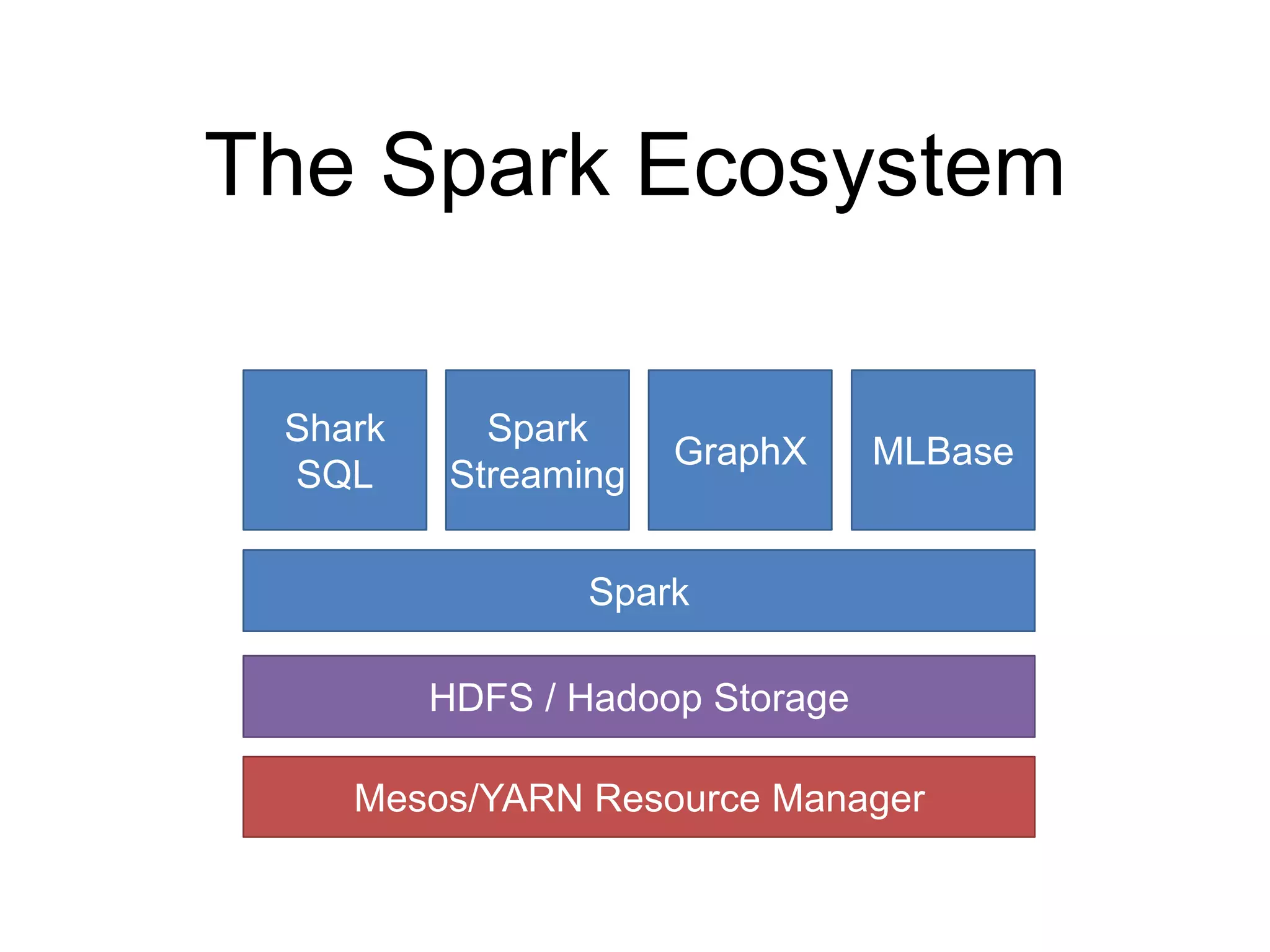
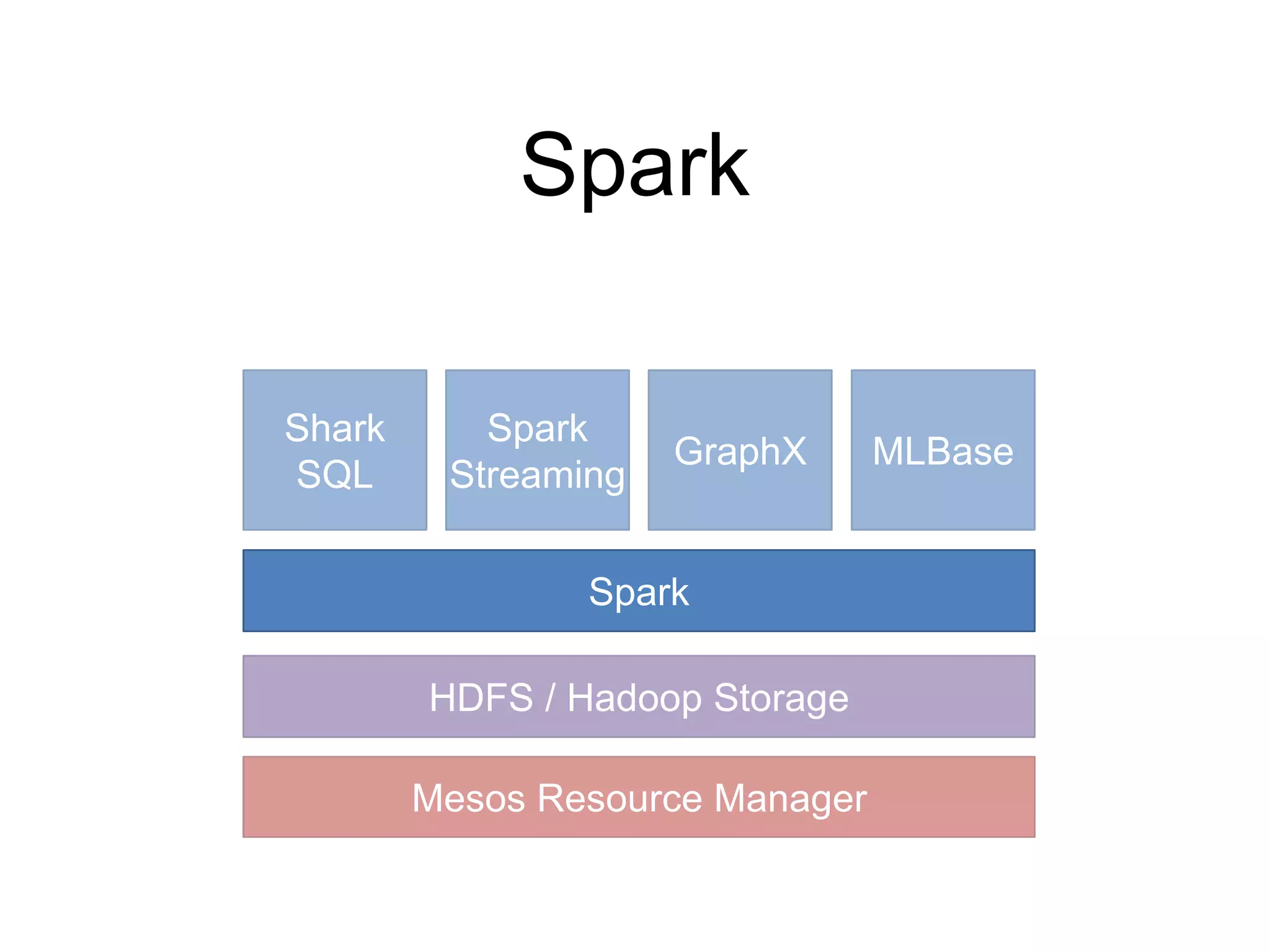
The Spark Ecosystem
Spark
Shark
SQL
HDFS / Hadoop Storage
Mesos/YARN Resource Manager
Spark
Streaming
GraphX MLBase
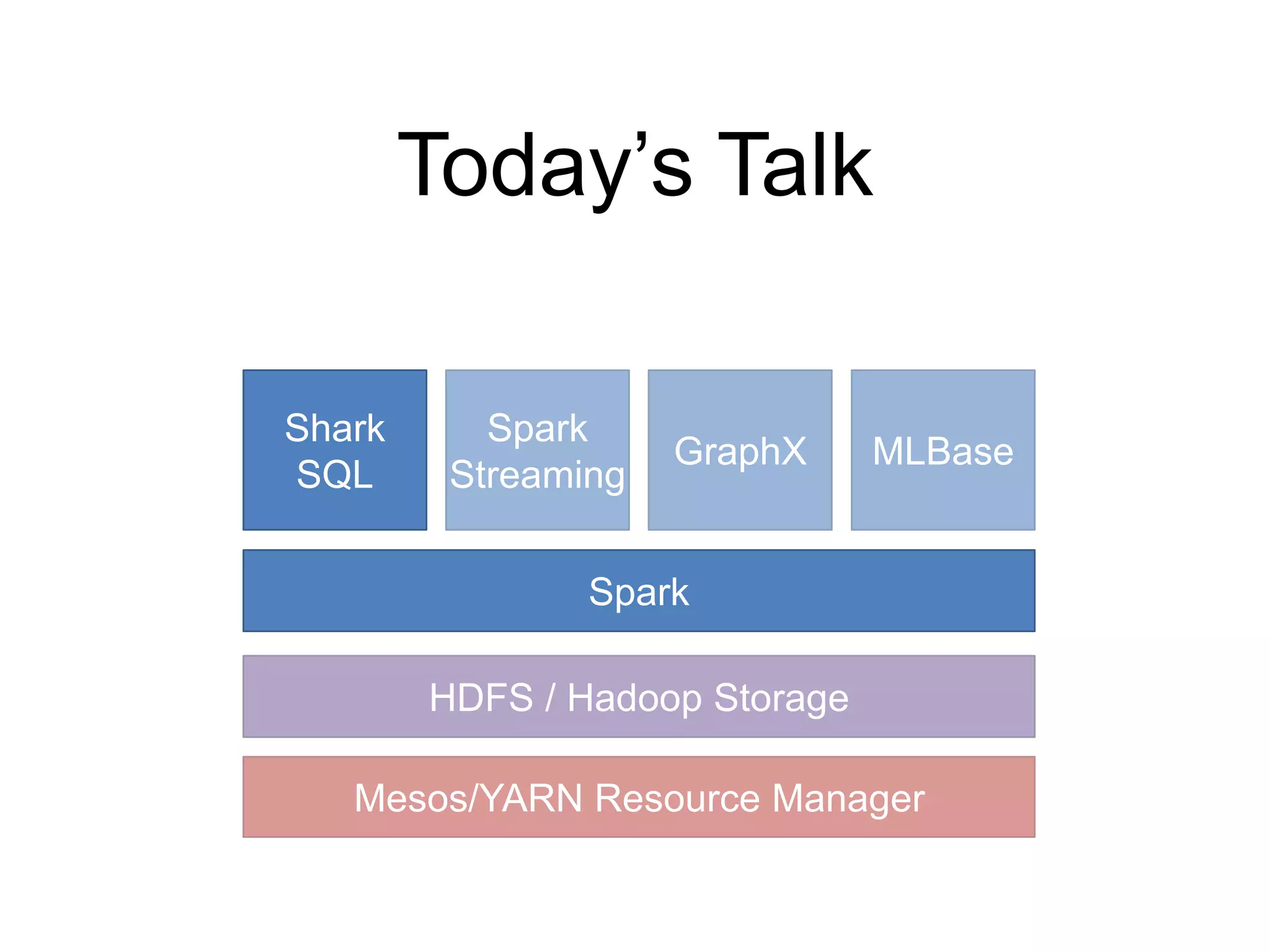
Today’s Talk
Spark
Shark
SQL
HDFS / Hadoop Storage
Mesos/YARN Resource Manager
Spark
Streaming
GraphX MLBase
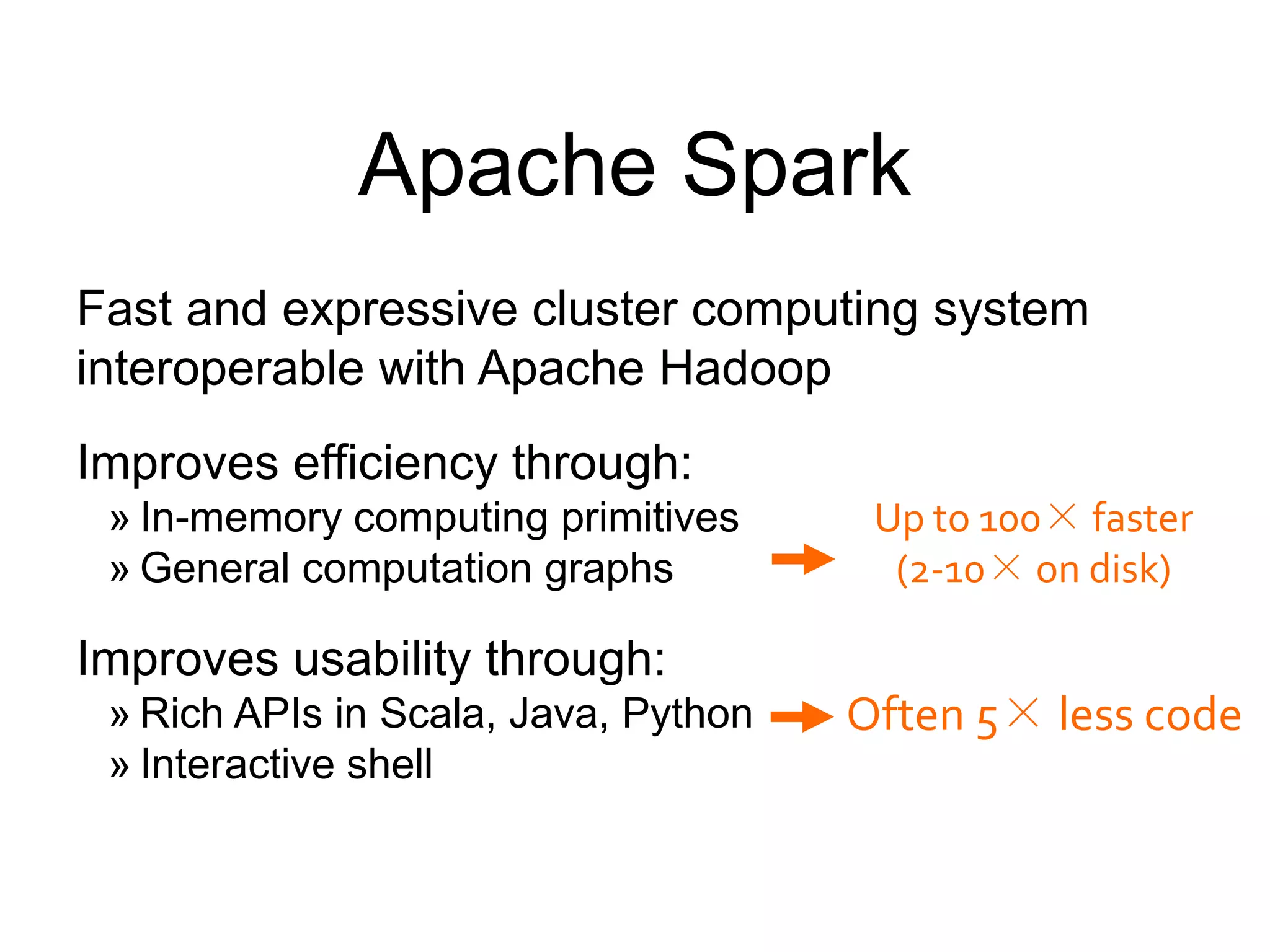
Apache Spark
Fast and expressive cluster computing system
interoperable with Apache Hadoop
Improves efficiency through:
» In-memory computing primitives
» General computation graphs
Improves usability through:
» Rich APIs in Scala, Java, Python
» Interactive shell
Up to 100× faster
(2-10× on disk)
Often 5× less code
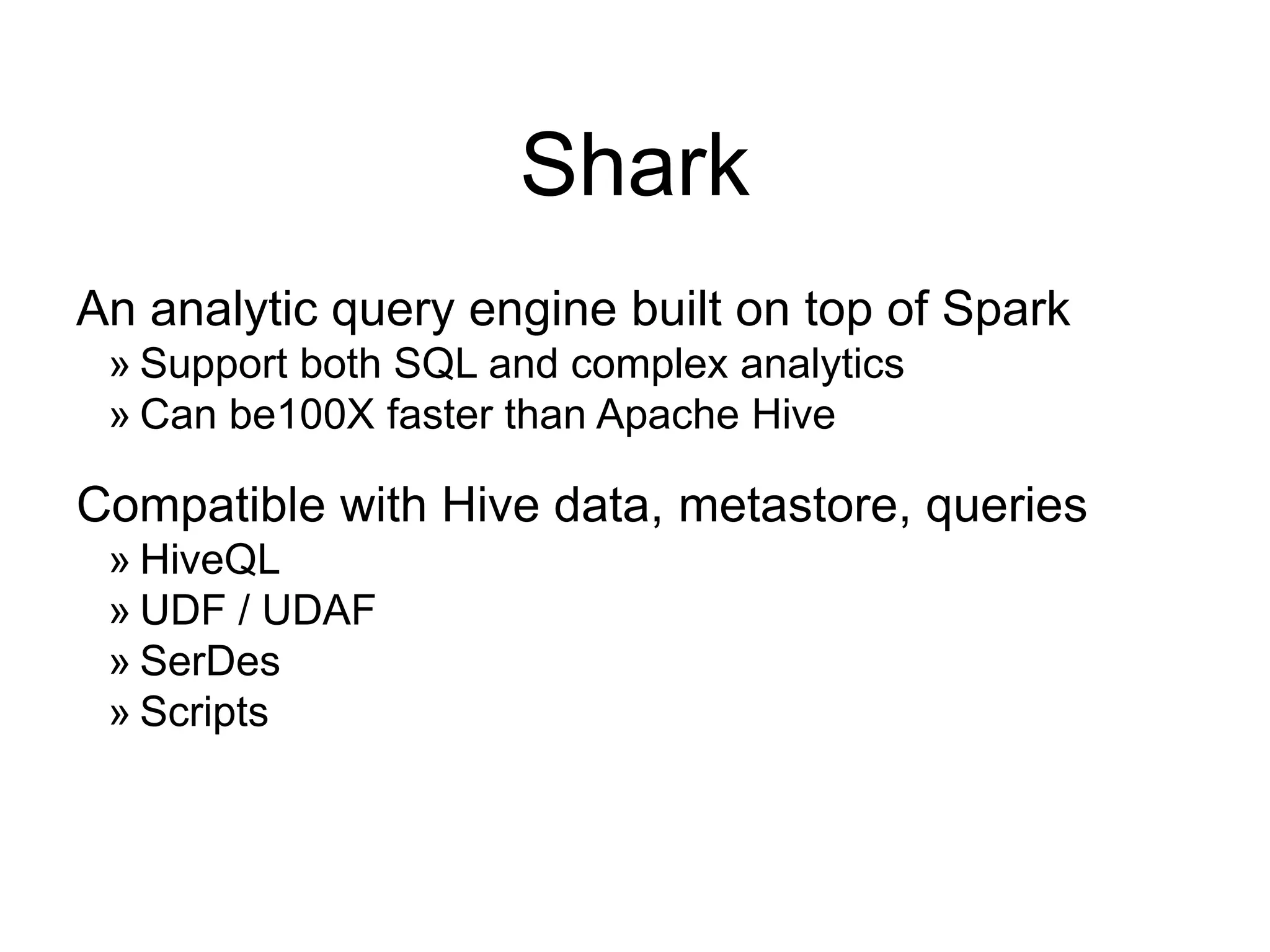
Shark
An analytic query engine built on top of Spark
» Support both SQL and complex analytics
» Can be100X faster than Apache Hive
Compatible with Hive data, metastore, queries
» HiveQL
» UDF / UDAF
» SerDes
» Scripts
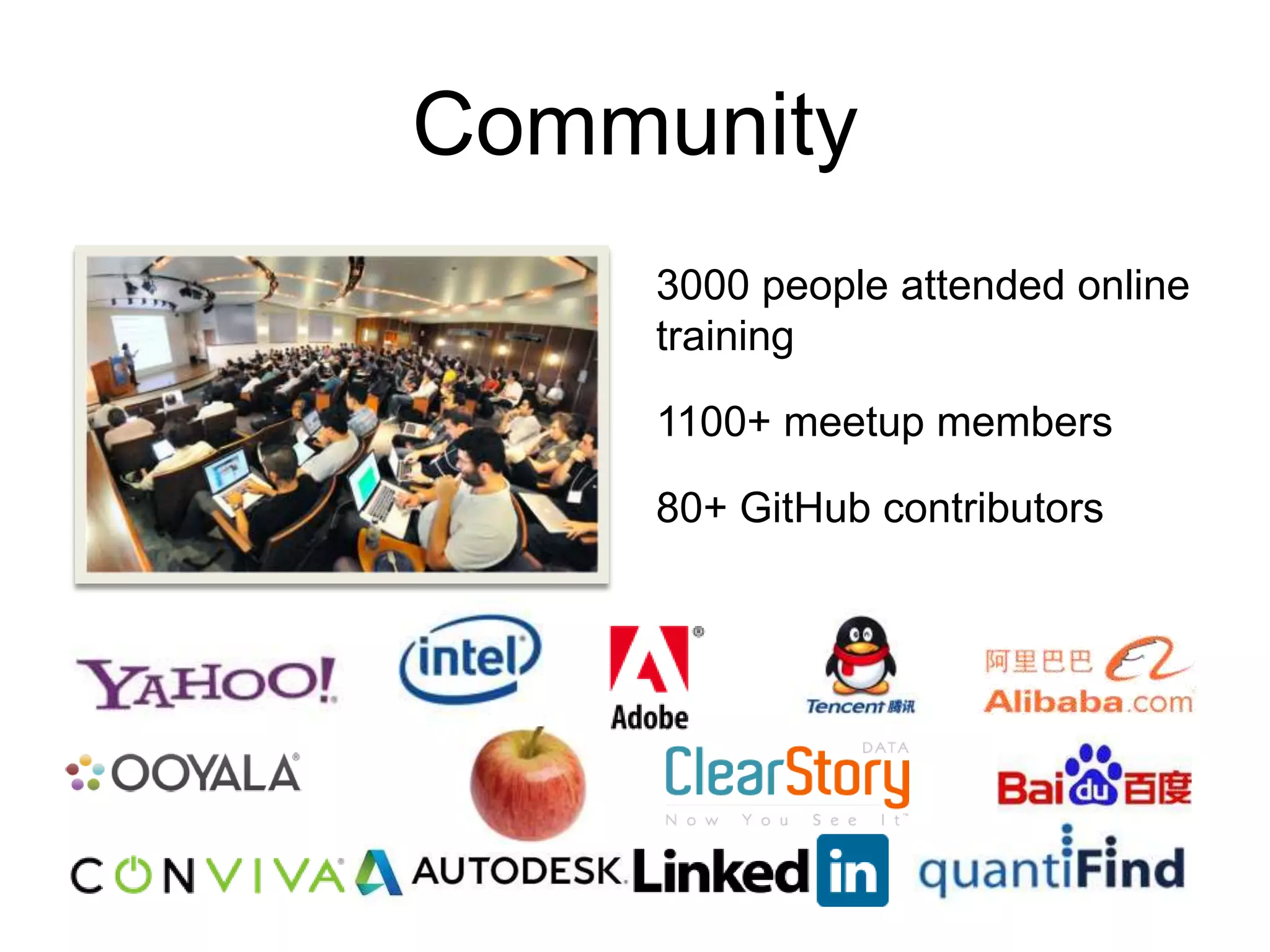
Community
3000 people attended online
training
1100+ meetup members
80+ GitHub contributors
Today’s Talk
Spark
Shark
SQL
HDFS / Hadoop Storage
Mesos Resource Manager
Spark
Streaming
GraphX MLBase
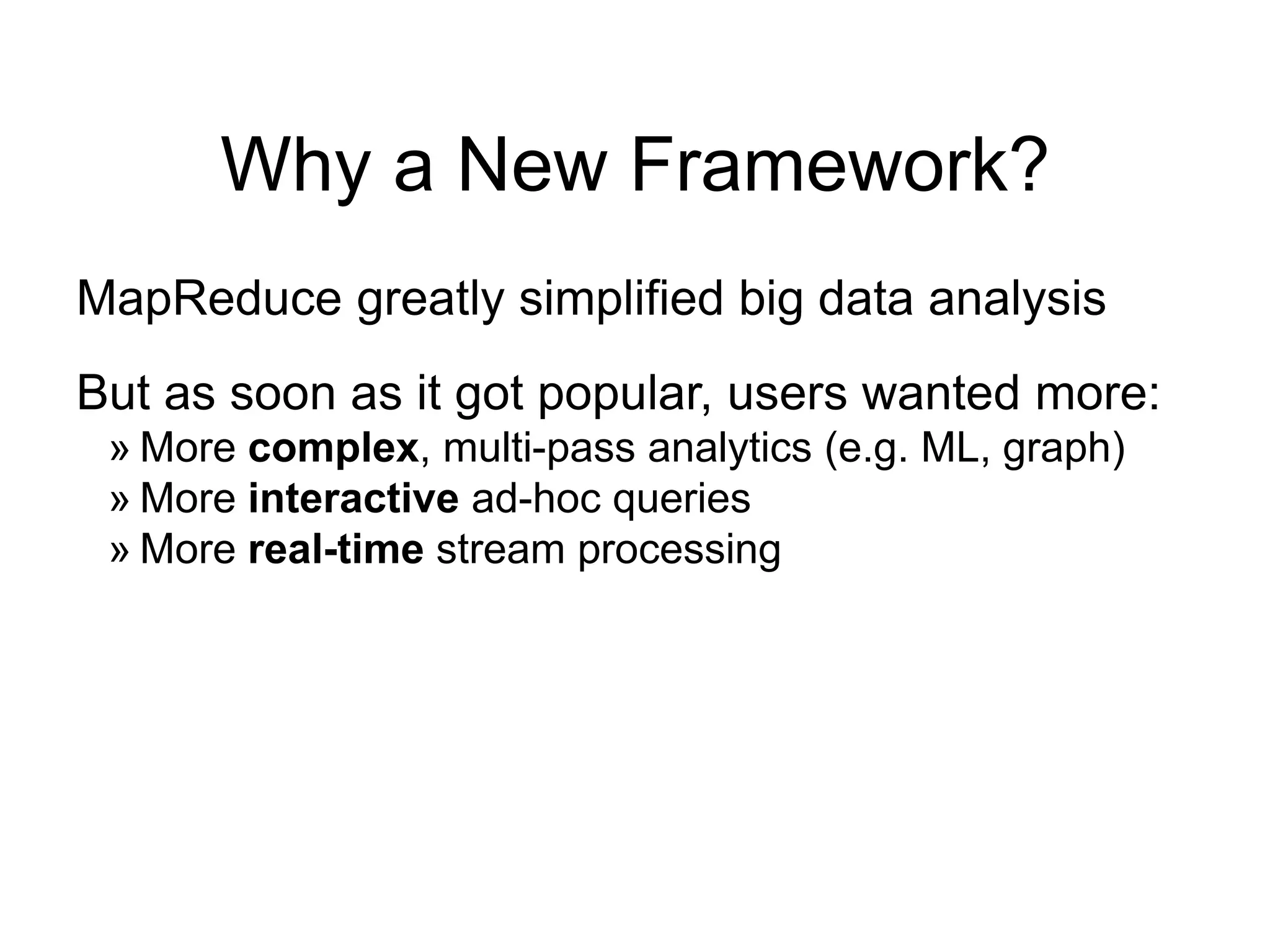
Why a New Framework?
MapReduce greatly simplified big data analysis
But as soon as it got popular, users wanted more:
» More complex, multi-pass analytics (e.g. ML, graph)
» More interactive ad-hoc queries
» More real-time stream processing
Hadoop MapReduce
iter. 1 iter. 2 …
Input
filesystem
read
filesystem
write
filesystem
read
filesystem
write
Iterative:
Interactive:
Input
query 1
query 2
…
select
Subset
Slow due to replication and disk I/O,
but necessary for fault tolerance
Spark Programming Model
Key idea: resilient distributed datasets (RDDs)
» Distributed collections of objects that can optionally be
cached in memory across cluster
» Manipulated through parallel operators
» Automatically recomputed on failure
Programming interface
» Functional APIs in Scala, Java, Python
» Interactive use from Scala shell
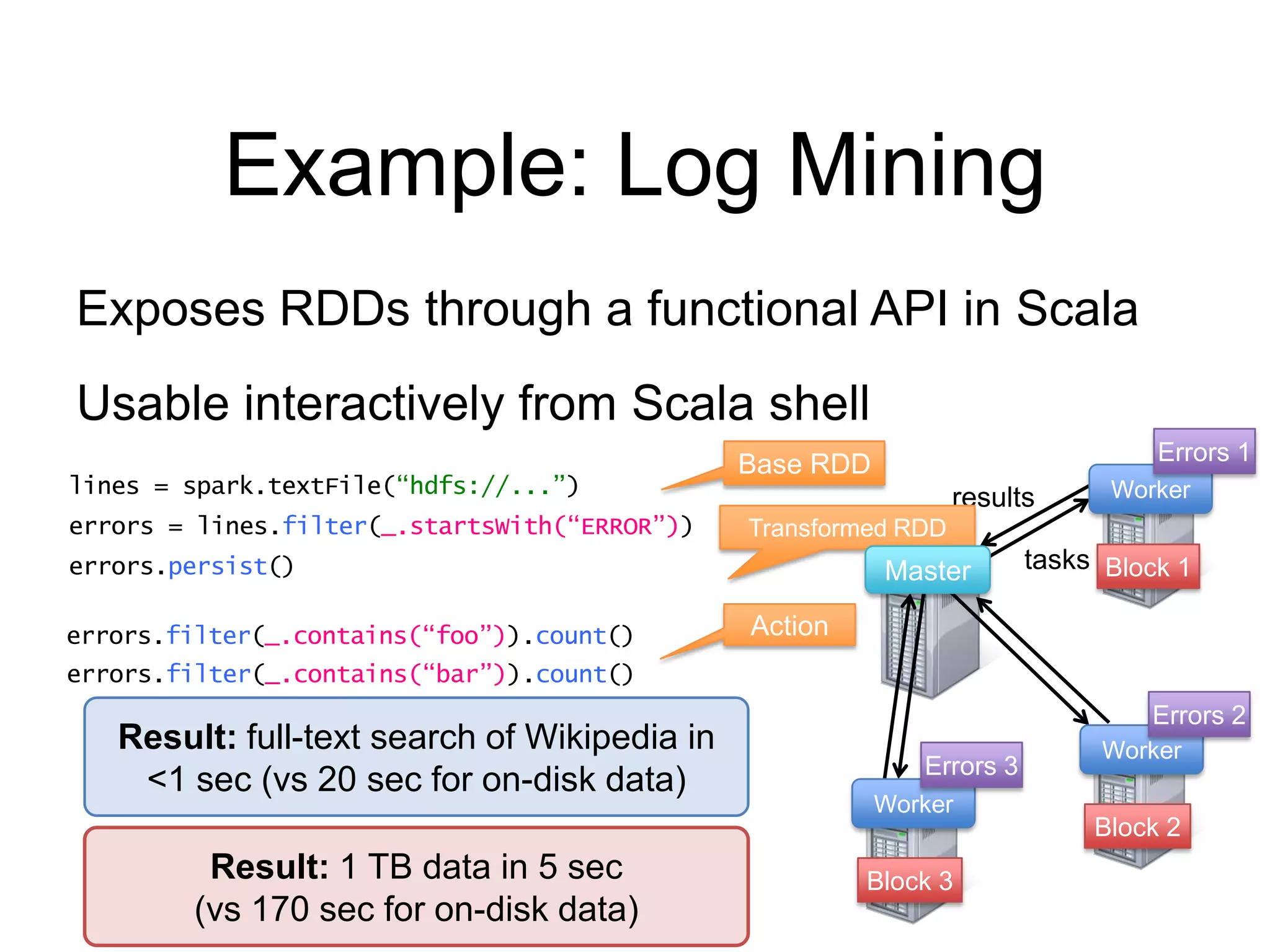
Example: Log Mining
Exposes RDDs through a functional API in Scala
Usable interactively from Scala shell
lines = spark.textFile(“hdfs://...”)
errors = lines.filter(_.startsWith(“ERROR”))
errors.persist() Block 1
Block 2
Block 3
Worker
errors.filter(_.contains(“foo”)).count()
errors.filter(_.contains(“bar”)).count()
tasks
results
Errors 2
Base RDD
Transformed RDD
Action
Result: full-text search of Wikipedia in
<1 sec (vs 20 sec for on-disk data)
Result: 1 TB data in 5 sec
(vs 170 sec for on-disk data)
Worker
Errors 3
Worker
Errors 1
Master
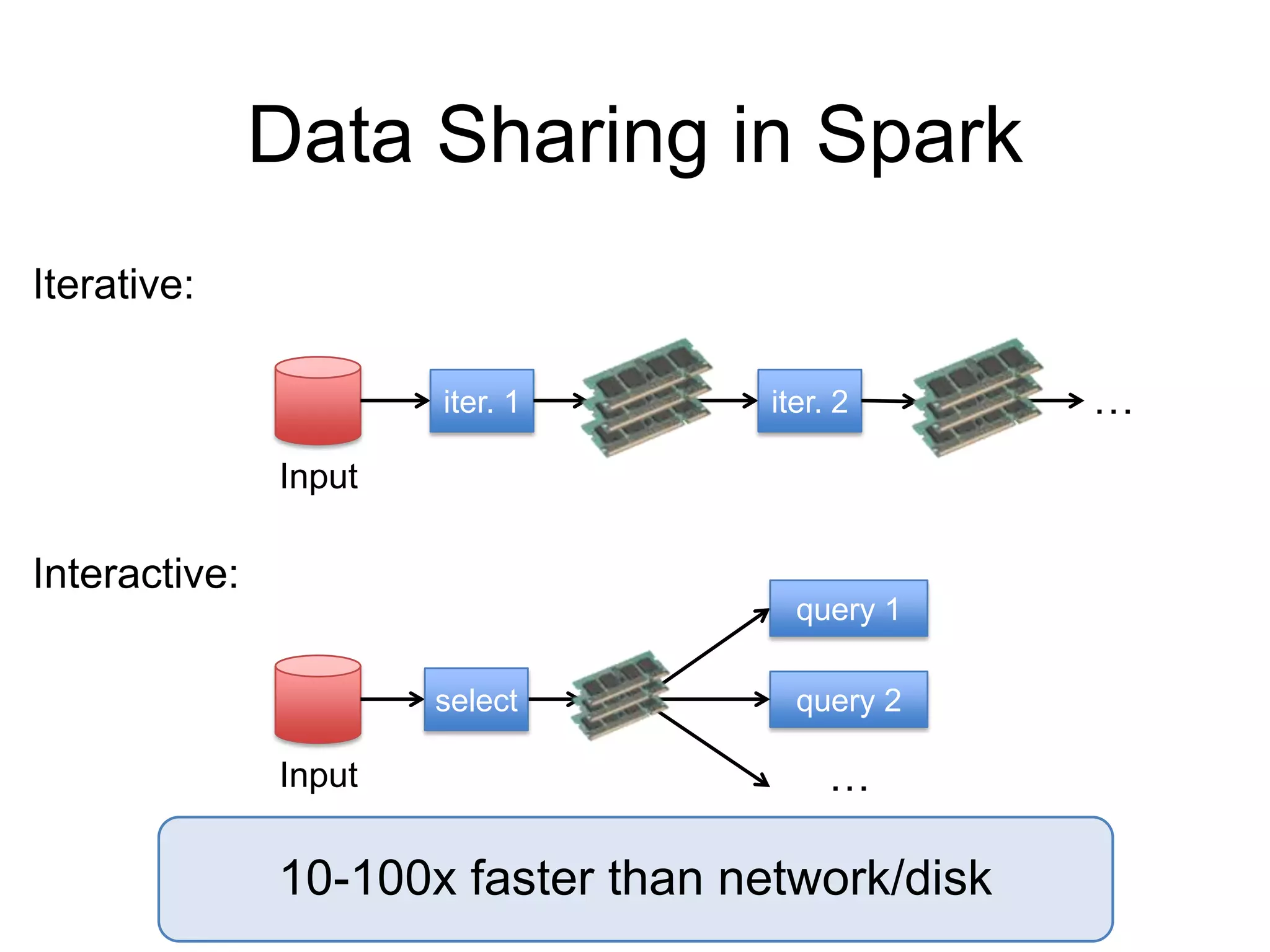
Data Sharing in Spark
iter. 1 iter. 2 …
Input
Iterative:
Interactive:
Input
query 1
query 2select
…
10-100x faster than network/disk
Fault Tolerance
RDDs track the series of transformations used to
build them (their lineage) to recompute lost data
E.g: messages = textFile(...).filter(_.contains(“error”))
.map(_.split(„t‟)(2))
HadoopRDD
path = hdfs://…
FilteredRDD
func = _.contains(...)
MappedRDD
func = _.split(…)
Spark: Expressive API
map
filter
groupBy
sort
union
join
leftOuterJoin
rightOuterJoin
reduce
count
fold
reduceByKey
groupByKey
cogroup
cross
zip
sample
take
first
partitionBy
mapWith
pipe
save
...
15
and broadcast variables, accumulators…
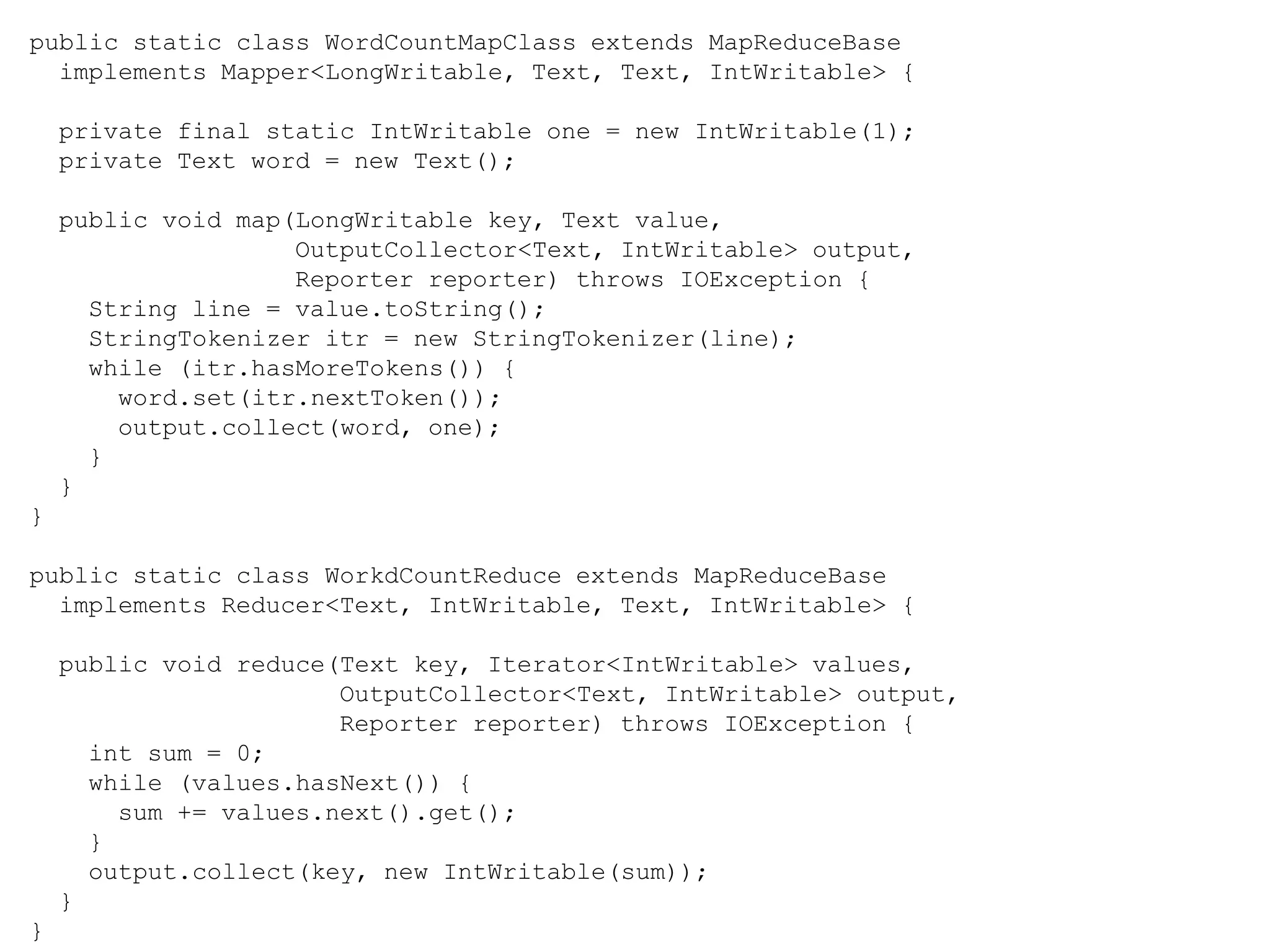
public static class WordCountMapClass extends MapReduceBase
implements Mapper<LongWritable, Text, Text, IntWritable> {
private final static IntWritable one = new IntWritable(1);
private Text word = new Text();
public void map(LongWritable key, Text value,
OutputCollector<Text, IntWritable> output,
Reporter reporter) throws IOException {
String line = value.toString();
StringTokenizer itr = new StringTokenizer(line);
while (itr.hasMoreTokens()) {
word.set(itr.nextToken());
output.collect(word, one);
}
}
}
public static class WorkdCountReduce extends MapReduceBase
implements Reducer<Text, IntWritable, Text, IntWritable> {
public void reduce(Text key, Iterator<IntWritable> values,
OutputCollector<Text, IntWritable> output,
Reporter reporter) throws IOException {
int sum = 0;
while (values.hasNext()) {
sum += values.next().get();
}
output.collect(key, new IntWritable(sum));
}
}
Word Count
val docs = sc.textFiles(“hdfs://…”)
docs.flatMap(line => line.split(“s”))
.map(word => (word, 1))
.reduceByKey((a, b) => a + b)
Word Count
val docs = sc.textFiles(“hdfs://…”)
docs.flatMap(line => line.split(“s”))
.map(word => (word, 1))
.reduceByKey((a, b) => a + b)
docs.flatMap(_.split(“s”))
.map((_, 1))
.reduceByKey(_ + _)
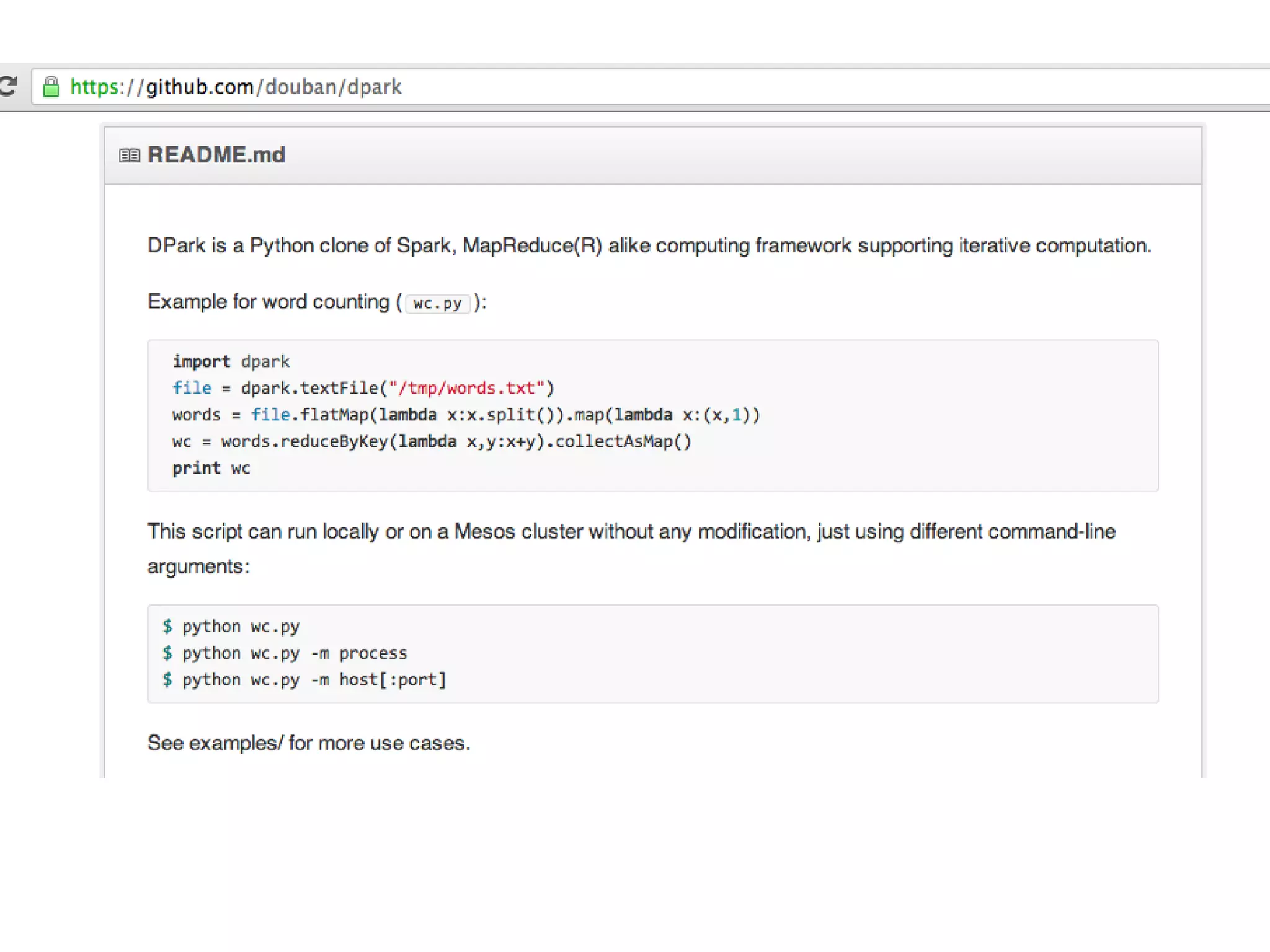
Spark in Java and Python
Python API
lines = spark.textFile(…)
errors = lines.filter(
lambda s: "ERROR" in s)
errors.count()
Java API
JavaRDD<String> lines =
spark.textFile(…);
errors = lines.filter(
new Function<String, Boolean>() {
public Boolean call(String s) {
return s.contains("ERROR");
}
});
errors.count()
Scheduler
General task DAGs
Pipelines functions
within a stage
Cache-aware data
locality & reuse
Partitioning-aware
to avoid shuffles
Launch jobs in ms
join
union
groupBy
map
Stage 3
Stage 1
Stage 2
A: B:
C: D:
E:
F:
G:
= previously computed partition
Example: Logistic
Regression
Goal: find best line separating two sets of points
target
random initial line
22
Logistic Regression: Prep the Data
val sc = new SparkContext(“spark://master”, “LRExp”)
def loadDict(): Map[String, Double] = { … }
val dict = sc.broadcast( loadDict() )
def parser(s: String): (Array[Double], Double) = {
val parts = s.split(„t‟)
val y = parts(0).toDouble
val x = parts.drop(1).map(dict.getOrElse(_, 0.0))
(x, y)
}
val data = sc.textFile(“hdfs://d”).map(parser).cache()
Load data in memory once
Start a new Spark Session
Build a dictionary for file parsing
Broadcast the Dictionary to the Cluster
Line Parser which uses the Dictionary
23
Logistic Regression: Grad. Desc.
val sc = new SparkContext(“spark://master”, “LRExp”)
// Parsing …
val data: Spark.RDD[(Array[Double],Double)] = …
var w = Vector.random(D)
val lambda = 1.0/data.count
for (i <- 1 to ITERATIONS) {
val gradient = data.map {
case (x, y) => (1.0/(1+exp(-y*(w dot x)))–1)*y*x
}.reduce( (g1, g2) => g1 + g2 )
w -= (lambda / sqrt(i) ) * gradient
}
Initial parameter vector
Iterate
Set Learning Rate
Apply Gradient on Master
Compute Gradient Using
Map & Reduce
24
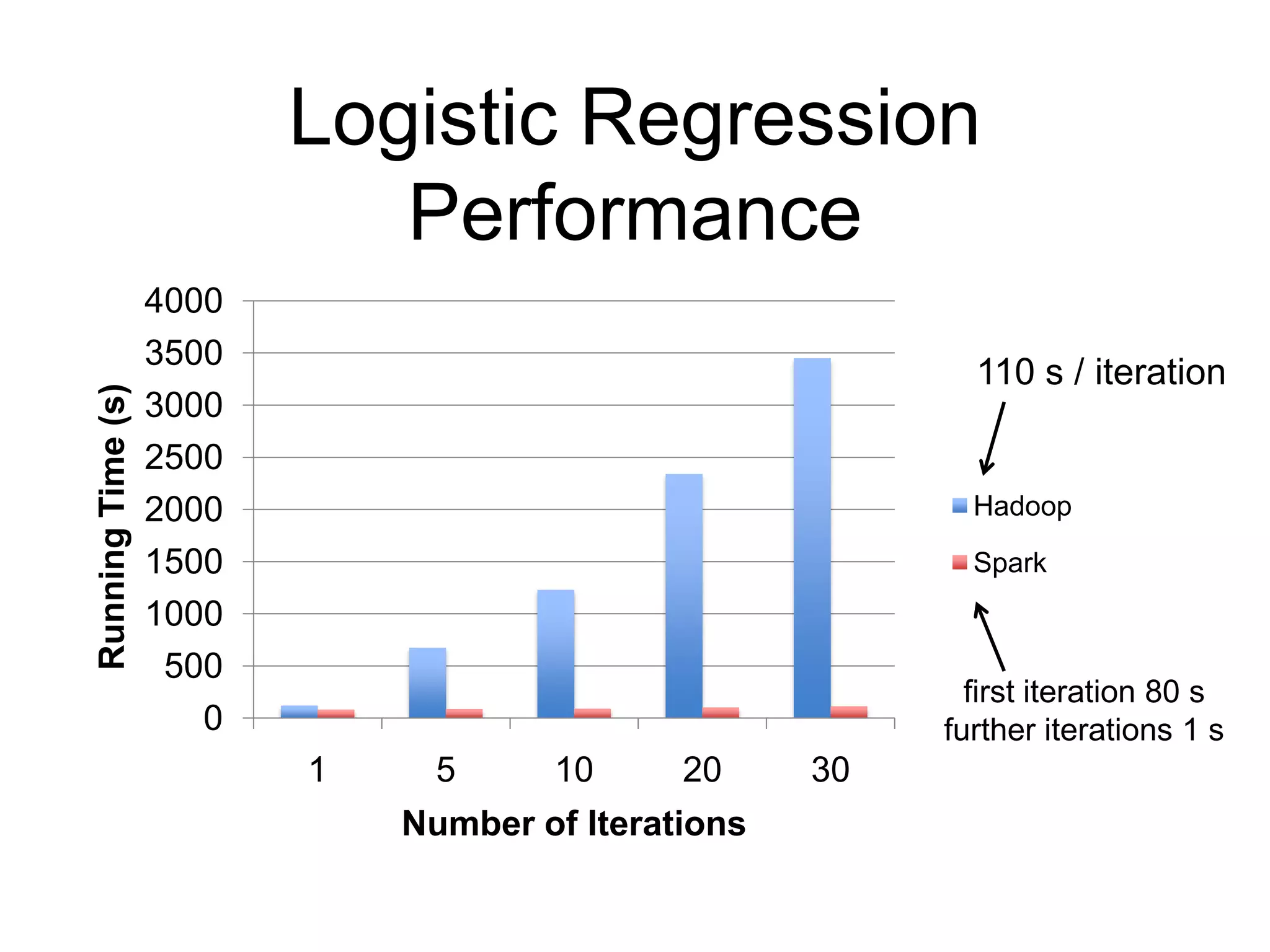
Logistic Regression
Performance
0
500
1000
1500
2000
2500
3000
3500
4000
1 5 10 20 30
RunningTime(s)
Number of Iterations
Hadoop
Spark
110 s / iteration
first iteration 80 s
further iterations 1 s
Spark ML Lib (Spark 0.8)
Classification Logistic Regression, Linear SVM
(+L1, L2)
Regression Linear Regression
(+Lasso, Ridge)
Collaborative Filtering Alternating Least Squares
Clustering K-Means
Optimization SGD, Parallel Gradient
Spark
Spark
Shark
SQL
HDFS / Hadoop Storage
Mesos Resource Manager
Spark
Streaming
GraphX MLBase
Shark
Spark
Shark
SQL
HDFS / Hadoop Storage
Mesos Resource Manager
Spark
Streaming
GraphX MLBase
Shark
A data analytics system that
» builds on Spark,
» scales out and tolerate worker failures,
» supports low-latency, interactive queries through
(optional) in-memory computation,
» supports both SQL and complex analytics,
» is compatible with Hive (storage, serdes, UDFs, types,
metadata).
Hive Architecture
Meta
store
HDFS
Client
Driver
SQL
Parse
r
Query
Optimizer
Physical Plan
Execution
CLI JDBC
MapReduce
Shark Architecture
Meta
store
HDFS
Client
Driver
SQL
Parse
r
Physical Plan
Execution
CLI JDBC
Spark
Cache Mgr.
Query
Optimizer
Shark Query Language
Hive QL and a few additional DDL add-ons:
Creating an in-memory table:
» CREATE TABLE src_cached AS SELECT * FROM …
Engine Features
Columnar Memory Store
Data Co-partitioning & Co-location
Partition Pruning based on Statistics (range, bloom
filter and others)
Spark Integration
…
Columnar Memory Store
Simply caching Hive records as JVM objects is
inefficient.
Shark employs column-oriented storage.
1
Column Storage
2 3
john mike sally
4.1 3.5 6.4
Row Storage
1 john 4.1
2 mike 3.5
3 sally 6.4Benefit: compact representation, CPU efficient
compression, cache locality.
Spark Integration
Unified system for query
processing and Spark
analytics
Query processing and ML
share the same set of
workers and caches
def logRegress(points: RDD[Point]): Vector {
var w = Vector(D, _ => 2 * rand.nextDouble - 1)
for (i <- 1 to ITERATIONS) {
val gradient = points.map { p =>
val denom = 1 + exp(-p.y * (w dot p.x))
(1 / denom - 1) * p.y * p.x
}.reduce(_ + _)
w -= gradient
}
w
}
val users = sql2rdd("SELECT * FROM user u
JOIN comment c ON c.uid=u.uid")
val features = users.mapRows { row =>
new Vector(extractFeature1(row.getInt("age")),
extractFeature2(row.getStr("country")),
...)}
val trainedVector = logRegress(features.cache())
Performance
0
25
50
75
100
Q1 Q2 Q3 Q4
Runtime(seconds)
Shark Shark (disk) Hive
1.1 0.8 0.7 1.0
1.7 TB Real Warehouse Data on 100 EC2 nodes
More Information
Download and docs: www.spark-project.org
» Easy to run locally, on EC2, or on Mesos/YARN
Email: rxin@apache.org
Twitter: @rxin
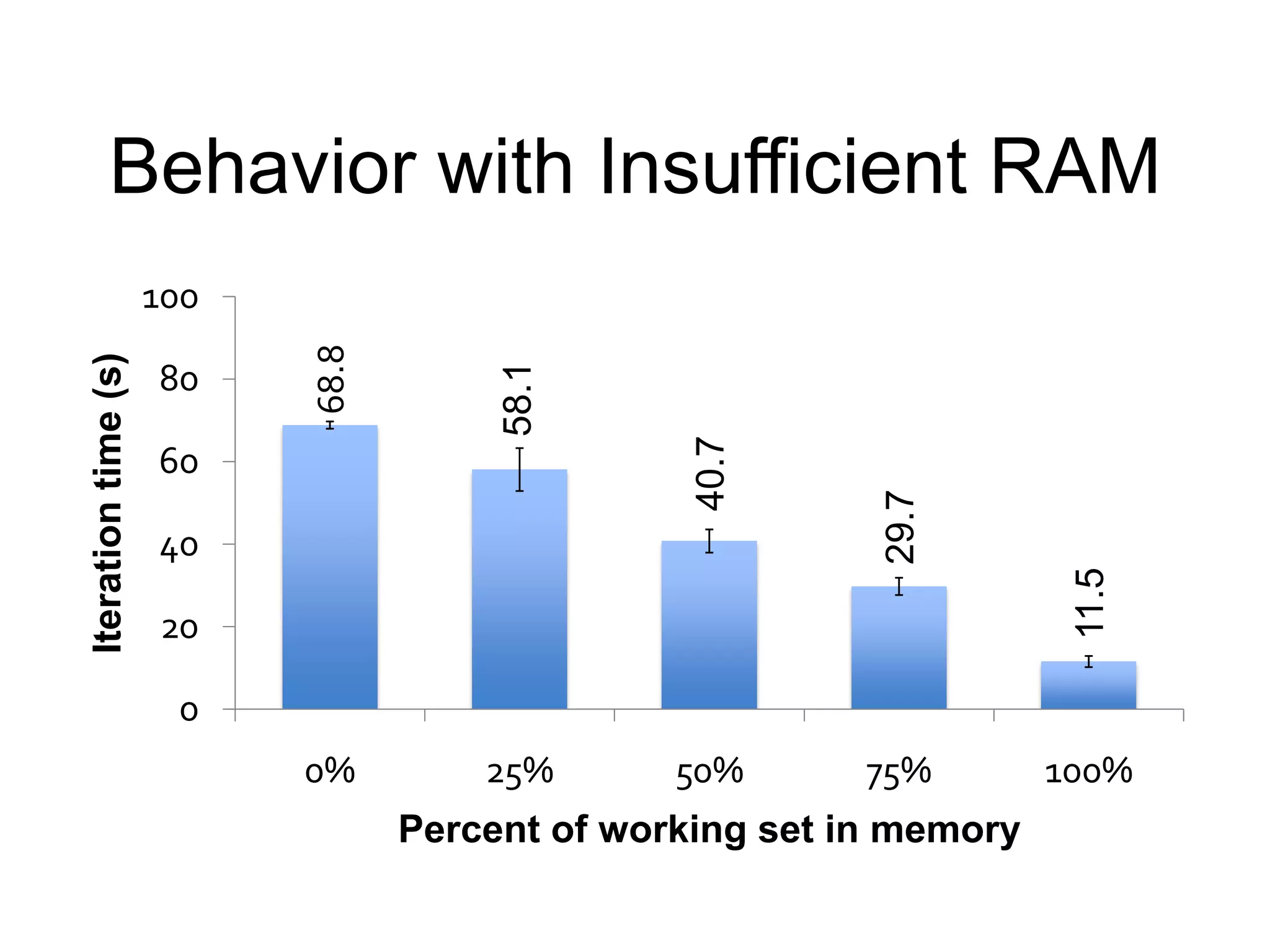
Behavior with Insufficient RAM
68.8
58.1
40.7
29.7
11.5
0
20
40
60
80
100
0% 25% 50% 75% 100%
Iterationtime(s)
Percent of working set in memory
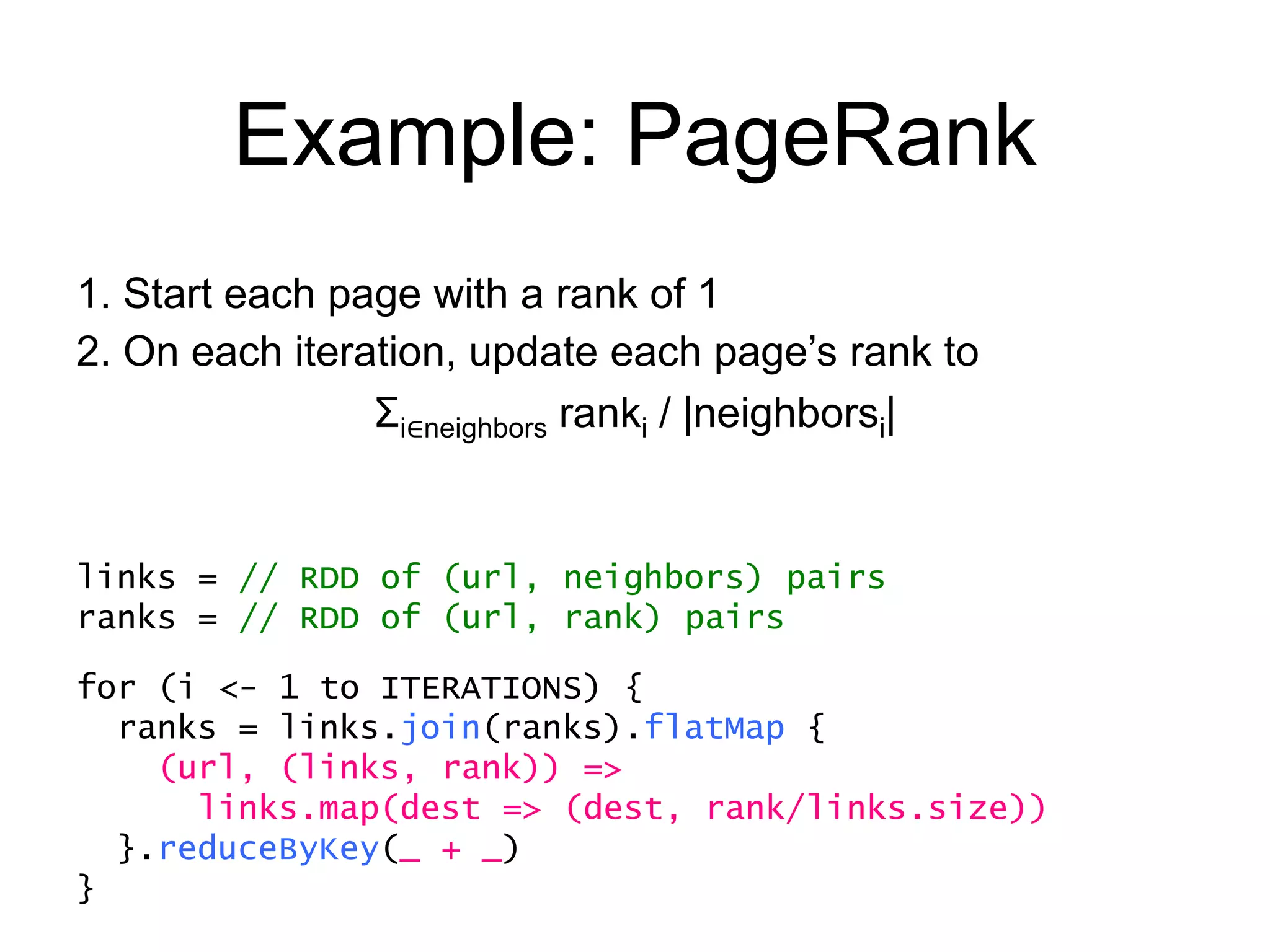
Example: PageRank
1. Start each page with a rank of 1
2. On each iteration, update each page’s rank to
Σi∈neighbors ranki / |neighborsi|
links = // RDD of (url, neighbors) pairs
ranks = // RDD of (url, rank) pairs
for (i <- 1 to ITERATIONS) {
ranks = links.join(ranks).flatMap {
(url, (links, rank)) =>
links.map(dest => (dest, rank/links.size))
}.reduceByKey(_ + _)
}

20130912 YTC_Reynold Xin_Spark and Shark

  • 1.
    Spark and Shark:High-speed Analytics over Hadoop Data Sep 12, 2013 @ Yahoo! Tech Conference Reynold Xin (辛湜), AMPLab, UC Berkeley
  • 2.
    The Spark Ecosystem Spark Shark SQL HDFS/ Hadoop Storage Mesos/YARN Resource Manager Spark Streaming GraphX MLBase
  • 3.
    Today’s Talk Spark Shark SQL HDFS /Hadoop Storage Mesos/YARN Resource Manager Spark Streaming GraphX MLBase
  • 4.
    Apache Spark Fast andexpressive cluster computing system interoperable with Apache Hadoop Improves efficiency through: » In-memory computing primitives » General computation graphs Improves usability through: » Rich APIs in Scala, Java, Python » Interactive shell Up to 100× faster (2-10× on disk) Often 5× less code
  • 5.
    Shark An analytic queryengine built on top of Spark » Support both SQL and complex analytics » Can be100X faster than Apache Hive Compatible with Hive data, metastore, queries » HiveQL » UDF / UDAF » SerDes » Scripts
  • 6.
    Community 3000 people attendedonline training 1100+ meetup members 80+ GitHub contributors
  • 8.
    Today’s Talk Spark Shark SQL HDFS /Hadoop Storage Mesos Resource Manager Spark Streaming GraphX MLBase
  • 9.
    Why a NewFramework? MapReduce greatly simplified big data analysis But as soon as it got popular, users wanted more: » More complex, multi-pass analytics (e.g. ML, graph) » More interactive ad-hoc queries » More real-time stream processing
  • 10.
    Hadoop MapReduce iter. 1iter. 2 … Input filesystem read filesystem write filesystem read filesystem write Iterative: Interactive: Input query 1 query 2 … select Subset Slow due to replication and disk I/O, but necessary for fault tolerance
  • 11.
    Spark Programming Model Keyidea: resilient distributed datasets (RDDs) » Distributed collections of objects that can optionally be cached in memory across cluster » Manipulated through parallel operators » Automatically recomputed on failure Programming interface » Functional APIs in Scala, Java, Python » Interactive use from Scala shell
  • 12.
    Example: Log Mining ExposesRDDs through a functional API in Scala Usable interactively from Scala shell lines = spark.textFile(“hdfs://...”) errors = lines.filter(_.startsWith(“ERROR”)) errors.persist() Block 1 Block 2 Block 3 Worker errors.filter(_.contains(“foo”)).count() errors.filter(_.contains(“bar”)).count() tasks results Errors 2 Base RDD Transformed RDD Action Result: full-text search of Wikipedia in <1 sec (vs 20 sec for on-disk data) Result: 1 TB data in 5 sec (vs 170 sec for on-disk data) Worker Errors 3 Worker Errors 1 Master
  • 13.
    Data Sharing inSpark iter. 1 iter. 2 … Input Iterative: Interactive: Input query 1 query 2select … 10-100x faster than network/disk
  • 14.
    Fault Tolerance RDDs trackthe series of transformations used to build them (their lineage) to recompute lost data E.g: messages = textFile(...).filter(_.contains(“error”)) .map(_.split(„t‟)(2)) HadoopRDD path = hdfs://… FilteredRDD func = _.contains(...) MappedRDD func = _.split(…)
  • 15.
  • 16.
    public static classWordCountMapClass extends MapReduceBase implements Mapper<LongWritable, Text, Text, IntWritable> { private final static IntWritable one = new IntWritable(1); private Text word = new Text(); public void map(LongWritable key, Text value, OutputCollector<Text, IntWritable> output, Reporter reporter) throws IOException { String line = value.toString(); StringTokenizer itr = new StringTokenizer(line); while (itr.hasMoreTokens()) { word.set(itr.nextToken()); output.collect(word, one); } } } public static class WorkdCountReduce extends MapReduceBase implements Reducer<Text, IntWritable, Text, IntWritable> { public void reduce(Text key, Iterator<IntWritable> values, OutputCollector<Text, IntWritable> output, Reporter reporter) throws IOException { int sum = 0; while (values.hasNext()) { sum += values.next().get(); } output.collect(key, new IntWritable(sum)); } }
  • 17.
    Word Count val docs= sc.textFiles(“hdfs://…”) docs.flatMap(line => line.split(“s”)) .map(word => (word, 1)) .reduceByKey((a, b) => a + b)
  • 18.
    Word Count val docs= sc.textFiles(“hdfs://…”) docs.flatMap(line => line.split(“s”)) .map(word => (word, 1)) .reduceByKey((a, b) => a + b) docs.flatMap(_.split(“s”)) .map((_, 1)) .reduceByKey(_ + _)
  • 19.
    Spark in Javaand Python Python API lines = spark.textFile(…) errors = lines.filter( lambda s: "ERROR" in s) errors.count() Java API JavaRDD<String> lines = spark.textFile(…); errors = lines.filter( new Function<String, Boolean>() { public Boolean call(String s) { return s.contains("ERROR"); } }); errors.count()
  • 20.
    Scheduler General task DAGs Pipelinesfunctions within a stage Cache-aware data locality & reuse Partitioning-aware to avoid shuffles Launch jobs in ms join union groupBy map Stage 3 Stage 1 Stage 2 A: B: C: D: E: F: G: = previously computed partition
  • 21.
    Example: Logistic Regression Goal: findbest line separating two sets of points target random initial line 22
  • 22.
    Logistic Regression: Prepthe Data val sc = new SparkContext(“spark://master”, “LRExp”) def loadDict(): Map[String, Double] = { … } val dict = sc.broadcast( loadDict() ) def parser(s: String): (Array[Double], Double) = { val parts = s.split(„t‟) val y = parts(0).toDouble val x = parts.drop(1).map(dict.getOrElse(_, 0.0)) (x, y) } val data = sc.textFile(“hdfs://d”).map(parser).cache() Load data in memory once Start a new Spark Session Build a dictionary for file parsing Broadcast the Dictionary to the Cluster Line Parser which uses the Dictionary 23
  • 23.
    Logistic Regression: Grad.Desc. val sc = new SparkContext(“spark://master”, “LRExp”) // Parsing … val data: Spark.RDD[(Array[Double],Double)] = … var w = Vector.random(D) val lambda = 1.0/data.count for (i <- 1 to ITERATIONS) { val gradient = data.map { case (x, y) => (1.0/(1+exp(-y*(w dot x)))–1)*y*x }.reduce( (g1, g2) => g1 + g2 ) w -= (lambda / sqrt(i) ) * gradient } Initial parameter vector Iterate Set Learning Rate Apply Gradient on Master Compute Gradient Using Map & Reduce 24
  • 24.
    Logistic Regression Performance 0 500 1000 1500 2000 2500 3000 3500 4000 1 510 20 30 RunningTime(s) Number of Iterations Hadoop Spark 110 s / iteration first iteration 80 s further iterations 1 s
  • 25.
    Spark ML Lib(Spark 0.8) Classification Logistic Regression, Linear SVM (+L1, L2) Regression Linear Regression (+Lasso, Ridge) Collaborative Filtering Alternating Least Squares Clustering K-Means Optimization SGD, Parallel Gradient
  • 26.
    Spark Spark Shark SQL HDFS / HadoopStorage Mesos Resource Manager Spark Streaming GraphX MLBase
  • 27.
    Shark Spark Shark SQL HDFS / HadoopStorage Mesos Resource Manager Spark Streaming GraphX MLBase
  • 28.
    Shark A data analyticssystem that » builds on Spark, » scales out and tolerate worker failures, » supports low-latency, interactive queries through (optional) in-memory computation, » supports both SQL and complex analytics, » is compatible with Hive (storage, serdes, UDFs, types, metadata).
  • 29.
  • 30.
  • 31.
    Shark Query Language HiveQL and a few additional DDL add-ons: Creating an in-memory table: » CREATE TABLE src_cached AS SELECT * FROM …
  • 32.
    Engine Features Columnar MemoryStore Data Co-partitioning & Co-location Partition Pruning based on Statistics (range, bloom filter and others) Spark Integration …
  • 33.
    Columnar Memory Store Simplycaching Hive records as JVM objects is inefficient. Shark employs column-oriented storage. 1 Column Storage 2 3 john mike sally 4.1 3.5 6.4 Row Storage 1 john 4.1 2 mike 3.5 3 sally 6.4Benefit: compact representation, CPU efficient compression, cache locality.
  • 34.
    Spark Integration Unified systemfor query processing and Spark analytics Query processing and ML share the same set of workers and caches def logRegress(points: RDD[Point]): Vector { var w = Vector(D, _ => 2 * rand.nextDouble - 1) for (i <- 1 to ITERATIONS) { val gradient = points.map { p => val denom = 1 + exp(-p.y * (w dot p.x)) (1 / denom - 1) * p.y * p.x }.reduce(_ + _) w -= gradient } w } val users = sql2rdd("SELECT * FROM user u JOIN comment c ON c.uid=u.uid") val features = users.mapRows { row => new Vector(extractFeature1(row.getInt("age")), extractFeature2(row.getStr("country")), ...)} val trainedVector = logRegress(features.cache())
  • 35.
    Performance 0 25 50 75 100 Q1 Q2 Q3Q4 Runtime(seconds) Shark Shark (disk) Hive 1.1 0.8 0.7 1.0 1.7 TB Real Warehouse Data on 100 EC2 nodes
  • 36.
    More Information Download anddocs: www.spark-project.org » Easy to run locally, on EC2, or on Mesos/YARN Email: rxin@apache.org Twitter: @rxin
  • 37.
    Behavior with InsufficientRAM 68.8 58.1 40.7 29.7 11.5 0 20 40 60 80 100 0% 25% 50% 75% 100% Iterationtime(s) Percent of working set in memory
  • 38.
    Example: PageRank 1. Starteach page with a rank of 1 2. On each iteration, update each page’s rank to Σi∈neighbors ranki / |neighborsi| links = // RDD of (url, neighbors) pairs ranks = // RDD of (url, rank) pairs for (i <- 1 to ITERATIONS) { ranks = links.join(ranks).flatMap { (url, (links, rank)) => links.map(dest => (dest, rank/links.size)) }.reduceByKey(_ + _) }

Editor's Notes

  • #14 FT = Fourier Transform
  • #22 NOT a modified versionof Hadoop
  • #23 Note that dataset is reused on each gradient computation
  • #24 Key idea: add “variables” to the “functions” in functional programming
  • #25 Key idea: add “variables” to the “functions” in functional programming
  • #26 100 GB of data on 50 m1.xlarge EC2 machines
  • #35 Query planning is also better in Shark due to (1) more optimizations and (2) use of more optimized Spark operators such as hash-based join