Smallest font
Smallest font
Please turn off and put
away your cell phone
These slides are meant
to help with note-taking
They are no substitute
for lecture attendance
Big
Data
Week 03: Map Reduce
DS-GA 1004: Big Data
Announcements
●Everyone will get HPC accounts now
●This week: Lab 2 (DB explorer)
●Useful for the upcoming homework
●HW 1 is due tonight (02/05)
●I’ll give you a couple of days extra
●1st quiz (on Brightspce) opens 02/09
●You have the weekend to do it
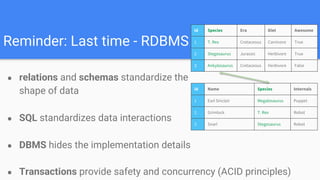
Reminder: Last time - RDBMS
● relations and schemas standardize the
shape of data
● SQL standardizes data interactions
● DBMS hides the implementation details
● Transactions provide safety and concurrency (ACID principles)
id Name Species Internals
1 Earl Sinclair Megalosaurus Puppet
2 Grimlock T. Rex Robot
3 Snarl Stegosaurus Robot
id Species Era Diet Awesome
1 T. Rex Cretaceous Carnivore True
2 Stegosaurus Jurassic Herbivore True
3 Ankylosaurus Cretaceous Herbivore False
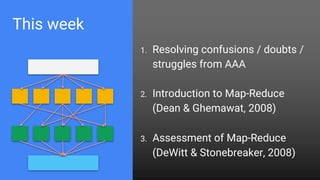
This week
1. Resolving confusions / doubts /
struggles from AAA
2. Introduction to Map-Reduce
(Dean & Ghemawat, 2008)
3. Assessment of Map-Reduce
(DeWitt & Stonebreaker, 2008)
Confusion, Doubt, & Struggle: Keys
“Keys” are a central concept in many CS applications
We have already seen the use of keys in SQL last week,
will see keys used today in MapReduce
and will see the use of keys in the future
If you do not have a CS background, you
might have an unhelpful association:
Unless specified
otherwise, when
you see “key” in CS,
think unique “ID”:
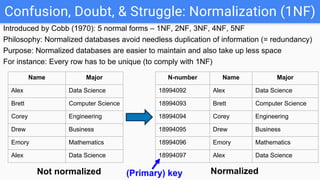
Confusion, Doubt, & Struggle: Normalization (1NF)
Introduced by Cobb (1970): 5 normal forms – 1NF, 2NF, 3NF, 4NF, 5NF
Philosophy: Normalized databases avoid needless duplication of information (= redundancy)
Purpose: Normalized databases are easier to maintain and also take up less space
For instance: Every row has to be unique (to comply with 1NF)
Name Major
Alex Data Science
Brett Computer Science
Corey Engineering
Drew Business
Emory Mathematics
Alex Data Science
Not normalized
N-number Name Major
18994092 Alex Data Science
18994093 Brett Computer Science
18994094 Corey Engineering
18994095 Drew Business
18994096 Emory Mathematics
18994097 Alex Data Science
Normalized
(Primary) key
Confusion, Doubt, & Struggle: Normalization
(beyond 1NF)
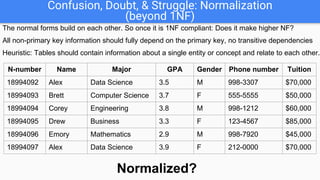
The normal forms build on each other. So once it is 1NF compliant: Does it make higher NF?
Normalized?
All non-primary key information should fully depend on the primary key, no transitive dependencies
Heuristic: Tables should contain information about a single entity or concept and relate to each other.
N-number Name Major GPA Gender Phone number Tuition
18994092 Alex Data Science 3.5 M 998-3307 $70,000
18994093 Brett Computer Science 3.7 F 555-5555 $50,000
18994094 Corey Engineering 3.8 M 998-1212 $60,000
18994095 Drew Business 3.3 F 123-4567 $85,000
18994096 Emory Mathematics 2.9 M 998-7920 $45,000
18994097 Alex Data Science 3.9 F 212-0000 $70,000
Confusion, Doubt, & Struggle: Normalization
(beyond 1NF)
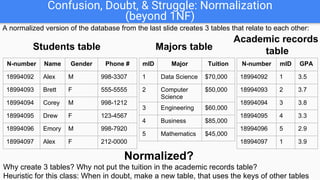
A normalized version of the database from the last slide creates 3 tables that relate to each other:
Heuristic for this class: When in doubt, make a new table, that uses the keys of other tables
N-number Name Gender Phone #
18994092 Alex M 998-3307
18994093 Brett F 555-5555
18994094 Corey M 998-1212
18994095 Drew F 123-4567
18994096 Emory M 998-7920
18994097 Alex F 212-0000
Students table
mID Major Tuition
1 Data Science $70,000
2 Computer
Science
$50,000
3 Engineering $60,000
4 Business $85,000
5 Mathematics $45,000
Majors table
N-number mID GPA
18994092 1 3.5
18994093 2 3.7
18994094 3 3.8
18994095 4 3.3
18994096 5 2.9
18994097 1 3.9
Academic records
table
Normalized?
Why create 3 tables? Why not put the tuition in the academic records table?
Confusion, Doubt, & Struggle: Index
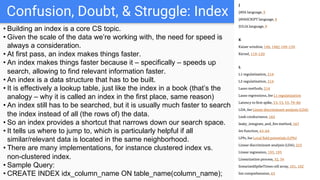
• Building an index is a core CS topic.
• Given the scale of the data we’re working with, the need for speed is
always a consideration.
• At first pass, an index makes things faster.
• An index makes things faster because it – specifically – speeds up
search, allowing to find relevant information faster.
• An index is a data structure that has to be built.
• It is effectively a lookup table, just like the index in a book (that’s the
analogy – why it is called an index in the first place, same reason)
• An index still has to be searched, but it is usually much faster to search
the index instead of all (the rows of) the data.
• So an index provides a shortcut that narrows down our search space.
• It tells us where to jump to, which is particularly helpful if all
similar/relevant data is located in the same neighborhood.
• There are many implementations, for instance clustered index vs.
non-clustered index.
• Sample Query:
• CREATE INDEX idx_column_name ON table_name(column_name);
NOW
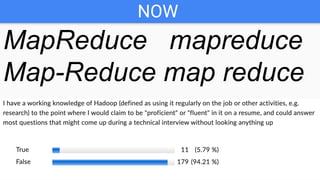
MapReduce mapreduce
Map-Reduce map reduce
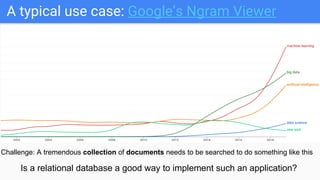
A typical use case: Google’s Ngram Viewer
Is a relational database a good way to implement such an application?
Challenge: A tremendous collection of documents needs to be searched to do something like this
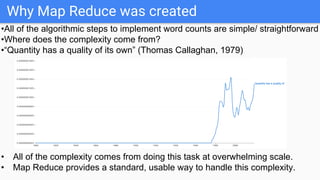
Why Map Reduce was created
•All of the algorithmic steps to implement word counts are simple/ straightforward
•Where does the complexity come from?
•“Quantity has a quality of its own” (Thomas Callaghan, 1979)
• All of the complexity comes from doing this task at overwhelming scale.
• Map Reduce provides a standard, usable way to handle this complexity.
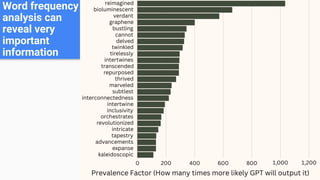
Word frequency
analysis can
reveal very
important
information
Google’s Motivation: text indexing
● Say you have N documents (with N very large, e.g. the web),
and you want to construct an index: words → documents
● On a single machine, this process takes Ω(N) time
● Observation: this problem is (almost) embarrassingly parallel
○ Whether any word appears in a document is independent of other documents
○ We should be able to process documents independently and combine the
results
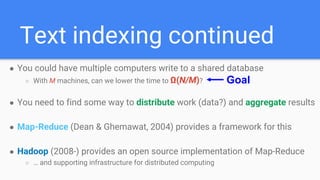
Text indexing continued
● You could have multiple computers write to a shared database
○ With M machines, can we lower the time to Ω(N/M)?
● You need to find some way to distribute work (data?) and aggregate results
● Map-Reduce (Dean & Ghemawat, 2004) provides a framework for this
● Hadoop (2008-) provides an open source implementation of Map-Reduce
○ … and supporting infrastructure for distributed computing
Goal
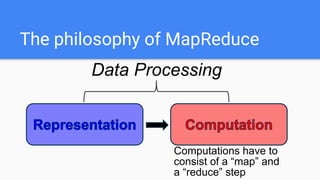
The philosophy of MapReduce
Data Processing
Computations have to
consist of a “map” and
a “reduce” step
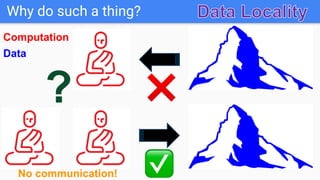
Why do such a thing?
Computation
Data
? ❌
✅
No communication!
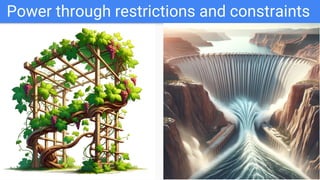
Power through restrictions and constraints
Why map-reduce?
● Distributed programming is really difficult!
● If we restrict how we program, parallelism becomes easier
● The map and reduce operations are surprisingly powerful!
Why “map” and “reduce”, specifically?
● These are common operations in functional programming
○ E.g.: LISP, Haskell, Scala…
● map(function f, values [x1, x2, …, xn]) → [f(x1), f(x2), … f(xn)]
○ map : function, list → list
○ f is applied element-wise
○ This allows for parallelism, if list elements are independent
● reduce(function g, values [x1, x2, …, xn]) → g(x1, reduce(g, [x2, …, xn]))
○ reduce : function, list → item
○ g is applied recursively to pairs of items
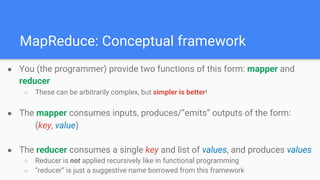
● You (the programmer) provide two functions of this form: mapper and
reducer
○ These can be arbitrarily complex, but simpler is better!
● The mapper consumes inputs, produces/”emits” outputs of the form:
(key, value)
● The reducer consumes a single key and list of values, and produces values
○ Reducer is not applied recursively like in functional programming
○ “reducer” is just a suggestive name borrowed from this framework
MapReduce: Conceptual framework
Map-Reduce flow
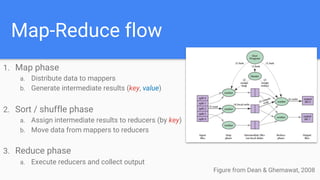
1. Map phase
a. Distribute data to mappers
b. Generate intermediate results (key, value)
2. Sort / shuffle phase
a. Assign intermediate results to reducers (by key)
b. Move data from mappers to reducers
3. Reduce phase
a. Execute reducers and collect output
Figure from Dean & Ghemawat, 2008
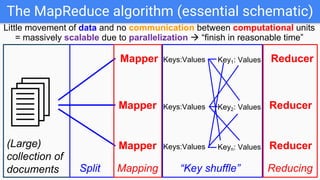
The MapReduce algorithm (essential schematic)
4
(Large)
collection of
documents Split
Mapper
Mapper
Mapper
Mapping
Keys:Values
Keys:Values
Keys:Values
Key1: Values
Key2: Values
Keyn: Values
Little movement of data and no communication between computational units
= massively scalable due to parallelization à “finish in reasonable time”
“Key shuffle”
Reducer
Reducer
Reducer
Reducing
Potential for confusion: Key shuffle vs. grouping by identity?
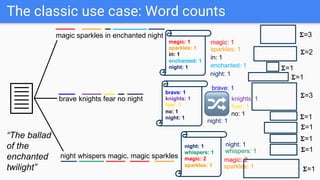
brave knights fear no night
The classic use case: Word counts
3
“The ballad
of the
enchanted
twilight”
magic sparkles in enchanted night
night whispers magic, magic sparkles
magic: 1
sparkles: 1
in: 1
enchanted: 1
night: 1
brave: 1
knights: 1
fear: 1
no: 1
night: 1
night: 1
whispers: 1
magic: 2
sparkles: 1
🔀
magic: 1
magic: 2
sparkles: 1
sparkles: 1
in: 1
enchanted: 1
night: 1
night: 1
night: 1
whispers: 1
brave: 1
knights: 1
fear: 1
no: 1
𝚺=3
𝚺=2
𝚺=1
𝚺=3
𝚺=1
𝚺=1
𝚺=1
𝚺=1
𝚺=1
𝚺=1
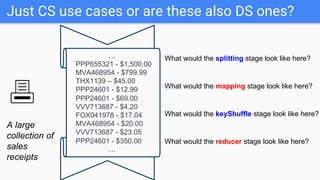
Just CS use cases or are these also DS ones?
A large
collection of
sales
receipts
…
PPP655321 - $1,500.00
MVA468954 - $799.99
THX1139 – $45.00
PPP24601 - $12.99
PPP24601 - $69.00
VVV713687 - $4.20
FOX041978 - $17.04
MVA468954 - $20.00
VVV713687 - $23.05
PPP24601 - $350.00
…
What would the splitting stage look like here?
What would the mapping stage look like here?
What would the keyShuffle stage look like here?
What would the reducer stage look like here?
Working with Map-Reduce:
Practical considerations
Some tips…
● Don’t use floating point / real numbers for keys
○ Keys need to hash consistently, and floating point equivalence can be subtle!
○ Use integers, strings, or tuples for keys
● Keep map and reduce simple!
○ Avoid loops if possible
○ Let sort do the work for you
● Compare your algorithm’s complexity to the simple / single-core solution
○ Think about all resources: time, storage, and communication!
Key → reducer assignment
● All values for a given key k go to exactly one reducer
● Conversely:
A reducer acting on key k needs to see all associated values
● This will have consequences!
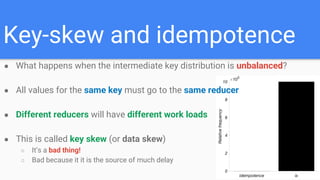
Key-skew and idempotence
● What happens when the intermediate key distribution is unbalanced?
● All values for the same key must go to the same reducer
● Different reducers will have different work loads
● This is called key skew (or data skew)
○ It’s a bad thing!
○ Bad because it it is the source of much delay
One strategy to handle key-skew: Combiners
● Key-skew leads to high latency
○ Reducer time scales (at least) like # values per key
● Lots of keys ⇒ lots of communication
○ Shuffling data is expensive!
● We can sometimes simplify the reducer’s job by having
mappers pre-emptively reduce (combine) intermediary data
before shuffling.
● Necessary: Multiple mappers live on the same machine.
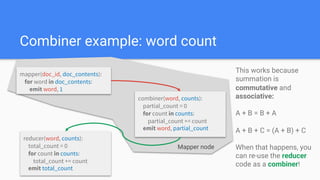
Combiner example: word count
mapper(doc_id, doc_contents):
for word in doc_contents:
emit word, 1
reducer(word, counts):
total_count = 0
for count in counts:
total_count += count
emit total_count
combiner(word, counts):
partial_count = 0
for count in counts:
partial_count += count
emit word, partial_count
This works because
summation is
commutative and
associative:
A + B = B + A
A + B + C = (A + B) + C
When that happens, you
can re-use the reducer
code as a combiner!
Mapper node
Heuristics for using MapReduce well
● Have fewer mappers than inputs
● Have fewer reducers than intermediate keys
● Combiners can help, but sometimes a fancier mapping is better
● Sometimes you can be clever with sorting to reduce
communication
Summary
● The Map-Reduce framework
simplifies how we think about
distributed computation
(empowering through constraint),
making it much more accessible
● MR was critical to the
development of large-scale data
analysis – particularly in the 2nd
half of the 2000s.
● But it’s not without drawbacks…
Assessment of MapReduce
From a historical CS perspective
From a modern DS perspective
5 key criticisms
(DeWitt & Stonebraker, 2008)
1. Too low-level
2. Poor implementation
3. Not novel
4. Missing important features
5. No DBMS compatibility
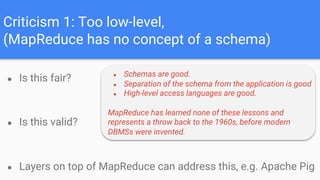
Criticism 1: Too low-level,
(MapReduce has no concept of a schema)
● Is this fair?
● Is this valid?
● Layers on top of MapReduce can address this, e.g. Apache Pig
● Schemas are good.
● Separation of the schema from the application is good
● High-level access languages are good.
MapReduce has learned none of these lessons and
represents a throw back to the 1960s, before modern
DBMSs were invented.
Criticism 2:
Mapreduce is poorly implemented
● For instance, MapReduce does not index data like an RDBMS
○ Much more like a file system, with keys as filenames
● Indexing should be better… right?
○ For example, analyzing only a given subset of data
● Is this a major failing?
Criticism 3:
MapReduce is not novel
● Plenty of previous systems used partitioning and aggregation
● Was MapReduce novel?
● Did Dean & Ghemawat claim that it was?
● Does it matter?
Criticism 4: MapReduce is missing all the
features one would expect from a database
● Indexing, transactions, schema, integrity constraints, views, …
These are all missing from MapReduce!
● Why are they missing? Is this a drawback?
● Is this a fair comparison?
Criticism 5: MapReduce ignores the rest of the
ecosystem: lack of DBMS compatibility
● Lots of infrastructure has been built on top of standard DBMS
for, e.g.,
○ Visualization
○ Data migration
○ Database design
● DW&S was over 10 years ago, things have changed a bit since
then
○ Apache Hive, Phoenix + HBase can fill in some of these gaps
Why was map-reduce so successful?
● DW&S raise valid points, so why was MapReduce as
transformational as it was?
● Some possible reasons:
○ Simplicity: “map” and “reduce” are powerful abstractions, and often easy to write
○ Many jobs are single-shot: not worth building elaborate DB infrastructure
Some very real problems with MapReduce
● Latency and scheduling
● Intermediate storage
● Not everything fits nicely in map-reduce
○ Iterative algorithms (e.g., gradient descent) are especially painful
○ Interactive processes (visualization, exploration) are too
MapReduce is *not* a general purpose
distributed computation engine…
● Due to its severe constraints / simplifications
● … but it can still do a lot!
● Algorithms with clear parallelism and no/little looping are okay
● It works best for “one-and-done” “ballistic” tasks
● Iterative or recursive algorithms … not so much
○ Gradient descent (and other ML approaches, e.g. alternating least squares)
What’s the role of map-reduce today?
● MapReduce is great for large Ω(N) batch jobs that run
infrequently, e.g.:
○ Data transformation / feature extraction
○ Index / data-structure construction
● It’s not so great for iterative or interactive (DS) jobs:
○ Machine learning (training)
○ Search and retrieval
○ Data exploration
So why do we study map-reduce?
● It’s historically important! (A big step in the history of
distributed computing)
● It’s a useful way of thinking about breaking down problems
into parts that can be parallelized (distributed paradigm)
● The Hadoop ecosystem is much bigger than map-reduce
(more on this in coming weeks)
● You may inherit legacy code.
Next week
● The Hadoop distributed file-
system (HDFS) to manage
distributed storage
● Lab 2: programming with
map-reduce
Q&R

bigD3_mapReducebigD3_mapReducebigD3_mapReduce.pdf

  • 1.
    Smallest font Smallest font Pleaseturn off and put away your cell phone These slides are meant to help with note-taking They are no substitute for lecture attendance
  • 2.
  • 3.
    Week 03: MapReduce DS-GA 1004: Big Data
  • 4.
    Announcements ●Everyone will getHPC accounts now ●This week: Lab 2 (DB explorer) ●Useful for the upcoming homework ●HW 1 is due tonight (02/05) ●I’ll give you a couple of days extra ●1st quiz (on Brightspce) opens 02/09 ●You have the weekend to do it
  • 5.
    Reminder: Last time- RDBMS ● relations and schemas standardize the shape of data ● SQL standardizes data interactions ● DBMS hides the implementation details ● Transactions provide safety and concurrency (ACID principles) id Name Species Internals 1 Earl Sinclair Megalosaurus Puppet 2 Grimlock T. Rex Robot 3 Snarl Stegosaurus Robot id Species Era Diet Awesome 1 T. Rex Cretaceous Carnivore True 2 Stegosaurus Jurassic Herbivore True 3 Ankylosaurus Cretaceous Herbivore False
  • 6.
    This week 1. Resolvingconfusions / doubts / struggles from AAA 2. Introduction to Map-Reduce (Dean & Ghemawat, 2008) 3. Assessment of Map-Reduce (DeWitt & Stonebreaker, 2008)
  • 7.
    Confusion, Doubt, &Struggle: Keys “Keys” are a central concept in many CS applications We have already seen the use of keys in SQL last week, will see keys used today in MapReduce and will see the use of keys in the future If you do not have a CS background, you might have an unhelpful association: Unless specified otherwise, when you see “key” in CS, think unique “ID”:
  • 8.
    Confusion, Doubt, &Struggle: Normalization (1NF) Introduced by Cobb (1970): 5 normal forms – 1NF, 2NF, 3NF, 4NF, 5NF Philosophy: Normalized databases avoid needless duplication of information (= redundancy) Purpose: Normalized databases are easier to maintain and also take up less space For instance: Every row has to be unique (to comply with 1NF) Name Major Alex Data Science Brett Computer Science Corey Engineering Drew Business Emory Mathematics Alex Data Science Not normalized N-number Name Major 18994092 Alex Data Science 18994093 Brett Computer Science 18994094 Corey Engineering 18994095 Drew Business 18994096 Emory Mathematics 18994097 Alex Data Science Normalized (Primary) key
  • 9.
    Confusion, Doubt, &Struggle: Normalization (beyond 1NF) The normal forms build on each other. So once it is 1NF compliant: Does it make higher NF? Normalized? All non-primary key information should fully depend on the primary key, no transitive dependencies Heuristic: Tables should contain information about a single entity or concept and relate to each other. N-number Name Major GPA Gender Phone number Tuition 18994092 Alex Data Science 3.5 M 998-3307 $70,000 18994093 Brett Computer Science 3.7 F 555-5555 $50,000 18994094 Corey Engineering 3.8 M 998-1212 $60,000 18994095 Drew Business 3.3 F 123-4567 $85,000 18994096 Emory Mathematics 2.9 M 998-7920 $45,000 18994097 Alex Data Science 3.9 F 212-0000 $70,000
  • 10.
    Confusion, Doubt, &Struggle: Normalization (beyond 1NF) A normalized version of the database from the last slide creates 3 tables that relate to each other: Heuristic for this class: When in doubt, make a new table, that uses the keys of other tables N-number Name Gender Phone # 18994092 Alex M 998-3307 18994093 Brett F 555-5555 18994094 Corey M 998-1212 18994095 Drew F 123-4567 18994096 Emory M 998-7920 18994097 Alex F 212-0000 Students table mID Major Tuition 1 Data Science $70,000 2 Computer Science $50,000 3 Engineering $60,000 4 Business $85,000 5 Mathematics $45,000 Majors table N-number mID GPA 18994092 1 3.5 18994093 2 3.7 18994094 3 3.8 18994095 4 3.3 18994096 5 2.9 18994097 1 3.9 Academic records table Normalized? Why create 3 tables? Why not put the tuition in the academic records table?
  • 11.
    Confusion, Doubt, &Struggle: Index • Building an index is a core CS topic. • Given the scale of the data we’re working with, the need for speed is always a consideration. • At first pass, an index makes things faster. • An index makes things faster because it – specifically – speeds up search, allowing to find relevant information faster. • An index is a data structure that has to be built. • It is effectively a lookup table, just like the index in a book (that’s the analogy – why it is called an index in the first place, same reason) • An index still has to be searched, but it is usually much faster to search the index instead of all (the rows of) the data. • So an index provides a shortcut that narrows down our search space. • It tells us where to jump to, which is particularly helpful if all similar/relevant data is located in the same neighborhood. • There are many implementations, for instance clustered index vs. non-clustered index. • Sample Query: • CREATE INDEX idx_column_name ON table_name(column_name);
  • 12.
  • 13.
    A typical usecase: Google’s Ngram Viewer Is a relational database a good way to implement such an application? Challenge: A tremendous collection of documents needs to be searched to do something like this
  • 14.
    Why Map Reducewas created •All of the algorithmic steps to implement word counts are simple/ straightforward •Where does the complexity come from? •“Quantity has a quality of its own” (Thomas Callaghan, 1979) • All of the complexity comes from doing this task at overwhelming scale. • Map Reduce provides a standard, usable way to handle this complexity.
  • 15.
    Word frequency analysis can revealvery important information
  • 16.
    Google’s Motivation: textindexing ● Say you have N documents (with N very large, e.g. the web), and you want to construct an index: words → documents ● On a single machine, this process takes Ω(N) time ● Observation: this problem is (almost) embarrassingly parallel ○ Whether any word appears in a document is independent of other documents ○ We should be able to process documents independently and combine the results
  • 17.
    Text indexing continued ●You could have multiple computers write to a shared database ○ With M machines, can we lower the time to Ω(N/M)? ● You need to find some way to distribute work (data?) and aggregate results ● Map-Reduce (Dean & Ghemawat, 2004) provides a framework for this ● Hadoop (2008-) provides an open source implementation of Map-Reduce ○ … and supporting infrastructure for distributed computing Goal
  • 18.
    The philosophy ofMapReduce Data Processing Computations have to consist of a “map” and a “reduce” step
  • 19.
    Why do sucha thing? Computation Data ? ❌ ✅ No communication!
  • 20.
  • 21.
    Why map-reduce? ● Distributedprogramming is really difficult! ● If we restrict how we program, parallelism becomes easier ● The map and reduce operations are surprisingly powerful!
  • 22.
    Why “map” and“reduce”, specifically? ● These are common operations in functional programming ○ E.g.: LISP, Haskell, Scala… ● map(function f, values [x1, x2, …, xn]) → [f(x1), f(x2), … f(xn)] ○ map : function, list → list ○ f is applied element-wise ○ This allows for parallelism, if list elements are independent ● reduce(function g, values [x1, x2, …, xn]) → g(x1, reduce(g, [x2, …, xn])) ○ reduce : function, list → item ○ g is applied recursively to pairs of items
  • 23.
    ● You (theprogrammer) provide two functions of this form: mapper and reducer ○ These can be arbitrarily complex, but simpler is better! ● The mapper consumes inputs, produces/”emits” outputs of the form: (key, value) ● The reducer consumes a single key and list of values, and produces values ○ Reducer is not applied recursively like in functional programming ○ “reducer” is just a suggestive name borrowed from this framework MapReduce: Conceptual framework
  • 24.
    Map-Reduce flow 1. Mapphase a. Distribute data to mappers b. Generate intermediate results (key, value) 2. Sort / shuffle phase a. Assign intermediate results to reducers (by key) b. Move data from mappers to reducers 3. Reduce phase a. Execute reducers and collect output Figure from Dean & Ghemawat, 2008
  • 25.
    The MapReduce algorithm(essential schematic) 4 (Large) collection of documents Split Mapper Mapper Mapper Mapping Keys:Values Keys:Values Keys:Values Key1: Values Key2: Values Keyn: Values Little movement of data and no communication between computational units = massively scalable due to parallelization à “finish in reasonable time” “Key shuffle” Reducer Reducer Reducer Reducing
  • 26.
    Potential for confusion:Key shuffle vs. grouping by identity?
  • 27.
    brave knights fearno night The classic use case: Word counts 3 “The ballad of the enchanted twilight” magic sparkles in enchanted night night whispers magic, magic sparkles magic: 1 sparkles: 1 in: 1 enchanted: 1 night: 1 brave: 1 knights: 1 fear: 1 no: 1 night: 1 night: 1 whispers: 1 magic: 2 sparkles: 1 🔀 magic: 1 magic: 2 sparkles: 1 sparkles: 1 in: 1 enchanted: 1 night: 1 night: 1 night: 1 whispers: 1 brave: 1 knights: 1 fear: 1 no: 1 𝚺=3 𝚺=2 𝚺=1 𝚺=3 𝚺=1 𝚺=1 𝚺=1 𝚺=1 𝚺=1 𝚺=1
  • 28.
    Just CS usecases or are these also DS ones? A large collection of sales receipts … PPP655321 - $1,500.00 MVA468954 - $799.99 THX1139 – $45.00 PPP24601 - $12.99 PPP24601 - $69.00 VVV713687 - $4.20 FOX041978 - $17.04 MVA468954 - $20.00 VVV713687 - $23.05 PPP24601 - $350.00 … What would the splitting stage look like here? What would the mapping stage look like here? What would the keyShuffle stage look like here? What would the reducer stage look like here?
  • 29.
  • 30.
    Some tips… ● Don’tuse floating point / real numbers for keys ○ Keys need to hash consistently, and floating point equivalence can be subtle! ○ Use integers, strings, or tuples for keys ● Keep map and reduce simple! ○ Avoid loops if possible ○ Let sort do the work for you ● Compare your algorithm’s complexity to the simple / single-core solution ○ Think about all resources: time, storage, and communication!
  • 31.
    Key → reducerassignment ● All values for a given key k go to exactly one reducer ● Conversely: A reducer acting on key k needs to see all associated values ● This will have consequences!
  • 32.
    Key-skew and idempotence ●What happens when the intermediate key distribution is unbalanced? ● All values for the same key must go to the same reducer ● Different reducers will have different work loads ● This is called key skew (or data skew) ○ It’s a bad thing! ○ Bad because it it is the source of much delay
  • 33.
    One strategy tohandle key-skew: Combiners ● Key-skew leads to high latency ○ Reducer time scales (at least) like # values per key ● Lots of keys ⇒ lots of communication ○ Shuffling data is expensive! ● We can sometimes simplify the reducer’s job by having mappers pre-emptively reduce (combine) intermediary data before shuffling. ● Necessary: Multiple mappers live on the same machine.
  • 34.
    Combiner example: wordcount mapper(doc_id, doc_contents): for word in doc_contents: emit word, 1 reducer(word, counts): total_count = 0 for count in counts: total_count += count emit total_count combiner(word, counts): partial_count = 0 for count in counts: partial_count += count emit word, partial_count This works because summation is commutative and associative: A + B = B + A A + B + C = (A + B) + C When that happens, you can re-use the reducer code as a combiner! Mapper node
  • 35.
    Heuristics for usingMapReduce well ● Have fewer mappers than inputs ● Have fewer reducers than intermediate keys ● Combiners can help, but sometimes a fancier mapping is better ● Sometimes you can be clever with sorting to reduce communication
  • 36.
    Summary ● The Map-Reduceframework simplifies how we think about distributed computation (empowering through constraint), making it much more accessible ● MR was critical to the development of large-scale data analysis – particularly in the 2nd half of the 2000s. ● But it’s not without drawbacks…
  • 37.
    Assessment of MapReduce Froma historical CS perspective From a modern DS perspective
  • 38.
    5 key criticisms (DeWitt& Stonebraker, 2008) 1. Too low-level 2. Poor implementation 3. Not novel 4. Missing important features 5. No DBMS compatibility
  • 39.
    Criticism 1: Toolow-level, (MapReduce has no concept of a schema) ● Is this fair? ● Is this valid? ● Layers on top of MapReduce can address this, e.g. Apache Pig ● Schemas are good. ● Separation of the schema from the application is good ● High-level access languages are good. MapReduce has learned none of these lessons and represents a throw back to the 1960s, before modern DBMSs were invented.
  • 40.
    Criticism 2: Mapreduce ispoorly implemented ● For instance, MapReduce does not index data like an RDBMS ○ Much more like a file system, with keys as filenames ● Indexing should be better… right? ○ For example, analyzing only a given subset of data ● Is this a major failing?
  • 41.
    Criticism 3: MapReduce isnot novel ● Plenty of previous systems used partitioning and aggregation ● Was MapReduce novel? ● Did Dean & Ghemawat claim that it was? ● Does it matter?
  • 42.
    Criticism 4: MapReduceis missing all the features one would expect from a database ● Indexing, transactions, schema, integrity constraints, views, … These are all missing from MapReduce! ● Why are they missing? Is this a drawback? ● Is this a fair comparison?
  • 43.
    Criticism 5: MapReduceignores the rest of the ecosystem: lack of DBMS compatibility ● Lots of infrastructure has been built on top of standard DBMS for, e.g., ○ Visualization ○ Data migration ○ Database design ● DW&S was over 10 years ago, things have changed a bit since then ○ Apache Hive, Phoenix + HBase can fill in some of these gaps
  • 44.
    Why was map-reduceso successful? ● DW&S raise valid points, so why was MapReduce as transformational as it was? ● Some possible reasons: ○ Simplicity: “map” and “reduce” are powerful abstractions, and often easy to write ○ Many jobs are single-shot: not worth building elaborate DB infrastructure
  • 45.
    Some very realproblems with MapReduce ● Latency and scheduling ● Intermediate storage ● Not everything fits nicely in map-reduce ○ Iterative algorithms (e.g., gradient descent) are especially painful ○ Interactive processes (visualization, exploration) are too
  • 46.
    MapReduce is *not*a general purpose distributed computation engine… ● Due to its severe constraints / simplifications ● … but it can still do a lot! ● Algorithms with clear parallelism and no/little looping are okay ● It works best for “one-and-done” “ballistic” tasks ● Iterative or recursive algorithms … not so much ○ Gradient descent (and other ML approaches, e.g. alternating least squares)
  • 47.
    What’s the roleof map-reduce today? ● MapReduce is great for large Ω(N) batch jobs that run infrequently, e.g.: ○ Data transformation / feature extraction ○ Index / data-structure construction ● It’s not so great for iterative or interactive (DS) jobs: ○ Machine learning (training) ○ Search and retrieval ○ Data exploration
  • 48.
    So why dowe study map-reduce? ● It’s historically important! (A big step in the history of distributed computing) ● It’s a useful way of thinking about breaking down problems into parts that can be parallelized (distributed paradigm) ● The Hadoop ecosystem is much bigger than map-reduce (more on this in coming weeks) ● You may inherit legacy code.
  • 49.
    Next week ● TheHadoop distributed file- system (HDFS) to manage distributed storage ● Lab 2: programming with map-reduce
  • 50.