Common MapReduce
    Patterns

     Chris K Wensel

     BuzzWords 2011
Engineer, Not Academic
•   Concurrent, Inc., Founder
     • Cascading support and tools
     • http://concurrentinc.com/

•   Cascading, Lead Developer (started Sept 2007)
     •  An alternative API to MapReduce
     •  http://cascading.org/

•   Formerly Hadoop mentoring and training
     •  Sun - Apple - HP - LexisNexis - startups - etc

•   Formerly Systems Architect & Consultant
     •  Thomson/Reuters - TeleAtlas - startups - etc
                                                Copyright Concurrent, Inc. 2011. All rights reserved.
Overview

• MapReduce
• Heavy Lifting
• Analytics
• Optimizations
                    Copyright Concurrent, Inc. 2011. All rights reserved.
MapReduce
• A “divide and conquer” strategy for parallelizing
  workloads against collections of data

• Map & Reduce are two user defined functions
  chained via Key Value Pairs

• It’s really Map->Group->Reduce where Group is
  built in

                                   Copyright Concurrent, Inc. 2011. All rights reserved.
Keys and Values
•   Map translates input to keys
    and values to new keys and
    values                             [K1,V1]               Map                     [K2,V2]*


•   System Groups each unique          [K2,V2]              Group               [K2,{V2,V2,....}]
    key with all its values

                                   [K2,{V2,V2,....}]        Reduce                   [K3,V3]*

•   Reduce translates the values
    of each unique key to new
    keys and values                                                    * = zero or more


                                                       Copyright Concurrent, Inc. 2011. All rights reserved.
Word Count
Mapper
 [0, "when in the course of
       human events"]            Map     ["when",1]     ["in",1]         ["the",1]          [...,1]


              ["when",1]
               ["when",1]
                ["when",1]
                 ["when",1]     Group    ["when",{1,1,1,1,1}]
                  ["when",1]
Reducer

         ["when",{1,1,1,1,1}]   Reduce   ["when",5]


                                                       Copyright Concurrent, Inc. 2011. All rights reserved.
Divide and Conquer
          Parallelism
• Since the ‘records’ entering the Map and ‘groups’
  entering the Reduce are independent

• That is, there is no expectation of order or
  requirement to share state between records/
  groups

• Arbitrary numbers of Map and Reduce function
  instances can be created against arbitrary portions
  of input data
                                   Copyright Concurrent, Inc. 2011. All rights reserved.
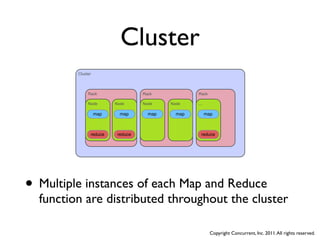
Cluster
         Cluster


              Rack                 Rack            Rack

              Node       Node      Node    Node    ...

                   map     map       map     map         map


               reduce     reduce                     reduce


• Multiple instances of each Map and Reduce
  function are distributed throughout the cluster

                                                           Copyright Concurrent, Inc. 2011. All rights reserved.
Another View
                  [K1,V1]            Map     [K2,V2]
                                             Combine   Group    [K2,{V2,...}]   Reduce    [K3,V3]


                                    Mapper
                                     Task                       same code


                                    Mapper                                      Reducer
                                                       Shuffle
                                     Task                                        Task


                                    Mapper                                      Reducer
                                                       Shuffle
                                     Task                                        Task


                                    Mapper                                      Reducer
                                                       Shuffle                    Task
                                     Task


                                    Mapper
                                     Task
                                                    Mappers must
                                                   complete before
                                                    Reducers can
                                                       begin
split1   split2   split3   split4      ...                              part-00000    part-00001    part-000N

                     file                                                             directory


                                                                                Copyright Concurrent, Inc. 2011. All rights reserved.
Complex job
                      assemblies
•   Real applications are many MapReduce jobs chained together

•   Linked by intermediate (usually temporary) files

•   Executed in order, by hand, from the ‘client’ application

       Count Job                                Sort Job
                    [ k, [v] ]                                    [ k, [v] ]
            Map                   Reduce              Map                         Reduce


      [ k, v ]                   [ k, v ]              [ k, v ]                         [ k, v ]


             File                            File                                    File


                                            [ k, v ] = key and value pair
                                            [ k, [v] ] = key and associated values collection
                                                                         Copyright Concurrent, Inc. 2011. All rights reserved.
Real World Apps
                                                                                                                                                                                                    [37/75] map+reduce


                                                                                                                                                                                                    [54/75] map+reduce


[41/75] map+reduce      [43/75] map+reduce       [42/75] map+reduce      [45/75] map+reduce       [44/75] map+reduce      [39/75] map+reduce    [36/75] map+reduce        [46/75] map+reduce        [40/75] map+reduce        [50/75] map+reduce     [38/75] map+reduce     [49/75] map+reduce     [51/75] map+reduce     [47/75] map+reduce     [52/75] map+reduce        [53/75] map+reduce    [48/75] map+reduce


[23/75] map+reduce      [25/75] map+reduce       [24/75] map+reduce      [27/75] map+reduce       [26/75] map+reduce      [21/75] map+reduce    [19/75] map+reduce        [28/75] map+reduce        [22/75] map+reduce        [32/75] map+reduce     [20/75] map+reduce     [31/75] map+reduce     [33/75] map+reduce     [29/75] map+reduce     [34/75] map+reduce        [35/75] map+reduce    [30/75] map+reduce


    [7/75] map+reduce        [2/75] map+reduce       [8/75] map+reduce       [10/75] map+reduce       [9/75] map+reduce     [5/75] map+reduce    [3/75] map+reduce        [11/75] map+reduce         [6/75] map+reduce        [13/75] map+reduce     [4/75] map+reduce    [16/75] map+reduce     [14/75] map+reduce     [15/75] map+reduce     [17/75] map+reduce        [18/75] map+reduce     [12/75] map+reduce


       [60/75] map              [62/75] map             [61/75] map                                                            [58/75] map          [55/75] map                                                     [56/75] map+reduce                  [57/75] map                                                                               [71/75] map               [72/75] map
                                                                                                                                                                                               [59/75] map


                                                                                                  [64/75] map+reduce                                 [63/75] map+reduce                        [65/75] map+reduce          [68/75] map+reduce      [67/75] map+reduce     [70/75] map+reduce     [69/75] map+reduce     [73/75] map+reduce     [66/75] map+reduce        [74/75] map+reduce


                                                                                                                                                                                                                                                                                                                                                    [75/75] map+reduce


                                                                                                                                                                                                                                                                                                                                                     [1/75] map+reduce


1 app, 75 jobs

green                                                     =                map + reduce
purple                                                    =                map
blue                                                      =                join/merge
orange                                                    =                map split
                                                                                                                                                                                                                                                                                  Copyright Concurrent, Inc. 2011. All rights reserved.
Heavy Lifting
•   Thing we must do because data can be heavy

•   These patterns are natural to MapReduce and easy to implement

•   But have some room for composition/aggregation within a Map/
    Reduce (i.e., Filter + Binning)

•   (leading us to think of Hadoop as an ETL framework)

•   Record Filtering
•   Parsing, Conversion           • Binning
•   Counting, Summing             • Distributed Tasks
•   Unique
                                            Copyright Concurrent, Inc. 2011. All rights reserved.
Record Filtering

• Think unix ‘grep’
• Filtering is discarding unwanted values (or
  preserving wanted)

• Only uses a Map function, no Reducer

                                   Copyright Concurrent, Inc. 2011. All rights reserved.
Parsing, Conversion
•   Think unix ‘sed’

•   A Map function that takes an input key and/or value and
    translates it into a new format

•   Examples:

    •   raw logs to delimited text or archival efficient binary

    •   entity extraction

                                           Copyright Concurrent, Inc. 2011. All rights reserved.
Counting, Summing

• The same as SQL aggregation functions
• Simply applying some function to the values
  collection seen in Reduce

• Other examples:
 • average, max, min, unique
                                 Copyright Concurrent, Inc. 2011. All rights reserved.
Merging
•   Where many files of the same type are converted to one
    output path
•   Map side merges
    •   One directory with as many part files as Mappers
•   Reduce side merges
    •   Allows for removing duplicates or deleted items
    •   One directory with as many part files as Reducers
•   Examples
    •   Nutch
    •   Normalizing log files (apache, log4j, etc)
                                              Copyright Concurrent, Inc. 2011. All rights reserved.
Binning
•   Where the values associated w/ unique keys are
    persisted together
•   Typically a directory path based on key’s value
•   Must be conscious of total open files, remember no
    appends
•   Examples:
    •   web log files by year/month/day
    •   trade data by symbol

                                         Copyright Concurrent, Inc. 2011. All rights reserved.
Distributed Tasks
•   Simply where a Map or Reduce function executes some
    ‘task’ based on the input key and value.
•   Examples:
    •   web crawling,
    •   load testing services,
    •   rdbms/nosql updates,
    •   file transfers (S3),
    •   image to pdf (NYT on EC2)

                                     Copyright Concurrent, Inc. 2011. All rights reserved.
Basic Analytic Patterns
•   Some of these patterns are unnatural to MapReduce

•   We think in terms of columns/fields, not key value
    pairs

•   (leading us to think of Hadoop as a RDBMS)


    •   Group By
                           •   Secondary Unique
    •   Unique
                           •   CoGrouping and Joining
    •   Secondary Sort

                                       Copyright Concurrent, Inc. 2011. All rights reserved.
Composite Keys/Values
              [K1,V1]     <A1,B1,C1,...>


• It is easier to think in columns/fields
 • e.g. “firstname” & “lastname”, not “line”
• Whether a set of columns are Keys or Values is
  arbitrary
• Keys become a means to piggyback the
  properties of MR and become an impl detail
                                     Copyright Concurrent, Inc. 2011. All rights reserved.
Group By
                            GroupBy
                                1001

                                        Jim
                  dept_id
                                       Mary

                    name               Susan

                                1002

                                       Fred

                                       Wilma

                                       Ernie

                                       Barny


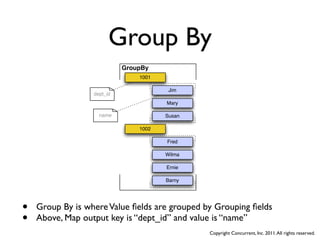
•   Group By is where Value fields are grouped by Grouping fields
•   Above, Map output key is “dept_id” and value is “name”
                                               Copyright Concurrent, Inc. 2011. All rights reserved.
Group By
                     Mapper                         Reducer
    Piggyback Code             [K1,V1]                      [K2,{V2,V2,....}]


                       [K1,V1] -> <A1,B1,C1,D1>     [K2,V2] -> <A2,B2,{<C2,D2>,...}>
        User Code


                                 Map                            Reduce


                     <A2,B2> -> K2, <C2,D2> -> V2    <A3,B3> -> K3, <C3,D3> -> V3


                               [K2,V2]                          [K3,V3]


•   So the K2 key becomes a composite Key of
    • key: [grouping], value: [values]

                                                                   Copyright Concurrent, Inc. 2011. All rights reserved.
Unique
         Mapper
          [0, "when in the course of
                human events"]             Map     ["when",null]      ["in",null]   [...,null]


                       ["when",1]
                        ["when",1]
                         ["when",1]
                          ["when",1]      Group    ["when",{nulls}]
                          ["when",null]
         Reducer

                      ["when",{nulls}]    Reduce   ["when",null]


•   Or Distinct (as in SQL)
•   Globally finding all the unique values in a dataset
    • Usually finding unique values in a column
•   Often used to filter a second dataset using a join
                                                                      Copyright Concurrent, Inc. 2011. All rights reserved.
Secondary Sort
      (group)   (sorted value)         (remaining value)
    Date          Time           Url

    08/08/2008, 1:00:00, http://www.example.com/foo

    08/08/2008, 1:01:00, http://www.example.com/bar

    08/08/2008, 1:01:30, http://www.example.com/baz


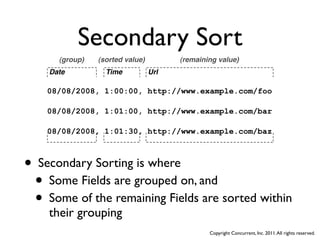
• Secondary Sorting is where
  • Some Fields are grouped on, and
  • Some of the remaining Fields are sorted within
    their grouping
                                               Copyright Concurrent, Inc. 2011. All rights reserved.
Secondary Sort
               Mapper                          Reducer
                          [K1,V1]                      [K2,{V2,V2,....}]


                 [K1,V1] -> <A1,B1,C1,D1>      [K2,V2] -> <A2,B2,{<C2,D2>,...}>


                           Map                             Reduce


               <A2,B2><C2> -> K2, <D2> -> V2    <A3,B3> -> K3, <C3,D3> -> V3


                          [K2,V2]                          [K3,V3]


•   So the K2 key becomes a composite Key of
    • key: [grouping, secondary], value: [remaining values]
•   The trick is to piggyback the Reduce sort yet not be compared
    during the unique key comparison
                                                                     Copyright Concurrent, Inc. 2011. All rights reserved.
Secondary Unique
        Mapper                                                                                       Assume Secondary Sorting
                                                                                                        magic happens here
               [0, "when in the course of
                     human events"]                Map     [0, "when"]    [0, "in"]     [0,"the"]    [0,...]


                             ["when",1]
                              ["when",1]
                               ["when",1]
                                ["when",1]        Group    [0,{"in","in","the","when","when",...}]
                                 [0,"when"]
        Reducer

        [0,{"in","in","the","when","when",...}]   Reduce   ["in",null]   ["the",null]    ["when",null]


•   Secondary Unique is where the grouping values are uniqued
    • .... in a “scale free” way
•   Perform a Secondary Sort...
•   Reducer removes duplicates by discarding every value that
    matches the previous value
    • since values are now ordered, no need to maintain a Set of
      values
                                                                                Copyright Concurrent, Inc. 2011. All rights reserved.
Joining
                           lhs data
                                          rhs data

                   1001

         dept_id           Jim        Accounting
                                                     dept_name
                          Mary        Accounting

         name             Susan       Accounting

                   1002

                          Fred         Shipping

                          Wilma        Shipping

                          Ernie        Shipping

                          Barny        Shipping


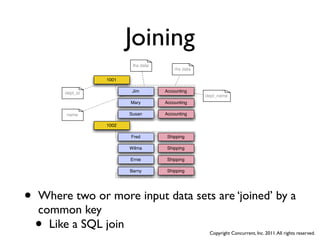
•   Where two or more input data sets are ‘joined’ by a
    common key
    • Like a SQL join
                                                      Copyright Concurrent, Inc. 2011. All rights reserved.
Join Definitions
•   Consider the input data [key, value]:
    •  LHS = [0,a] [1,b] [2,c]
    •  RHS = [0,A]                    [2,C] [3,D]
•   Joins on the key:
    •  Inner
      •   [0,a,A] [2,c,C]
    •  Outer (Left Outer, Right Outer)
      •   [0,a,A] [1,b,null] [2,c,C] [3,null,D]
    •  Left (Left Inner, Right Outer)
      •   [0,a,A] [1,b,null] [2,c,C]
    •  Right (Left Outer, Right Inner)
      •   [0,a,A] [2,c,C] [3,null,D]
                                     Copyright Concurrent, Inc. 2011. All rights reserved.
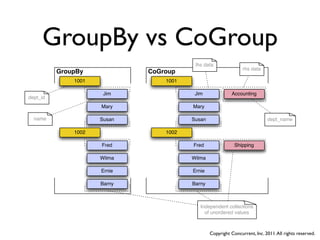
CoGrouping


• Before Joining, CoGrouping must happen
• Simply concurrent GroupBy operations on each
  input data set


                               Copyright Concurrent, Inc. 2011. All rights reserved.
GroupBy vs CoGroup
                                         lhs data
                                                                rhs data
          GroupBy            CoGroup
              1001               1001

                      Jim                Jim               Accounting
dept_id
                     Mary               Mary

  name               Susan              Susan                                dept_name

              1002               1002

                     Fred               Fred                Shipping

                     Wilma              Wilma

                     Ernie              Ernie

                     Barny              Barny


                                           Independent collections
                                             of unordered values


                                                Copyright Concurrent, Inc. 2011. All rights reserved.
CoGroup Joined
                          lhs data
                                         rhs data

                  1001

        dept_id           Jim        Accounting
                                                            dept_name
                         Mary        Accounting

         name            Susan       Accounting

                  1002

                         Fred         Shipping

                         Wilma        Shipping

                         Ernie        Shipping

                         Barny        Shipping


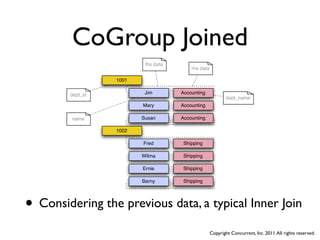
• Considering the previous data, a typical Inner Join
                                                    Copyright Concurrent, Inc. 2011. All rights reserved.
CoGrouping
    Mapper    [n]                            [n+1]                Reducer
            [K1,V1]                        [K1',V1']                           [K2,{V2,V2,....}]


                                                                   [K2,V2] -> <A2,B2,{<C2,D2,C2',D2'>,...}>
    [K1,V1] -> <A1,B1,C1,D1>     [K1',V1'] -> <A1',B1',C1',D1'>


                                                                                   Reduce
                               Map


                                                                       <A3,B3> -> K3, <C3,D3> -> V3
               <A2,B2> -> K2, [n]<C2,D2> -> V2


                           [K2,V2]                                                 [K3,V3]


•   Maps must run for each input set in same Job (n, n+1, etc)
•   CoGrouping must happen against each common key
                                                                           Copyright Concurrent, Inc. 2011. All rights reserved.
Joining
       Reducer
                    [K2,{V2,V2,....}]
                                                          <A2,B2,{[n]<C2,D2>,[n+1]..}>


        [K2,V2] -> <A2,B2,{<C2,D2,C2',D2'>,...}>
                                                      <A2,B2,{<C2,D2>,...},{<C2',D2'>,...}>


                        Reduce
                                                   {<C2,D2>,...}     Join       {<C2',D2'>,...}


            <A3,B3> -> K3, <C3,D3> -> V3                       <C2,D2,C2',D2'>


                        [K3,V3]                          <A2,B2,{<C2,D2,C2',D2'>,...}>


•   The CoGroups must be joined

•   Finally the Reduce can be applied
                                                                    Copyright Concurrent, Inc. 2011. All rights reserved.
Optimizations

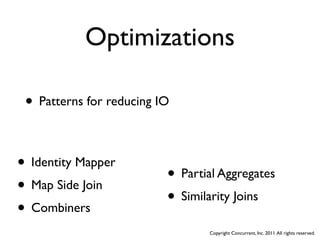
 • Patterns for reducing IO

• Identity Mapper
                          • Partial Aggregates
• Map Side Join
                          • Similarity Joins
• Combiners
                                 Copyright Concurrent, Inc. 2011. All rights reserved.
Identity Mapper                                                                                                                                                                                                  [head]


                                                                                                                                                                                Dfs['TextLine[['offset', 'line']->[ALL]]']['/logs/stumbles/short-stumbles-20090504.log']']

                                                                                                                                                                                                                       [{2}:'offset', 'line']
                                                                                                                                                                                                                       [{2}:'offset', 'line']

                                                                                                                                                                                             Each('import')[RegexParser[decl:'day', 'urlid', 'method'][args:1]]

                                                                                                                                                                                                                  [{3}:'day', 'urlid', 'method']
                                                                                                                                                                                                                  [{3}:'day', 'urlid', 'method']

                                                                                                                                                                                               Each('import')[ExpressionFilter[decl:'day', 'urlid', 'method']]

                                                                                                                                                                                                                  [{3}:'day', 'urlid', 'method']
                                                                                                                                                                                                                  [{3}:'day', 'urlid', 'method']

                                                                                                                                                                                            TempHfs['SequenceFile[['day', 'urlid', 'method']]'][import/71897/]

                                                                                                                                                                                             [{3}:'day', 'urlid', 'method']
                                                                                                                                                                                             [{3}:'day', 'urlid', 'method']
                                                                                                                                                                                                                       [{3}:'day', 'urlid', 'method']
                                                   identity                                                                                                                                                            [{3}:'day', 'urlid', 'method']
                                                                                                                                                                     Each('paidCount')[Not[decl:'day', 'urlid', 'method']]


                                                  function                                                                                                                       [{3}:'day', 'urlid', 'method']
                                                                                                                                                                                 [{3}:'day', 'urlid', 'method']
                                                                                                                                                                                                                  Each('organicCount')[OrganicFilter[decl:'day', 'urlid', 'method']]


                                                                                                                                                                                                                                         [{3}:'day', 'urlid', 'method']
                                                                                                                                                                        GroupBy('paidCount')[by:['day', 'urlid']]
                                                                                                                                                                                                                                         [{3}:'day', 'urlid', 'method']

                                                                                                                                                                              paidCount[{2}:'day', 'urlid']
                                                                                                                                                                                                                               GroupBy('organicCount')[by:['day', 'urlid']]
                                                                                                                                                                              [{3}:'day', 'urlid', 'method']

                                                                                                                                                                                                                                       organicCount[{2}:'day', 'urlid']
                                                                                                                                                                       Every('paidCount')[Count[decl:'count']]
                                                                                                                                                                                                                                       [{3}:'day', 'urlid', 'method']

                                                                                                                                                                               [{3}:'day', 'urlid', 'count']
                                                                                                                                                                                                                               Every('organicCount')[Count[decl:'count']]


•
                                                                                                                                                                               [{3}:'day', 'urlid', 'method']


    Move Map operations to the
                                                                                                                                                        Each('paidCount')[Identity[decl:'paid_day', 'paid_urlid', 'paid_count']]
                                                                                                                                                                                                                                                           [{3}:'day', 'urlid', 'count']
                                                                                                                                                                                                                                                           [{3}:'day', 'urlid', 'method']
                                                                                                                                                             [{3}:'paid_day', 'paid_urlid', 'paid_count']
                                                                                                                                                             [{3}:'paid_day', 'paid_urlid', 'paid_count']

                                                                                                                         TempHfs['SequenceFile[['paid_day', 'paid_urlid', 'paid_count']]'][paidCount/33072/]                                         TempHfs['SequenceFile[['day', 'urlid', 'count']]'][organicCount/97544/]

                                                                                                                    [{3}:'paid_day', 'paid_urlid', 'paid_count']                      [{3}:'paid_day', 'paid_urlid', 'paid_count']


    previous Reduce
                                                                                                                    [{3}:'paid_day', 'paid_urlid', 'paid_count']                                   [{3}:'day', 'urlid', 'count']
                                                                                                                                                                                      [{3}:'paid_day', 'paid_urlid', 'paid_count']                                           [{3}:'day', 'urlid', 'count']
                                                                                                                                                                                                   [{3}:'day', 'urlid', 'count']
                                                                                                                                                                                                                                                                             [{3}:'day', 'urlid', 'count']
                                                    CoGroup('organicCount*paidCount')[by:organicCount:['day', 'urlid']paidCount:['paid_day', 'paid_urlid']]                                             Each('paidDomainCount')[LookupDomainFunction[decl:'domainid'][args:1]]


                                                                 organicCount[{2}:'day', 'urlid'],paidCount[{2}:'paid_day', 'paid_urlid']                                                                            [{4}:'paid_day', 'paid_urlid', 'paid_count', 'domainid']
                                                                                                                                                                                                                                                                   Each('organicDomainCount')[LookupDomainFunction[decl:'domainid'][args:1]]
                                                                 [{6}:'day', 'urlid', 'count', 'paid_day', 'paid_urlid', 'paid_count']                                                                               [{4}:'paid_day', 'paid_urlid', 'paid_count', 'domainid']

                                                                                                                                                                                                                                                                                                [{4}:'day', 'urlid', 'count', 'domainid']
                                                        Each('organicCount*paidCount')[ExpressionFunction[decl:'urlid_day']]                                                                                      GroupBy('paidDomainCount')[by:['paid_day', 'domainid']]
                                                                                                                                                                                                                                                                                                [{4}:'day', 'urlid', 'count', 'domainid']


•
                                                     [{7}:'day', 'urlid', 'count', 'paid_day', 'paid_urlid', 'paid_count', 'urlid_day']                                                                              paidDomainCount[{2}:'paid_day', 'domainid']
                                                                                                                                                                                                                                                                                     GroupBy('organicDomainCount')[by:['day', 'domainid']]
                                                     [{7}:'day', 'urlid', 'count', 'paid_day', 'paid_urlid', 'paid_count', 'urlid_day']                                                                              [{4}:'paid_day', 'paid_urlid', 'paid_count', 'domainid']


    Replace with an Identity
                                                                                                                                                                                                                                                                                             organicDomainCount[{2}:'day', 'domainid']
                                                   Each('organicCount*paidCount')[ExpressionFunction[decl:'fixed_count']]                                                                                             Every('paidDomainCount')[Sum[decl:'sum'][args:1]]
                                                                                                                                                                                                                                                                                             [{4}:'day', 'urlid', 'count', 'domainid']

                                            [{8}:'day', 'urlid', 'count', 'paid_day', 'paid_urlid', 'paid_count', 'urlid_day', 'fixed_count']                                                                         [{3}:'paid_day', 'domainid', 'sum']
                                                                                                                                                                                                                                                                                      Every('organicDomainCount')[Sum[decl:'sum'][args:1]]
                                            [{8}:'day', 'urlid', 'count', 'paid_day', 'paid_urlid', 'paid_count', 'urlid_day', 'fixed_count']                                                                         [{4}:'paid_day', 'paid_urlid', 'paid_count', 'domainid']


    function
                                                                                                                                                                                                                                                                                                     [{3}:'day', 'domainid', 'sum']
                                               Each('organicCount*paidCount')[ExpressionFunction[decl:'fixed_paid_count']]                                                                            Each('paidDomainCount')[Identity[decl:'paid_day', 'paid_domainid', 'paid_sum']]
                                                                                                                                                                                                                                                                                                     [{4}:'day', 'urlid', 'count', 'domainid']

                                 [{9}:'day', 'urlid', 'count', 'paid_day', 'paid_urlid', 'paid_count', 'urlid_day', 'fixed_count', 'fixed_paid_count']                                                                     [{3}:'paid_day', 'paid_domainid', 'paid_sum']
                                                                                                                                                                                                                                                                       TempHfs['SequenceFile[['day', 'domainid', 'sum']]'][organicDomainCount/49784/]
                                 [{9}:'day', 'urlid', 'count', 'paid_day', 'paid_urlid', 'paid_count', 'urlid_day', 'fixed_count', 'fixed_paid_count']                                                                     [{3}:'paid_day', 'paid_domainid', 'paid_sum']


                               Each('organicCount*paidCount')[Identity[decl:'urlid_day', 'default:organic_stumbles', 'default:paid_stumbles']]                                              TempHfs['SequenceFile[['paid_day', 'paid_domainid', 'paid_sum']]'][paidDomainCount/54349/]

                                                                                                                                                                                                                         [{3}:'paid_day', 'paid_domainid', 'paid_sum']                      [{3}:'day', 'domainid', 'sum']


•
                                                                                                                                                                                                                         [{3}:'paid_day', 'paid_domainid', 'paid_sum']                      [{3}:'day', 'domainid', 'sum']
                                                                       [{3}:'urlid_day', 'default:organic_stumbles', 'default:paid_stumbles']
                                                                       [{3}:'urlid_day', 'default:organic_stumbles', 'default:paid_stumbles']
                                                                                                                                                                 CoGroup('organicDomainCount*paidDomainCount')[by:organicDomainCount:['day', 'domainid']paidDomainCount:['paid_day', 'paid_domainid']]


    Assumes Map operations                                                                              cascading.hbase.HBaseTap@d9a475a0
                                                                                                                                                                                         organicDomainCount[{2}:'day', 'domainid'],paidDomainCount[{2}:'paid_day', 'paid_domainid']
                                                                                                                                                                                         [{6}:'day', 'domainid', 'sum', 'paid_day', 'paid_domainid', 'paid_sum']


                                                                                                                                                                                      Each('organicDomainCount*paidDomainCount')[ExpressionFunction[decl:'domainid_day']]


    reduce the data
                                                                                                                                                                                         [{7}:'day', 'domainid', 'sum', 'paid_day', 'paid_domainid', 'paid_sum', 'domainid_day']
                                                                                                                                                                                         [{7}:'day', 'domainid', 'sum', 'paid_day', 'paid_domainid', 'paid_sum', 'domainid_day']

                                                                                             [{3}:'urlid_day', 'default:organic_stumbles', 'default:paid_stumbles']
                                                                                                                                                                                      Each('organicDomainCount*paidDomainCount')[ExpressionFunction[decl:'fixed_sum']]
                                                                                             [{3}:'urlid_day', 'default:organic_stumbles', 'default:paid_stumbles']

                                                                                                                                                                               [{8}:'day', 'domainid', 'sum', 'paid_day', 'paid_domainid', 'paid_sum', 'domainid_day', 'fixed_sum']
                                                                                                                                                                               [{8}:'day', 'domainid', 'sum', 'paid_day', 'paid_domainid', 'paid_sum', 'domainid_day', 'fixed_sum']

                                                                                                                                                                                  Each('organicDomainCount*paidDomainCount')[ExpressionFunction[decl:'fixed_paid_sum']]

                                                                                                                                                                     [{9}:'day', 'domainid', 'sum', 'paid_day', 'paid_domainid', 'paid_sum', 'domainid_day', 'fixed_sum', 'fixed_paid_sum']
                                                                                                                                                                     [{9}:'day', 'domainid', 'sum', 'paid_day', 'paid_domainid', 'paid_sum', 'domainid_day', 'fixed_sum', 'fixed_paid_sum']

                                                                                                                                                             Each('organicDomainCount*paidDomainCount')[Identity[decl:'domainid_day', 'default:organic_stumbles', 'default:paid_stumbles']]

                                                                                                                                                                     [{3}:'domainid_day', 'default:organic_stumbles', 'default:paid_stumbles']
                                                                                                                                                                     [{3}:'domainid_day', 'default:organic_stumbles', 'default:paid_stumbles']

                                                                                                                                                                cascading.hbase.HBaseTap@3d07f00

                                                                                                                        [{3}:'domainid_day', 'default:organic_stumbles', 'default:paid_stumbles']
                                                                                                                        [{3}:'domainid_day', 'default:organic_stumbles', 'default:paid_stumbles']

                                                                                                                                               [tail]


                                                                                                                                          Copyright Concurrent, Inc. 2011. All rights reserved.
Map Side Joins
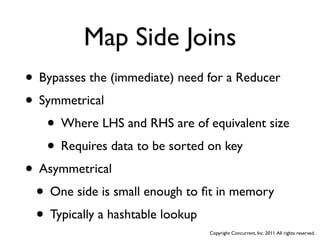
• Bypasses the (immediate) need for a Reducer
• Symmetrical
   • Where LHS and RHS are of equivalent size
   • Requires data to be sorted on key
• Asymmetrical
 • One side is small enough to fit in memory
 • Typically a hashtable lookup
                               Copyright Concurrent, Inc. 2011. All rights reserved.
Combiners
        Mapper
         [0, "when in the course of
               human events"]           Map     ["when",1]    ["in",1]     ["the",1]    [...,1]

                Combiner
                         ["when",1]
                          ["when",1]   Group      ["when",{1,1}]


                   ["when",{1,1}]      Reduce   ["when",2]
                                                                         Same Implementation

                        ["when",1]
                         ["when",1]    Group     ["when",{2,1,2}]
                          ["when",2]
        Reducer

                   ["when",{2,1,2}]    Reduce   ["when",5]


•   Where Reduce runs Map side, and again Reduce side
•   Only works if Reduce is commutative and associative
•   Reduces bandwidth by trading CPU for IO
    • Serialization/deserialization during local sorting before combining
                                                                    Copyright Concurrent, Inc. 2011. All rights reserved.
Partial Aggregates
         Mapper
          [0, "when in the course of
                human events"]                   ["when",1]    ["in",1]    ["the",1]     [...,1]

                                         Map
                 Partial
                                                                             Provides an opportunity to
                         ["when",1]
                          ["when",1]             ["when",2]                  promote the functionality of
                                                                            the next Map to this Reduce

                         ["when",1]
                          ["when",1]    Group     ["when",{2,1,2}]
                           ["when",2]
         Reducer

                    ["when",{2,1,2}]    Reduce   ["when",5]


•   Supports any aggregate type, while being composable with other
    aggregates
•   Reduces bandwidth by trading Memory for IO
    • Very important for a CPU constrained cluster
    • Use a bounded LRU to keep constant memory (requires tuning)
                                                                      Copyright Concurrent, Inc. 2011. All rights reserved.
Partial Aggregates
                   [a,b,c,a,a,b]
                    [a,b,c,a,a,b]     partial unique
                                       partial unique     [a,b,c,a,b]
                                                           [a,b,c,a,b]
                     [a,b,c,a,a,b]
                      [a,b,c,a,a,b]     partial unique
                                         partial unique     [a,b,c,a,b]
                                                             [a,b,c,a,b]

                                          LRU*

                                          {_,_}
                                                            *cache size of 2
                                      a -> {a,_} -> _

                                      b -> {b,a} -> _
                         incoming                          discarded
                                      c -> {c,b} -> a
                           value                             value
                                      a -> {a,c} -> b

                                        a -> {a,c}

                                      b -> {b,a} -> c


•   OK that dupes emit from a Mapper and across
    Mappers (or prev Reducers!)
•   Final aggregation happens in Reducer
•   Larger the cache, fewer dupes     Copyright Concurrent, Inc. 2011. All rights reserved.
Tradeoffs


• CPU for IO == fault tolerance
• Memory for IO == performance


                              Copyright Concurrent, Inc. 2011. All rights reserved.
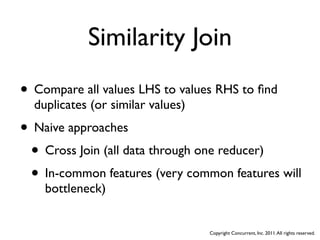
Similarity Join
• Compare all values LHS to values RHS to find
  duplicates (or similar values)
• Naive approaches
 • Cross Join (all data through one reducer)
 • In-common features (very common features will
    bottleneck)


                                   Copyright Concurrent, Inc. 2011. All rights reserved.
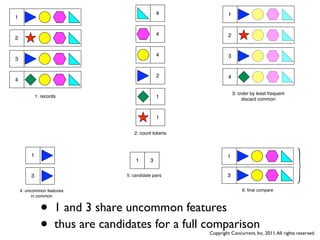
Set-Similarity Joining


• “Efficient Parallel Set-Similarity Joins Using
  MapReduce” - R Vernica, M Carey, C Li

• Only compare candidate pairs
• Candidates share uncommon features
                                 Copyright Concurrent, Inc. 2011. All rights reserved.
4             1
1


                                                    4             2
2


                                                    4             3
3


                                                    2             4
4

                                                                      3: order by least frequent
             1: records                             1                      discard common


                                                    1

                                       2: count tokens


         1                                                        1
                                        1       3

         3                          5: candidate pairs            3

    4: uncommon features                                                  6: final compare
          in common


               •      1 and 3 share uncommon features
               •      thus are candidates for a full comparison
                                                         Copyright Concurrent, Inc. 2011. All rights reserved.
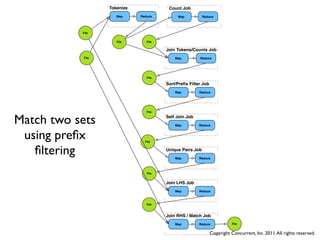
Tokenize              Count Job
                      Map     Reduce         Map           Reduce


           File


                      File       File

                                        Join Tokens/Counts Job
            File                            Map         Reduce


                                 File

                                        Sort/Prefix Filter Job
                                            Map         Reduce


                                 File


Match two sets                          Self Join Job
                                            Map         Reduce


 using prefix                    File


   filtering                             Unique Pairs Job
                                            Map         Reduce


                                 File


                                        Join LHS Job
                                            Map         Reduce


                                 File


                                        Join RHS / Match Job
                                            Map         Reduce             File


                                                                Copyright Concurrent, Inc. 2011. All rights reserved.
Duality


• Note the use of the previous patterns to route
  data to implement a more efficient algorithm


                                 Copyright Concurrent, Inc. 2011. All rights reserved.
Use a Higher
               Abstraction
•   Command Line
    • Multitool - CLI for parallel sed, grep & joins

•   API
    • Cascading - Java Query API and Planner
    • Plume - “approximate clone of FlumeJava”

•   Interactive Shell
    •  Cascalog - Clojure+Cascading query language (API also)
    •  Pig - A text Syntax
    •  Hive - Syntax + Infrastructure - SQL “like”
                                             Copyright Concurrent, Inc. 2011. All rights reserved.
References

•   Set Similarity
    •  http://www.slideshare.net/ydn/4-similarity-joinshadoopsummit2010
    •  http://asterix.ics.uci.edu/fuzzyjoin-mapreduce/

•   MapReduce Text Processing
    • http://www.umiacs.umd.edu/~jimmylin/book.html

•   Plume/FlumeJava
    •  http://portal.acm.org/citation.cfm?id=1806596.1806638
    •  http://github.com/tdunning/Plume/wiki


                                                Copyright Concurrent, Inc. 2011. All rights reserved.
I’m Hiring

• Enterprise Java server and web client
• Language design, compilers, and interpreters
• No Hadoop experience required
• More info
 • http://www.concurrentinc.com/careers/
                                  Copyright Concurrent, Inc. 2011. All rights reserved.
Resources
•   Chris K Wensel
    •chris@wensel.net
    •@cwensel

•   Cascading & Cascalog
    •http://cascading.org
    •@cascading

•   Concurrent, Inc.
    •http://concurrentinc.com
    •@concurrent
                                Copyright Concurrent, Inc. 2011. All rights reserved.
Appendix


       Copyright Concurrent, Inc. 2011. All rights reserved.
Simple Total Sorting

•   Where lines in a result file should be sorted


•   Must set number of reducers to 1
    •   Sorting in MR is local per Reduce, not global across
        Reducers


                                          Copyright Concurrent, Inc. 2011. All rights reserved.
Why Sorting Isn’t
                 “Total”
       [aaa,aab,aac]    Mapper

                                 aaa

                        Mapper   aac      Reducer    [aaa,zzx]

                                 aab

                        Mapper            Reducer    [aac,zzz]

                                 zzx

                        Mapper   zzz      Reducer    [aab,zzy]

                                 zzy

        [zzx,zzy,zzz]   Mapper


•   Keys emitted from Map are naturally sorted at a given Reducer
•   But are Partitioned to Reducers in a random way
•   Thus, only one Reducer can be used for a total sort
                                              Copyright Concurrent, Inc. 2011. All rights reserved.
Distributed Total Sort

• To work, the Shuffling phase must be modified
  with:
 • Custom Partitioner to partition on the
    distribution of ordered Keys
 • Custom Comparator for comparing Key types
  • Strings work by default
                                   Copyright Concurrent, Inc. 2011. All rights reserved.
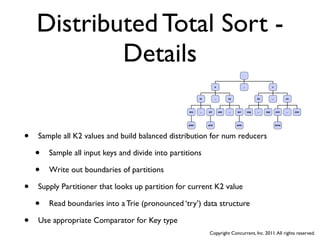
Distributed Total Sort -
            Details
                                                                       a                        ...                     z


                                                          ar           ...         ax                       za          ...          zo


                                                    ara   ...   ari          axe   ...   axi          zag   ...   zap         zon    ...   zoo


                                                   aran         aria                     axis                                 zone


•   Sample all K2 values and build balanced distribution for num reducers

    •   Sample all input keys and divide into partitions

    •   Write out boundaries of partitions

•   Supply Partitioner that looks up partition for current K2 value

    •   Read boundaries into a Trie (pronounced ‘try’) data structure

•   Use appropriate Comparator for Key type
                                                                 Copyright Concurrent, Inc. 2011. All rights reserved.

Buzz words

  • 1.
    Common MapReduce Patterns Chris K Wensel BuzzWords 2011
  • 2.
    Engineer, Not Academic • Concurrent, Inc., Founder • Cascading support and tools • http://concurrentinc.com/ • Cascading, Lead Developer (started Sept 2007) • An alternative API to MapReduce • http://cascading.org/ • Formerly Hadoop mentoring and training • Sun - Apple - HP - LexisNexis - startups - etc • Formerly Systems Architect & Consultant • Thomson/Reuters - TeleAtlas - startups - etc Copyright Concurrent, Inc. 2011. All rights reserved.
  • 3.
    Overview • MapReduce • HeavyLifting • Analytics • Optimizations Copyright Concurrent, Inc. 2011. All rights reserved.
  • 4.
    MapReduce • A “divideand conquer” strategy for parallelizing workloads against collections of data • Map & Reduce are two user defined functions chained via Key Value Pairs • It’s really Map->Group->Reduce where Group is built in Copyright Concurrent, Inc. 2011. All rights reserved.
  • 5.
    Keys and Values • Map translates input to keys and values to new keys and values [K1,V1] Map [K2,V2]* • System Groups each unique [K2,V2] Group [K2,{V2,V2,....}] key with all its values [K2,{V2,V2,....}] Reduce [K3,V3]* • Reduce translates the values of each unique key to new keys and values * = zero or more Copyright Concurrent, Inc. 2011. All rights reserved.
  • 6.
    Word Count Mapper [0,"when in the course of human events"] Map ["when",1] ["in",1] ["the",1] [...,1] ["when",1] ["when",1] ["when",1] ["when",1] Group ["when",{1,1,1,1,1}] ["when",1] Reducer ["when",{1,1,1,1,1}] Reduce ["when",5] Copyright Concurrent, Inc. 2011. All rights reserved.
  • 7.
    Divide and Conquer Parallelism • Since the ‘records’ entering the Map and ‘groups’ entering the Reduce are independent • That is, there is no expectation of order or requirement to share state between records/ groups • Arbitrary numbers of Map and Reduce function instances can be created against arbitrary portions of input data Copyright Concurrent, Inc. 2011. All rights reserved.
  • 8.
    Cluster Cluster Rack Rack Rack Node Node Node Node ... map map map map map reduce reduce reduce • Multiple instances of each Map and Reduce function are distributed throughout the cluster Copyright Concurrent, Inc. 2011. All rights reserved.
  • 9.
    Another View [K1,V1] Map [K2,V2] Combine Group [K2,{V2,...}] Reduce [K3,V3] Mapper Task same code Mapper Reducer Shuffle Task Task Mapper Reducer Shuffle Task Task Mapper Reducer Shuffle Task Task Mapper Task Mappers must complete before Reducers can begin split1 split2 split3 split4 ... part-00000 part-00001 part-000N file directory Copyright Concurrent, Inc. 2011. All rights reserved.
  • 10.
    Complex job assemblies • Real applications are many MapReduce jobs chained together • Linked by intermediate (usually temporary) files • Executed in order, by hand, from the ‘client’ application Count Job Sort Job [ k, [v] ] [ k, [v] ] Map Reduce Map Reduce [ k, v ] [ k, v ] [ k, v ] [ k, v ] File File File [ k, v ] = key and value pair [ k, [v] ] = key and associated values collection Copyright Concurrent, Inc. 2011. All rights reserved.
  • 11.
    Real World Apps [37/75] map+reduce [54/75] map+reduce [41/75] map+reduce [43/75] map+reduce [42/75] map+reduce [45/75] map+reduce [44/75] map+reduce [39/75] map+reduce [36/75] map+reduce [46/75] map+reduce [40/75] map+reduce [50/75] map+reduce [38/75] map+reduce [49/75] map+reduce [51/75] map+reduce [47/75] map+reduce [52/75] map+reduce [53/75] map+reduce [48/75] map+reduce [23/75] map+reduce [25/75] map+reduce [24/75] map+reduce [27/75] map+reduce [26/75] map+reduce [21/75] map+reduce [19/75] map+reduce [28/75] map+reduce [22/75] map+reduce [32/75] map+reduce [20/75] map+reduce [31/75] map+reduce [33/75] map+reduce [29/75] map+reduce [34/75] map+reduce [35/75] map+reduce [30/75] map+reduce [7/75] map+reduce [2/75] map+reduce [8/75] map+reduce [10/75] map+reduce [9/75] map+reduce [5/75] map+reduce [3/75] map+reduce [11/75] map+reduce [6/75] map+reduce [13/75] map+reduce [4/75] map+reduce [16/75] map+reduce [14/75] map+reduce [15/75] map+reduce [17/75] map+reduce [18/75] map+reduce [12/75] map+reduce [60/75] map [62/75] map [61/75] map [58/75] map [55/75] map [56/75] map+reduce [57/75] map [71/75] map [72/75] map [59/75] map [64/75] map+reduce [63/75] map+reduce [65/75] map+reduce [68/75] map+reduce [67/75] map+reduce [70/75] map+reduce [69/75] map+reduce [73/75] map+reduce [66/75] map+reduce [74/75] map+reduce [75/75] map+reduce [1/75] map+reduce 1 app, 75 jobs green = map + reduce purple = map blue = join/merge orange = map split Copyright Concurrent, Inc. 2011. All rights reserved.
  • 12.
    Heavy Lifting • Thing we must do because data can be heavy • These patterns are natural to MapReduce and easy to implement • But have some room for composition/aggregation within a Map/ Reduce (i.e., Filter + Binning) • (leading us to think of Hadoop as an ETL framework) • Record Filtering • Parsing, Conversion • Binning • Counting, Summing • Distributed Tasks • Unique Copyright Concurrent, Inc. 2011. All rights reserved.
  • 13.
    Record Filtering • Thinkunix ‘grep’ • Filtering is discarding unwanted values (or preserving wanted) • Only uses a Map function, no Reducer Copyright Concurrent, Inc. 2011. All rights reserved.
  • 14.
    Parsing, Conversion • Think unix ‘sed’ • A Map function that takes an input key and/or value and translates it into a new format • Examples: • raw logs to delimited text or archival efficient binary • entity extraction Copyright Concurrent, Inc. 2011. All rights reserved.
  • 15.
    Counting, Summing • Thesame as SQL aggregation functions • Simply applying some function to the values collection seen in Reduce • Other examples: • average, max, min, unique Copyright Concurrent, Inc. 2011. All rights reserved.
  • 16.
    Merging • Where many files of the same type are converted to one output path • Map side merges • One directory with as many part files as Mappers • Reduce side merges • Allows for removing duplicates or deleted items • One directory with as many part files as Reducers • Examples • Nutch • Normalizing log files (apache, log4j, etc) Copyright Concurrent, Inc. 2011. All rights reserved.
  • 17.
    Binning • Where the values associated w/ unique keys are persisted together • Typically a directory path based on key’s value • Must be conscious of total open files, remember no appends • Examples: • web log files by year/month/day • trade data by symbol Copyright Concurrent, Inc. 2011. All rights reserved.
  • 18.
    Distributed Tasks • Simply where a Map or Reduce function executes some ‘task’ based on the input key and value. • Examples: • web crawling, • load testing services, • rdbms/nosql updates, • file transfers (S3), • image to pdf (NYT on EC2) Copyright Concurrent, Inc. 2011. All rights reserved.
  • 19.
    Basic Analytic Patterns • Some of these patterns are unnatural to MapReduce • We think in terms of columns/fields, not key value pairs • (leading us to think of Hadoop as a RDBMS) • Group By • Secondary Unique • Unique • CoGrouping and Joining • Secondary Sort Copyright Concurrent, Inc. 2011. All rights reserved.
  • 20.
    Composite Keys/Values [K1,V1] <A1,B1,C1,...> • It is easier to think in columns/fields • e.g. “firstname” & “lastname”, not “line” • Whether a set of columns are Keys or Values is arbitrary • Keys become a means to piggyback the properties of MR and become an impl detail Copyright Concurrent, Inc. 2011. All rights reserved.
  • 21.
    Group By GroupBy 1001 Jim dept_id Mary name Susan 1002 Fred Wilma Ernie Barny • Group By is where Value fields are grouped by Grouping fields • Above, Map output key is “dept_id” and value is “name” Copyright Concurrent, Inc. 2011. All rights reserved.
  • 22.
    Group By Mapper Reducer Piggyback Code [K1,V1] [K2,{V2,V2,....}] [K1,V1] -> <A1,B1,C1,D1> [K2,V2] -> <A2,B2,{<C2,D2>,...}> User Code Map Reduce <A2,B2> -> K2, <C2,D2> -> V2 <A3,B3> -> K3, <C3,D3> -> V3 [K2,V2] [K3,V3] • So the K2 key becomes a composite Key of • key: [grouping], value: [values] Copyright Concurrent, Inc. 2011. All rights reserved.
  • 23.
    Unique Mapper [0, "when in the course of human events"] Map ["when",null] ["in",null] [...,null] ["when",1] ["when",1] ["when",1] ["when",1] Group ["when",{nulls}] ["when",null] Reducer ["when",{nulls}] Reduce ["when",null] • Or Distinct (as in SQL) • Globally finding all the unique values in a dataset • Usually finding unique values in a column • Often used to filter a second dataset using a join Copyright Concurrent, Inc. 2011. All rights reserved.
  • 24.
    Secondary Sort (group) (sorted value) (remaining value) Date Time Url 08/08/2008, 1:00:00, http://www.example.com/foo 08/08/2008, 1:01:00, http://www.example.com/bar 08/08/2008, 1:01:30, http://www.example.com/baz • Secondary Sorting is where • Some Fields are grouped on, and • Some of the remaining Fields are sorted within their grouping Copyright Concurrent, Inc. 2011. All rights reserved.
  • 25.
    Secondary Sort Mapper Reducer [K1,V1] [K2,{V2,V2,....}] [K1,V1] -> <A1,B1,C1,D1> [K2,V2] -> <A2,B2,{<C2,D2>,...}> Map Reduce <A2,B2><C2> -> K2, <D2> -> V2 <A3,B3> -> K3, <C3,D3> -> V3 [K2,V2] [K3,V3] • So the K2 key becomes a composite Key of • key: [grouping, secondary], value: [remaining values] • The trick is to piggyback the Reduce sort yet not be compared during the unique key comparison Copyright Concurrent, Inc. 2011. All rights reserved.
  • 26.
    Secondary Unique Mapper Assume Secondary Sorting magic happens here [0, "when in the course of human events"] Map [0, "when"] [0, "in"] [0,"the"] [0,...] ["when",1] ["when",1] ["when",1] ["when",1] Group [0,{"in","in","the","when","when",...}] [0,"when"] Reducer [0,{"in","in","the","when","when",...}] Reduce ["in",null] ["the",null] ["when",null] • Secondary Unique is where the grouping values are uniqued • .... in a “scale free” way • Perform a Secondary Sort... • Reducer removes duplicates by discarding every value that matches the previous value • since values are now ordered, no need to maintain a Set of values Copyright Concurrent, Inc. 2011. All rights reserved.
  • 27.
    Joining lhs data rhs data 1001 dept_id Jim Accounting dept_name Mary Accounting name Susan Accounting 1002 Fred Shipping Wilma Shipping Ernie Shipping Barny Shipping • Where two or more input data sets are ‘joined’ by a common key • Like a SQL join Copyright Concurrent, Inc. 2011. All rights reserved.
  • 28.
    Join Definitions • Consider the input data [key, value]: • LHS = [0,a] [1,b] [2,c] • RHS = [0,A] [2,C] [3,D] • Joins on the key: • Inner • [0,a,A] [2,c,C] • Outer (Left Outer, Right Outer) • [0,a,A] [1,b,null] [2,c,C] [3,null,D] • Left (Left Inner, Right Outer) • [0,a,A] [1,b,null] [2,c,C] • Right (Left Outer, Right Inner) • [0,a,A] [2,c,C] [3,null,D] Copyright Concurrent, Inc. 2011. All rights reserved.
  • 29.
    CoGrouping • Before Joining,CoGrouping must happen • Simply concurrent GroupBy operations on each input data set Copyright Concurrent, Inc. 2011. All rights reserved.
  • 30.
    GroupBy vs CoGroup lhs data rhs data GroupBy CoGroup 1001 1001 Jim Jim Accounting dept_id Mary Mary name Susan Susan dept_name 1002 1002 Fred Fred Shipping Wilma Wilma Ernie Ernie Barny Barny Independent collections of unordered values Copyright Concurrent, Inc. 2011. All rights reserved.
  • 31.
    CoGroup Joined lhs data rhs data 1001 dept_id Jim Accounting dept_name Mary Accounting name Susan Accounting 1002 Fred Shipping Wilma Shipping Ernie Shipping Barny Shipping • Considering the previous data, a typical Inner Join Copyright Concurrent, Inc. 2011. All rights reserved.
  • 32.
    CoGrouping Mapper [n] [n+1] Reducer [K1,V1] [K1',V1'] [K2,{V2,V2,....}] [K2,V2] -> <A2,B2,{<C2,D2,C2',D2'>,...}> [K1,V1] -> <A1,B1,C1,D1> [K1',V1'] -> <A1',B1',C1',D1'> Reduce Map <A3,B3> -> K3, <C3,D3> -> V3 <A2,B2> -> K2, [n]<C2,D2> -> V2 [K2,V2] [K3,V3] • Maps must run for each input set in same Job (n, n+1, etc) • CoGrouping must happen against each common key Copyright Concurrent, Inc. 2011. All rights reserved.
  • 33.
    Joining Reducer [K2,{V2,V2,....}] <A2,B2,{[n]<C2,D2>,[n+1]..}> [K2,V2] -> <A2,B2,{<C2,D2,C2',D2'>,...}> <A2,B2,{<C2,D2>,...},{<C2',D2'>,...}> Reduce {<C2,D2>,...} Join {<C2',D2'>,...} <A3,B3> -> K3, <C3,D3> -> V3 <C2,D2,C2',D2'> [K3,V3] <A2,B2,{<C2,D2,C2',D2'>,...}> • The CoGroups must be joined • Finally the Reduce can be applied Copyright Concurrent, Inc. 2011. All rights reserved.
  • 34.
    Optimizations • Patternsfor reducing IO • Identity Mapper • Partial Aggregates • Map Side Join • Similarity Joins • Combiners Copyright Concurrent, Inc. 2011. All rights reserved.
  • 35.
    Identity Mapper [head] Dfs['TextLine[['offset', 'line']->[ALL]]']['/logs/stumbles/short-stumbles-20090504.log']'] [{2}:'offset', 'line'] [{2}:'offset', 'line'] Each('import')[RegexParser[decl:'day', 'urlid', 'method'][args:1]] [{3}:'day', 'urlid', 'method'] [{3}:'day', 'urlid', 'method'] Each('import')[ExpressionFilter[decl:'day', 'urlid', 'method']] [{3}:'day', 'urlid', 'method'] [{3}:'day', 'urlid', 'method'] TempHfs['SequenceFile[['day', 'urlid', 'method']]'][import/71897/] [{3}:'day', 'urlid', 'method'] [{3}:'day', 'urlid', 'method'] [{3}:'day', 'urlid', 'method'] identity [{3}:'day', 'urlid', 'method'] Each('paidCount')[Not[decl:'day', 'urlid', 'method']] function [{3}:'day', 'urlid', 'method'] [{3}:'day', 'urlid', 'method'] Each('organicCount')[OrganicFilter[decl:'day', 'urlid', 'method']] [{3}:'day', 'urlid', 'method'] GroupBy('paidCount')[by:['day', 'urlid']] [{3}:'day', 'urlid', 'method'] paidCount[{2}:'day', 'urlid'] GroupBy('organicCount')[by:['day', 'urlid']] [{3}:'day', 'urlid', 'method'] organicCount[{2}:'day', 'urlid'] Every('paidCount')[Count[decl:'count']] [{3}:'day', 'urlid', 'method'] [{3}:'day', 'urlid', 'count'] Every('organicCount')[Count[decl:'count']] • [{3}:'day', 'urlid', 'method'] Move Map operations to the Each('paidCount')[Identity[decl:'paid_day', 'paid_urlid', 'paid_count']] [{3}:'day', 'urlid', 'count'] [{3}:'day', 'urlid', 'method'] [{3}:'paid_day', 'paid_urlid', 'paid_count'] [{3}:'paid_day', 'paid_urlid', 'paid_count'] TempHfs['SequenceFile[['paid_day', 'paid_urlid', 'paid_count']]'][paidCount/33072/] TempHfs['SequenceFile[['day', 'urlid', 'count']]'][organicCount/97544/] [{3}:'paid_day', 'paid_urlid', 'paid_count'] [{3}:'paid_day', 'paid_urlid', 'paid_count'] previous Reduce [{3}:'paid_day', 'paid_urlid', 'paid_count'] [{3}:'day', 'urlid', 'count'] [{3}:'paid_day', 'paid_urlid', 'paid_count'] [{3}:'day', 'urlid', 'count'] [{3}:'day', 'urlid', 'count'] [{3}:'day', 'urlid', 'count'] CoGroup('organicCount*paidCount')[by:organicCount:['day', 'urlid']paidCount:['paid_day', 'paid_urlid']] Each('paidDomainCount')[LookupDomainFunction[decl:'domainid'][args:1]] organicCount[{2}:'day', 'urlid'],paidCount[{2}:'paid_day', 'paid_urlid'] [{4}:'paid_day', 'paid_urlid', 'paid_count', 'domainid'] Each('organicDomainCount')[LookupDomainFunction[decl:'domainid'][args:1]] [{6}:'day', 'urlid', 'count', 'paid_day', 'paid_urlid', 'paid_count'] [{4}:'paid_day', 'paid_urlid', 'paid_count', 'domainid'] [{4}:'day', 'urlid', 'count', 'domainid'] Each('organicCount*paidCount')[ExpressionFunction[decl:'urlid_day']] GroupBy('paidDomainCount')[by:['paid_day', 'domainid']] [{4}:'day', 'urlid', 'count', 'domainid'] • [{7}:'day', 'urlid', 'count', 'paid_day', 'paid_urlid', 'paid_count', 'urlid_day'] paidDomainCount[{2}:'paid_day', 'domainid'] GroupBy('organicDomainCount')[by:['day', 'domainid']] [{7}:'day', 'urlid', 'count', 'paid_day', 'paid_urlid', 'paid_count', 'urlid_day'] [{4}:'paid_day', 'paid_urlid', 'paid_count', 'domainid'] Replace with an Identity organicDomainCount[{2}:'day', 'domainid'] Each('organicCount*paidCount')[ExpressionFunction[decl:'fixed_count']] Every('paidDomainCount')[Sum[decl:'sum'][args:1]] [{4}:'day', 'urlid', 'count', 'domainid'] [{8}:'day', 'urlid', 'count', 'paid_day', 'paid_urlid', 'paid_count', 'urlid_day', 'fixed_count'] [{3}:'paid_day', 'domainid', 'sum'] Every('organicDomainCount')[Sum[decl:'sum'][args:1]] [{8}:'day', 'urlid', 'count', 'paid_day', 'paid_urlid', 'paid_count', 'urlid_day', 'fixed_count'] [{4}:'paid_day', 'paid_urlid', 'paid_count', 'domainid'] function [{3}:'day', 'domainid', 'sum'] Each('organicCount*paidCount')[ExpressionFunction[decl:'fixed_paid_count']] Each('paidDomainCount')[Identity[decl:'paid_day', 'paid_domainid', 'paid_sum']] [{4}:'day', 'urlid', 'count', 'domainid'] [{9}:'day', 'urlid', 'count', 'paid_day', 'paid_urlid', 'paid_count', 'urlid_day', 'fixed_count', 'fixed_paid_count'] [{3}:'paid_day', 'paid_domainid', 'paid_sum'] TempHfs['SequenceFile[['day', 'domainid', 'sum']]'][organicDomainCount/49784/] [{9}:'day', 'urlid', 'count', 'paid_day', 'paid_urlid', 'paid_count', 'urlid_day', 'fixed_count', 'fixed_paid_count'] [{3}:'paid_day', 'paid_domainid', 'paid_sum'] Each('organicCount*paidCount')[Identity[decl:'urlid_day', 'default:organic_stumbles', 'default:paid_stumbles']] TempHfs['SequenceFile[['paid_day', 'paid_domainid', 'paid_sum']]'][paidDomainCount/54349/] [{3}:'paid_day', 'paid_domainid', 'paid_sum'] [{3}:'day', 'domainid', 'sum'] • [{3}:'paid_day', 'paid_domainid', 'paid_sum'] [{3}:'day', 'domainid', 'sum'] [{3}:'urlid_day', 'default:organic_stumbles', 'default:paid_stumbles'] [{3}:'urlid_day', 'default:organic_stumbles', 'default:paid_stumbles'] CoGroup('organicDomainCount*paidDomainCount')[by:organicDomainCount:['day', 'domainid']paidDomainCount:['paid_day', 'paid_domainid']] Assumes Map operations cascading.hbase.HBaseTap@d9a475a0 organicDomainCount[{2}:'day', 'domainid'],paidDomainCount[{2}:'paid_day', 'paid_domainid'] [{6}:'day', 'domainid', 'sum', 'paid_day', 'paid_domainid', 'paid_sum'] Each('organicDomainCount*paidDomainCount')[ExpressionFunction[decl:'domainid_day']] reduce the data [{7}:'day', 'domainid', 'sum', 'paid_day', 'paid_domainid', 'paid_sum', 'domainid_day'] [{7}:'day', 'domainid', 'sum', 'paid_day', 'paid_domainid', 'paid_sum', 'domainid_day'] [{3}:'urlid_day', 'default:organic_stumbles', 'default:paid_stumbles'] Each('organicDomainCount*paidDomainCount')[ExpressionFunction[decl:'fixed_sum']] [{3}:'urlid_day', 'default:organic_stumbles', 'default:paid_stumbles'] [{8}:'day', 'domainid', 'sum', 'paid_day', 'paid_domainid', 'paid_sum', 'domainid_day', 'fixed_sum'] [{8}:'day', 'domainid', 'sum', 'paid_day', 'paid_domainid', 'paid_sum', 'domainid_day', 'fixed_sum'] Each('organicDomainCount*paidDomainCount')[ExpressionFunction[decl:'fixed_paid_sum']] [{9}:'day', 'domainid', 'sum', 'paid_day', 'paid_domainid', 'paid_sum', 'domainid_day', 'fixed_sum', 'fixed_paid_sum'] [{9}:'day', 'domainid', 'sum', 'paid_day', 'paid_domainid', 'paid_sum', 'domainid_day', 'fixed_sum', 'fixed_paid_sum'] Each('organicDomainCount*paidDomainCount')[Identity[decl:'domainid_day', 'default:organic_stumbles', 'default:paid_stumbles']] [{3}:'domainid_day', 'default:organic_stumbles', 'default:paid_stumbles'] [{3}:'domainid_day', 'default:organic_stumbles', 'default:paid_stumbles'] cascading.hbase.HBaseTap@3d07f00 [{3}:'domainid_day', 'default:organic_stumbles', 'default:paid_stumbles'] [{3}:'domainid_day', 'default:organic_stumbles', 'default:paid_stumbles'] [tail] Copyright Concurrent, Inc. 2011. All rights reserved.
  • 36.
    Map Side Joins •Bypasses the (immediate) need for a Reducer • Symmetrical • Where LHS and RHS are of equivalent size • Requires data to be sorted on key • Asymmetrical • One side is small enough to fit in memory • Typically a hashtable lookup Copyright Concurrent, Inc. 2011. All rights reserved.
  • 37.
    Combiners Mapper [0, "when in the course of human events"] Map ["when",1] ["in",1] ["the",1] [...,1] Combiner ["when",1] ["when",1] Group ["when",{1,1}] ["when",{1,1}] Reduce ["when",2] Same Implementation ["when",1] ["when",1] Group ["when",{2,1,2}] ["when",2] Reducer ["when",{2,1,2}] Reduce ["when",5] • Where Reduce runs Map side, and again Reduce side • Only works if Reduce is commutative and associative • Reduces bandwidth by trading CPU for IO • Serialization/deserialization during local sorting before combining Copyright Concurrent, Inc. 2011. All rights reserved.
  • 38.
    Partial Aggregates Mapper [0, "when in the course of human events"] ["when",1] ["in",1] ["the",1] [...,1] Map Partial Provides an opportunity to ["when",1] ["when",1] ["when",2] promote the functionality of the next Map to this Reduce ["when",1] ["when",1] Group ["when",{2,1,2}] ["when",2] Reducer ["when",{2,1,2}] Reduce ["when",5] • Supports any aggregate type, while being composable with other aggregates • Reduces bandwidth by trading Memory for IO • Very important for a CPU constrained cluster • Use a bounded LRU to keep constant memory (requires tuning) Copyright Concurrent, Inc. 2011. All rights reserved.
  • 39.
    Partial Aggregates [a,b,c,a,a,b] [a,b,c,a,a,b] partial unique partial unique [a,b,c,a,b] [a,b,c,a,b] [a,b,c,a,a,b] [a,b,c,a,a,b] partial unique partial unique [a,b,c,a,b] [a,b,c,a,b] LRU* {_,_} *cache size of 2 a -> {a,_} -> _ b -> {b,a} -> _ incoming discarded c -> {c,b} -> a value value a -> {a,c} -> b a -> {a,c} b -> {b,a} -> c • OK that dupes emit from a Mapper and across Mappers (or prev Reducers!) • Final aggregation happens in Reducer • Larger the cache, fewer dupes Copyright Concurrent, Inc. 2011. All rights reserved.
  • 40.
    Tradeoffs • CPU forIO == fault tolerance • Memory for IO == performance Copyright Concurrent, Inc. 2011. All rights reserved.
  • 41.
    Similarity Join • Compareall values LHS to values RHS to find duplicates (or similar values) • Naive approaches • Cross Join (all data through one reducer) • In-common features (very common features will bottleneck) Copyright Concurrent, Inc. 2011. All rights reserved.
  • 42.
    Set-Similarity Joining • “EfficientParallel Set-Similarity Joins Using MapReduce” - R Vernica, M Carey, C Li • Only compare candidate pairs • Candidates share uncommon features Copyright Concurrent, Inc. 2011. All rights reserved.
  • 43.
    4 1 1 4 2 2 4 3 3 2 4 4 3: order by least frequent 1: records 1 discard common 1 2: count tokens 1 1 1 3 3 5: candidate pairs 3 4: uncommon features 6: final compare in common • 1 and 3 share uncommon features • thus are candidates for a full comparison Copyright Concurrent, Inc. 2011. All rights reserved.
  • 44.
    Tokenize Count Job Map Reduce Map Reduce File File File Join Tokens/Counts Job File Map Reduce File Sort/Prefix Filter Job Map Reduce File Match two sets Self Join Job Map Reduce using prefix File filtering Unique Pairs Job Map Reduce File Join LHS Job Map Reduce File Join RHS / Match Job Map Reduce File Copyright Concurrent, Inc. 2011. All rights reserved.
  • 45.
    Duality • Note theuse of the previous patterns to route data to implement a more efficient algorithm Copyright Concurrent, Inc. 2011. All rights reserved.
  • 46.
    Use a Higher Abstraction • Command Line • Multitool - CLI for parallel sed, grep & joins • API • Cascading - Java Query API and Planner • Plume - “approximate clone of FlumeJava” • Interactive Shell • Cascalog - Clojure+Cascading query language (API also) • Pig - A text Syntax • Hive - Syntax + Infrastructure - SQL “like” Copyright Concurrent, Inc. 2011. All rights reserved.
  • 47.
    References • Set Similarity • http://www.slideshare.net/ydn/4-similarity-joinshadoopsummit2010 • http://asterix.ics.uci.edu/fuzzyjoin-mapreduce/ • MapReduce Text Processing • http://www.umiacs.umd.edu/~jimmylin/book.html • Plume/FlumeJava • http://portal.acm.org/citation.cfm?id=1806596.1806638 • http://github.com/tdunning/Plume/wiki Copyright Concurrent, Inc. 2011. All rights reserved.
  • 48.
    I’m Hiring • EnterpriseJava server and web client • Language design, compilers, and interpreters • No Hadoop experience required • More info • http://www.concurrentinc.com/careers/ Copyright Concurrent, Inc. 2011. All rights reserved.
  • 49.
    Resources • Chris K Wensel •chris@wensel.net •@cwensel • Cascading & Cascalog •http://cascading.org •@cascading • Concurrent, Inc. •http://concurrentinc.com •@concurrent Copyright Concurrent, Inc. 2011. All rights reserved.
  • 50.
    Appendix Copyright Concurrent, Inc. 2011. All rights reserved.
  • 51.
    Simple Total Sorting • Where lines in a result file should be sorted • Must set number of reducers to 1 • Sorting in MR is local per Reduce, not global across Reducers Copyright Concurrent, Inc. 2011. All rights reserved.
  • 52.
    Why Sorting Isn’t “Total” [aaa,aab,aac] Mapper aaa Mapper aac Reducer [aaa,zzx] aab Mapper Reducer [aac,zzz] zzx Mapper zzz Reducer [aab,zzy] zzy [zzx,zzy,zzz] Mapper • Keys emitted from Map are naturally sorted at a given Reducer • But are Partitioned to Reducers in a random way • Thus, only one Reducer can be used for a total sort Copyright Concurrent, Inc. 2011. All rights reserved.
  • 53.
    Distributed Total Sort •To work, the Shuffling phase must be modified with: • Custom Partitioner to partition on the distribution of ordered Keys • Custom Comparator for comparing Key types • Strings work by default Copyright Concurrent, Inc. 2011. All rights reserved.
  • 54.
    Distributed Total Sort- Details a ... z ar ... ax za ... zo ara ... ari axe ... axi zag ... zap zon ... zoo aran aria axis zone • Sample all K2 values and build balanced distribution for num reducers • Sample all input keys and divide into partitions • Write out boundaries of partitions • Supply Partitioner that looks up partition for current K2 value • Read boundaries into a Trie (pronounced ‘try’) data structure • Use appropriate Comparator for Key type Copyright Concurrent, Inc. 2011. All rights reserved.

Editor's Notes