Joy Dutta
Pursuing PhD (Jadavpur University)
M.Tech in CSE (1St Class : CU)
Post Graduate B.Tech in CSE (1St Class : CU)
B.Sc in Physics ( Honours : CU)
What is an Embedded System?
 Definition:
“An embedded system is a system that has software
embedded into computer-hardware, which makes a
system dedicated for an application (s) or specific part
of an application or product or part of a larger system.”
i.e. It is a dedicated computer based system for an application(s) or
product. It may be an independent system or a part of large
system. Its software usually embeds into a ROM (Read Only
Memory) or flash.”
Introduction to Embedded SystemsSunday, November 8, 2015 2
Examples of Embedded Systems:
 Time display system – Watch
 Automatic cloth washing system – Washing Machine
 Fax Machines
 ATM
 Cell Phone
 Digital Camera
 Portable Video Games
 Calculator
 Etc.
 All of these devices are dedicated in their approach.
Sunday, November 8, 2015 Introduction to Embedded Systems 3
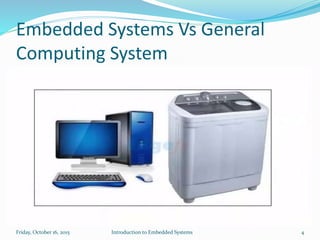
Embedded Systems Vs General
Computing System
Introduction to Embedded SystemsSunday, November 8, 2015 4
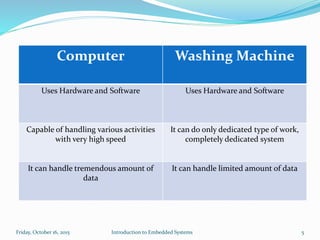
Computer Washing Machine
Uses Hardware and Software Uses Hardware and Software
Capable of handling various activities
with very high speed
It can do only dedicated type of work,
completely dedicated system
It can handle tremendous amount of
data
It can handle limited amount of data
Introduction to Embedded SystemsSunday, November 8, 2015 5
Let’s consider a Computer
 A computer is a system that has the following or more
components.
 A microprocessor
 A large memory comprising the following two kinds:
(a) Primary memory (semiconductor memories - RAM, ROM
and fast accessible caches)
(b) Secondary memory [(magnetic memory located in hard
disks, diskettes (Floppy Disk) and cartridge tapes, optical
memory in CD-ROM or memory stick (removable
flash memory card in mobile computer)] using which
different user programs can load into the primary memory
and can be run.
Sunday, November 8, 2015 Introduction to Embedded Systems 6
Computer …
 I/O units such as touch screen, modem, fax cum modem
etc.
 Input units such as keyboard, mouse, digitizer, scanner,
etc.
 Output units like LCD screen, video monitor, printer, etc.
 Networking units like Ethernet card, front-end
processor-based server, bus drivers, etc.
 Operating system (OS).
 General purpose user interfaces and application software,
mostly in secondary memory
Introduction to Embedded SystemsSunday, November 8, 2015 7
Now consider an Embedded system
 Three main embedded components-
1. Embeds hardware to give computer like
functionalities
2. Embeds main application software generally into
flash or ROM and the application software performs
concurrently the number of tasks.
3. Embeds a real time operating system( RTOS),
which supervises the application software tasks
running on the hardware and organizes the accesses
to system resources according to priorities and
timing constraints of tasks in the system.
Introduction to Embedded SystemsSunday, November 8, 2015 8
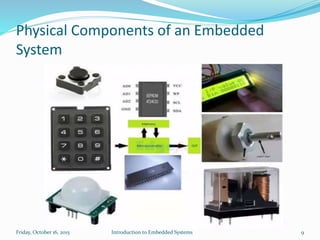
Physical Components of an Embedded
System
Introduction to Embedded SystemsSunday, November 8, 2015 9
Embedded system RTOS
 Enables execution of concurrent processes or threads or tasks
 Provides a mechanism to let the processor run each process as
per scheduling and to do context-switch between the various
processes (threads or tasks)
 RTOS sets the rules during execution of application processes to
enable finishing of a process within the assigned time interval
and with assigned priority
**RTOS:
A real-time operating system (RTOS) is an operating system (OS)
intended to serve real-time application process data as it comes in,
typically without buffering delays. Processing time requirements
(including any OS delay) are measured in tenths of seconds or shorter.
Sunday, November 8, 2015 Introduction to Embedded Systems 10
Sophisticated Embedded System
Characteristics
(1) Dedicated functions
(2) Dedicated complex algorithms
(3) Dedicated (GUIs) and other user interfaces for the
application
(4) Real time operations— Defines the ways in which the
system works, reacts to the events and interrupts,
schedules the system functioning in real time and executes
by following a plan to control the latencies and to meet the
deadlines. [Latency — Waiting interval between the
instance at which a need to run the codes arises for task (or
interrupt service routine) following an event and instance
of start executing the codes]
Sunday, November 8, 2015 Introduction to Embedded Systems 11
Sophisticated Embedded System
Characteristics (cont …)
(5) Multi-rate operations — Different operations may
take place at distinct rates. For example, the audio,
video, network data or stream and events have the
different rates and time constraints to finish associated
processes.
Sunday, November 8, 2015 Introduction to Embedded Systems 12
Constraints of an Embedded
System Design
 Available system-memory
 Available processor speed
 Limited power dissipation when running the system
continuously in cycles of the system start, wait for
event, wake-up and run, sleep and stop.
Sunday, November 8, 2015 Introduction to Embedded Systems 13
System design constraints
 Performance,
 power,
 size,
 non-recurring design cost, and
 manufacturing costs.
Sunday, November 8, 2015 Introduction to Embedded Systems 14
What is a Microcontroller?
Introduction to Embedded SystemsSunday, November 8, 2015 15
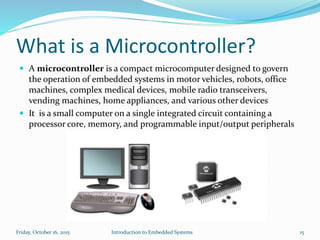
 A microcontroller is a compact microcomputer designed to govern
the operation of embedded systems in motor vehicles, robots, office
machines, complex medical devices, mobile radio transceivers,
vending machines, home appliances, and various other devices
 It is a small computer on a single integrated circuit containing a
processor core, memory, and programmable input/output peripherals
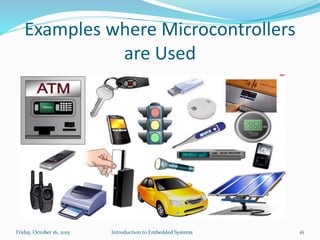
Examples where Microcontrollers
are Used
Introduction to Embedded SystemsSunday, November 8, 2015 16
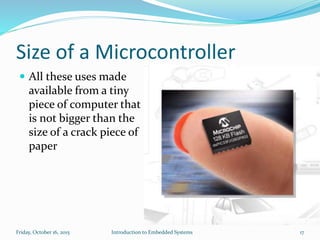
Size of a Microcontroller
Introduction to Embedded SystemsSunday, November 8, 2015 17
 All these uses made
available from a tiny
piece of computer that
is not bigger than the
size of a crack piece of
paper
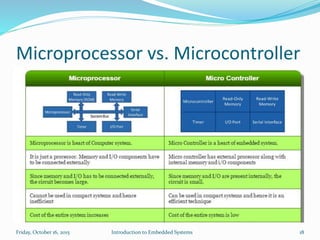
Microprocessor | Microcontroller
Introduction to Embedded SystemsSunday, November 8, 2015 18
Wrong
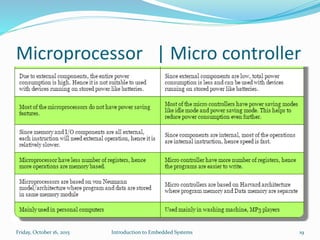
Microprocessor | Micro controller
Introduction to Embedded SystemsSunday, November 8, 2015 19
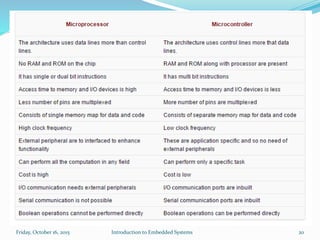
Introduction to Embedded SystemsSunday, November 8, 2015 20
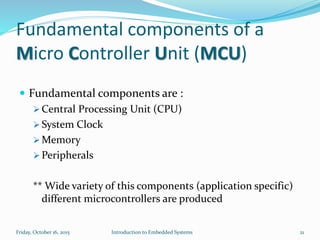
Fundamental components of a
Micro Controller Unit (MCU)
 Fundamental components are :
 Central Processing Unit (CPU)
 System Clock
 Memory
 Peripherals
** Wide variety of this components (application specific)
different microcontrollers are produced
Introduction to Embedded SystemsSunday, November 8, 2015 21
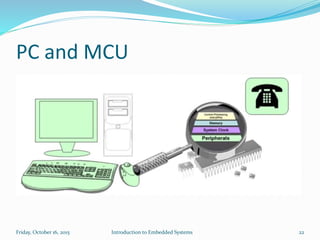
PC and MCU
Introduction to Embedded SystemsSunday, November 8, 2015 22
Questions???
Email id –
 joydutta.nsec@gmail.com
Mob: +91 8981532753
Introduction to Embedded SystemsSunday, November 8, 2015 23
8 November 2015 RTOS Synchronization 24
Sunday, November 8, 2015 Introduction to Embedded Systems 25

Introduction to Embedded Systems

  • 1.
    Joy Dutta Pursuing PhD(Jadavpur University) M.Tech in CSE (1St Class : CU) Post Graduate B.Tech in CSE (1St Class : CU) B.Sc in Physics ( Honours : CU)
  • 2.
    What is anEmbedded System?  Definition: “An embedded system is a system that has software embedded into computer-hardware, which makes a system dedicated for an application (s) or specific part of an application or product or part of a larger system.” i.e. It is a dedicated computer based system for an application(s) or product. It may be an independent system or a part of large system. Its software usually embeds into a ROM (Read Only Memory) or flash.” Introduction to Embedded SystemsSunday, November 8, 2015 2
  • 3.
    Examples of EmbeddedSystems:  Time display system – Watch  Automatic cloth washing system – Washing Machine  Fax Machines  ATM  Cell Phone  Digital Camera  Portable Video Games  Calculator  Etc.  All of these devices are dedicated in their approach. Sunday, November 8, 2015 Introduction to Embedded Systems 3
  • 4.
    Embedded Systems VsGeneral Computing System Introduction to Embedded SystemsSunday, November 8, 2015 4
  • 5.
    Computer Washing Machine UsesHardware and Software Uses Hardware and Software Capable of handling various activities with very high speed It can do only dedicated type of work, completely dedicated system It can handle tremendous amount of data It can handle limited amount of data Introduction to Embedded SystemsSunday, November 8, 2015 5
  • 6.
    Let’s consider aComputer  A computer is a system that has the following or more components.  A microprocessor  A large memory comprising the following two kinds: (a) Primary memory (semiconductor memories - RAM, ROM and fast accessible caches) (b) Secondary memory [(magnetic memory located in hard disks, diskettes (Floppy Disk) and cartridge tapes, optical memory in CD-ROM or memory stick (removable flash memory card in mobile computer)] using which different user programs can load into the primary memory and can be run. Sunday, November 8, 2015 Introduction to Embedded Systems 6
  • 7.
    Computer …  I/Ounits such as touch screen, modem, fax cum modem etc.  Input units such as keyboard, mouse, digitizer, scanner, etc.  Output units like LCD screen, video monitor, printer, etc.  Networking units like Ethernet card, front-end processor-based server, bus drivers, etc.  Operating system (OS).  General purpose user interfaces and application software, mostly in secondary memory Introduction to Embedded SystemsSunday, November 8, 2015 7
  • 8.
    Now consider anEmbedded system  Three main embedded components- 1. Embeds hardware to give computer like functionalities 2. Embeds main application software generally into flash or ROM and the application software performs concurrently the number of tasks. 3. Embeds a real time operating system( RTOS), which supervises the application software tasks running on the hardware and organizes the accesses to system resources according to priorities and timing constraints of tasks in the system. Introduction to Embedded SystemsSunday, November 8, 2015 8
  • 9.
    Physical Components ofan Embedded System Introduction to Embedded SystemsSunday, November 8, 2015 9
  • 10.
    Embedded system RTOS Enables execution of concurrent processes or threads or tasks  Provides a mechanism to let the processor run each process as per scheduling and to do context-switch between the various processes (threads or tasks)  RTOS sets the rules during execution of application processes to enable finishing of a process within the assigned time interval and with assigned priority **RTOS: A real-time operating system (RTOS) is an operating system (OS) intended to serve real-time application process data as it comes in, typically without buffering delays. Processing time requirements (including any OS delay) are measured in tenths of seconds or shorter. Sunday, November 8, 2015 Introduction to Embedded Systems 10
  • 11.
    Sophisticated Embedded System Characteristics (1)Dedicated functions (2) Dedicated complex algorithms (3) Dedicated (GUIs) and other user interfaces for the application (4) Real time operations— Defines the ways in which the system works, reacts to the events and interrupts, schedules the system functioning in real time and executes by following a plan to control the latencies and to meet the deadlines. [Latency — Waiting interval between the instance at which a need to run the codes arises for task (or interrupt service routine) following an event and instance of start executing the codes] Sunday, November 8, 2015 Introduction to Embedded Systems 11
  • 12.
    Sophisticated Embedded System Characteristics(cont …) (5) Multi-rate operations — Different operations may take place at distinct rates. For example, the audio, video, network data or stream and events have the different rates and time constraints to finish associated processes. Sunday, November 8, 2015 Introduction to Embedded Systems 12
  • 13.
    Constraints of anEmbedded System Design  Available system-memory  Available processor speed  Limited power dissipation when running the system continuously in cycles of the system start, wait for event, wake-up and run, sleep and stop. Sunday, November 8, 2015 Introduction to Embedded Systems 13
  • 14.
    System design constraints Performance,  power,  size,  non-recurring design cost, and  manufacturing costs. Sunday, November 8, 2015 Introduction to Embedded Systems 14
  • 15.
    What is aMicrocontroller? Introduction to Embedded SystemsSunday, November 8, 2015 15  A microcontroller is a compact microcomputer designed to govern the operation of embedded systems in motor vehicles, robots, office machines, complex medical devices, mobile radio transceivers, vending machines, home appliances, and various other devices  It is a small computer on a single integrated circuit containing a processor core, memory, and programmable input/output peripherals
  • 16.
    Examples where Microcontrollers areUsed Introduction to Embedded SystemsSunday, November 8, 2015 16
  • 17.
    Size of aMicrocontroller Introduction to Embedded SystemsSunday, November 8, 2015 17  All these uses made available from a tiny piece of computer that is not bigger than the size of a crack piece of paper
  • 18.
    Microprocessor | Microcontroller Introductionto Embedded SystemsSunday, November 8, 2015 18 Wrong
  • 19.
    Microprocessor | Microcontroller Introduction to Embedded SystemsSunday, November 8, 2015 19
  • 20.
    Introduction to EmbeddedSystemsSunday, November 8, 2015 20
  • 21.
    Fundamental components ofa Micro Controller Unit (MCU)  Fundamental components are :  Central Processing Unit (CPU)  System Clock  Memory  Peripherals ** Wide variety of this components (application specific) different microcontrollers are produced Introduction to Embedded SystemsSunday, November 8, 2015 21
  • 22.
    PC and MCU Introductionto Embedded SystemsSunday, November 8, 2015 22
  • 23.
    Questions??? Email id – joydutta.nsec@gmail.com Mob: +91 8981532753 Introduction to Embedded SystemsSunday, November 8, 2015 23
  • 24.
    8 November 2015RTOS Synchronization 24
  • 25.
    Sunday, November 8,2015 Introduction to Embedded Systems 25

Editor's Notes

  • #10 Components of Embedded Systems: (I) Input: It can be button , Keypad , Sensors etc. (II) Microcontroller : It can have either or both external / internal memory. Oldest microcontroller is 8051 series. The Intel MCS-51 (commonly referred to as8051) is a Harvard architecture, CISC instruction set, single chip microcontroller(µC) series which was developed by Intel in 1980 for use in embedded systems. The Harvard architecture is a computer architecture with physically separate storage and signal pathways for instructions and data. Complex instruction set computing (CISC ) is a processor design where single instructions can execute several low-level operations (such as a load from memory, an arithmetic operation, and a memory store) or are capable of multi-step operations or addressing modes within single instructions The term was retroactively coined in contrast to reduced instruction set computer (RISC)  and has therefore become something of an umbrella term for everything that is not RISC, i.e. everything from large and complex mainframes to simplistic microcontrollers where memory load and store operations are not separated from arithmetic instructions. (III) Output : Motor, Display screen etc. ** Actually program is burnt into the microcontroller. The program can be written in any language which the microcontroller converts in its own machine format. We can write the code in C language or in any assembly language or any other complicated language but the microcontroller will take only the machine code to run it.
  • #17 Examples: A simple remote for TV For communication application : Cell phone Medical application : Thermometer , Utility meter Home Appliances : Induction cooker , Microwave Automotive application : Rain sensor , Air bags sensor, Tire pressure Sensor Energy harvesting : Solar Panel Etc.
  • #19 Microprocessor : A microprocessor is the unit that processes the input instruction and produces the respective output. The unit is manufactured using the micrometer technology of the CMOS transistors. Microcontroller : A microcontroller is defined as the microprocessor equipped with RAM, ROM, clock and I/O interface. Microcontrollers are also manufactured using the micrometer technology of the CMOS transistors.
  • #20 Microcontrollers find their applications mostly in the embedded systems and the microprocessors find their applications in almost any computing mechanism.
  • #23 For MCU System clock is based on Oscillators in MCU System Clock determines resolution , response and even power consumption MCU won’t need peripherals like . It is generally associated with particular pin on the package. You need to connect circuitry to that specified pin to accomplish this.