Open Multimedia Applications Platform
(OMAP)
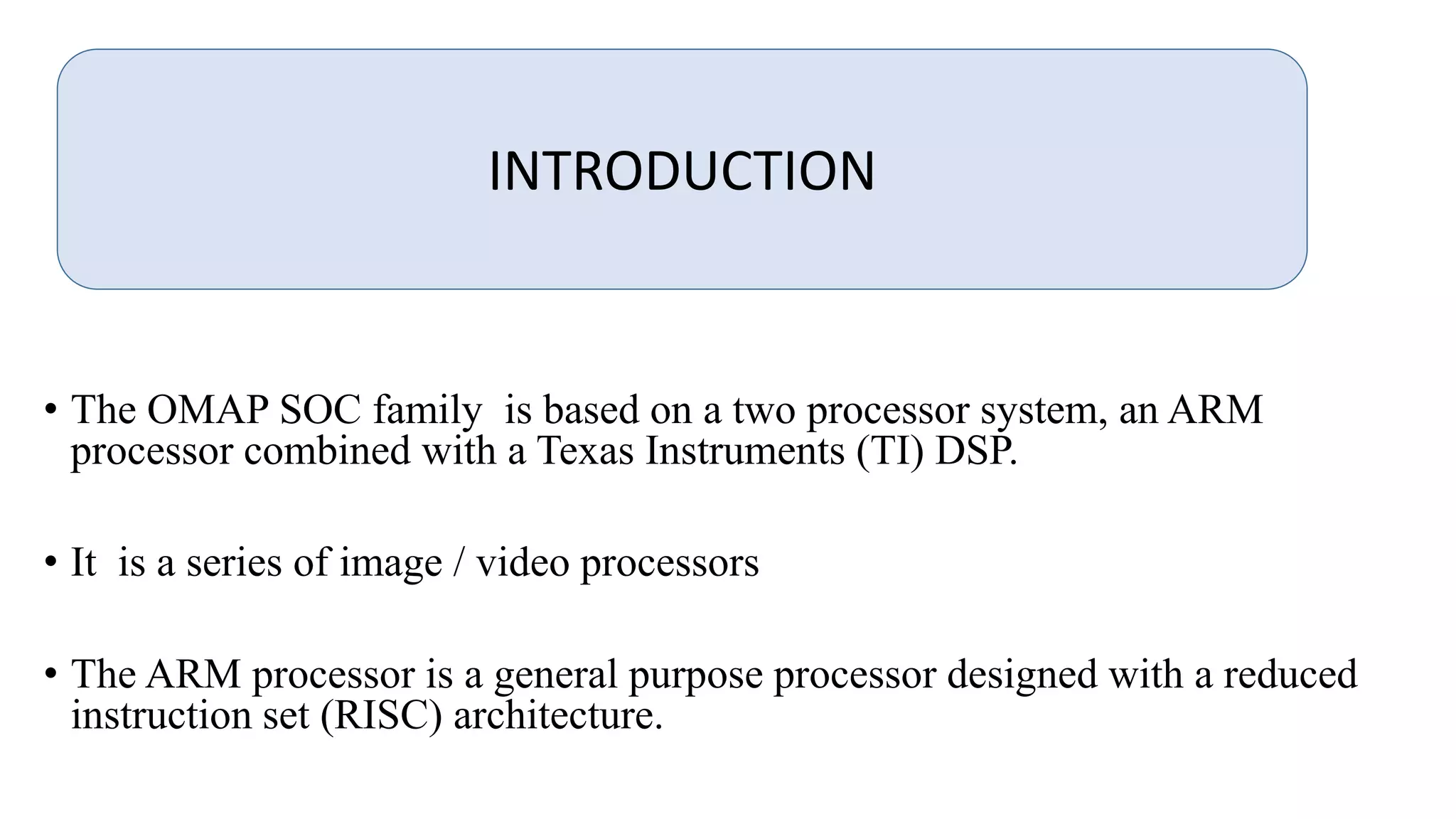
• The OMAP SOC family is based on a two processor system, an ARM
processor combined with a Texas Instruments (TI) DSP.
• It is a series of image / video processors
• The ARM processor is a general purpose processor designed with a reduced
instruction set (RISC) architecture.
INTRODUCTION
• The TI DSP has an instruction set optimized for digital signal processing
applications.
• The GPP and the DSP provide processors with complimentary
instruction sets,
• the GPP is suited for general purpose data processing and
communication tasks, the DSP supports operations for signal and image
processing.
• The combination of these two processors creates a power efficient
platform for applications that must perform complex signal processing
algorithms and communicate the results to network and human
interfaces
DSP with ARM
The OMAP family consists of three product groups classified by
performance and intended applications:
OMAP FAMILY
1) Integrated modem and applications processors
2) Basic multimedia applications processors
3) High-performance applications processors
integrated modem and applications processors
These are marketed only used by handset
manufacturers. Many of the newer versions are
highly integrated for use in very low cost cell
phones
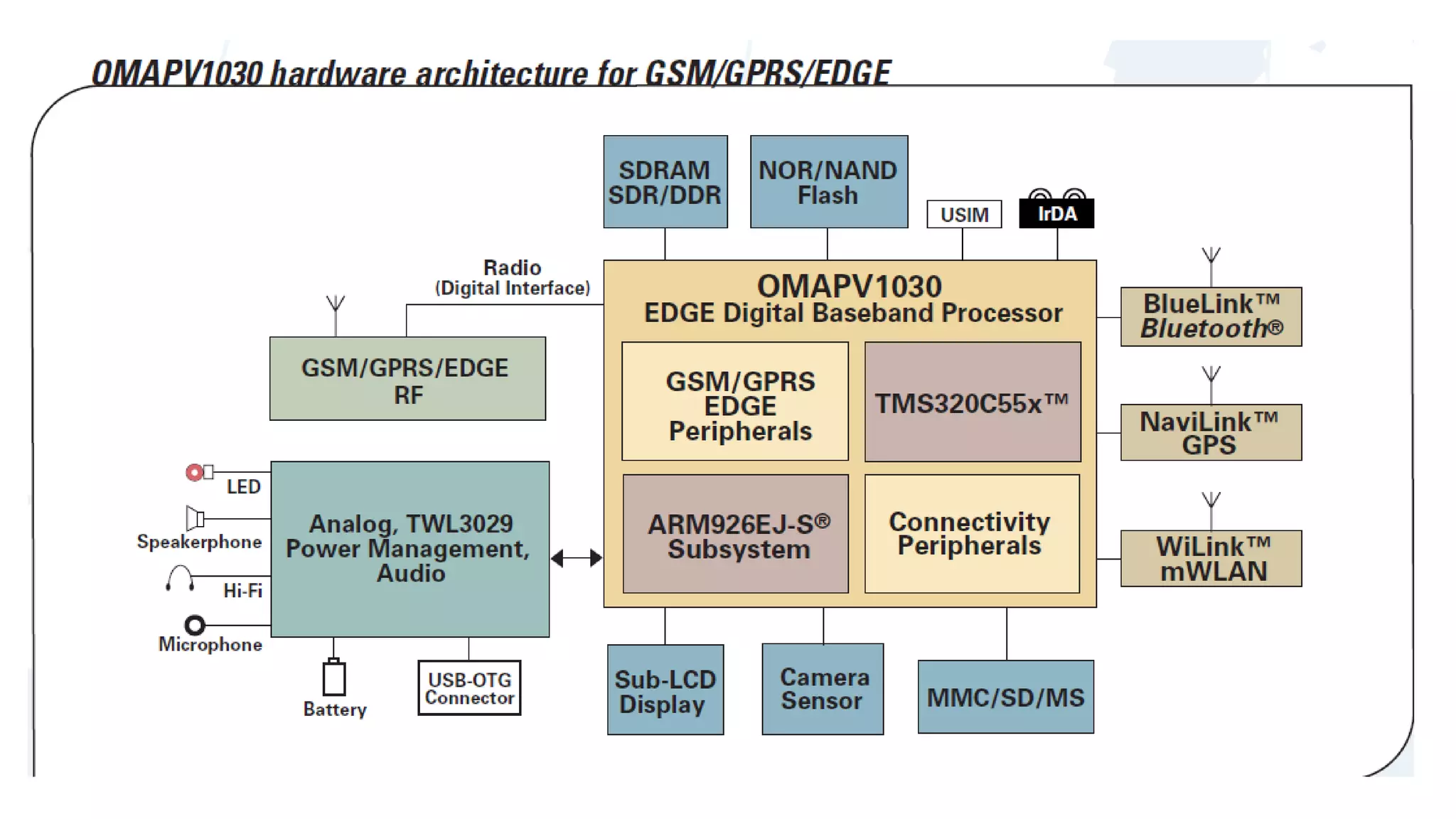
Example – Toshiba G710 (OMAP- V 1030)
various integrated modems and application of OMAP
processors
PROCESSOR APPLICATION
OMAPV1035 Single-chip EDGE
OMAPV1030 ARM926TEJ, GSM/GPRS/EDGE
OMAP850 200 MHz ARM926EJ-S + GSM/GPRS digital baseband + stacked
EDGE co-processor
OMAP750 200 MHz ARM926EJ-S + GSM/GPRS digital baseband + DDR
Memory support
OMAP733 200 MHz ARM926EJ-S + GSM/GPRS digital baseband + stacked
SDRAM
OMAP730 200 MHz ARM926EJ-S + GSM/GPRS digital baseband + SDRAM
Memory support
OMAP710 133 MHz ARM925 + GSM/GPRS digital baseband
OMAPV1030 features and specifications
Integrated, digital baseband combines ARM926TEJ
and TI DSP
 GSM/GPRS/EDGE Class 12 capable
 Includes single-chip analog companion device:
Full power management
Audio codecs
Analog drivers
 Supports a wide range of image codecs:
JPEG
GIF87a, GIF89a
PNG
BMP, WBMP
Video record, playback and streaming downloads:
Up to QCIF 30 fps or CIF 15 fps
Up to 15 fps (MPEG4 and WB-AMR decode)
 Digital audio processing:
Decode/Encode with streaming support
Audio treatment (mono-stereo, equalizer)
Full range of audio codecs:
MP3
AAC
MIDI 64 polyphonics
ADPCM
2D and 3D gaming
Enhanced connectivity options including
Bluetooth, WLAN, A-GPS
Complete hardware and software smart
phone reference design
Supports Nucleus and Embedded Linux
3 UARTs
SDRAM, NAND Flash, NOR Flash
SIM, USIM, EMV smart card controller
 IrDA support including SIR, MIR, FIR
Hardware and software security protection:
Secure boot loader
Acceleration for security
standards and random number generation
Security software library
Full range of hardware accelerators
 USB OTG
 Manufactured in TI’s 90-nm advanced CMOS
process technology
 Roadmap includes integration of RF functions
in digital CMOS
OMAPV1030 features and specifications
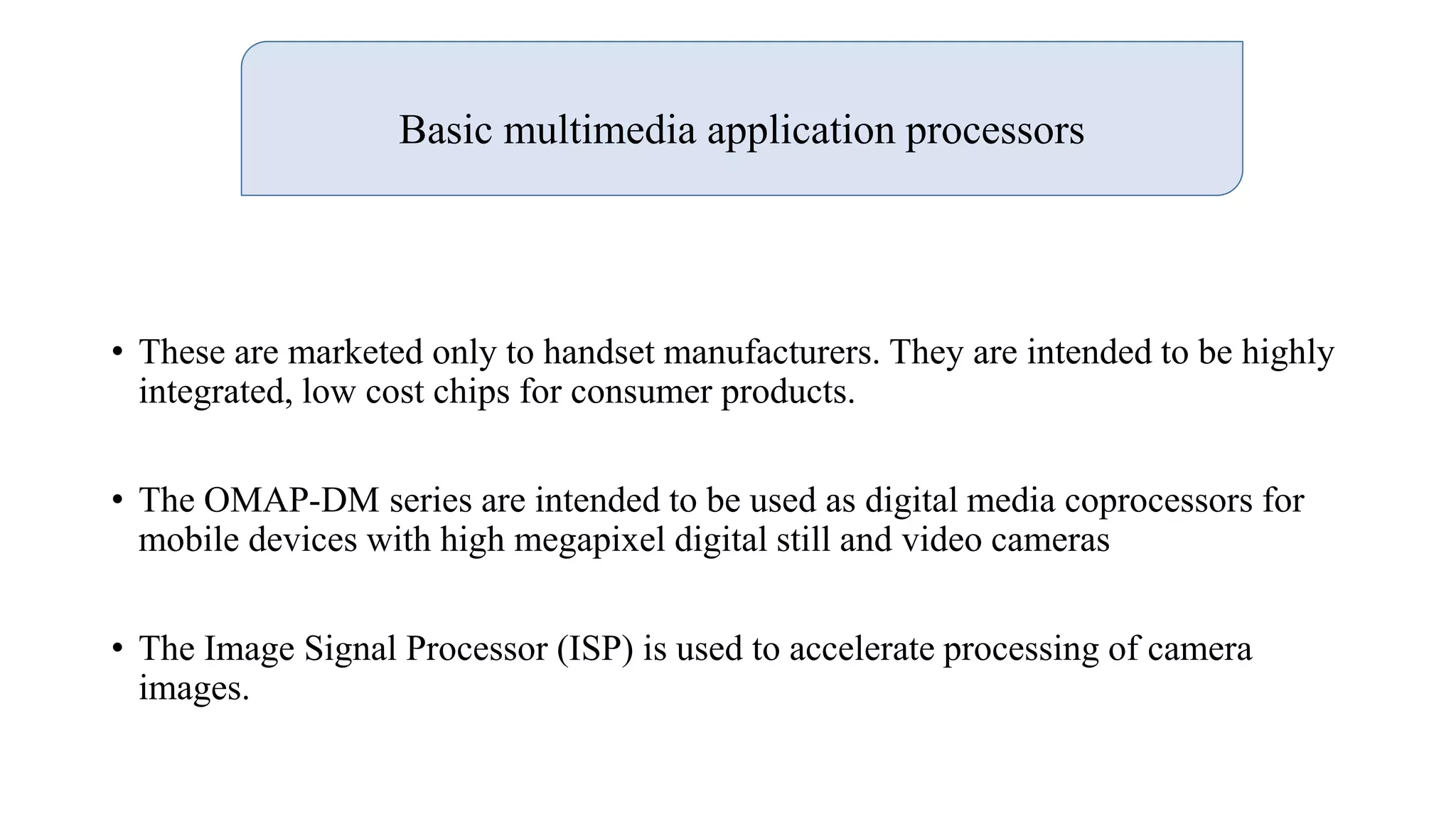
• These are marketed only to handset manufacturers. They are intended to be highly
integrated, low cost chips for consumer products.
• The OMAP-DM series are intended to be used as digital media coprocessors for
mobile devices with high megapixel digital still and video cameras
• The Image Signal Processor (ISP) is used to accelerate processing of camera
images.
Basic multimedia application processors
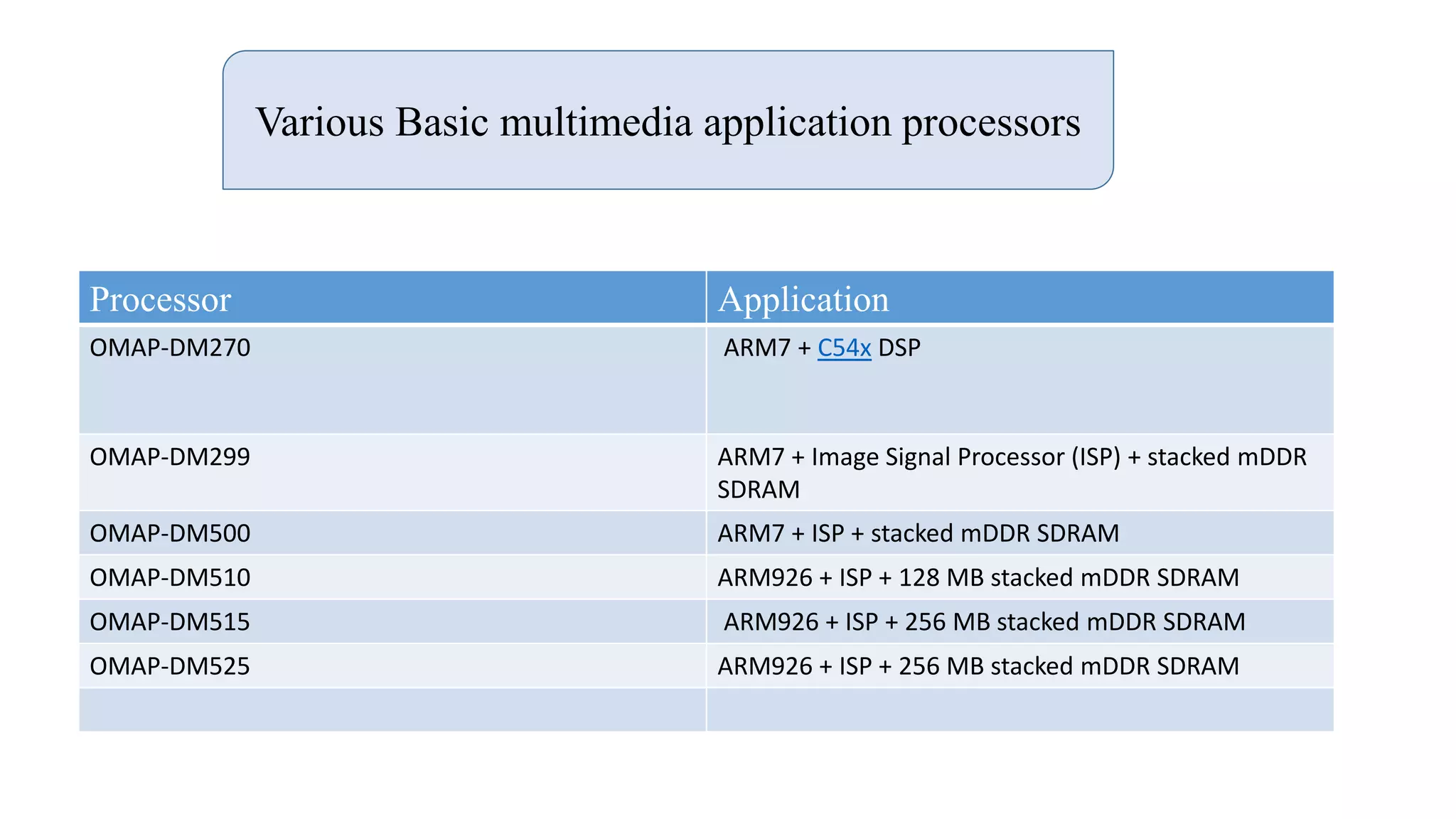
Processor Application
OMAP-DM270 ARM7 + C54x DSP
OMAP-DM299 ARM7 + Image Signal Processor (ISP) + stacked mDDR
SDRAM
OMAP-DM500 ARM7 + ISP + stacked mDDR SDRAM
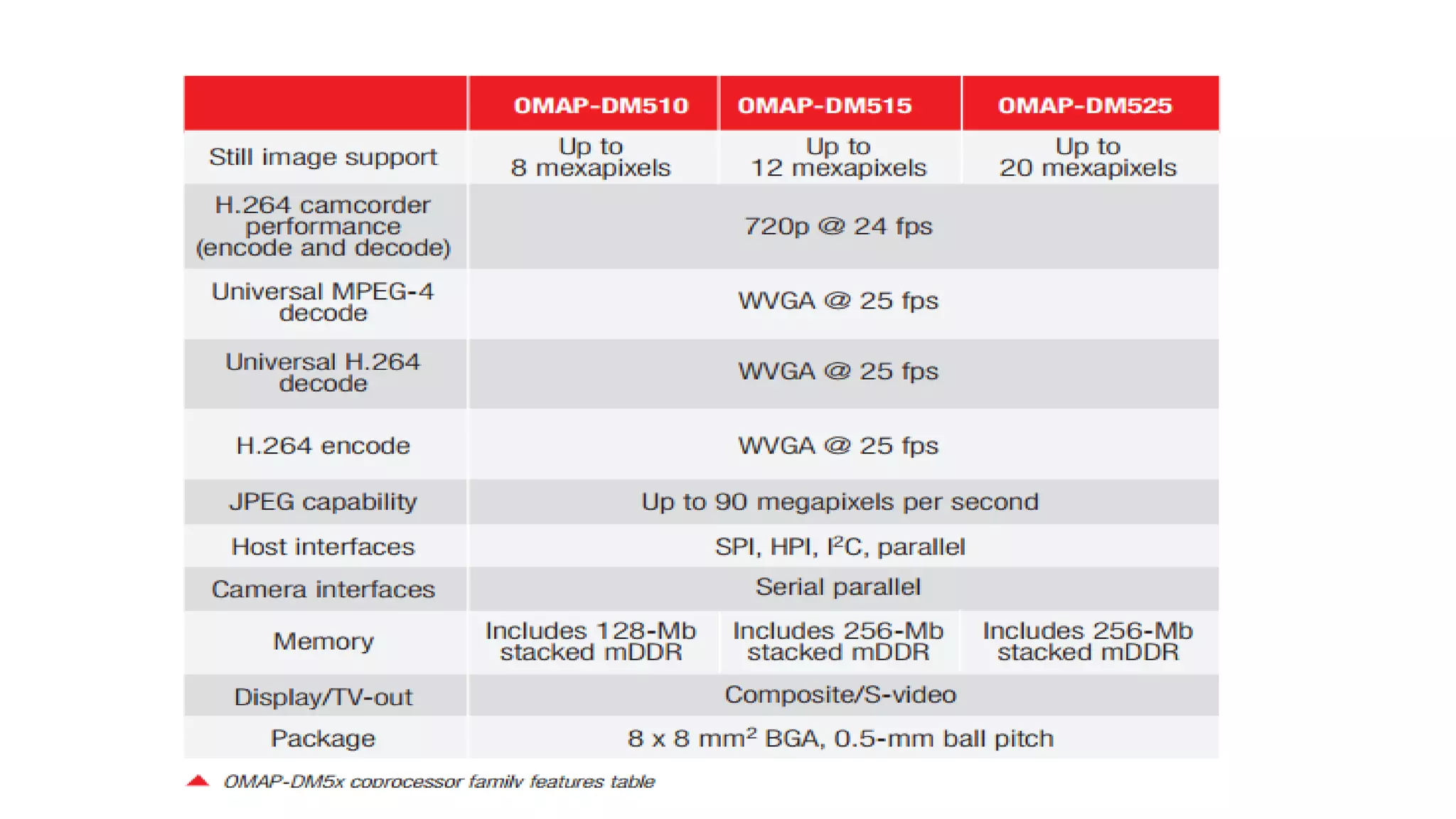
OMAP-DM510 ARM926 + ISP + 128 MB stacked mDDR SDRAM
OMAP-DM515 ARM926 + ISP + 256 MB stacked mDDR SDRAM
OMAP-DM525 ARM926 + ISP + 256 MB stacked mDDR SDRAM
Various Basic multimedia application processors
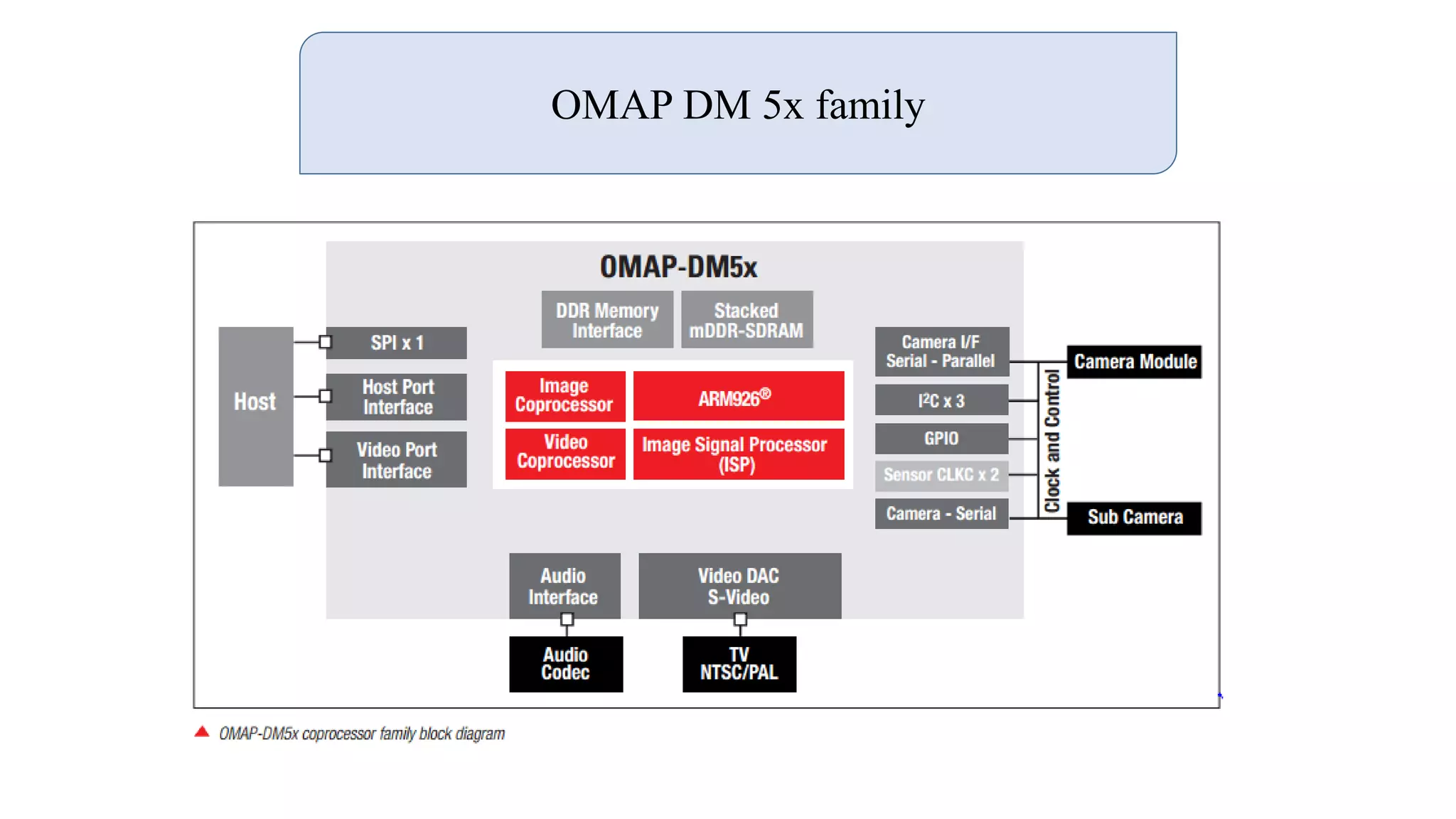
OMAP DM 5x family
Integrated video coprocessor
• Supports up to 25-fps MPEG4 (WVGA),
• H.264 (WVGA) encode and decode
• High quality 720p H.264 camcorder
• Video stabilization and noise filtering
Integrated Image Signal Processor (ISP)
• JPEG compression up to 90 megapixels per second
• Supports up to 20-megapixel camera sensors
Advanced image and video features
• Red eye reduction, face tracking, image
• stabilization, backlight compensation
Hardware imaging noise filter
• Ajustable 1-3200 ISO noise filter Increase image
processing speed
Flexible interfaces
• Various types of CMOS sensor interfaces
• Signal conditioning circuits
• Power management
• Mobile DDR-SDRAM
• Shutter, iris and auto-focus motor controls
Integrated composite and S video output to TV
with digital overlay
• Easily connect to external TV
• Easily view content with others
OMAP DM 5x family key feature
• High performance application processors are used in smart phones which are
powerful enough to run significant operating systems such as Linux, Android,
Symbian ,
• support connectivity to personal computers and support various audio and video
applications.
• These high performance application processors include different OMAP serieses
(OMAP1, OMAP2, OMAP3, OMAP4, OMAP5)
High performance application processors
• The OMAP1 family started with a TI enhanced ARM core and then changed to a
standard ARM926 core. It included many variants, most easily distinguished
according to manufacturing technology, CPU, peripheral set and distribution
channel
• Products using OMAP1 processors include hundreds of cell phone models, and
the Nokia 770, Internet tablets
OMAP 1
Procssor Application
OMAP171x 220 MHz ARM926EJ-S + C55x DSP, low-
voltage 90 nm technology
OMAP162x 204 MHz ARM926EJ-S + C55x DSP + 2 MB internal
SRAM, 130 nm technology
OMAP161x 204 MHz ARM926EJ-S + C55x DSP, 130 nm technology
OMAP1510 168 MHz ARM925T (TI-enhanced) + C55x DSP
Various OMAP 1 processors
OMP1710 BLOCK DIAGRAM
• Advanced 90 nanometer CMOS Technology
• Low-voltage 90 nm technology
• 1.05 - 1.3V cores; 1.8V I/O
• Consumes less than 10 µA in standby mode
• Split power supplies for application processing, digital baseband and real-time clock enable precise
control over power consumption
• Optimized clocking and power management: only two clocks required at 13 MHz and 32 kHz
• TMS320C55x DSP core subsystem
• Up to 220 MHz (maximum frequency)
• 32K x 16-bit on-chip dual-access RAM (DARAM) (64 KB)
• 48K x 16-bit on-chip single-access RAM (SARAM) (96 KB)
• 24 KB I-cache
• One/two instructions executed per cycle
• Video hardware accelerators for DCT, iDCT, pixel interpolation, and motion estimation for video
compression
Key features
• ARM926TEJ core subsystem
• Up to 220 MHz ARM926TEJ V5 architecture (maximum frequency)
• 32KB I-cache; 16KB D-cache
• Java acceleration
• Support for 32-bit and 16-bit (thumb mode) instruction sets
• Data and program MMUs
• Two 64-entry translation look-aside buffers (TLBs) for MMUs
• 17-word write buffer
• Security Acceleration in Hardware
• Secure bootloader
• 48 kB of secure ROM
• 16 kB of secure RAM
• Hardware acceleration for security standards and random number generator
• Unique die ID cell
• Third-party Security software library
• Memory Traffic Controller (TC)
• 16-bit EMIFS external memory interface
• 16-bit EMIFF external memory interface
• Application Subsystem
• Supports leading operating systems
• DMA with 4 physical and 17 logical channels and a dedicated
2D graphics engine
• USB On-the-Go (OTG)
• Two SD/MMC/SDIO ports
• Two high-speed 3.68 MHz UARTs
• I2C controller
• Two high-speed 3.68 MHz UARTs
• CompactFlash
• Parallel and compact camera ports
• Enhanced Debug Trace (ETM) for debug
• Fast IrDA (FIR)
• SPI
• LCD controller
• Comprehensive memory controller for interfaces to:
• 128 MB of mobile SDRAM and mobile DDR
• 256 MB Flash (for burst, programmable NOR flash)
• 289-ball, 12 mm x 12 mm MicroStar BGA™ Package
Processors Application
OMAP2431 330 MHz ARM1136 + 220 MHz C64x DSP
OMAP2430 330 MHz ARM1136 + 220 MHz C64x DSP
+ PowerVR MBX lite GPU, 90 nm technology
OMAP2420 330 MHz ARM1136 + 220 MHz C55x DSP + PowerVR
MBX GPU, 90 nm technology
OMAP 2
These parts were marketed only to handset vendors which include both internet tablets and mobile
phones
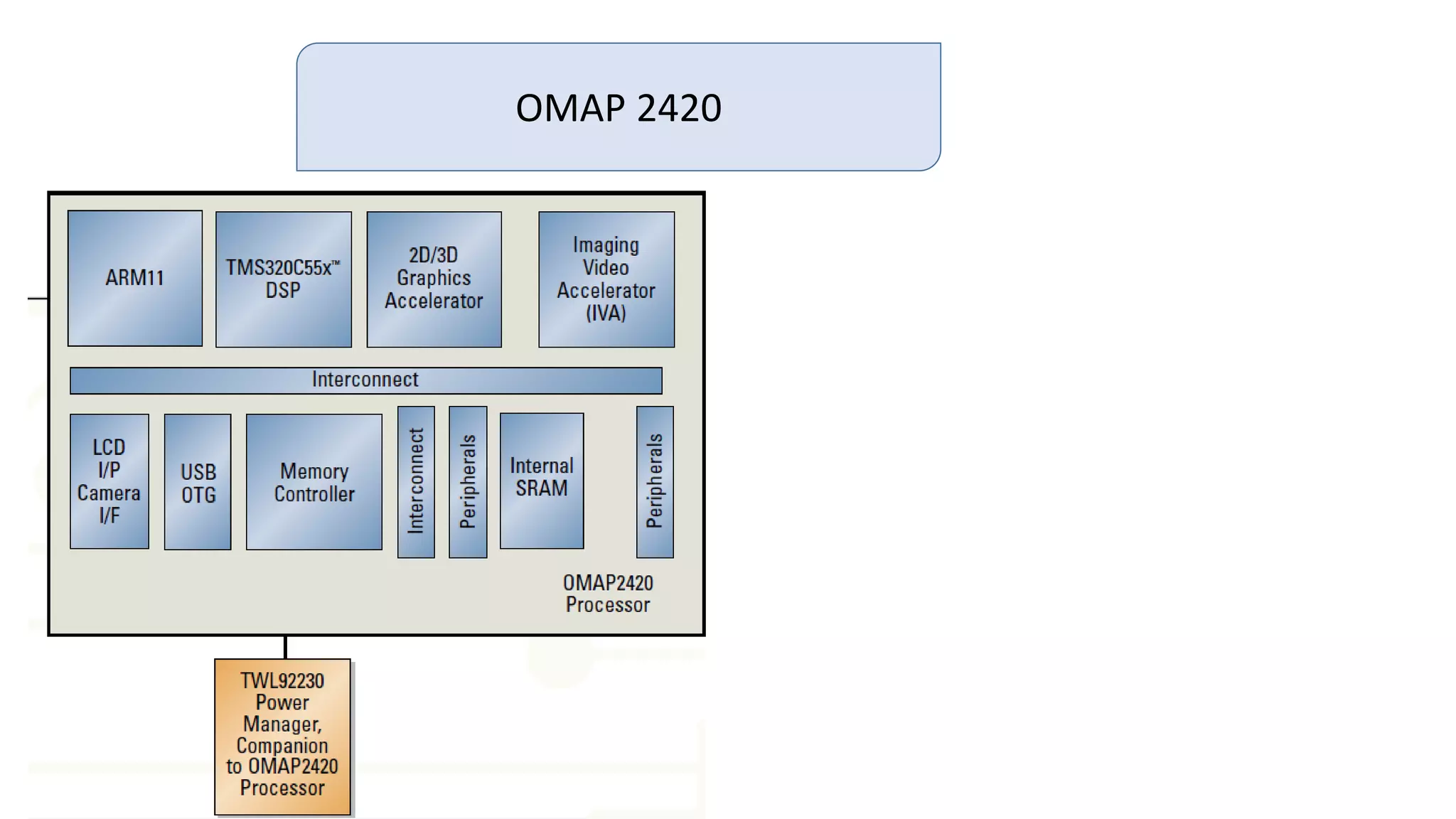
OMAP 2420
• ARM1136 at 330 MHz
• TMS320C55x™ DSP at 220 MHz
• 2D/3D hardware MBX/VGP accelerators, up
to 2 Million polygons/sec
• Cross-bar high-speed, low-latency
interconnect
• LCD and camera interfaces
• 32/32 KB caches
• Integrated memory controllers
• Complete peripheral set
• Hardware security platform
• Hardware accelerated camera and LCD
interfaces
• Imaging and Video Accelerator:
– Boosts still pictures> 4 Mpixels
– Full motion video encoding or decoding at
rates up to 30 frames per second Up to VGA
resolution
• 5 Mbit internal SRAM supporting a VGA
display
 Video out supporting an external TV display
• 325 ball, 12 mm x 12 mm package
• DDR system in package
• memory stacking (512 Mb and 768 Mb
options)
OMAP2420 Processor specification
• The OMAP™ 3 family of multimedia applications processors from
Texas Instruments (TI) introduces a new level of performance that
enables laptop-like productivity and advanced entertainment in
multimedia-enabled handsets. OMAP 3 devices support all levels of
handsets, from the entry-level multimedia-enabled handsets to high-
end Mobile Internet Devices (MIDs).
OMAP3
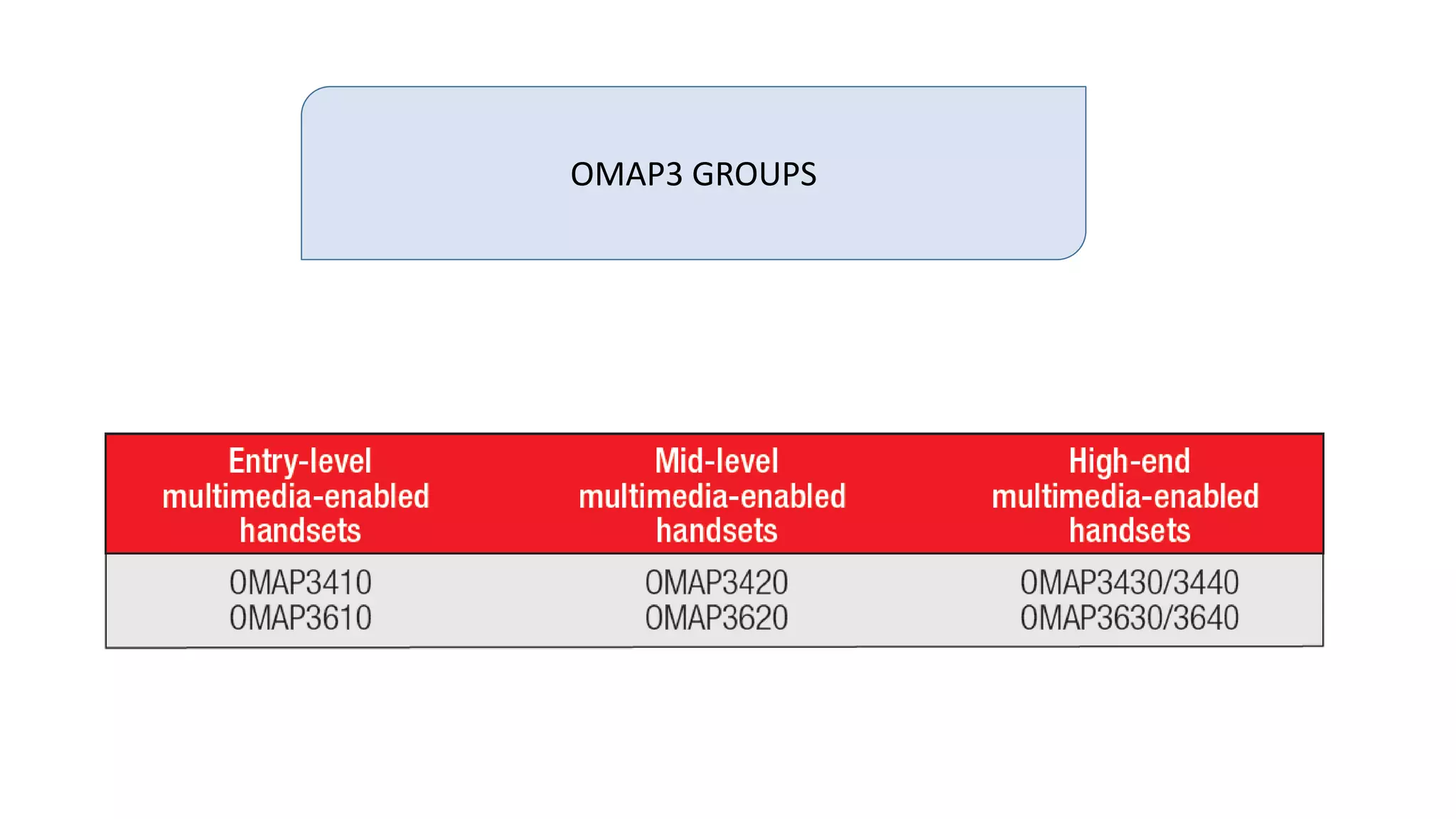
OMAP3 GROUPS
• Combines mobile entertainment and high-
performance productivity applications
• Integrates the advanced Superscalar ARM
Cortex-A8 RISC core, enabling up to 3x gain in
performance versus ARM11.
• Designed in 45-nm (OMAP36x platform) and
65-nm (OMAP34x platform) CMOS process
technologies for less power consumption and
increased device performance.
• Includes integrated IVA hardware accelerators
to enable multi-standard encode decode up
to HD resolution
• Packaging: 12 mm x 12 mm or 14 mm x 14
mm MicroStar BGA™ integrated circuit
packages, memory-stackable.
• Available integrated image signal processor
(ISP) enables faster, higher quality image
capture, lower system cost and lower power
consumption.
• Provides seamless connectivity to hard
diskdrive (HDD) devices for mass storage
• Assures mobile security with M-Shield™
mobile security technology capability
enhanced with ARM Trust Zone support.
• Shares fully scalable software solution with all
OMAP 2 processor
• Supports all high-level OSs for customizable
interfaces, including Linux, Microsoft
Windows Mobile, Open Handset Alliance
Android and Symbian.
Key features
OMAP4
At the heart of the OMAP 4 platform is a powerful system-on-chip that includes the perfect balance
of power efficiency and high performance.The OMAP 4 processor balances processing across four main engines: a
programmable multimedia engine based on TI’s C64x DSP andpower-efficient, multi-format hardware accelerators;
general-purpose processing based on
the dual-core ARM® Cortex™-A9 MPCore™ supporting symmetric multiprocessing (SMP) and capable of speeds of
more than 1 GHz per core;
a high-performance programmable graphics engine; and an Image Signal Processor (ISP) for
unparalleled video and imaging performance.
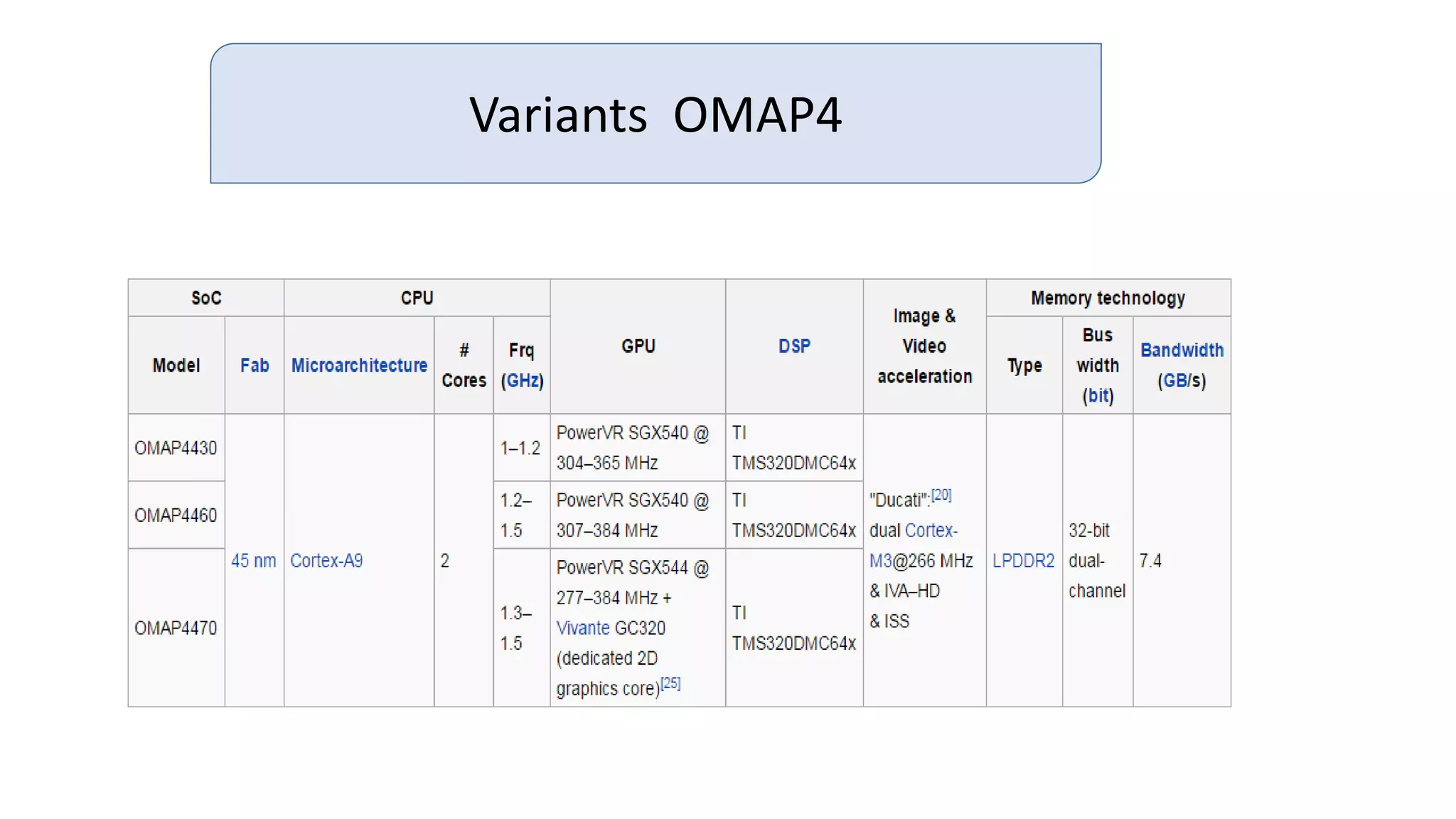
Variants OMAP4
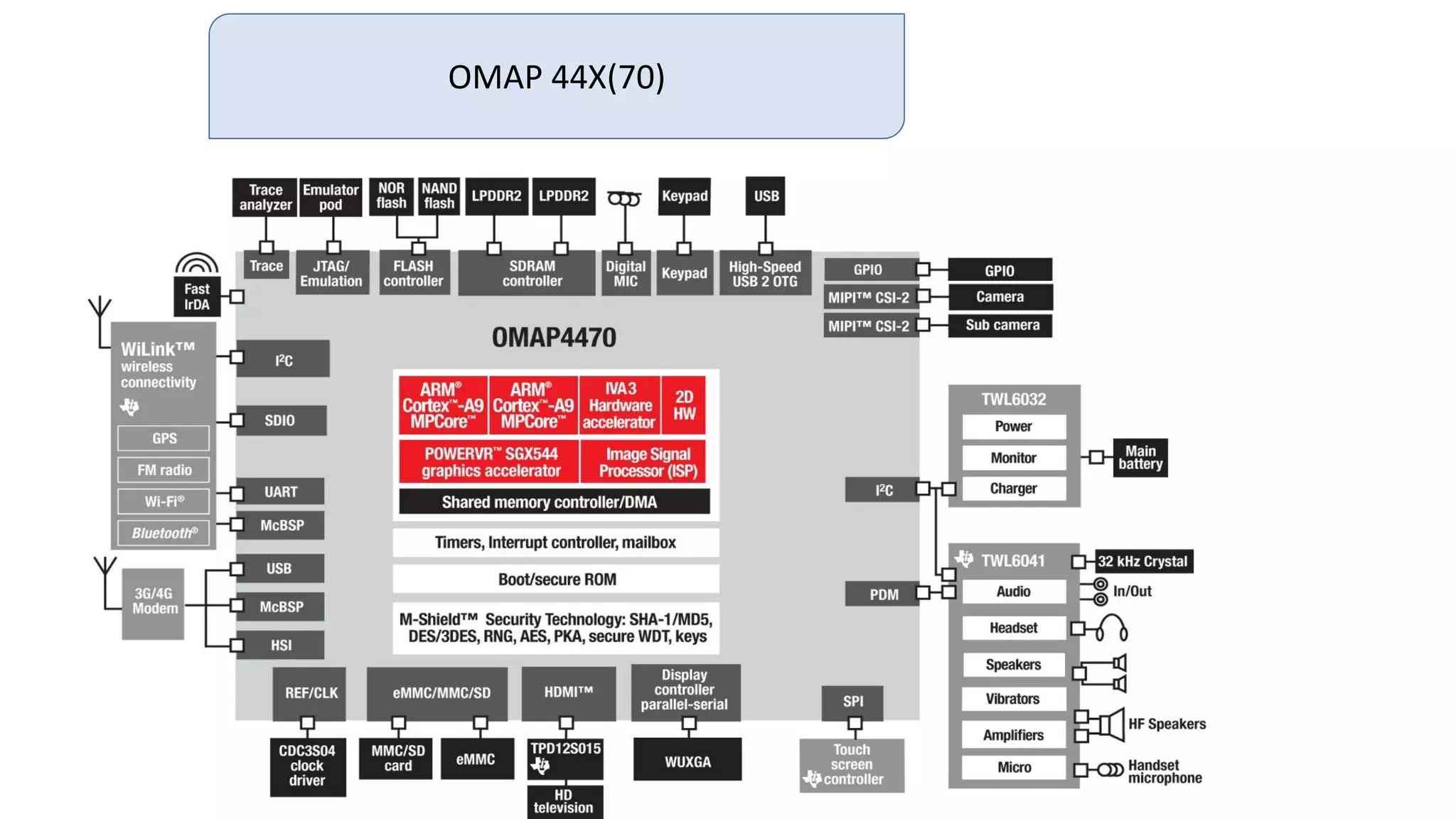
OMAP 44X(70)
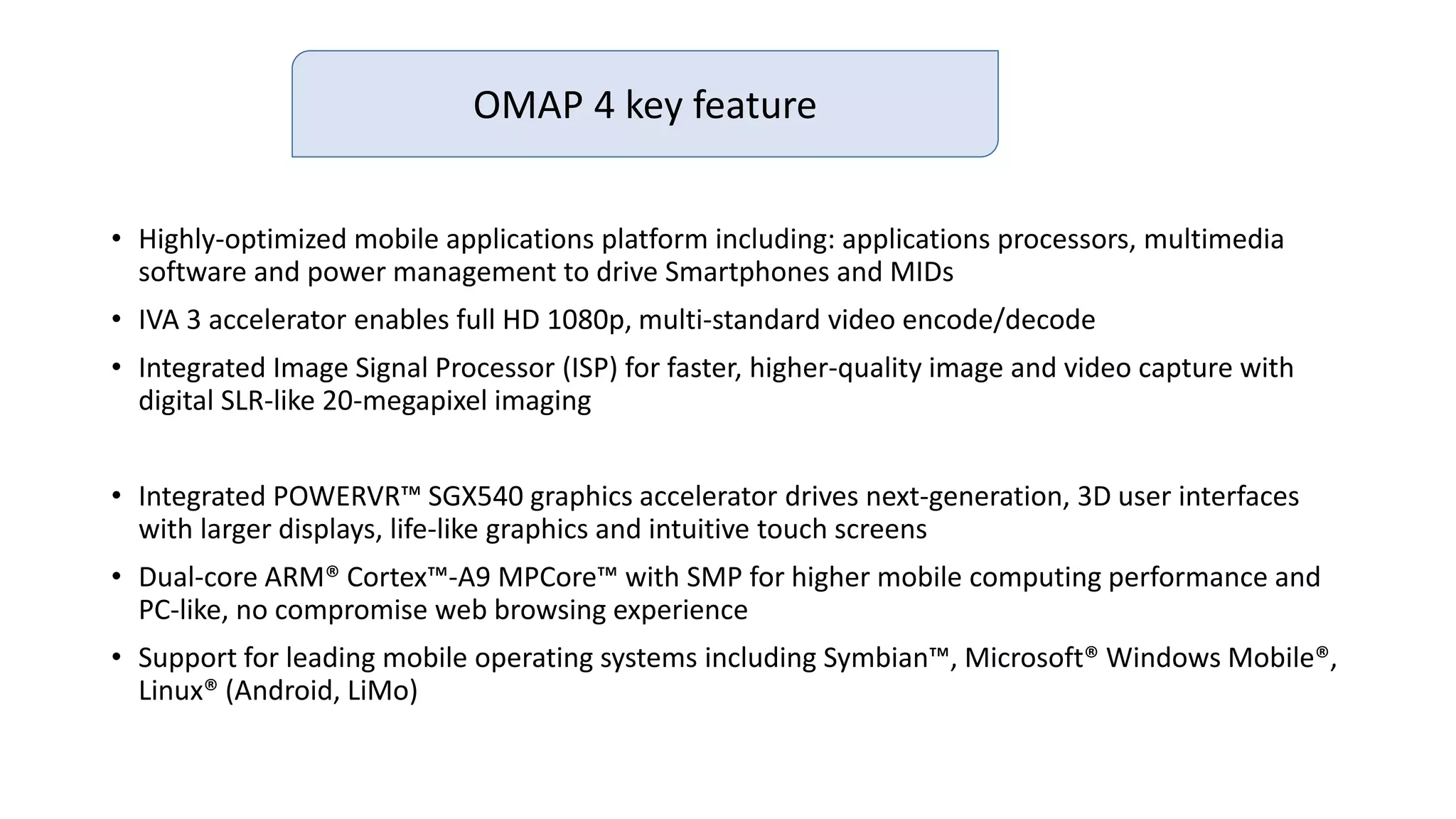
• Highly-optimized mobile applications platform including: applications processors, multimedia
software and power management to drive Smartphones and MIDs
• IVA 3 accelerator enables full HD 1080p, multi-standard video encode/decode
• Integrated Image Signal Processor (ISP) for faster, higher-quality image and video capture with
digital SLR-like 20-megapixel imaging
• Integrated POWERVR™ SGX540 graphics accelerator drives next-generation, 3D user interfaces
with larger displays, life-like graphics and intuitive touch screens
• Dual-core ARM® Cortex™-A9 MPCore™ with SMP for higher mobile computing performance and
PC-like, no compromise web browsing experience
• Support for leading mobile operating systems including Symbian™, Microsoft® Windows Mobile®,
Linux® (Android, LiMo)
OMAP 4 key feature
• Programmability and performance headroom to support new and emerging applications and
standards
• Pre-integrated connectivity solutions from TI’s portfolio of WiLink™, BlueLink™ and NaviLink™
mobile connectivity solutions and pre-validated modem interface software to connect with any
external modem
• Industry-leading power management and SmartReflex™ 2 technologies delivers more than 10
hours of 1080p HD video playback, 4+ hours of 1080p HD video recording and 140+ hours of CD
quality audio playback
• Designed in mobile 45-nm CMOS process technology for less power consumption and increased
device performance
• M-Shield™ capability enhanced with ARM TrustZone™ support ensures mobile security
• Packaging: 12 mm x 12 mm, 0.4 mm pitch PoP (Package-on-Package)
• TI’s OMAP 5 platform transforms the concept of “mobile” to deliver truly unique mobile
experiences.
• The OMAP 5 platform sets the stage for future mobile devices to transform from content
consumption devices to primary computing devices.
• This includes support for content creation and editing, as well as supporting advanced
experiencessuch as immersive 3D gaming, gesture recognition and augmented reality applications.
• The OMAP 5 system-on-chip (SoC) is the first featuring ARM®’s Cortex™-A15 MPCore™ onthe
market, as TI worked closely with ARM as the Advanced Lead Partner on the Cortex-
A15’sdevelopment.
OMAP 5
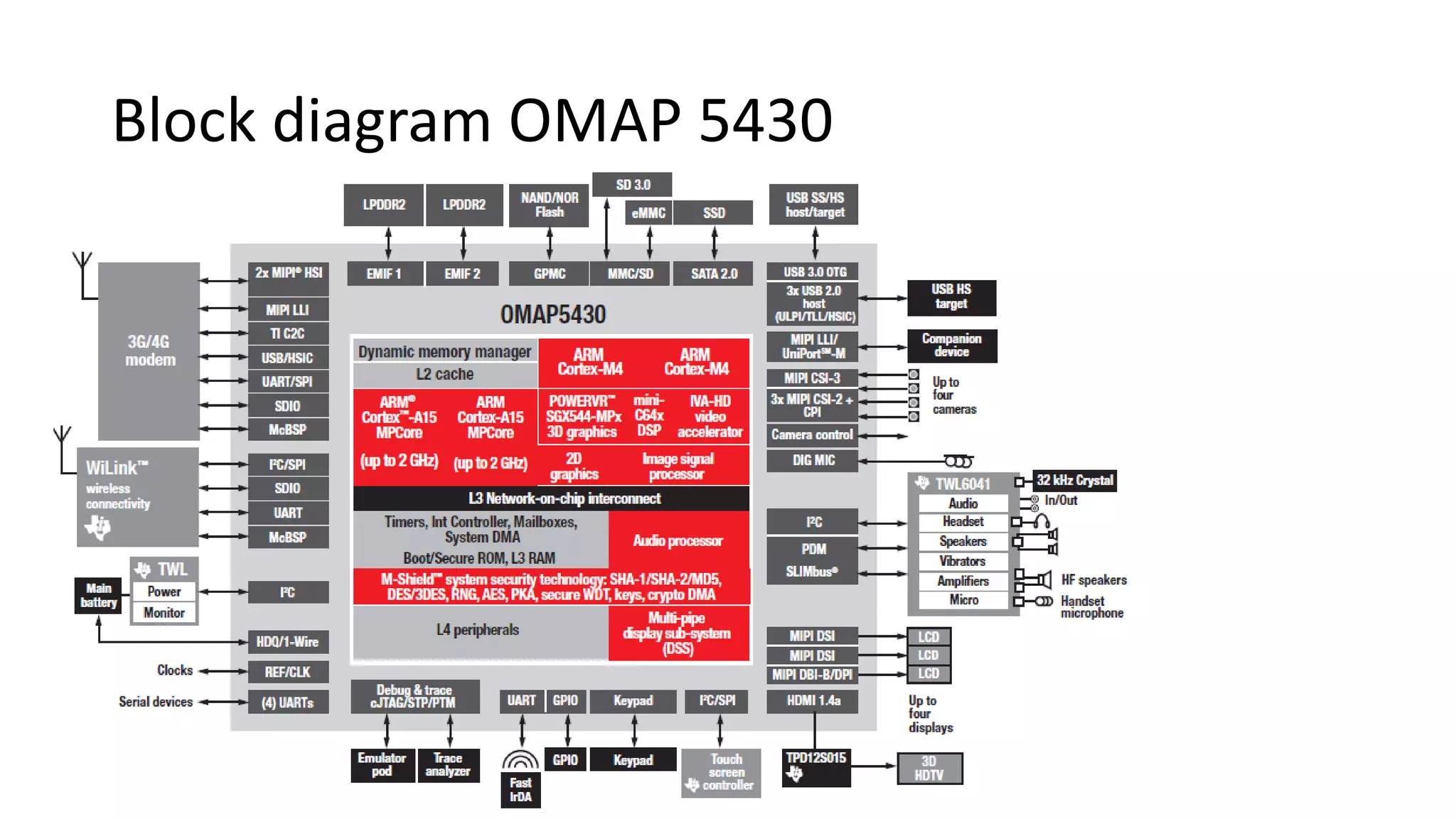
• The fifth generation OMAP(OMAP5) SoC uses a dual core ARM Cortex-A15 CPU with 2
additional Cortex-M4 cores to offload the A15s in lesscomputationally intensive tasks to increase
powerefficiency, two powerVR SGX544MP graphics
• cores and a dedicated TI 2D graphics accelerator, a multiple sub systems and a signal processor.
They respectively support 24 and 20 megapixel cameras for front and rear 3D HD video recording.
The chip also supports up to 8GB of dual channel LPDDR2/DDR3 memory, output to four HD 3D
displays and 3D HDMI 1.4 video output.OMAP5
• also includes three USB 2.0 ports, one USB 3.0 OTG and a SATA 2.0 controller
28 nano meter CMOS low-power process
The highest levels of processor performance and lowest power consumption
Smart multicore architecture with Symmetric Multiprocessing (SMP) including two ARM Cortex-
A15 MP Core processors for SMP and two Cortex-M4 processors for low-power offload and real-
time control
Higher mobile computing performance
2-3x higher performance versus previous generation
Faster user interfaces and less power consumption
Scalable performance activates only the cores that are needed for a particular process
Hardware virtualization through Hypervisor allows power and performance-efficient, multiple
operating system (OS) support
Key features
IVA 3 HD multimedia accelerator
Full high definition 1080p60 multi-standard video encode/decode and stereoscopic 3D
encode/decode at 1080p30
Imagination Technologies‘ POWERVR™ SGX544 graphics core
5x performance increase versus previous generation enables compelling 2D and 3D interfaces and
screens
Multi-core imaging and vision processing unit
• High-quality, high-megapixel digital SLR-like images at upto 24 MP (or 12 MP S3D)
• On-the-fly support with real-time face detection, stabilization, noise filtering and 3D optimization
to replace digital still cameras
SmartReflex™ 3 technology
• Dynamically controlled voltage, frequency and power based on device activity, modes of
operation and temperature
Low Power audio
• Provides up to 140+ hours of CD-quality audio playback
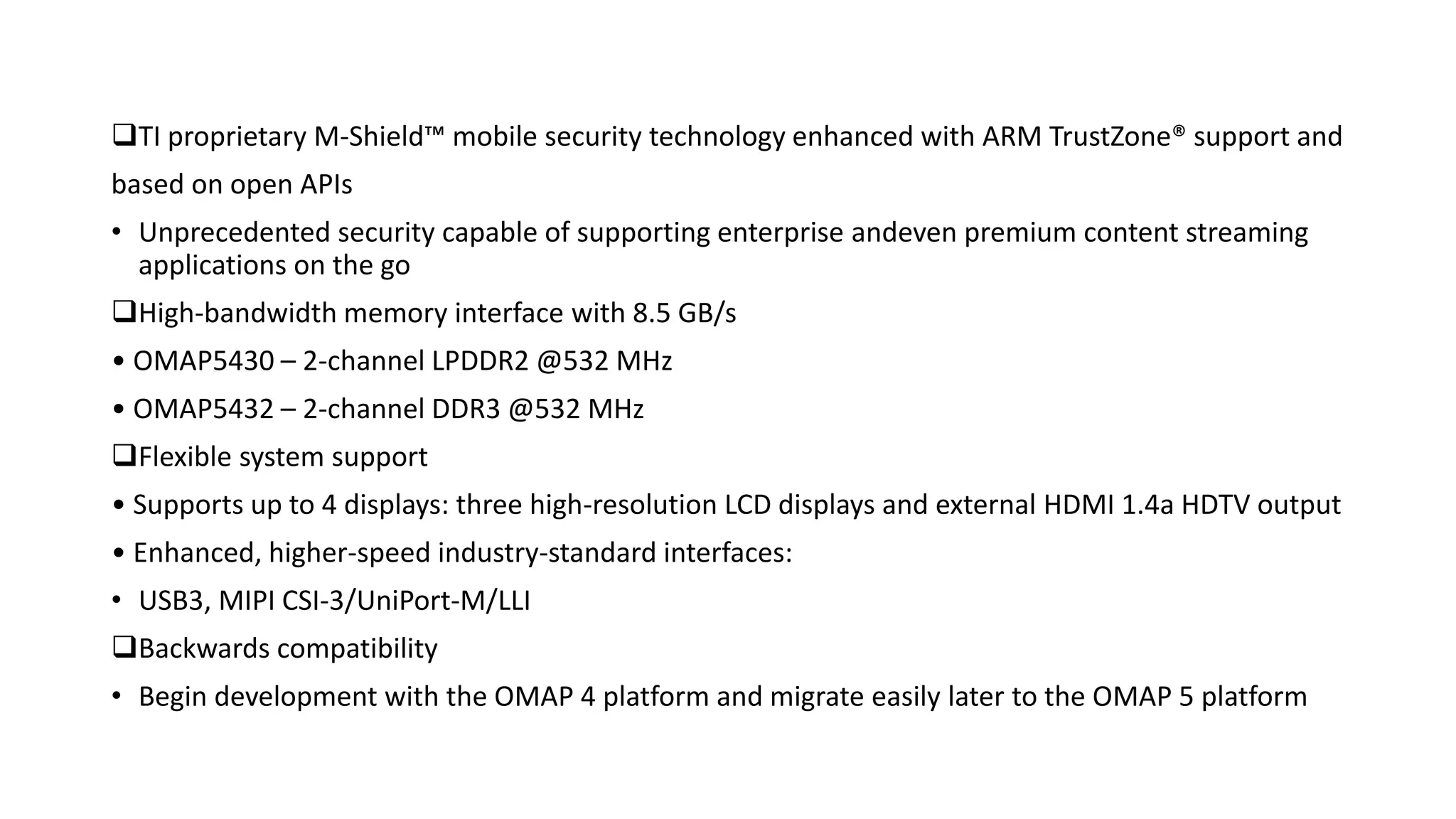
TI proprietary M-Shield™ mobile security technology enhanced with ARM TrustZone® support and
based on open APIs
• Unprecedented security capable of supporting enterprise andeven premium content streaming
applications on the go
High-bandwidth memory interface with 8.5 GB/s
• OMAP5430 – 2-channel LPDDR2 @532 MHz
• OMAP5432 – 2-channel DDR3 @532 MHz
Flexible system support
• Supports up to 4 displays: three high-resolution LCD displays and external HDMI 1.4a HDTV output
• Enhanced, higher-speed industry-standard interfaces:
• USB3, MIPI CSI-3/UniPort-M/LLI
Backwards compatibility
• Begin development with the OMAP 4 platform and migrate easily later to the OMAP 5 platform
Block diagram OMAP 5430
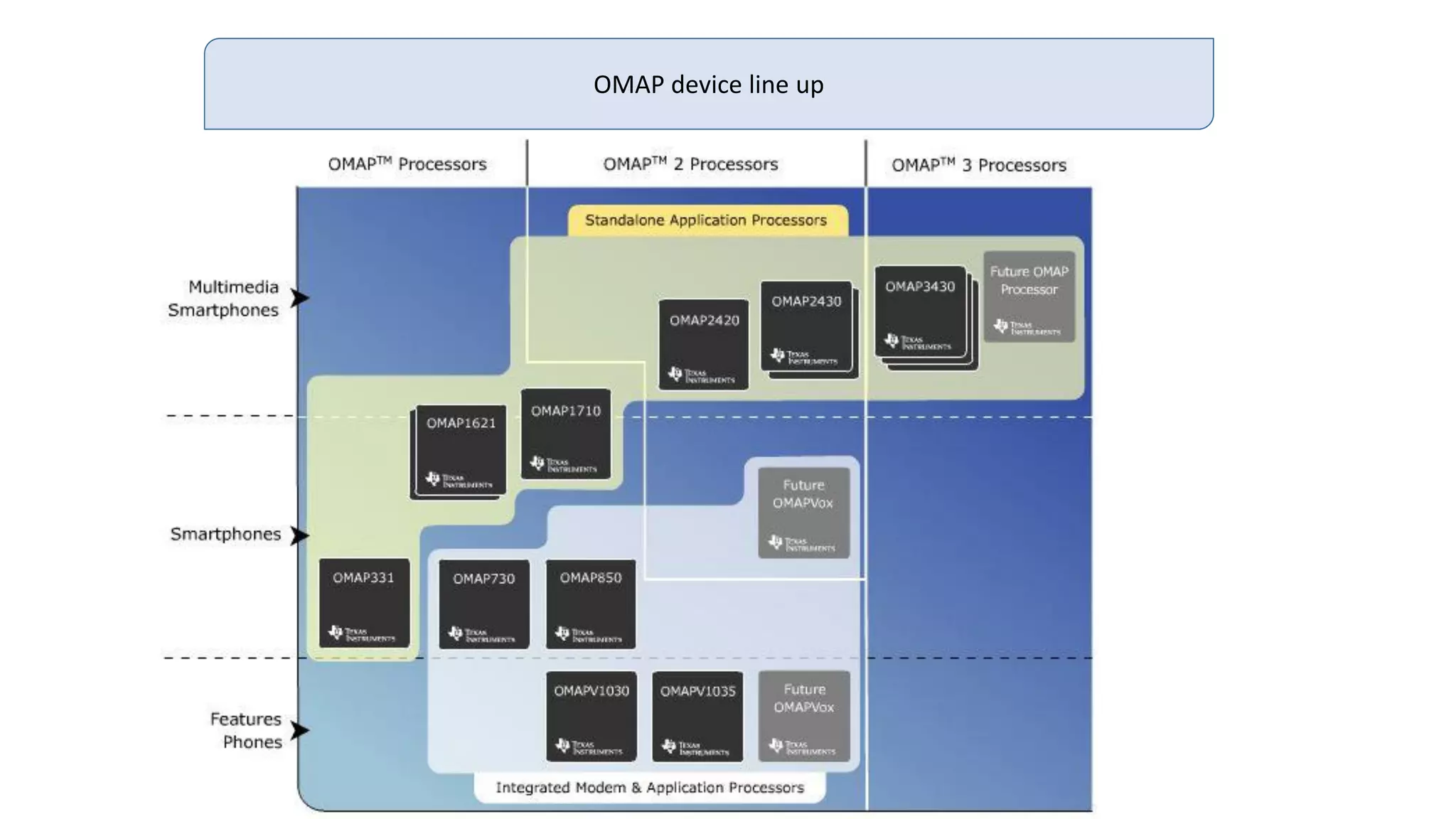
OMAP device line up
OMAP family core performance
The OMAP in TI's mobile market processor products
REFERENCES
• http://processors.wiki.ti.com/index.php/OMAP
• http://www.ti.com/general/docs/wtbu/wtbuproductcontent.tsp?tem
plateId=6123&navigationId=11991&path=templatedata/cm/product/
data/omap_1710
• A review on OMAP processors in embedded applications
Venkatarami reddy, 2D Sowjanya reddy .
• https://en.wikipedia.org/wiki/OMAP

OMAP

  • 1.
  • 2.
    • The OMAPSOC family is based on a two processor system, an ARM processor combined with a Texas Instruments (TI) DSP. • It is a series of image / video processors • The ARM processor is a general purpose processor designed with a reduced instruction set (RISC) architecture. INTRODUCTION
  • 3.
    • The TIDSP has an instruction set optimized for digital signal processing applications. • The GPP and the DSP provide processors with complimentary instruction sets, • the GPP is suited for general purpose data processing and communication tasks, the DSP supports operations for signal and image processing. • The combination of these two processors creates a power efficient platform for applications that must perform complex signal processing algorithms and communicate the results to network and human interfaces DSP with ARM
  • 4.
    The OMAP familyconsists of three product groups classified by performance and intended applications: OMAP FAMILY 1) Integrated modem and applications processors 2) Basic multimedia applications processors 3) High-performance applications processors
  • 5.
    integrated modem andapplications processors These are marketed only used by handset manufacturers. Many of the newer versions are highly integrated for use in very low cost cell phones Example – Toshiba G710 (OMAP- V 1030)
  • 6.
    various integrated modemsand application of OMAP processors PROCESSOR APPLICATION OMAPV1035 Single-chip EDGE OMAPV1030 ARM926TEJ, GSM/GPRS/EDGE OMAP850 200 MHz ARM926EJ-S + GSM/GPRS digital baseband + stacked EDGE co-processor OMAP750 200 MHz ARM926EJ-S + GSM/GPRS digital baseband + DDR Memory support OMAP733 200 MHz ARM926EJ-S + GSM/GPRS digital baseband + stacked SDRAM OMAP730 200 MHz ARM926EJ-S + GSM/GPRS digital baseband + SDRAM Memory support OMAP710 133 MHz ARM925 + GSM/GPRS digital baseband
  • 8.
    OMAPV1030 features andspecifications Integrated, digital baseband combines ARM926TEJ and TI DSP  GSM/GPRS/EDGE Class 12 capable  Includes single-chip analog companion device: Full power management Audio codecs Analog drivers  Supports a wide range of image codecs: JPEG GIF87a, GIF89a PNG BMP, WBMP Video record, playback and streaming downloads: Up to QCIF 30 fps or CIF 15 fps Up to 15 fps (MPEG4 and WB-AMR decode)  Digital audio processing: Decode/Encode with streaming support Audio treatment (mono-stereo, equalizer) Full range of audio codecs: MP3 AAC MIDI 64 polyphonics ADPCM
  • 9.
    2D and 3Dgaming Enhanced connectivity options including Bluetooth, WLAN, A-GPS Complete hardware and software smart phone reference design Supports Nucleus and Embedded Linux 3 UARTs SDRAM, NAND Flash, NOR Flash SIM, USIM, EMV smart card controller  IrDA support including SIR, MIR, FIR Hardware and software security protection: Secure boot loader Acceleration for security standards and random number generation Security software library Full range of hardware accelerators  USB OTG  Manufactured in TI’s 90-nm advanced CMOS process technology  Roadmap includes integration of RF functions in digital CMOS OMAPV1030 features and specifications
  • 10.
    • These aremarketed only to handset manufacturers. They are intended to be highly integrated, low cost chips for consumer products. • The OMAP-DM series are intended to be used as digital media coprocessors for mobile devices with high megapixel digital still and video cameras • The Image Signal Processor (ISP) is used to accelerate processing of camera images. Basic multimedia application processors
  • 11.
    Processor Application OMAP-DM270 ARM7+ C54x DSP OMAP-DM299 ARM7 + Image Signal Processor (ISP) + stacked mDDR SDRAM OMAP-DM500 ARM7 + ISP + stacked mDDR SDRAM OMAP-DM510 ARM926 + ISP + 128 MB stacked mDDR SDRAM OMAP-DM515 ARM926 + ISP + 256 MB stacked mDDR SDRAM OMAP-DM525 ARM926 + ISP + 256 MB stacked mDDR SDRAM Various Basic multimedia application processors
  • 12.
    OMAP DM 5xfamily
  • 13.
    Integrated video coprocessor •Supports up to 25-fps MPEG4 (WVGA), • H.264 (WVGA) encode and decode • High quality 720p H.264 camcorder • Video stabilization and noise filtering Integrated Image Signal Processor (ISP) • JPEG compression up to 90 megapixels per second • Supports up to 20-megapixel camera sensors Advanced image and video features • Red eye reduction, face tracking, image • stabilization, backlight compensation Hardware imaging noise filter • Ajustable 1-3200 ISO noise filter Increase image processing speed Flexible interfaces • Various types of CMOS sensor interfaces • Signal conditioning circuits • Power management • Mobile DDR-SDRAM • Shutter, iris and auto-focus motor controls Integrated composite and S video output to TV with digital overlay • Easily connect to external TV • Easily view content with others OMAP DM 5x family key feature
  • 15.
    • High performanceapplication processors are used in smart phones which are powerful enough to run significant operating systems such as Linux, Android, Symbian , • support connectivity to personal computers and support various audio and video applications. • These high performance application processors include different OMAP serieses (OMAP1, OMAP2, OMAP3, OMAP4, OMAP5) High performance application processors
  • 16.
    • The OMAP1family started with a TI enhanced ARM core and then changed to a standard ARM926 core. It included many variants, most easily distinguished according to manufacturing technology, CPU, peripheral set and distribution channel • Products using OMAP1 processors include hundreds of cell phone models, and the Nokia 770, Internet tablets OMAP 1
  • 17.
    Procssor Application OMAP171x 220MHz ARM926EJ-S + C55x DSP, low- voltage 90 nm technology OMAP162x 204 MHz ARM926EJ-S + C55x DSP + 2 MB internal SRAM, 130 nm technology OMAP161x 204 MHz ARM926EJ-S + C55x DSP, 130 nm technology OMAP1510 168 MHz ARM925T (TI-enhanced) + C55x DSP Various OMAP 1 processors
  • 18.
  • 19.
    • Advanced 90nanometer CMOS Technology • Low-voltage 90 nm technology • 1.05 - 1.3V cores; 1.8V I/O • Consumes less than 10 µA in standby mode • Split power supplies for application processing, digital baseband and real-time clock enable precise control over power consumption • Optimized clocking and power management: only two clocks required at 13 MHz and 32 kHz • TMS320C55x DSP core subsystem • Up to 220 MHz (maximum frequency) • 32K x 16-bit on-chip dual-access RAM (DARAM) (64 KB) • 48K x 16-bit on-chip single-access RAM (SARAM) (96 KB) • 24 KB I-cache • One/two instructions executed per cycle • Video hardware accelerators for DCT, iDCT, pixel interpolation, and motion estimation for video compression Key features
  • 20.
    • ARM926TEJ coresubsystem • Up to 220 MHz ARM926TEJ V5 architecture (maximum frequency) • 32KB I-cache; 16KB D-cache • Java acceleration • Support for 32-bit and 16-bit (thumb mode) instruction sets • Data and program MMUs • Two 64-entry translation look-aside buffers (TLBs) for MMUs • 17-word write buffer • Security Acceleration in Hardware • Secure bootloader • 48 kB of secure ROM • 16 kB of secure RAM • Hardware acceleration for security standards and random number generator • Unique die ID cell • Third-party Security software library
  • 21.
    • Memory TrafficController (TC) • 16-bit EMIFS external memory interface • 16-bit EMIFF external memory interface • Application Subsystem • Supports leading operating systems • DMA with 4 physical and 17 logical channels and a dedicated 2D graphics engine • USB On-the-Go (OTG) • Two SD/MMC/SDIO ports • Two high-speed 3.68 MHz UARTs • I2C controller • Two high-speed 3.68 MHz UARTs
  • 22.
    • CompactFlash • Paralleland compact camera ports • Enhanced Debug Trace (ETM) for debug • Fast IrDA (FIR) • SPI • LCD controller • Comprehensive memory controller for interfaces to: • 128 MB of mobile SDRAM and mobile DDR • 256 MB Flash (for burst, programmable NOR flash) • 289-ball, 12 mm x 12 mm MicroStar BGA™ Package
  • 23.
    Processors Application OMAP2431 330MHz ARM1136 + 220 MHz C64x DSP OMAP2430 330 MHz ARM1136 + 220 MHz C64x DSP + PowerVR MBX lite GPU, 90 nm technology OMAP2420 330 MHz ARM1136 + 220 MHz C55x DSP + PowerVR MBX GPU, 90 nm technology OMAP 2 These parts were marketed only to handset vendors which include both internet tablets and mobile phones
  • 24.
  • 25.
    • ARM1136 at330 MHz • TMS320C55x™ DSP at 220 MHz • 2D/3D hardware MBX/VGP accelerators, up to 2 Million polygons/sec • Cross-bar high-speed, low-latency interconnect • LCD and camera interfaces • 32/32 KB caches • Integrated memory controllers • Complete peripheral set • Hardware security platform • Hardware accelerated camera and LCD interfaces • Imaging and Video Accelerator: – Boosts still pictures> 4 Mpixels – Full motion video encoding or decoding at rates up to 30 frames per second Up to VGA resolution • 5 Mbit internal SRAM supporting a VGA display  Video out supporting an external TV display • 325 ball, 12 mm x 12 mm package • DDR system in package • memory stacking (512 Mb and 768 Mb options) OMAP2420 Processor specification
  • 26.
    • The OMAP™3 family of multimedia applications processors from Texas Instruments (TI) introduces a new level of performance that enables laptop-like productivity and advanced entertainment in multimedia-enabled handsets. OMAP 3 devices support all levels of handsets, from the entry-level multimedia-enabled handsets to high- end Mobile Internet Devices (MIDs). OMAP3
  • 27.
  • 28.
    • Combines mobileentertainment and high- performance productivity applications • Integrates the advanced Superscalar ARM Cortex-A8 RISC core, enabling up to 3x gain in performance versus ARM11. • Designed in 45-nm (OMAP36x platform) and 65-nm (OMAP34x platform) CMOS process technologies for less power consumption and increased device performance. • Includes integrated IVA hardware accelerators to enable multi-standard encode decode up to HD resolution • Packaging: 12 mm x 12 mm or 14 mm x 14 mm MicroStar BGA™ integrated circuit packages, memory-stackable. • Available integrated image signal processor (ISP) enables faster, higher quality image capture, lower system cost and lower power consumption. • Provides seamless connectivity to hard diskdrive (HDD) devices for mass storage • Assures mobile security with M-Shield™ mobile security technology capability enhanced with ARM Trust Zone support. • Shares fully scalable software solution with all OMAP 2 processor • Supports all high-level OSs for customizable interfaces, including Linux, Microsoft Windows Mobile, Open Handset Alliance Android and Symbian. Key features
  • 29.
    OMAP4 At the heartof the OMAP 4 platform is a powerful system-on-chip that includes the perfect balance of power efficiency and high performance.The OMAP 4 processor balances processing across four main engines: a programmable multimedia engine based on TI’s C64x DSP andpower-efficient, multi-format hardware accelerators; general-purpose processing based on the dual-core ARM® Cortex™-A9 MPCore™ supporting symmetric multiprocessing (SMP) and capable of speeds of more than 1 GHz per core; a high-performance programmable graphics engine; and an Image Signal Processor (ISP) for unparalleled video and imaging performance.
  • 30.
  • 31.
  • 32.
    • Highly-optimized mobileapplications platform including: applications processors, multimedia software and power management to drive Smartphones and MIDs • IVA 3 accelerator enables full HD 1080p, multi-standard video encode/decode • Integrated Image Signal Processor (ISP) for faster, higher-quality image and video capture with digital SLR-like 20-megapixel imaging • Integrated POWERVR™ SGX540 graphics accelerator drives next-generation, 3D user interfaces with larger displays, life-like graphics and intuitive touch screens • Dual-core ARM® Cortex™-A9 MPCore™ with SMP for higher mobile computing performance and PC-like, no compromise web browsing experience • Support for leading mobile operating systems including Symbian™, Microsoft® Windows Mobile®, Linux® (Android, LiMo) OMAP 4 key feature
  • 33.
    • Programmability andperformance headroom to support new and emerging applications and standards • Pre-integrated connectivity solutions from TI’s portfolio of WiLink™, BlueLink™ and NaviLink™ mobile connectivity solutions and pre-validated modem interface software to connect with any external modem • Industry-leading power management and SmartReflex™ 2 technologies delivers more than 10 hours of 1080p HD video playback, 4+ hours of 1080p HD video recording and 140+ hours of CD quality audio playback • Designed in mobile 45-nm CMOS process technology for less power consumption and increased device performance • M-Shield™ capability enhanced with ARM TrustZone™ support ensures mobile security • Packaging: 12 mm x 12 mm, 0.4 mm pitch PoP (Package-on-Package)
  • 34.
    • TI’s OMAP5 platform transforms the concept of “mobile” to deliver truly unique mobile experiences. • The OMAP 5 platform sets the stage for future mobile devices to transform from content consumption devices to primary computing devices. • This includes support for content creation and editing, as well as supporting advanced experiencessuch as immersive 3D gaming, gesture recognition and augmented reality applications. • The OMAP 5 system-on-chip (SoC) is the first featuring ARM®’s Cortex™-A15 MPCore™ onthe market, as TI worked closely with ARM as the Advanced Lead Partner on the Cortex- A15’sdevelopment. OMAP 5
  • 35.
    • The fifthgeneration OMAP(OMAP5) SoC uses a dual core ARM Cortex-A15 CPU with 2 additional Cortex-M4 cores to offload the A15s in lesscomputationally intensive tasks to increase powerefficiency, two powerVR SGX544MP graphics • cores and a dedicated TI 2D graphics accelerator, a multiple sub systems and a signal processor. They respectively support 24 and 20 megapixel cameras for front and rear 3D HD video recording. The chip also supports up to 8GB of dual channel LPDDR2/DDR3 memory, output to four HD 3D displays and 3D HDMI 1.4 video output.OMAP5 • also includes three USB 2.0 ports, one USB 3.0 OTG and a SATA 2.0 controller
  • 36.
    28 nano meterCMOS low-power process The highest levels of processor performance and lowest power consumption Smart multicore architecture with Symmetric Multiprocessing (SMP) including two ARM Cortex- A15 MP Core processors for SMP and two Cortex-M4 processors for low-power offload and real- time control Higher mobile computing performance 2-3x higher performance versus previous generation Faster user interfaces and less power consumption Scalable performance activates only the cores that are needed for a particular process Hardware virtualization through Hypervisor allows power and performance-efficient, multiple operating system (OS) support Key features
  • 37.
    IVA 3 HDmultimedia accelerator Full high definition 1080p60 multi-standard video encode/decode and stereoscopic 3D encode/decode at 1080p30 Imagination Technologies‘ POWERVR™ SGX544 graphics core 5x performance increase versus previous generation enables compelling 2D and 3D interfaces and screens Multi-core imaging and vision processing unit • High-quality, high-megapixel digital SLR-like images at upto 24 MP (or 12 MP S3D) • On-the-fly support with real-time face detection, stabilization, noise filtering and 3D optimization to replace digital still cameras SmartReflex™ 3 technology • Dynamically controlled voltage, frequency and power based on device activity, modes of operation and temperature Low Power audio • Provides up to 140+ hours of CD-quality audio playback
  • 38.
    TI proprietary M-Shield™mobile security technology enhanced with ARM TrustZone® support and based on open APIs • Unprecedented security capable of supporting enterprise andeven premium content streaming applications on the go High-bandwidth memory interface with 8.5 GB/s • OMAP5430 – 2-channel LPDDR2 @532 MHz • OMAP5432 – 2-channel DDR3 @532 MHz Flexible system support • Supports up to 4 displays: three high-resolution LCD displays and external HDMI 1.4a HDTV output • Enhanced, higher-speed industry-standard interfaces: • USB3, MIPI CSI-3/UniPort-M/LLI Backwards compatibility • Begin development with the OMAP 4 platform and migrate easily later to the OMAP 5 platform
  • 39.
  • 41.
  • 42.
    OMAP family coreperformance
  • 43.
    The OMAP inTI's mobile market processor products
  • 44.