Introduction to
CloudStack Networking
           Geoff Higginbottom
             CTO ShapeBlue
  geoff.higginbottom@shapeblue.com
          Twitter: @ShapeBlue
About ShapeBlue

“ShapeBlue are expert builders of public & private
 clouds. They are the leading global CloudStack /
    CloudPlatform integrator & consultancy”


                   www.shapeblue.com   CloudStack Collaboration Conference 2012
www.shapeblue.com   CloudStack Collaboration Conference 2012
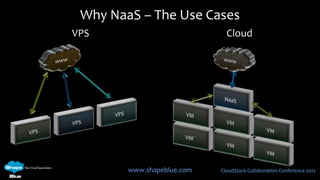
Why NaaS – The Use Cases
VPS                           Cloud


        www.shapeblue.com   CloudStack Collaboration Conference 2012
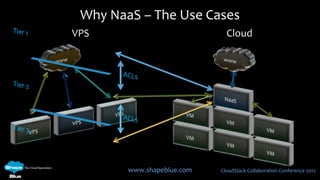
Why NaaS – The Use Cases
VPS                           Cloud


        www.shapeblue.com   CloudStack Collaboration Conference 2012
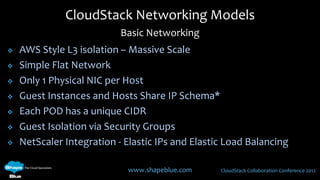
CloudStack Networking Models
                           Basic Networking
   AWS Style L3 isolation – Massive Scale
   Simple Flat Network
   Only 1 Physical NIC per Host
   Guest Instances and Hosts Share IP Schema*
   Each POD has a unique CIDR
   Guest Isolation via Security Groups
   NetScaler Integration - Elastic IPs and Elastic Load Balancing

                             www.shapeblue.com    CloudStack Collaboration Conference 2012
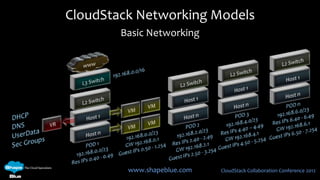
CloudStack Networking Models
        Basic Networking


         www.shapeblue.com   CloudStack Collaboration Conference 2012
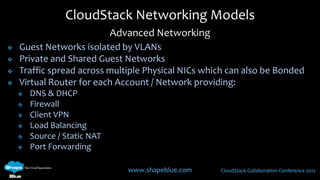
CloudStack Networking Models
                              Advanced Networking
   Guest Networks isolated by VLANs
   Private and Shared Guest Networks
   Traffic spread across multiple Physical NICs which can also be Bonded
   Virtual Router for each Account / Network providing:
       DNS & DHCP
       Firewall
       Client VPN
       Load Balancing
       Source / Static NAT
       Port Forwarding

                                 www.shapeblue.com   CloudStack Collaboration Conference 2012
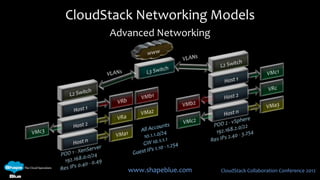
CloudStack Networking Models
      Advanced Networking


         www.shapeblue.com   CloudStack Collaboration Conference 2012
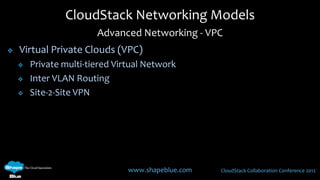
CloudStack Networking Models
                        Advanced Networking - VPC
   Virtual Private Clouds (VPC)
       Private multi-tiered Virtual Network
       Inter VLAN Routing
       Site-2-Site VPN


                                www.shapeblue.com   CloudStack Collaboration Conference 2012
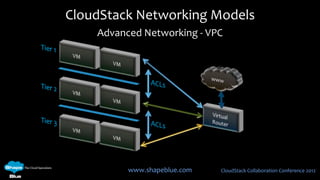
CloudStack Networking Models
    Advanced Networking - VPC


          www.shapeblue.com   CloudStack Collaboration Conference 2012
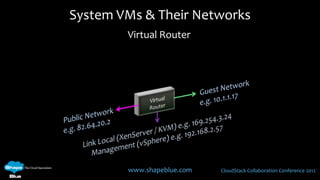
System VMs & Their Networks
        Virtual Router


        www.shapeblue.com   CloudStack Collaboration Conference 2012
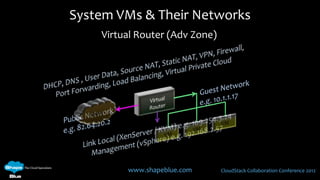
System VMs & Their Networks
    Virtual Router (Adv Zone)


         www.shapeblue.com      CloudStack Collaboration Conference 2012
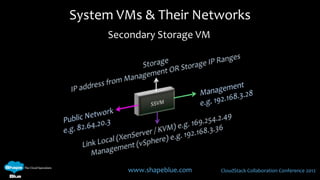
System VMs & Their Networks
     Secondary Storage VM


        www.shapeblue.com   CloudStack Collaboration Conference 2012
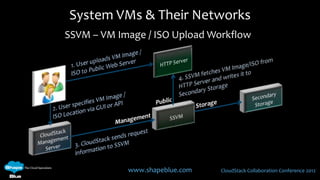
System VMs & Their Networks
SSVM – VM Image / ISO Upload Workflow


            www.shapeblue.com   CloudStack Collaboration Conference 2012
System VMs & Their Networks
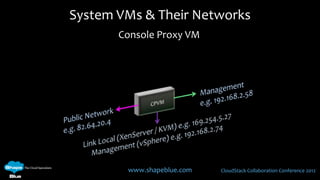
       Console Proxy VM


        www.shapeblue.com   CloudStack Collaboration Conference 2012
System VMs & Their Networks
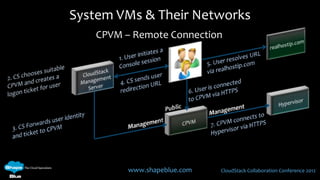
   CPVM – Remote Connection


         www.shapeblue.com   CloudStack Collaboration Conference 2012
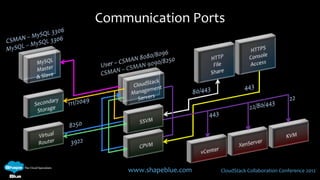
Communication Ports


    www.shapeblue.com   CloudStack Collaboration Conference 2012
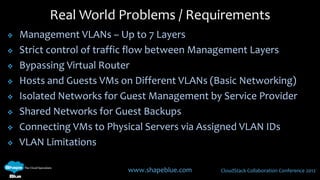
Real World Problems / Requirements
   Management VLANs – Up to 7 Layers
   Strict control of traffic flow between Management Layers
   Bypassing Virtual Router
   Hosts and Guests VMs on Different VLANs (Basic Networking)
   Isolated Networks for Guest Management by Service Provider
   Shared Networks for Guest Backups
   Connecting VMs to Physical Servers via Assigned VLAN IDs
   VLAN Limitations

                          www.shapeblue.com   CloudStack Collaboration Conference 2012
The Future
   Software Defined Networking
       Remove VLAN Limitations
       Bring full control of Network into CloudStack GUI
       Massive Scalability
       Reduce Costs


                               www.shapeblue.com      CloudStack Collaboration Conference 2012
Introduction to
CloudStack Networking
           Geoff Higginbottom
             CTO ShapeBlue
  geoff.higginbottom@shapeblue.com
          Twitter: @ShapeBlue

Introduction to CloudStack Networking

  • 1.
    Introduction to CloudStack Networking Geoff Higginbottom CTO ShapeBlue geoff.higginbottom@shapeblue.com Twitter: @ShapeBlue
  • 2.
    About ShapeBlue “ShapeBlue areexpert builders of public & private clouds. They are the leading global CloudStack / CloudPlatform integrator & consultancy” www.shapeblue.com CloudStack Collaboration Conference 2012
  • 3.
    www.shapeblue.com CloudStack Collaboration Conference 2012
  • 4.
    Why NaaS –The Use Cases VPS Cloud www.shapeblue.com CloudStack Collaboration Conference 2012
  • 5.
    Why NaaS –The Use Cases VPS Cloud www.shapeblue.com CloudStack Collaboration Conference 2012
  • 6.
    CloudStack Networking Models Basic Networking  AWS Style L3 isolation – Massive Scale  Simple Flat Network  Only 1 Physical NIC per Host  Guest Instances and Hosts Share IP Schema*  Each POD has a unique CIDR  Guest Isolation via Security Groups  NetScaler Integration - Elastic IPs and Elastic Load Balancing www.shapeblue.com CloudStack Collaboration Conference 2012
  • 7.
    CloudStack Networking Models Basic Networking www.shapeblue.com CloudStack Collaboration Conference 2012
  • 8.
    CloudStack Networking Models Advanced Networking  Guest Networks isolated by VLANs  Private and Shared Guest Networks  Traffic spread across multiple Physical NICs which can also be Bonded  Virtual Router for each Account / Network providing:  DNS & DHCP  Firewall  Client VPN  Load Balancing  Source / Static NAT  Port Forwarding www.shapeblue.com CloudStack Collaboration Conference 2012
  • 9.
    CloudStack Networking Models Advanced Networking www.shapeblue.com CloudStack Collaboration Conference 2012
  • 10.
    CloudStack Networking Models Advanced Networking - VPC  Virtual Private Clouds (VPC)  Private multi-tiered Virtual Network  Inter VLAN Routing  Site-2-Site VPN www.shapeblue.com CloudStack Collaboration Conference 2012
  • 11.
    CloudStack Networking Models Advanced Networking - VPC www.shapeblue.com CloudStack Collaboration Conference 2012
  • 12.
    System VMs &Their Networks Virtual Router www.shapeblue.com CloudStack Collaboration Conference 2012
  • 13.
    System VMs &Their Networks Virtual Router (Adv Zone) www.shapeblue.com CloudStack Collaboration Conference 2012
  • 14.
    System VMs &Their Networks Secondary Storage VM www.shapeblue.com CloudStack Collaboration Conference 2012
  • 15.
    System VMs &Their Networks SSVM – VM Image / ISO Upload Workflow www.shapeblue.com CloudStack Collaboration Conference 2012
  • 16.
    System VMs &Their Networks Console Proxy VM www.shapeblue.com CloudStack Collaboration Conference 2012
  • 17.
    System VMs &Their Networks CPVM – Remote Connection www.shapeblue.com CloudStack Collaboration Conference 2012
  • 18.
    Communication Ports www.shapeblue.com CloudStack Collaboration Conference 2012
  • 19.
    Real World Problems/ Requirements  Management VLANs – Up to 7 Layers  Strict control of traffic flow between Management Layers  Bypassing Virtual Router  Hosts and Guests VMs on Different VLANs (Basic Networking)  Isolated Networks for Guest Management by Service Provider  Shared Networks for Guest Backups  Connecting VMs to Physical Servers via Assigned VLAN IDs  VLAN Limitations www.shapeblue.com CloudStack Collaboration Conference 2012
  • 20.
    The Future  Software Defined Networking  Remove VLAN Limitations  Bring full control of Network into CloudStack GUI  Massive Scalability  Reduce Costs www.shapeblue.com CloudStack Collaboration Conference 2012
  • 21.
    Introduction to CloudStack Networking Geoff Higginbottom CTO ShapeBlue geoff.higginbottom@shapeblue.com Twitter: @ShapeBlue

Editor's Notes

  • #2 eSkyCityBroker BinSunGardCiscoOrangeT-Mobile
  • #5 VPS – Single VM, or multiples but with no control over connectivityCloud – NaaS giving end user control of the network layer, and provides virtual networks which can then be used by multiple VMs, these could be isolated networks, accessible to only VMs within a particular account, or Shared Networks, which are available to multiple Accounts5 min
  • #6 New features in CloudStack 4 allow the end user to configure vastly more complicated networks with multiple tiers, inter-VLAN routing, and full control over what traffic passes between Tiers and the public internet.7 min
  • #7 There are two networking models, Basic and Advanced and a Zone can only one typeBasic – AWS style L3 isolation – Massive ScaleReal-World Tip - Guest VMs and Hosts can be on different VLANs even though Admin Guide states they cannotSegmentation achieved via Security GroupsIngress and Egress rules control the flow of traffic into and out of Security Groups. 10 min
  • #8 Lets take a look at the typical configuration of a Basic ZoneStart with an IP Allocation for the Zone big enough to cover all Guest VMs in the ZoneIn Basic Networking each POD will be assigned a Unique IP Range for Guest VMs, which is a subnet of the Zones IP SchemaWe typically see in the region of 24-36 Hosts within a POD due limits of mx Hosts in a Cluster, and the size of Physical RacksReserved IP Range is allocated for the System VMsVirtual Router – Handles DHCP, DNS, UserData and Security Groups for the PODGuest VMs – IP Schema – each VM allocated an IP from the PODConcept is repeated over each PODGuest VMs can reside in different PODs so with Basic Networking VMs within a particular account do not have contiguous IP addresses15 min
  • #9 17 min
  • #10 22 min
  • #11 23 min
  • #12 25 min
  • #13 27 min
  • #14 29 min
  • #15 31 min
  • #16 33 min
  • #17 35 min
  • #18 37 min
  • #19 40 min
  • #20 45 min