An Introduction to 
Apache CloudStack 
Geoff Higginbottom 
CTO ShapeBlue 
geoff.higginbottom@shapeblue.com 
Twitter: @CloudStackGuru
 Cloud Architect & ShapeBlue CTO 
www.shapeblue.com @CloudStackGuru 
 Specialise in…. 
 Designing & Building Clouds based on Apache CloudStack / Citrix 
CloudPlatform 
 Developing CloudStack training 
 Blogging and sharing CloudStack knowledge 
 Involved with CloudStack before donation to Apache 
 Designed Clouds for Cloudera, SunGard, Ascenty, BskyB, Trader Media, 
M5 Hosting, Team Cymru, Interoute, University of Pennsylvania.… 
 CloudStack Committer 
About Me
About ShapeBlue 
“ShapeBlue are expert builders of public & 
private clouds. They are the leading global 
Apache CloudStack / CloudPlatform 
integrator & consultancy” 
www.shapeblue.com @CloudStackGuru
What is ‘The Cloud’? 
 Cloud computing is a general term for anything that involves 
delivering hosted services over a network. 
 These services are broadly divided into three categories: 
 Infrastructure-as-a-Service (IaaS) 
 I want virtual servers all connected to each other via an internal 
www.shapeblue.com @CloudStackGuru 
network 
 Platform-as-a-Service (PaaS) 
 I want web server, app server, and database functionality 
 Software-as-a-Service (SaaS) 
 I want X number of mailboxes or SharePoint instances
What is ‘The Cloud’? 
 What makes these services ‘Cloudy’? 
www.shapeblue.com @CloudStackGuru 
 On-demand self-service 
 Elasticity 
 Scalability 
 API integration 
 Resource accounting
Who Uses Clouds? 
 Public clouds (SPs/MSPs) 
 General public can create or log into instances themselves 
 Private Clouds (Enterprises) 
 Anyone who wants to be able to orchestrate their environment 
www.shapeblue.com @CloudStackGuru
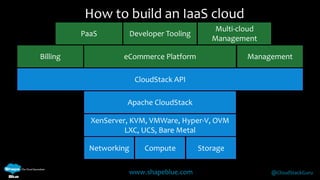
How to build an IaaS cloud 
PaaS Developer Tooling 
Multi-cloud 
Management 
Billing Management 
eCommerce Platform 
CloudStack API 
Orchestration API 
CMP Apache - Orchestration CloudStack 
layer 
XenServer, KVM, VMWare, Hyper-V, OVM 
Hypervisor 
LXC, UCS, Bare Metal 
Commodity 
Compute 
Networking Compute Storage 
www.shapeblue.com @CloudStackGuru
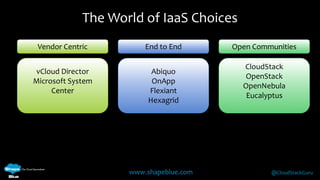
End to End 
Open Communities 
www.shapeblue.com @CloudStackGuru 
Vendor Centric 
vCloud Director 
Microsoft System 
Center 
Abiquo 
OnApp 
Flexiant 
Hexagrid 
CloudStack 
OpenStack 
OpenNebula 
Eucalyptus 
The World of IaaS Choices
Apache CloudStack 
 Apache CloudStack is a top-level project of the Apache Software 
Foundation (ASF). The project develops open source software 
for deploying public and private Infrastructure-as-a-Service (IaaS) 
clouds. 
 CloudStack provides an open and flexible cloud orchestration 
platform to deliver reliable and scalable private and public clouds 
www.shapeblue.com @CloudStackGuru
CloudStack Background 
 Open source Infrastructure-as-a-Service platform, under ASL 2.0 
www.shapeblue.com @CloudStackGuru 
license 
 A vibrant and growing community in ASF 
 Developed since 2008 by Cloud.com 
 Acquired by Citrix in 2011 
 Donated to Apache April 2012 
 Became top level ASF project March 2013 
 A proven cloud platform
Why CloudStack? 
 “OpenStack is for science projects” 
www.shapeblue.com @CloudStackGuru 
 Proven “product” 
 Quick to deploy 
 AWS API fidelity 
 Scalable 
 Open standards 
 Strong & open governance from Apache
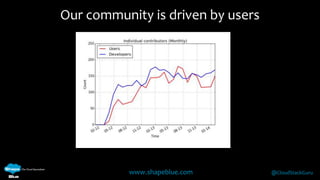
Our community is driven by users 
www.shapeblue.com @CloudStackGuru
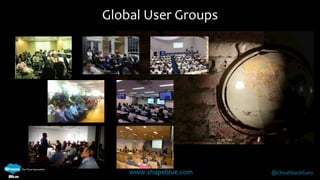
Global User Groups 
www.shapeblue.com @CloudStackGuru
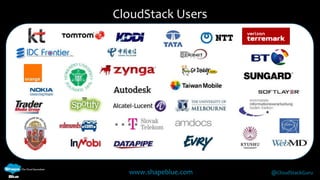
CloudStack Users 
www.shapeblue.com @CloudStackGuru
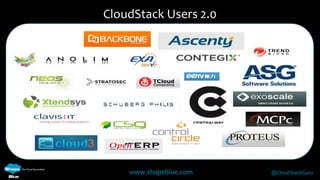
CloudStack Users 2.0 
www.shapeblue.com 15 @CloudStackGuru
CloudStack Users 3.0 
www.shapeblue.com 16 @CloudStackGuru
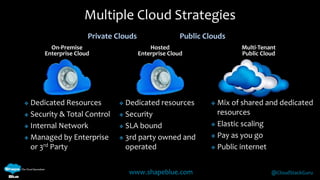
Multiple Cloud Strategies 
Private Clouds Public Clouds 
Hosted 
Enterprise Cloud 
www.shapeblue.com @CloudStackGuru 
 Dedicated Resources 
 Security & Total Control 
 Internal Network 
 Managed by Enterprise 
or 3rd Party 
 Mix of shared and dedicated 
resources 
 Elastic scaling 
 Pay as you go 
 Public internet 
On-Premise 
Enterprise Cloud 
 Dedicated resources 
 Security 
 SLA bound 
 3rd party owned and 
operated 
Multi-Tenant 
Public Cloud
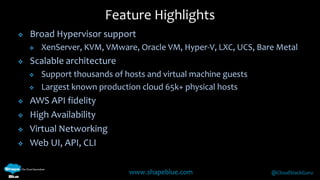
 Broad Hypervisor support 
 XenServer, KVM, VMware, Oracle VM, Hyper-V, LXC, UCS, Bare Metal 
www.shapeblue.com @CloudStackGuru 
 Scalable architecture 
 Support thousands of hosts and virtual machine guests 
 Largest known production cloud 65k+ physical hosts 
 AWS API fidelity 
 High Availability 
 Virtual Networking 
 Web UI, API, CLI 
Feature Highlights
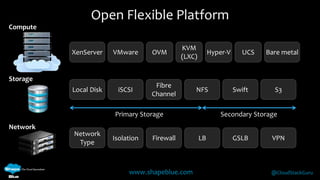
Open Flexible Platform 
XenServer VMware OVM 
KVM 
(LXC) 
UCS 
Bare metal 
S3 
www.shapeblue.com @CloudStackGuru 
Compute 
Network 
Type 
Isolation Firewall LB GSLB 
Network 
Local Disk iSCSI 
Fibre 
Channel 
NFS Swift 
Storage 
Primary Storage Secondary Storage 
VPN 
Hyper-V
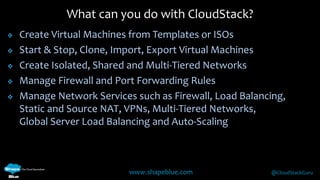
What can you do with CloudStack? 
 Create Virtual Machines from Templates or ISOs 
 Start & Stop, Clone, Import, Export Virtual Machines 
 Create Isolated, Shared and Multi-Tiered Networks 
 Manage Firewall and Port Forwarding Rules 
 Manage Network Services such as Firewall, Load Balancing, 
Static and Source NAT, VPNs, Multi-Tiered Networks, 
Global Server Load Balancing and Auto-Scaling 
www.shapeblue.com @CloudStackGuru
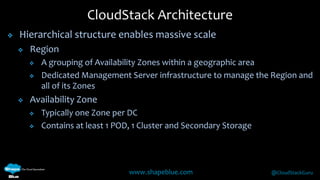
CloudStack Architecture 
 Hierarchical structure enables massive scale 
www.shapeblue.com @CloudStackGuru 
 Region 
 A grouping of Availability Zones within a geographic area 
 Dedicated Management Server infrastructure to manage the Region and 
all of its Zones 
 Availability Zone 
 Typically one Zone per DC 
 Contains at least 1 POD, 1 Cluster and Secondary Storage
CloudStack Architecture 
www.shapeblue.com @CloudStackGuru 
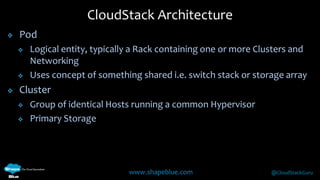
 Pod 
 Logical entity, typically a Rack containing one or more Clusters and 
Networking 
 Uses concept of something shared i.e. switch stack or storage array 
 Cluster 
 Group of identical Hosts running a common Hypervisor 
 Primary Storage
CloudStack Architecture 
www.shapeblue.com @CloudStackGuru 
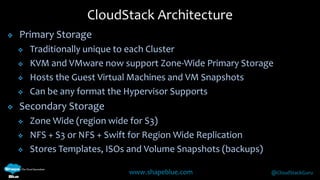
 Primary Storage 
 Traditionally unique to each Cluster 
 KVM and VMware now support Zone-Wide Primary Storage 
 Hosts the Guest Virtual Machines and VM Snapshots 
 Can be any format the Hypervisor Supports 
 Secondary Storage 
 Zone Wide (region wide for S3) 
 NFS + S3 or NFS + Swift for Region Wide Replication 
 Stores Templates, ISOs and Volume Snapshots (backups)
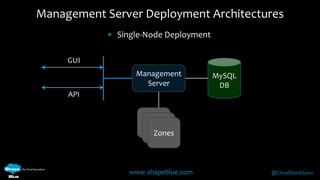
Management Server Deployment Architectures 
 Single-Node Deployment 
Management 
Server 
Zone 1 
Zone 1 
Zones 
MySQL 
DB 
www.shapeblue.com @CloudStackGuru 
GUI 
API
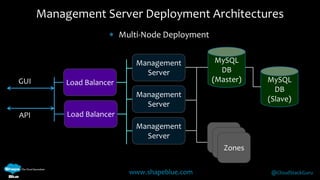
Management Server Deployment Architectures 
 Multi-Node Deployment 
GUI (Master) 
Management 
Server 
MySQL 
DB 
Zone 1 
Zone 1 
Zones 
www.shapeblue.com @CloudStackGuru 
API 
MySQL 
DB 
(Slave) 
Management 
Server 
Management 
Server 
Load Balancer 
Load Balancer
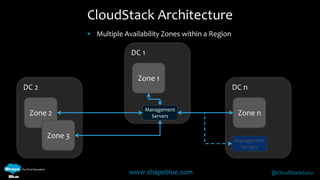
CloudStack Architecture 
 Multiple Availability Zones within a Region 
DC 1 
Zone 1 
www.shapeblue.com @CloudStackGuru 
DC 2 
Zone 2 
Zone 3 
DC n 
Zone n Management 
Servers 
Management 
Servers
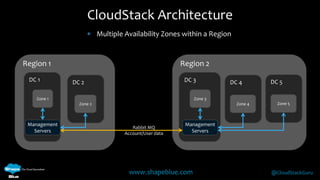
CloudStack Architecture 
 Multiple Availability Zones within a Region 
www.shapeblue.com @CloudStackGuru 
Region 1 
DC 1 
Zone 1 
DC 2 
Zone 2 
Management 
Servers 
Region 2 
DC 3 
Zone 3 
DC 4 
Zone 4 
Management 
Servers 
Rabbit MQ 
Account/User data 
DC 5 
Zone 5
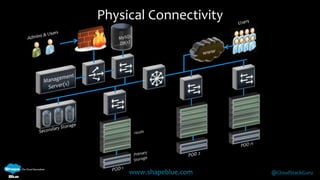
Physical Connectivity 
www.shapeblue.com @CloudStackGuru
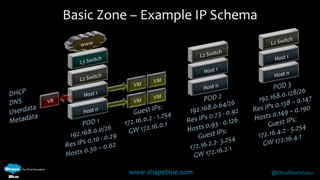
Basic Networking 
 AWS Style L3 isolation – Massive Scale 
www.shapeblue.com @CloudStackGuru 
 Simple Flat Network 
 Each POD has a unique CIDR (Broadcast domain) 
 Optional Guest Isolation via Security Groups 
 Optional NetScaler Integration - Elastic IPs and Elastic LB 
 Optional Nicira NVP Integration
 Guest Networks isolated by VLANs / SDN Technologies 
 Private and Shared Guest Networks 
 Multiple Physical Networks 
 Virtual Router for each Network providing: 
www.shapeblue.com @CloudStackGuru 
 DNS & DHCP 
 Firewall 
 Client VPN 
 Load Balancing 
 Source / Static NAT 
 Port Forwarding 
Advanced Networking
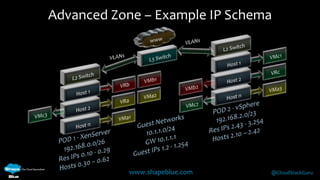
Security Groups in Advanced Zones 
 Effectively enables the deployment of multiple ‘Basic’ style 
networks which use Security Groups for isolation of VMs, but 
with each Network encapsulated within a unique VLAN (or SDN) 
 Enables the ‘stretching’ of Guest IP Address Space across 
www.shapeblue.com @CloudStackGuru 
multiple PODs
Basic Zone – Example IP Schema 
www.shapeblue.com @CloudStackGuru
Advanced Zone – Example IP Schema 
www.shapeblue.com @CloudStackGuru
Demo 
www.shapeblue.com @CloudStackGuru
Any Questions ? 
www.shapeblue.com @CloudStackGuru
An Introduction to Apache 
CloudStack 
Geoff Higginbottom 
CTO ShapeBlue 
geoff.higginbottom@shapeblue.com 
Twitter: @CloudStackGuru

Silicon Valley CloudStack User Group - Introduction to Apache CloudStack

  • 1.
    An Introduction to Apache CloudStack Geoff Higginbottom CTO ShapeBlue geoff.higginbottom@shapeblue.com Twitter: @CloudStackGuru
  • 2.
     Cloud Architect& ShapeBlue CTO www.shapeblue.com @CloudStackGuru  Specialise in….  Designing & Building Clouds based on Apache CloudStack / Citrix CloudPlatform  Developing CloudStack training  Blogging and sharing CloudStack knowledge  Involved with CloudStack before donation to Apache  Designed Clouds for Cloudera, SunGard, Ascenty, BskyB, Trader Media, M5 Hosting, Team Cymru, Interoute, University of Pennsylvania.…  CloudStack Committer About Me
  • 3.
    About ShapeBlue “ShapeBlueare expert builders of public & private clouds. They are the leading global Apache CloudStack / CloudPlatform integrator & consultancy” www.shapeblue.com @CloudStackGuru
  • 4.
    What is ‘TheCloud’?  Cloud computing is a general term for anything that involves delivering hosted services over a network.  These services are broadly divided into three categories:  Infrastructure-as-a-Service (IaaS)  I want virtual servers all connected to each other via an internal www.shapeblue.com @CloudStackGuru network  Platform-as-a-Service (PaaS)  I want web server, app server, and database functionality  Software-as-a-Service (SaaS)  I want X number of mailboxes or SharePoint instances
  • 5.
    What is ‘TheCloud’?  What makes these services ‘Cloudy’? www.shapeblue.com @CloudStackGuru  On-demand self-service  Elasticity  Scalability  API integration  Resource accounting
  • 6.
    Who Uses Clouds?  Public clouds (SPs/MSPs)  General public can create or log into instances themselves  Private Clouds (Enterprises)  Anyone who wants to be able to orchestrate their environment www.shapeblue.com @CloudStackGuru
  • 7.
    How to buildan IaaS cloud PaaS Developer Tooling Multi-cloud Management Billing Management eCommerce Platform CloudStack API Orchestration API CMP Apache - Orchestration CloudStack layer XenServer, KVM, VMWare, Hyper-V, OVM Hypervisor LXC, UCS, Bare Metal Commodity Compute Networking Compute Storage www.shapeblue.com @CloudStackGuru
  • 8.
    End to End Open Communities www.shapeblue.com @CloudStackGuru Vendor Centric vCloud Director Microsoft System Center Abiquo OnApp Flexiant Hexagrid CloudStack OpenStack OpenNebula Eucalyptus The World of IaaS Choices
  • 9.
    Apache CloudStack Apache CloudStack is a top-level project of the Apache Software Foundation (ASF). The project develops open source software for deploying public and private Infrastructure-as-a-Service (IaaS) clouds.  CloudStack provides an open and flexible cloud orchestration platform to deliver reliable and scalable private and public clouds www.shapeblue.com @CloudStackGuru
  • 10.
    CloudStack Background Open source Infrastructure-as-a-Service platform, under ASL 2.0 www.shapeblue.com @CloudStackGuru license  A vibrant and growing community in ASF  Developed since 2008 by Cloud.com  Acquired by Citrix in 2011  Donated to Apache April 2012  Became top level ASF project March 2013  A proven cloud platform
  • 11.
    Why CloudStack? “OpenStack is for science projects” www.shapeblue.com @CloudStackGuru  Proven “product”  Quick to deploy  AWS API fidelity  Scalable  Open standards  Strong & open governance from Apache
  • 12.
    Our community isdriven by users www.shapeblue.com @CloudStackGuru
  • 13.
    Global User Groups www.shapeblue.com @CloudStackGuru
  • 14.
  • 15.
    CloudStack Users 2.0 www.shapeblue.com 15 @CloudStackGuru
  • 16.
    CloudStack Users 3.0 www.shapeblue.com 16 @CloudStackGuru
  • 17.
    Multiple Cloud Strategies Private Clouds Public Clouds Hosted Enterprise Cloud www.shapeblue.com @CloudStackGuru  Dedicated Resources  Security & Total Control  Internal Network  Managed by Enterprise or 3rd Party  Mix of shared and dedicated resources  Elastic scaling  Pay as you go  Public internet On-Premise Enterprise Cloud  Dedicated resources  Security  SLA bound  3rd party owned and operated Multi-Tenant Public Cloud
  • 18.
     Broad Hypervisorsupport  XenServer, KVM, VMware, Oracle VM, Hyper-V, LXC, UCS, Bare Metal www.shapeblue.com @CloudStackGuru  Scalable architecture  Support thousands of hosts and virtual machine guests  Largest known production cloud 65k+ physical hosts  AWS API fidelity  High Availability  Virtual Networking  Web UI, API, CLI Feature Highlights
  • 19.
    Open Flexible Platform XenServer VMware OVM KVM (LXC) UCS Bare metal S3 www.shapeblue.com @CloudStackGuru Compute Network Type Isolation Firewall LB GSLB Network Local Disk iSCSI Fibre Channel NFS Swift Storage Primary Storage Secondary Storage VPN Hyper-V
  • 20.
    What can youdo with CloudStack?  Create Virtual Machines from Templates or ISOs  Start & Stop, Clone, Import, Export Virtual Machines  Create Isolated, Shared and Multi-Tiered Networks  Manage Firewall and Port Forwarding Rules  Manage Network Services such as Firewall, Load Balancing, Static and Source NAT, VPNs, Multi-Tiered Networks, Global Server Load Balancing and Auto-Scaling www.shapeblue.com @CloudStackGuru
  • 21.
    CloudStack Architecture Hierarchical structure enables massive scale www.shapeblue.com @CloudStackGuru  Region  A grouping of Availability Zones within a geographic area  Dedicated Management Server infrastructure to manage the Region and all of its Zones  Availability Zone  Typically one Zone per DC  Contains at least 1 POD, 1 Cluster and Secondary Storage
  • 22.
    CloudStack Architecture www.shapeblue.com@CloudStackGuru  Pod  Logical entity, typically a Rack containing one or more Clusters and Networking  Uses concept of something shared i.e. switch stack or storage array  Cluster  Group of identical Hosts running a common Hypervisor  Primary Storage
  • 23.
    CloudStack Architecture www.shapeblue.com@CloudStackGuru  Primary Storage  Traditionally unique to each Cluster  KVM and VMware now support Zone-Wide Primary Storage  Hosts the Guest Virtual Machines and VM Snapshots  Can be any format the Hypervisor Supports  Secondary Storage  Zone Wide (region wide for S3)  NFS + S3 or NFS + Swift for Region Wide Replication  Stores Templates, ISOs and Volume Snapshots (backups)
  • 24.
    Management Server DeploymentArchitectures  Single-Node Deployment Management Server Zone 1 Zone 1 Zones MySQL DB www.shapeblue.com @CloudStackGuru GUI API
  • 25.
    Management Server DeploymentArchitectures  Multi-Node Deployment GUI (Master) Management Server MySQL DB Zone 1 Zone 1 Zones www.shapeblue.com @CloudStackGuru API MySQL DB (Slave) Management Server Management Server Load Balancer Load Balancer
  • 26.
    CloudStack Architecture Multiple Availability Zones within a Region DC 1 Zone 1 www.shapeblue.com @CloudStackGuru DC 2 Zone 2 Zone 3 DC n Zone n Management Servers Management Servers
  • 27.
    CloudStack Architecture Multiple Availability Zones within a Region www.shapeblue.com @CloudStackGuru Region 1 DC 1 Zone 1 DC 2 Zone 2 Management Servers Region 2 DC 3 Zone 3 DC 4 Zone 4 Management Servers Rabbit MQ Account/User data DC 5 Zone 5
  • 28.
  • 29.
    Basic Networking AWS Style L3 isolation – Massive Scale www.shapeblue.com @CloudStackGuru  Simple Flat Network  Each POD has a unique CIDR (Broadcast domain)  Optional Guest Isolation via Security Groups  Optional NetScaler Integration - Elastic IPs and Elastic LB  Optional Nicira NVP Integration
  • 30.
     Guest Networksisolated by VLANs / SDN Technologies  Private and Shared Guest Networks  Multiple Physical Networks  Virtual Router for each Network providing: www.shapeblue.com @CloudStackGuru  DNS & DHCP  Firewall  Client VPN  Load Balancing  Source / Static NAT  Port Forwarding Advanced Networking
  • 31.
    Security Groups inAdvanced Zones  Effectively enables the deployment of multiple ‘Basic’ style networks which use Security Groups for isolation of VMs, but with each Network encapsulated within a unique VLAN (or SDN)  Enables the ‘stretching’ of Guest IP Address Space across www.shapeblue.com @CloudStackGuru multiple PODs
  • 32.
    Basic Zone –Example IP Schema www.shapeblue.com @CloudStackGuru
  • 33.
    Advanced Zone –Example IP Schema www.shapeblue.com @CloudStackGuru
  • 34.
  • 35.
    Any Questions ? www.shapeblue.com @CloudStackGuru
  • 36.
    An Introduction toApache CloudStack Geoff Higginbottom CTO ShapeBlue geoff.higginbottom@shapeblue.com Twitter: @CloudStackGuru

Editor's Notes

  • #7 Service providers – public create instances themselves and pay per-instance per-hour depending on the size of offering Add services such as vpn extra ip addresses backup etc. MSP add their own value-add
  • #18 CloudStack works within multiple enterprise strategies and mandates, as well as supporting multiple cloud strategies from a provider perspective. As an initial step beyond traditional server virtualization, many organizations are looking to private cloud implementations as a means to satisfy flexibility while still retaining control over service delivery. The private cloud may be hosted by the IT organization itself, or sourced from a managed service provider, but the net goals of total control and security without compromising SLAs is achieved. For some organizations, the managed service model is stepped up one level with all resources sourced from a hosted solution. SLA guarantees and security concerns often dictate the types of providers an enterprise will look towards. At the far end of the spectrum are public cloud providers with pay as you go pricing structures and elastic scaling. Since public clouds often abstract details such as network topology, a hybrid cloud strategy allows IT to retain control over key aspects of their operations such as data, while leveraging the benefits of elastic public cloud capacity.

  • #26 MS is stateless MS can be deployed as physical server or VM Single MS node can manage up to 10K hosts. Multiple nodes can be deployed for scale or redundancy
  • #27 Single Management Server can manage multiple zones Zones can be geographically distributed but low latency links are expected for better performance Single MS node can manage up to 10K hosts Multiple MS nodes can be deployed as cluster for scale or redundancy
  • #30 Guest VMs and Hosts can be on different VLANs even though Admin Guide states they cannot
  • #31 Private – limited to one account Shared – Accessible to either the whole Zone, a Domain (with or without subdomains), an Account or Project
  • #32 A Zone can be either Basic OR Advanced