SDN in CloudStack
About me
Hugo Trippaers
Email: htrippaers@schubergphilis.com
Twitter: @Spark404
Freenode: Spark404
I’ve been working in IT for over two decades, mainly at ISP ands hosting companies
Mission Critical Engineer at Schuberg Philis for almost 6 years.
Responsible for the 100% availability of our customers application landscapes
Currently part of the internal development team
PMC member for Apache Cloudstack
»
–
–
–
»
»
–
–
»
CloudStack networking - the five minute version
CloudStack networking
Basic, isolation using security groups (L3)
Advanced, isolation using network isolation (L2)
SDN was introduced to create isolated networks in Advanced
zones
By now it can do much more... (Routing, Firewall, NAT)
»
–
–
»
»
3
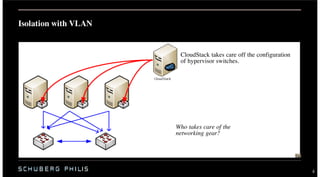
Isolation with VLAN
4
CloudStack takes care off the configuration
of hypervisor switches.
Who takes care of the
networking gear?
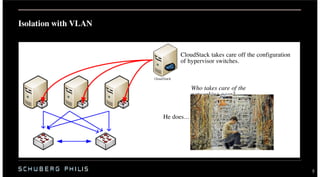
Isolation with VLAN
5
CloudStack takes care off the configuration
of hypervisor switches.
Who takes care of the
networking gear?
He does...
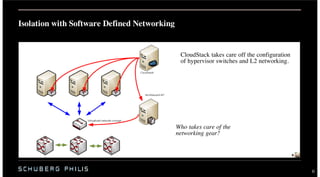
Isolation with Software Defined Networking
6
Who takes care of the
networking gear?
CloudStack takes care off the configuration
of hypervisor switches and L2 networking.
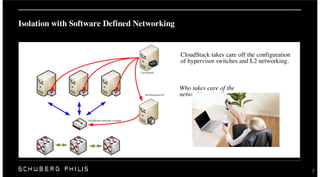
Isolation with Software Defined Networking
7
Who takes care of the
networking gear?
CloudStack takes care off the configuration
of hypervisor switches and L2 networking.
Software defined networking - core concepts
Decouples the control plane (what data is going where) from the data plane (how to get data
there)
Makes network management easier by abstracting low-level functionality into virtual services.
Independent of hardware and/or vendor
Provides a Northbound API
Allows administrators to use automated tooling to provision services
Scale?
»
»
–
»
–
»
8
Software Defined Networking - advanced
Where can we go if we have a software based network infrastructure.
Distributed routing?
Integrated security framework?
Application controlled networking?
Endless possibilities, it’s all software anyway
»
–
–
–
»
9
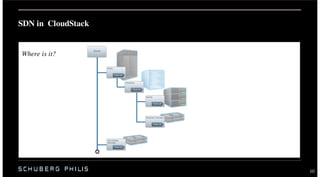
SDN in CloudStack
Where is it?»
10
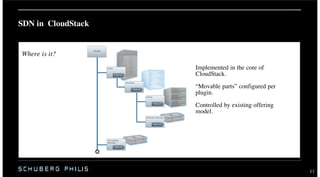
SDN in CloudStack
Where is it?»
11
Implemented in the core of
CloudStack.
“Movable parts” configured per
plugin.
Controlled by existing offering
model.
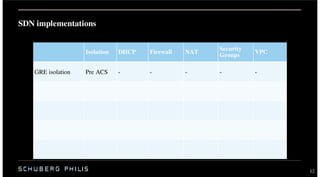
SDN implementations
12
Isolation DHCP Firewall NAT Security
Groups VPC
GRE isolation Pre ACS - - - - -
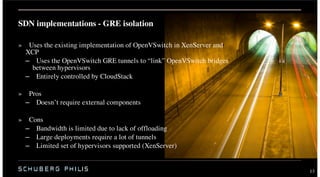
SDN implementations - GRE isolation
Uses the existing implementation of OpenVSwitch in XenServer and
XCP
Uses the OpenVSwitch GRE tunnels to “link” OpenVSwitch bridges
between hypervisors
Entirely controlled by CloudStack
Pros
Doesn’t require external components
Cons
Bandwidth is limited due to lack of offloading
Large deployments require a lot of tunnels
Limited set of hypervisors supported (XenServer)
»
–
–
»
–
»
–
–
–
13
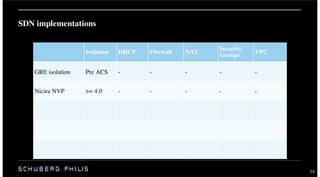
SDN implementations
14
Isolation DHCP Firewall NAT Security
Groups VPC
GRE isolation Pre ACS - - - - -
Nicira NVP >= 4.0 - - - - -
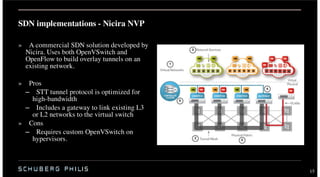
SDN implementations - Nicira NVP
A commercial SDN solution developed by
Nicira. Uses both OpenVSwitch and
OpenFlow to build overlay tunnels on an
existing network.
Pros
STT tunnel protocol is optimized for
high-bandwidth
Includes a gateway to link existing L3
or L2 networks to the virtual switch
Cons
Requires custom OpenVSwitch on
hypervisors.
»
»
–
–
»
–
15
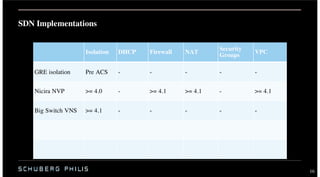
SDN Implementations
16
Isolation DHCP Firewall NAT Security
Groups VPC
GRE isolation Pre ACS - - - - -
Nicira NVP >= 4.0 - >= 4.1 >= 4.1 - >= 4.1
Big Switch VNS >= 4.1 - - - - -
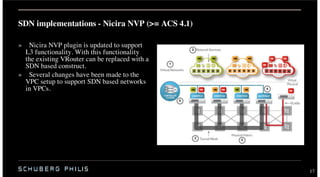
SDN implementations - Nicira NVP (>= ACS 4.1)
Nicira NVP plugin is updated to support
L3 functionality. With this functionality
the existing VRouter can be replaced with a
SDN based construct.
Several changes have been made to the
VPC setup to support SDN based networks
in VPCs.
»
»
17
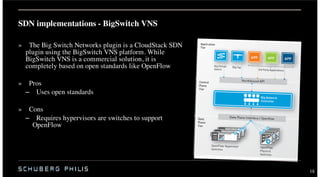
SDN implementations - BigSwitch VNS
The Big Switch Networks plugin is a CloudStack SDN
plugin using the BigSwitch VNS platform. While
BigSwitch VNS is a commercial solution, it is
completely based on open standards like OpenFlow
Pros
Uses open standards
Cons
Requires hypervisors are switches to support
OpenFlow
»
»
–
»
–
18
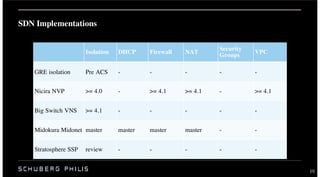
SDN Implementations
19
Isolation DHCP Firewall NAT
Security
Groups VPC
GRE isolation Pre ACS - - - - -
Nicira NVP >= 4.0 - >= 4.1 >= 4.1 - >= 4.1
Big Switch VNS >= 4.1 - - - - -
Midokura Midonet master master master master - -
Stratosphere SSP review - - - - -
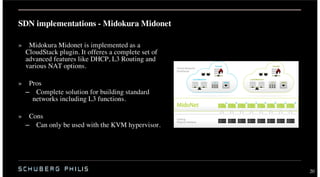
SDN implementations - Midokura Midonet
Midokura Midonet is implemented as a
CloudStack plugin. It offeres a complete set of
advanced features like DHCP, L3 Routing and
various NAT options.
Pros
Complete solution for building standard
networks including L3 functions.
Cons
Can only be used with the KVM hypervisor.
»
»
–
»
–
20
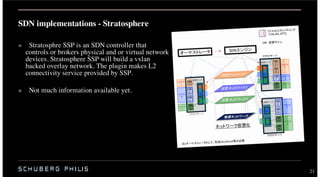
SDN implementations - Stratosphere
Stratosphre SSP is an SDN controller that
controls or brokers physical and or virtual network
devices. Stratosphere SSP will build a vxlan
backed overlay network. The plugin makes L2
connectivity service provided by SSP.
Not much information available yet.
»
»
21
SDN implementations - next steps?
Support for VPC
Including private gateways
Common configuration and setup
Security Groups
»
–
»
»
22
SDN in CloudStack - how does it work
Preparing a SDN solution for use requires some
configuration work up front
»
23
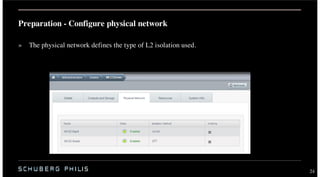
Preparation - Configure physical network
The physical network defines the type of L2 isolation used.»
24
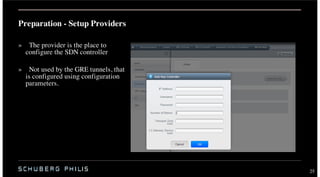
Preparation - Setup Providers
The provider is the place to
configure the SDN controller
Not used by the GRE tunnels, that
is configured using configuration
parameters.
»
»
25
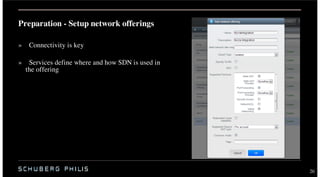
Preparation - Setup network offerings
Connectivity is key
Services define where and how SDN is used in
the offering
»
»
26
SDN in CloudStack - how does it work
Preparing a SDN solution for use requires some
configuration work up front
Using the SDN solution is as straight forward as any
networking in CloudStack
»
»
27
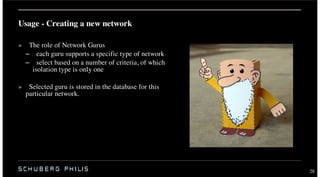
Usage - Creating a new network
The role of Network Gurus
each guru supports a specific type of network
select based on a number of criteria, of which
isolation type is only one
Selected guru is stored in the database for this
particular network.
»
–
–
»
28
Usage - Creating a new network
The role of Network Elements
triggered when ever a new NIC is attached to a network
configure devices like firewall, routers, etc..
Elements are selected based on the network offering used to
create the network.
»
–
–
»
29
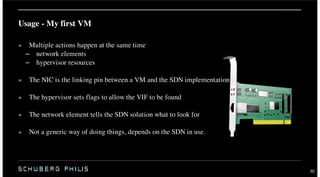
Usage - My first VM
Multiple actions happen at the same time
network elements
hypervisor resources
The NIC is the linking pin between a VM and the SDN implementation
The hypervisor sets flags to allow the VIF to be found
The network element tells the SDN solution what to look for
Not a generic way of doing things, depends on the SDN in use.
»
–
–
»
»
»
»
30
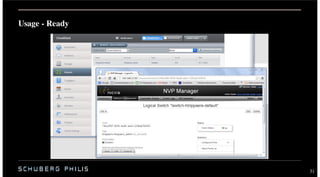
Usage - Ready
31
Thats all there is to it
http://apache.cloudstack.org
http://www.nicira.com
http://www.bigswitch.com
http://www.midokura.com
http://www.iij.ad.jp/en/
Email: htrippaers@schubergphilis.com
Twitter: @Spark404
IRC Freenode: Spark404
»
»
»
»
»
–
–
–
32

SDN in CloudStack

  • 1.
  • 2.
    About me Hugo Trippaers Email:htrippaers@schubergphilis.com Twitter: @Spark404 Freenode: Spark404 I’ve been working in IT for over two decades, mainly at ISP ands hosting companies Mission Critical Engineer at Schuberg Philis for almost 6 years. Responsible for the 100% availability of our customers application landscapes Currently part of the internal development team PMC member for Apache Cloudstack » – – – » » – – »
  • 3.
    CloudStack networking -the five minute version CloudStack networking Basic, isolation using security groups (L3) Advanced, isolation using network isolation (L2) SDN was introduced to create isolated networks in Advanced zones By now it can do much more... (Routing, Firewall, NAT) » – – » » 3
  • 4.
    Isolation with VLAN 4 CloudStacktakes care off the configuration of hypervisor switches. Who takes care of the networking gear?
  • 5.
    Isolation with VLAN 5 CloudStacktakes care off the configuration of hypervisor switches. Who takes care of the networking gear? He does...
  • 6.
    Isolation with SoftwareDefined Networking 6 Who takes care of the networking gear? CloudStack takes care off the configuration of hypervisor switches and L2 networking.
  • 7.
    Isolation with SoftwareDefined Networking 7 Who takes care of the networking gear? CloudStack takes care off the configuration of hypervisor switches and L2 networking.
  • 8.
    Software defined networking- core concepts Decouples the control plane (what data is going where) from the data plane (how to get data there) Makes network management easier by abstracting low-level functionality into virtual services. Independent of hardware and/or vendor Provides a Northbound API Allows administrators to use automated tooling to provision services Scale? » » – » – » 8
  • 9.
    Software Defined Networking- advanced Where can we go if we have a software based network infrastructure. Distributed routing? Integrated security framework? Application controlled networking? Endless possibilities, it’s all software anyway » – – – » 9
  • 10.
  • 11.
    SDN in CloudStack Whereis it?» 11 Implemented in the core of CloudStack. “Movable parts” configured per plugin. Controlled by existing offering model.
  • 12.
    SDN implementations 12 Isolation DHCPFirewall NAT Security Groups VPC GRE isolation Pre ACS - - - - -
  • 13.
    SDN implementations -GRE isolation Uses the existing implementation of OpenVSwitch in XenServer and XCP Uses the OpenVSwitch GRE tunnels to “link” OpenVSwitch bridges between hypervisors Entirely controlled by CloudStack Pros Doesn’t require external components Cons Bandwidth is limited due to lack of offloading Large deployments require a lot of tunnels Limited set of hypervisors supported (XenServer) » – – » – » – – – 13
  • 14.
    SDN implementations 14 Isolation DHCPFirewall NAT Security Groups VPC GRE isolation Pre ACS - - - - - Nicira NVP >= 4.0 - - - - -
  • 15.
    SDN implementations -Nicira NVP A commercial SDN solution developed by Nicira. Uses both OpenVSwitch and OpenFlow to build overlay tunnels on an existing network. Pros STT tunnel protocol is optimized for high-bandwidth Includes a gateway to link existing L3 or L2 networks to the virtual switch Cons Requires custom OpenVSwitch on hypervisors. » » – – » – 15
  • 16.
    SDN Implementations 16 Isolation DHCPFirewall NAT Security Groups VPC GRE isolation Pre ACS - - - - - Nicira NVP >= 4.0 - >= 4.1 >= 4.1 - >= 4.1 Big Switch VNS >= 4.1 - - - - -
  • 17.
    SDN implementations -Nicira NVP (>= ACS 4.1) Nicira NVP plugin is updated to support L3 functionality. With this functionality the existing VRouter can be replaced with a SDN based construct. Several changes have been made to the VPC setup to support SDN based networks in VPCs. » » 17
  • 18.
    SDN implementations -BigSwitch VNS The Big Switch Networks plugin is a CloudStack SDN plugin using the BigSwitch VNS platform. While BigSwitch VNS is a commercial solution, it is completely based on open standards like OpenFlow Pros Uses open standards Cons Requires hypervisors are switches to support OpenFlow » » – » – 18
  • 19.
    SDN Implementations 19 Isolation DHCPFirewall NAT Security Groups VPC GRE isolation Pre ACS - - - - - Nicira NVP >= 4.0 - >= 4.1 >= 4.1 - >= 4.1 Big Switch VNS >= 4.1 - - - - - Midokura Midonet master master master master - - Stratosphere SSP review - - - - -
  • 20.
    SDN implementations -Midokura Midonet Midokura Midonet is implemented as a CloudStack plugin. It offeres a complete set of advanced features like DHCP, L3 Routing and various NAT options. Pros Complete solution for building standard networks including L3 functions. Cons Can only be used with the KVM hypervisor. » » – » – 20
  • 21.
    SDN implementations -Stratosphere Stratosphre SSP is an SDN controller that controls or brokers physical and or virtual network devices. Stratosphere SSP will build a vxlan backed overlay network. The plugin makes L2 connectivity service provided by SSP. Not much information available yet. » » 21
  • 22.
    SDN implementations -next steps? Support for VPC Including private gateways Common configuration and setup Security Groups » – » » 22
  • 23.
    SDN in CloudStack- how does it work Preparing a SDN solution for use requires some configuration work up front » 23
  • 24.
    Preparation - Configurephysical network The physical network defines the type of L2 isolation used.» 24
  • 25.
    Preparation - SetupProviders The provider is the place to configure the SDN controller Not used by the GRE tunnels, that is configured using configuration parameters. » » 25
  • 26.
    Preparation - Setupnetwork offerings Connectivity is key Services define where and how SDN is used in the offering » » 26
  • 27.
    SDN in CloudStack- how does it work Preparing a SDN solution for use requires some configuration work up front Using the SDN solution is as straight forward as any networking in CloudStack » » 27
  • 28.
    Usage - Creatinga new network The role of Network Gurus each guru supports a specific type of network select based on a number of criteria, of which isolation type is only one Selected guru is stored in the database for this particular network. » – – » 28
  • 29.
    Usage - Creatinga new network The role of Network Elements triggered when ever a new NIC is attached to a network configure devices like firewall, routers, etc.. Elements are selected based on the network offering used to create the network. » – – » 29
  • 30.
    Usage - Myfirst VM Multiple actions happen at the same time network elements hypervisor resources The NIC is the linking pin between a VM and the SDN implementation The hypervisor sets flags to allow the VIF to be found The network element tells the SDN solution what to look for Not a generic way of doing things, depends on the SDN in use. » – – » » » » 30
  • 31.
  • 32.
    Thats all thereis to it http://apache.cloudstack.org http://www.nicira.com http://www.bigswitch.com http://www.midokura.com http://www.iij.ad.jp/en/ Email: htrippaers@schubergphilis.com Twitter: @Spark404 IRC Freenode: Spark404 » » » » » – – – 32