Introduction to CloudStack 4.3
Networking
Geoff Higginbottom
CTO ShapeBlue
geoff.higginbottom@shapeblue.com
Twitter: @CloudStackGuru
www.shapeblue.com @CloudStackGuru
 Cloud Architect & ShapeBlue CTO
 Specialise in….
 Designing & Building Clouds based on Apache CloudStack / Citrix
CloudPlatform
 Developing CloudStack training
 Blogging and sharing CloudStack knowledge
 Involved with CloudStack before donation to Apache
 Designed Clouds for SunGard, Ascenty, BskyB, Trader Media,
M5 Hosting, Team Cymru, Interoute, University of Pennsylvania.…
 CloudStack Committer (non-developer)
About Me
www.shapeblue.com @CloudStackGuru
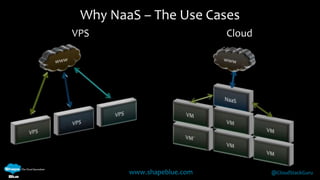
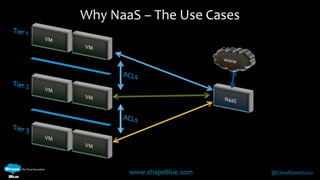
Why NaaS – The Use Cases
VPS Cloud
www.shapeblue.com @CloudStackGuru
Why NaaS – The Use Cases
www.shapeblue.com @CloudStackGuru
 AWS Style L3 isolation – Massive Scale
 Simple Flat Network
 Each POD has a unique CIDR
 Optional Guest Isolation via Security Groups
 Optional NetScaler Integration - Elastic IPs and Elastic LB
 Optional Nicira NVP Integration
Basic Networking
www.shapeblue.com @CloudStackGuru
 Isolate traffic between VMs
 Available for both Basic and Advanced Networking
 Only supported on XenServer 6.x and KVM
 XenServer 6.0.x requires the Cloud Support Package
 XenServer must use Linux Bridge and not Open vSwitch
 xe-switch-network-backend bridge
 Must be implemented before adding to CloudStack
Security Groups
www.shapeblue.com @CloudStackGuru
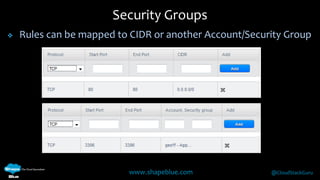
Security Groups
 Rules can be mapped to CIDR or another Account/Security Group
www.shapeblue.com @CloudStackGuru
 This network model provides the most flexibility in defining
guest networks and providing custom network offerings such as
firewall, VPN, Load Balancer & VPC functionality.
 Guest isolation is provided through layer-2 means such as VLANs
or SDN technologies
Advanced Networking
www.shapeblue.com @CloudStackGuru
 Private and Shared Guest Networks
 Multiple Physical Networks
 Virtual Router for each Network providing:
 DNS & DHCP
 Firewall
 Client VPN
 Load Balancing
 Source / Static NAT
 Port Forwarding
Advanced Networking
www.shapeblue.com @CloudStackGuru
 Effectively enables the deployment of multiple ‘Basic’ style
networks which use Security Groups for isolation of VMs, but
with each Network encapsulated within a unique VLAN.
Advanced Networking & Security Groups
www.shapeblue.com @CloudStackGuru
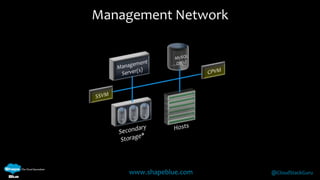
Management Network
www.shapeblue.com @CloudStackGuru
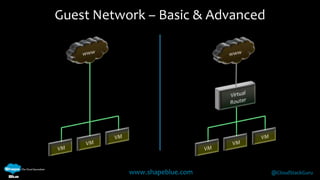
Guest Network – Basic & Advanced
www.shapeblue.com @CloudStackGuru
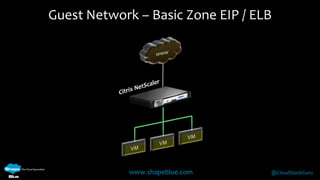
Guest Network – Basic Zone EIP / ELB
www.shapeblue.com @CloudStackGuru
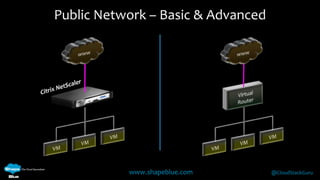
Public Network – Basic & Advanced
www.shapeblue.com @CloudStackGuru
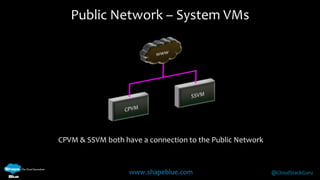
Public Network – System VMs
CPVM & SSVM both have a connection to the Public Network
www.shapeblue.com @CloudStackGuru
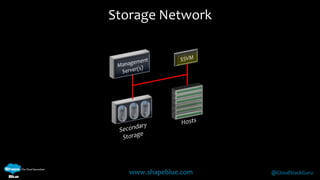
Storage Network
www.shapeblue.com @CloudStackGuru
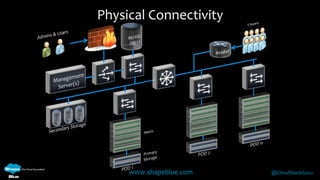
Physical Connectivity
www.shapeblue.com @CloudStackGuru
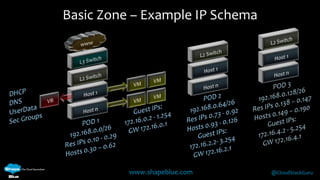
Basic Zone – Example IP Schema
www.shapeblue.com @CloudStackGuru
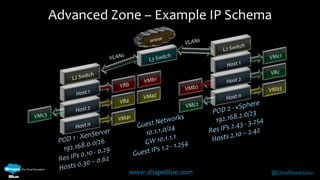
Advanced Zone – Example IP Schema
www.shapeblue.com @CloudStackGuru
 A Hardware or Virtual Appliance that provide Network Services
to CloudStack e.g.
Network Service Providers
 Virtual Router
 VPC Virtual Router
 Internal LBVM
 Citrix NetScaler
 F5 Load Balancer
 Juniper SRX Firewall
 Nicira Nvp
 Midokura Midonet
 BigSwitch Vns
 Cisco VNMC
 Baremetal DHCP*
 Baremetal PXE*
 Palo Alto*
 Ovs* *new in 4.3
www.shapeblue.com @CloudStackGuru
 Private multi-tiered Virtual Networks
 ACLs to control traffic isolation
 Inter VLAN Routing
 Site-2-Site VPN
 Private Gateway
 VPC-2-VPC VPN*
 User VPN*
Virtual Private Clouds (VPC)
*new in 4.3
www.shapeblue.com @CloudStackGuru
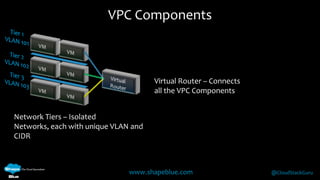
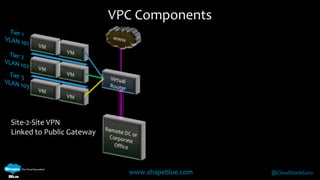
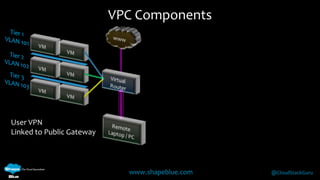
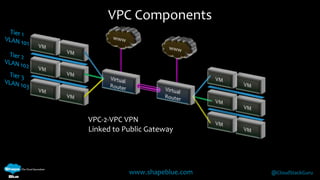
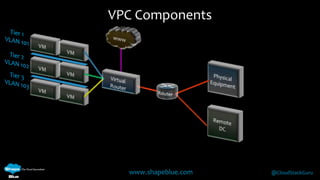
VPC Components
Virtual Router – Connects
all the VPC Components
Network Tiers – Isolated
Networks, each with unique VLAN and
CIDR
www.shapeblue.com @CloudStackGuru
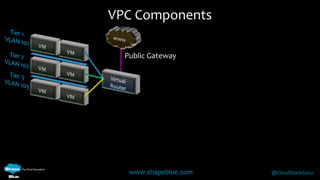
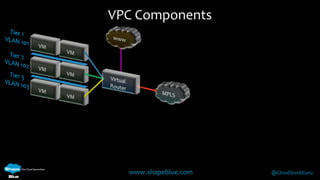
VPC Components
Public Gateway
www.shapeblue.com @CloudStackGuru
VPC Components
Site-2-Site VPN
Linked to Public Gateway
www.shapeblue.com @CloudStackGuru
VPC Components
User VPN
Linked to Public Gateway
www.shapeblue.com @CloudStackGuru
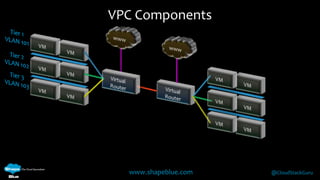
VPC Components
VPC-2-VPC VPN
Linked to Public Gateway
www.shapeblue.com @CloudStackGuru
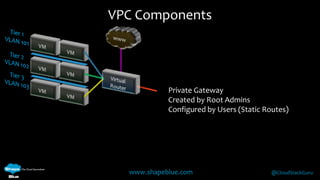
Private Gateway
Created by Root Admins
Configured by Users (Static Routes)
VPC Components
www.shapeblue.com @CloudStackGuru
VPC Components
www.shapeblue.com @CloudStackGuru
VPC Components
www.shapeblue.com @CloudStackGuru
VPC Components
www.shapeblue.com @CloudStackGuru
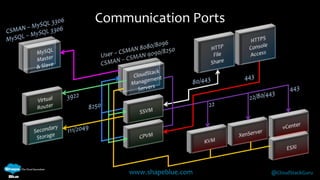
Communication Ports
www.shapeblue.com @CloudStackGuru
 Lots of great technical info on http://shapeblue.com/blog/
 These slides can be found at www.slideshare.net/shapeblue
 geoff.higginbottom@shapeblue.com
 @CloudStackGuru
Further Information

Introduction to cloudstack 4.3 networking

Editor's Notes

  • #2 eSkyCityBroker BinSunGardCiscoOrangeT-Mobile
  • #8 Guest VMs and Hosts can be on different VLANs even though Admin Guide states they cannot
  • #9 XenServer requires the CloudStack Support Package to be installed BEFORE adding to CloudStack in order to use Security GroupsSecurity Groups - Guest VM will be assigned to ‘default’ security Group if none is specified – Denies all inbound but allows all outbound. VMs can belong to multiple security groups but not the Default SG and another SG. Ingress and Egress rules control the flow of traffic into and out of Security Groups. If no Egress rules have been specified all outbound traffic is allowed, however once an Egress Rule has been created, only traffic specified by Egress Rules, in response to an Ingress Rule or related to DHCP & DNS queries is allowed out.
  • #11 A Zone can be either Basic OR Advanced
  • #12 Private – limited to one accountShared – Accessible to either the whole Zone, a Domain (with or without subdomains), an Account or Project
  • #13 A Zone can be either Basic OR Advanced
  • #14 Traffic between CloudStack Management Servers and the various cloud componentsSecondary Storage also uses the Management Network of the optional ‘Storage’ network has not been configured.
  • #15 Traffic between VMs within an Account, and their Virtual Router, Physical Load Balancer or Physical Firewall
  • #16 Traffic between VMs and the Internal Interface of the NetScaler
  • #17 Traffic between the Virtual Router and the Internet GatewayBasic Zone but only when using a NetScaler for EIP/ELB
  • #18 SSVM & CPVM each have a Public Interface
  • #19 Traffic between SSVM and the Secondary StorageOptional Network, traffic will use the Management Network if not configured. If configured, there must be a route between Management and Storage NetworksIt is NOT for Primary Storage Traffic
  • #23 Virtual RouterVPC Virtual RouterInternal Load Balancer VMCitrix NetScalerF5 Load BalancerJuniper SRX FirewallNicira Network Virtualization PlatformMidokuraMidonetBigSwitch Virtual Network SegmentsCisco Virtual Network Management Center
  • #24 23 min