• Welcome!
• CloudStack 101
• What’s New
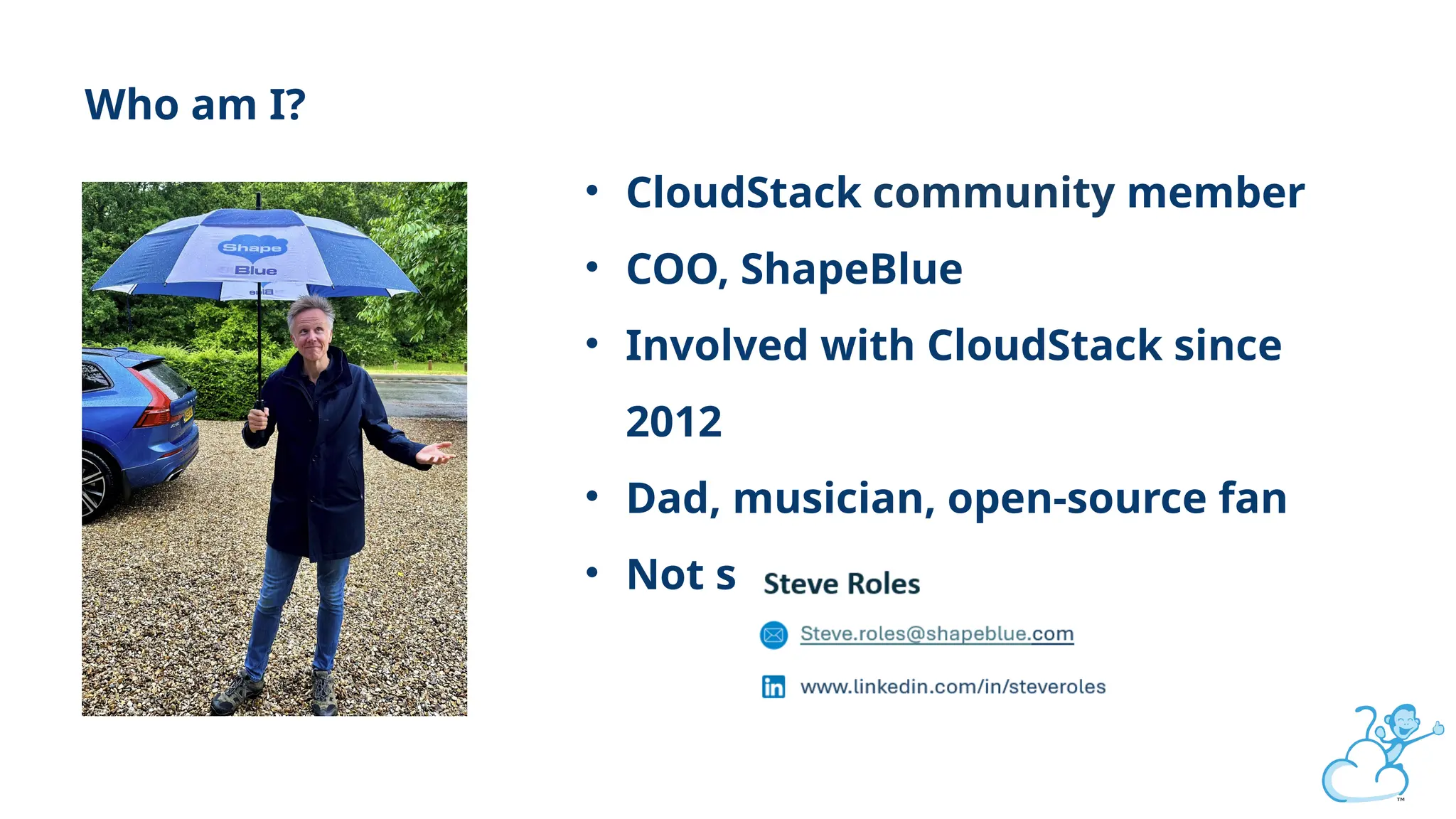
Who am I?
• CloudStack community member
• COO, ShapeBlue
• Involved with CloudStack since
2012
• Dad, musician, open-source fan
• Not super-technical!
The aims of this group
• Collaborative environment for:
• All things Apache CloudStack
• Related tech: ecosystem products, hypervisors, storage,
etc.
• Technical deep-dives, issues & best practice
• Case studies & user stories
• To showcase complementary technologies
• To share ideas & problems with other users
• Meetings in various European destinations
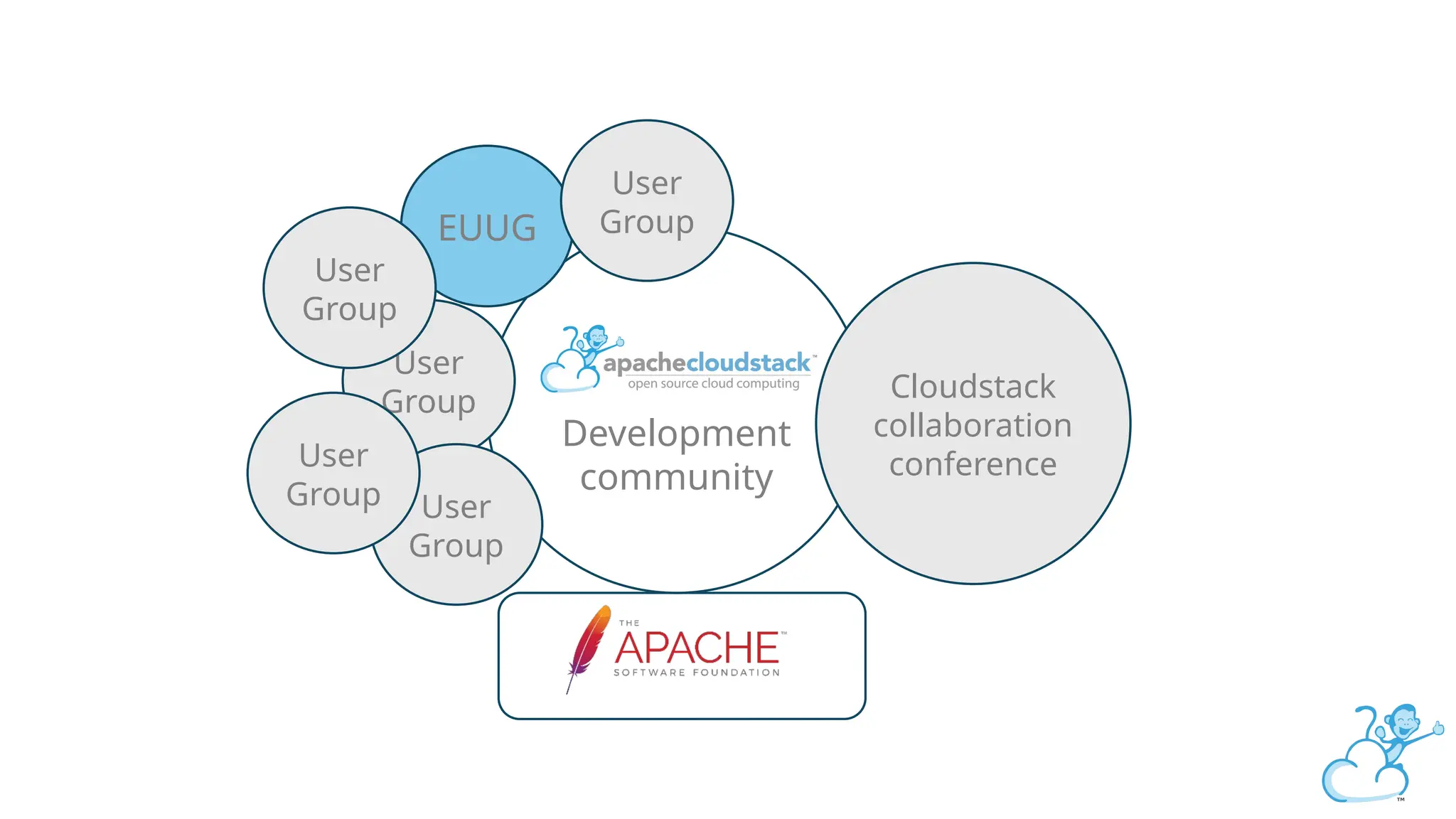
Development
community
EUUG
User
Group
User
Group
User
Group
User
Group
User
Group
Cloudstack
collaboration
conference
Thank you to our
sponsors…
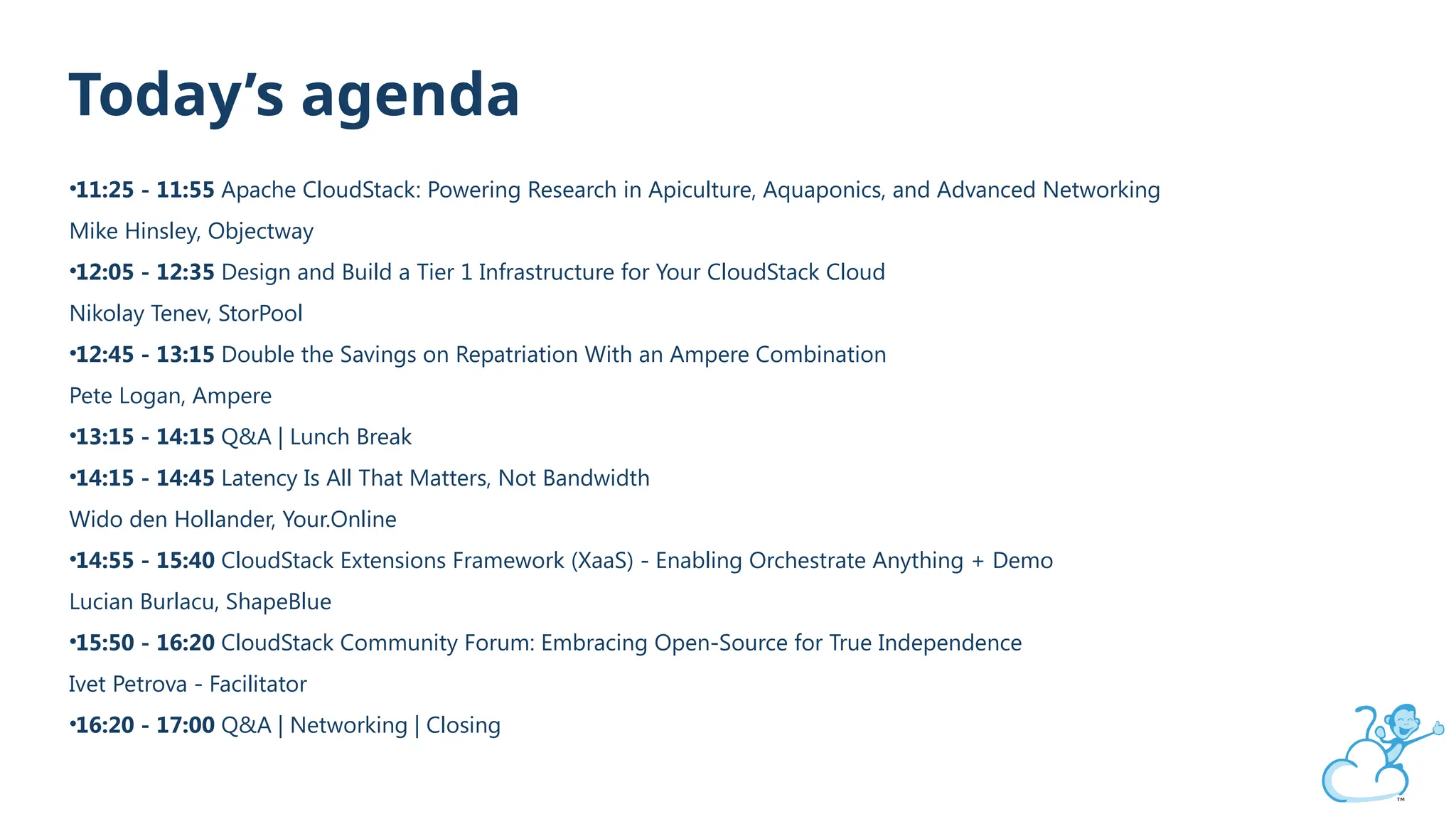
Today’s agenda
•11:25 - 11:55 Apache CloudStack: Powering Research in Apiculture, Aquaponics, and Advanced Networking
Mike Hinsley, Objectway
•12:05 - 12:35 Design and Build a Tier 1 Infrastructure for Your CloudStack Cloud
Nikolay Tenev, StorPool
•12:45 - 13:15 Double the Savings on Repatriation With an Ampere Combination
Pete Logan, Ampere
•13:15 - 14:15 Q&A | Lunch Break
•14:15 - 14:45 Latency Is All That Matters, Not Bandwidth
Wido den Hollander, Your.Online
•14:55 - 15:40 CloudStack Extensions Framework (XaaS) - Enabling Orchestrate Anything + Demo
Lucian Burlacu, ShapeBlue
•15:50 - 16:20 CloudStack Community Forum: Embracing Open-Source for True Independence
Ivet Petrova - Facilitator
•16:20 - 17:00 Q&A | Networking | Closing
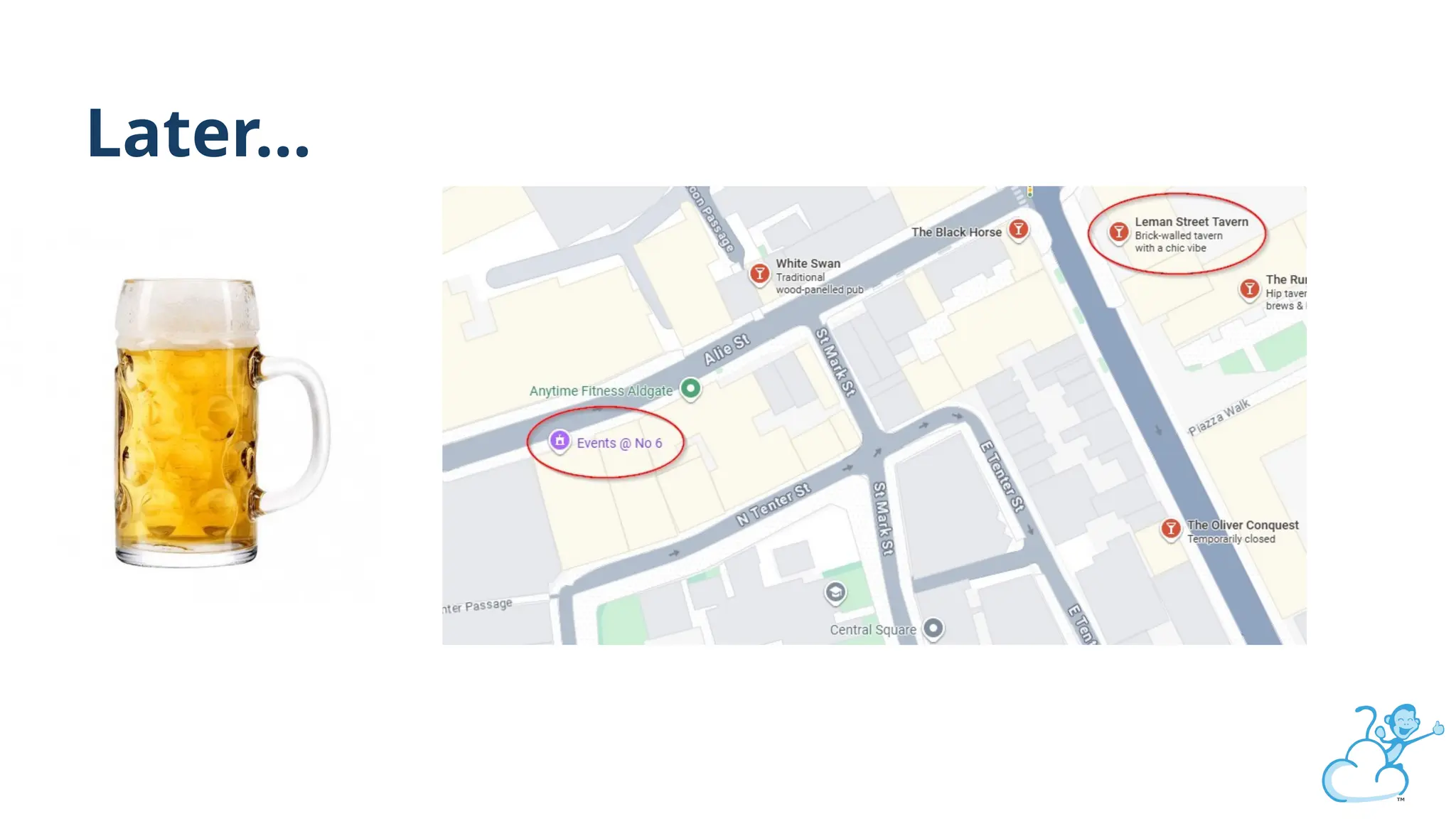
Later…
CloudStack 101
Apache CloudStack is a
scalable, multi-tenant,
open-source, purpose-built,
cloud orchestration
platform for delivering
turnkey Infrastructure-as-a-
Service clouds
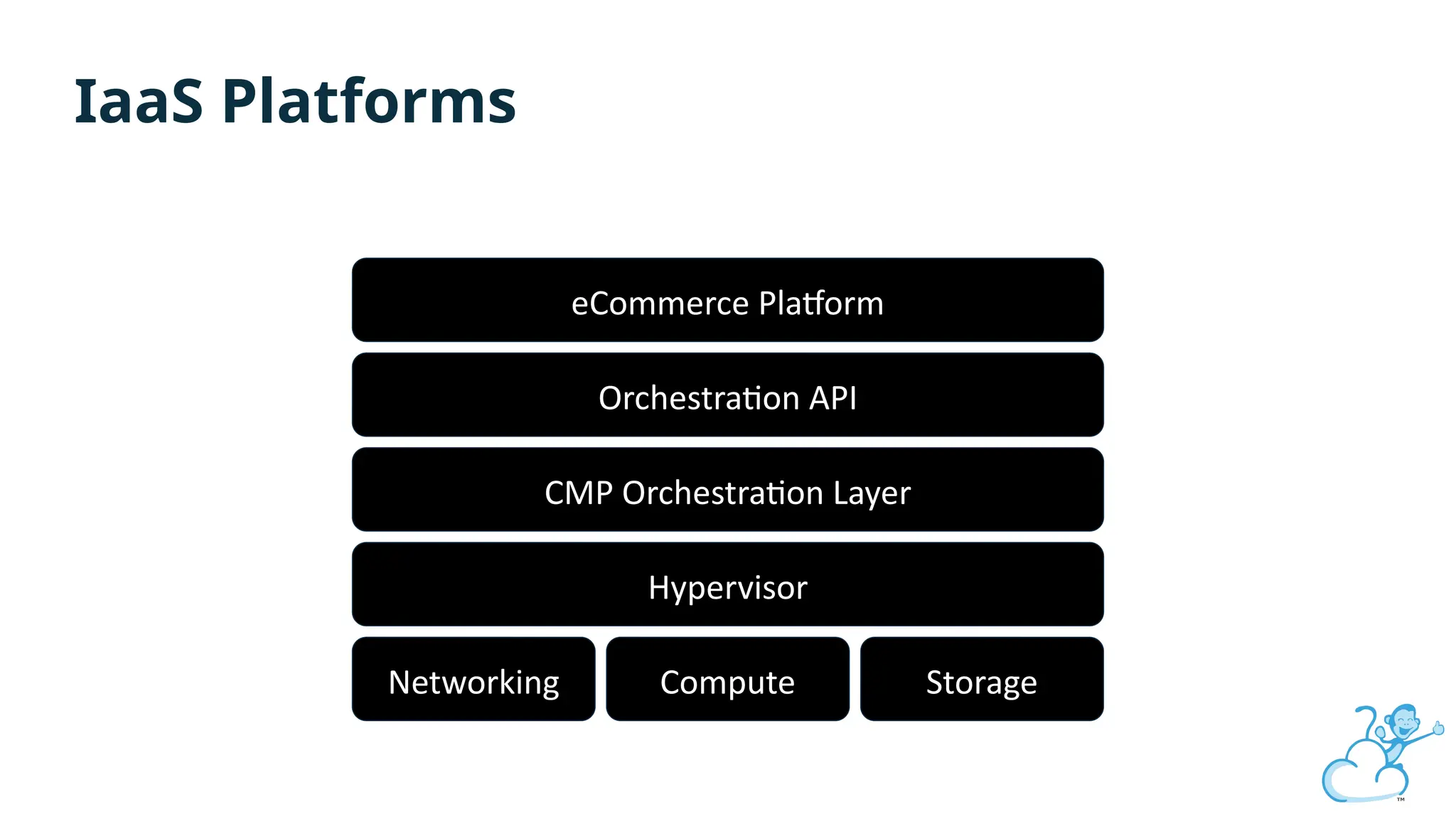
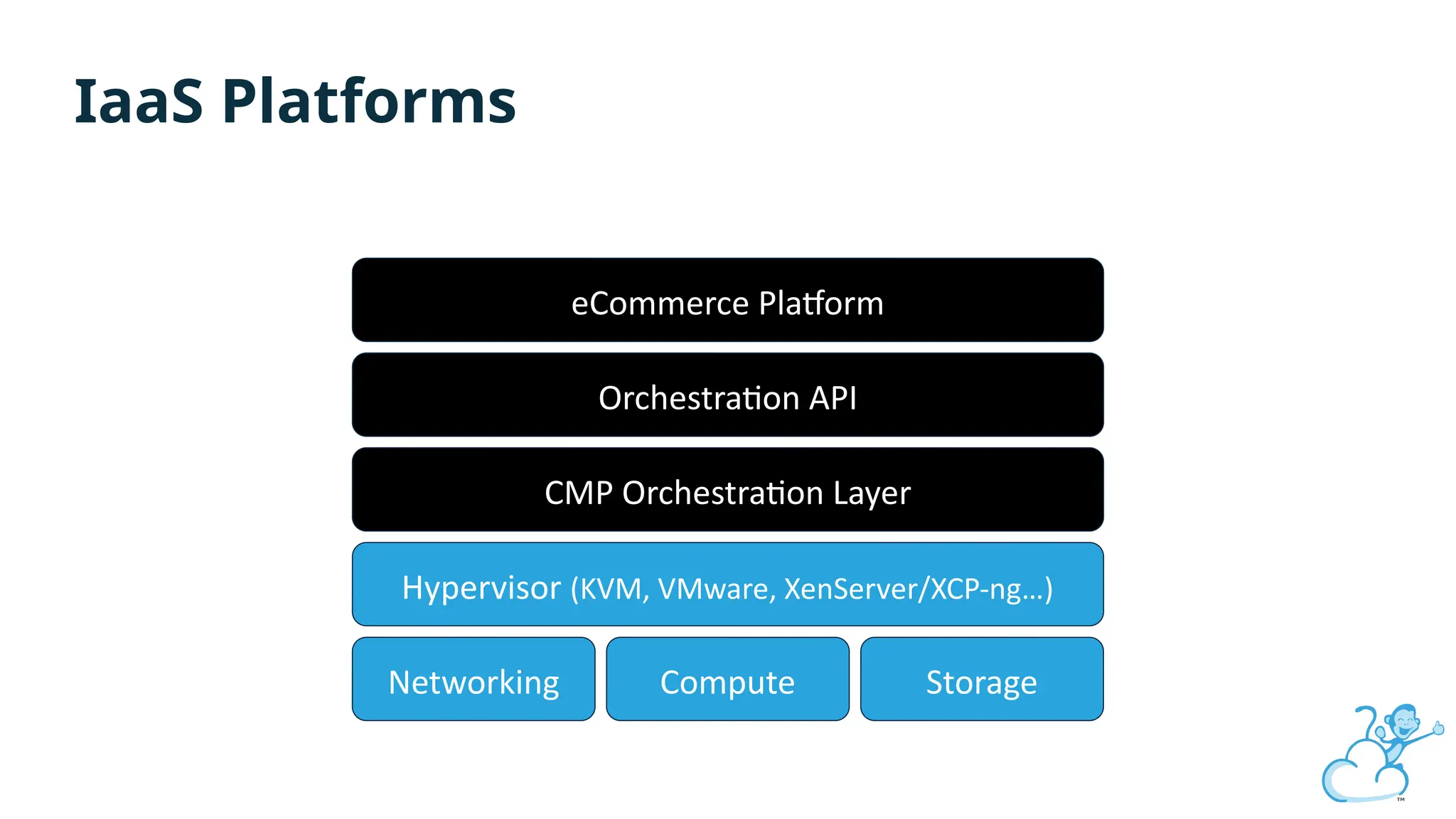
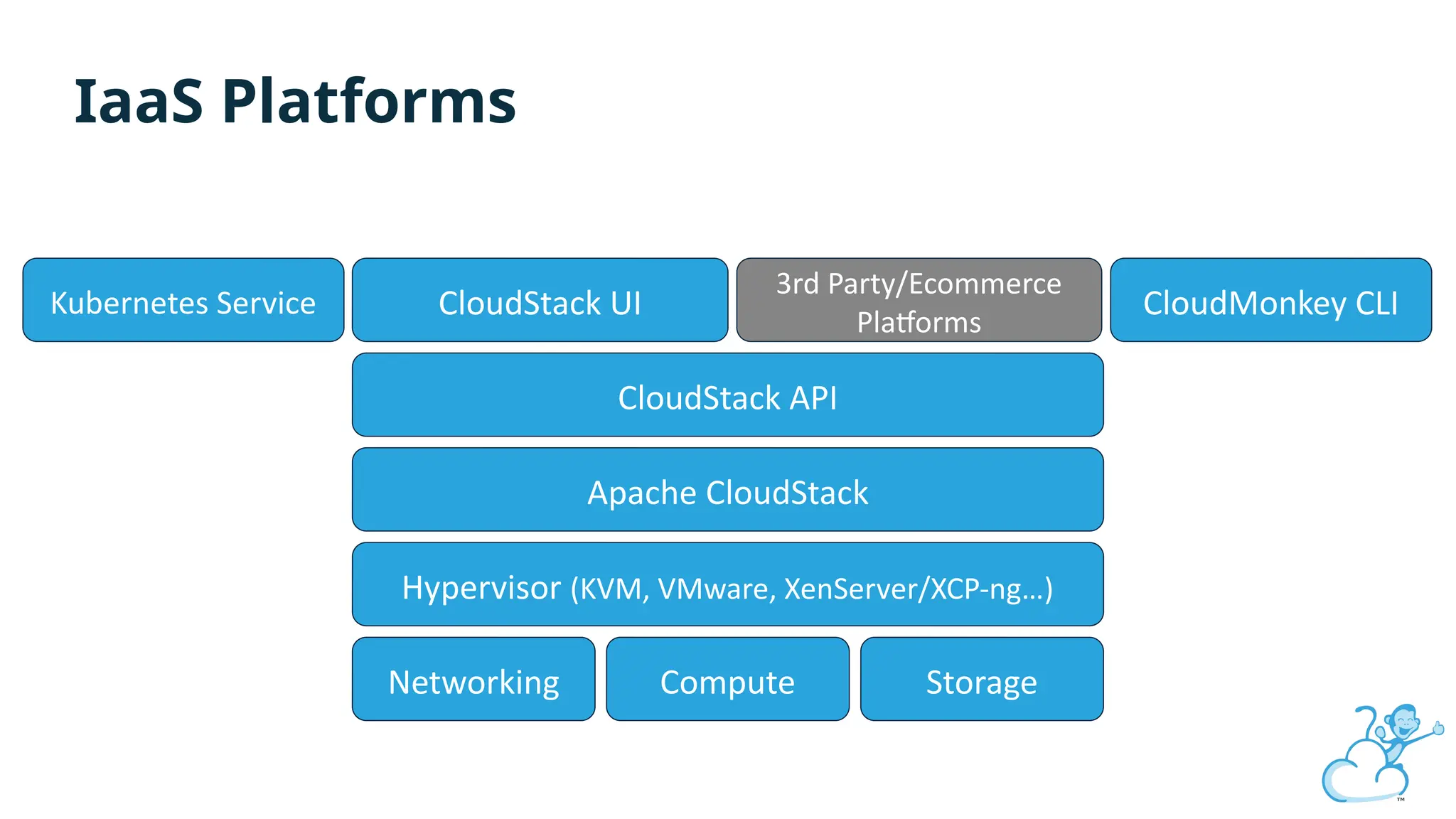
Hypervisor
Networking Compute Storage
CMP Orchestration Layer
Orchestration API
eCommerce Platform
IaaS Platforms
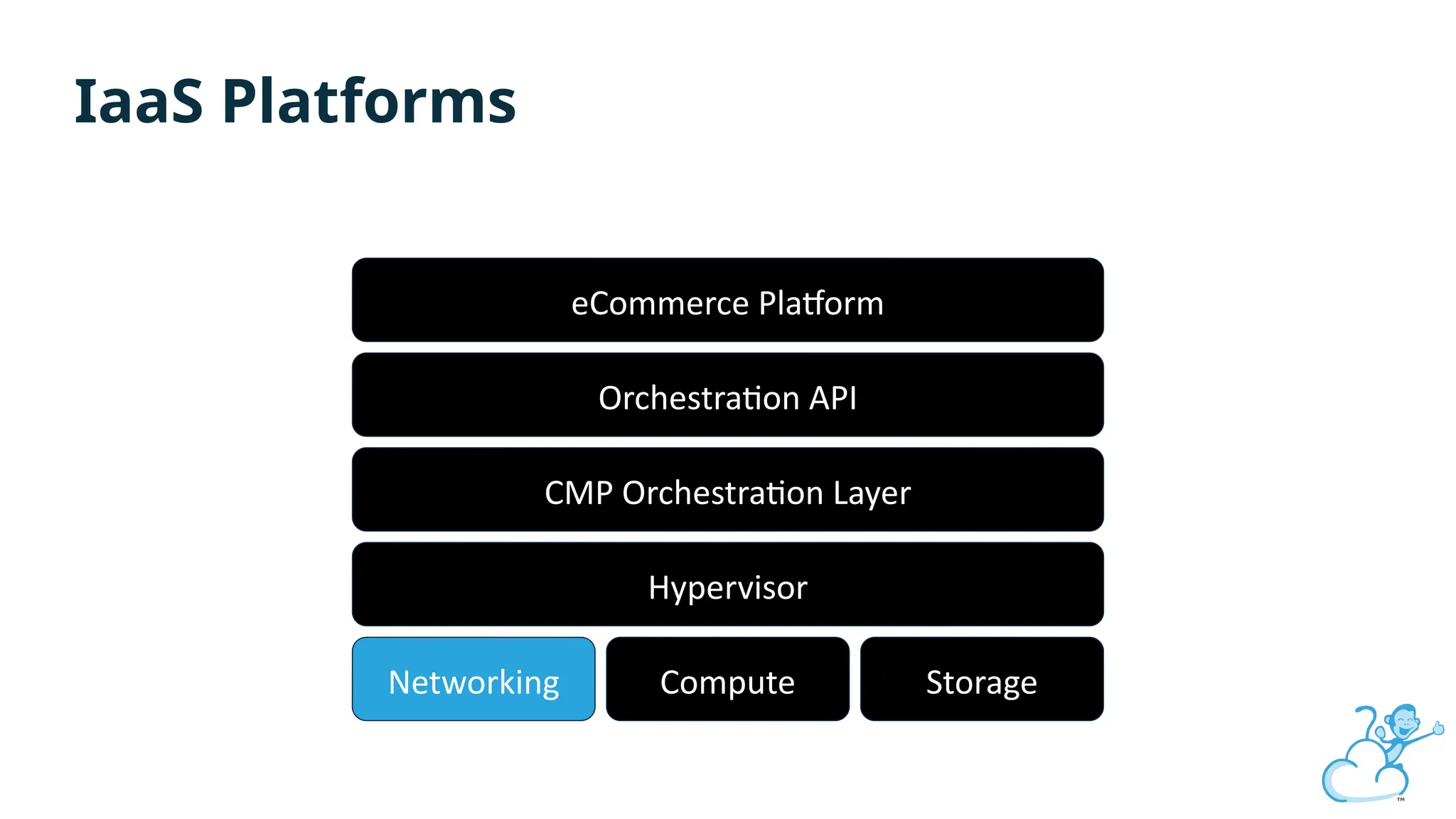
Hypervisor
Networking Compute Storage
CMP Orchestration Layer
Orchestration API
eCommerce Platform
IaaS Platforms
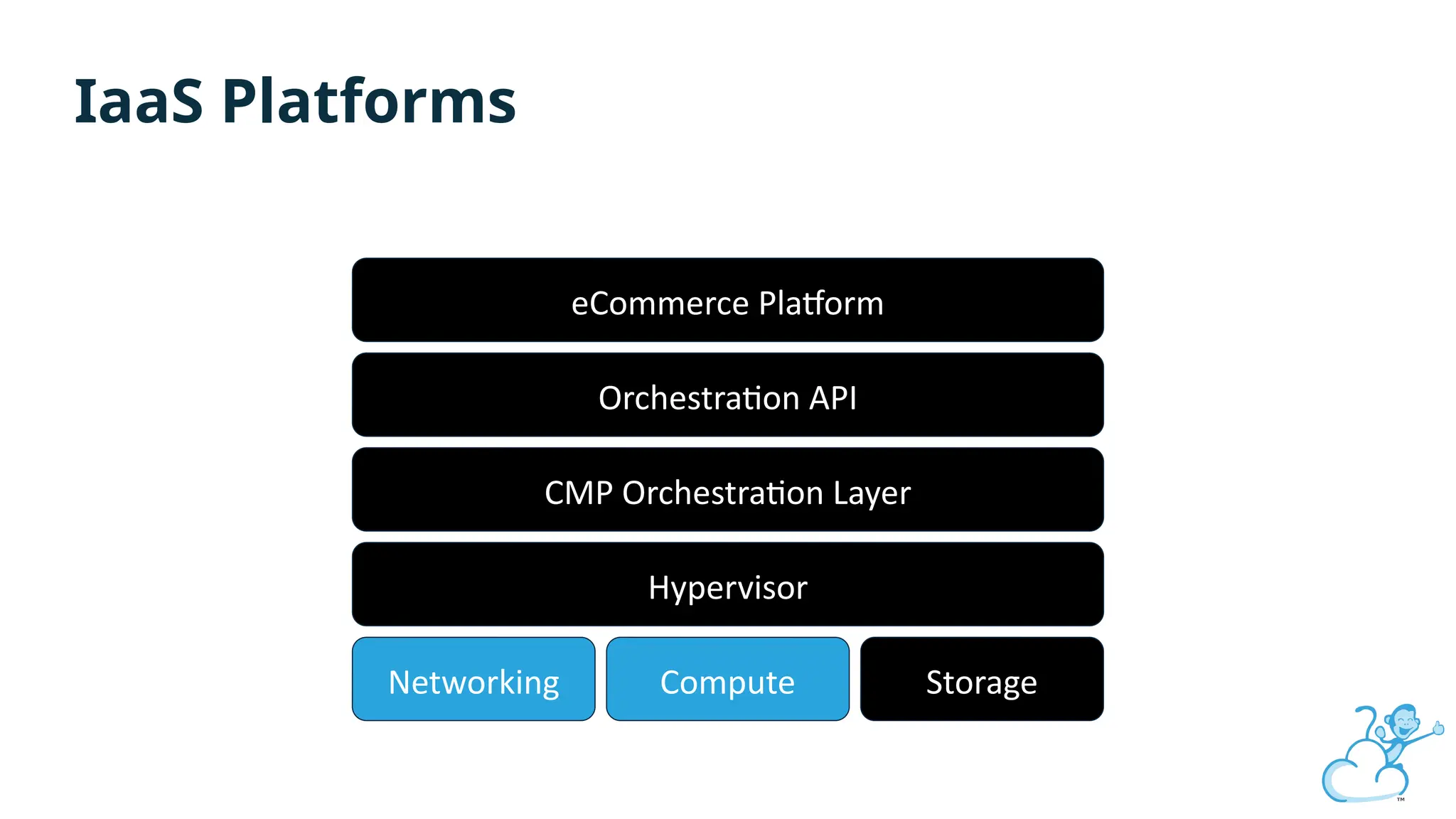
Hypervisor
Networking Compute Storage
CMP Orchestration Layer
Orchestration API
eCommerce Platform
IaaS Platforms
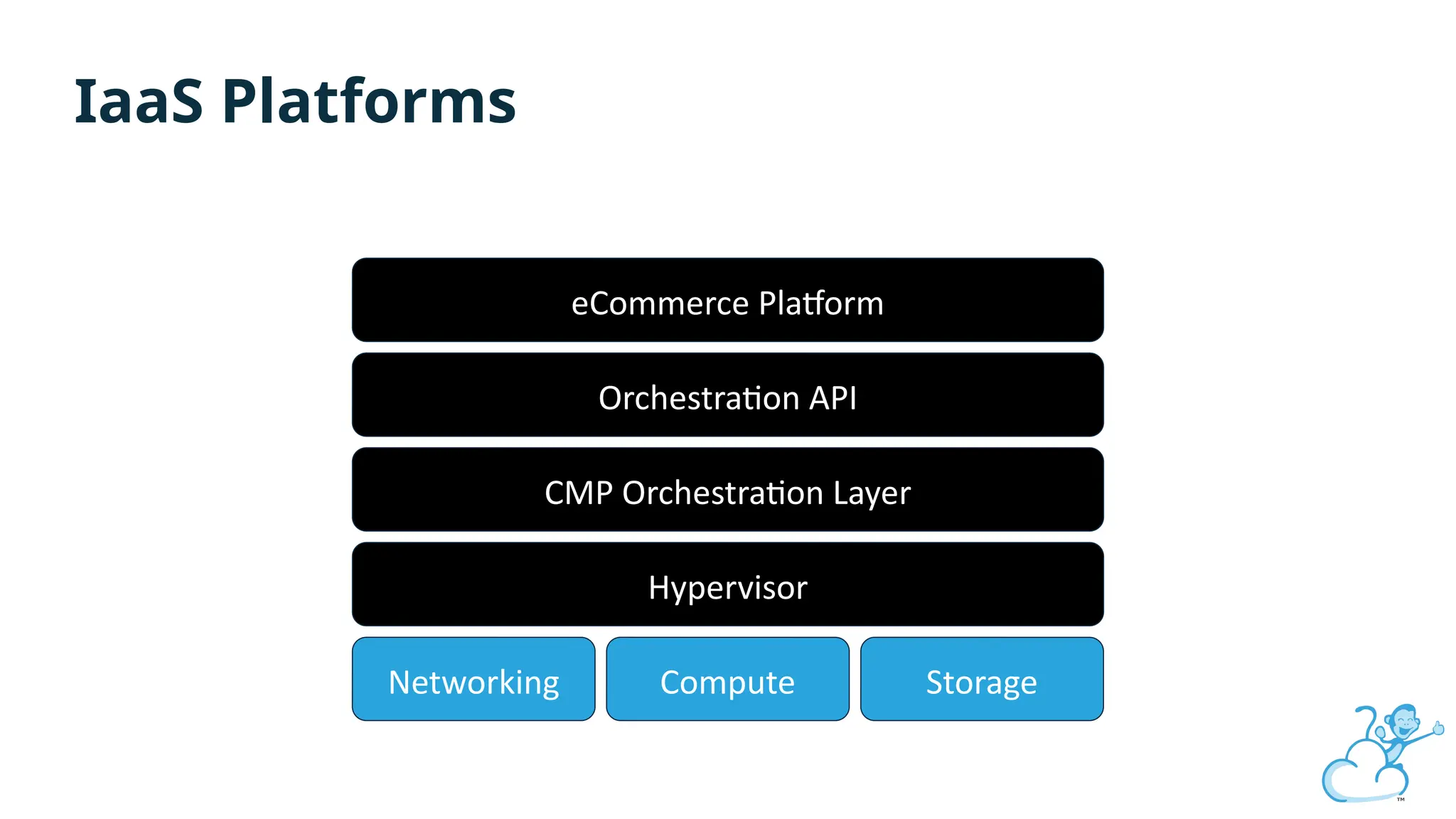
Hypervisor
Networking Compute Storage
CMP Orchestration Layer
Orchestration API
eCommerce Platform
IaaS Platforms
Hypervisor (KVM, VMware, XenServer/XCP-ng…)
Networking Compute Storage
CMP Orchestration Layer
Orchestration API
eCommerce Platform
IaaS Platforms
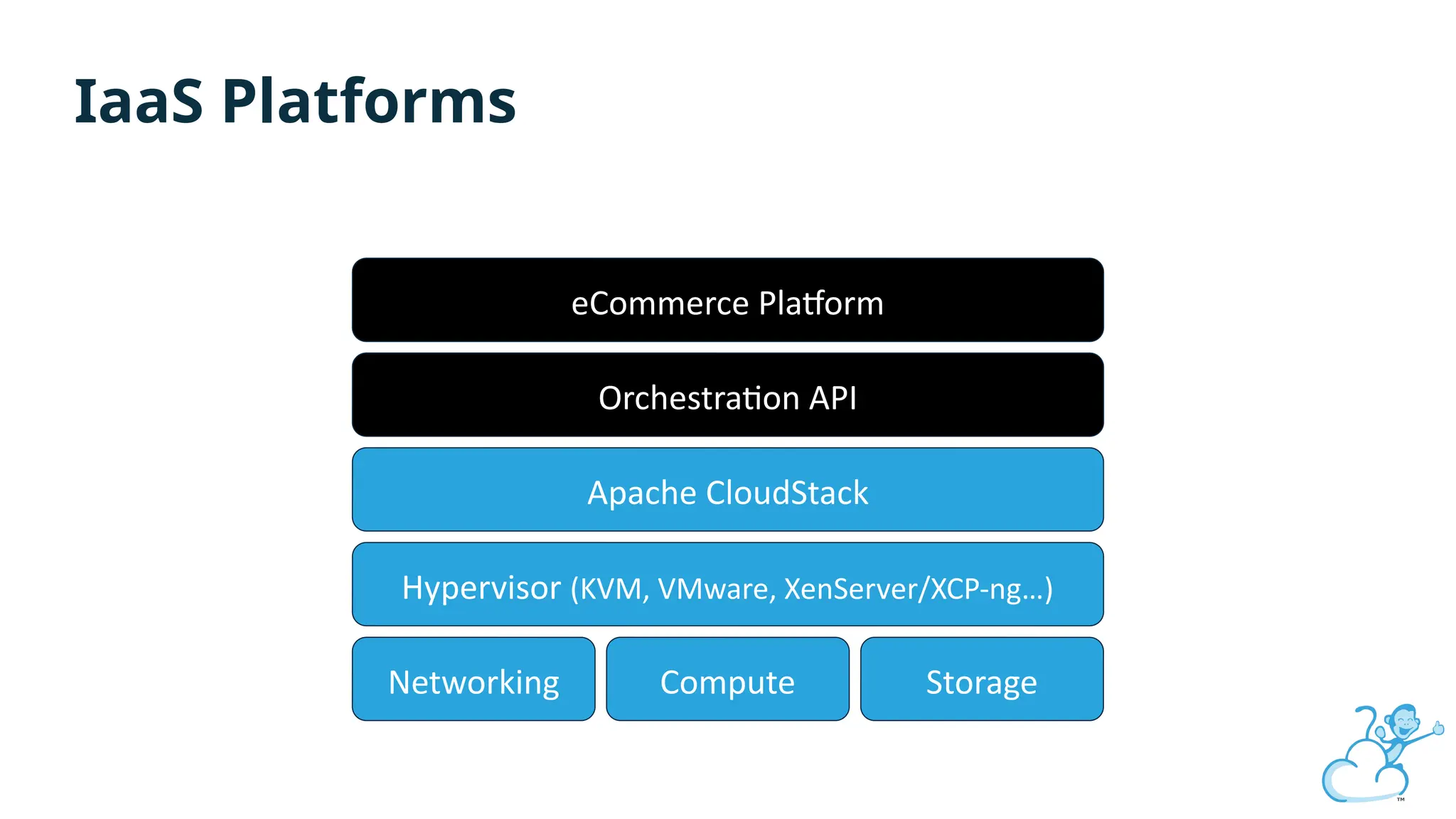
Hypervisor (KVM, VMware, XenServer/XCP-ng…)
Networking Compute Storage
Apache CloudStack
Orchestration API
eCommerce Platform
IaaS Platforms
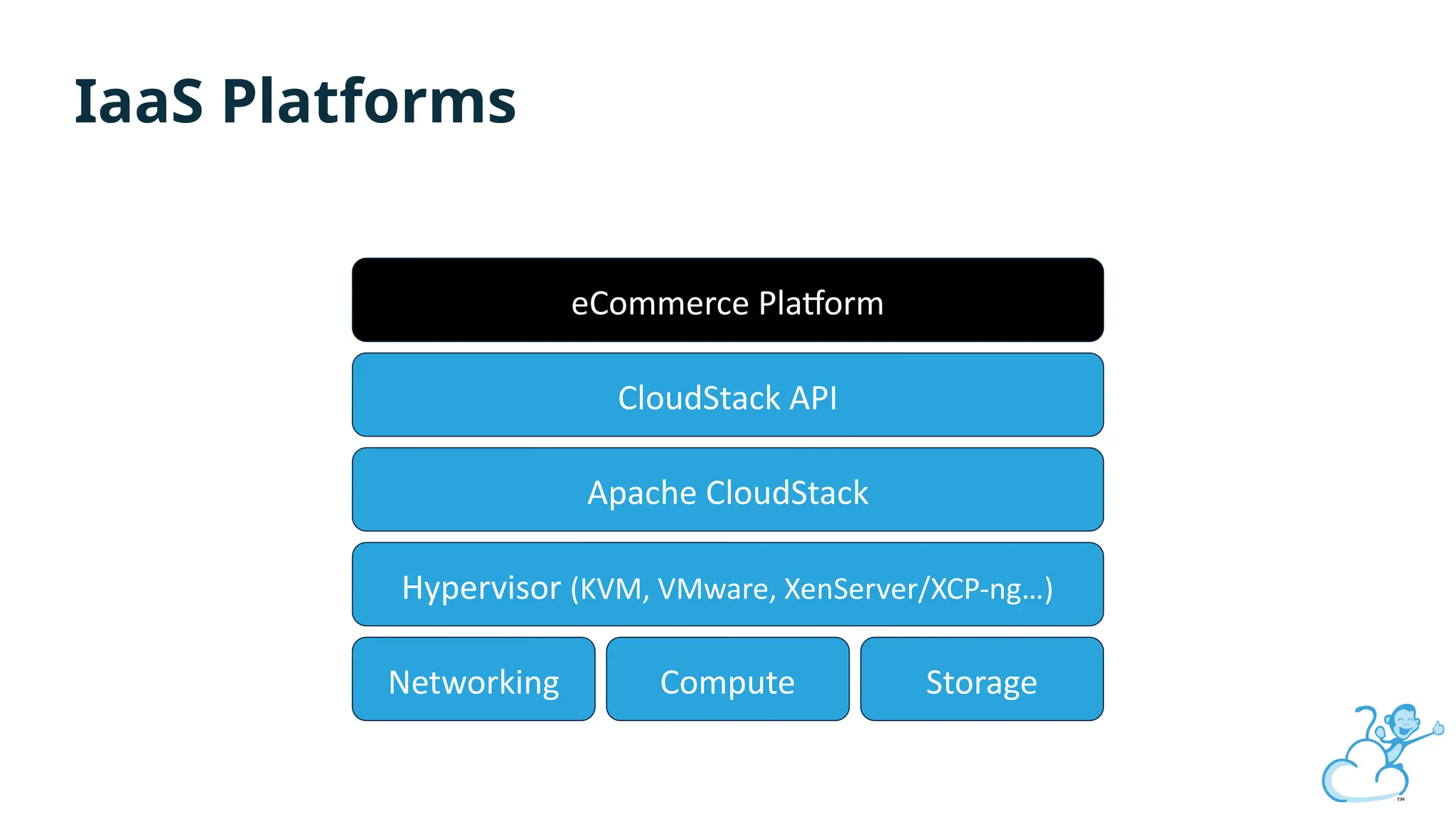
Hypervisor (KVM, VMware, XenServer/XCP-ng…)
Networking Compute Storage
Apache CloudStack
CloudStack API
eCommerce Platform
IaaS Platforms
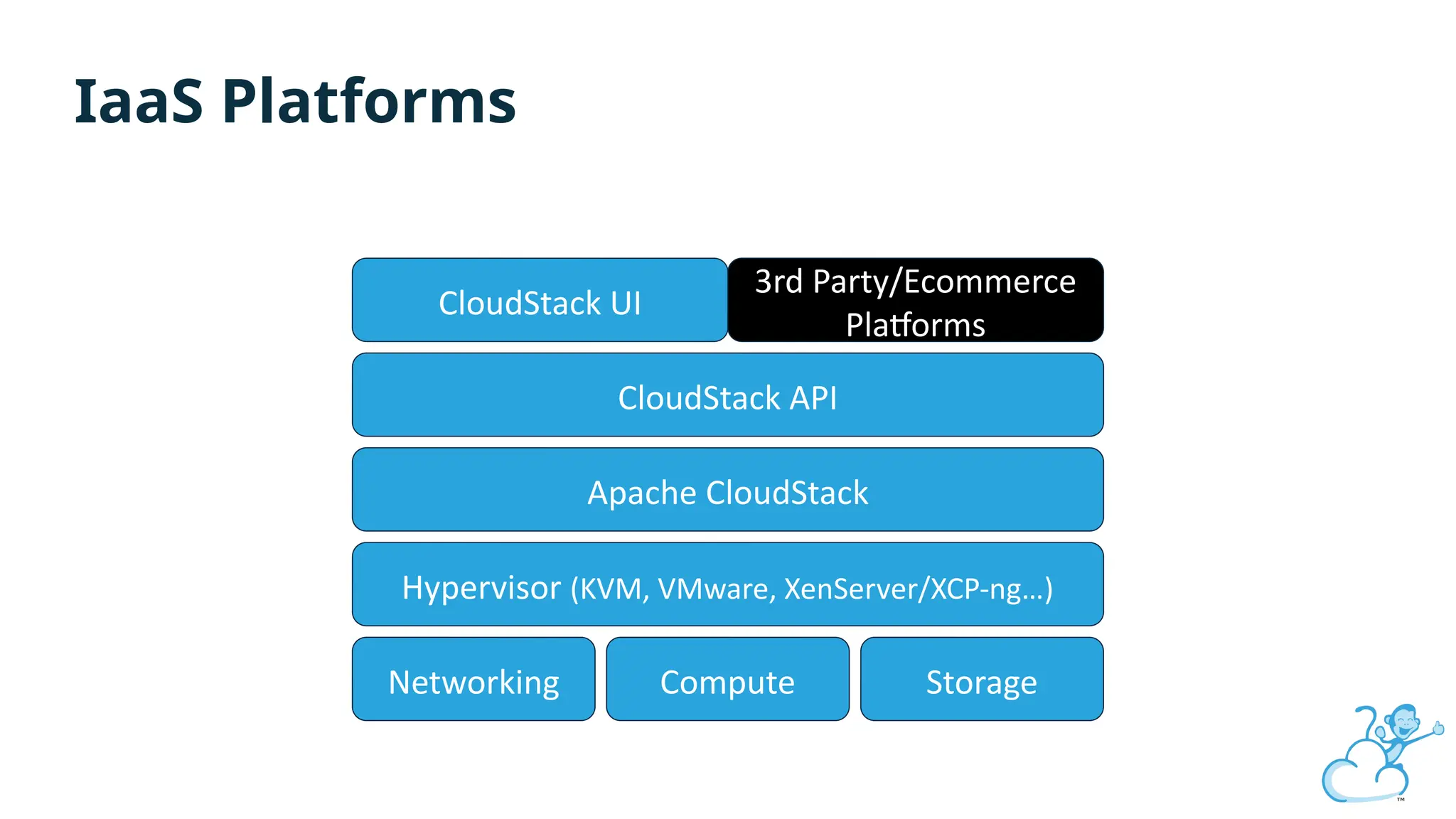
Hypervisor (KVM, VMware, XenServer/XCP-ng…)
Networking Compute Storage
Apache CloudStack
CloudStack API
CloudStack UI
3rd Party/Ecommerce
Platforms
IaaS Platforms
Hypervisor (KVM, VMware, XenServer/XCP-ng…)
Networking Compute Storage
Apache CloudStack
CloudStack API
CloudStack UI
3rd Party/Ecommerce
Platforms
CloudMonkey CLI
Kubernetes Service
IaaS Platforms
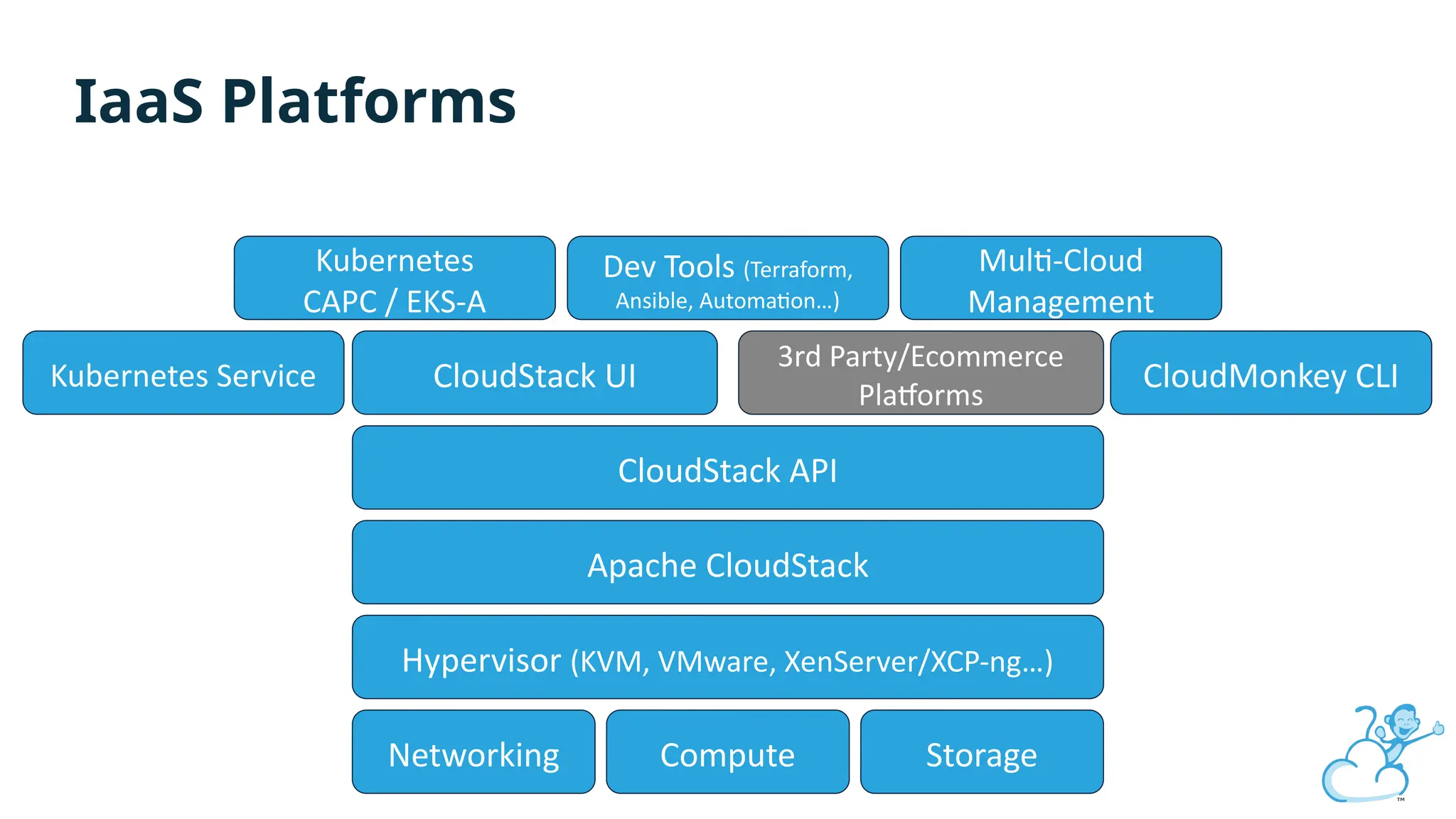
Hypervisor (KVM, VMware, XenServer/XCP-ng…)
Networking Compute Storage
Apache CloudStack
CloudStack API
CloudStack UI
3rd Party/Ecommerce
Platforms
CloudMonkey CLI
Kubernetes Service
Kubernetes
CAPC / EKS-A
Dev Tools (Terraform,
Ansible, Automation…)
Multi-Cloud
Management
IaaS Platforms
Click to edit
CloudStack 101:
Key CloudStack features
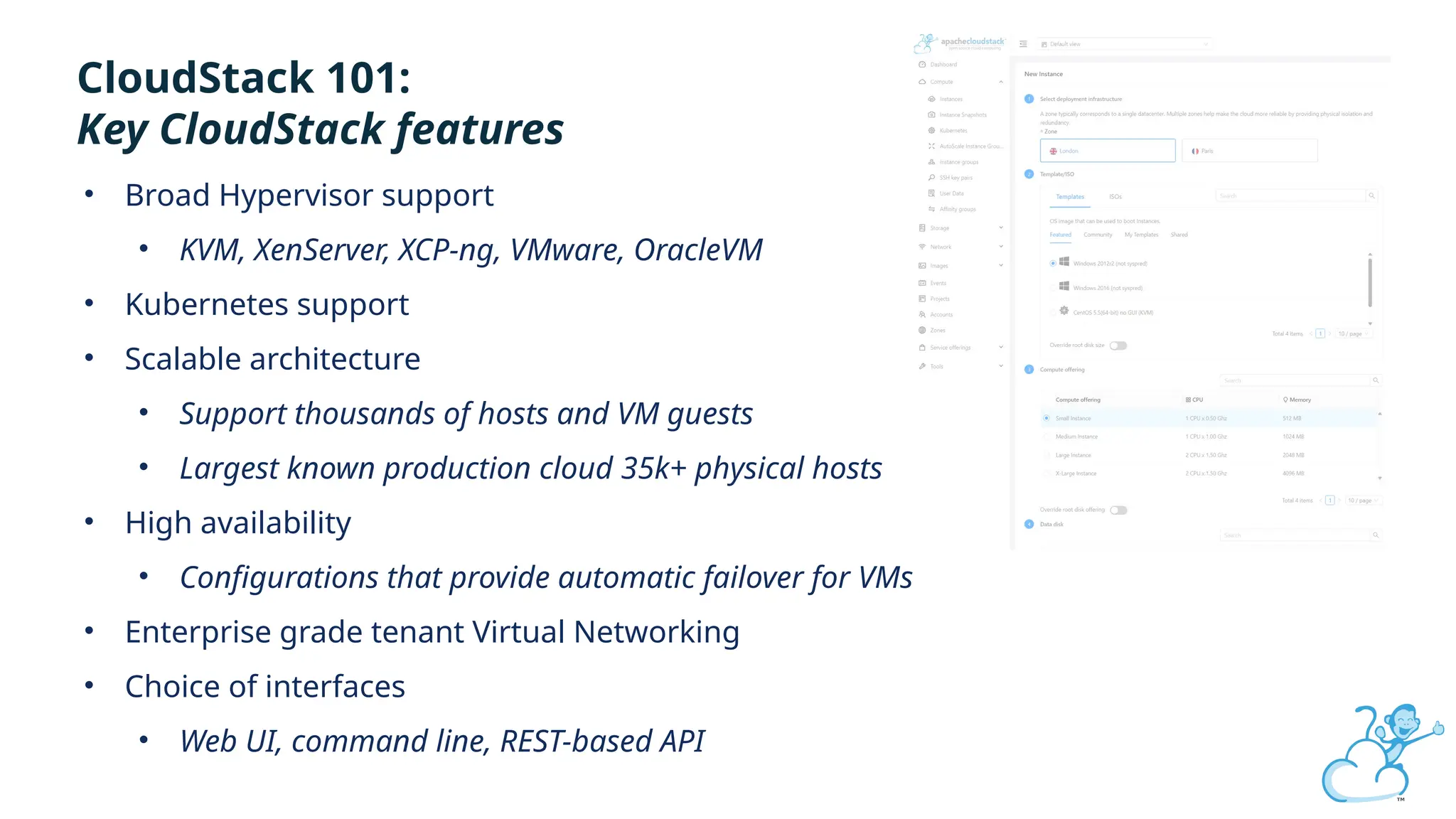
• Broad Hypervisor support
• KVM, XenServer, XCP-ng, VMware, OracleVM
• Kubernetes support
• Scalable architecture
• Support thousands of hosts and VM guests
• Largest known production cloud 35k+ physical hosts
• High availability
• Configurations that provide automatic failover for VMs
• Enterprise grade tenant Virtual Networking
• Choice of interfaces
• Web UI, command line, REST-based API
Click to edit
CloudStack 101:
Key CloudStack features
CloudStack provides two types of networking:.
• Basic For AWS-style networking. Provides a single network where guest isolation
can be provided through layer-3 means such as security groups (IP address source
filtering).
• Advanced For more sophisticated network topologies. This network model
provides the most flexibility in defining guest networks but requires more
configuration steps than basic networking.
• Different types of network traffic can be segmented on the same physical network.
• Guest traffic can also be segmented by account. To isolate traffic, you can use
separate VLANs.
Click to edit
CloudStack 101:
Key CloudStack features
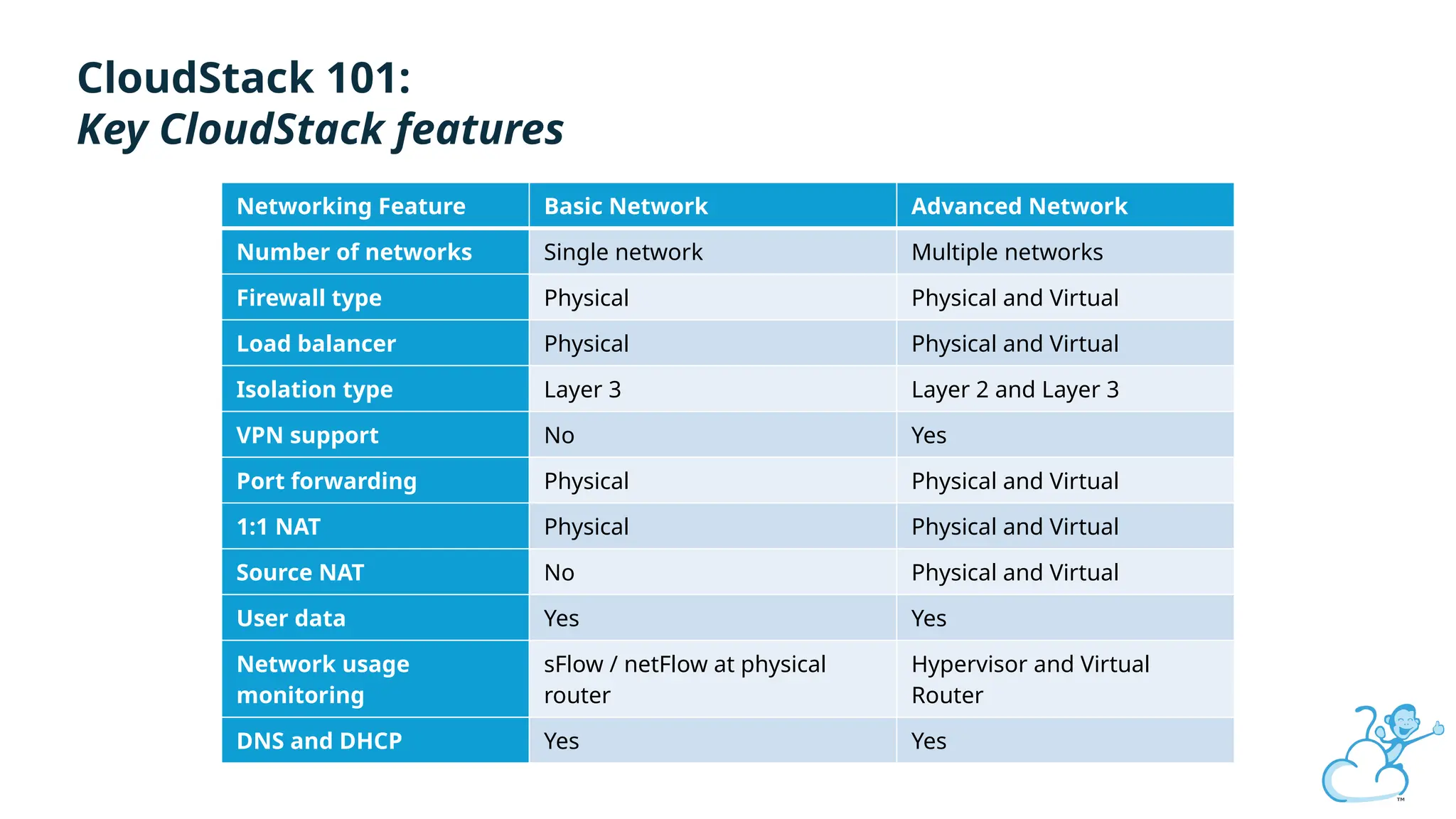
Networking Feature Basic Network Advanced Network
Number of networks Single network Multiple networks
Firewall type Physical Physical and Virtual
Load balancer Physical Physical and Virtual
Isolation type Layer 3 Layer 2 and Layer 3
VPN support No Yes
Port forwarding Physical Physical and Virtual
1:1 NAT Physical Physical and Virtual
Source NAT No Physical and Virtual
User data Yes Yes
Network usage
monitoring
sFlow / netFlow at physical
router
Hypervisor and Virtual
Router
DNS and DHCP Yes Yes
Click to edit
CloudStack 101:
Key CloudStack features
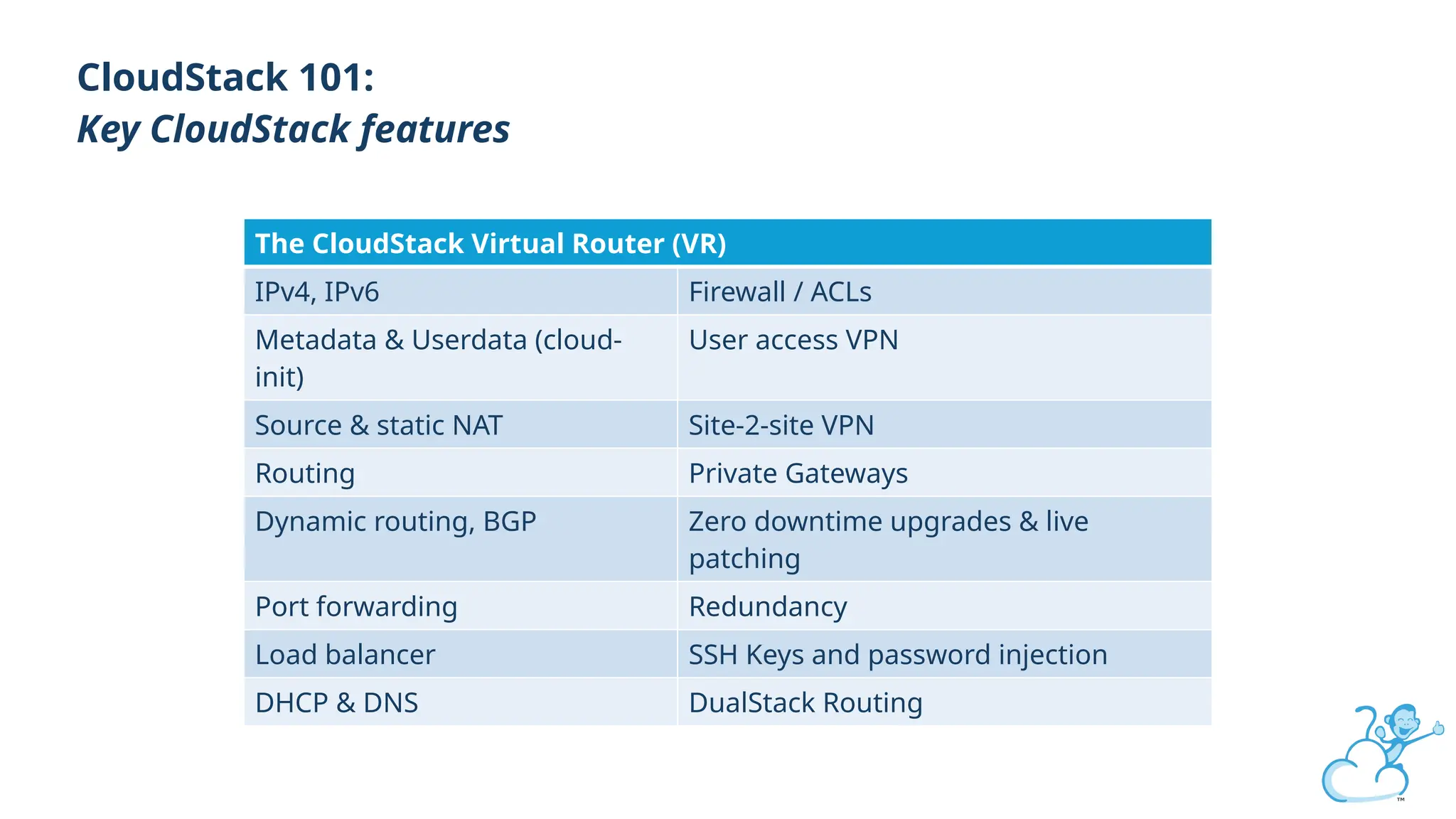
The CloudStack Virtual Router (VR)
IPv4, IPv6 Firewall / ACLs
Metadata & Userdata (cloud-
init)
User access VPN
Source & static NAT Site-2-site VPN
Routing Private Gateways
Dynamic routing, BGP Zero downtime upgrades & live
patching
Port forwarding Redundancy
Load balancer SSH Keys and password injection
DHCP & DNS DualStack Routing
Click to edit
CloudStack 101
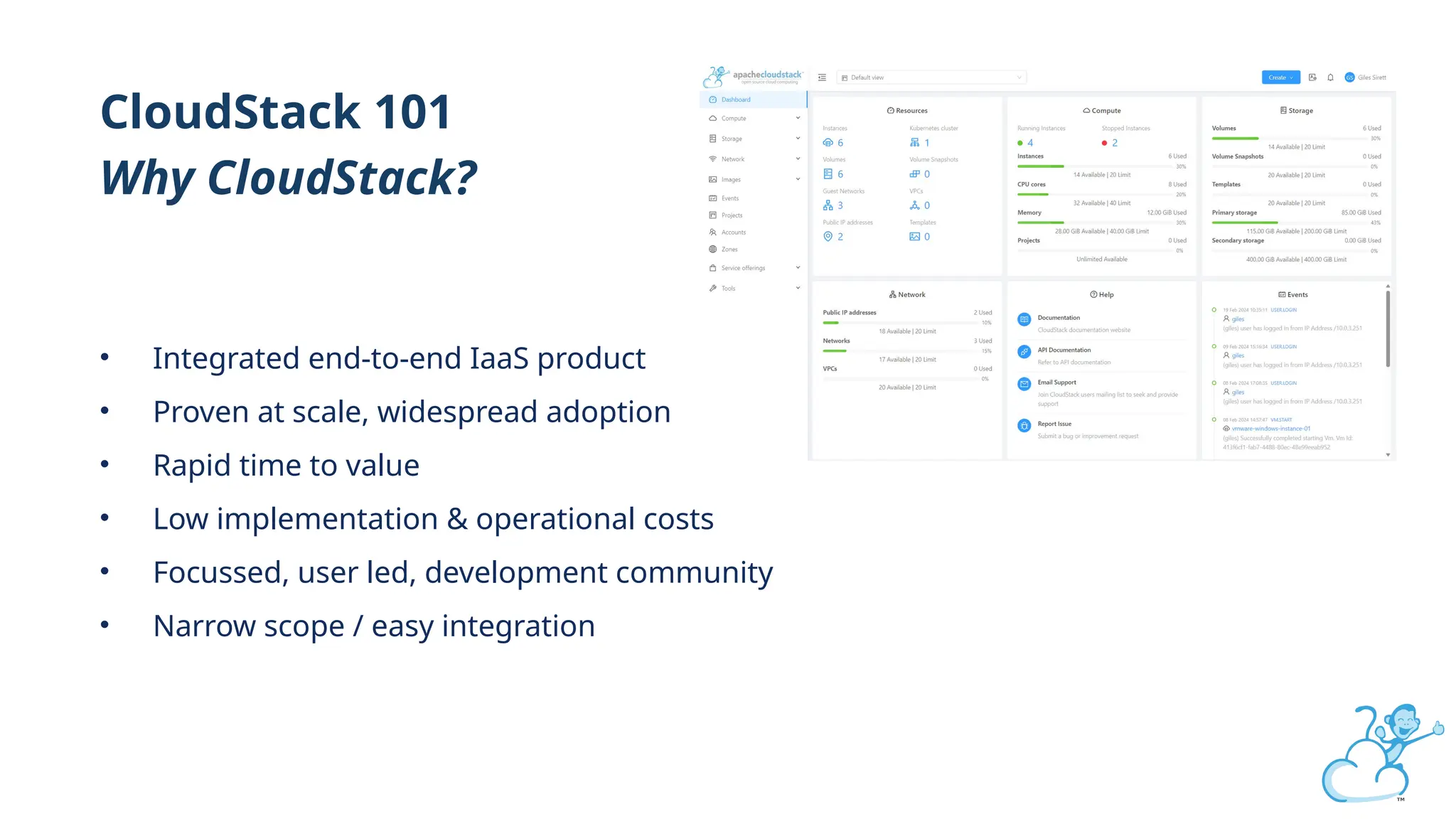
Why CloudStack?
• Integrated end-to-end IaaS product
• Proven at scale, widespread adoption
• Rapid time to value
• Low implementation & operational costs
• Focussed, user led, development community
• Narrow scope / easy integration
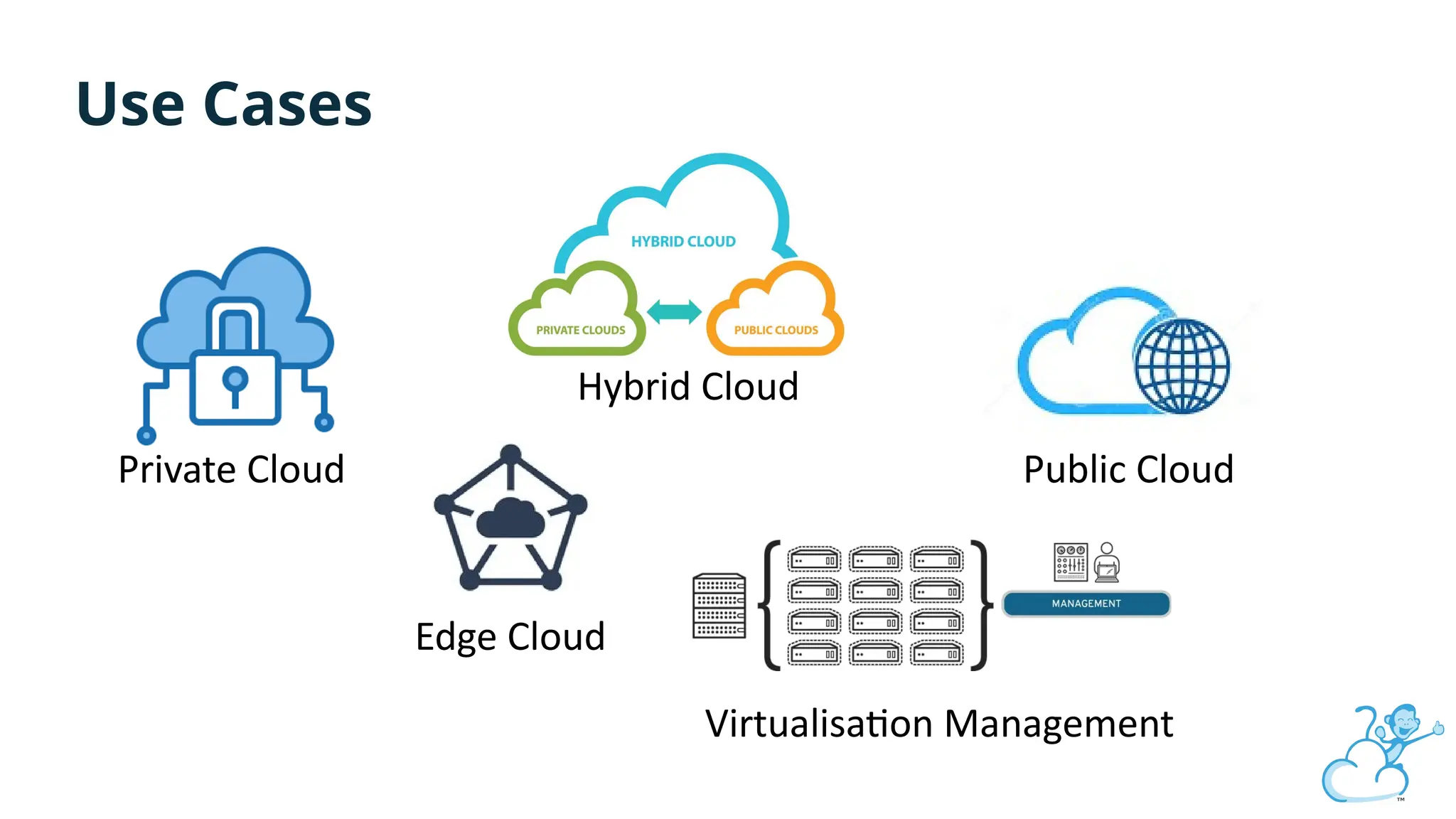
Use Cases
Private Cloud Public Cloud
Hybrid Cloud
Edge Cloud
Virtualisation Management
(Some) Known CloudStack
Users…
(Some more) Known CloudStack
Users…
Click to edit
CloudStack 101
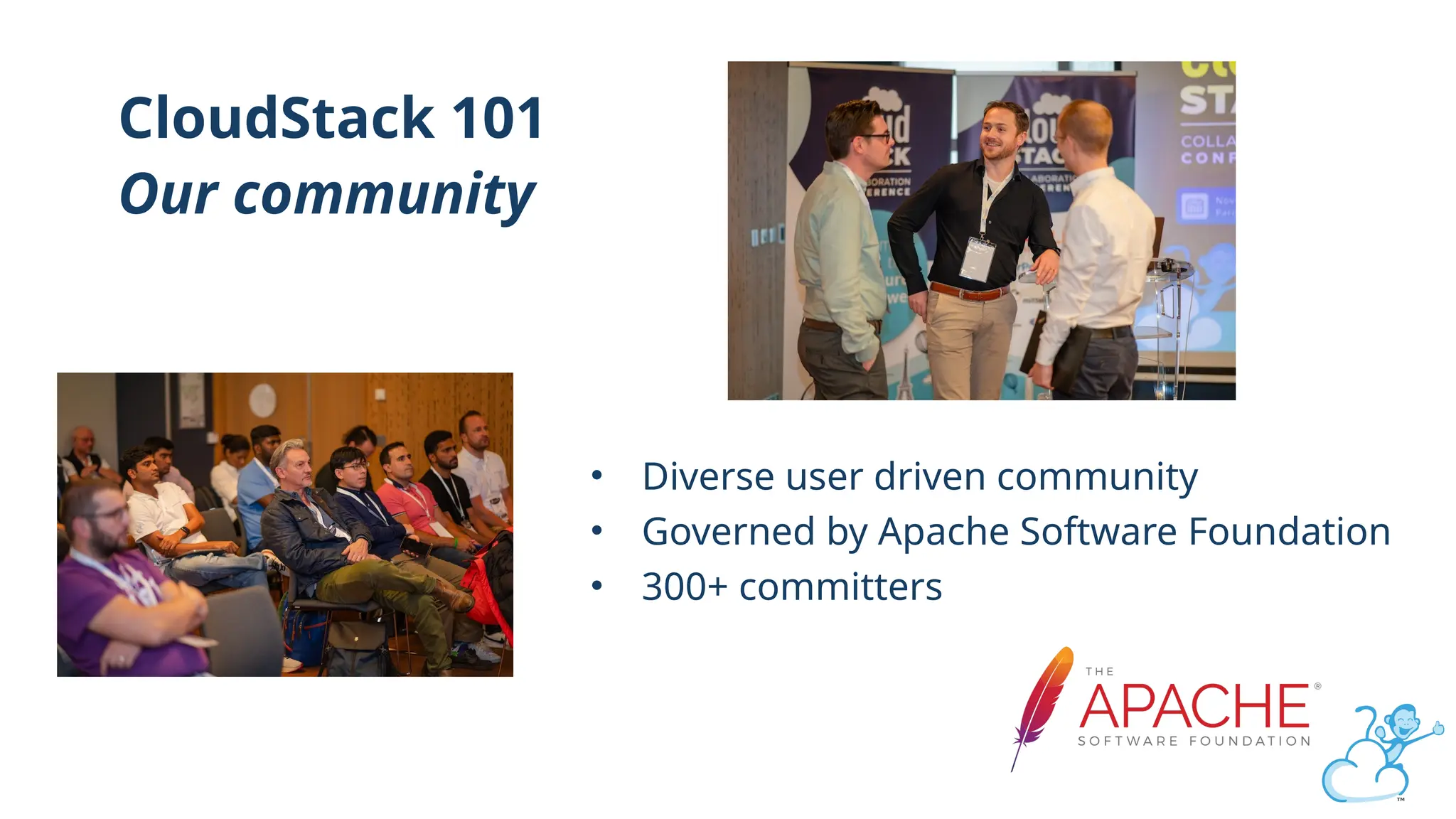
Our community
• Diverse user driven community
• Governed by Apache Software Foundation
• 300+ committers
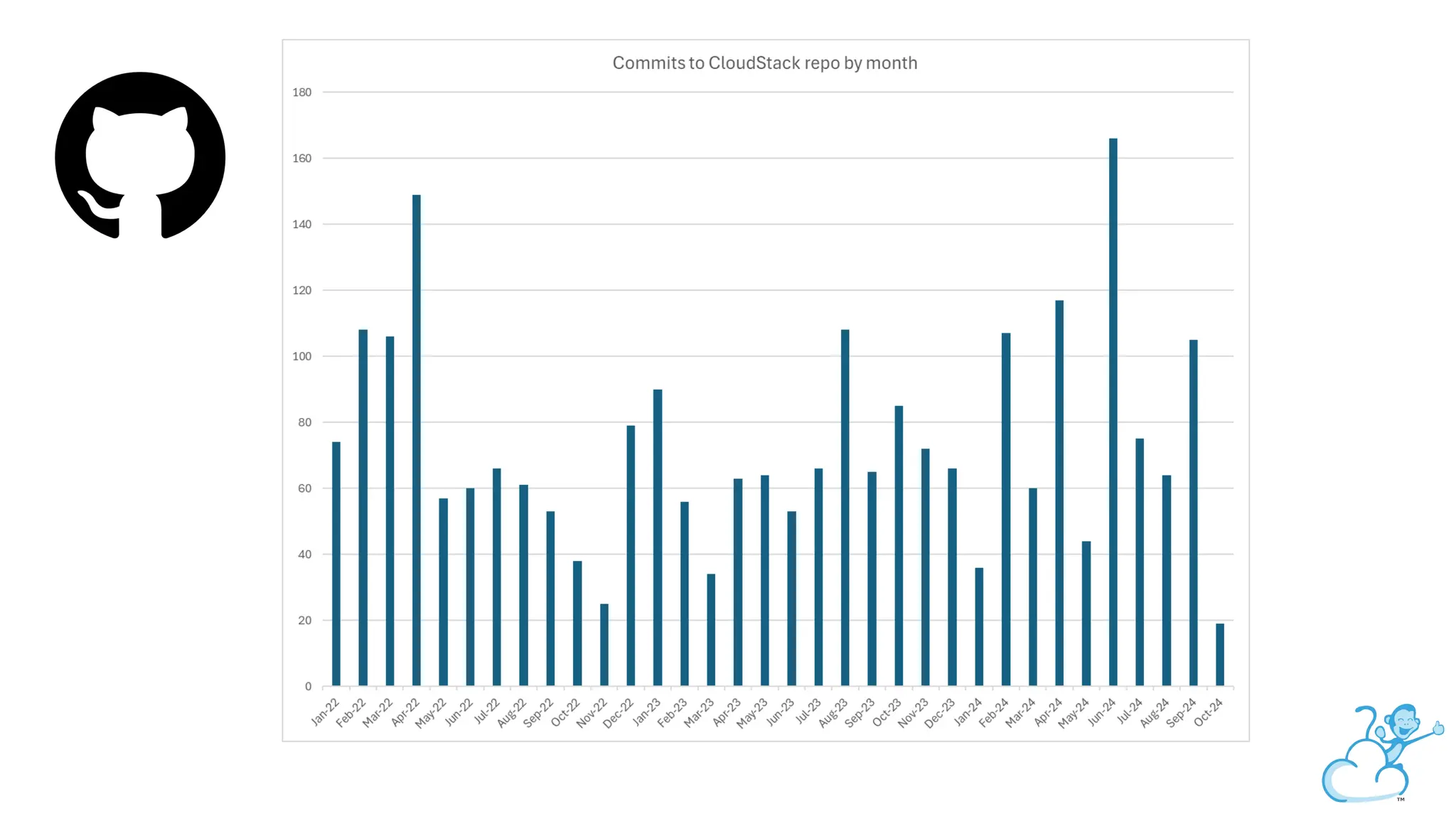
A super-active community
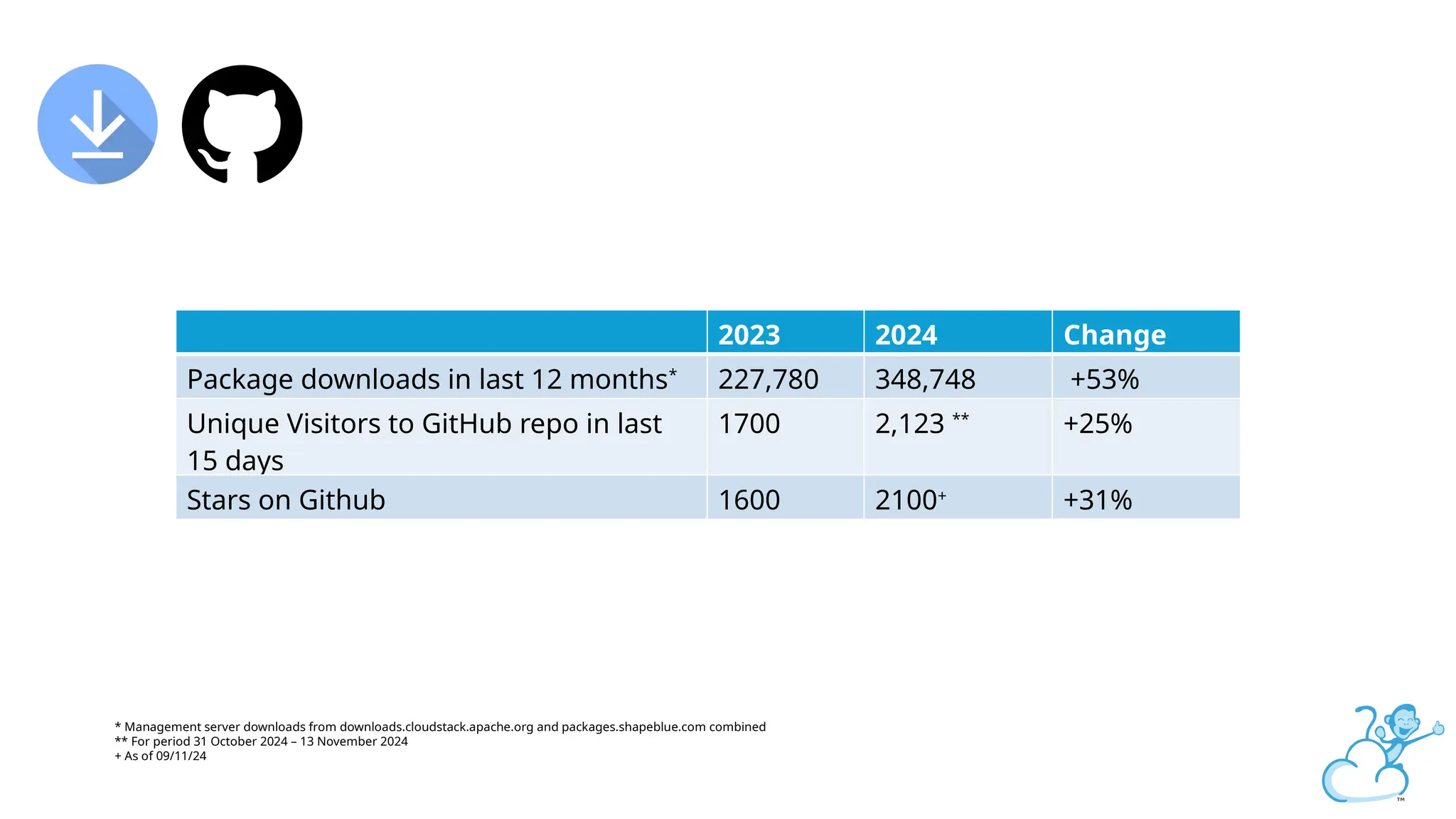
* Management server downloads from downloads.cloudstack.apache.org and packages.shapeblue.com combined
** For period 31 October 2024 – 13 November 2024
+ As of 09/11/24
2023
Package downloads in last 12 months*
227,780
Unique Visitors to GitHub repo in last
15 days
1700
Stars on Github 1600
2024 Change
2024 Change
348,748 +53%
2,123 **
+25%
2100+
+31%
Releases & new features
The highlights
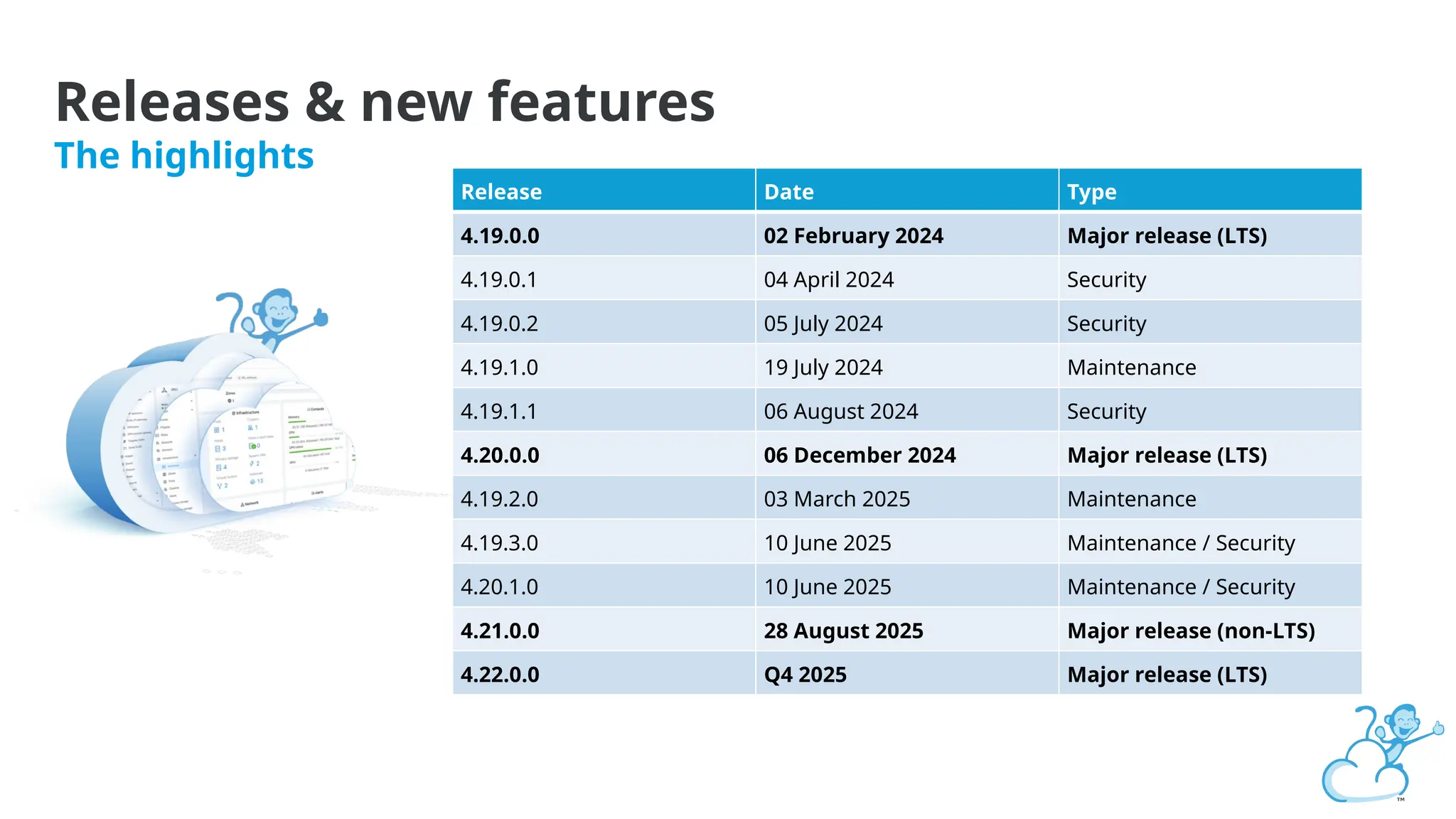
Release Date Type
4.19.0.0 02 February 2024 Major release (LTS)
4.19.0.1 04 April 2024 Security
4.19.0.2 05 July 2024 Security
4.19.1.0 19 July 2024 Maintenance
4.19.1.1 06 August 2024 Security
4.20.0.0 06 December 2024 Major release (LTS)
4.19.2.0 03 March 2025 Maintenance
4.19.3.0 10 June 2025 Maintenance / Security
4.20.1.0 10 June 2025 Maintenance / Security
4.21.0.0 28 August 2025 Major release (non-LTS)
4.22.0.0 Q4 2025 Major release (LTS)
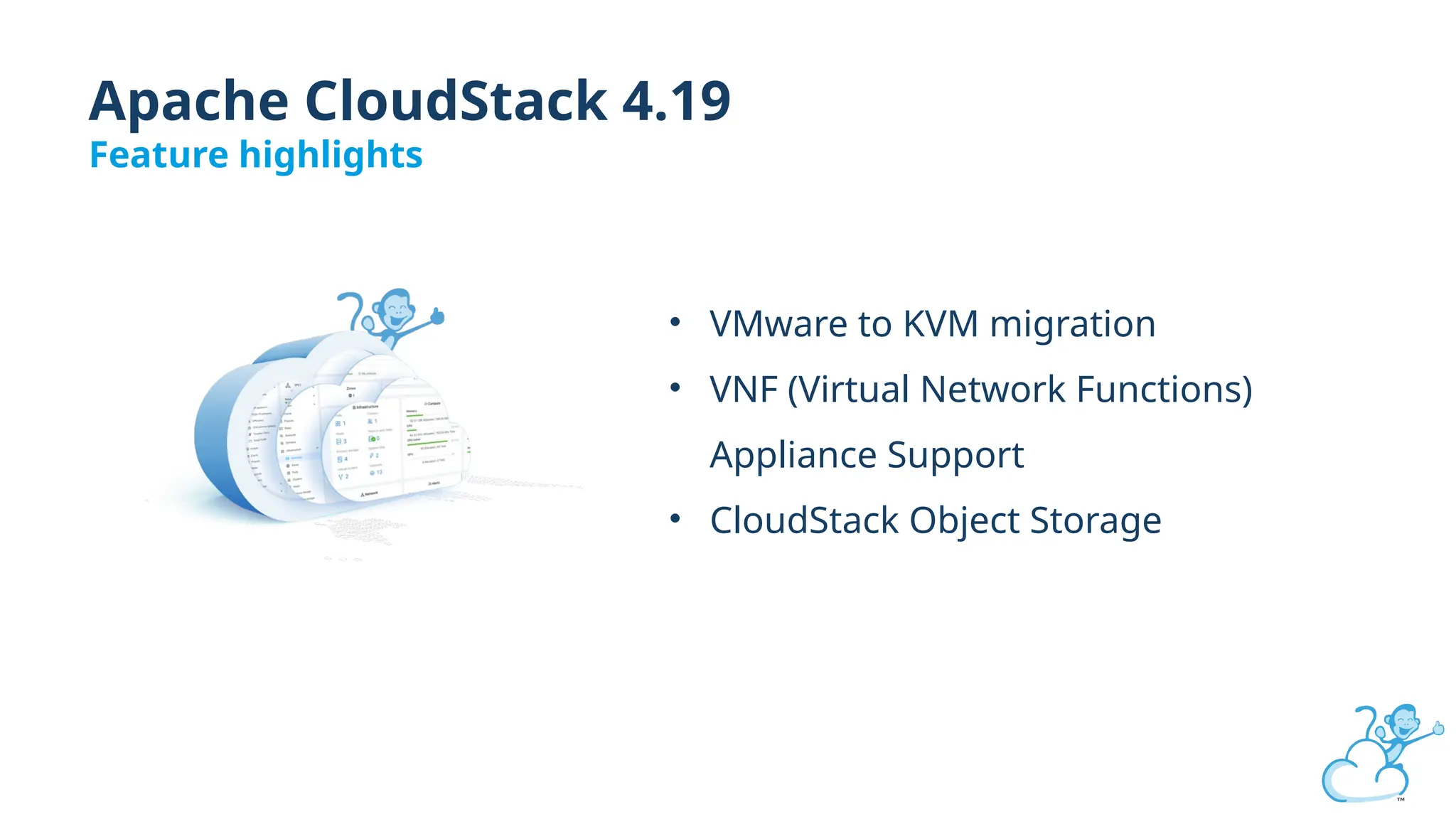
Apache CloudStack 4.19
Feature highlights
• VMware to KVM migration
• VNF (Virtual Network Functions)
Appliance Support
• CloudStack Object Storage
Apache CloudStack 4.20
Feature highlights
• ARM64 Support and Multi Architecture
Zones
• Shared FileSystems
• VMware NSX Support
• Dynamic & static routing
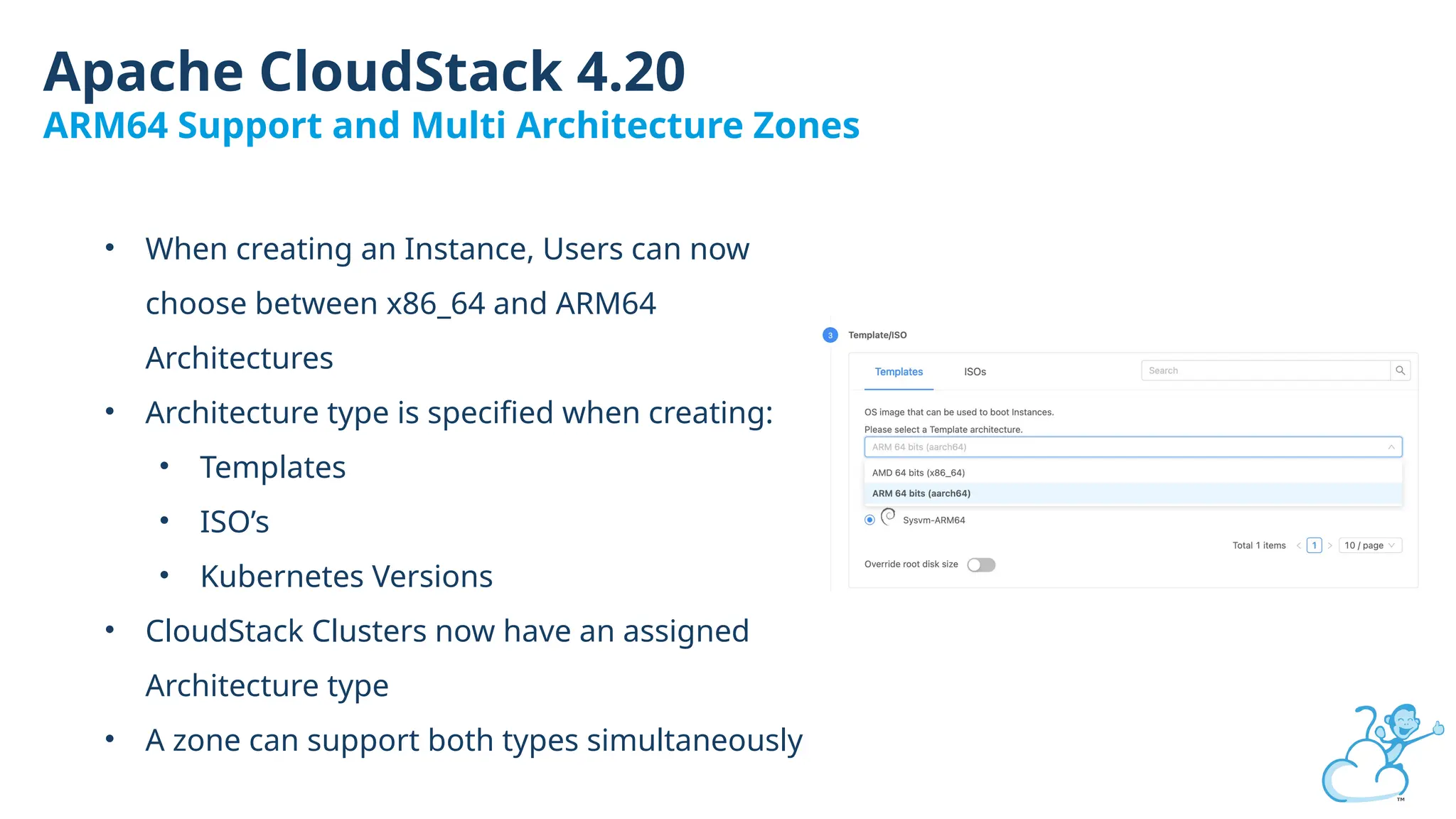
• When creating an Instance, Users can now
choose between x86_64 and ARM64
Architectures
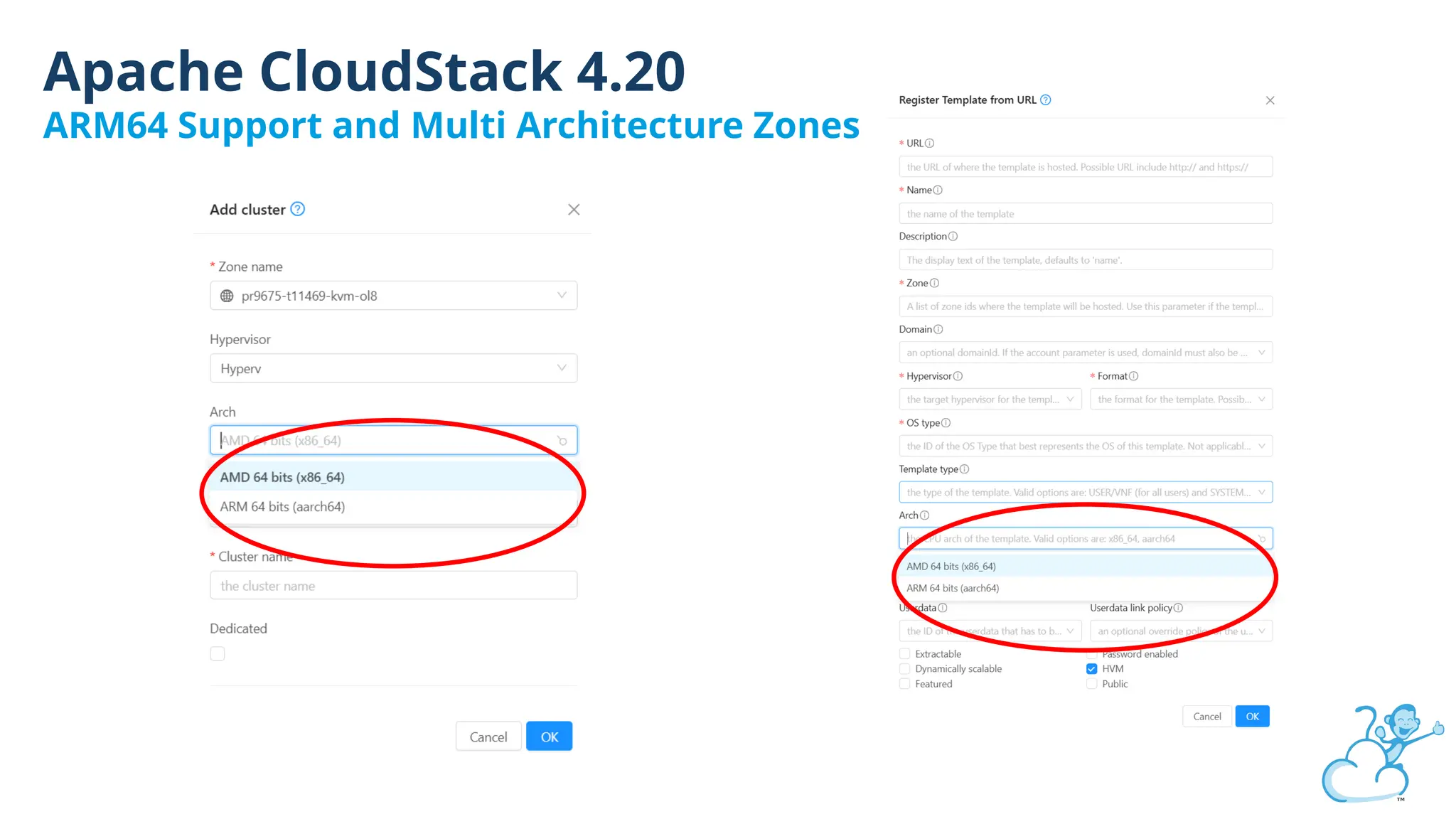
• Architecture type is specified when creating:
• Templates
• ISO’s
• Kubernetes Versions
• CloudStack Clusters now have an assigned
Architecture type
• A zone can support both types simultaneously
Apache CloudStack 4.20
ARM64 Support and Multi Architecture Zones
Apache CloudStack 4.20
ARM64 Support and Multi Architecture Zones
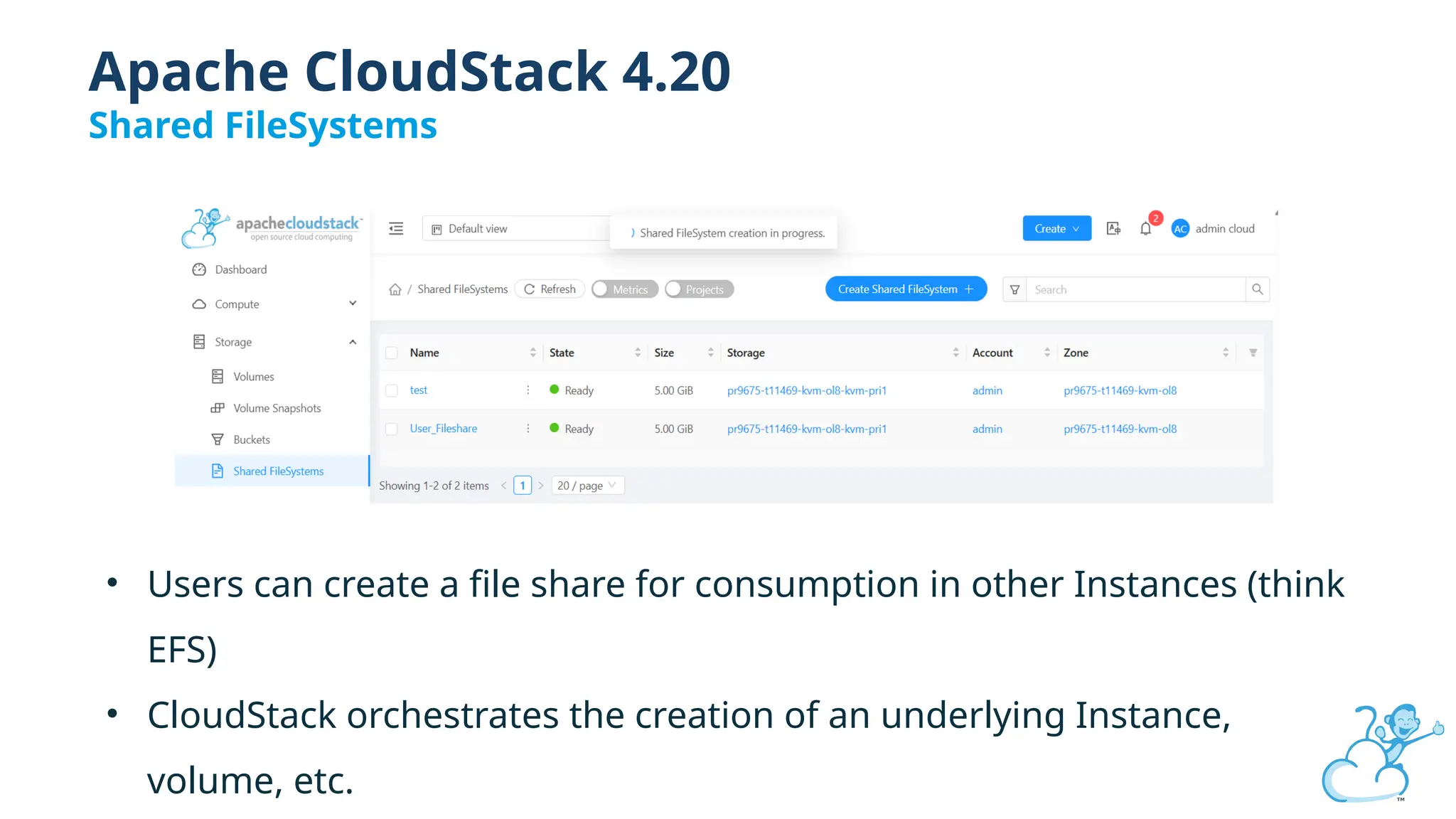
• Users can create a file share for consumption in other Instances (think
EFS)
• CloudStack orchestrates the creation of an underlying Instance,
volume, etc.
Apache CloudStack 4.20
Shared FileSystems
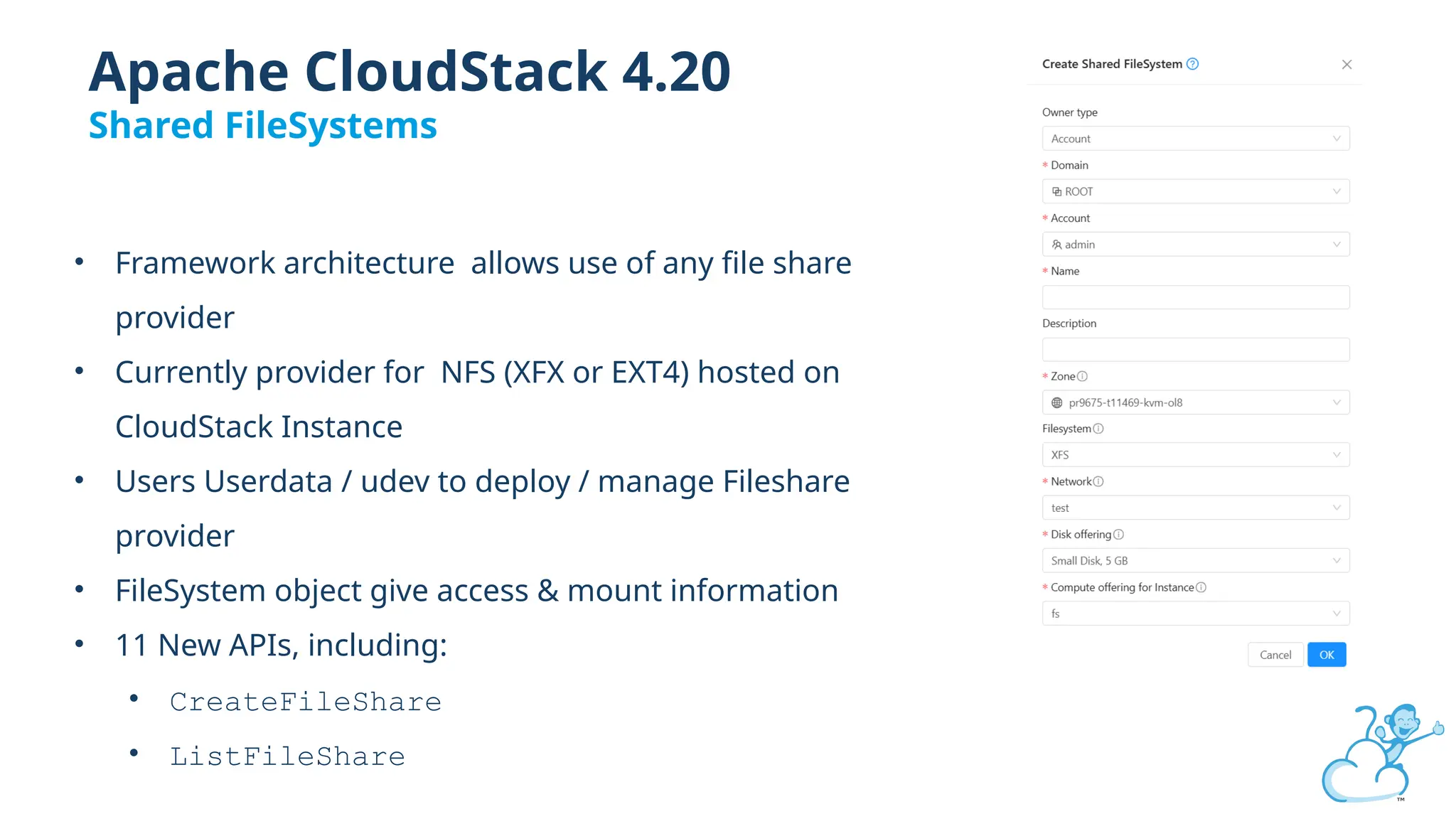
• Framework architecture allows use of any file share
provider
• Currently provider for NFS (XFX or EXT4) hosted on
CloudStack Instance
• Users Userdata / udev to deploy / manage Fileshare
provider
• FileSystem object give access & mount information
• 11 New APIs, including:
• CreateFileShare
• ListFileShare
Apache CloudStack 4.20
Shared FileSystems
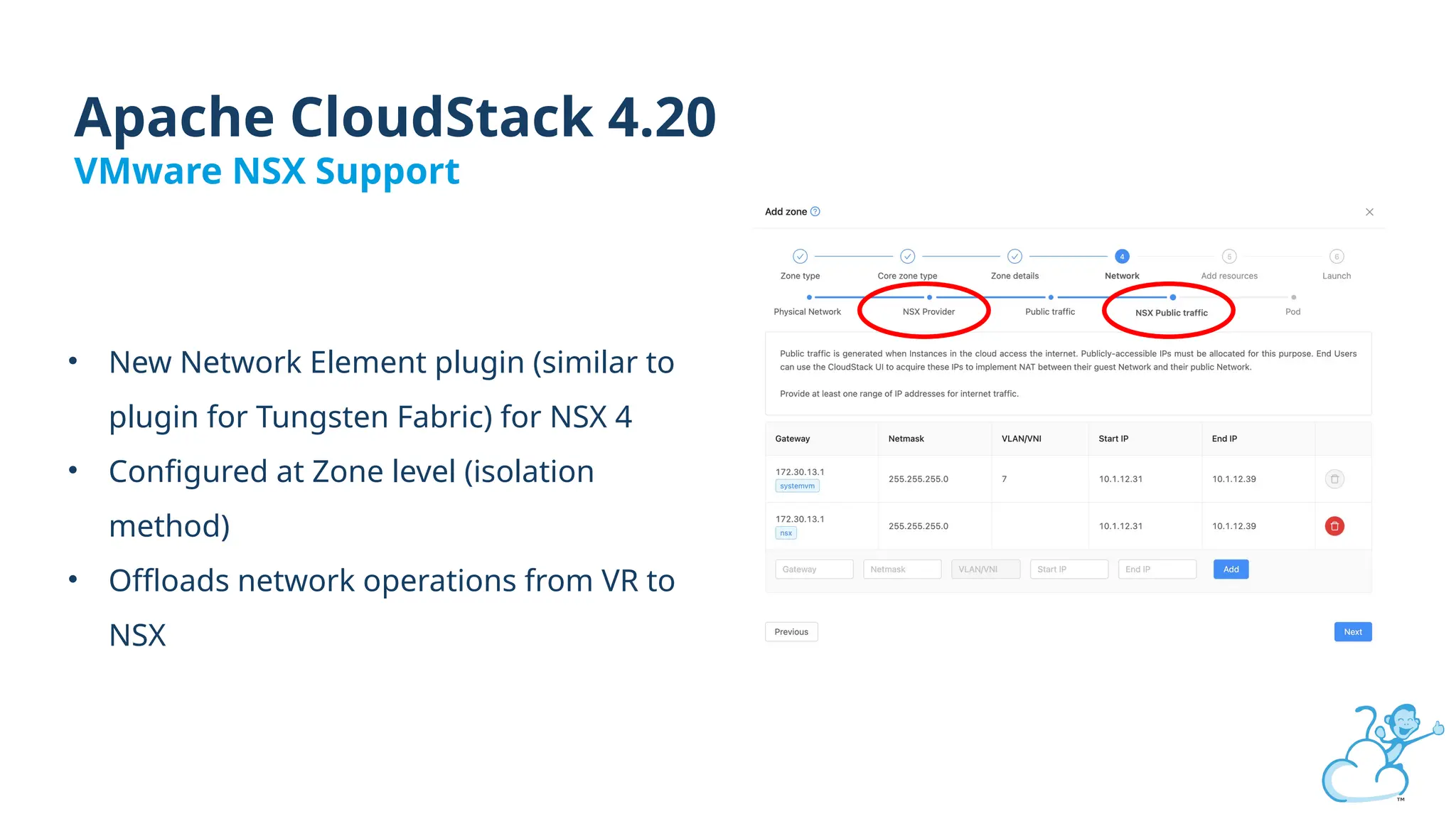
• New Network Element plugin (similar to
plugin for Tungsten Fabric) for NSX 4
• Configured at Zone level (isolation
method)
• Offloads network operations from VR to
NSX
Apache CloudStack 4.20
VMware NSX Support
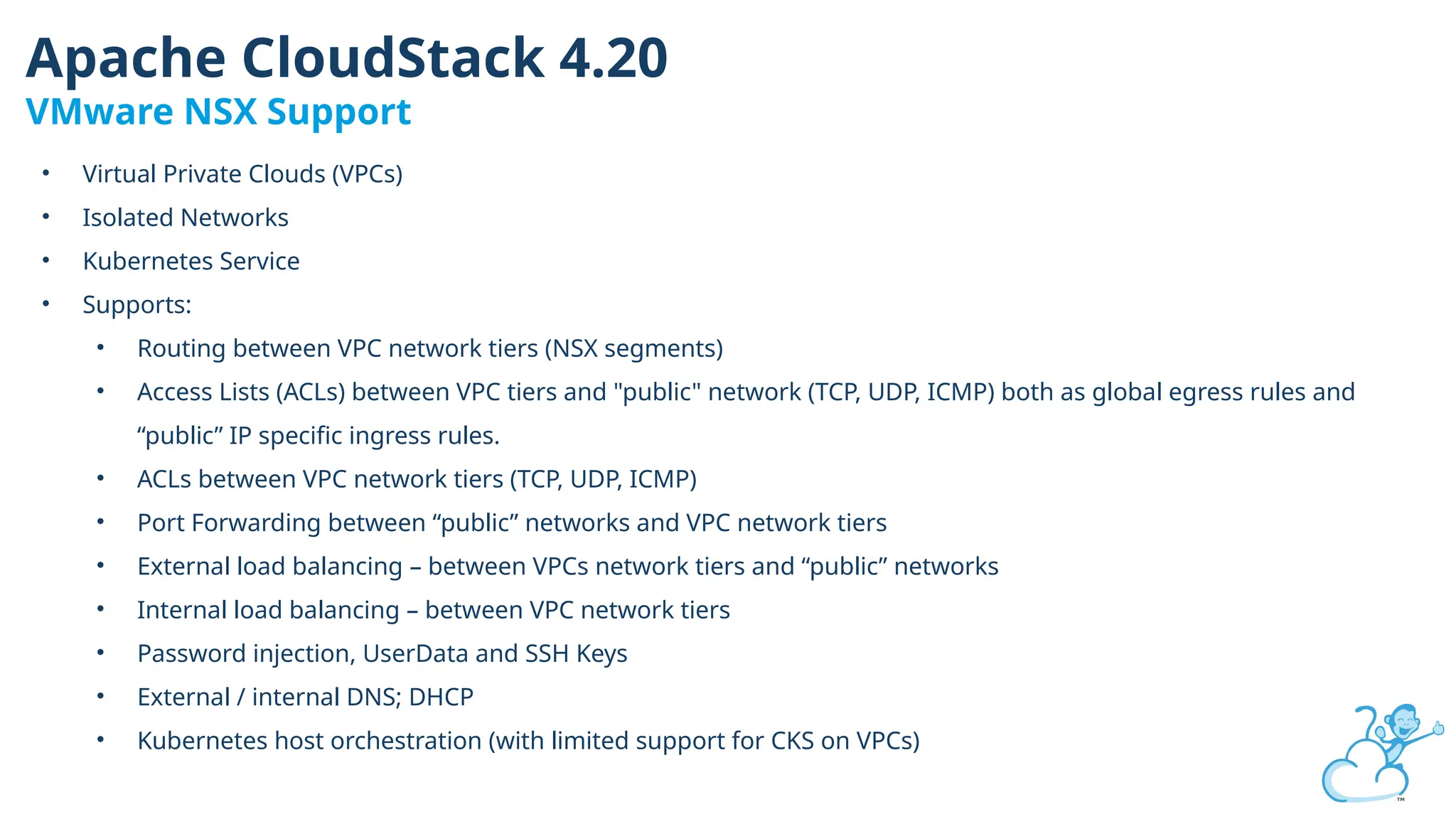
• Virtual Private Clouds (VPCs)
• Isolated Networks
• Kubernetes Service
• Supports:
• Routing between VPC network tiers (NSX segments)
• Access Lists (ACLs) between VPC tiers and "public" network (TCP, UDP, ICMP) both as global egress rules and
“public” IP specific ingress rules.
• ACLs between VPC network tiers (TCP, UDP, ICMP)
• Port Forwarding between “public” networks and VPC network tiers
• External load balancing – between VPCs network tiers and “public” networks
• Internal load balancing – between VPC network tiers
• Password injection, UserData and SSH Keys
• External / internal DNS; DHCP
• Kubernetes host orchestration (with limited support for CKS on VPCs)
Apache CloudStack 4.20
VMware NSX Support
Apache CloudStack 4.20
Dynamic & Static routing
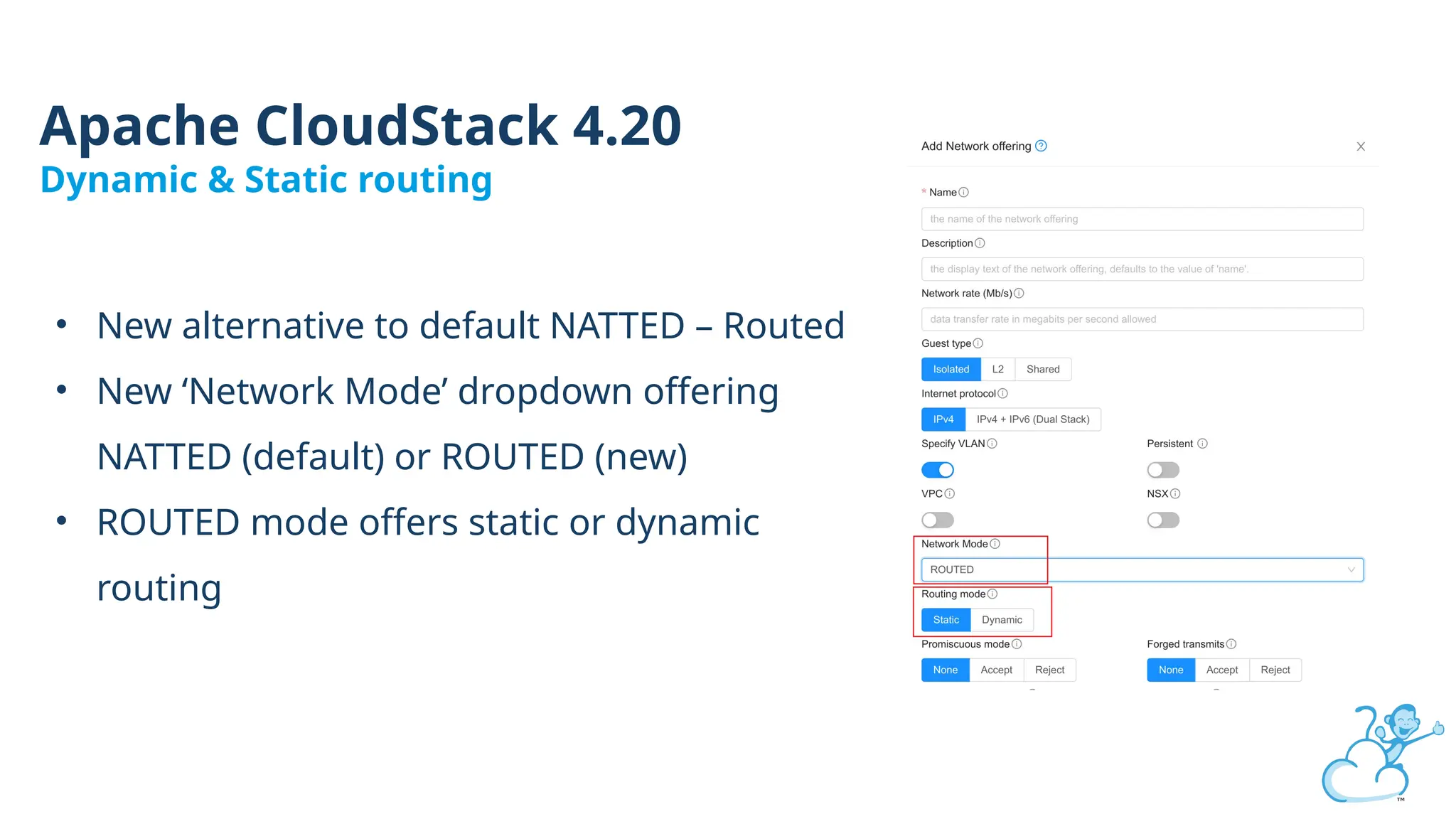
• New alternative to default NATTED – Routed
• New ‘Network Mode’ dropdown offering
NATTED (default) or ROUTED (new)
• ROUTED mode offers static or dynamic
routing
Apache CloudStack 4.20
Dynamic & Static routing
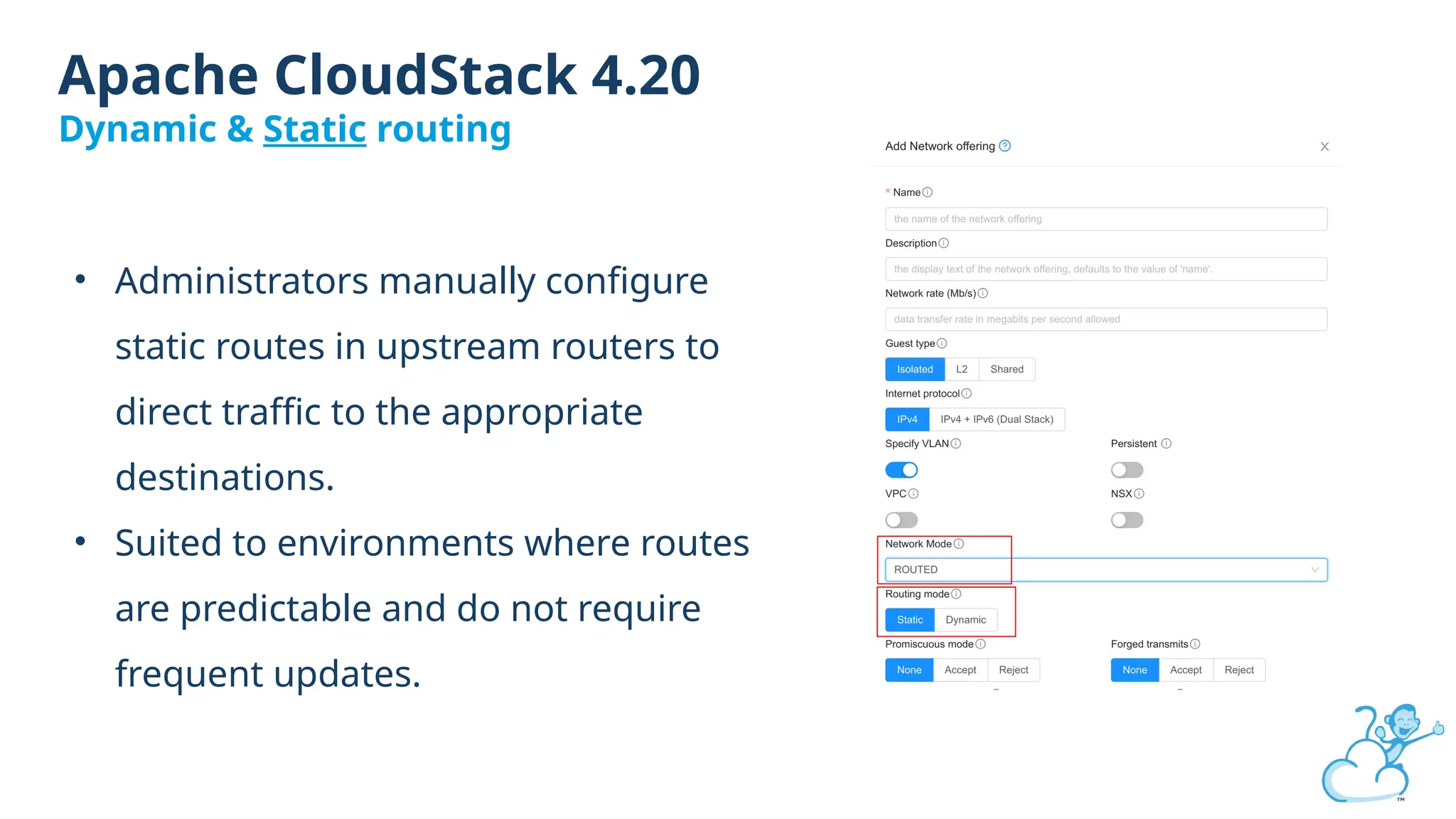
• Administrators manually configure
static routes in upstream routers to
direct traffic to the appropriate
destinations.
• Suited to environments where routes
are predictable and do not require
frequent updates.
Apache CloudStack 4.20
Dynamic & static routing
• This mode leverages BGP (Border Gateway Protocol) to automatically exchange routing
information between networks. CloudStack manages the setup by assigning AS
(Autonomous System) numbers and establishing BGP peer sessions for Virtual Routers.
• Suited to larger, complex environments where routes may change frequently.
Apache CloudStack 4.21
Feature Highlights
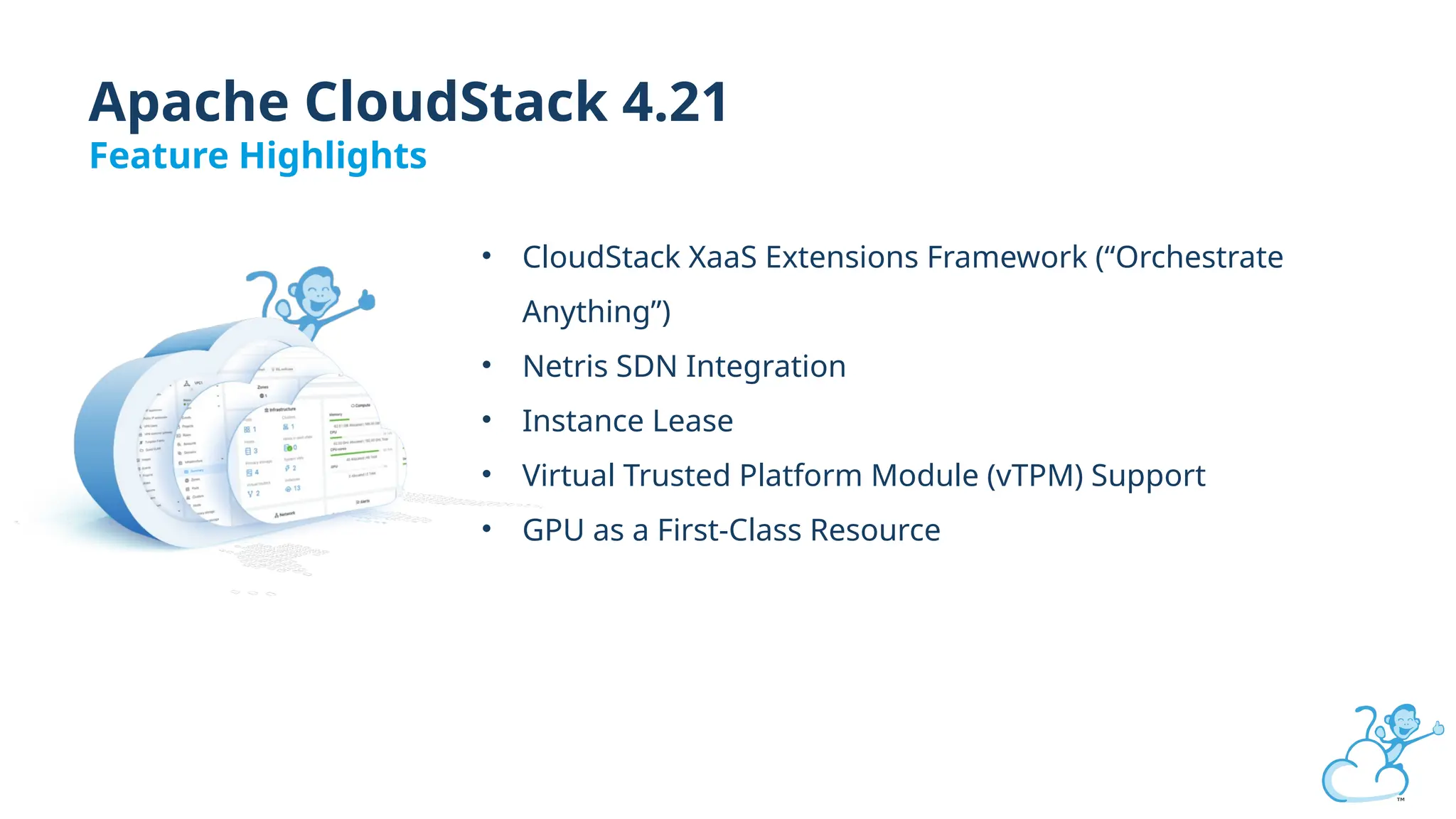
• CloudStack XaaS Extensions Framework (“Orchestrate
Anything”)
• Netris SDN Integration
• Instance Lease
• Virtual Trusted Platform Module (vTPM) Support
• GPU as a First-Class Resource
Apache CloudStack 4.21
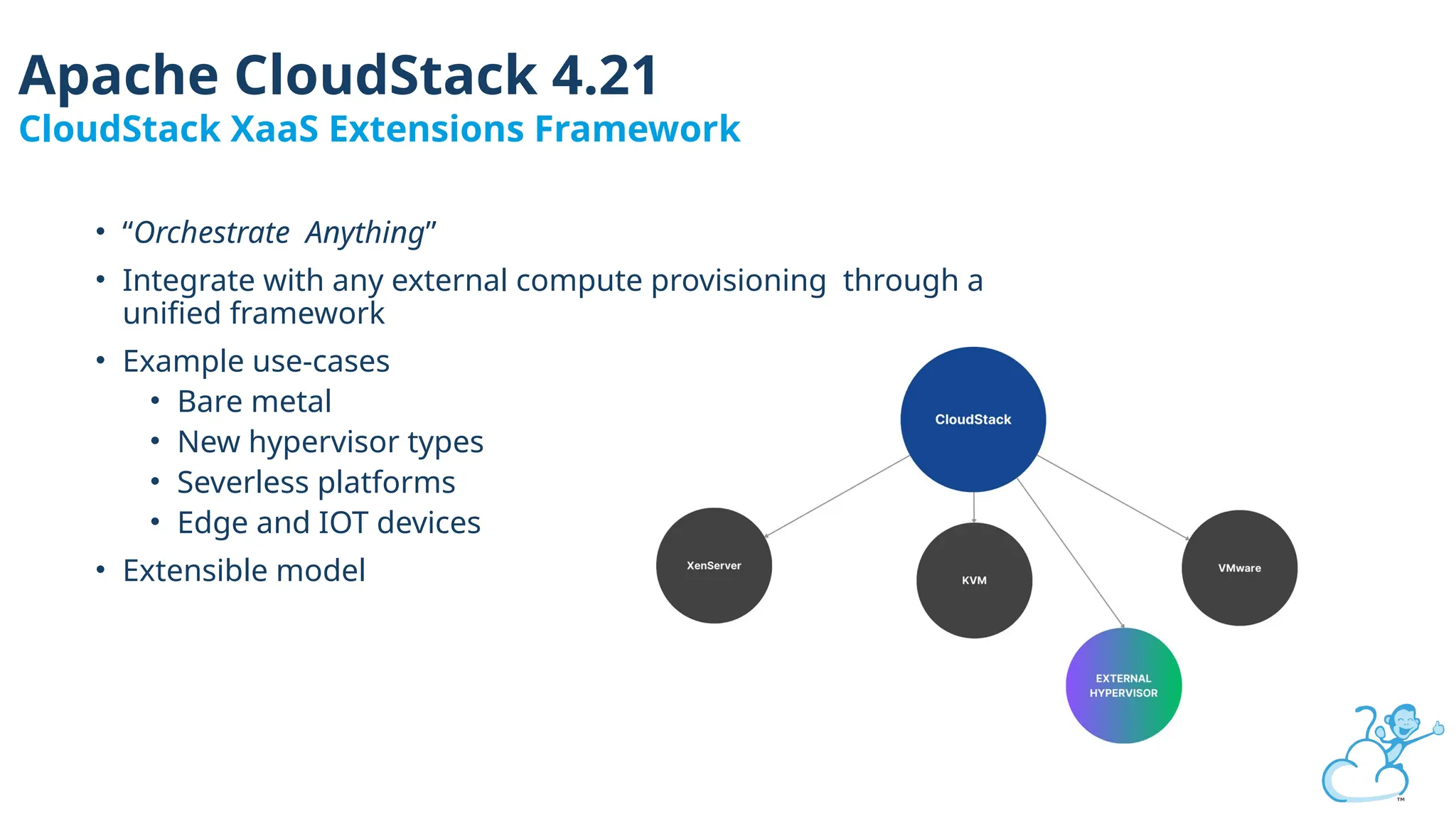
CloudStack XaaS Extensions Framework
• “Orchestrate Anything”
• Integrate with any external compute provisioning through a
unified framework
• Example use-cases
• Bare metal
• New hypervisor types
• Severless platforms
• Edge and IOT devices
• Extensible model
Apache CloudStack 4.21
Netris Integration
• Netris = Automated switch fabric manager for cloud
• Addresses some network challenges when running CloudStack at scale:
• VLAN limits (4096)
• Tungsten fabric uncertainty
• Some challenges with VXLAN
• Replaces CloudStack Virtual Router
Netris - The Cloud Provider Networ
king
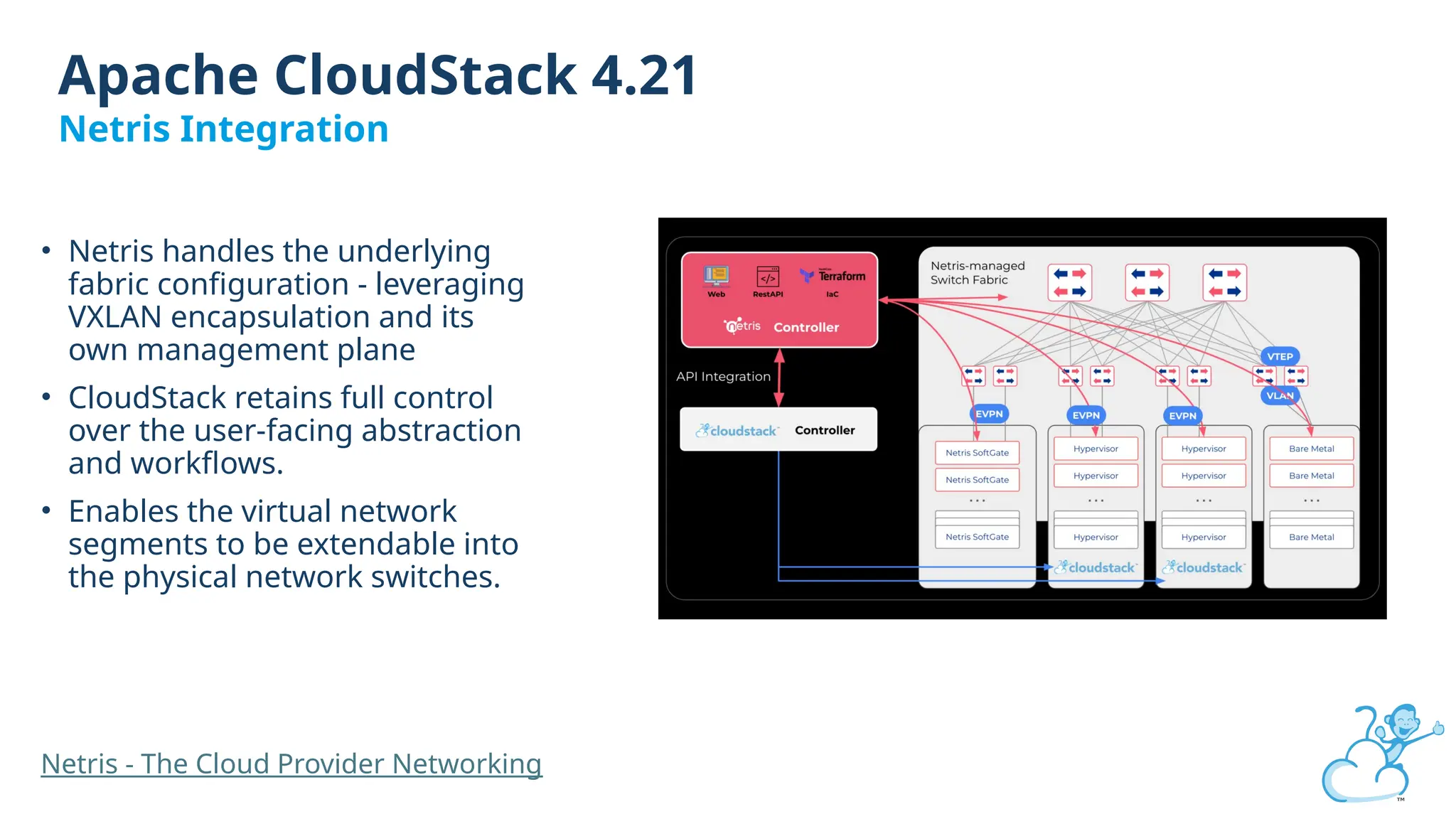
• Netris handles the underlying
fabric configuration - leveraging
VXLAN encapsulation and its
own management plane
• CloudStack retains full control
over the user-facing abstraction
and workflows.
• Enables the virtual network
segments to be extendable into
the physical network switches.
Apache CloudStack 4.21
Netris Integration
Netris - The Cloud Provider Networking
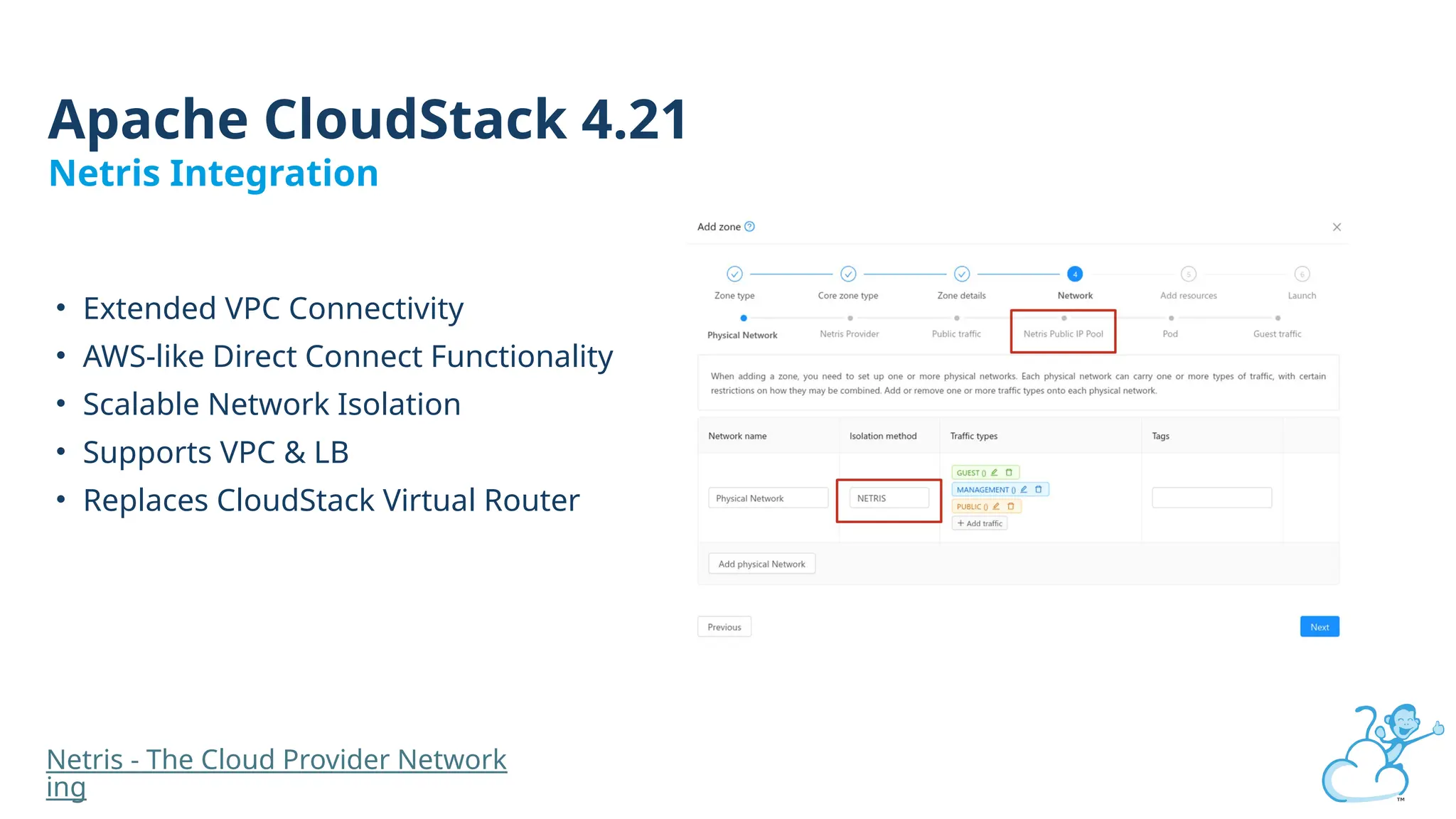
• Extended VPC Connectivity
• AWS-like Direct Connect Functionality
• Scalable Network Isolation
• Supports VPC & LB
• Replaces CloudStack Virtual Router
Apache CloudStack 4.21
Netris Integration
Netris - The Cloud Provider Network
ing
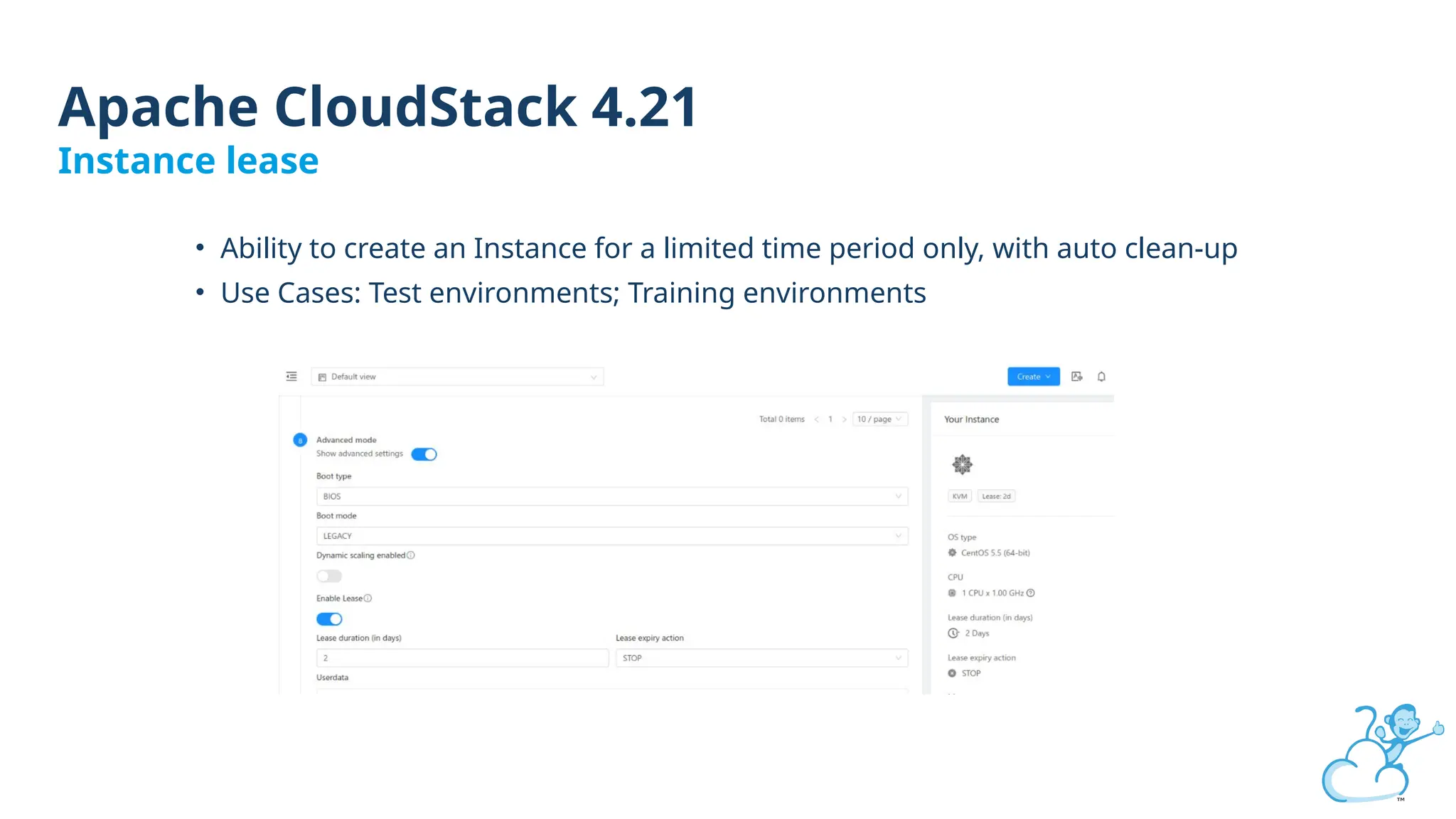
• Ability to create an Instance for a limited time period only, with auto clean-up
• Use Cases: Test environments; Training environments
Apache CloudStack 4.21
Instance lease
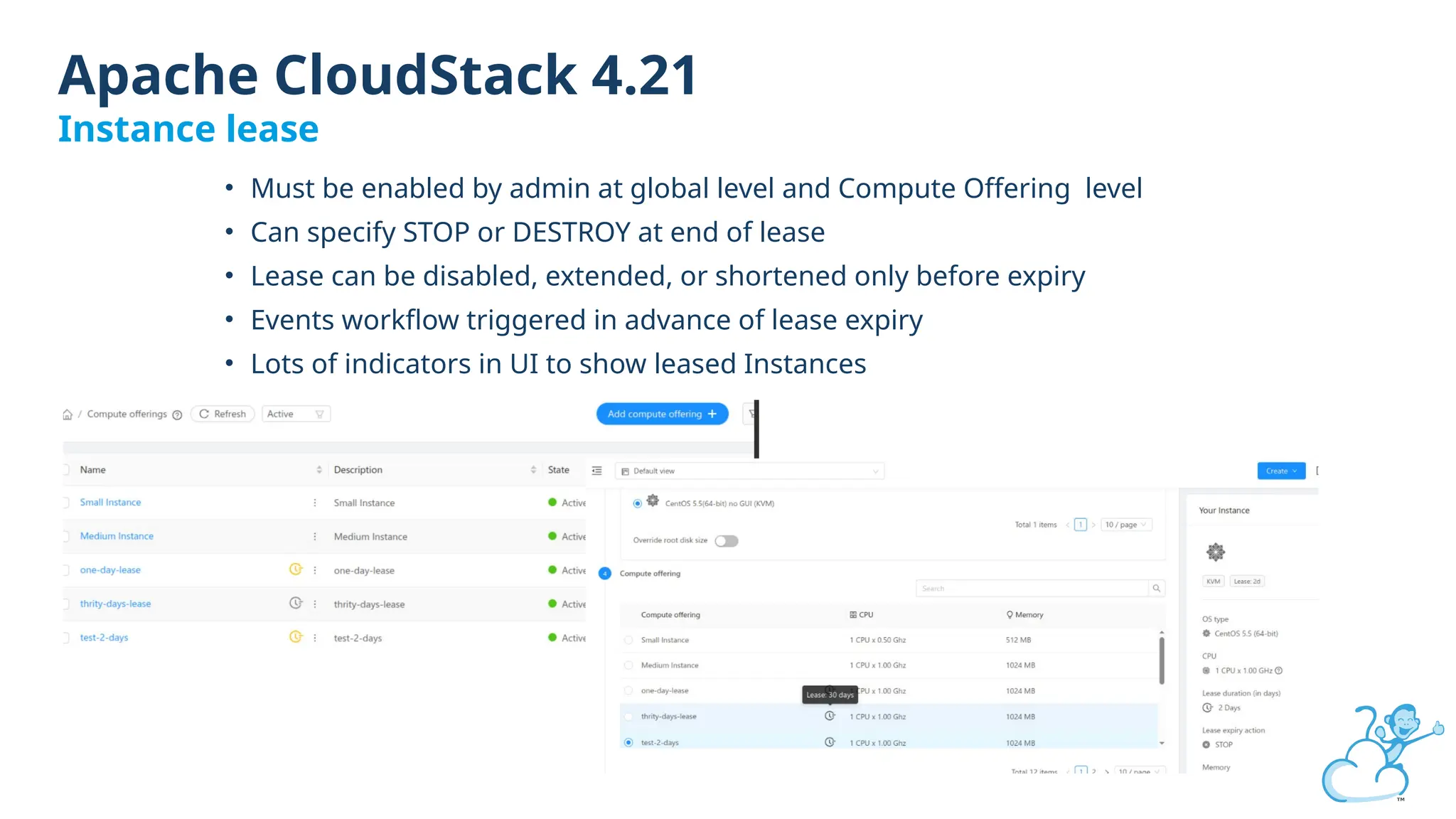
• Must be enabled by admin at global level and Compute Offering level
• Can specify STOP or DESTROY at end of lease
• Lease can be disabled, extended, or shortened only before expiry
• Events workflow triggered in advance of lease expiry
• Lots of indicators in UI to show leased Instances
Apache CloudStack 4.21
Instance lease
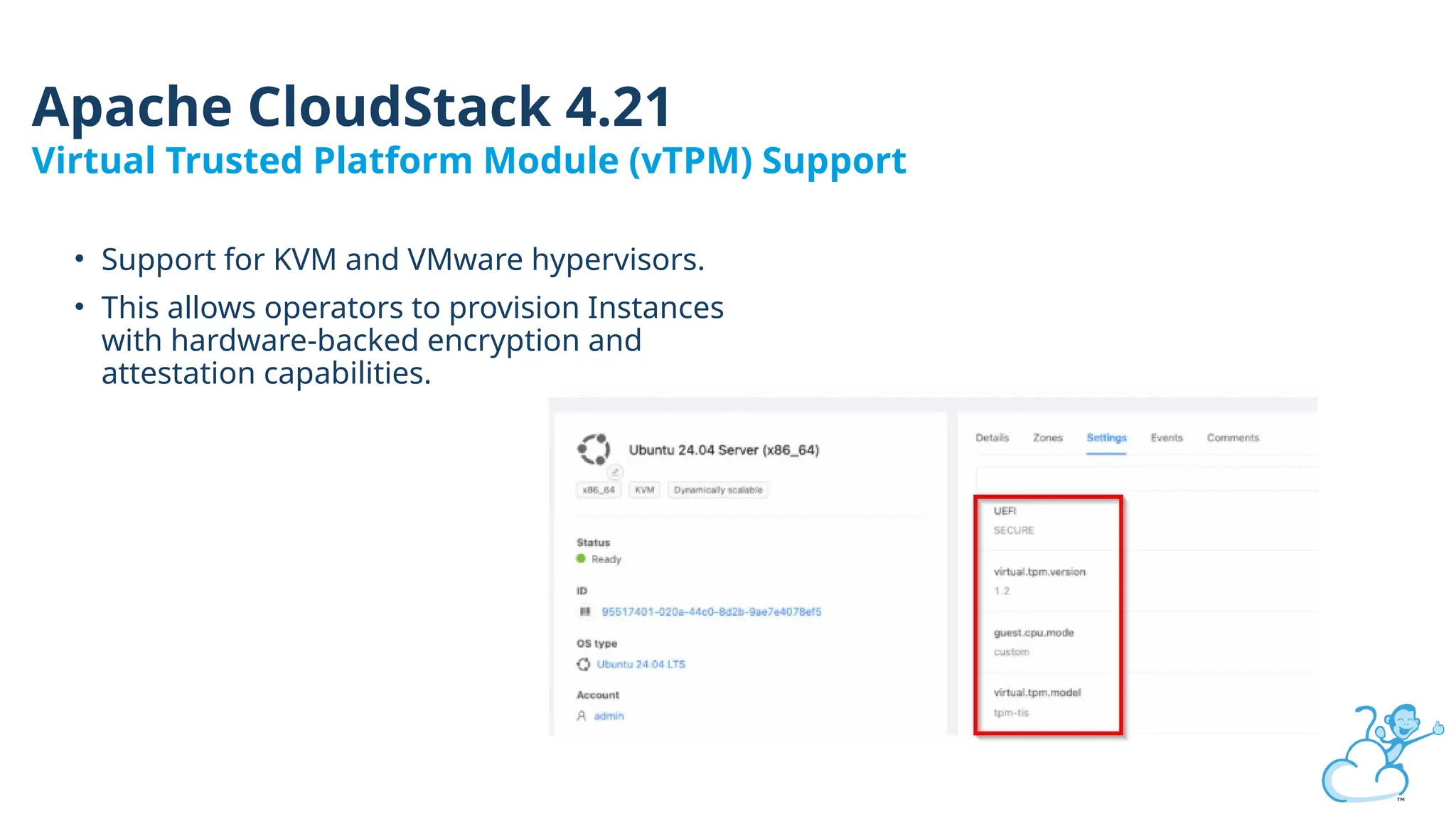
• Support for KVM and VMware hypervisors.
• This allows operators to provision Instances
with hardware-backed encryption and
attestation capabilities.
Apache CloudStack 4.21
Virtual Trusted Platform Module (vTPM) Support
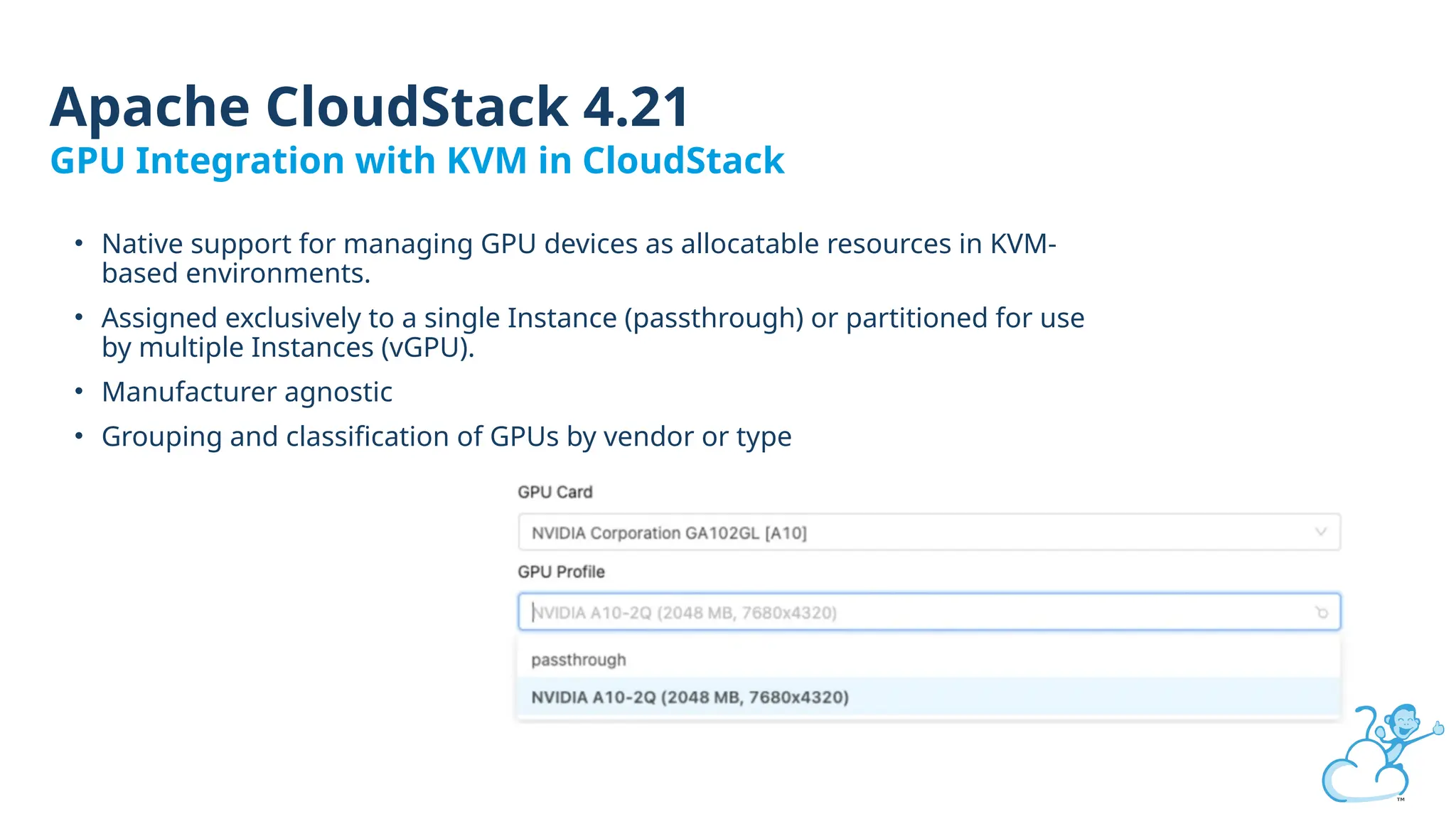
• Native support for managing GPU devices as allocatable resources in KVM-
based environments.
• Assigned exclusively to a single Instance (passthrough) or partitioned for use
by multiple Instances (vGPU).
• Manufacturer agnostic
• Grouping and classification of GPUs by vendor or type
Apache CloudStack 4.21
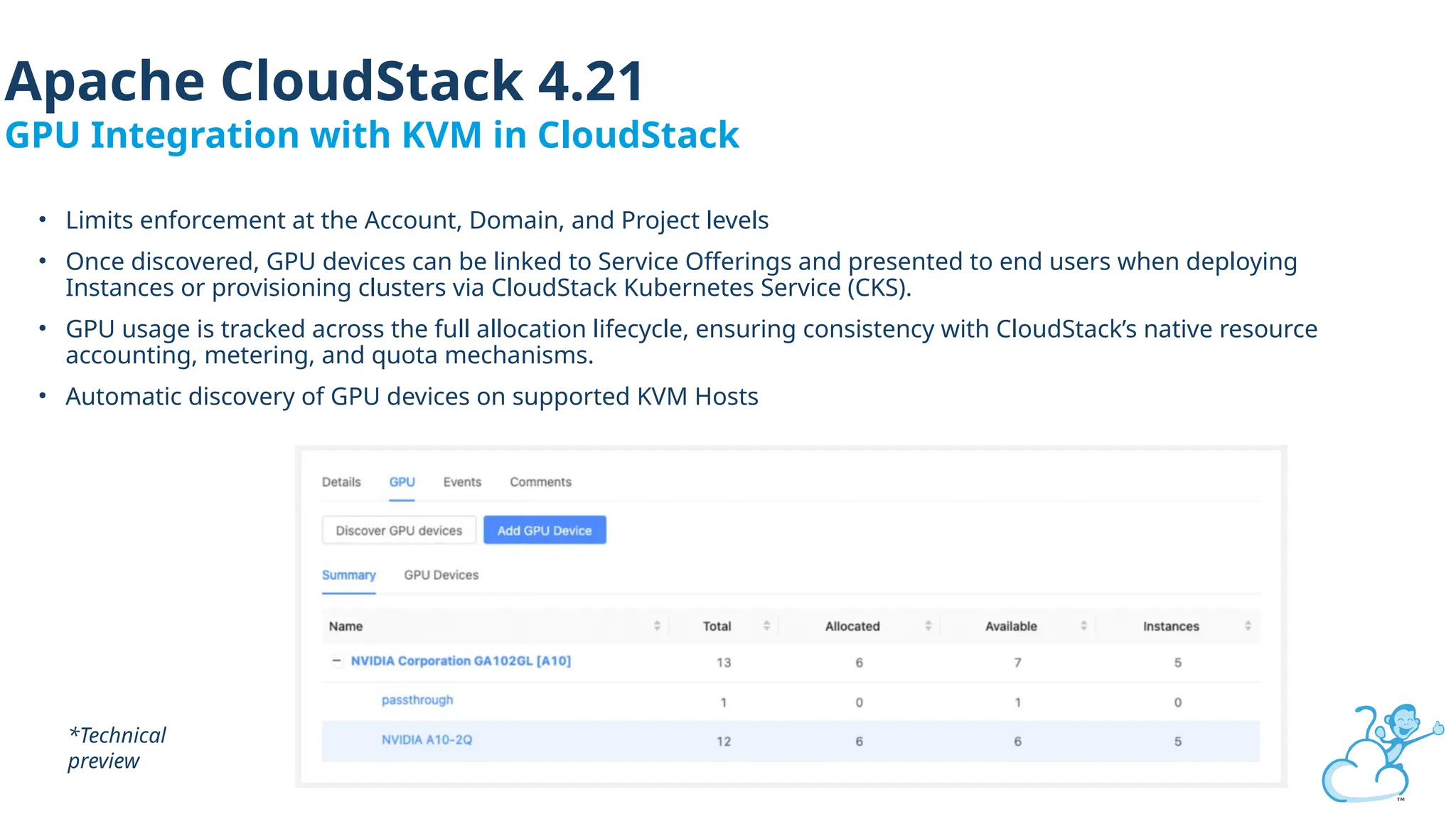
GPU Integration with KVM in CloudStack
• Limits enforcement at the Account, Domain, and Project levels
• Once discovered, GPU devices can be linked to Service Offerings and presented to end users when deploying
Instances or provisioning clusters via CloudStack Kubernetes Service (CKS).
• GPU usage is tracked across the full allocation lifecycle, ensuring consistency with CloudStack’s native resource
accounting, metering, and quota mechanisms.
• Automatic discovery of GPU devices on supported KVM Hosts
Apache CloudStack 4.21
GPU Integration with KVM in CloudStack
*Technical
preview
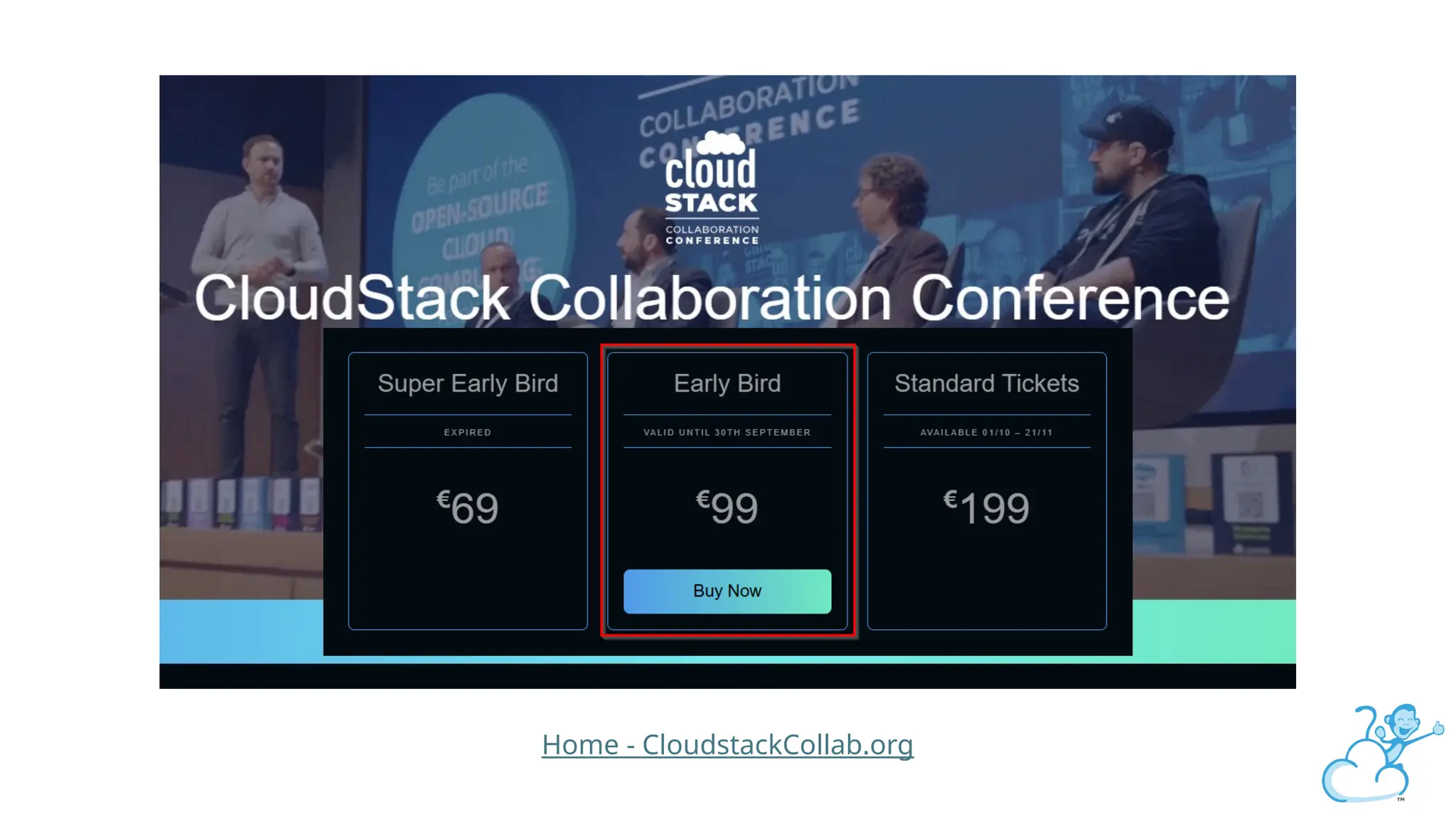
Home - CloudstackCollab.org
Thank you for
listening…
• Apache CloudStack 4.20 deep-dive:
https://www.shapeblue.com/apache-cloudstack-4-20-deep-dive/
• Apache CloudStack 4.21 deep-dive: https://www.shapeblue.com/cloudstack-4-21-deep-dive/
• Apache CloudStack 4.21 FAQ: https://www.shapeblue.com/apache-cloudstack-4-21-faq/
• Apache CloudStack Mailing Lists:
https://cloudstack.apache.org/mailing-lists/Apache CloudStack Collaboration Conference:
https://www.cloudstackcollab.org/

Introduction 101 Whats New - Steve Roles

  • 1.
    • Welcome! • CloudStack101 • What’s New
  • 2.
    Who am I? •CloudStack community member • COO, ShapeBlue • Involved with CloudStack since 2012 • Dad, musician, open-source fan • Not super-technical!
  • 3.
    The aims ofthis group • Collaborative environment for: • All things Apache CloudStack • Related tech: ecosystem products, hypervisors, storage, etc. • Technical deep-dives, issues & best practice • Case studies & user stories • To showcase complementary technologies • To share ideas & problems with other users • Meetings in various European destinations
  • 4.
  • 5.
    Thank you toour sponsors…
  • 6.
    Today’s agenda •11:25 -11:55 Apache CloudStack: Powering Research in Apiculture, Aquaponics, and Advanced Networking Mike Hinsley, Objectway •12:05 - 12:35 Design and Build a Tier 1 Infrastructure for Your CloudStack Cloud Nikolay Tenev, StorPool •12:45 - 13:15 Double the Savings on Repatriation With an Ampere Combination Pete Logan, Ampere •13:15 - 14:15 Q&A | Lunch Break •14:15 - 14:45 Latency Is All That Matters, Not Bandwidth Wido den Hollander, Your.Online •14:55 - 15:40 CloudStack Extensions Framework (XaaS) - Enabling Orchestrate Anything + Demo Lucian Burlacu, ShapeBlue •15:50 - 16:20 CloudStack Community Forum: Embracing Open-Source for True Independence Ivet Petrova - Facilitator •16:20 - 17:00 Q&A | Networking | Closing
  • 7.
  • 8.
    CloudStack 101 Apache CloudStackis a scalable, multi-tenant, open-source, purpose-built, cloud orchestration platform for delivering turnkey Infrastructure-as-a- Service clouds
  • 9.
    Hypervisor Networking Compute Storage CMPOrchestration Layer Orchestration API eCommerce Platform IaaS Platforms
  • 10.
    Hypervisor Networking Compute Storage CMPOrchestration Layer Orchestration API eCommerce Platform IaaS Platforms
  • 11.
    Hypervisor Networking Compute Storage CMPOrchestration Layer Orchestration API eCommerce Platform IaaS Platforms
  • 12.
    Hypervisor Networking Compute Storage CMPOrchestration Layer Orchestration API eCommerce Platform IaaS Platforms
  • 13.
    Hypervisor (KVM, VMware,XenServer/XCP-ng…) Networking Compute Storage CMP Orchestration Layer Orchestration API eCommerce Platform IaaS Platforms
  • 14.
    Hypervisor (KVM, VMware,XenServer/XCP-ng…) Networking Compute Storage Apache CloudStack Orchestration API eCommerce Platform IaaS Platforms
  • 15.
    Hypervisor (KVM, VMware,XenServer/XCP-ng…) Networking Compute Storage Apache CloudStack CloudStack API eCommerce Platform IaaS Platforms
  • 16.
    Hypervisor (KVM, VMware,XenServer/XCP-ng…) Networking Compute Storage Apache CloudStack CloudStack API CloudStack UI 3rd Party/Ecommerce Platforms IaaS Platforms
  • 17.
    Hypervisor (KVM, VMware,XenServer/XCP-ng…) Networking Compute Storage Apache CloudStack CloudStack API CloudStack UI 3rd Party/Ecommerce Platforms CloudMonkey CLI Kubernetes Service IaaS Platforms
  • 18.
    Hypervisor (KVM, VMware,XenServer/XCP-ng…) Networking Compute Storage Apache CloudStack CloudStack API CloudStack UI 3rd Party/Ecommerce Platforms CloudMonkey CLI Kubernetes Service Kubernetes CAPC / EKS-A Dev Tools (Terraform, Ansible, Automation…) Multi-Cloud Management IaaS Platforms
  • 19.
    Click to edit CloudStack101: Key CloudStack features • Broad Hypervisor support • KVM, XenServer, XCP-ng, VMware, OracleVM • Kubernetes support • Scalable architecture • Support thousands of hosts and VM guests • Largest known production cloud 35k+ physical hosts • High availability • Configurations that provide automatic failover for VMs • Enterprise grade tenant Virtual Networking • Choice of interfaces • Web UI, command line, REST-based API
  • 20.
    Click to edit CloudStack101: Key CloudStack features CloudStack provides two types of networking:. • Basic For AWS-style networking. Provides a single network where guest isolation can be provided through layer-3 means such as security groups (IP address source filtering). • Advanced For more sophisticated network topologies. This network model provides the most flexibility in defining guest networks but requires more configuration steps than basic networking. • Different types of network traffic can be segmented on the same physical network. • Guest traffic can also be segmented by account. To isolate traffic, you can use separate VLANs.
  • 21.
    Click to edit CloudStack101: Key CloudStack features Networking Feature Basic Network Advanced Network Number of networks Single network Multiple networks Firewall type Physical Physical and Virtual Load balancer Physical Physical and Virtual Isolation type Layer 3 Layer 2 and Layer 3 VPN support No Yes Port forwarding Physical Physical and Virtual 1:1 NAT Physical Physical and Virtual Source NAT No Physical and Virtual User data Yes Yes Network usage monitoring sFlow / netFlow at physical router Hypervisor and Virtual Router DNS and DHCP Yes Yes
  • 22.
    Click to edit CloudStack101: Key CloudStack features The CloudStack Virtual Router (VR) IPv4, IPv6 Firewall / ACLs Metadata & Userdata (cloud- init) User access VPN Source & static NAT Site-2-site VPN Routing Private Gateways Dynamic routing, BGP Zero downtime upgrades & live patching Port forwarding Redundancy Load balancer SSH Keys and password injection DHCP & DNS DualStack Routing
  • 23.
    Click to edit CloudStack101 Why CloudStack? • Integrated end-to-end IaaS product • Proven at scale, widespread adoption • Rapid time to value • Low implementation & operational costs • Focussed, user led, development community • Narrow scope / easy integration
  • 24.
    Use Cases Private CloudPublic Cloud Hybrid Cloud Edge Cloud Virtualisation Management
  • 25.
  • 26.
    (Some more) KnownCloudStack Users…
  • 27.
    Click to edit CloudStack101 Our community • Diverse user driven community • Governed by Apache Software Foundation • 300+ committers
  • 28.
  • 30.
    * Management serverdownloads from downloads.cloudstack.apache.org and packages.shapeblue.com combined ** For period 31 October 2024 – 13 November 2024 + As of 09/11/24 2023 Package downloads in last 12 months* 227,780 Unique Visitors to GitHub repo in last 15 days 1700 Stars on Github 1600 2024 Change 2024 Change 348,748 +53% 2,123 ** +25% 2100+ +31%
  • 34.
    Releases & newfeatures The highlights Release Date Type 4.19.0.0 02 February 2024 Major release (LTS) 4.19.0.1 04 April 2024 Security 4.19.0.2 05 July 2024 Security 4.19.1.0 19 July 2024 Maintenance 4.19.1.1 06 August 2024 Security 4.20.0.0 06 December 2024 Major release (LTS) 4.19.2.0 03 March 2025 Maintenance 4.19.3.0 10 June 2025 Maintenance / Security 4.20.1.0 10 June 2025 Maintenance / Security 4.21.0.0 28 August 2025 Major release (non-LTS) 4.22.0.0 Q4 2025 Major release (LTS)
  • 35.
    Apache CloudStack 4.19 Featurehighlights • VMware to KVM migration • VNF (Virtual Network Functions) Appliance Support • CloudStack Object Storage
  • 36.
    Apache CloudStack 4.20 Featurehighlights • ARM64 Support and Multi Architecture Zones • Shared FileSystems • VMware NSX Support • Dynamic & static routing
  • 37.
    • When creatingan Instance, Users can now choose between x86_64 and ARM64 Architectures • Architecture type is specified when creating: • Templates • ISO’s • Kubernetes Versions • CloudStack Clusters now have an assigned Architecture type • A zone can support both types simultaneously Apache CloudStack 4.20 ARM64 Support and Multi Architecture Zones
  • 38.
    Apache CloudStack 4.20 ARM64Support and Multi Architecture Zones
  • 39.
    • Users cancreate a file share for consumption in other Instances (think EFS) • CloudStack orchestrates the creation of an underlying Instance, volume, etc. Apache CloudStack 4.20 Shared FileSystems
  • 40.
    • Framework architectureallows use of any file share provider • Currently provider for NFS (XFX or EXT4) hosted on CloudStack Instance • Users Userdata / udev to deploy / manage Fileshare provider • FileSystem object give access & mount information • 11 New APIs, including: • CreateFileShare • ListFileShare Apache CloudStack 4.20 Shared FileSystems
  • 41.
    • New NetworkElement plugin (similar to plugin for Tungsten Fabric) for NSX 4 • Configured at Zone level (isolation method) • Offloads network operations from VR to NSX Apache CloudStack 4.20 VMware NSX Support
  • 42.
    • Virtual PrivateClouds (VPCs) • Isolated Networks • Kubernetes Service • Supports: • Routing between VPC network tiers (NSX segments) • Access Lists (ACLs) between VPC tiers and "public" network (TCP, UDP, ICMP) both as global egress rules and “public” IP specific ingress rules. • ACLs between VPC network tiers (TCP, UDP, ICMP) • Port Forwarding between “public” networks and VPC network tiers • External load balancing – between VPCs network tiers and “public” networks • Internal load balancing – between VPC network tiers • Password injection, UserData and SSH Keys • External / internal DNS; DHCP • Kubernetes host orchestration (with limited support for CKS on VPCs) Apache CloudStack 4.20 VMware NSX Support
  • 43.
    Apache CloudStack 4.20 Dynamic& Static routing • New alternative to default NATTED – Routed • New ‘Network Mode’ dropdown offering NATTED (default) or ROUTED (new) • ROUTED mode offers static or dynamic routing
  • 44.
    Apache CloudStack 4.20 Dynamic& Static routing • Administrators manually configure static routes in upstream routers to direct traffic to the appropriate destinations. • Suited to environments where routes are predictable and do not require frequent updates.
  • 45.
    Apache CloudStack 4.20 Dynamic& static routing • This mode leverages BGP (Border Gateway Protocol) to automatically exchange routing information between networks. CloudStack manages the setup by assigning AS (Autonomous System) numbers and establishing BGP peer sessions for Virtual Routers. • Suited to larger, complex environments where routes may change frequently.
  • 46.
    Apache CloudStack 4.21 FeatureHighlights • CloudStack XaaS Extensions Framework (“Orchestrate Anything”) • Netris SDN Integration • Instance Lease • Virtual Trusted Platform Module (vTPM) Support • GPU as a First-Class Resource
  • 47.
    Apache CloudStack 4.21 CloudStackXaaS Extensions Framework • “Orchestrate Anything” • Integrate with any external compute provisioning through a unified framework • Example use-cases • Bare metal • New hypervisor types • Severless platforms • Edge and IOT devices • Extensible model
  • 48.
    Apache CloudStack 4.21 NetrisIntegration • Netris = Automated switch fabric manager for cloud • Addresses some network challenges when running CloudStack at scale: • VLAN limits (4096) • Tungsten fabric uncertainty • Some challenges with VXLAN • Replaces CloudStack Virtual Router Netris - The Cloud Provider Networ king
  • 49.
    • Netris handlesthe underlying fabric configuration - leveraging VXLAN encapsulation and its own management plane • CloudStack retains full control over the user-facing abstraction and workflows. • Enables the virtual network segments to be extendable into the physical network switches. Apache CloudStack 4.21 Netris Integration Netris - The Cloud Provider Networking
  • 50.
    • Extended VPCConnectivity • AWS-like Direct Connect Functionality • Scalable Network Isolation • Supports VPC & LB • Replaces CloudStack Virtual Router Apache CloudStack 4.21 Netris Integration Netris - The Cloud Provider Network ing
  • 51.
    • Ability tocreate an Instance for a limited time period only, with auto clean-up • Use Cases: Test environments; Training environments Apache CloudStack 4.21 Instance lease
  • 52.
    • Must beenabled by admin at global level and Compute Offering level • Can specify STOP or DESTROY at end of lease • Lease can be disabled, extended, or shortened only before expiry • Events workflow triggered in advance of lease expiry • Lots of indicators in UI to show leased Instances Apache CloudStack 4.21 Instance lease
  • 53.
    • Support forKVM and VMware hypervisors. • This allows operators to provision Instances with hardware-backed encryption and attestation capabilities. Apache CloudStack 4.21 Virtual Trusted Platform Module (vTPM) Support
  • 54.
    • Native supportfor managing GPU devices as allocatable resources in KVM- based environments. • Assigned exclusively to a single Instance (passthrough) or partitioned for use by multiple Instances (vGPU). • Manufacturer agnostic • Grouping and classification of GPUs by vendor or type Apache CloudStack 4.21 GPU Integration with KVM in CloudStack
  • 55.
    • Limits enforcementat the Account, Domain, and Project levels • Once discovered, GPU devices can be linked to Service Offerings and presented to end users when deploying Instances or provisioning clusters via CloudStack Kubernetes Service (CKS). • GPU usage is tracked across the full allocation lifecycle, ensuring consistency with CloudStack’s native resource accounting, metering, and quota mechanisms. • Automatic discovery of GPU devices on supported KVM Hosts Apache CloudStack 4.21 GPU Integration with KVM in CloudStack *Technical preview
  • 56.
  • 57.
    Thank you for listening… •Apache CloudStack 4.20 deep-dive: https://www.shapeblue.com/apache-cloudstack-4-20-deep-dive/ • Apache CloudStack 4.21 deep-dive: https://www.shapeblue.com/cloudstack-4-21-deep-dive/ • Apache CloudStack 4.21 FAQ: https://www.shapeblue.com/apache-cloudstack-4-21-faq/ • Apache CloudStack Mailing Lists: https://cloudstack.apache.org/mailing-lists/Apache CloudStack Collaboration Conference: https://www.cloudstackcollab.org/

Editor's Notes

  • #2 2 things should be obvious from this photo – I work at ShapeBlue and I live in England.
  • #3 Group been going 12 yrs, try to do 3 a year Try to avoid straight up vendor pitches (although please be polite to our sponsors) Last CSEUG was Vienna in May
  • #4 These groups are around the edge, organised by the community India User Group is really taking off
  • #8 Why am I doing a 101?
  • #9 This is how Amazon EC2 was built – it’s an Amazon diagram and I’m putting CloudStack over it. In terms of building blocks & why it was created in the first place; in the initial days of amazon started to have some components … People being able to replicate that functionality -> this is the way CloudStack looks at this
  • #18 What cloudstack does underneath is automate the infrastructure
  • #19 Hyper-V via XaaS I know of enterprises with clouds in production right now at 5, 10, 20 hosts
  • #20 CloudStack’s native SDN The two types of networking may be in use in the same cloud. However, a given zone must use either Basic Networking or Advanced Networking.
  • #21 Couple of slides on CloudStack’s native networking capability. Lots of talk about SDN, don’t forget that the native capability is going to provide 99% of people’s needs.
  • #22 I’ll talk later on networking improvements, and integration with 3rd party SDN technologies, but I wanted to illustrate that out of the box CloudStack’s own SDN is fully featured and enterprise ready.
  • #24 CloudStack 101: Use-cases, where it fits, what it is and what it does 50:50 split in private cloud and CSP (service providers) Virt mgmt – NEW use case. People not necessarily looking for a CMP, looking for something to manage (e.g.) their KVM estate, looking for the tooling that ACS can provide.
  • #26 …and these are enterprises that have started using CloudStack in the last 12-24 months. Financial, medical, service providers, educational, national telecoms Some big names. Most of the new names all moving away from VMware as quickly as possible. ’
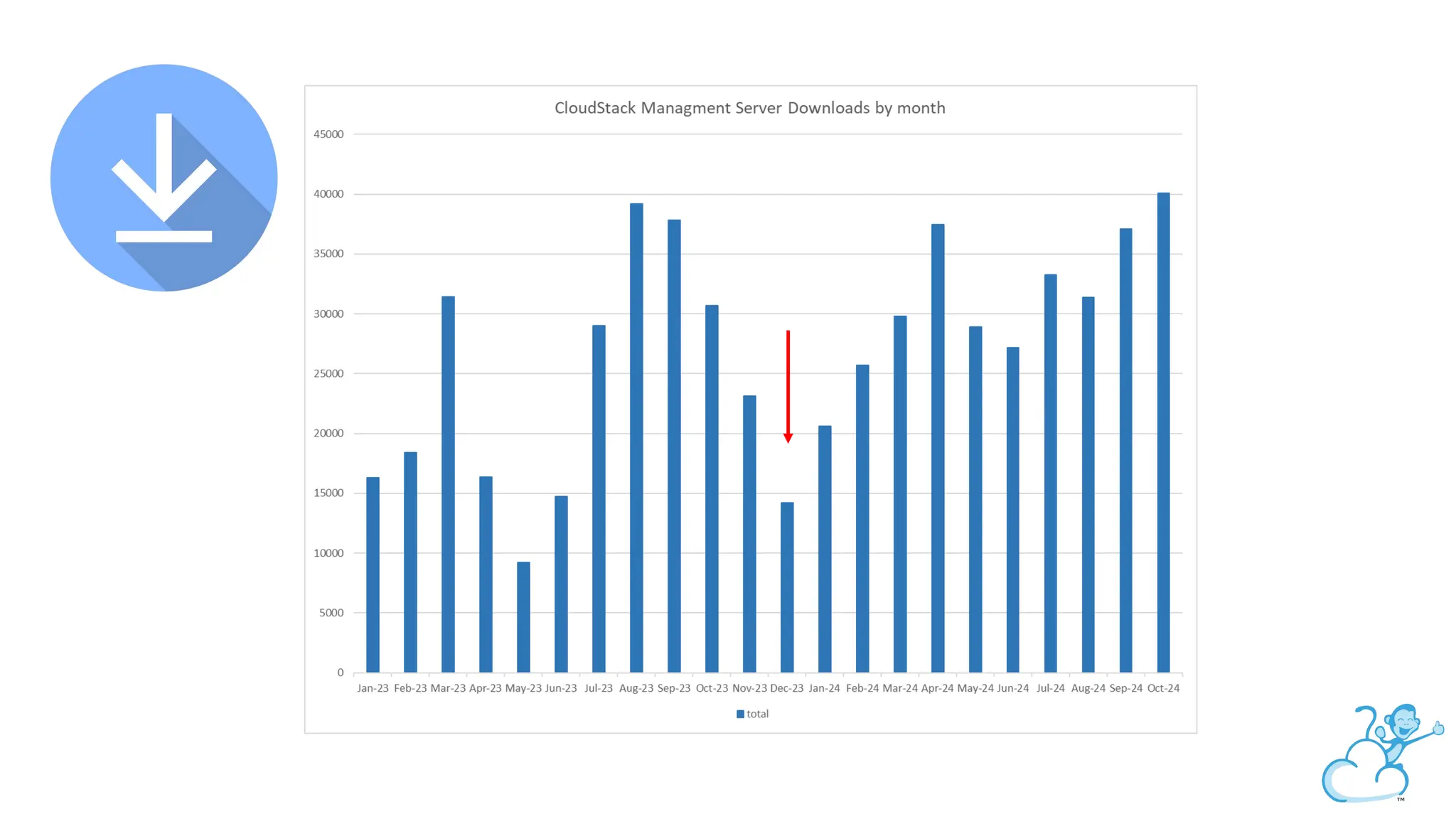
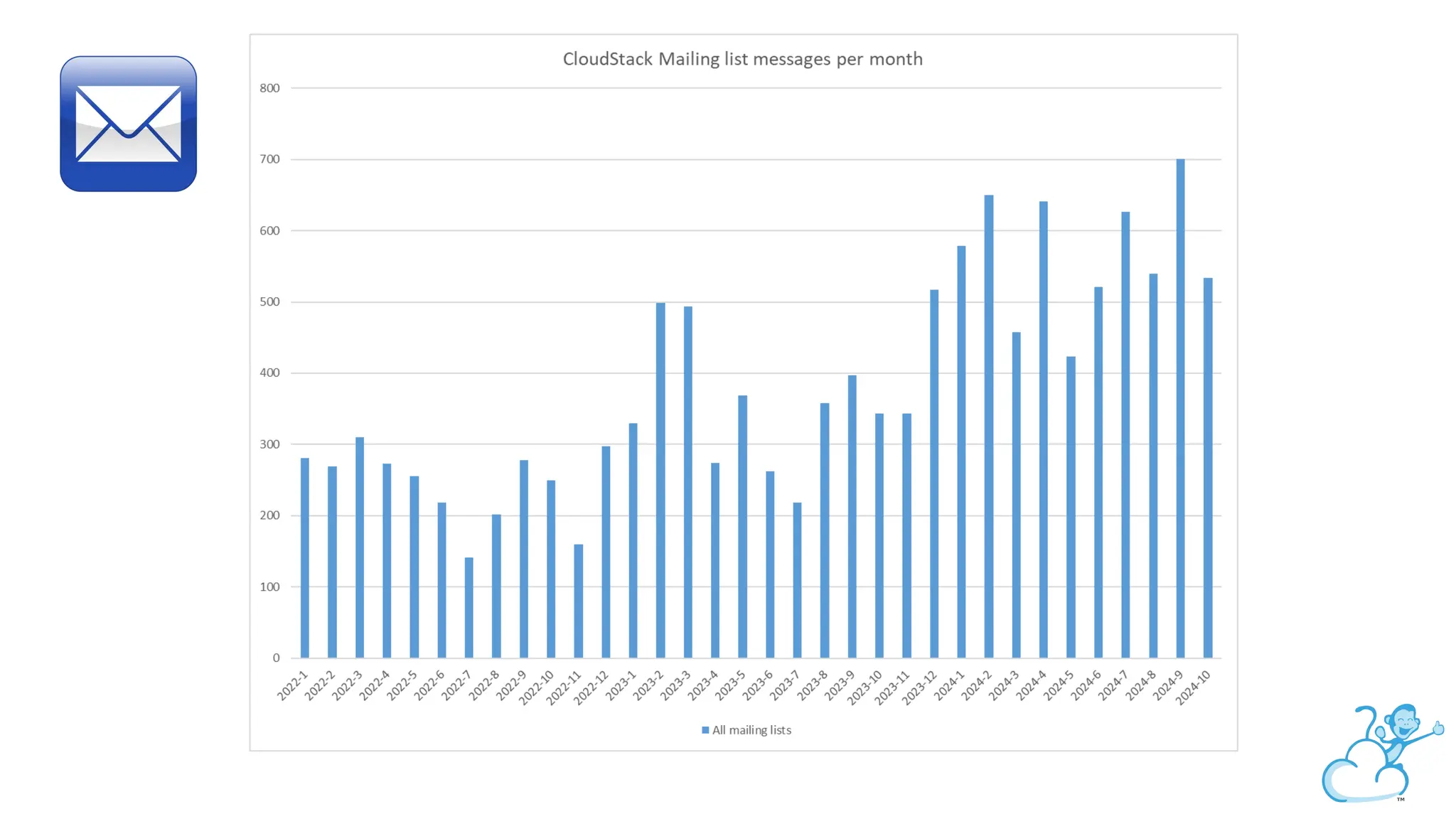
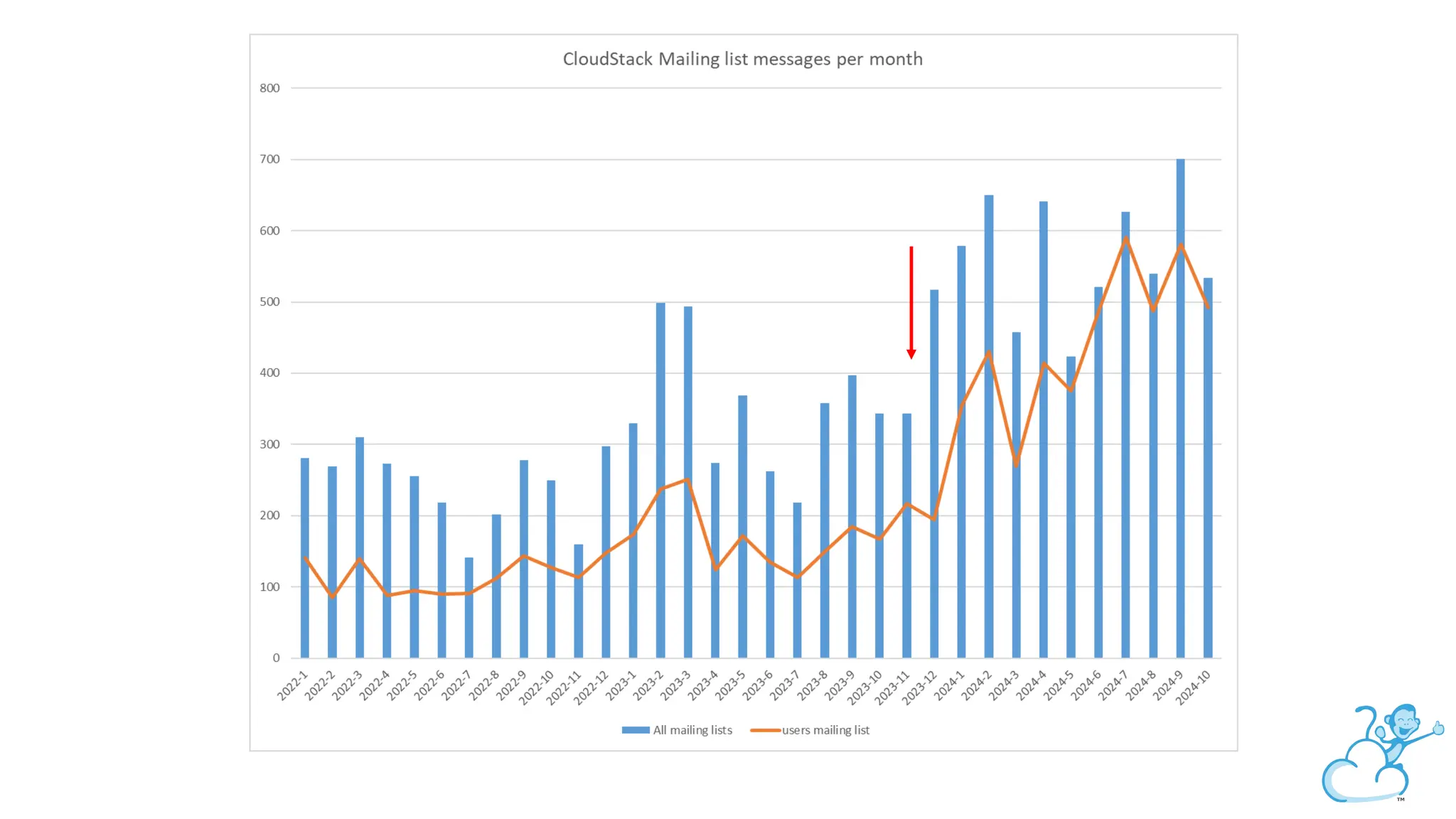
  • #28 Show you some metrics to show you the scale of CloudStack. People want to know how healthy is the community, will it be here in 10 years? A warning - no 2025 data – simply ran out of time and the data here illustrates the point!
  • #29 Nothing unusual A stable / mature project – well past its hype curve
  • #35 Why is 4.21 non-LTS? Feedback from community, users; more time for sec / maint releases
  • #36 4.19: February 2024 VMware to KVM Migration Converts VMware Instances, including disks, networks and configurations to KVM Admin only feature Can migrate existing CloudStack VMware Instances VMware VMs from an external vCenter Datacenter Uses virt-v2v to convert the Instance disks Migration of Linux Instances can be performed when running For Windows, the Instances need to be stopped Scalability / performance improvements in 4.19.1; ongoing improvements 2. VNF Appliance Support Allows users to deploy and configure 3rd party VNF appliances in their CloudStack environment Configures required network interfaces Configures network rules for access to the Appliance admin console Based on VNF Templates created by admin Usage recorded for billing by CSP Support API and UI Set up and Deployment 3. CloudStack Object Storage Object storage framework Currently provider for MIN.IO & Ceph, simulator for testing UI browser for managing the data. Admin specifies the object storage provider(s) The underlying object-storage provider is responsible for flexible storage management, multi-site replication, security, and backup Supports features: bucket quota, encryption, versioning, object lock and bucket policy (public, private)
  • #38 Pete (Ampere) will be doing a talk later.
  • #40 Amazon Elastic File System
  • #44 Before I talk about new networking features – refer back to CloudStack’s native networking The NATTED Network Mode is the default setting for Isolated and VPC Networks in CloudStack. In this mode, the Virtual Router performs NAT between private IP addresses within the Network and public IP addresses for external access. This setup avoids the complexities of source NAT and port forwarding, providing a more straightforward path for traffic.
  • #45 This setup avoids the complexities of source NAT and port forwarding, providing a more straightforward path for traffic.  
  • #47 Now… we have a brand-new release! 4.21 was announced just a few weeks ago, and has 15 new features, around 40 improvements and more than 150 bug fixes since 4.20. Lots to talk about here...
  • #48 I’m not going to go into detail on this – we have a talk (and demo) later today covering this in depth. You will note ‘extensible’. However, In 4.21, orchestrators for Proxmox and Hyper-V are provided out of the box.
  • #49 As I showed you earlier, CloudStack already has excellent, native SDN’… …some people want specific functionality… Apache CloudStack 4.21 adds native support for Netris, a controller-driven SDN platform designed to simplify Layer 3 network operations. This integration allows administrators to register Netris controllers during zone creation and use them as network service providers in advanced KVM zones.
  • #50 This plugin eliminates the need for static switch configuration or overlay automation tooling - enabling CloudStack to act as a control plane for Netris-powered SDN fabrics.
  • #51 Once integrated, CloudStack can orchestrate VPC-based network topologies with automated provisioning of virtual routers, ACLs, source NAT, static NAT, port forwarding, load balancing, site-to-site and remote access VPNs. Netris handles the underlying fabric configuration—leveraging VXLAN encapsulation and its own management plane—while CloudStack retains full control over the user-facing abstraction and workflows. The integration supports: VPC and tier orchestration with policy-driven routing and NAT ACL configuration and VPN provisioning through standard CloudStack flows Kubernetes support via CKS, with Netris-backed networking for pods and services Full API and UI management without requiring manual configuration of physical switches
  • #54 1. KVM Support vTPM is enabled via a flag in the Compute Offering (vtpm). The underlying host must support tpm-emulator and UEFI-based booting with OVMF (/usr/share/qemu/OVMF.fd). Compatible only with templates using UEFI firmware and without password-based instantiation. 2. VMware Support VMware vSphere environments must be version 6.7 or later. CloudStack provisions a virtual TPM device by using the EnableVTPM configuration. Requires that the Instance be deployed with a compatible guest OS and firmware (UEFI). vTPM is automatically attached when supported by the template and Compute Offering. Security Use Cases Enables disk encryption solutions (BitLocker, LUKS/Clevis). Supports measured boot and attestation in cloud environments. Useful for compliance frameworks (e.g., CJIS, HIPAA, PCI-DSS) that require TPM-backed secrets. This enhancement aligns CloudStack with enterprise-grade virtualization platforms by supporting secure boot and trusted computing features on both major hypervisor families.
  • #55 Why ‘Preview’? Technical preview the feature is available for preview in a lab or test environment only and may not work in production environments. In case of the GPU feature, since we did not have env or hardware (every single GPU on the market) we don't know to what extent it will work.
  • #56 Why ‘Preview’? Technical preview means the feature is available for preview in a lab or test environment and may not work in production environments. In case of the GPU feature, since we did not have customer env or hardware we don't know to what extent it will work.
  • #57 It was 77 days when I prepared these slides – it’s 61 now!
  • #58 Next talk: 11:25 - 11:55 Apache CloudStack: Powering Research in Apiculture, Aquaponics, and Advanced Networking (Mike Hinsley, Objectway). Some chat about Mike, ObjectWay, looking forward to hearing what he has to say.