2
Mohammad Asif Waquar
Senior Software Engineer
atABN AMRO Bank
@asifwaquar
BlockchainIntroduction&ArchitectureonAzure
2
about me
Senior Software Engineer at ABN AMRO
https://www.linkedin.com/in/mohammad-asif-6a6153111/
2
Team
@arrnagaraj @Sachit_Keshari
@SanjivVenkatram
@altfo@Sakthis
Road Map
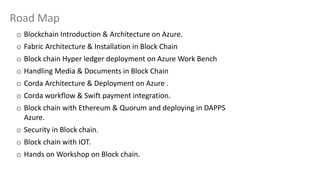
o Blockchain Introduction & Architecture on Azure.
o Fabric Architecture & Installation in Block Chain
o Block chain Hyper ledger deployment on Azure Work Bench
o Handling Media & Documents in Block Chain
o Corda Architecture & Deployment on Azure .
o Corda workflow & Swift payment integration.
o Block chain with Ethereum & Quorum and deploying in DAPPS
Azure.
o Security in Block chain.
o Block chain with IOT.
o Hands on Workshop on Block chain.
Today’s Agenda
o What is Blockchain ?
o Enterprise Blockchain Concepts
o Consensus Overview
o Security
o Blockchain Solution Architecture in Hyperledger Fabric
o Blockchain Architecture on Azure
o Demo
Technology Movement
In the last 15 years or so, we have experienced a significant
business transformation because of open-source software,
cloud, big data and artificial intelligence (AI). These are not
just buzzwords anymore because enterprises have adopted various
technologies that fall under the umbrella of these terms.
Blockchain is at the same place where the cloud and big data were
several years ago.
e:https://www.forbes.com/sites/forbestechcouncil/2018/05/14/blockchain-in-enterprises
Blockchain Disruption
Blockchain is disruptive in the same way quantum computing
will be.
You can’t ignore the beauty of decentralization and this new
way of exchanging information without involving a
middleman.
Blockchain is not cryptocurrency, and it can fit into enterprises
as a part of their enterprise solutions.
Source: https://www.forbes.com/sites/forbestechcouncil/2018/07/09/seven-ways-
advancements-in-technology-will-change-the-near-future
Industries
✓ Banking & Finance
✓ Marketplace
✓ Healthcare
✓ Supply Chain
✓ Gaming
✓ Digital Assets Platform
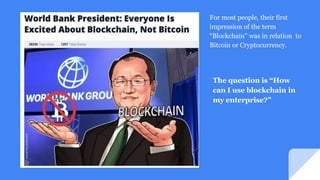
For most people, their first
impression of the term
“Blockchain” was in relation to
Bitcoin or Cryptocurrency.
The question is “How
can I use blockchain in
my enterprise?”
What is Blockchain ?
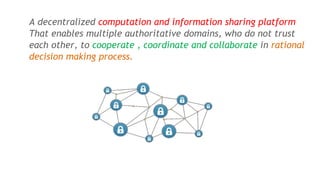
What is block chain ?A decentralized computation and information sharing platform
That enables multiple authoritative domains, who do not trust
each other, to cooperate , coordinate and collaborate in rational
decision making process.
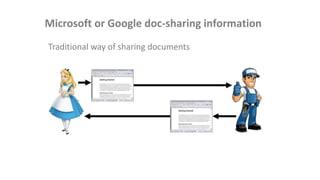
Microsoft or Google doc-sharing information
Traditional way of sharing documents
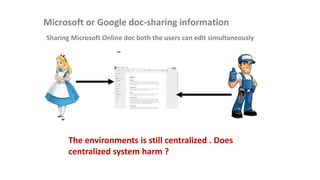
Microsoft or Google doc-sharing information
Sharing Microsoft Online doc both the users can edit simultaneously
The environments is still centralized . Does
centralized system harm ?
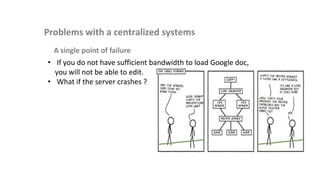
Problems with a centralized systems
A single point of failure
• If you do not have sufficient bandwidth to load Google doc,
you will not be able to edit.
• What if the server crashes ?
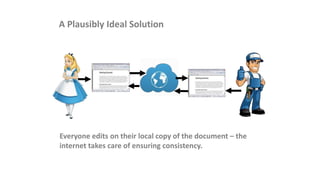
A Plausibly Ideal Solution
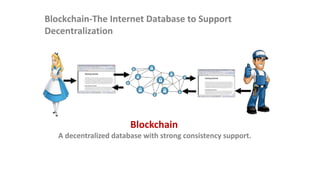
Everyone edits on their local copy of the document – the
internet takes care of ensuring consistency.
Blockchain-The Internet Database to Support
Decentralization
Blockchain
A decentralized database with strong consistency support.
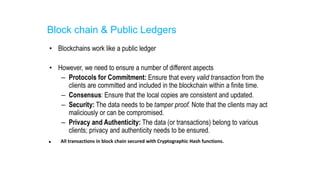
Block chain & Public Ledgers
All transactions in block chain secured with Cryptographic Hash functions.
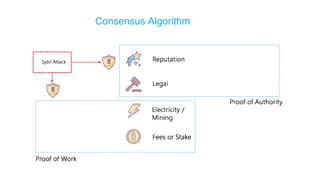
Consensus
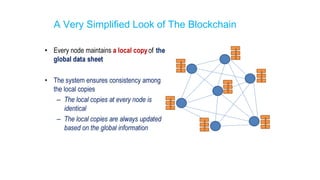
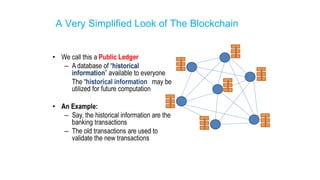
A Very Simplified Look of The Blockchain
Consensus Algorithm
Security
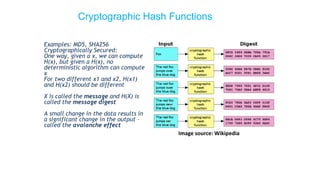
Cryptographic Hash Functions
Examples: MD5, SHA256
Cryptographically Secured:
One way, given a x, we can compute
H(x), but given a H(x), no
deterministic algorithm can compute
x
For two different x1 and x2, H(x1)
and H(x2) should be different
X is called the message and H(X) is
called the message digest
A small change in the data results in
a significant change in the output –
called the avalanche effect
Image source: Wikipedia
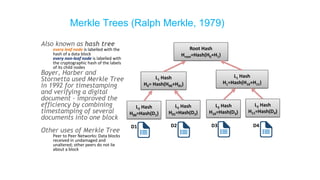
Also known as hash tree
every leaf node is labelled with the
hash of a data block
every non-leaf node is labelled with
the cryptographic hash of the labels
of its child nodes
Bayer, Harber and
Stornetta used Merkle Tree
in 1992 for timestamping
and verifying a digital
document - improved the
efficiency by combining
timestamping of several
documents into one block
Other uses of Merkle Tree
Peer to Peer Networks: Data blocks
received in undamaged and
unaltered; other peers do not lie
about a block
Merkle Trees (Ralph Merkle, 1979)
Root Hash
Hroot=Hash(H0+H1)
L1 Hash
H0= Hash(H00+H01)
L1 Hash
H1=Hash(H10+H11)
L2 Hash
H00=Hash(D1)
L2 Hash
H01=Hash(D2)
L2 Hash
H10=Hash(D3)
L2 Hash
H11=Hash(D4)
D1 D2 D3 D4
Enterprise Blockchain
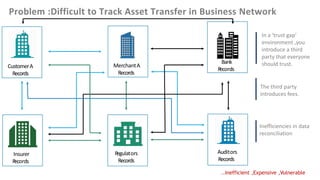
In a ‘trust gap’
environment ,you
introduce a third
party that everyone
should trust.
Problem :Difficult to Track Asset Transfer in Business Network
The third party
introduces fees.
Inefficiencies in data
reconciliation
..Inefficient ,Expensive ,Vulnerable
CustomerA
Records
Insurer
Records
Bank
Records
Regulators
Records
Auditors
Records
MerchantA
Records
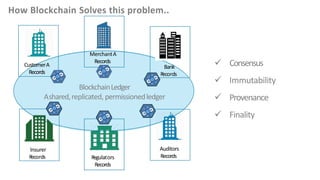
How Blockchain Solves this problem..
CustomerA
Records
Insurer
Records
Bank
Records
Regulators
Records
Auditors
Records
MerchantA
Records
BlockchainLedger
Ashared,replicated, permissionedledger
✓ Consensus
✓ Immutability
✓ Provenance
✓ Finality
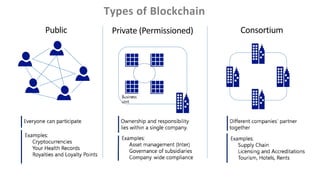
Types of Blockchain
Public Private (Permissioned) Consortium
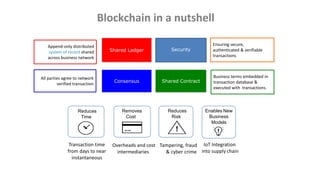
Blockchain in a nutshell
Shared Contract
Shared Ledger
Consensus
Ensuring secure,
authenticated & verifiable
transactions
Business terms embedded in
transaction database &
executed with transactions.
All parties agree to network
verified transaction
Append-only distributed
system of record shared
across business network
Security
Overheads and cost
intermediaries
Tampering, fraud
& cyber crime
Reduces
Time
Removes
Cost
Reduces
Risk
Enables New
Business
Models
IoT Integration
into supply chain
Transaction time
from days to near
instantaneous
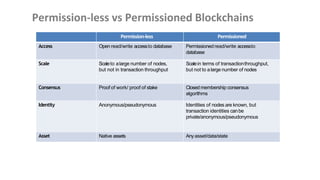
Permission-less vs Permissioned Blockchains
Permission-less Permissioned
Access Open read/write accessto database Permissionedread/write accessto
database
Scale Scaleto alarge number of nodes,
but not in transaction throughput
Scalein terms of transactionthroughput,
but not to alarge number of nodes
Consensus Proof of work/ proof of stake Closedmembership consensus
algorithms
Identity Anonymous/pseudonymous Identities of nodes are known, but
transaction identities canbe
private/anonymous/pseudonymous
Asset Native assets Anyasset/data/state
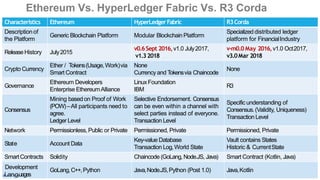
Ethereum Vs. HyperLedger Fabric Vs. R3 Corda
Characteristics Ethereum HyperLedgerFabric R3Corda
Description of
the Platform
Generic Blockchain Platform Modular BlockchainPlatform
Specialized distributed ledger
platform for FinancialIndustry
ReleaseHistory July2015
v0.6Sept 2016,v1.0 July2017,
v1.32018
v-m0.0 May 2016,v1.0 Oct2017,
v3.0Mar 2018
Crypto Currency
Ether / Tokens(Usage,Work)via
Smart Contract
None
Currency and Tokensvia Chaincode
None
Governance
Ethereum Developers
Enterprise EthereumAlliance
LinuxFoundation
IBM
R3
Consensus
Mining basedon Proof of Work
(POW)–All participants need to
agree.
Ledger Level
Selective Endorsement. Consensus
can be even within a channel with
select parties instead of everyone.
Transaction Level
Specific understanding of
Consensus.(Validity, Uniqueness)
Transaction Level
Network Permissionless, Public or Private Permissioned, Private Permissioned, Private
State Account Data
Key-value Database
Transaction Log,World State
Vault contains States
Historic & CurrentState
SmartContracts Solidity Chaincode (GoLang,Node.JS, Java) Smart Contract (Kotlin, Java)
GoLang,C++,Python Java,Node.JS,Python (Post 1.0) Java,KotlinDevelopment
01L-0a2-n20g19uages
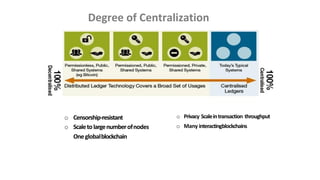
Degree of Centralization
o Censorship-resistant
o Scaletolargenumberofnodes
Oneglobalblockchain
o Privacy Scaleintransaction throughput
o Many interactingblockchains
Blockchain Solution
Architecture in
Hyperledger Fabric
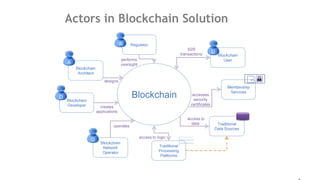
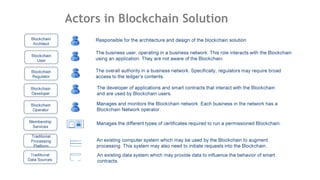
Actors in Blockchain Solution
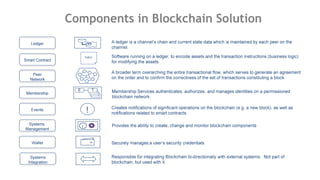
Components in Blockchain Solution
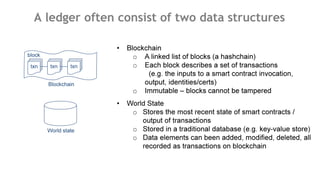
A ledger often consist of two data structures
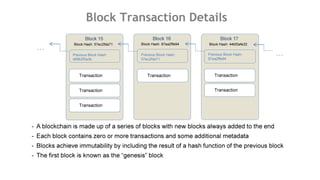
Block Transaction Details
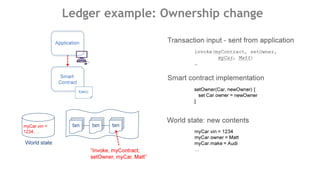
Ledger example: Ownership change
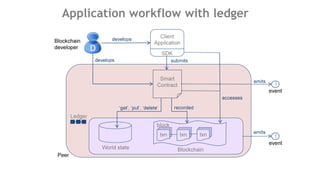
Application workflow with ledger
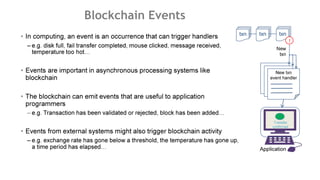
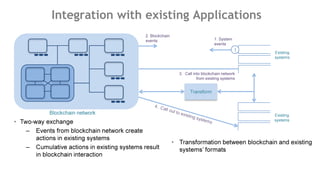
Blockchain Events
Integration with existing Applications
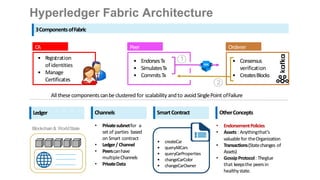
Hyperledger Fabric Architecture
Orderer
• Consensus
verification
• CreatesBlocks
CA
• Registration
ofidentities
• Manage
Certificates
Peer
• EndorsesTx
• SimulatesTx
• CommitsTx
All thesecomponentscanbeclustered for scalability andto avoidSinglePoint ofFailure
3ComponentsofFabric
Ledger
Blockchain& WorldState
• createCar
• queryAllCars
• queryCarProperties
• changeCarColor
• changeCarOwner
• EndorsementPolicies
• Assets : Anythingthat’s
valuablefor theOrganization
• Transactions(Statechanges of
Assets)
• GossipProtocol: Theglue
that keepsthe peersin
healthystate.
Channels SmartContract OtherConcepts
• Privatesubnetfor a
set of parties based
on Smart contract
• Ledger/ Channel
• Peerscanhave
multipleChannels
• PrivateData
1
2
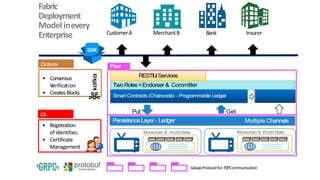
Fabric
Deployment
Modelinevery
Enterprise CustomerA MerchantB Bank Insurer
GossipProtocolfor P2PCommunication
Orderer
• Consensus
Verification
• CreatesBlocks
CA
• Registration
ofidentities.
• Certificate
Management
Blockchain Architecture
on Azure
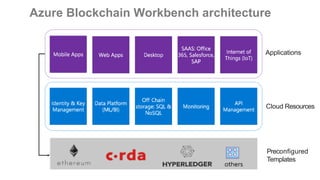
Preconfigured
Templates
Cloud Resources
Applications
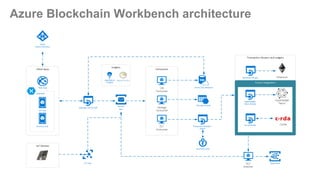
Azure Blockchain Workbench architecture
Demo
Questions?
12
ThankYou
12

Blockchin architecture azure meetup

  • 1.
    2 Mohammad Asif Waquar SeniorSoftware Engineer atABN AMRO Bank @asifwaquar BlockchainIntroduction&ArchitectureonAzure
  • 2.
    2 about me Senior SoftwareEngineer at ABN AMRO https://www.linkedin.com/in/mohammad-asif-6a6153111/
  • 3.
  • 4.
    Road Map o BlockchainIntroduction & Architecture on Azure. o Fabric Architecture & Installation in Block Chain o Block chain Hyper ledger deployment on Azure Work Bench o Handling Media & Documents in Block Chain o Corda Architecture & Deployment on Azure . o Corda workflow & Swift payment integration. o Block chain with Ethereum & Quorum and deploying in DAPPS Azure. o Security in Block chain. o Block chain with IOT. o Hands on Workshop on Block chain.
  • 5.
    Today’s Agenda o Whatis Blockchain ? o Enterprise Blockchain Concepts o Consensus Overview o Security o Blockchain Solution Architecture in Hyperledger Fabric o Blockchain Architecture on Azure o Demo
  • 6.
    Technology Movement In thelast 15 years or so, we have experienced a significant business transformation because of open-source software, cloud, big data and artificial intelligence (AI). These are not just buzzwords anymore because enterprises have adopted various technologies that fall under the umbrella of these terms. Blockchain is at the same place where the cloud and big data were several years ago. e:https://www.forbes.com/sites/forbestechcouncil/2018/05/14/blockchain-in-enterprises
  • 8.
    Blockchain Disruption Blockchain isdisruptive in the same way quantum computing will be. You can’t ignore the beauty of decentralization and this new way of exchanging information without involving a middleman. Blockchain is not cryptocurrency, and it can fit into enterprises as a part of their enterprise solutions. Source: https://www.forbes.com/sites/forbestechcouncil/2018/07/09/seven-ways- advancements-in-technology-will-change-the-near-future
  • 10.
    Industries ✓ Banking &Finance ✓ Marketplace ✓ Healthcare ✓ Supply Chain ✓ Gaming ✓ Digital Assets Platform
  • 11.
    For most people,their first impression of the term “Blockchain” was in relation to Bitcoin or Cryptocurrency. The question is “How can I use blockchain in my enterprise?”
  • 12.
  • 13.
    What is blockchain ?A decentralized computation and information sharing platform That enables multiple authoritative domains, who do not trust each other, to cooperate , coordinate and collaborate in rational decision making process.
  • 14.
    Microsoft or Googledoc-sharing information Traditional way of sharing documents
  • 15.
    Microsoft or Googledoc-sharing information Sharing Microsoft Online doc both the users can edit simultaneously The environments is still centralized . Does centralized system harm ?
  • 16.
    Problems with acentralized systems A single point of failure • If you do not have sufficient bandwidth to load Google doc, you will not be able to edit. • What if the server crashes ?
  • 17.
    A Plausibly IdealSolution Everyone edits on their local copy of the document – the internet takes care of ensuring consistency.
  • 18.
    Blockchain-The Internet Databaseto Support Decentralization Blockchain A decentralized database with strong consistency support.
  • 19.
    Block chain &Public Ledgers All transactions in block chain secured with Cryptographic Hash functions.
  • 20.
  • 21.
    A Very SimplifiedLook of The Blockchain
  • 22.
    A Very SimplifiedLook of The Blockchain
  • 23.
  • 24.
  • 25.
    Cryptographic Hash Functions Examples:MD5, SHA256 Cryptographically Secured: One way, given a x, we can compute H(x), but given a H(x), no deterministic algorithm can compute x For two different x1 and x2, H(x1) and H(x2) should be different X is called the message and H(X) is called the message digest A small change in the data results in a significant change in the output – called the avalanche effect Image source: Wikipedia
  • 26.
    Also known ashash tree every leaf node is labelled with the hash of a data block every non-leaf node is labelled with the cryptographic hash of the labels of its child nodes Bayer, Harber and Stornetta used Merkle Tree in 1992 for timestamping and verifying a digital document - improved the efficiency by combining timestamping of several documents into one block Other uses of Merkle Tree Peer to Peer Networks: Data blocks received in undamaged and unaltered; other peers do not lie about a block Merkle Trees (Ralph Merkle, 1979) Root Hash Hroot=Hash(H0+H1) L1 Hash H0= Hash(H00+H01) L1 Hash H1=Hash(H10+H11) L2 Hash H00=Hash(D1) L2 Hash H01=Hash(D2) L2 Hash H10=Hash(D3) L2 Hash H11=Hash(D4) D1 D2 D3 D4
  • 27.
  • 28.
    In a ‘trustgap’ environment ,you introduce a third party that everyone should trust. Problem :Difficult to Track Asset Transfer in Business Network The third party introduces fees. Inefficiencies in data reconciliation ..Inefficient ,Expensive ,Vulnerable CustomerA Records Insurer Records Bank Records Regulators Records Auditors Records MerchantA Records
  • 29.
    How Blockchain Solvesthis problem.. CustomerA Records Insurer Records Bank Records Regulators Records Auditors Records MerchantA Records BlockchainLedger Ashared,replicated, permissionedledger ✓ Consensus ✓ Immutability ✓ Provenance ✓ Finality
  • 30.
    Types of Blockchain PublicPrivate (Permissioned) Consortium
  • 31.
    Blockchain in anutshell Shared Contract Shared Ledger Consensus Ensuring secure, authenticated & verifiable transactions Business terms embedded in transaction database & executed with transactions. All parties agree to network verified transaction Append-only distributed system of record shared across business network Security Overheads and cost intermediaries Tampering, fraud & cyber crime Reduces Time Removes Cost Reduces Risk Enables New Business Models IoT Integration into supply chain Transaction time from days to near instantaneous
  • 32.
    Permission-less vs PermissionedBlockchains Permission-less Permissioned Access Open read/write accessto database Permissionedread/write accessto database Scale Scaleto alarge number of nodes, but not in transaction throughput Scalein terms of transactionthroughput, but not to alarge number of nodes Consensus Proof of work/ proof of stake Closedmembership consensus algorithms Identity Anonymous/pseudonymous Identities of nodes are known, but transaction identities canbe private/anonymous/pseudonymous Asset Native assets Anyasset/data/state
  • 33.
    Ethereum Vs. HyperLedgerFabric Vs. R3 Corda Characteristics Ethereum HyperLedgerFabric R3Corda Description of the Platform Generic Blockchain Platform Modular BlockchainPlatform Specialized distributed ledger platform for FinancialIndustry ReleaseHistory July2015 v0.6Sept 2016,v1.0 July2017, v1.32018 v-m0.0 May 2016,v1.0 Oct2017, v3.0Mar 2018 Crypto Currency Ether / Tokens(Usage,Work)via Smart Contract None Currency and Tokensvia Chaincode None Governance Ethereum Developers Enterprise EthereumAlliance LinuxFoundation IBM R3 Consensus Mining basedon Proof of Work (POW)–All participants need to agree. Ledger Level Selective Endorsement. Consensus can be even within a channel with select parties instead of everyone. Transaction Level Specific understanding of Consensus.(Validity, Uniqueness) Transaction Level Network Permissionless, Public or Private Permissioned, Private Permissioned, Private State Account Data Key-value Database Transaction Log,World State Vault contains States Historic & CurrentState SmartContracts Solidity Chaincode (GoLang,Node.JS, Java) Smart Contract (Kotlin, Java) GoLang,C++,Python Java,Node.JS,Python (Post 1.0) Java,KotlinDevelopment 01L-0a2-n20g19uages
  • 34.
    Degree of Centralization oCensorship-resistant o Scaletolargenumberofnodes Oneglobalblockchain o Privacy Scaleintransaction throughput o Many interactingblockchains
  • 35.
  • 36.
  • 37.
  • 38.
  • 39.
    A ledger oftenconsist of two data structures
  • 40.
  • 41.
  • 42.
  • 43.
  • 44.
  • 45.
    Hyperledger Fabric Architecture Orderer •Consensus verification • CreatesBlocks CA • Registration ofidentities • Manage Certificates Peer • EndorsesTx • SimulatesTx • CommitsTx All thesecomponentscanbeclustered for scalability andto avoidSinglePoint ofFailure 3ComponentsofFabric Ledger Blockchain& WorldState • createCar • queryAllCars • queryCarProperties • changeCarColor • changeCarOwner • EndorsementPolicies • Assets : Anythingthat’s valuablefor theOrganization • Transactions(Statechanges of Assets) • GossipProtocol: Theglue that keepsthe peersin healthystate. Channels SmartContract OtherConcepts • Privatesubnetfor a set of parties based on Smart contract • Ledger/ Channel • Peerscanhave multipleChannels • PrivateData 1 2
  • 46.
    Fabric Deployment Modelinevery Enterprise CustomerA MerchantBBank Insurer GossipProtocolfor P2PCommunication Orderer • Consensus Verification • CreatesBlocks CA • Registration ofidentities. • Certificate Management
  • 47.
  • 48.
  • 49.
  • 50.
  • 51.
  • 52.