Nested CloudStack with VMware 
Paul Angus 
Cloud Architect ShapeBlue 
paul.angus@shapeblue.com 
Twitter: @CloudyAngus
 Why – not just a science project 
@shapeblue #ccceu14 
 How 
 What (you can do with it) 
 Next steps 
Nested CloudStack with VMware
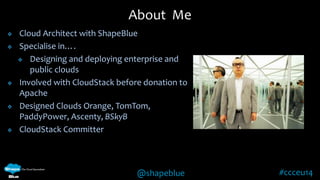
 Cloud Architect with ShapeBlue 
@shapeblue #ccceu14 
 Specialise in…. 
 Designing and deploying enterprise and 
public clouds 
 Involved with CloudStack before donation to 
Apache 
 Designed Clouds Orange, TomTom, 
PaddyPower, Ascenty, BSkyB 
 CloudStack Committer 
About Me
About ShapeBlue 
“ShapeBlue are expert builders of public & 
private clouds. They are the leading global 
Apache CloudStack 
integrator & consultancy” 
@shapeblue #ccceu14
Nested CloudStack with VMware 
Why? 
@shapeblue #ccceu14
@shapeblue #ccceu14 
CEO 
Why 
“Building CloudStack 
environments using CloudStack? 
Are you just having fun?”
Why 
Talented Cloud Architect 
“If we can automate the 
building of environments 
including the networking, and 
generate any topology we 
want quickly, we can achieve 
the tasks that I’ve highlighted 
in these slides that I have with 
me, just in case you asked.” 
@shapeblue #ccceu14 
“Building CloudStack 
environments using CloudStack? 
Are you just having fun?”
Why 
@shapeblue #ccceu14 
CEO 
“That would be excellent. 
Go ahead. 
Oh, and here’s a pay rise” 
building of environments 
including the networking, and 
generate any topology we 
want quickly, we can achieve 
the tasks that I’ve highlighted 
in these slides that I have with 
me, just in case you asked.”
Why? 
@shapeblue #ccceu14 
Client: 
“We have a large global multi-zone public deployment, which we need to 
upgrade. Upgrade requires all virtual routers to be restarted. Virtual router 
restarts need to be done in phases (due to time zones). We need to know 
what the users will experience while CloudStack has been upgraded but 
the virtual routers have not be restarted. We also want to know if the 
latency between some zones will be an issue during the upgrade. 
No, we don’t have a couple of dozen hosts that you can use”
@shapeblue #ccceu14 
Test/Dev 
Need to be able to create full environments to test: 
 CloudStack release candidates 
 CloudStack features 
 ShapeBlue patches 
Why
Why? 
@shapeblue #ccceu14 
Training 
 Bootcamp runs in Virtualbox – limited by amount of RAM and cores in laptops 
 We can’t use KVM or ESXi hosts because no HVM support for guests.
Why? 
@shapeblue #ccceu14 
Client Demos 
 Need to create demo environments to show features
Nested CloudStack with VMware 
How 
@shapeblue #ccceu14
Nested Hypervisors 
 Nested virtualisation has been possible in ESXi since 4.1 with some hacking 
(editing /etc/vmware/config and changing the CPU IDs) if the CPU supported 
VT-x or AMD-V 
 Since 5.1 nested virtualisation more powerful with the introduction of support 
for 2nd generation hardware virtualisation within processors. Extended Page 
Tables (EPT) from Intel (Nehalem onwards) or Rapid Virtualization (RV) from 
AMD (0x10 Barcelona onwards) 
 Still not supported for production loads 
@shapeblue #ccceu14
Nested Hypervisors 
@shapeblue #ccceu14 
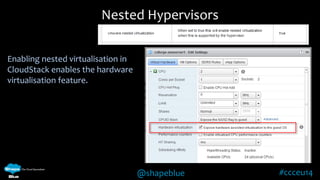
Enabling nested virtualisation in 
CloudStack enables the hardware 
virtualisation feature.
Networking 
 Trunking VLANs no problem with vSwitches/bridges on any hypervisor 
 Portgroup/vSwitch need to be set to promiscuous mode to nest network 
@shapeblue #ccceu14 
interfaces. 
 To create a hypervisor VM purely in CloudStack we need to add a network 
interface which can use a range of VLANs for the guest VLANs 
 But within CloudStack you can only map one VLAN to any network
Networking 
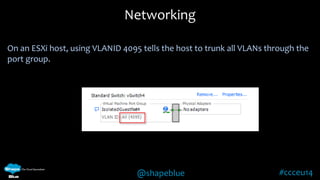
On an ESXi host, using VLANID 4095 tells the host to trunk all VLANs through the 
port group. 
@shapeblue #ccceu14
Guest Networks 
@shapeblue #ccceu14 
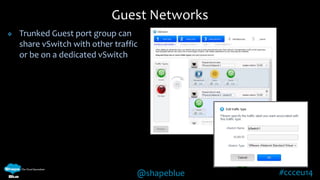
 Trunked Guest port group can 
share vSwitch with other traffic 
or be on a dedicated vSwitch
Shared Guest Networks 
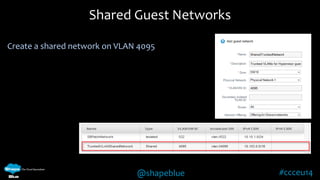
Create a shared network on VLAN 4095 
@shapeblue #ccceu14
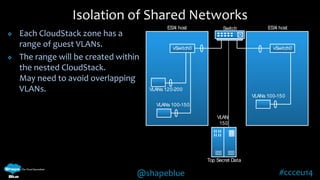
Isolation of Shared Networks 
ESXi host Switch 
VLAN 
150 
ESXi host 
vSwitch0 
@shapeblue #ccceu14 
 Each CloudStack zone has a 
range of guest VLANs. 
 The range will be created within 
the nested CloudStack. 
May need to avoid overlapping 
VLANs. 
vSwitch0 
VLANs 100-150 
Top Secret Data 
VLANs 100-150 
VLANs 120-200
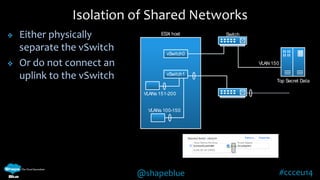
Isolation of Shared Networks 
vSwitch0 
VLAN 150 
@shapeblue #ccceu14 
 Either physically 
separate the vSwitch 
 Or do not connect an 
uplink to the vSwitch 
vSwitch1 
VLANs 100-150 
Top Secret Data 
ESXi host Switch 
VLANs 151-200
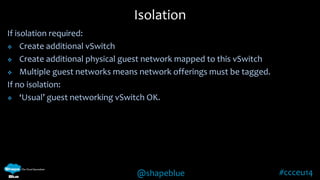
Isolation 
@shapeblue #ccceu14 
If isolation required: 
 Create additional vSwitch 
 Create additional physical guest network mapped to this vSwitch 
 Multiple guest networks means network offerings must be tagged. 
If no isolation: 
 ‘Usual’ guest networking vSwitch OK.
@shapeblue #ccceu14 
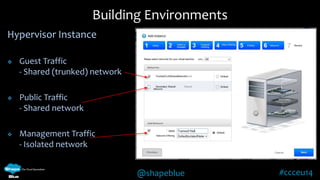
Hypervisor Instance 
 Guest Traffic 
- Shared (trunked) network 
 Public Traffic 
- Shared network 
 Management Traffic 
- Isolated network 
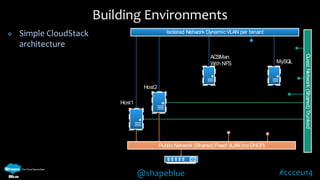
Building Environments
Isolated Network Dynamic VLAN per tenant 
@shapeblue #ccceu14 
 Simple CloudStack 
architecture 
Building Environments 
Host1 
Host2 
ACSMan 
With NFS MySQL 
Public Network (Shared) Fixed VLAN (no DHCP) 
Guest Network (Shared) Trunked
Nested CloudStack with VMware 
What 
(you can do with it) 
@shapeblue #ccceu14
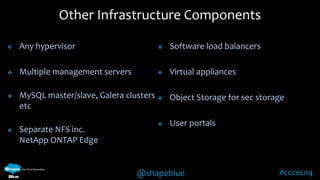
Other Infrastructure Components 
@shapeblue #ccceu14 
 Any hypervisor 
 Multiple management servers 
 MySQL master/slave, Galera clusters 
etc 
 Separate NFS inc. 
NetApp ONTAP Edge 
 Software load balancers 
 Virtual appliances 
 Object Storage for sec storage 
 User portals
@shapeblue #ccceu14 
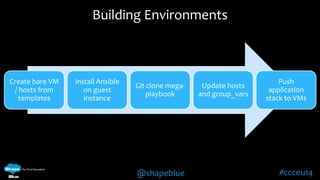
Create bare VM 
/ hosts from 
templates 
Install Ansible 
on guest 
instance 
Git clone mega-playbook 
Update hosts 
and group_vars 
Push 
application 
stack to VMs 
Building Environments
Building Environments 
@shapeblue #ccceu14 
Hypervisor Builds 
 ESXi – multiple templates as cold standby 
 XenServer – deployed from template: 
 Reset installation_uuid, state.db and control_domain_uuid 
 Recreate network interfaces and storage devices 
 KVM – Base OS then push cloudstack-agent 
 Windows vCenter - multiple templates as cold standby
MySQL 
Slave 
@shapeblue #ccceu14 
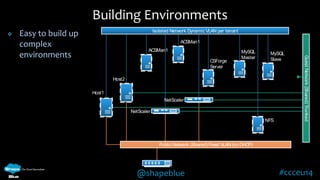
 Easy to build up 
complex 
environments 
Building Environments 
Host1 
Host2 
ACSMan1 
MySQL 
Master 
Isolated Network Dynamic VLAN per tenant 
Public Network (Shared) Fixed VLAN (no DHCP) 
Guest Network (Shared) Trunked 
NFS 
ACSMan1 
NetScaler 
NetScaler 
CSForge 
Server
MySQL 
MySQL 
@shapeblue #ccceu14 
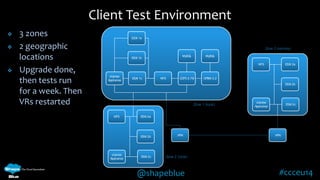
 3 zones 
 2 geographic 
locations 
 Upgrade done, 
then tests run 
for a week. Then 
VRs restarted 
Client Test Environment 
CCP3.0.7B 
CPBM 2.2 
ESXi 1a 
ESXi 1b 
ESXi 1c 
vCenter 
Appliance 
ESXi 2a 
ESXi 2b 
ESXi 2c 
vCenter 
Appliance 
Zone 1 (local) 
Zone 2 (local) 
Zone 3 (remote) 
NFS 
NFS 
VPN VPN 
ESXi 2a 
ESXi 2b 
ESXi 2c 
NFS 
vCenter 
Appliance
What you can do with it 
@shapeblue #ccceu14 
Test Dev 
 Automate the building of entire environments to test releases, features and 
patches against. 
Client Demos 
 Need to create demo environments to show features
@shapeblue #ccceu14 
Training 
 Hosted training in environments containing all hypervisors with a full 
infrastructure. 
What you can do with it
Nested CloudStack with VMware 
Next Steps 
@shapeblue #ccceu14
Nested CloudStack with VMware 
@shapeblue #ccceu14 
Next steps: 
 Automated build of Windows VMs 
 Bootstrapped build of ESXi hosts. 
 Using AWS module to provision VMs 
 CloudStack module 
 Dynamic inventories
Nested CloudStack with VMware 
Paul Angus 
Cloud Architect ShapeBlue 
paul.angus@shapeblue.com 
Twitter: @CloudyAngus

Nested CloudStack with VMware

  • 1.
    Nested CloudStack withVMware Paul Angus Cloud Architect ShapeBlue paul.angus@shapeblue.com Twitter: @CloudyAngus
  • 2.
     Why –not just a science project @shapeblue #ccceu14  How  What (you can do with it)  Next steps Nested CloudStack with VMware
  • 3.
     Cloud Architectwith ShapeBlue @shapeblue #ccceu14  Specialise in….  Designing and deploying enterprise and public clouds  Involved with CloudStack before donation to Apache  Designed Clouds Orange, TomTom, PaddyPower, Ascenty, BSkyB  CloudStack Committer About Me
  • 4.
    About ShapeBlue “ShapeBlueare expert builders of public & private clouds. They are the leading global Apache CloudStack integrator & consultancy” @shapeblue #ccceu14
  • 6.
    Nested CloudStack withVMware Why? @shapeblue #ccceu14
  • 7.
    @shapeblue #ccceu14 CEO Why “Building CloudStack environments using CloudStack? Are you just having fun?”
  • 8.
    Why Talented CloudArchitect “If we can automate the building of environments including the networking, and generate any topology we want quickly, we can achieve the tasks that I’ve highlighted in these slides that I have with me, just in case you asked.” @shapeblue #ccceu14 “Building CloudStack environments using CloudStack? Are you just having fun?”
  • 9.
    Why @shapeblue #ccceu14 CEO “That would be excellent. Go ahead. Oh, and here’s a pay rise” building of environments including the networking, and generate any topology we want quickly, we can achieve the tasks that I’ve highlighted in these slides that I have with me, just in case you asked.”
  • 10.
    Why? @shapeblue #ccceu14 Client: “We have a large global multi-zone public deployment, which we need to upgrade. Upgrade requires all virtual routers to be restarted. Virtual router restarts need to be done in phases (due to time zones). We need to know what the users will experience while CloudStack has been upgraded but the virtual routers have not be restarted. We also want to know if the latency between some zones will be an issue during the upgrade. No, we don’t have a couple of dozen hosts that you can use”
  • 11.
    @shapeblue #ccceu14 Test/Dev Need to be able to create full environments to test:  CloudStack release candidates  CloudStack features  ShapeBlue patches Why
  • 12.
    Why? @shapeblue #ccceu14 Training  Bootcamp runs in Virtualbox – limited by amount of RAM and cores in laptops  We can’t use KVM or ESXi hosts because no HVM support for guests.
  • 13.
    Why? @shapeblue #ccceu14 Client Demos  Need to create demo environments to show features
  • 14.
    Nested CloudStack withVMware How @shapeblue #ccceu14
  • 15.
    Nested Hypervisors Nested virtualisation has been possible in ESXi since 4.1 with some hacking (editing /etc/vmware/config and changing the CPU IDs) if the CPU supported VT-x or AMD-V  Since 5.1 nested virtualisation more powerful with the introduction of support for 2nd generation hardware virtualisation within processors. Extended Page Tables (EPT) from Intel (Nehalem onwards) or Rapid Virtualization (RV) from AMD (0x10 Barcelona onwards)  Still not supported for production loads @shapeblue #ccceu14
  • 16.
    Nested Hypervisors @shapeblue#ccceu14 Enabling nested virtualisation in CloudStack enables the hardware virtualisation feature.
  • 17.
    Networking  TrunkingVLANs no problem with vSwitches/bridges on any hypervisor  Portgroup/vSwitch need to be set to promiscuous mode to nest network @shapeblue #ccceu14 interfaces.  To create a hypervisor VM purely in CloudStack we need to add a network interface which can use a range of VLANs for the guest VLANs  But within CloudStack you can only map one VLAN to any network
  • 18.
    Networking On anESXi host, using VLANID 4095 tells the host to trunk all VLANs through the port group. @shapeblue #ccceu14
  • 19.
    Guest Networks @shapeblue#ccceu14  Trunked Guest port group can share vSwitch with other traffic or be on a dedicated vSwitch
  • 20.
    Shared Guest Networks Create a shared network on VLAN 4095 @shapeblue #ccceu14
  • 21.
    Isolation of SharedNetworks ESXi host Switch VLAN 150 ESXi host vSwitch0 @shapeblue #ccceu14  Each CloudStack zone has a range of guest VLANs.  The range will be created within the nested CloudStack. May need to avoid overlapping VLANs. vSwitch0 VLANs 100-150 Top Secret Data VLANs 100-150 VLANs 120-200
  • 22.
    Isolation of SharedNetworks vSwitch0 VLAN 150 @shapeblue #ccceu14  Either physically separate the vSwitch  Or do not connect an uplink to the vSwitch vSwitch1 VLANs 100-150 Top Secret Data ESXi host Switch VLANs 151-200
  • 23.
    Isolation @shapeblue #ccceu14 If isolation required:  Create additional vSwitch  Create additional physical guest network mapped to this vSwitch  Multiple guest networks means network offerings must be tagged. If no isolation:  ‘Usual’ guest networking vSwitch OK.
  • 24.
    @shapeblue #ccceu14 HypervisorInstance  Guest Traffic - Shared (trunked) network  Public Traffic - Shared network  Management Traffic - Isolated network Building Environments
  • 25.
    Isolated Network DynamicVLAN per tenant @shapeblue #ccceu14  Simple CloudStack architecture Building Environments Host1 Host2 ACSMan With NFS MySQL Public Network (Shared) Fixed VLAN (no DHCP) Guest Network (Shared) Trunked
  • 26.
    Nested CloudStack withVMware What (you can do with it) @shapeblue #ccceu14
  • 27.
    Other Infrastructure Components @shapeblue #ccceu14  Any hypervisor  Multiple management servers  MySQL master/slave, Galera clusters etc  Separate NFS inc. NetApp ONTAP Edge  Software load balancers  Virtual appliances  Object Storage for sec storage  User portals
  • 28.
    @shapeblue #ccceu14 Createbare VM / hosts from templates Install Ansible on guest instance Git clone mega-playbook Update hosts and group_vars Push application stack to VMs Building Environments
  • 29.
    Building Environments @shapeblue#ccceu14 Hypervisor Builds  ESXi – multiple templates as cold standby  XenServer – deployed from template:  Reset installation_uuid, state.db and control_domain_uuid  Recreate network interfaces and storage devices  KVM – Base OS then push cloudstack-agent  Windows vCenter - multiple templates as cold standby
  • 30.
    MySQL Slave @shapeblue#ccceu14  Easy to build up complex environments Building Environments Host1 Host2 ACSMan1 MySQL Master Isolated Network Dynamic VLAN per tenant Public Network (Shared) Fixed VLAN (no DHCP) Guest Network (Shared) Trunked NFS ACSMan1 NetScaler NetScaler CSForge Server
  • 31.
    MySQL MySQL @shapeblue#ccceu14  3 zones  2 geographic locations  Upgrade done, then tests run for a week. Then VRs restarted Client Test Environment CCP3.0.7B CPBM 2.2 ESXi 1a ESXi 1b ESXi 1c vCenter Appliance ESXi 2a ESXi 2b ESXi 2c vCenter Appliance Zone 1 (local) Zone 2 (local) Zone 3 (remote) NFS NFS VPN VPN ESXi 2a ESXi 2b ESXi 2c NFS vCenter Appliance
  • 32.
    What you cando with it @shapeblue #ccceu14 Test Dev  Automate the building of entire environments to test releases, features and patches against. Client Demos  Need to create demo environments to show features
  • 33.
    @shapeblue #ccceu14 Training  Hosted training in environments containing all hypervisors with a full infrastructure. What you can do with it
  • 34.
    Nested CloudStack withVMware Next Steps @shapeblue #ccceu14
  • 35.
    Nested CloudStack withVMware @shapeblue #ccceu14 Next steps:  Automated build of Windows VMs  Bootstrapped build of ESXi hosts.  Using AWS module to provision VMs  CloudStack module  Dynamic inventories
  • 36.
    Nested CloudStack withVMware Paul Angus Cloud Architect ShapeBlue paul.angus@shapeblue.com Twitter: @CloudyAngus

Editor's Notes

  • #7 About to show a conversation – names have been taken out.
  • #10 Some of that might actually have happened.
  • #11 More than just a science project This is a real client request. What will they see when they try to create a network Will they be able to create new firewall rules
  • #13 Limited RAM limits the number of VMs we can create and can’t use KVM or ESXi hosts because no HVM support for guests.
  • #14 Want to see it’s worth their while investing further. But want admin access.
  • #22 If you’re working in an environment where you have full control of all VLANs – OK If not – hosted labs – have to isolate the vSwitches Because guest networks could be created with any VLAN range
  • #24 Explain isolation later
  • #25 To get consistency create VM using API without starting the VM, then add the NICs in order, then start VM.
  • #32 Zone 3 – truly remote (latency issues during upgrade) Controlled VR reboots
  • #33 Test official CloudStack releases and features and ShapeBlue patches