Introduction to
Group members
Faiza Farrukh
Anam Munir
Atiqa Ishtiaq
Ayesha Bibi
Ethics
involves the set of rules that society
have agreed about living with other people for
minimums, which are human rights.
Bioethics
• Bioethics is a branch of ethics, which is the
interdisciplinary study of problems created by
biological and medical progress (micro and
macrosocial level), and its impact in society
and value system, both for now and for the
future.
The birth of bioethics
• Bioethics was preceded by medical ethics, which
focused primarily on issues arising out of the
physician–patient relationship.
• The ancient Hippocratic literature (which includes
but is not limited to the Hippocratic Oath) enjoins
doctors to use their knowledge and powers to
benefit the sick, to heal and not to harm, to
preserve life, and to keep in the strictest
confidence information that ought not to be
spread about (though precisely what must be
kept confidential is not detailed).
• These basic values and principles remain an
essential part of contemporary bioethics.
• After the Second World War it became clear
that the old medical ethics was not sufficient
to meet contemporary challenges.
Bioethics defined
• In the Introduction to the 1995 revised edition
of the Encyclopedia of Bioethics, Warren
Thomas Reich,defined bioethics as
• “the systematic study of the moral
dimensions—including moral vision, decisions,
conduct, and policies—of the life sciences and
health care, employing a variety of ethical
methodologies in an interdisciplinary setting.”
The Coining of the Term ‘Bioethics
The word bioethics was coined in the early 1970s
by biologists in order to encourage public and
professional reflection on two topics of urgency:
• 1) The responsibility to maintain the generative
ecology of the planet, upon which life and human
life depends
• 2) The future implications of rapid advances in
the life sciences with regard to potential
modifications of a malleable human nature
Bioethical theories
by
Anam Munir
Defination
Ethical theory means by
which we justify a particular
ethical descision
Deontologism-duty ethics
• Greek; deontos: that which is
binding,right,proper;deon-theory.
• Emphasis on universal imperatives such moral
laws,duties,obligations,prohibitions.
• It is sometimes also called imperativism.
• It looks on one's duties and obligations in
determining what is ethical.
• It is also known as Duty Ethics.
• An ethical act is the one that meets
obligations,responsibilities and duties.
Utilitarianism-Greatest Happiness Principle
• The greatest happiness of the greatest number
is the test of right and wrong.
• Action is good if it produces as much or more
good than the alternative behaviour.
• What is useful is good and consequently.
• the ethical value of conduct is determined by
the utility of its results.
• No action is instrinsically right,moral or good.
• Choose the action the produce the most
benefits and least cost of pain and
unhappiness.
Principle of utility
• By utility,we mean property in any
object,whereby it tends to produce
benefit,advantage ,pleasure or happiness
• By preventing pain,evil or unhappiness to
happen.
• it is also called
Principle of Greatest Happiness
- An actionis good as it produces the greatest
happiness for greatest number of people,and
bad it produces more harm than benefit for
the greatest number of individuals.
• Happiness for Bentham and Mill is intrinsic
good.
• Happiness is intended pleasure and absence
of pain.
• Pain- unhappiness
• Pleasure-calculus of Bentham
Pleasure-pain calculus
• Intensity
The more intense the pleasure,the better.
• Duration
the longer it lasts,the better
• Purity
the pure the pleasure,the better
• Extent
the grater the number of benefited,the better
• Presented by
Atiqa ishtiaq
Principles of Bioethics
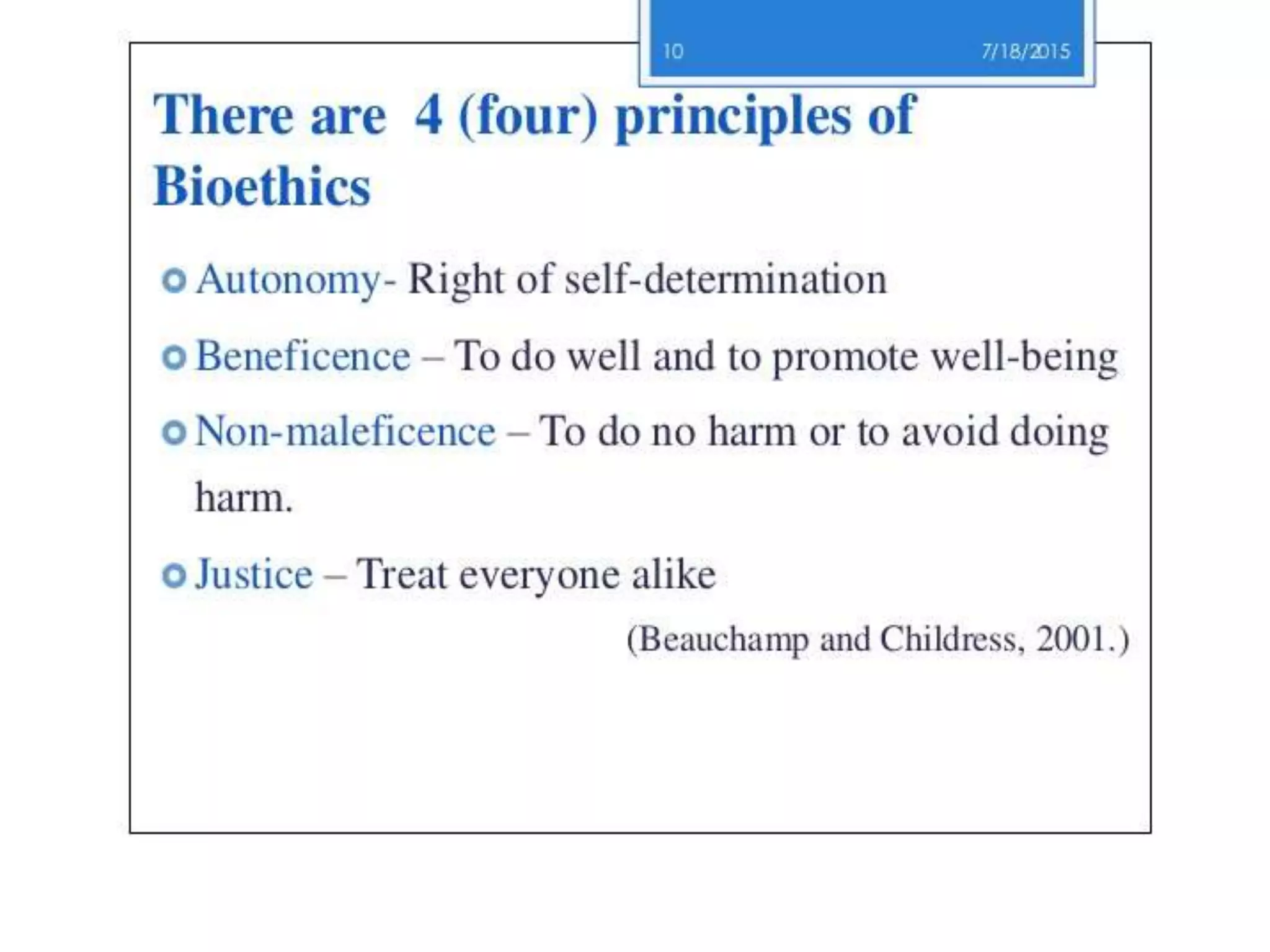
• In bioethics they are four basic principles and
they were proposed by Beaucham and
Childress (1979):
• Autonomy
• Beneficence
• Non maleficence
• Justice
Grouping of principles
• Minimum levels:
obligations that generate universal
duties and these involve negative transitive
duties (facts that you cannot do other people).
Here, there are principles of no maleficence
and justice.
Continue…..
• Maximum levels:
they are related with the choice
of the vital project that every person choose
to depend on their scale of values. They
generate imperfect obligations. Here, there
are principles of autonomy and beneficence.
PRINCIPLE OF AUTONOMY
Actions are only autonomous when it exists:
• Intentionality
• Knowledge (it is essential)
• Not external control (there are not pressures)
• Authenticity (coherence with system of values
and usual attitudes of the person)
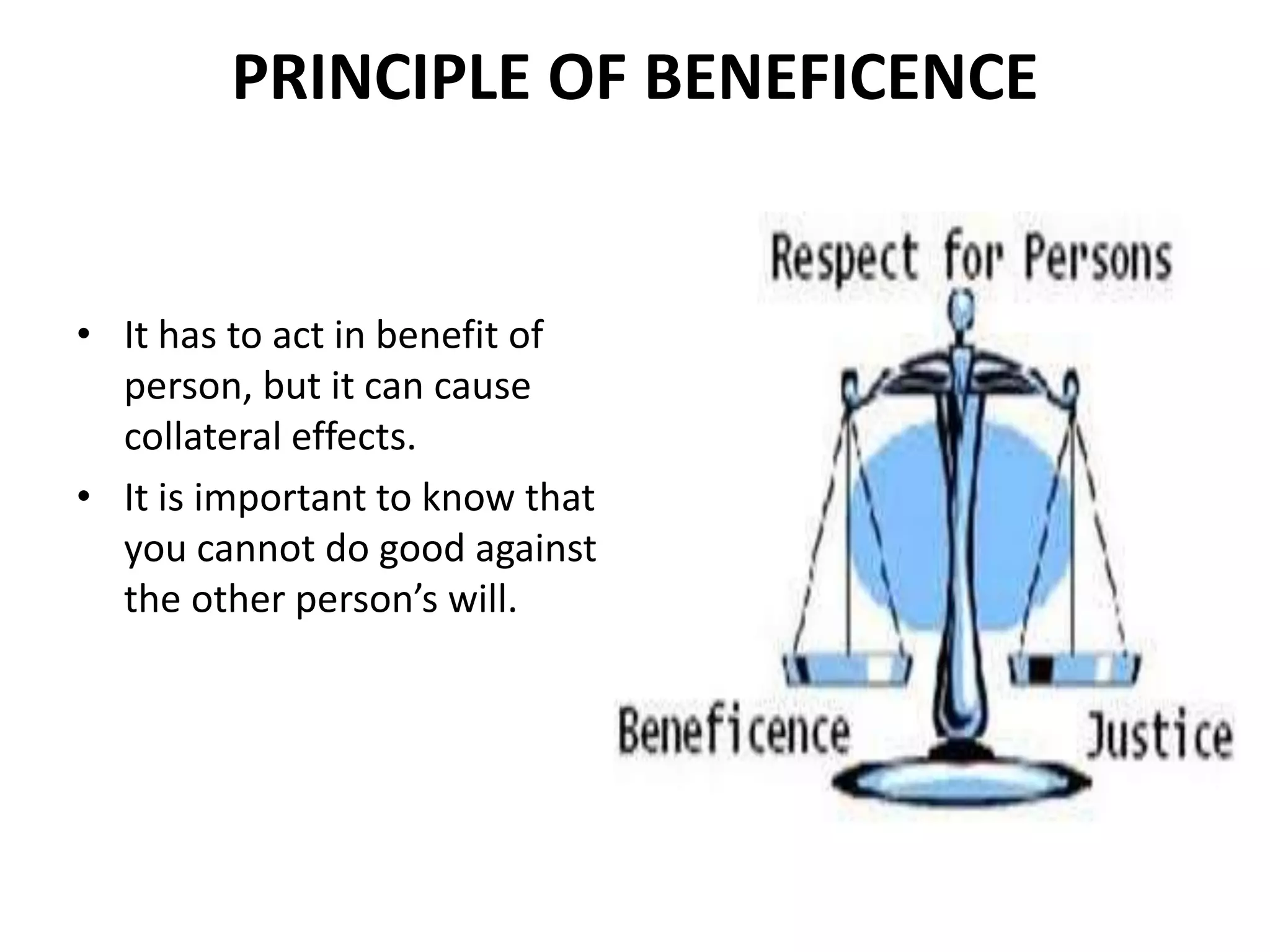
PRINCIPLE OF BENEFICENCE
• It has to act in benefit of
person, but it can cause
collateral effects.
• It is important to know that
you cannot do good against
the other person’s will.
PRINCIPLE OF NO MALEFICENCY
• You cannot harm unnecessary other people.
Damage can be avoided not acting, with a
passive attitude. However, good has done with
active attitude.
• If someone asks you, you cannot do damage.
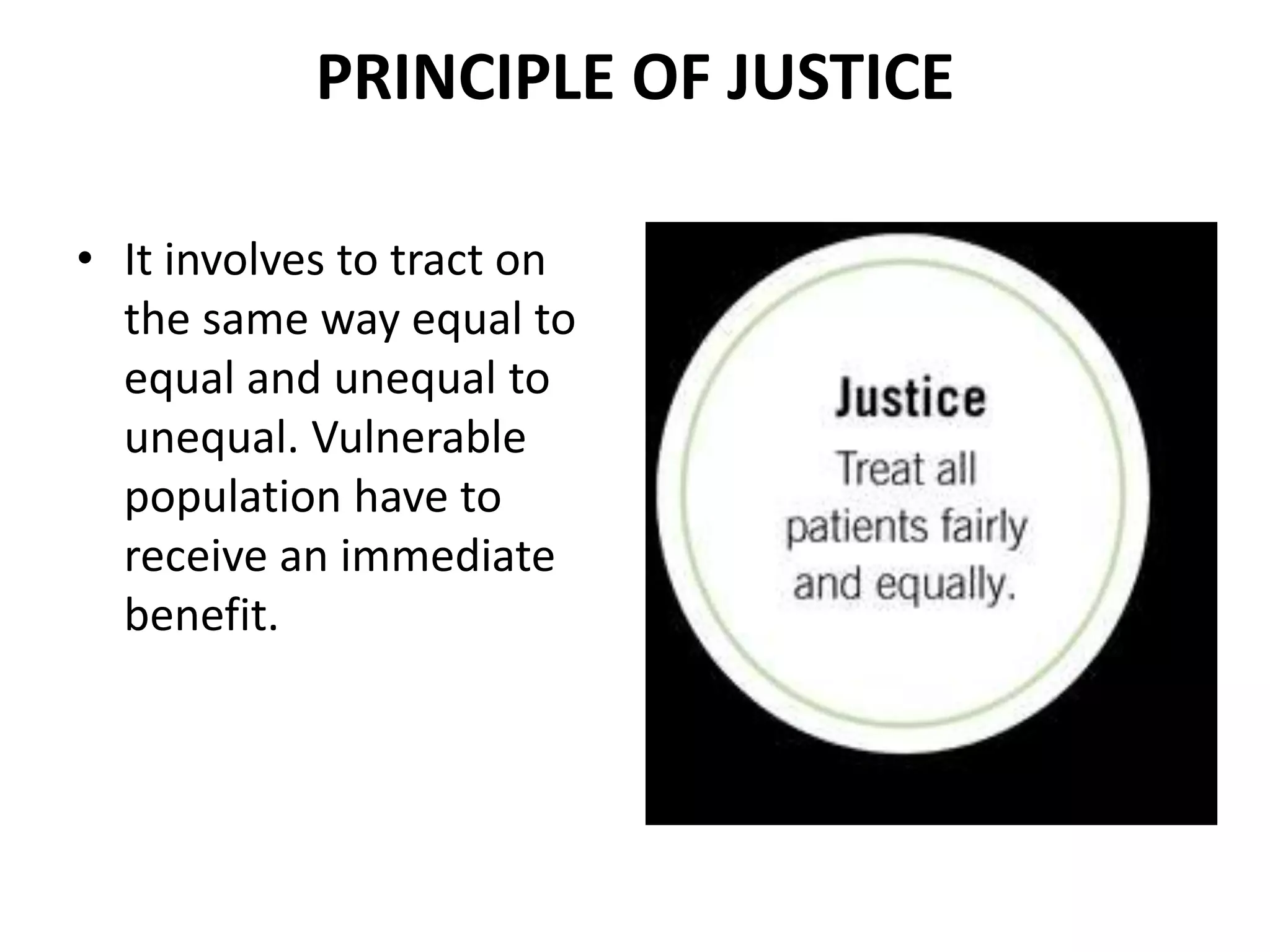
PRINCIPLE OF JUSTICE
• It involves to tract on
the same way equal to
equal and unequal to
unequal. Vulnerable
population have to
receive an immediate
benefit.
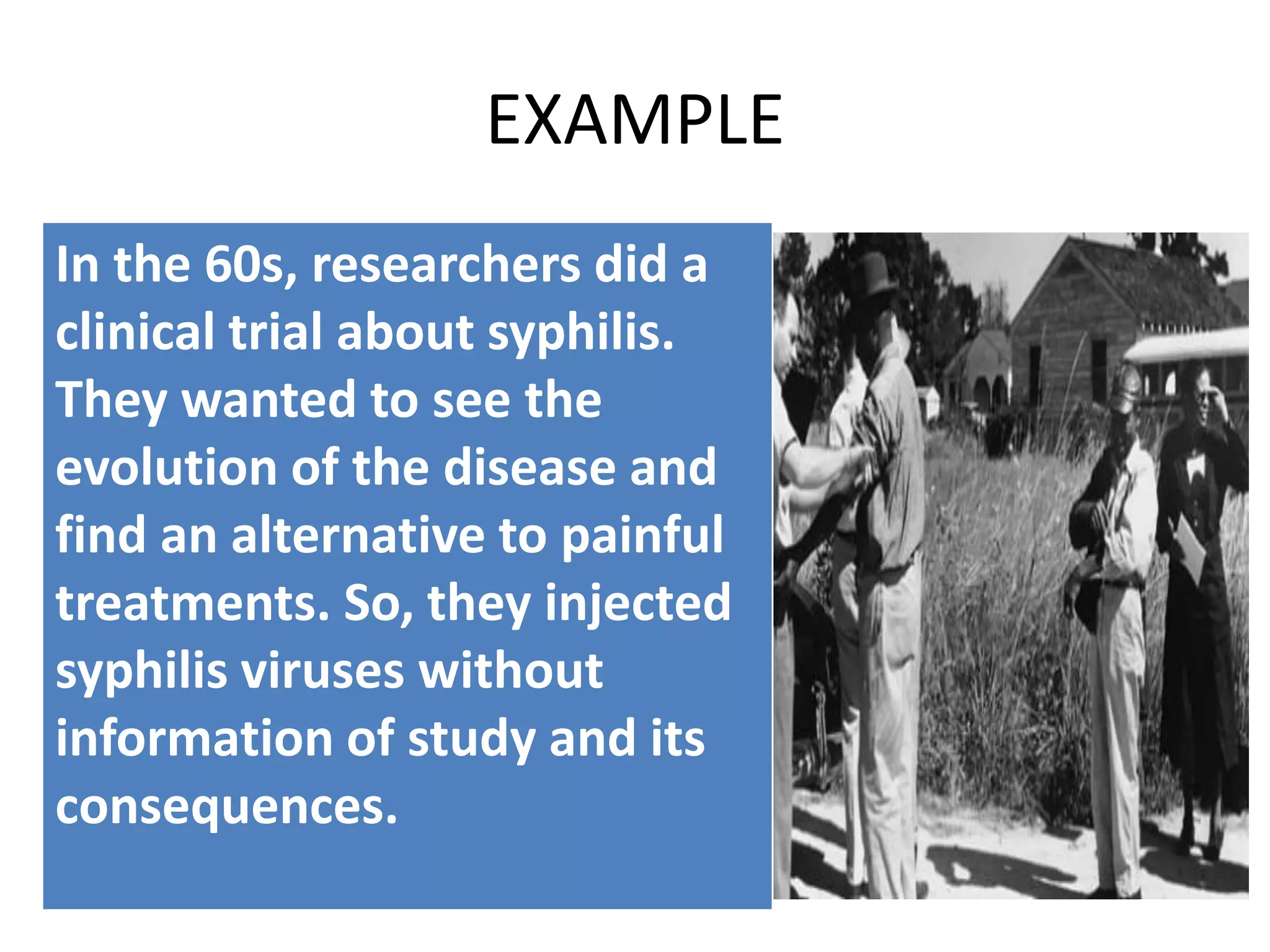
EXAMPLE
In the 60s, researchers did a
clinical trial about syphilis.
They wanted to see the
evolution of the disease and
find an alternative to painful
treatments. So, they injected
syphilis viruses without
information of study and its
consequences.
OTHER IMPORTANT PRINCIPLES
• Principle of proportionality.
• Caution: based on analysis of risks.
• Principle of non-discrimination: all persons
who must be treated equally.
• Principle of respect for the right to
information.

Introduction to bioethics

  • 1.
  • 2.
    Group members Faiza Farrukh AnamMunir Atiqa Ishtiaq Ayesha Bibi
  • 3.
    Ethics involves the setof rules that society have agreed about living with other people for minimums, which are human rights.
  • 4.
    Bioethics • Bioethics isa branch of ethics, which is the interdisciplinary study of problems created by biological and medical progress (micro and macrosocial level), and its impact in society and value system, both for now and for the future.
  • 5.
    The birth ofbioethics • Bioethics was preceded by medical ethics, which focused primarily on issues arising out of the physician–patient relationship. • The ancient Hippocratic literature (which includes but is not limited to the Hippocratic Oath) enjoins doctors to use their knowledge and powers to benefit the sick, to heal and not to harm, to preserve life, and to keep in the strictest confidence information that ought not to be spread about (though precisely what must be kept confidential is not detailed).
  • 6.
    • These basicvalues and principles remain an essential part of contemporary bioethics. • After the Second World War it became clear that the old medical ethics was not sufficient to meet contemporary challenges.
  • 7.
    Bioethics defined • Inthe Introduction to the 1995 revised edition of the Encyclopedia of Bioethics, Warren Thomas Reich,defined bioethics as • “the systematic study of the moral dimensions—including moral vision, decisions, conduct, and policies—of the life sciences and health care, employing a variety of ethical methodologies in an interdisciplinary setting.”
  • 8.
    The Coining ofthe Term ‘Bioethics The word bioethics was coined in the early 1970s by biologists in order to encourage public and professional reflection on two topics of urgency: • 1) The responsibility to maintain the generative ecology of the planet, upon which life and human life depends • 2) The future implications of rapid advances in the life sciences with regard to potential modifications of a malleable human nature
  • 9.
  • 10.
    Defination Ethical theory meansby which we justify a particular ethical descision
  • 11.
    Deontologism-duty ethics • Greek;deontos: that which is binding,right,proper;deon-theory. • Emphasis on universal imperatives such moral laws,duties,obligations,prohibitions. • It is sometimes also called imperativism.
  • 12.
    • It lookson one's duties and obligations in determining what is ethical. • It is also known as Duty Ethics. • An ethical act is the one that meets obligations,responsibilities and duties.
  • 13.
    Utilitarianism-Greatest Happiness Principle •The greatest happiness of the greatest number is the test of right and wrong. • Action is good if it produces as much or more good than the alternative behaviour.
  • 14.
    • What isuseful is good and consequently. • the ethical value of conduct is determined by the utility of its results. • No action is instrinsically right,moral or good. • Choose the action the produce the most benefits and least cost of pain and unhappiness.
  • 15.
    Principle of utility •By utility,we mean property in any object,whereby it tends to produce benefit,advantage ,pleasure or happiness • By preventing pain,evil or unhappiness to happen.
  • 16.
    • it isalso called Principle of Greatest Happiness - An actionis good as it produces the greatest happiness for greatest number of people,and bad it produces more harm than benefit for the greatest number of individuals.
  • 17.
    • Happiness forBentham and Mill is intrinsic good. • Happiness is intended pleasure and absence of pain. • Pain- unhappiness • Pleasure-calculus of Bentham
  • 18.
    Pleasure-pain calculus • Intensity Themore intense the pleasure,the better. • Duration the longer it lasts,the better • Purity the pure the pleasure,the better • Extent the grater the number of benefited,the better
  • 19.
  • 20.
    Principles of Bioethics •In bioethics they are four basic principles and they were proposed by Beaucham and Childress (1979): • Autonomy • Beneficence • Non maleficence • Justice
  • 22.
    Grouping of principles •Minimum levels: obligations that generate universal duties and these involve negative transitive duties (facts that you cannot do other people). Here, there are principles of no maleficence and justice.
  • 23.
    Continue….. • Maximum levels: theyare related with the choice of the vital project that every person choose to depend on their scale of values. They generate imperfect obligations. Here, there are principles of autonomy and beneficence.
  • 24.
    PRINCIPLE OF AUTONOMY Actionsare only autonomous when it exists: • Intentionality • Knowledge (it is essential) • Not external control (there are not pressures) • Authenticity (coherence with system of values and usual attitudes of the person)
  • 25.
    PRINCIPLE OF BENEFICENCE •It has to act in benefit of person, but it can cause collateral effects. • It is important to know that you cannot do good against the other person’s will.
  • 26.
    PRINCIPLE OF NOMALEFICENCY • You cannot harm unnecessary other people. Damage can be avoided not acting, with a passive attitude. However, good has done with active attitude. • If someone asks you, you cannot do damage.
  • 27.
    PRINCIPLE OF JUSTICE •It involves to tract on the same way equal to equal and unequal to unequal. Vulnerable population have to receive an immediate benefit.
  • 28.
    EXAMPLE In the 60s,researchers did a clinical trial about syphilis. They wanted to see the evolution of the disease and find an alternative to painful treatments. So, they injected syphilis viruses without information of study and its consequences.
  • 29.
    OTHER IMPORTANT PRINCIPLES •Principle of proportionality. • Caution: based on analysis of risks. • Principle of non-discrimination: all persons who must be treated equally. • Principle of respect for the right to information.