What is Bioethics?
 Now often known as medical ethics or
clinical ethics – hospital based issues
 Philosophical study of ethical issues
brought about by advances in scientific and
medical technologies
 Bioethical dilemmas arise when different
parties, albeit all well-meaning, hold
divergent values that lead to opposing
viewpoints on appropriate actions
Common Bioethical Issues
 Disagreements between family and clinicians
regarding the patient/resident’s best interest
 Living at risk (eating, wandering, falling)
 Deciding appropriate forms of care
 Determining legitimate level of restraint
 Determining patient preferences without clear
instructions (Terri Schiavo)
 Providing services that take up tremendous
resource (e.g., multiple transplants)
History of Bioethics
 Started as concerns regarding research ethics
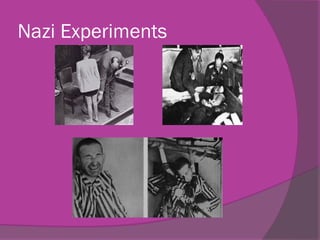
 Nuremberg Doctors’ Trial -- 23 German physicians
who either participated in the Nazi program to
euthanize persons deemed "unworthy of life“ or
who conducted experiments on concentration
camp prisoners without their consent were tried.
The trial lasted 140 days. 85 witnesses testified
and almost 1,500 documents were introduced. 16
of the doctors charged were found guilty. 7 were
executed.
Nazi Experiments
The Nuremberg Code (1947)
 Voluntary consent
 Anticipate scientific benefits
 Benefits outweigh risks
 Animal experiments first
 Avoid suffering
 No intentional death or disability
 Protection from harm
 Subject free to stop / withdraw
 Qualified investigators
 Investigator will stop if harm occurs
History of Bioethics
 The distinct academic field began in the 1960s in
the United States
 Philosophers and theologians were later joined
by physician-ethicists and lawyers
 Scientific advances coupled with cultural changes
 New emphasis on individual autonomy and rights
– suspicion of medical paternalism
 Focused on individual research participant and
patient
What Were Founding Bioethicists
Studying?
 Normative ethics – formulation and defense
of basic principles, values, virtues, and ideals
governing moral behaviour
 Descriptive ethics – factual descriptions of
moral behaviour and belief systems
 Analytic approach – discerning meanings of
life, concepts of rights/justice/fairness, etc.
 Balancing ethical principles
 Shift from the greatest good to individual rights
Major Principles in Bioethics
 Tom Beauchamp and James Childress’s
Principles of Biomedical Ethics:
 Non-maleficence and Beneficence
○ Utilitarian – harm-benefit analysis
○ do no harm
○ best interest standard
 Autonomy
○ respect for one’s rights and dignity
○ informed and voluntary consent
 Justice
○ fairness
○ caring for the most vulnerable
How Bioethics Have Evolved
 Feminist critique
 Social structure and power hierarchy
 Concerns of medicalization
 Significance of social relationships
 Multiculturalism and perceived homogeneity
among bioethicists
 Care ethics -- justice reconfigured
 Relational autonomy
How Bioethics Have Evolved
(Continued)
 Disability critique
 Vulnerability and dependency as human
conditions
 Meanings of “normal” and a “good” life
 Medical vs social model
 Cure vs social acceptance
 Social contexts affect individual decisions
 Meaning of autonomy challenged
Current Focus in Bioethics
 Branches – biomedical/clinical ethics,
research ethics, organizational ethics
 Genetics
 Brain imaging technologies
 Multiculturalism
 End-of-life care
 Aging
 Health-care resource allocation
Systematic Approach in Resolving Dilemmas
 Finding thoughtful and rational justification for our
beliefs and decisions
 More than intuitive responses – ask why we may
have certain intuitions, and how to manage
conflicting intuitions
 Systematic approach can help to identify
essential elements to ethical decision-making,
ease pressure, and promote consistency in
resolving dilemmas
Issues to Consider in Approaching Dilemmas
 Define and identify the ethical dilemma
 Clarify the facts and identify stakeholders –
what’s known and what’s not?
 Medical indications
○ Diagnosis, prognosis, treatments or medication
history, other clinical options, etc.
 Patient/Resident/Family (PRF) preferences
○ Advance directives, code status, goals of care, etc.
 Quality of life
○ The PR’s subjective evaluation of his or her situation
 Contextual factors
○ Social contexts, family situation, cultural/religious
values, financial situation, etc.
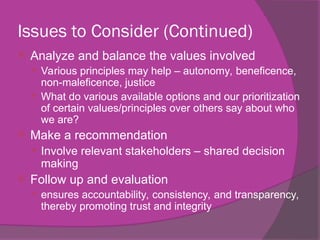
Issues to Consider (Continued)
 Analyze and balance the values involved
 Various principles may help – autonomy, beneficence,
non-maleficence, justice
 What do various available options and our prioritization
of certain values/principles over others say about who
we are?
 Make a recommendation
 Involve relevant stakeholders – shared decision
making
 Follow up and evaluation
 ensures accountability, consistency, and transparency,
thereby promoting trust and integrity
INDIVIDUAL ACTIVITY
 In a clean sheet of paper, write your name, year,
date, signature. Write an essay about the
following:
 1) Your favorite bioethical dilemma that you want to be
tackled in this class. Give your positions/views about
it.
 2) What is your expectation in this Bioethics class
 Take a photo of your output, copy paste it in this file and
then turn it in to your class representative. DO NOT
POST IT IN COMMENT SECTION, MESSENGER,
GROUP CHAT.
 Submit on or before March 3, 2023, 5 pm.

Introduction to Bioethics march 2023 2.ppt

  • 2.
    What is Bioethics? Now often known as medical ethics or clinical ethics – hospital based issues  Philosophical study of ethical issues brought about by advances in scientific and medical technologies  Bioethical dilemmas arise when different parties, albeit all well-meaning, hold divergent values that lead to opposing viewpoints on appropriate actions
  • 3.
    Common Bioethical Issues Disagreements between family and clinicians regarding the patient/resident’s best interest  Living at risk (eating, wandering, falling)  Deciding appropriate forms of care  Determining legitimate level of restraint  Determining patient preferences without clear instructions (Terri Schiavo)  Providing services that take up tremendous resource (e.g., multiple transplants)
  • 4.
    History of Bioethics Started as concerns regarding research ethics  Nuremberg Doctors’ Trial -- 23 German physicians who either participated in the Nazi program to euthanize persons deemed "unworthy of life“ or who conducted experiments on concentration camp prisoners without their consent were tried. The trial lasted 140 days. 85 witnesses testified and almost 1,500 documents were introduced. 16 of the doctors charged were found guilty. 7 were executed.
  • 5.
  • 6.
    The Nuremberg Code(1947)  Voluntary consent  Anticipate scientific benefits  Benefits outweigh risks  Animal experiments first  Avoid suffering  No intentional death or disability  Protection from harm  Subject free to stop / withdraw  Qualified investigators  Investigator will stop if harm occurs
  • 7.
    History of Bioethics The distinct academic field began in the 1960s in the United States  Philosophers and theologians were later joined by physician-ethicists and lawyers  Scientific advances coupled with cultural changes  New emphasis on individual autonomy and rights – suspicion of medical paternalism  Focused on individual research participant and patient
  • 8.
    What Were FoundingBioethicists Studying?  Normative ethics – formulation and defense of basic principles, values, virtues, and ideals governing moral behaviour  Descriptive ethics – factual descriptions of moral behaviour and belief systems  Analytic approach – discerning meanings of life, concepts of rights/justice/fairness, etc.  Balancing ethical principles  Shift from the greatest good to individual rights
  • 9.
    Major Principles inBioethics  Tom Beauchamp and James Childress’s Principles of Biomedical Ethics:  Non-maleficence and Beneficence ○ Utilitarian – harm-benefit analysis ○ do no harm ○ best interest standard  Autonomy ○ respect for one’s rights and dignity ○ informed and voluntary consent  Justice ○ fairness ○ caring for the most vulnerable
  • 10.
    How Bioethics HaveEvolved  Feminist critique  Social structure and power hierarchy  Concerns of medicalization  Significance of social relationships  Multiculturalism and perceived homogeneity among bioethicists  Care ethics -- justice reconfigured  Relational autonomy
  • 11.
    How Bioethics HaveEvolved (Continued)  Disability critique  Vulnerability and dependency as human conditions  Meanings of “normal” and a “good” life  Medical vs social model  Cure vs social acceptance  Social contexts affect individual decisions  Meaning of autonomy challenged
  • 12.
    Current Focus inBioethics  Branches – biomedical/clinical ethics, research ethics, organizational ethics  Genetics  Brain imaging technologies  Multiculturalism  End-of-life care  Aging  Health-care resource allocation
  • 13.
    Systematic Approach inResolving Dilemmas  Finding thoughtful and rational justification for our beliefs and decisions  More than intuitive responses – ask why we may have certain intuitions, and how to manage conflicting intuitions  Systematic approach can help to identify essential elements to ethical decision-making, ease pressure, and promote consistency in resolving dilemmas
  • 14.
    Issues to Considerin Approaching Dilemmas  Define and identify the ethical dilemma  Clarify the facts and identify stakeholders – what’s known and what’s not?  Medical indications ○ Diagnosis, prognosis, treatments or medication history, other clinical options, etc.  Patient/Resident/Family (PRF) preferences ○ Advance directives, code status, goals of care, etc.  Quality of life ○ The PR’s subjective evaluation of his or her situation  Contextual factors ○ Social contexts, family situation, cultural/religious values, financial situation, etc.
  • 15.
    Issues to Consider(Continued)  Analyze and balance the values involved  Various principles may help – autonomy, beneficence, non-maleficence, justice  What do various available options and our prioritization of certain values/principles over others say about who we are?  Make a recommendation  Involve relevant stakeholders – shared decision making  Follow up and evaluation  ensures accountability, consistency, and transparency, thereby promoting trust and integrity
  • 16.
    INDIVIDUAL ACTIVITY  Ina clean sheet of paper, write your name, year, date, signature. Write an essay about the following:  1) Your favorite bioethical dilemma that you want to be tackled in this class. Give your positions/views about it.  2) What is your expectation in this Bioethics class  Take a photo of your output, copy paste it in this file and then turn it in to your class representative. DO NOT POST IT IN COMMENT SECTION, MESSENGER, GROUP CHAT.  Submit on or before March 3, 2023, 5 pm.

Editor's Notes

  • #2 Bioethics is the study of typically controversial ethics brought about by advances in biology and medicine. It is also moral discernment as it relates to medical policy, practice, and research