1
Majed H. Mohammed Ph.D.
Scientific Research Center
Faculty of Science
Duhok, Kurdistan, Iraq
Common Challenges on
Biosafety and Bioethics
Basics of BioSafety
This lesson will define and present information on
methods used to provide biosafety in facilities
where potentially infectious agents are used.
These include:
 Containment
 Biological safety cabinets
 Personal protection equipment
 The facility as barrier
 Secondary barriers
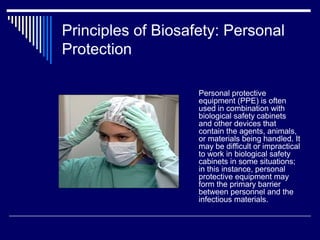
Principles of Biosafety: Personal
Protection
Personal protective
equipment (PPE) is often
used in combination with
biological safety cabinets
and other devices that
contain the agents, animals,
or materials being handled. It
may be difficult or impractical
to work in biological safety
cabinets in some situations;
in this instance, personal
protective equipment may
form the primary barrier
between personnel and the
infectious materials.
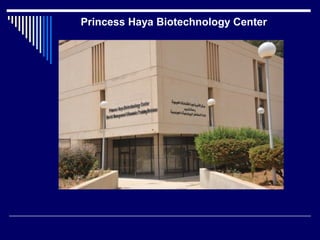
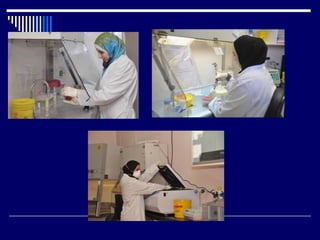
Princess Haya Biotechnology Center
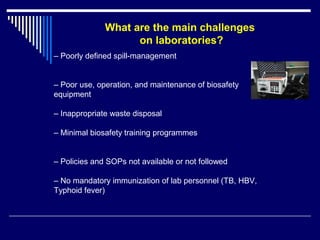
– Poorly defined spill-management
– Poor use, operation, and maintenance of biosafety
equipment
– Inappropriate waste disposal
– Minimal biosafety training programmes
– Policies and SOPs not available or not followed
– No mandatory immunization of lab personnel (TB, HBV,
Typhoid fever)
What are the main challenges
on laboratories?
Needs and Recommendations
Awareness raising on Biosafety and
Biosecurity
There is need for guidelines and clear
regulations on Biorisk management
including , SOPs, hazardous Waste
management
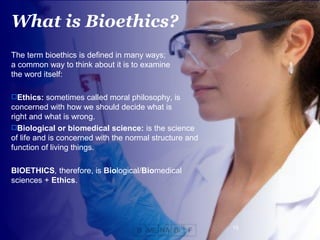
What is Bioethics?
The term bioethics is defined in many ways;
a common way to think about it is to examine
the word itself:
Ethics: sometimes called moral philosophy, is
concerned with how we should decide what is
right and what is wrong.
Biological or biomedical science: is the science
of life and is concerned with the normal structure and
function of living things.
BIOETHICS, therefore, is Biological/Biomedical
sciences + Ethics.
15
What is “ethical” research?
Based on Diener and Chandall (1978) we can
say that behaving ethically means:
No harm should come to research participants,
They should agree to participate and know what
the research is about,
Their privacy should not be invaded,
They should not be lied or cheated.
Why is it important?
The prohibition against fabricating in the
research data and promote the truth and
avoid error.
Ethical standards promote the values
that are essential to collaborative work,
such as trust, accountability, mutual
respect, and fairness
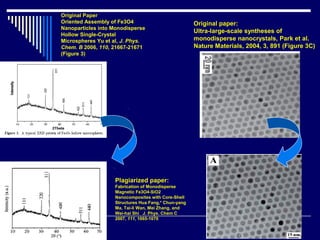
Original Paper
Oriented Assembly of Fe3O4
Nanoparticles into Monodisperse
Hollow Single-Crystal
Microspheres Yu et al, J. Phys.
Chem. B 2006, 110, 21667-21671
(Figure 3)
Plagiarized paper:
Fabrication of Monodisperse
Magnetic Fe3O4-SiO2
Nanocomposites with Core-Shell
Structures Hua Fang,* Chun-yang
Ma, Tai-li Wan, Mei Zhang, and
Wei-hai Shi J. Phys. Chem C
2007, 111, 1065-1070
Original paper:
Ultra-large-scale syntheses of
monodisperse nanocrystals, Park et al.
Nature Materials, 2004, 3, 891 (Figure 3C)
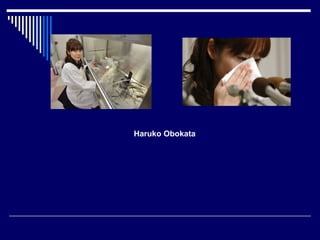
Haruko Obokata
Biosafety and bioethics

Biosafety and bioethics

  • 1.
    1 Majed H. MohammedPh.D. Scientific Research Center Faculty of Science Duhok, Kurdistan, Iraq Common Challenges on Biosafety and Bioethics
  • 3.
    Basics of BioSafety Thislesson will define and present information on methods used to provide biosafety in facilities where potentially infectious agents are used. These include:  Containment  Biological safety cabinets  Personal protection equipment  The facility as barrier  Secondary barriers
  • 6.
    Principles of Biosafety:Personal Protection Personal protective equipment (PPE) is often used in combination with biological safety cabinets and other devices that contain the agents, animals, or materials being handled. It may be difficult or impractical to work in biological safety cabinets in some situations; in this instance, personal protective equipment may form the primary barrier between personnel and the infectious materials.
  • 9.
  • 11.
    – Poorly definedspill-management – Poor use, operation, and maintenance of biosafety equipment – Inappropriate waste disposal – Minimal biosafety training programmes – Policies and SOPs not available or not followed – No mandatory immunization of lab personnel (TB, HBV, Typhoid fever) What are the main challenges on laboratories?
  • 12.
  • 13.
    Awareness raising onBiosafety and Biosecurity There is need for guidelines and clear regulations on Biorisk management including , SOPs, hazardous Waste management
  • 15.
    What is Bioethics? Theterm bioethics is defined in many ways; a common way to think about it is to examine the word itself: Ethics: sometimes called moral philosophy, is concerned with how we should decide what is right and what is wrong. Biological or biomedical science: is the science of life and is concerned with the normal structure and function of living things. BIOETHICS, therefore, is Biological/Biomedical sciences + Ethics. 15
  • 16.
    What is “ethical”research? Based on Diener and Chandall (1978) we can say that behaving ethically means: No harm should come to research participants, They should agree to participate and know what the research is about, Their privacy should not be invaded, They should not be lied or cheated.
  • 17.
    Why is itimportant? The prohibition against fabricating in the research data and promote the truth and avoid error. Ethical standards promote the values that are essential to collaborative work, such as trust, accountability, mutual respect, and fairness
  • 18.
    Original Paper Oriented Assemblyof Fe3O4 Nanoparticles into Monodisperse Hollow Single-Crystal Microspheres Yu et al, J. Phys. Chem. B 2006, 110, 21667-21671 (Figure 3) Plagiarized paper: Fabrication of Monodisperse Magnetic Fe3O4-SiO2 Nanocomposites with Core-Shell Structures Hua Fang,* Chun-yang Ma, Tai-li Wan, Mei Zhang, and Wei-hai Shi J. Phys. Chem C 2007, 111, 1065-1070 Original paper: Ultra-large-scale syntheses of monodisperse nanocrystals, Park et al. Nature Materials, 2004, 3, 891 (Figure 3C)
  • 19.