Ethics
What do youknow about ethics?
Why is it more important to consider ethics in the pandemic?
https://youtu.be/VJ_s51QGbg8
https://youtu.be/4vWXpzlL7Mo
Meta- ethics
https://youtu.be/FOoffXFpAlU
4.
COVID19 and ethics
https://youtu.be/nYrP14BhMXg
1)Is it OKAY to disclose information about an infected person?
2) Ethics about social distancing/movement restriction?
3) Are the medical professional ethically bound to work in an unsafe environment?
4) Allocation of resources: who should be tested? Who should be treated?
Ethics
A branch ofphilosophy that ask the practical questions on:
What should we live?
What choices should we make?
What makes our lives worth living?
Provides a framework for understanding and interpreting what’s
right and wrong in the society
7.
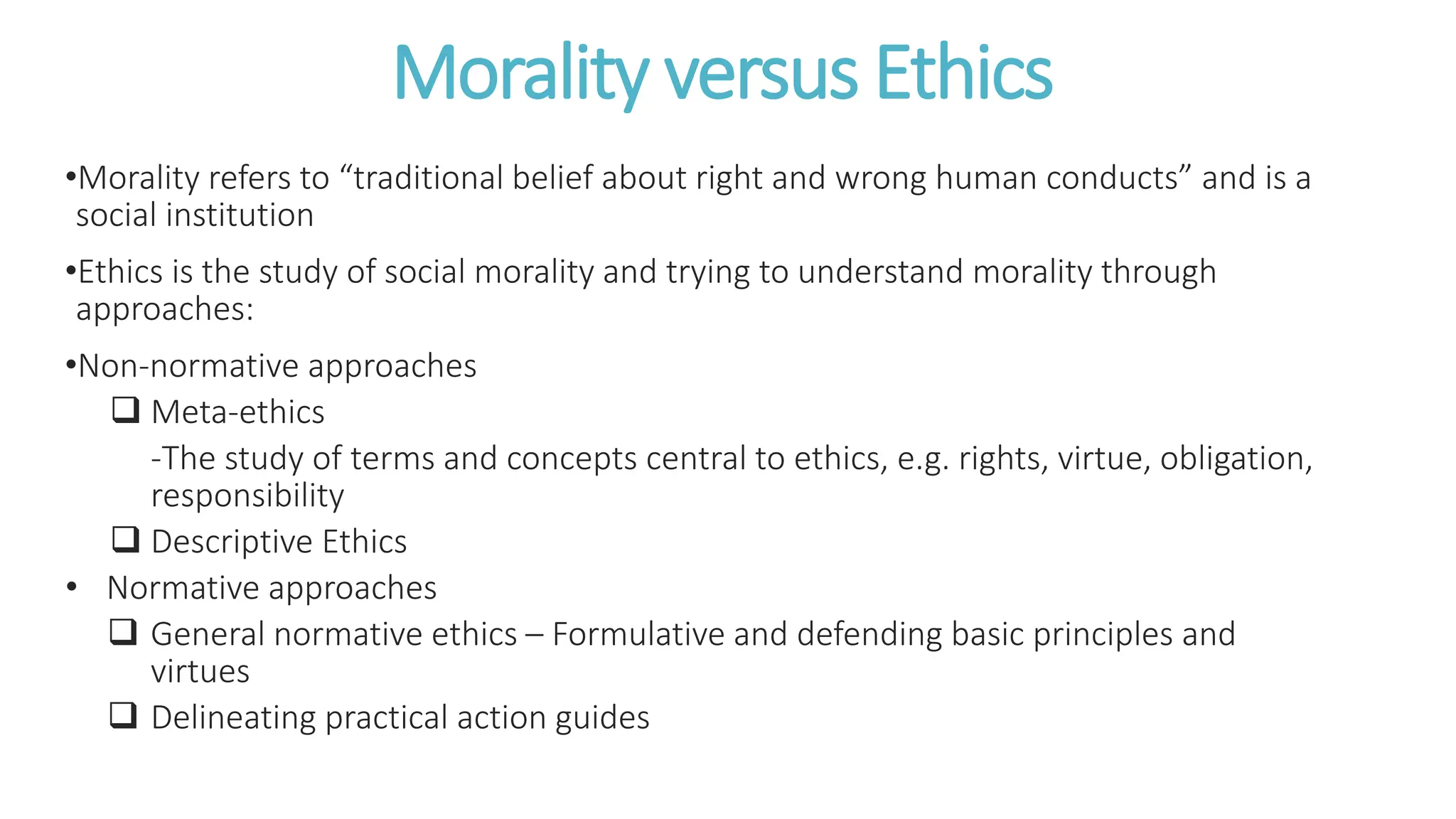
Morality versus Ethics
•Moralityrefers to “traditional belief about right and wrong human conducts” and is a
social institution
•Ethics is the study of social morality and trying to understand morality through
approaches:
•Non-normative approaches
Meta-ethics
-The study of terms and concepts central to ethics, e.g. rights, virtue, obligation,
responsibility
Descriptive Ethics
• Normative approaches
General normative ethics – Formulative and defending basic principles and
virtues
Delineating practical action guides
Working in MoralPhilosophy
•Facts and Values
•What is the case and what ought to be the case
• The so-called Is/Ought problem
• How to move from “is” to “ought”?
• Resolving moral disagreements
• Facts matter
• Definition matter
• Agreeing on a common set of moral guidelines (codes)
• Examples and counterexamples
• Analysis of arguments
10.
Ethical Theories
Classic Theories
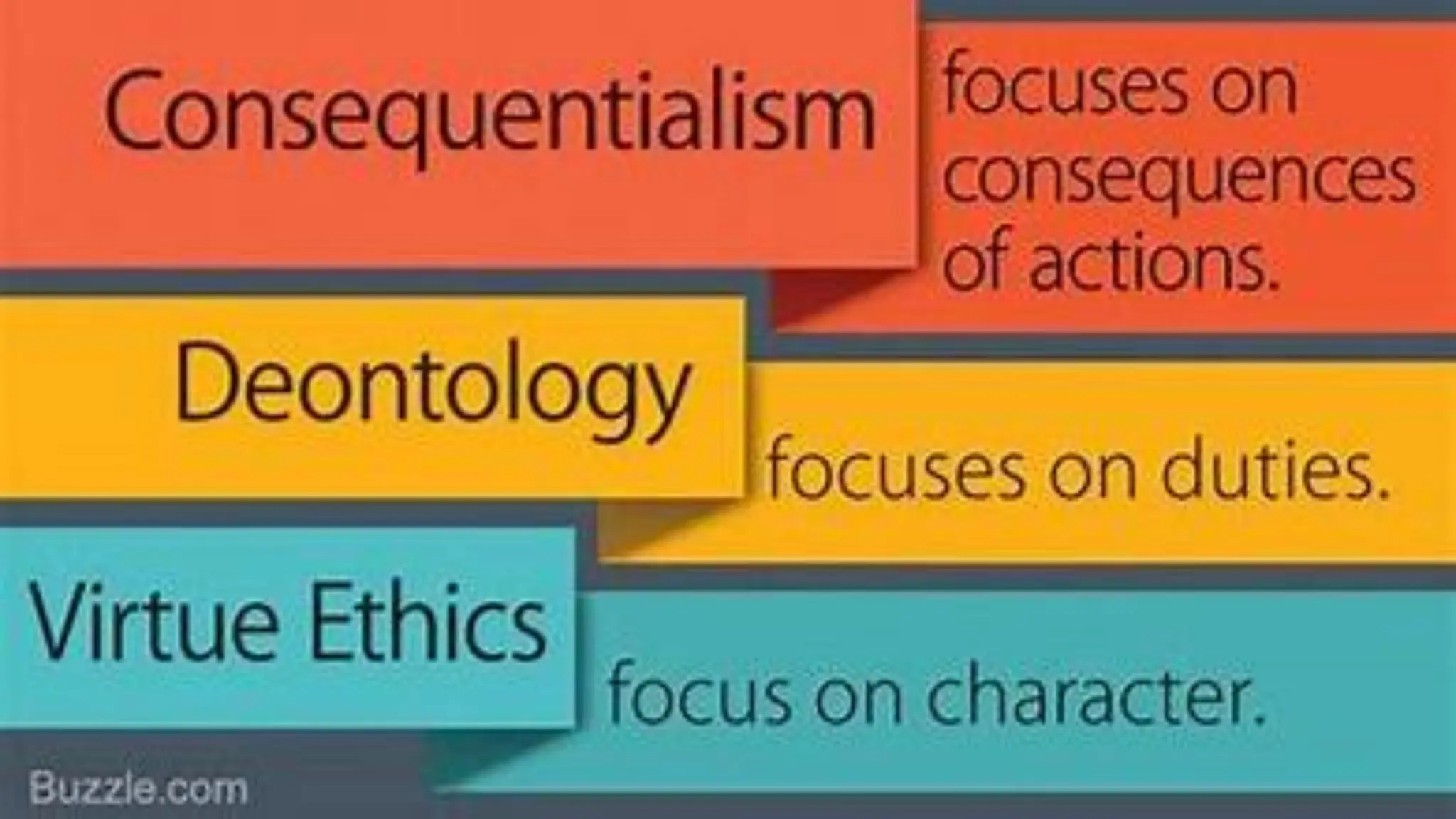
1)Virtue Theory
• Actions governed by good character
2) Deontological (Kantian)
• Actions governed by duties (“deon”)
• Kant’s categorical imperative
-universal duties
-including never treat another person as a mere means to the ends of another
-who counts as a person, and what are mere means
3) Consequentialism
• Action guided by outcomes (consequences)
• Utilitarianism (Mills and others)
• Acts are good (right) if they create the greatest utility
• Acts are good (right) if they serve the role of utility; the greatest good to the greatest number
11.
Virtue Ethics
• Aristotle(384-322 B.C.)
• The highest aims of life are living well through virtue and the pursuit of
eudaimonia, that feeling of well being or happiness, or living one’s best
life, flourishing and thriving instead of mere existing.
• In Nicomachean Ethics, Aristotle discusses the cause of happiness. If it is
not god-sent, he says (and Aristotle did not believe that gods involve
themselves in human affairs),
“then it comes as a result of a goodness, along with a learning process,
and effort”
• “a person with excellent character just has an inclination to the right thing;
and not only does such person do the right thing, he also does it the right
time and in the right way”
• Character-based ethics
13.
Deontological Theory
• ImmanuelKant (1724-1804)
• “Deon”, Greek word for duty
• Morality is based on duties and obligations – that as human
beings we are bound by some unwritten code or codified
system to do and say the objectively right thing.
• Rule-based ethics (“Rules Are Meant To Be Followed”)
15.
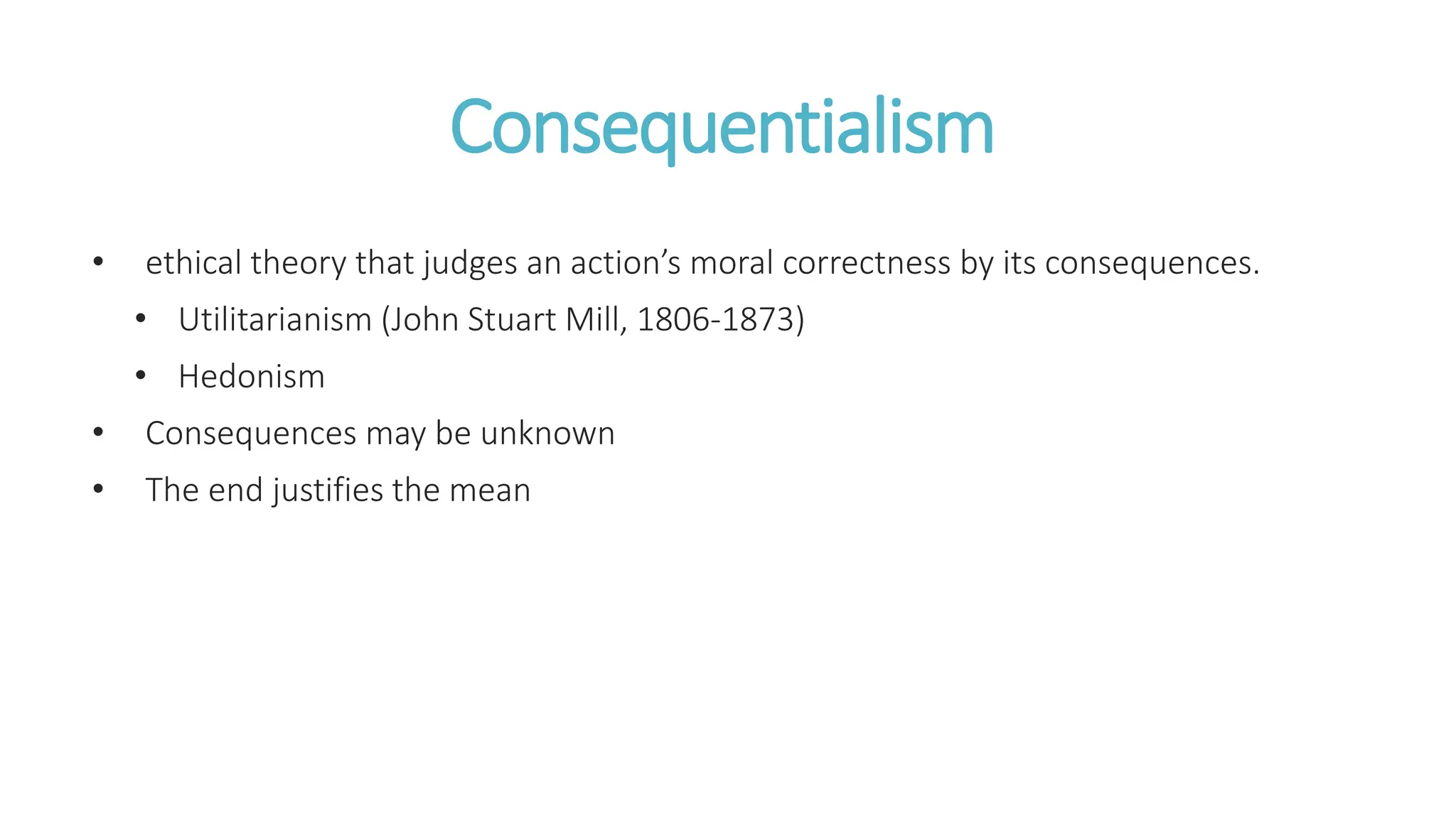
Consequentialism
• ethical theorythat judges an action’s moral correctness by its consequences.
• Utilitarianism (John Stuart Mill, 1806-1873)
• Hedonism
• Consequences may be unknown
• The end justifies the mean
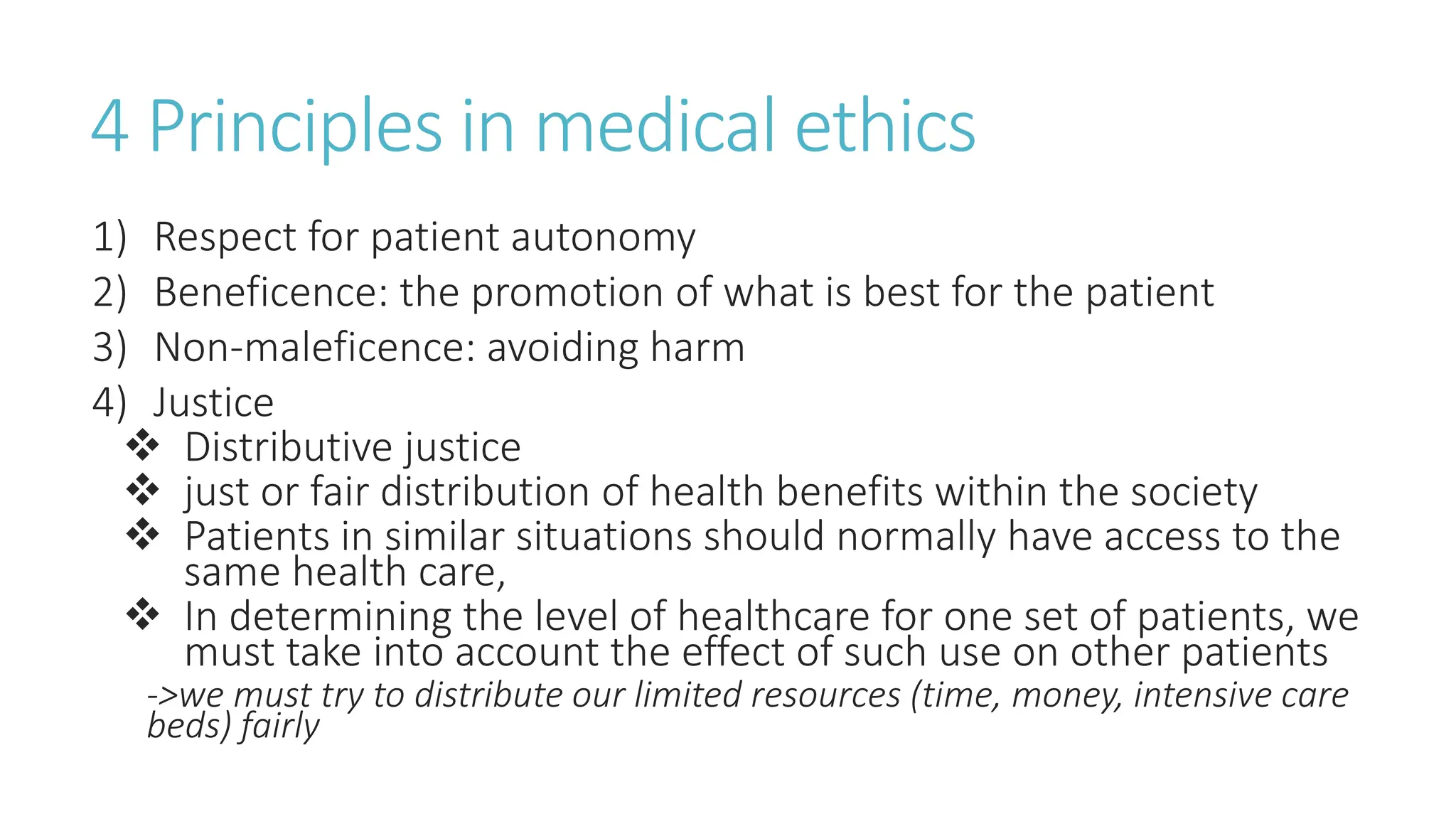
4 Principles inmedical ethics
1) Respect for patient autonomy
2) Beneficence: the promotion of what is best for the patient
3) Non-maleficence: avoiding harm
4) Justice
Distributive justice
just or fair distribution of health benefits within the society
Patients in similar situations should normally have access to the
same health care,
In determining the level of healthcare for one set of patients, we
must take into account the effect of such use on other patients
->we must try to distribute our limited resources (time, money, intensive care
beds) fairly
22.
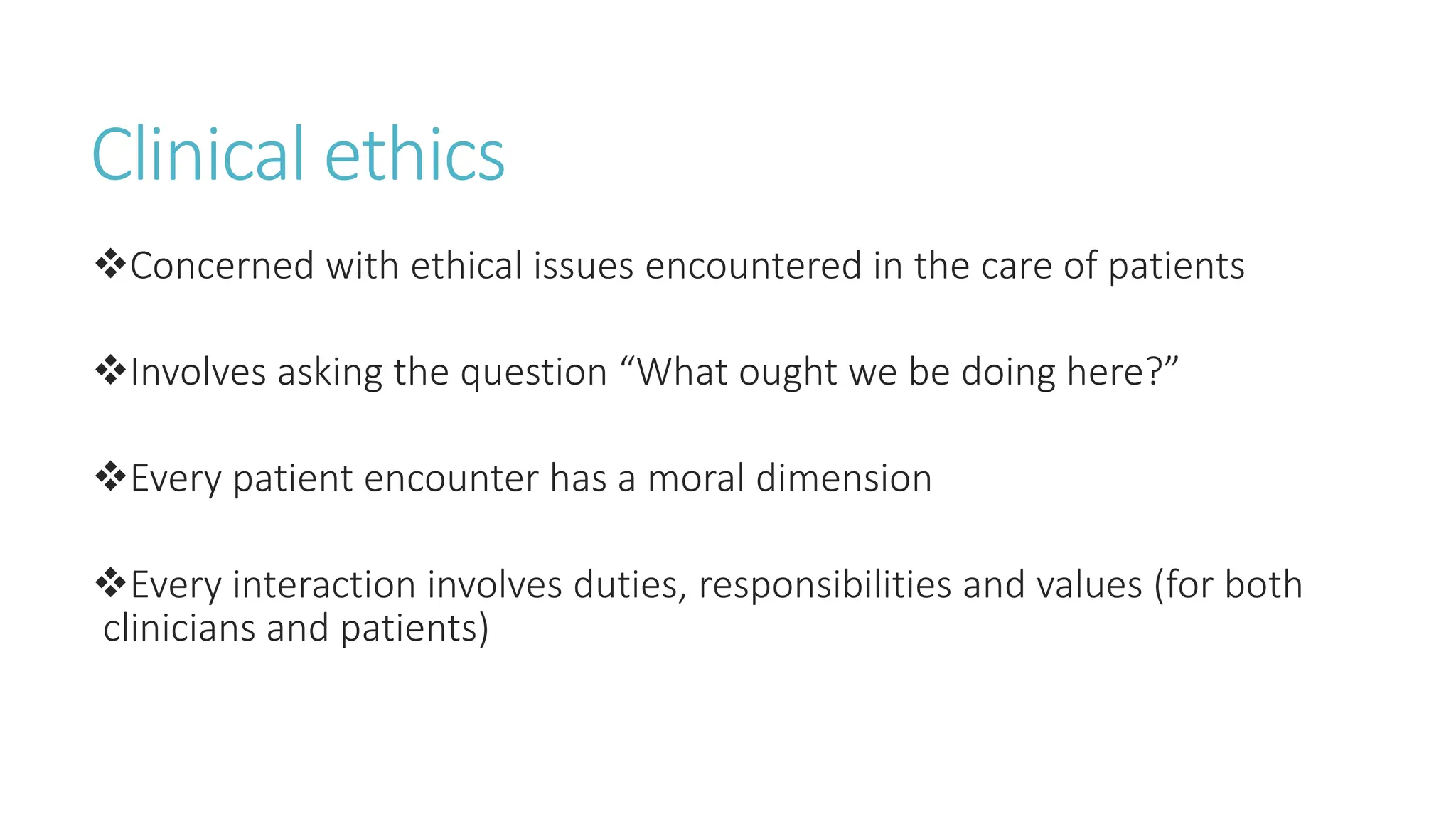
Clinical ethics
Concerned withethical issues encountered in the care of patients
Involves asking the question “What ought we be doing here?”
Every patient encounter has a moral dimension
Every interaction involves duties, responsibilities and values (for both
clinicians and patients)
23.
Clinical ethics
Concerned withethical issues encountered in the care of patients
Involves asking the question “What ought we be doing here?”
Every patient encounter has a moral dimension
Every interaction involves duties, responsibilities and values (for both
clinicians and patients)
24.
Conceptual approaches toclinical ethics
Principlism:
-Respect for persons/autonomy
-Beneficence/ Non-maleficence
-Justice
Casuitry (case-based ethics)
-stresses the importance of appreciating the particular feature of
specific cases
- pragmatic, more likely to solve a problem than appealing to abstract
principles
25.
Clinical ethics
Virtue Theory
-stresses qualities or character that a healthcare professional should exhibit:
compassion, honesty, respect, humility, altruism, courage, tolerance, etc.
Feminism/Ethics of care
-Question basic sociocultural assumptions underlying the core principles
- For example, respect for autonomy emphasizes individualism and self-determination,
while feminist thinking emphasizes the relational aspect of being human
-Feminist approaches to bioethics also focus on freedom, caring, and justice, and
critiquing existing power structures as they relate to gender
26.
What are thecontemporary (thorny)
issues in bioethics?
27.
•The value oflife (what is life? What is death?)
•Killing versus letting die
•Organ transplantation
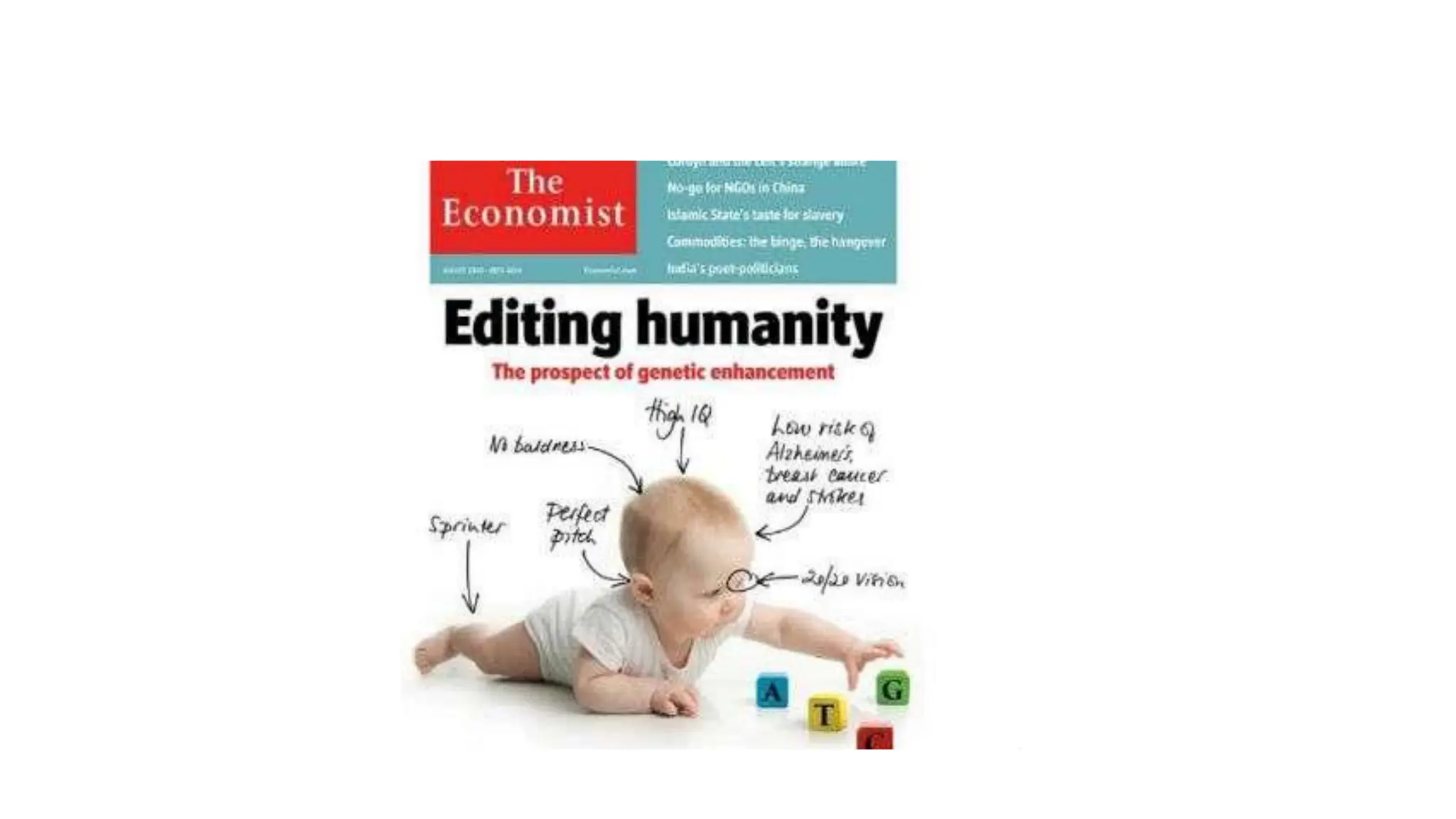
•Prenatal genetic intervention (embryonic genetic therapy), “designer baby”
•Genetic enhancement
•Human cloning
•Vaccine allocation and distribution
31.
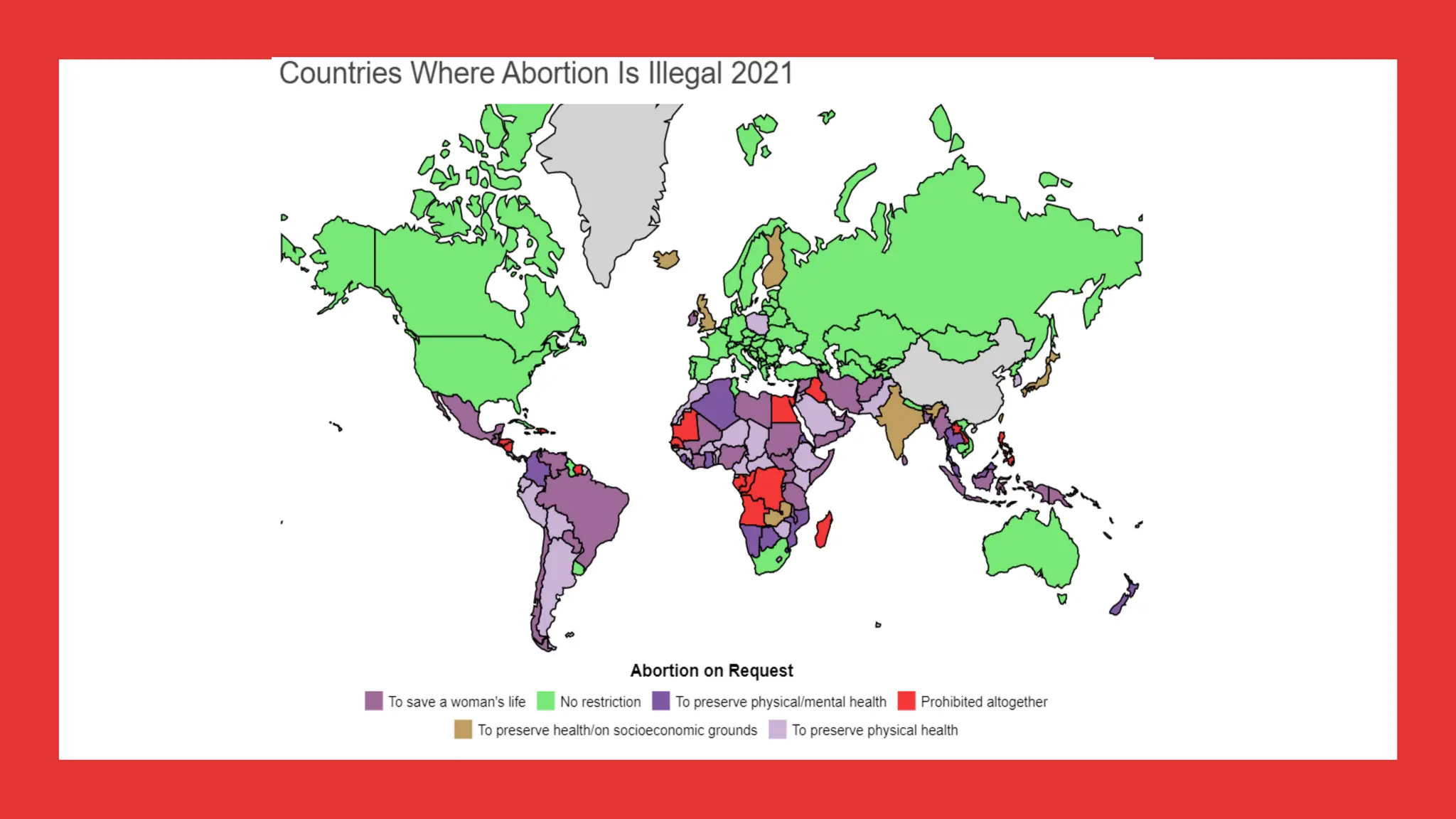
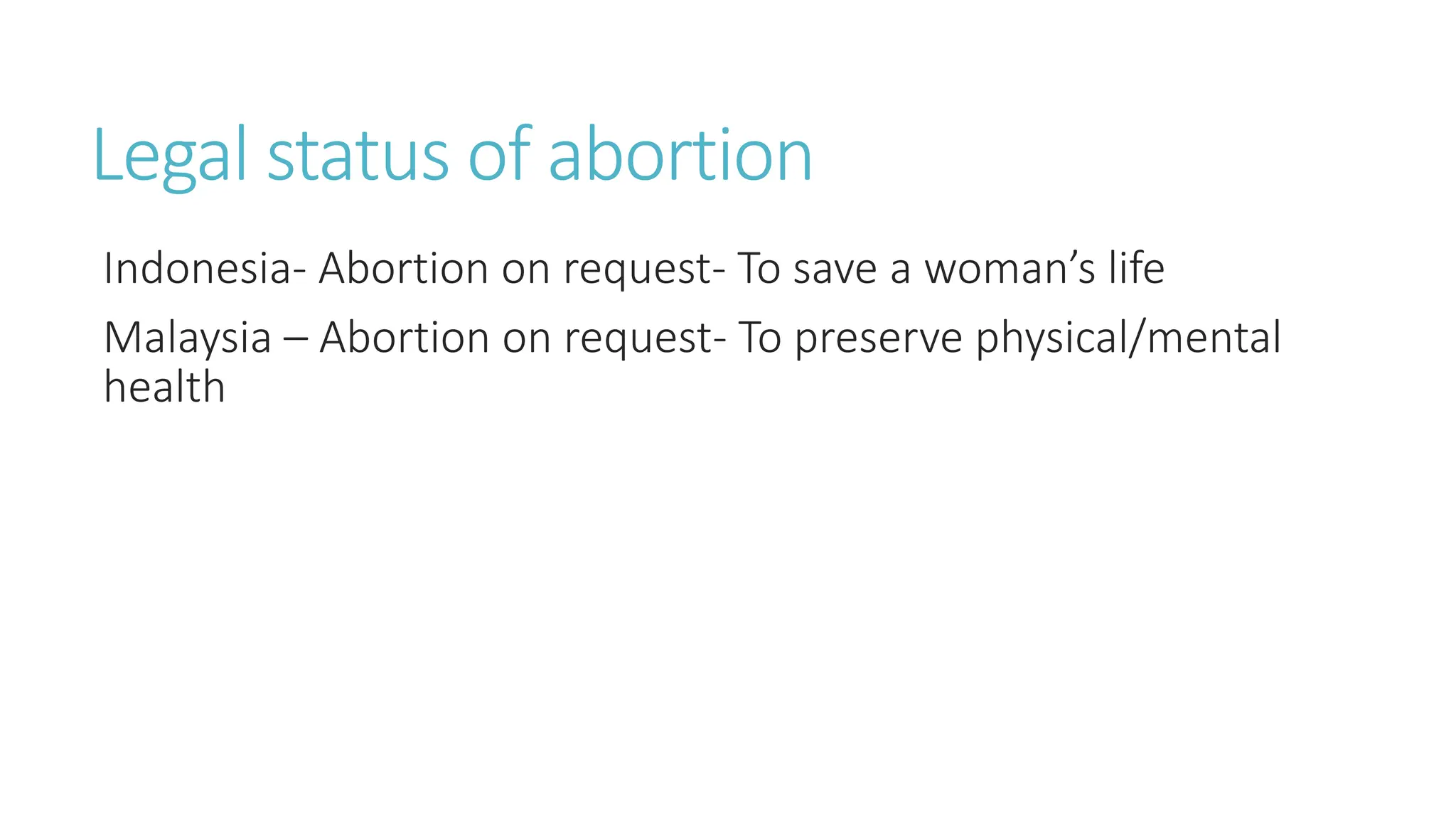
Legal status ofabortion
Indonesia- Abortion on request- To save a woman’s life
Malaysia – Abortion on request- To preserve physical/mental
health
32.
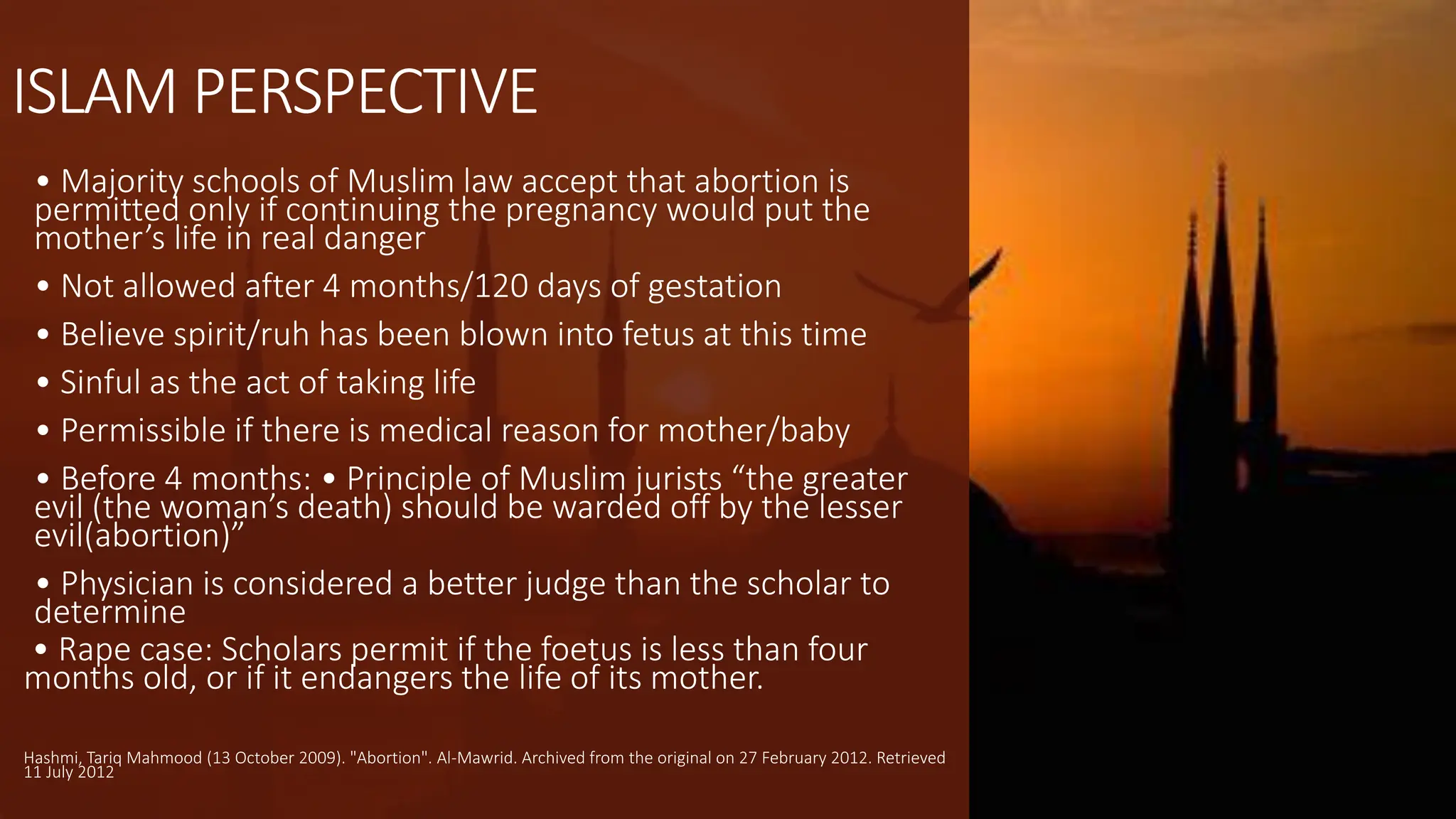
ISLAM PERSPECTIVE
• Majorityschools of Muslim law accept that abortion is
permitted only if continuing the pregnancy would put the
mother’s life in real danger
• Not allowed after 4 months/120 days of gestation
• Believe spirit/ruh has been blown into fetus at this time
• Sinful as the act of taking life
• Permissible if there is medical reason for mother/baby
• Before 4 months: • Principle of Muslim jurists “the greater
evil (the woman’s death) should be warded off by the lesser
evil(abortion)”
• Physician is considered a better judge than the scholar to
determine
• Rape case: Scholars permit if the foetus is less than four
months old, or if it endangers the life of its mother.
Hashmi, Tariq Mahmood (13 October 2009). "Abortion". Al-Mawrid. Archived from the original on 27 February 2012. Retrieved
11 July 2012
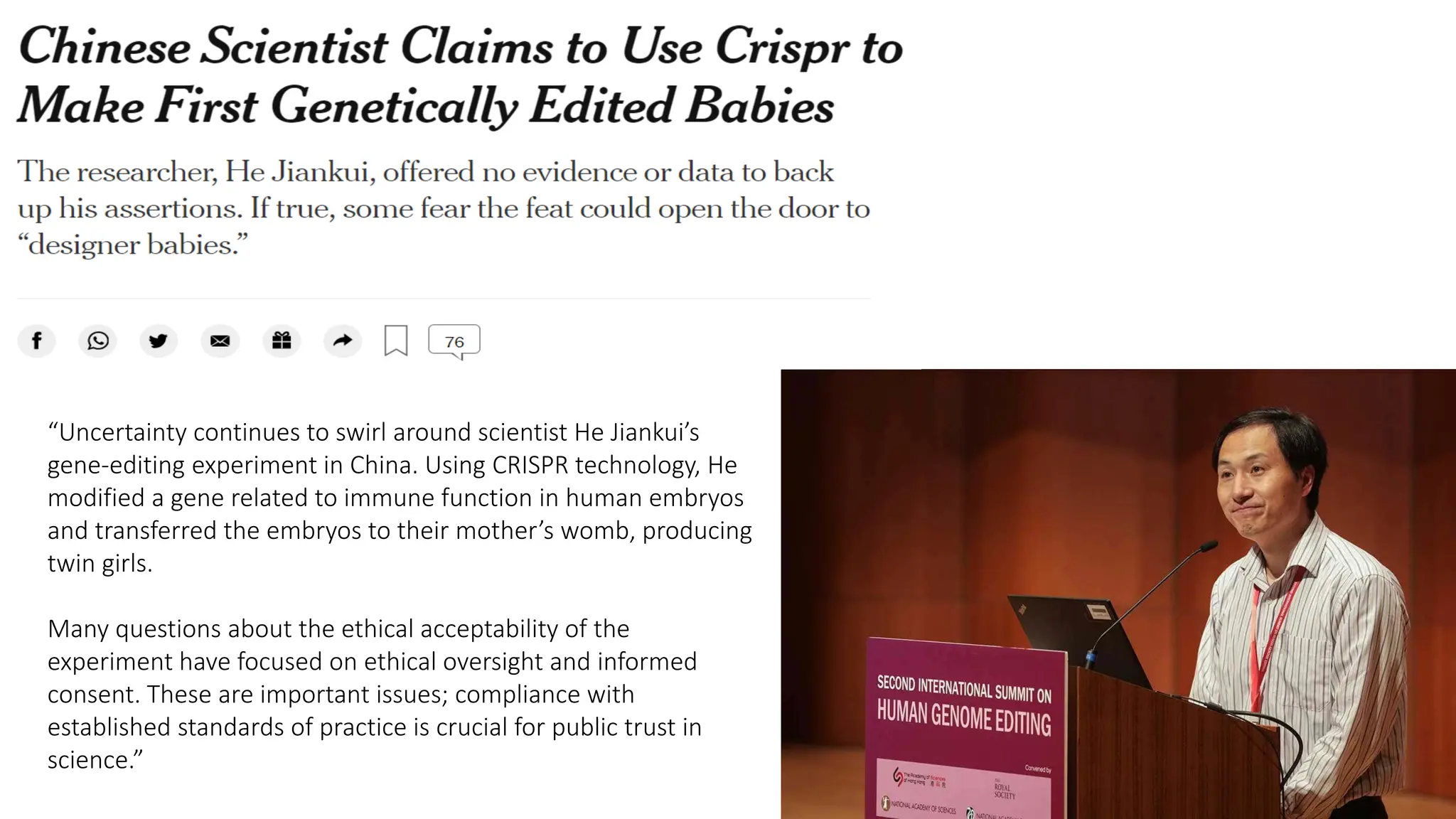
“Uncertainty continues toswirl around scientist He Jiankui’s
gene-editing experiment in China. Using CRISPR technology, He
modified a gene related to immune function in human embryos
and transferred the embryos to their mother’s womb, producing
twin girls.
Many questions about the ethical acceptability of the
experiment have focused on ethical oversight and informed
consent. These are important issues; compliance with
established standards of practice is crucial for public trust in
science.”
36.
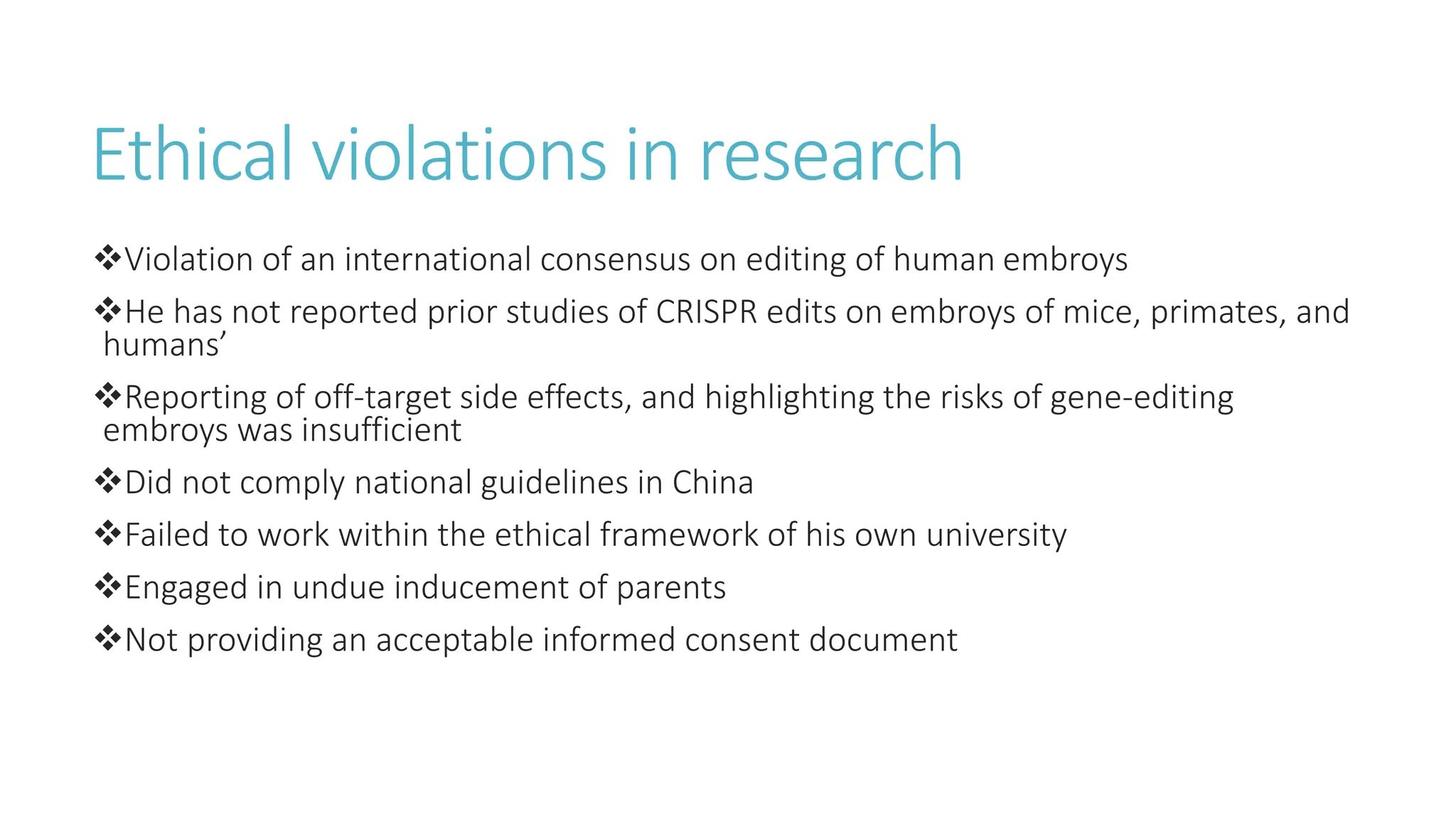
Ethical violations inresearch
Violation of an international consensus on editing of human embroys
He has not reported prior studies of CRISPR edits on embroys of mice, primates, and
humans’
Reporting of off-target side effects, and highlighting the risks of gene-editing
embroys was insufficient
Did not comply national guidelines in China
Failed to work within the ethical framework of his own university
Engaged in undue inducement of parents
Not providing an acceptable informed consent document