Introduction to
Bioethicss
Objectives:
• Define ETHICS & Bioethics
• Trace the birth and
development of Bioethics
Outline
•Definition of Ethics
•Definition of
Bioethics
•Rationale in the study
of Bioethics
•Birth of Bioethics
What is Ethics?
• Greek word “ethos” – behavior
or custom that is permanent –
”ethics”
• Latin’s “mos” or “moris” –
“morals”
• Basic human behaviors that are
specific & inherent to human
beings
• Natural to human which
confers and develops goodness
in them
What is Ethics?
• A sense of right & wrong from
which human actions proceeds
• Study of the morality of the
human act (Moral philosophy)
• Guides both speculative &
practical intellect in the
acquisition of ethical principles
in concrete human conduct
What is Ethics?
• ETHICS is the rational
inquiry into what
constitutes human
happiness in the light of
human nature as reflected
in human conduct
empirically and
emphatically observed.
What is Ethics?
•Ethics- study of the end
of man and of human
acts insofar as they are
related to that end.
Outline
•Definition of Ethics
•Definition of Bioethics
•Rationale in the study
of Bioethics
•Birth of Bioethics
What is BIOETHICS?
• “ethics of life” or of life science
• Health care ethics, medical
ethics or life ethics
• Application of the basic
principles of ethics to the new
possibilities opened by modern
biology & biotechnology with
regard to human life
• Professional ethics in allied
health
» Manlangit
What is BIOETHICS?
• Study of human actions of
allied health professionals
with regards to human life
and towards the patient
Rationale in the study of
Bioethics
• To address the perennial ethical
problems, issues, dilemmas
confronting health workers
• To address legal problems in health
care with ethical concerns
• To address the challenge of the
modern technology
• To address & enhance professional
development & ethical values of the
health professionals
Outline
•Definition of Ethics
•Definition of Bioethics
•Rationale in the study
of Bioethics
•Birth of Bioethics
BIRTH OF BIOETHICS
History of Bioethics
•Historical Code
•Research Ethics
•Clinical Ethics
•Emerging technology
Historical Codes
–Greek Philosophers
• personhood & virtues
behavior
– Hippocrates (5th cent.
B.C.)
• Hippocratic Oath –
“first do no harm”
Historical Codes
• Oath of Maimonides (1200)
– Look upon the sick with
empathy & respect
– Accept teaching of elders with
med skills
– Work for the benefit of the
mankind
Historical Codes
•Percival’s Code 1794
– 1st code of medical ethics adopted by
group of professional physicians
•American Medical Association
Code
– Duties & obligations of physician to
pts & to the society & the field of
medicine
Hippocratic Oath (400 BC)
“DO NO HARM”
•“and abstain from whatever in
deleterious & mischievous. I will
give no deadly medicine to any
one if asked, nor suggest any such
counsel; & in like manner I will
not give to woman a pessary to
produce abortion.”
THE TURNING POINT:
•The medical profession had
confront new questions,
raised directly as a result of
extraordinary progress
being made in biomedical
sciences.
Research Ethics:
• Nazi Experiments. 1940s
• Tuskegee Syphilis
Experiment (1930 – 1970)
• Jewish Chronic Disease
Study (1963)
• Willobrook Hepatitis Study
(1963 – 1966) – New York
Research Ethics:
Nazi Experimentation 1940’s
• Nazi Doctors’ horrific
experimentation on death
camp prisoners
• THE NUREMBERG CODE
– Recognizes the subject
Research Ethics:
Tuskegee Syphilis
Experiment (1930 – 1970’s)
• 400 Syphilitic black men in
Alabama (1947)
• Denied of tx even after
penicillin was introduced
in 1947
Research Ethics:
• Jewish Chronic Disease
Study (1963)
– Tumor cells were injected into
elderly patients w/o permission
• Willobrook Hepatitis Study
(1963 – 1966) – New York
– Mentally disable children were
intentionally infected with
hepatitis.
Research Ethics
• NATIONAL RESEACH ACT
1974
• National Commission for the
Protection of Human Subject
of Biomedical & Behavioral
Research
BELMONT REPORT 1979
• 3 fundamental principles of
biomedical research ethics
• Respect for persons
• Beneficence
• Justice
• Importance of INFORMED
CONSENT
Ethical Concerns From
Research
• Artificial heart transplantation
– (1960) Dr. Denton Cooley’s
artificial heart -- w/o proper
ethical & regulatory overview
– 1980: Dr. Copeland – quality of
life
• Xenotransplantation – non
human to human
CLINICAL ETHICAL
ISSUES
• 1960: Kidney Dialysis machine:
“God Squad” – based from
value – laden, social worth
• New definition of Death by Ad
Hoc Committee at Harvard
University 1968
CLINICAL ETHICAL
ISSUES
• Discussion of Demographic
Explosion
• Contraceptive pill by Gregory
Pinkus
• Human Vitae 1968
CLINICAL ETHICAL
ISSUES
• Dramatic Shift to civil liberties
and individual rights (1960 &
1970s)
• Women demanded greater
Privacy in Reproductive Decisions
• Patients demanded control over
their treatment decisions
CLINICAL ETHICAL
ISSUES
• Dramatic Shift to civil liberties and
individual rights (1960 & 1970s)
• Women demanded greater Privacy
in reproductive Decisions
• Patients demanded control over
their treatment decisions
• Artificial Reproductive technology
CLINICAL ETHICAL
ISSUES
• End of Life Issues:
• Patient Self Determination Act of
1991
• Advance directives & living will
• Right to Die Movement
• Oregon Death Dignity
History of Bioethics
•Historical Code
•Research Ethics
•Clinical Ethics
•Emerging technology
QUESTION:
•Which moral criteria
must be applied in
order to clarify the
problems posed
today in the field of
biomedicine?
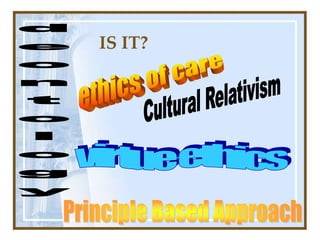
IS IT?
QUESTION:
•Which moral criteria
must be applied in
order to clarify the
problems posed
today in the field of
biomedicine?
ANSWER:
Anthropological Vision
•The answer to this
question presupposes a
proper idea of the nature
of the human person in his
bodily dimension.
Criteria to Judge Our Ethical
Choices
• Need to be founded in an
anthropology that contains
the objective truth about
man… nature of the
person… of his or her
truth….
• WHAT AND WHO IS THE
PERSON!
Outline
•Definition of Ethics
•Definition of Bioethics
•Rationale in the study
of Bioethics
•Birth of Bioethics

Bioethics defined

  • 1.
  • 2.
    Objectives: • Define ETHICS& Bioethics • Trace the birth and development of Bioethics
  • 3.
    Outline •Definition of Ethics •Definitionof Bioethics •Rationale in the study of Bioethics •Birth of Bioethics
  • 4.
    What is Ethics? •Greek word “ethos” – behavior or custom that is permanent – ”ethics” • Latin’s “mos” or “moris” – “morals” • Basic human behaviors that are specific & inherent to human beings • Natural to human which confers and develops goodness in them
  • 5.
    What is Ethics? •A sense of right & wrong from which human actions proceeds • Study of the morality of the human act (Moral philosophy) • Guides both speculative & practical intellect in the acquisition of ethical principles in concrete human conduct
  • 6.
    What is Ethics? •ETHICS is the rational inquiry into what constitutes human happiness in the light of human nature as reflected in human conduct empirically and emphatically observed.
  • 7.
    What is Ethics? •Ethics-study of the end of man and of human acts insofar as they are related to that end.
  • 8.
    Outline •Definition of Ethics •Definitionof Bioethics •Rationale in the study of Bioethics •Birth of Bioethics
  • 9.
    What is BIOETHICS? •“ethics of life” or of life science • Health care ethics, medical ethics or life ethics • Application of the basic principles of ethics to the new possibilities opened by modern biology & biotechnology with regard to human life • Professional ethics in allied health » Manlangit
  • 10.
    What is BIOETHICS? •Study of human actions of allied health professionals with regards to human life and towards the patient
  • 11.
    Rationale in thestudy of Bioethics • To address the perennial ethical problems, issues, dilemmas confronting health workers • To address legal problems in health care with ethical concerns • To address the challenge of the modern technology • To address & enhance professional development & ethical values of the health professionals
  • 12.
    Outline •Definition of Ethics •Definitionof Bioethics •Rationale in the study of Bioethics •Birth of Bioethics
  • 13.
  • 14.
    History of Bioethics •HistoricalCode •Research Ethics •Clinical Ethics •Emerging technology
  • 15.
    Historical Codes –Greek Philosophers •personhood & virtues behavior – Hippocrates (5th cent. B.C.) • Hippocratic Oath – “first do no harm”
  • 16.
    Historical Codes • Oathof Maimonides (1200) – Look upon the sick with empathy & respect – Accept teaching of elders with med skills – Work for the benefit of the mankind
  • 17.
    Historical Codes •Percival’s Code1794 – 1st code of medical ethics adopted by group of professional physicians •American Medical Association Code – Duties & obligations of physician to pts & to the society & the field of medicine
  • 18.
    Hippocratic Oath (400BC) “DO NO HARM” •“and abstain from whatever in deleterious & mischievous. I will give no deadly medicine to any one if asked, nor suggest any such counsel; & in like manner I will not give to woman a pessary to produce abortion.”
  • 19.
    THE TURNING POINT: •Themedical profession had confront new questions, raised directly as a result of extraordinary progress being made in biomedical sciences.
  • 20.
    Research Ethics: • NaziExperiments. 1940s • Tuskegee Syphilis Experiment (1930 – 1970) • Jewish Chronic Disease Study (1963) • Willobrook Hepatitis Study (1963 – 1966) – New York
  • 21.
    Research Ethics: Nazi Experimentation1940’s • Nazi Doctors’ horrific experimentation on death camp prisoners • THE NUREMBERG CODE – Recognizes the subject
  • 22.
    Research Ethics: Tuskegee Syphilis Experiment(1930 – 1970’s) • 400 Syphilitic black men in Alabama (1947) • Denied of tx even after penicillin was introduced in 1947
  • 23.
    Research Ethics: • JewishChronic Disease Study (1963) – Tumor cells were injected into elderly patients w/o permission • Willobrook Hepatitis Study (1963 – 1966) – New York – Mentally disable children were intentionally infected with hepatitis.
  • 24.
    Research Ethics • NATIONALRESEACH ACT 1974 • National Commission for the Protection of Human Subject of Biomedical & Behavioral Research
  • 25.
    BELMONT REPORT 1979 •3 fundamental principles of biomedical research ethics • Respect for persons • Beneficence • Justice • Importance of INFORMED CONSENT
  • 26.
    Ethical Concerns From Research •Artificial heart transplantation – (1960) Dr. Denton Cooley’s artificial heart -- w/o proper ethical & regulatory overview – 1980: Dr. Copeland – quality of life • Xenotransplantation – non human to human
  • 27.
    CLINICAL ETHICAL ISSUES • 1960:Kidney Dialysis machine: “God Squad” – based from value – laden, social worth • New definition of Death by Ad Hoc Committee at Harvard University 1968
  • 28.
    CLINICAL ETHICAL ISSUES • Discussionof Demographic Explosion • Contraceptive pill by Gregory Pinkus • Human Vitae 1968
  • 29.
    CLINICAL ETHICAL ISSUES • DramaticShift to civil liberties and individual rights (1960 & 1970s) • Women demanded greater Privacy in Reproductive Decisions • Patients demanded control over their treatment decisions
  • 30.
    CLINICAL ETHICAL ISSUES • DramaticShift to civil liberties and individual rights (1960 & 1970s) • Women demanded greater Privacy in reproductive Decisions • Patients demanded control over their treatment decisions • Artificial Reproductive technology
  • 31.
    CLINICAL ETHICAL ISSUES • Endof Life Issues: • Patient Self Determination Act of 1991 • Advance directives & living will • Right to Die Movement • Oregon Death Dignity
  • 32.
    History of Bioethics •HistoricalCode •Research Ethics •Clinical Ethics •Emerging technology
  • 33.
    QUESTION: •Which moral criteria mustbe applied in order to clarify the problems posed today in the field of biomedicine?
  • 34.
  • 35.
    QUESTION: •Which moral criteria mustbe applied in order to clarify the problems posed today in the field of biomedicine?
  • 36.
    ANSWER: Anthropological Vision •The answerto this question presupposes a proper idea of the nature of the human person in his bodily dimension.
  • 37.
    Criteria to JudgeOur Ethical Choices • Need to be founded in an anthropology that contains the objective truth about man… nature of the person… of his or her truth…. • WHAT AND WHO IS THE PERSON!
  • 38.
    Outline •Definition of Ethics •Definitionof Bioethics •Rationale in the study of Bioethics •Birth of Bioethics

Editor's Notes

  • #2 *At pnt in your life, questions with moral dimension? Goodness or badness of an action? If we will offend others? *We tend to judge the external action of others – constantly evaluate the real world. We can say that a person is what his behavior manifest..good actions or bad actions? -- Purpose .. ** this is where ethics comes in.. It helps us establish norms and criteria for judging actions.. * Judge – our judgement has foundations or basis..
  • #5 Human behavior – that is inherent to human beings; NOT etiquettes, social manner, convention or fashions – culture
  • #6 **Mental-set, disposition or set of values & conviction to which is attributed a sense of right & wrong fr which human actions proceeds ** points to way to moral living & compels man to practice in it in his life & in the society.
  • #14 How real event & stories shaped bioethics today Understand the present Learn from the past
  • #16 Health care has been imbued with moral & religious significance Grk philosphers – ponder issues related to personhood, virtous behavior by physicians & rules of med practice Ancient Greece – Hippocratic Oath – 1st do no harm ---
  • #17 Jewish physician & philosopers – Moses
  • #18 AMA – adopted in philadelphia (1847) – duties & obligation of physicians to their ps & society & pt towards MD
  • #22 NUREMBERG code – not legal but continues to influence the direction of research ethics policy & practice as it essentially captures historical events -- informed consent, ensure objective protection
  • #24 Study the developmental spread of tumors— -- MR children – admittance into the home was contingent upon parents
  • #25 Commission was a multidiciplinary grp – scientist, moral theologian, ethicist – philosophers, policy experts “identify the basic ethical principles that should underlie the conduct of biomedical & behavioral research involving human subjects & to develop guidelines w/c should be followed to assure that such research is conducted with those principles.
  • #26 Commission promulgated the BELMONT REPORT
  • #27 Risks:
  • #28 God squad – who to live & who to die
  • #29 Control of life
  • #30 Control of the begginning of life; change in definition of conception of embryo in OB gyne Book
  • #31 Control of the begginning of life; change in definition of conception of embryo in OB gyne Book
  • #32 Control of the begginning of life; change in definition of conception of embryo in OB gyne Book
  • #38 Antropology – study of the mystery of man.