Subtitle
BIOSAFETY GUIDELINES
 Policy proposed or adopted by the Government to avoid the risks
of GEOs on environment and public health.
What is biosafety guidelines?
 Regulating rDNA research with organisms that have least or no
adverse effect.
 Minimizing the possibilities of occasional release of GEOs from the
laboratory
 Banning the release of GEOs if they are supposed to be causing
potential risks in the environment
Aim of biosafety guidelines
 In India, DBT has proposed “The recombinant DNA safety
guidelines” in 1983 and amended in 1990.
 These guidelines deals with a set of rules for production, use,
import, export and storage of hazardous organisms.
The rDNA Biosafety Guidelines Of India
 Institutional biosafety committee (IBSC)- controls research
activities at institutional level.
 Review committee on genetic manipulation(RCGM)- reviews
special situations where research with hazardous organisms in
laboratory and grants permission to do that research.
 Genetic engineering approval committee(GEAC)- approves the
GEOs for large scale production and use in India.
In India, the rDNA guidelines has been implanted
through three committees
 Toxin gene cloning
 Cloning of genes for vaccine production
 Cloning of mosquito and tick DNA
 Cloning of antibiotics resistance genes
 Cloning of oncogenes
 Experiments with infectious animal and plant viruses
 Transgenesis experiment in animal cell cultures
 Transfer of toxicity genes into plants
 Gene therapy for hereditary diseases
To perform certain gene manipulation experiments,theworkers
need to acquire permission of review committee and approval
committee before commencement
 The term "Containment" is used in describing the safe methods
for managing infectious agents in the laboratory environment
where they are being handled or maintained.
CONTAINMENTS
 To reduce exposure of laboratory workers, other persons, and
outside environment to potentially
Purpose of containments
 Laboratory Practice and Technique
 Safety Equipment(primary barriers)
 Design Facility(Secondary Barrier)
Elements of containments
 Physical containment
 Biological containment
types of containments
 The physical methods being adopted inside the laboratories to
prevent escaping the GEOs to the environment
 It works on the principal of physical barriers
 It helps to keep the dirt in the laboratory itself
Physical containment
 Air filtration
 Sterilization lights
 Waste disposal
 Protective handling
The physical containment include
 The biological principles used in the laboratories to prevent the
escape of GEOs or microbes
 Biological containment makes the organisms unable to survive in
the outside environment
Biological containment
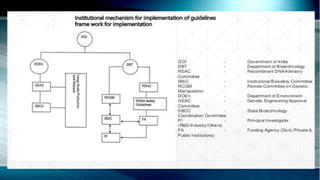
 The rDNA biosafety guidelines are implemented for the
government of India by four committee
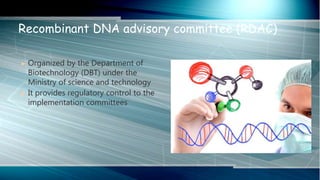
 Recombinant DNA advisory committee (RDAC)
 Institutional biosafety committee (IBSC)
 Review committee on genetic manipulation (RCGM)
 Genetic engineering approval committee (GEAC)
Implementation of biosafety guidelines
 Organized by the Department of
Biotechnology (DBT) under the
Ministry of science and technology
 It provides regulatory control to the
implementation committees
Recombinant DNA advisory committee (RDAC)
 These meeting helps to
 Evolve long term policy for R/D in rDNA research
 Formulate suitable safety guidelines
 Train the research and technicians about the hazards and risks of
rDNA research techniques
The RDAC has been arranging meeting once in six
months or sooner to discuss about the standards of
safety regulations
 This is a small committee established by
every institution engaged in rDNA
research and the related production
activities
 It monitors rDNA research activities at the
institutional level
 This committee is formed of head of
institution, 3or more scientists, a medical
officer and one DBT nominated person
Institutional biosafety committee (IBSC)
 Sends report to RCGM regarding observance of safety guidelines
on accidents risks and on deviations if any
 Reviews the requirements of guidelines for safety new projects
 Allows some person to take training on biosafety in research
activities
 Takes emergency plans in urgent situations
 Attempts to provide medical care to persons working in the
laboratory
Role of IBSC
 The RCGM is functioning under DBT
 It is formed of
 Department of biotechnology (DBT)
 Indian council of medical research (ICMR)
 Indian council of agricultural research
(ICAR)
 Council of scientific and industrial research
(CSIR)
 Department of science and technology
(DST)
Review committee on genetic manipulation (RCGM)
 Establishes the procedural guidance manual for regulatory process
with GEOs
 It reviews the risk potentials of GEOs in the laboratory and field
experiments
 It decides which containment have to be followed for experiments
with risky hazardous microbes
 It advices custom authorities on import of GEOs and other
biological materials from other nations
 It provides advice on IPR and patents
RCGM functions
 It assists the Bureau of India standards (BIS) to evolve standards
of products coming from rDNA technology
 The monitoring group of RCGM visit frequently to laboratories
where rDNA works are going on and inspects safety conditions in
those lab
 This is a higher level committee working
under the Department of Environment and
Forests.
 It has full power to permit
 Large scale use of genetically
engineered organisms
 rDNA products
 R/D of rDNA technology
 Industrial production of rDNA products
 Release of GEOS in environment and
field use
GENETIC ENGINEERING APPROVAL
COMMITTEE (GEAC)
 Import, export, transport,production and sale of GEOs and other
organisms
 Release of GEOs from the laboratories to environment
 Large scale culture and use of GEOs and microbes in industries
 Use of GEOs in field application and experimental trials
 Monitoring the risks and accidents due to GEOs
The GEAC gives approval for
Mechanism of implementation
Biosafety guidelines

Biosafety guidelines

  • 1.
  • 2.
     Policy proposedor adopted by the Government to avoid the risks of GEOs on environment and public health. What is biosafety guidelines?
  • 3.
     Regulating rDNAresearch with organisms that have least or no adverse effect.  Minimizing the possibilities of occasional release of GEOs from the laboratory  Banning the release of GEOs if they are supposed to be causing potential risks in the environment Aim of biosafety guidelines
  • 4.
     In India,DBT has proposed “The recombinant DNA safety guidelines” in 1983 and amended in 1990.  These guidelines deals with a set of rules for production, use, import, export and storage of hazardous organisms. The rDNA Biosafety Guidelines Of India
  • 5.
     Institutional biosafetycommittee (IBSC)- controls research activities at institutional level.  Review committee on genetic manipulation(RCGM)- reviews special situations where research with hazardous organisms in laboratory and grants permission to do that research.  Genetic engineering approval committee(GEAC)- approves the GEOs for large scale production and use in India. In India, the rDNA guidelines has been implanted through three committees
  • 6.
     Toxin genecloning  Cloning of genes for vaccine production  Cloning of mosquito and tick DNA  Cloning of antibiotics resistance genes  Cloning of oncogenes  Experiments with infectious animal and plant viruses  Transgenesis experiment in animal cell cultures  Transfer of toxicity genes into plants  Gene therapy for hereditary diseases To perform certain gene manipulation experiments,theworkers need to acquire permission of review committee and approval committee before commencement
  • 7.
     The term"Containment" is used in describing the safe methods for managing infectious agents in the laboratory environment where they are being handled or maintained. CONTAINMENTS
  • 8.
     To reduceexposure of laboratory workers, other persons, and outside environment to potentially Purpose of containments
  • 9.
     Laboratory Practiceand Technique  Safety Equipment(primary barriers)  Design Facility(Secondary Barrier) Elements of containments
  • 10.
     Physical containment Biological containment types of containments
  • 11.
     The physicalmethods being adopted inside the laboratories to prevent escaping the GEOs to the environment  It works on the principal of physical barriers  It helps to keep the dirt in the laboratory itself Physical containment
  • 12.
     Air filtration Sterilization lights  Waste disposal  Protective handling The physical containment include
  • 13.
     The biologicalprinciples used in the laboratories to prevent the escape of GEOs or microbes  Biological containment makes the organisms unable to survive in the outside environment Biological containment
  • 14.
     The rDNAbiosafety guidelines are implemented for the government of India by four committee  Recombinant DNA advisory committee (RDAC)  Institutional biosafety committee (IBSC)  Review committee on genetic manipulation (RCGM)  Genetic engineering approval committee (GEAC) Implementation of biosafety guidelines
  • 15.
     Organized bythe Department of Biotechnology (DBT) under the Ministry of science and technology  It provides regulatory control to the implementation committees Recombinant DNA advisory committee (RDAC)
  • 16.
     These meetinghelps to  Evolve long term policy for R/D in rDNA research  Formulate suitable safety guidelines  Train the research and technicians about the hazards and risks of rDNA research techniques The RDAC has been arranging meeting once in six months or sooner to discuss about the standards of safety regulations
  • 17.
     This isa small committee established by every institution engaged in rDNA research and the related production activities  It monitors rDNA research activities at the institutional level  This committee is formed of head of institution, 3or more scientists, a medical officer and one DBT nominated person Institutional biosafety committee (IBSC)
  • 18.
     Sends reportto RCGM regarding observance of safety guidelines on accidents risks and on deviations if any  Reviews the requirements of guidelines for safety new projects  Allows some person to take training on biosafety in research activities  Takes emergency plans in urgent situations  Attempts to provide medical care to persons working in the laboratory Role of IBSC
  • 19.
     The RCGMis functioning under DBT  It is formed of  Department of biotechnology (DBT)  Indian council of medical research (ICMR)  Indian council of agricultural research (ICAR)  Council of scientific and industrial research (CSIR)  Department of science and technology (DST) Review committee on genetic manipulation (RCGM)
  • 20.
     Establishes theprocedural guidance manual for regulatory process with GEOs  It reviews the risk potentials of GEOs in the laboratory and field experiments  It decides which containment have to be followed for experiments with risky hazardous microbes  It advices custom authorities on import of GEOs and other biological materials from other nations  It provides advice on IPR and patents RCGM functions
  • 21.
     It assiststhe Bureau of India standards (BIS) to evolve standards of products coming from rDNA technology  The monitoring group of RCGM visit frequently to laboratories where rDNA works are going on and inspects safety conditions in those lab
  • 22.
     This isa higher level committee working under the Department of Environment and Forests.  It has full power to permit  Large scale use of genetically engineered organisms  rDNA products  R/D of rDNA technology  Industrial production of rDNA products  Release of GEOS in environment and field use GENETIC ENGINEERING APPROVAL COMMITTEE (GEAC)
  • 23.
     Import, export,transport,production and sale of GEOs and other organisms  Release of GEOs from the laboratories to environment  Large scale culture and use of GEOs and microbes in industries  Use of GEOs in field application and experimental trials  Monitoring the risks and accidents due to GEOs The GEAC gives approval for
  • 24.