LEARNING OBJECTIVES
• Tounderstand the meaning of ethics and
appreciate its evolution
• To be able to compare ethical theories
• To be able to apply the various ethical
principles in everyday medical practice
ETHICS
•Ethics came fromthe greek word ethos
[character/custom/disposition]
•defined as the systematic study of morality.
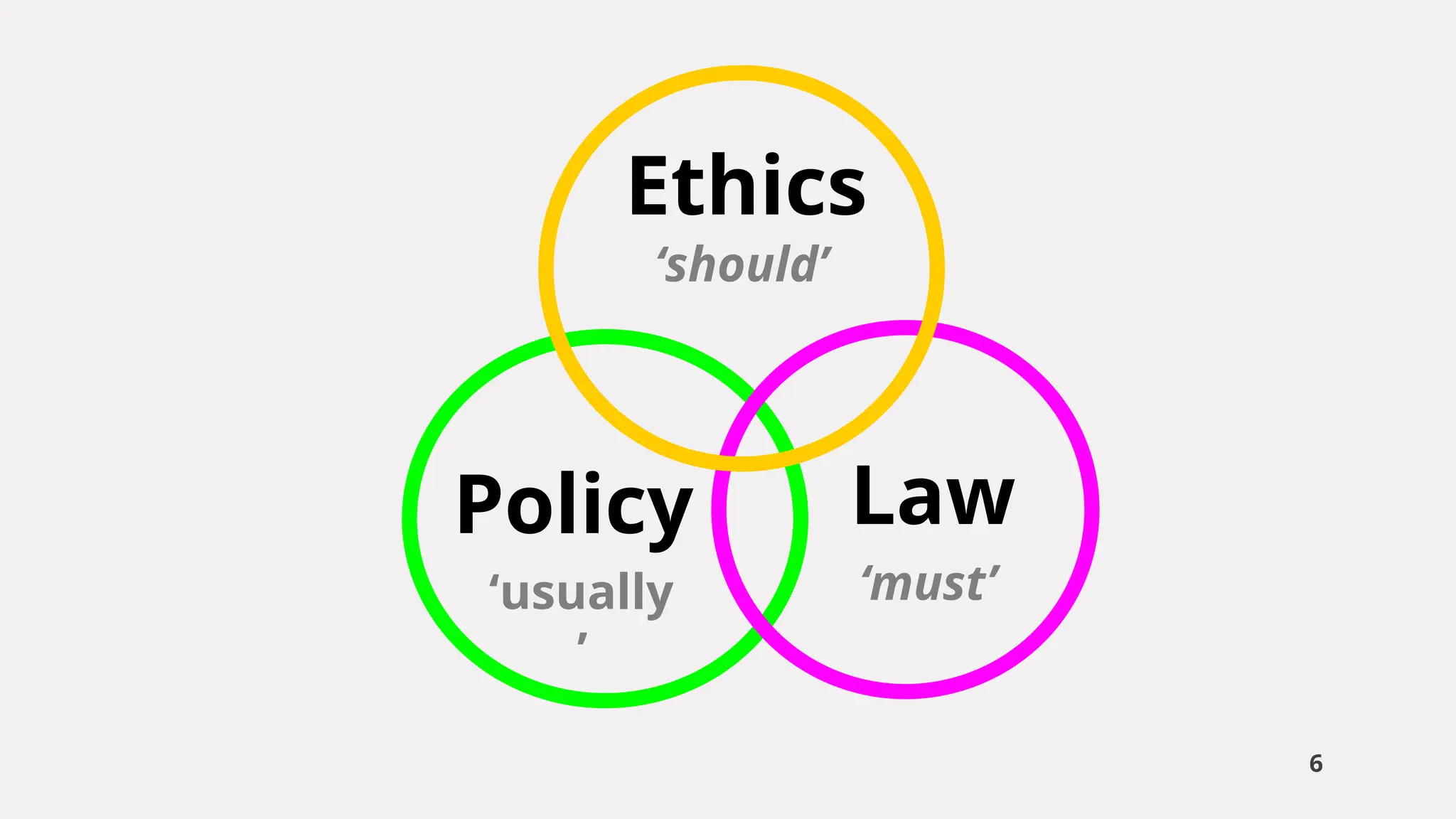
•A set of values, principles, and beliefs that guides the behaviour
of a specified group
•It is concerned with moral judgement and moral decision,
involving questions about human behaviour or conduct
IMPORTANCE OF MEDICALETHICS
• To help medical students recognize the importance of being
sensitive to ethical issues within everyday clinical practice
• To develop in them the ability to effectively address the ethical
concerns of patients, as well as participants in research.
• In recent times, Medical ethics is very relevant to a medical
professional due to a variety of reasons, including increasing
litigation, changes in complexities in medical practice.
8.
EVOLUTION
• Medical ethicshas developed over centuries.
• In the allopathic system of medicine, such developments
commenced from the time of Hippocrates (the Hippocratic oath)
• Over time several “codes” have been developed;
(These include the Helsinki Declaration, World Medical Report
and Belmont Report.)
9.
9
Ancient history ofethics in medicine
• 2700 BCE - Third Dynasty (Egypt)
Have an expectant attitude and trust in nature's healing
Be observant of the patient's condition
• 400 BCE - Oath of Hippocrates (Greece)
Give no deadly medicines, only benefit the sick and maintain
confidentiality
"First, do no harm!” (Hippocrates “On Epidemics”)
10.
10
Ethical Principles –Middle Ages
• 12th century - Jewish Daily Prayer of a Physician (Egypt)
-attributed to Moses Maimonides,
- Don't let desire for profit, fame, or admiration interfere
with your work
• 14th c. CE - Ming Dynasty (China) (1368 to 1644)
Appreciate the value of life. Rescue the dying. Heal the wounded.
Acknowledge that all patients are equal to the physician
11.
11
Contemporary Medical Ethics
•The central hub around which the practice of health sciences
revolves since Hippocrates
• Appeared as a recognizable academic discipline in the 19th century,
as a professional ethic
• Compulsory part of medical curriculum in the UK since 1993
(GMC, 1993)
12.
12
Contemporary Medical Ethics(2)
Medical ethics traces its roots to several early codes of ethics:
Ancient Greek Hippocratic oath- most famous
The Nuremberg code for research ethics
Declaration of Geneva (1948)- update the Hippocratic oath for 20th century use
International Code of Medical Ethics (1949)
Declaration of Helsinki (1964)- ethical guidelines for research on human
subjects
13.
13
Research Ethics
a subsetof applied ethics (bioethics), concerned with
responsible conduct of biomedical research in conformity
to norms
these norms were written partly in response to
unpleasant events in the history of biomedical research
These norms have developed into codes /guidelines that
are now widely applicable in many jurisdictions
14.
Ethical theories
Are aset of theories that guide ethical
thinking
There are many theories but we will focus on
the most popular ones;
15.
DEONTOLOGY
• Derived fromthe Greek word ‘DEON’which means duty
• Deontological theory states that we are morally
obligated to act according to a set of moral principles
regardless of the outcome
• Also known as “duty based ethics”
16.
DEONTOLOGY
• This theoryposits that some acts are morally wrong even if
they lead to a good outcome
• Actions are always judged independent of their outcome
• E.g if a terminally ill pt asks if he will be ok after a surgery
that they are unlikely to survive, deontology suggests you
don’t lie to comfort them as lying is morally wrong
17.
CONSEQUENTIALISM
• Balances favourableand unfavourable
consequences; the more favourable the
consequences of an act, the more the act should
be encouraged.
• A consequentialist believes what determines the
moral quality of an action are its consequences.
18.
CONSEQUENTIALISM
• Consequentialism simplyconsiders which course of action
has the most desirable consequences.
• It considers the moral value of the act according to its
consequences, so that if the outcome produces happiness,
the act must be morally right
• demonstrates the concept that "the end justifies the means"
19.
CASE SCENARIO
if wekill one healthy hospital visitor, and use their organs to save the lives
of five patients, utilitarianism may well be satisfied but social injustice is
outraged.
•Although the five patients may all recover satisfactory which in turn would
create happiness for their family and friends, the healthy patient's
autonomous wishes have been overlooked and the application of this
scenario makes utilitarianism morally unacceptable.
•Focusing on the consequences of an act in order to determine its ethically
acceptability can ignore fundamental principles of justice
20.
Ethical principles
• Serveas a guide or framework for morally right behavior
in the field of ethics
• Are four in number
• Two have been around since the time of Hippocrates
• Two were later added
21.
ETHICAL PRINCIPLES
1. Autonomy:[patient centered] "refers to the right to
make decisions about one's own life and body
without coercion by others...
As long as their decisions do not harm others,
individuals should be left alone to make fundamental
medical decisions
22.
ETHICAL PRINCIPLES
2. Beneficence:[physician centered] "doing good to others"
Example: If a physician means to help diabetic patients, an
experiment on diabetic patients (with their consent) is
ethical.
23.
Ethical principles
3. Nonmaleficence:[patient centered] "not
harming others"
Above all, this maxim implies that if a
physician is not technically competent to do
something, he shouldn't do it.
24.
ETHICAL PRINCIPLES
4. Justice:
"...hasboth a social and a political interpretation. Socially, it
means treating similar kinds of people similarily...A just physician treat each
patient the same...Politically, the principle amounts to distributive justice...At
the very least, it would mean a guarantee of equal access to medical care for
every citizen, such that insurance coverage would not be a factor..
justice requires physicians to treat patients impartially, without bias on account
of gender, race, sexuality, or wealth.
25.
CASE SCENARIOS
•In 1946,Nazi doctors, among other Nazi officials were
tried for war crimes committed during World War II
• “Experiments” these doctors were tried for included:
• Subjecting victims to freezing conditions to discover
ways to prevent and treat hypothermia.
26.
CASE SCENARIOS
• Manyvictims died in the process
• ○ Administering bacterial infections to victims to determine the
effects of sulfonamide, an antibiotic
• ○ Observing the effects of mustard gas on humans to see how
to treat it
• What ethical principles (autonomy, beneficence, non-
maleficence, and/or justice) were violated?
27.
Tuskegee syphilis trial
•Thestudy started in 1932 and involved 600 black men – 399 with
syphilis, 201 who did not have the disease.
•The study intended to investigate the symptoms and progression of
syphilis
•It was conducted without the benefit of patients’ informed consent.
•Researchers told the men they were being treated for “bad blood” but
they did not receive the proper treatment needed to cure their illness
28.
•In exchange fortaking part in the study, the men received free medical
exams, free meals, and burial insurance
•Although originally projected to last 6 months, the study actually went on
for 40 years
• In 1945, penicillin was accepted as the choice of treatment for syphilis, yet
the men were not given penicillin and the study did not end until 1972
•What ethical principles (autonomy, beneficence, non-maleficence, and/or
justice) were violated?
29.
These ethical violationsalong with other cases resulted in
establishing medical ethics committees, review boards, and patient
confidentiality laws
#4 Health care decisions are based not only on clinical and technical grounds, but also on ethical grounds. Although we carefully weigh the clinical and technical aspects, ethical issues involved may be overlooked.
#14 Health care decisions are based not only on clinical and technical grounds, but also on ethical grounds. Although we carefully weigh the clinical and technical aspects, ethical issues involved may be overlooked.
![ETHICS
•Ethics came from the greek word ethos
[character/custom/disposition]
•defined as the systematic study of morality.
•A set of values, principles, and beliefs that guides the behaviour
of a specified group
•It is concerned with moral judgement and moral decision,
involving questions about human behaviour or conduct](https://image.slidesharecdn.com/ethicslecture1-250501191640-caddf67f/75/Medical-Ethics-lecture-by-Dr-Hadiza-M-Abdullah-5-2048.jpg)
![ETHICAL PRINCIPLES
1. Autonomy: [patient centered] "refers to the right to
make decisions about one's own life and body
without coercion by others...
As long as their decisions do not harm others,
individuals should be left alone to make fundamental
medical decisions](https://image.slidesharecdn.com/ethicslecture1-250501191640-caddf67f/75/Medical-Ethics-lecture-by-Dr-Hadiza-M-Abdullah-21-2048.jpg)
![ETHICAL PRINCIPLES
2. Beneficence: [physician centered] "doing good to others"
Example: If a physician means to help diabetic patients, an
experiment on diabetic patients (with their consent) is
ethical.](https://image.slidesharecdn.com/ethicslecture1-250501191640-caddf67f/75/Medical-Ethics-lecture-by-Dr-Hadiza-M-Abdullah-22-2048.jpg)
![Ethical principles
3. Nonmaleficence: [patient centered] "not
harming others"
Above all, this maxim implies that if a
physician is not technically competent to do
something, he shouldn't do it.](https://image.slidesharecdn.com/ethicslecture1-250501191640-caddf67f/75/Medical-Ethics-lecture-by-Dr-Hadiza-M-Abdullah-23-2048.jpg)