Ethics
As a moralphilosophy, ethics is
an application of a moral code of
conduct and good behavior in
the field of professional
endeavor.
It illustrates the act of
professionalism in any
professional services and enter
every sphere of life while a
person carries out his/ her moral
obligations and responsibilities.
3.
Ethics
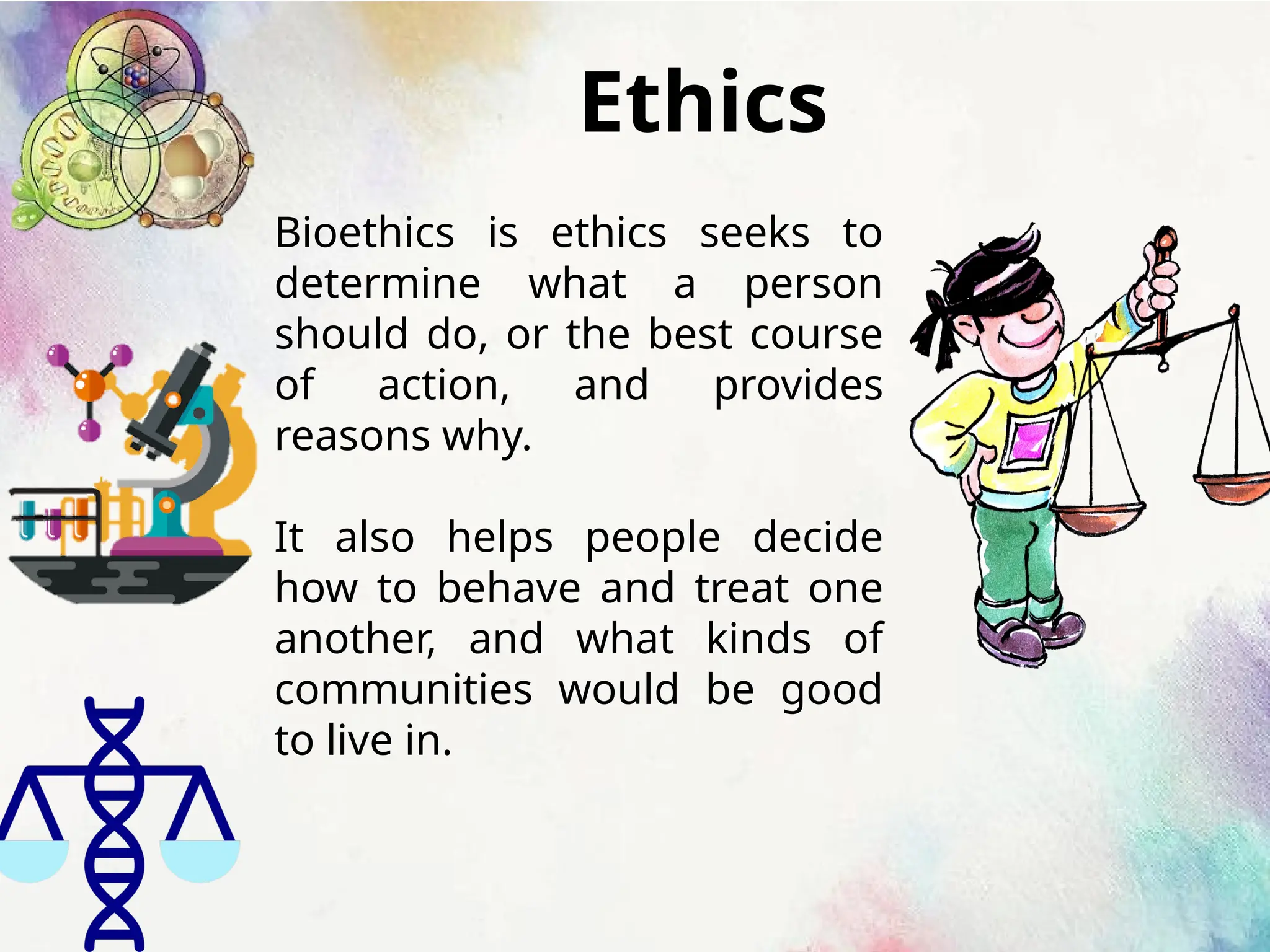
Bioethics is ethicsseeks to
determine what a person
should do, or the best course
of action, and provides
reasons why.
It also helps people decide
how to behave and treat one
another, and what kinds of
communities would be good
to live in.
4.
Ethics
• Greek: ethicos= “custom or “character
• Defined as the philosophical science that deals
with the morality of human conduct
• Establishes the standards or norms of human
acts; Determines human acts as good or bad
and right or wrong
• Science of GOOD and BAD or RIGHT and
WRONG actions
5.
Ethics
∙ Morality ofhuman acts-refers to the
goodness/badness, rightness or the
wrongness of human acts
∙ Morality = Latin: moralitas
∙ One must apply theories of ethics for one to
actually live a good and MORAL life. When one
does this, one is already in the ambiance of
morality = praxis theory
o Ethics provides the theories and the
principles
o Morality actualizes these theories and
principles
6.
Ethics
POSTULATES in ETHICS(presumed to be true):
o Existence of God
o Existence of Intellect and Free Will
o Spirituality and Immortality of Human Soul
7.
Ethics
HUMANS
∙ It isrationality that makes every human
being a unique class of animal
∙ The human person’s perceptual
knowledge helps him/her draw judgments
as he/she compares ideas so that eventually
he/she engages in what is called reasoning
∙ The human person, therefore, does not just
perceive things but also analyzes, criticizes, or
in a word
8.
Ethics
INTELLECT and WILL
oHuman person’s INTELLECT enables
him/her to search for TRUTH;
o Human person’s WILL enables him/her to
choose for one which is deemed good.
o If a person possesses the TRUTH, he/she
can apply what she knows WISDOM,
while his/her exercise of good makes him/her
∙ Polarity in Morality – When a person
exercises his/her freedom to choose between
good and bad or right or wrong actions
9.
BIOLOG
Y
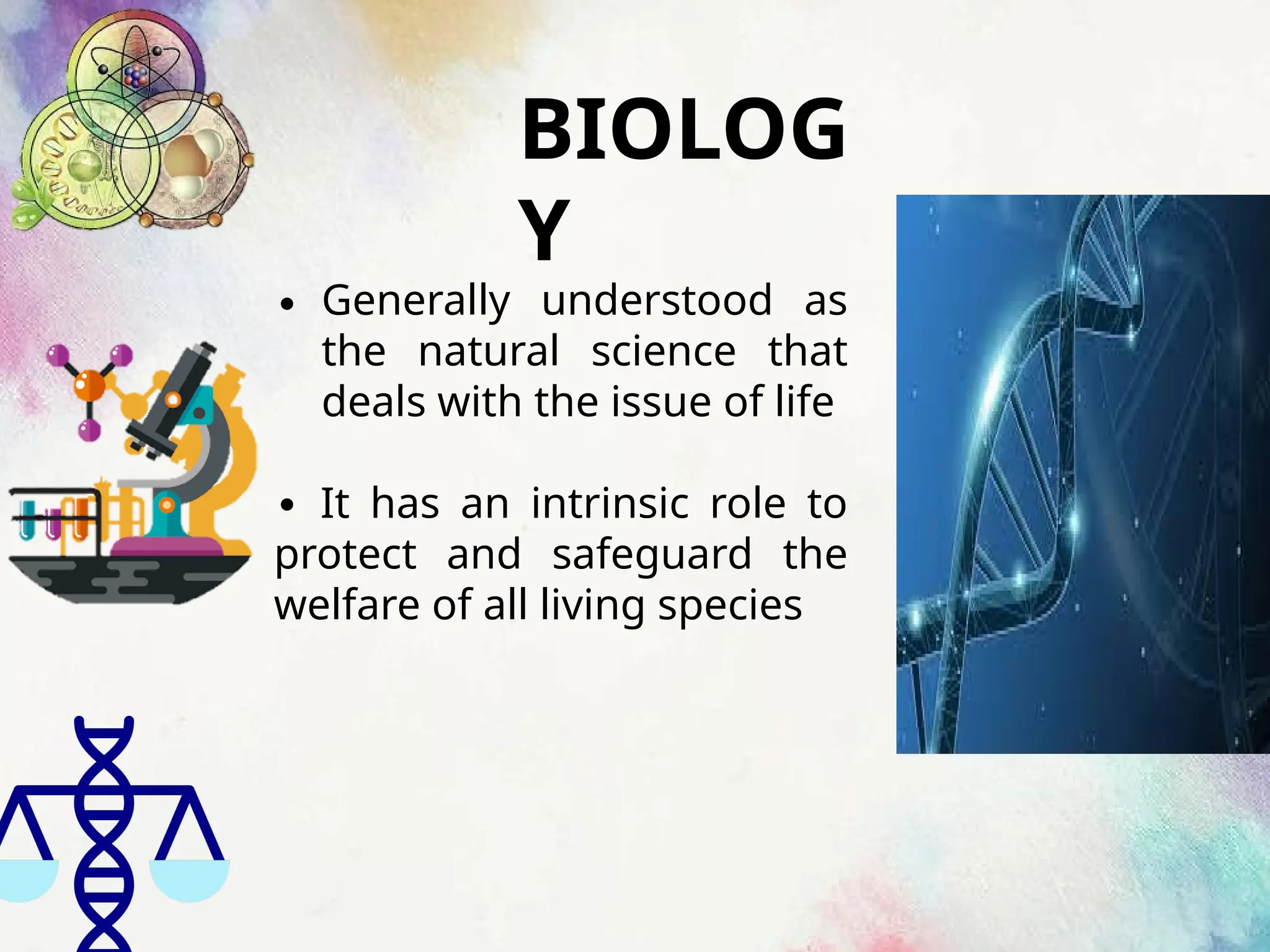
∙ Generally understoodas
the natural science that
deals with the issue of life
∙ It has an intrinsic role to
protect and safeguard the
welfare of all living species
10.
HEALTHCARE ETHICS
∙ Domainin the practice of healthcare
profession that sets the standards or
guidelines relative to studies, inquiries, and
decisions on the part of healthcare
professionals in relation to the delivery of
healthcare
∙ Deals and treats ethical issues such as
withdrawal of life-support system, testing of
diseases, access to healthcare services, brain
death, clinical death, suicide, euthanasia,
vices and virtues, conscience, law, and the
like.
11.
PROFESSIONAL ETHICS
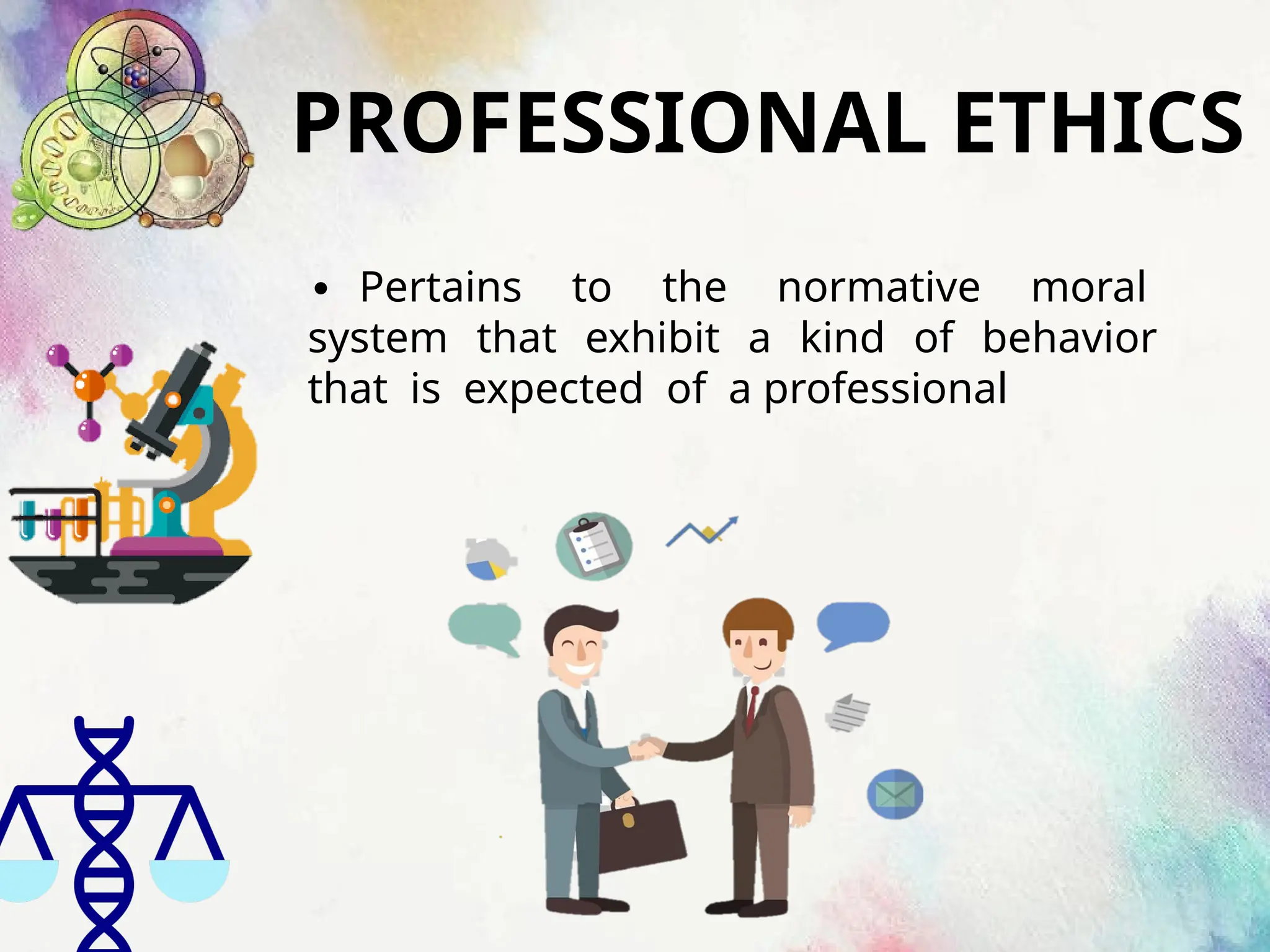
∙ Pertainsto the normative moral
system that exhibit a kind of behavior
that is expected of a professional
12.
BIOETHIC
S
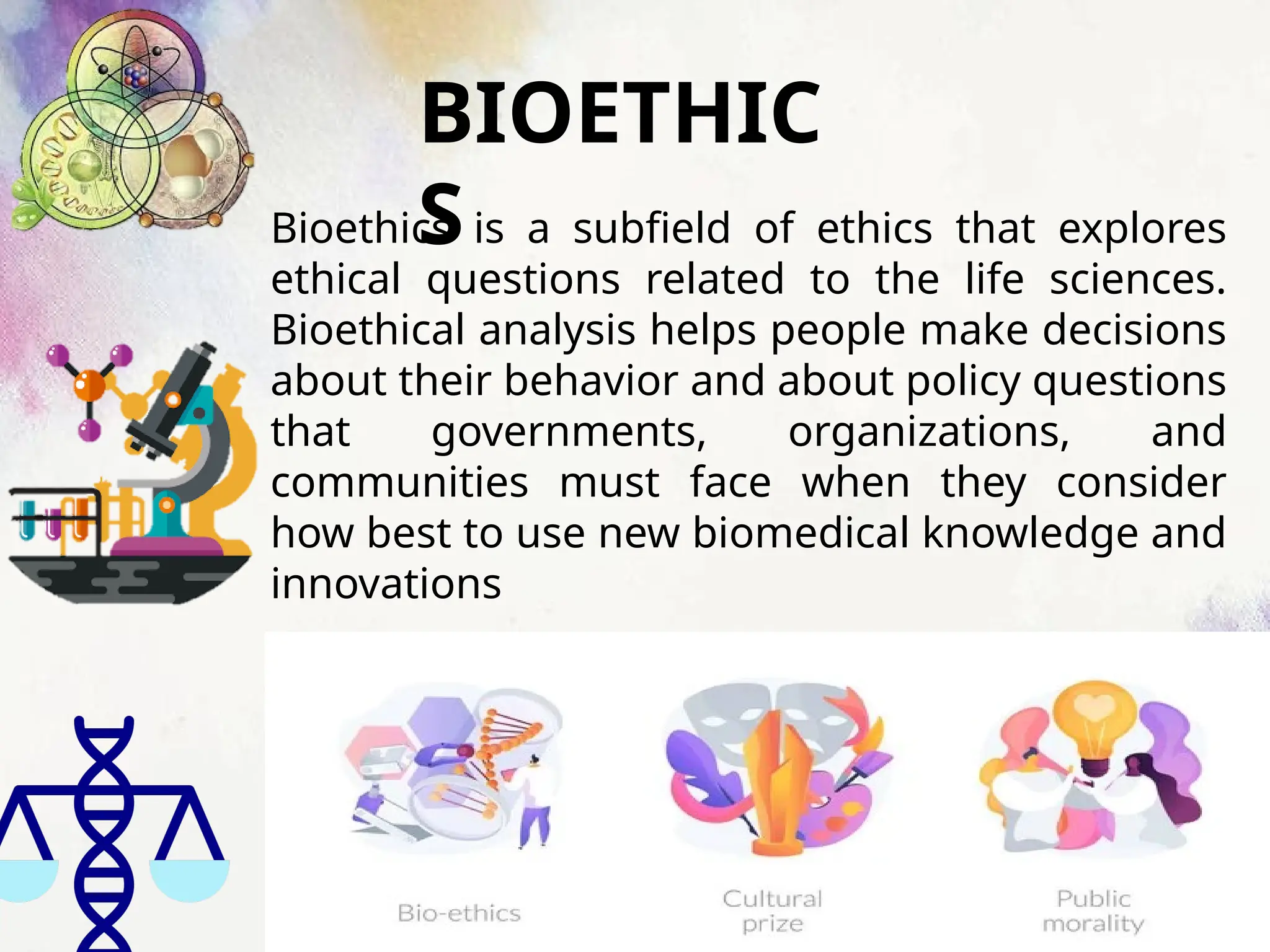
Bioethics is asubfield of ethics that explores
ethical questions related to the life sciences.
Bioethical analysis helps people make decisions
about their behavior and about policy questions
that governments, organizations, and
communities must face when they consider
how best to use new biomedical knowledge and
innovations
13.
BIOETHIC
S
∙ Etymology: bio(life), ethos
(ethics)
∙ Begins from the womb
(conception) and ends to
the tomb (death)
∙ Daniel Callahan – first to
introduce the term
bioethics in 1969, when he,
together with Willard
Gaylin, founded the
Hastings Center
14.
BIOETHIC
S
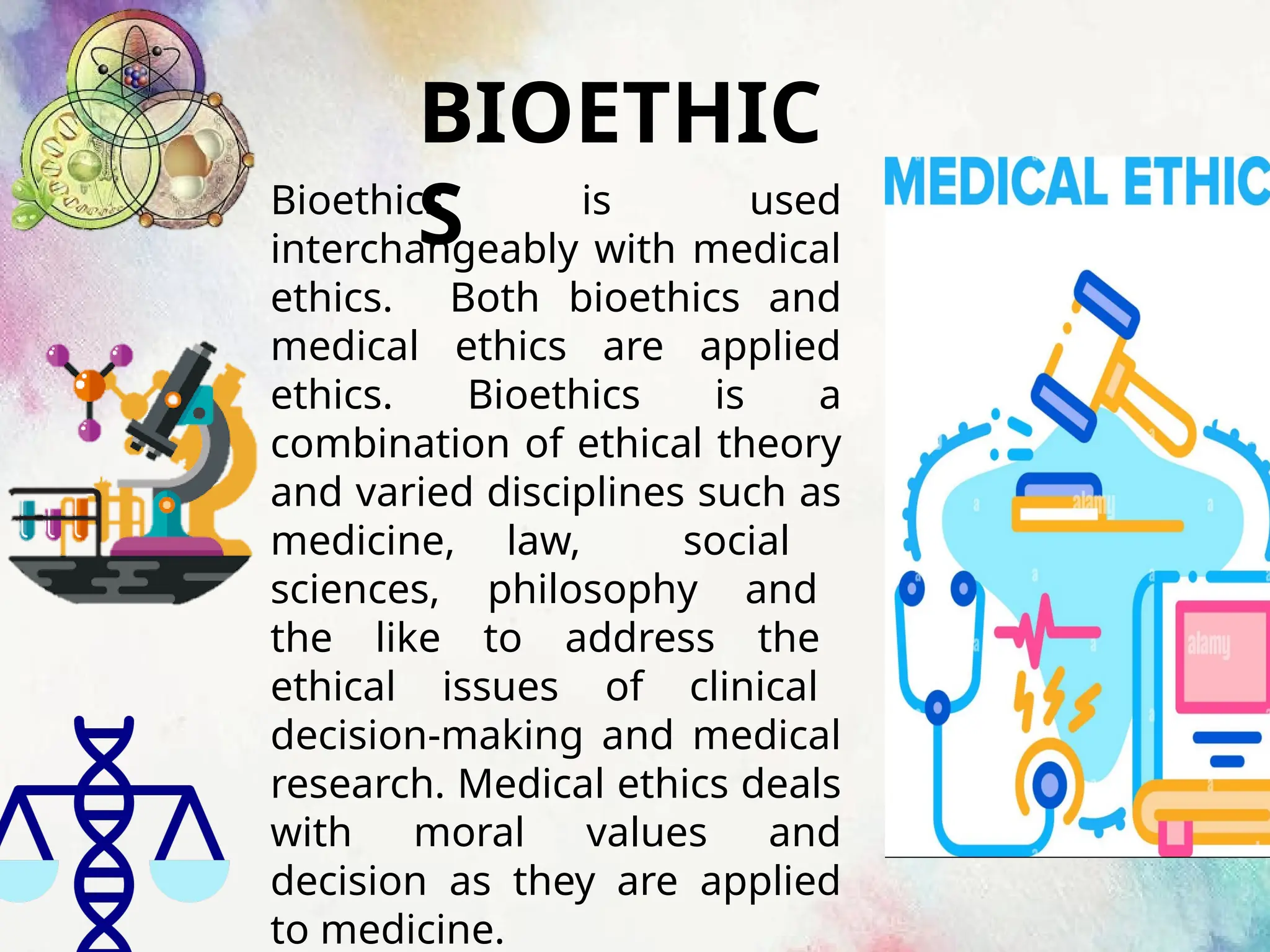
Bioethics is used
interchangeablywith medical
ethics. Both bioethics and
medical ethics are applied
ethics. Bioethics is a
combination of ethical theory
and varied disciplines such as
medicine, law, social
sciences, philosophy and
the like to address the
ethical issues of clinical
decision-making and medical
research. Medical ethics deals
with moral values and
decision as they are applied
to medicine.
15.
Why teach
Bioethics?
Advances inthe life sciences are giving humans
new capacities. New medicines, biomedical
procedures, and ways of altering plants and
animals are bringing benefits to millions of
people.
However, these same innovations also have the
potential to bring harms or to raise other kinds
of ethical questions about their appropriate
use. All citizens will confront questions such as
these
16.
Why teach
Bioethics?
• Isit okay to take steroids to enhance sports
performance?
• How are they different from a high-protein
diet or vitamins?
• How should I decide which ways of
enhancing my natural abilities are
permissible?
17.
Why teach
Bioethics?
• ShouldI take a genetic test to determine
whether I carry the gene for an illness I know is
eventually fatal but there is little I could do to
prevent? If I find out that I carry it, should I tell
my siblings or my spouse? Many of the
questions students will confront, like the ones
above, have to do with decisions individuals will
have to make about their own lives. Other
questions have to do with decisions groups will
have to make that affect the lives of many
individuals. These are public policy decisions.
18.
Why teach
Bioethics?
For Example.Should vaccinations for all
students be mandatory, even when some
parents object?
• What is the fairest way to distribute lifesaving,
but scarce, organs to the thousands of people
who need them? People face all these
questions today.
19.
of
Bioethics?
∙ Build positiveattitude and behavior towards
the chosen professionals.
∙ Show concern for human life and those of
other living organisms.
∙ Produce professionals in body, mind, and
spirit.
∙ Establish a functional philosophy in life.
How Are Bioethicaland
Scientific Questions
Different?
The major difference between bioethical
and scientific inquiry is that scientists seek
to understand phenomena in the world—
they want to describe what is— while
bioethicists seek to figure out what people
should do. This is an oversimplification, but
by emphasizing the difference between the
words is and should,.
22.
How Are Bioethicaland
Scientific Questions
Different?
A scientist might ask, “What are the physical
risks of using steroids?” while an ethicist might
ask, “Should athletes be allowed to use steroids?”
Or, a scientist might ask, “How can we genetically
modify a mouse to produce human antibodies
for use as therapeutics?”— as has been done to
develop treatments for colorectal cancer,
rheumatoid arthritis, and asthma. An ethicist
might ask, “Should we modify a mouse so that it
can produce human antibodies?”
Ethical questions are also different from legal
questions and from questions of personal
preference, custom, or habit
23.
Ethical Principles and
Frameworks
1.Autonomy: Respecting individuals' right to
make decisions about their own healthcare
and ensuring their informed consent.
2. Beneficence: Promoting the well-being and
best interests of individuals, seeking to
maximize benefits and minimize harm.
3. Non-maleficence: The principle of "do no
harm." It requires healthcare professionals
and researchers to avoid causing harm to
individuals and to prevent foreseeable risks
or harm.
4. Justice: Fairness in the distribution of
healthcare resources, access to medical
services, and the allocation of benefits and
burdens.
24.
BIOETHICAL
ISSUES
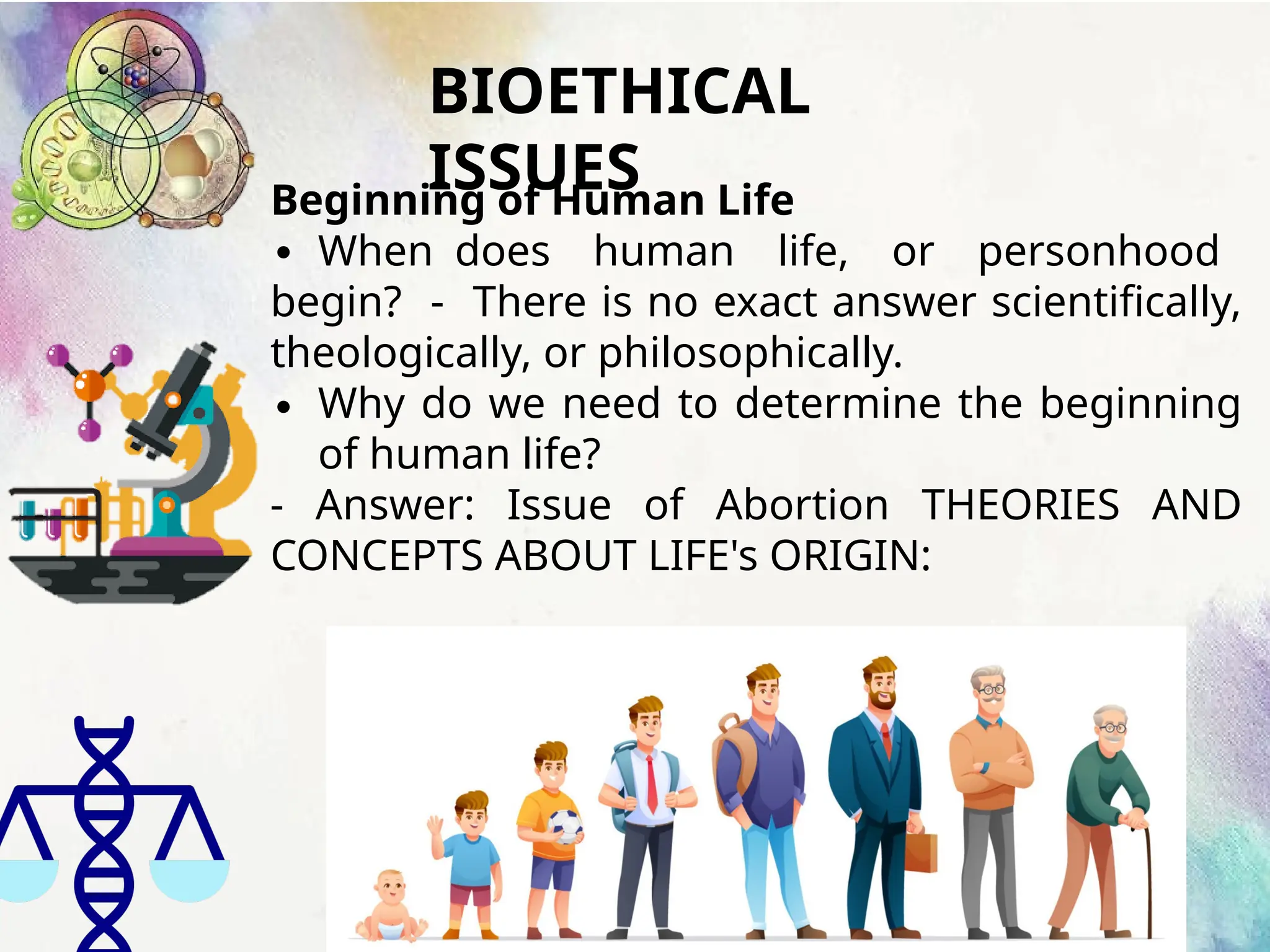
Beginning of HumanLife
∙ When does human life, or personhood
begin? - There is no exact answer scientifically,
theologically, or philosophically.
∙ Why do we need to determine the beginning
of human life?
- Answer: Issue of Abortion THEORIES AND
CONCEPTS ABOUT LIFE's ORIGIN:
25.
BIOETHICAL
ISSUES
Neurological Theory
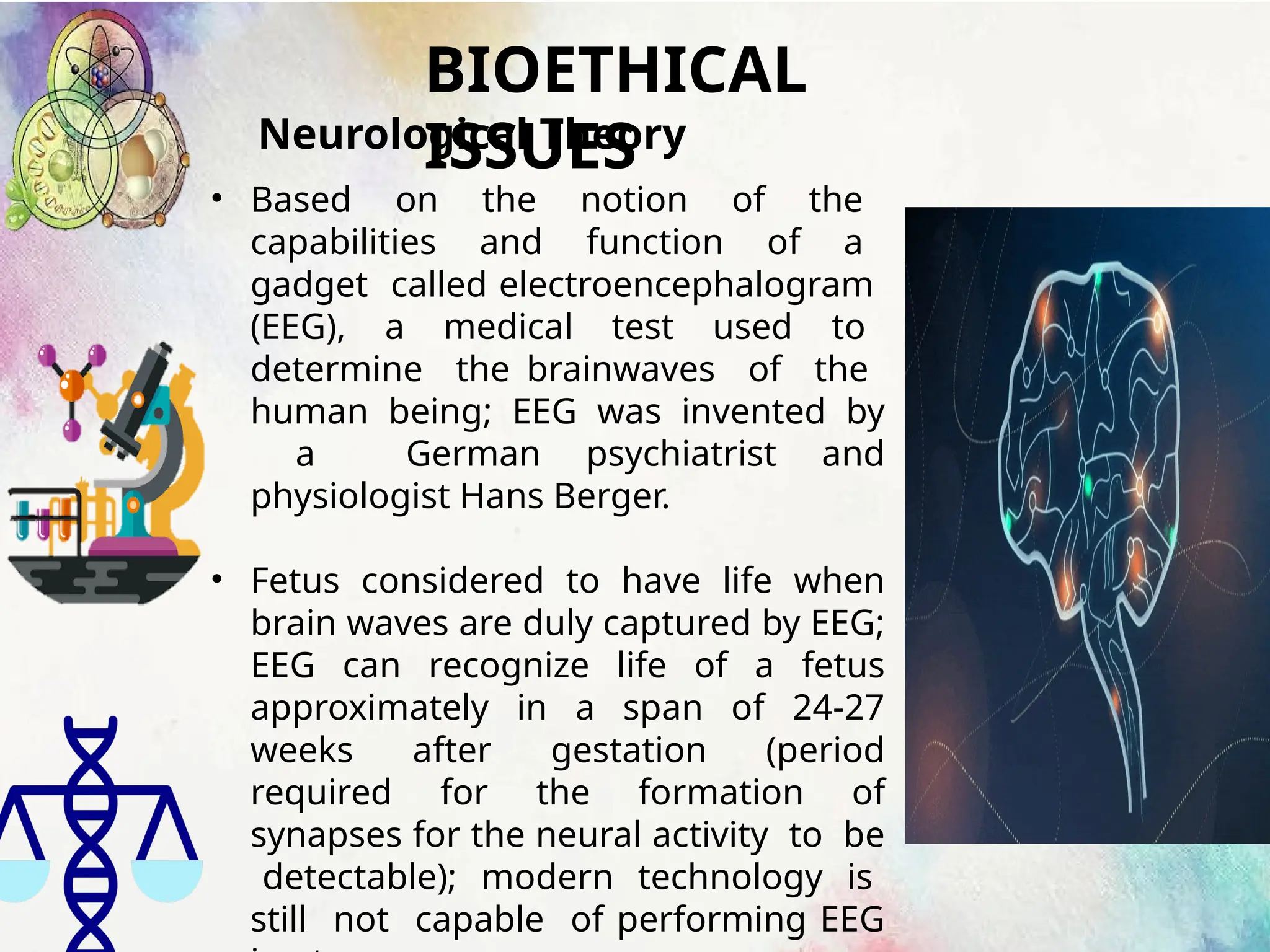
• Basedon the notion of the
capabilities and function of a
gadget called electroencephalogram
(EEG), a medical test used to
determine the brainwaves of the
human being; EEG was invented by
a German psychiatrist and
physiologist Hans Berger.
• Fetus considered to have life when
brain waves are duly captured by EEG;
EEG can recognize life of a fetus
approximately in a span of 24-27
weeks after gestation (period
required for the formation of
synapses for the neural activity to be
detectable); modern technology is
still not capable of performing EEG
26.
BIOETHICAL
ISSUES
Neurological Theory
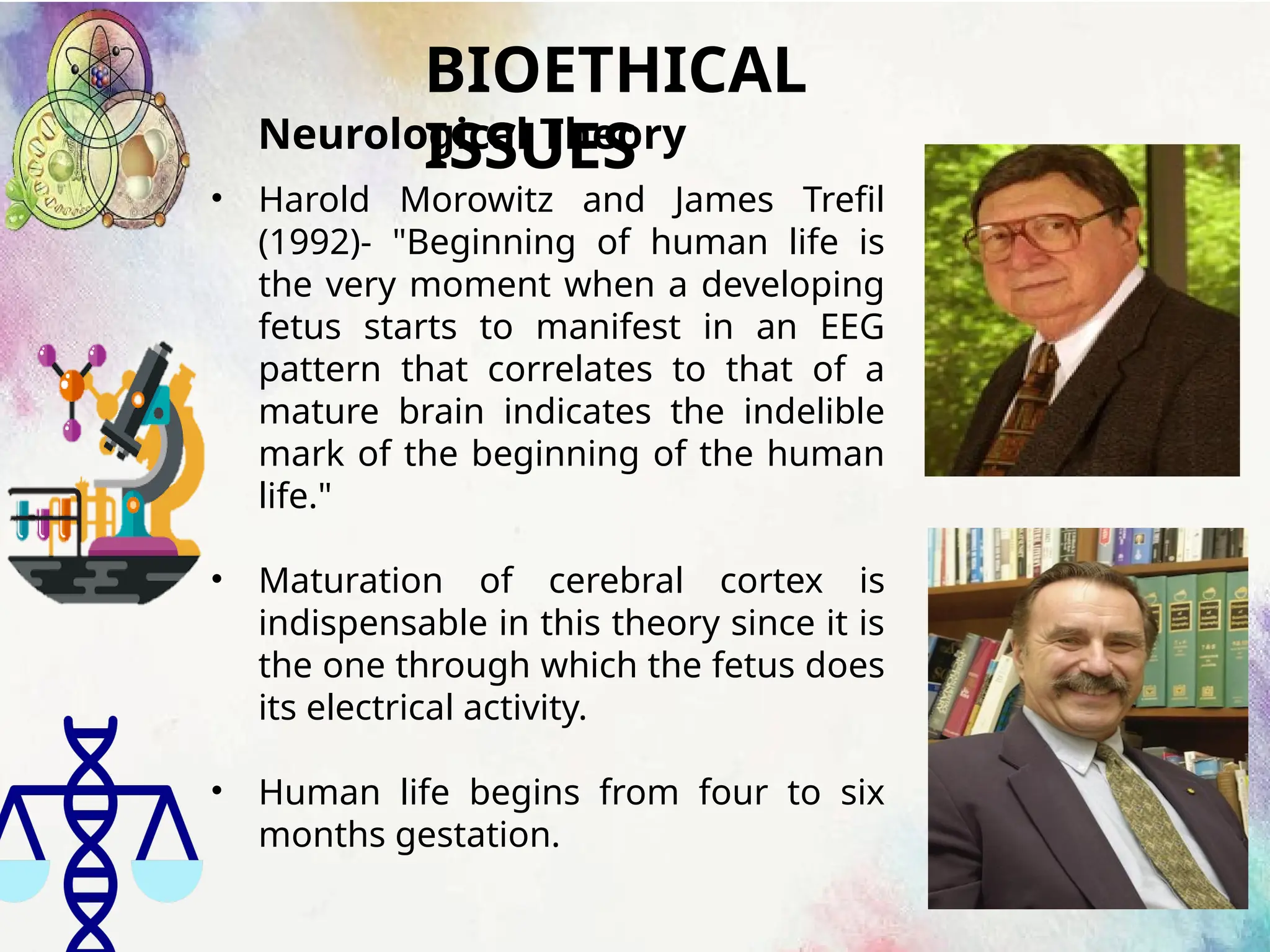
• HaroldMorowitz and James Trefil
(1992)- "Beginning of human life is
the very moment when a developing
fetus starts to manifest in an EEG
pattern that correlates to that of a
mature brain indicates the indelible
mark of the beginning of the human
life."
• Maturation of cerebral cortex is
indispensable in this theory since it is
the one through which the fetus does
its electrical activity.
• Human life begins from four to six
months gestation.
27.
BIOETHICAL
ISSUES
Biological Independence
• Foundedon the notion of viability; Depends on the
maturation of lungs of the growing fetus .
• Viability of human fetus increases significantly
beyond 24 weeks after gestation as the lungs of
the fetus develop progressively towards a saccular
stage (stage of lung development of the fetus
wherein the lung volume increases significantly to
form a saccule/ subdivision of the saccules into
alveoli
28.
BIOETHICAL
ISSUES
Metabolic
• Advocates theidea that there is no such thing as
a fertilization (moment of fusion of the ovum and
the sperm cell that leads to the formation of the
so-called new reality or term zygote).
• Fertilization cannot be exactly determined in as
much as it is, a process that requires 20- 22
hours between the duration when the sperm
cell has successfully penetrated the outmost
layers of the egg cell that results in the formation
of a diploid cell- the cell or organism that
have two sets of chromosomes.
• Proponents of this theory do not accept the
agreed 14th day of approximation of the
complete fertilization that leads to the formation
of an embryo.
29.
BIOETHICAL
ISSUES
Embryological
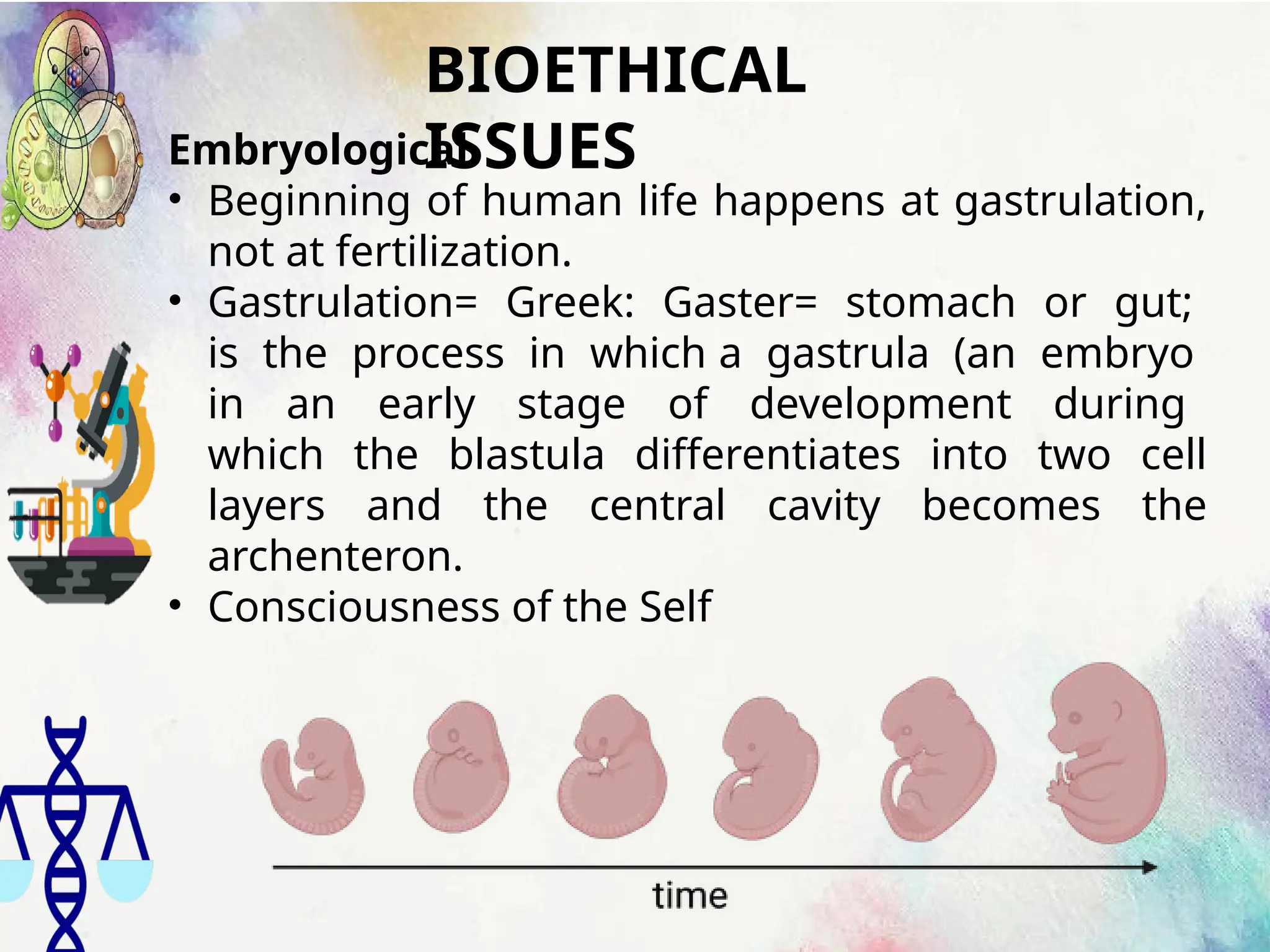
• Beginning ofhuman life happens at gastrulation,
not at fertilization.
• Gastrulation= Greek: Gaster= stomach or gut;
is the process in which a gastrula (an embryo
in an early stage of development during
which the blastula differentiates into two cell
layers and the central cavity becomes the
archenteron.
• Consciousness of the Self
30.
BIOETHICAL
ISSUES
Embryological
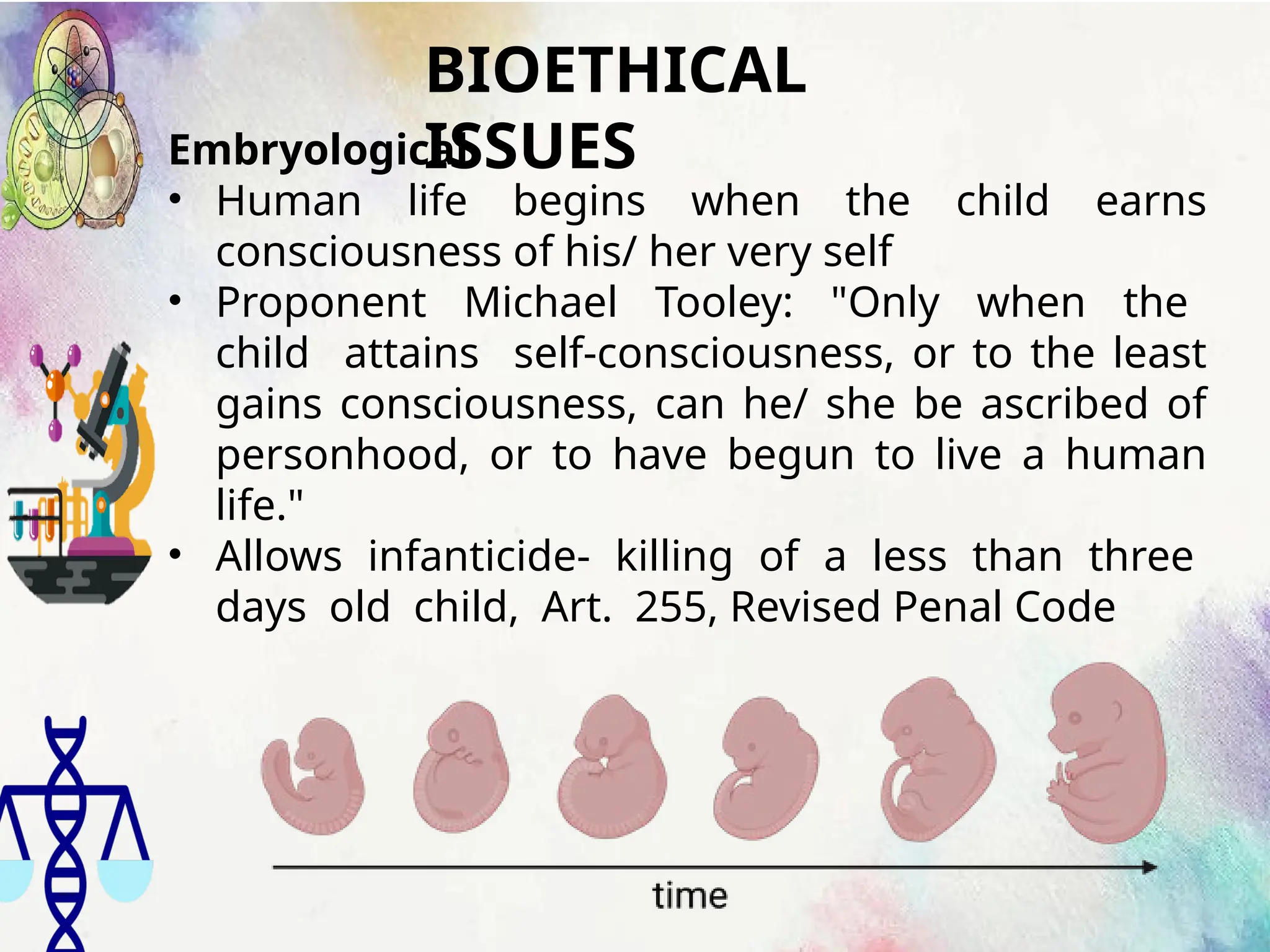
• Human lifebegins when the child earns
consciousness of his/ her very self
• Proponent Michael Tooley: "Only when the
child attains self-consciousness, or to the least
gains consciousness, can he/ she be ascribed of
personhood, or to have begun to live a human
life."
• Allows infanticide- killing of a less than three
days old child, Art. 255, Revised Penal Code
31.
BIOETHICAL
ISSUES
Genetic
• Fertilization orconception occurs the moment the
sperm cell fuses with the egg cell
• Support in consonance with the teachings of the
Catholic Church.
• Fertilization is a process that occurs over a period of
12-24 hours after the actual combination of the
sperm and the egg. The sperm will penetrate into
the egg by passing through the egg's corona radiata
and zona fellucida, the egg will close itself, making a
stern order that there will be no other sperm that
will be accommodated inside.
• Experts claim that approximately, it takes 10 hours
for the sperm to take a successful journey from the
cervix to the fallopian tube, specifically at the
middle part ( or the ampulla), where it usually meets
the egg.
BIOETHICAL
ISSUES
Current Reproductive
Technologies
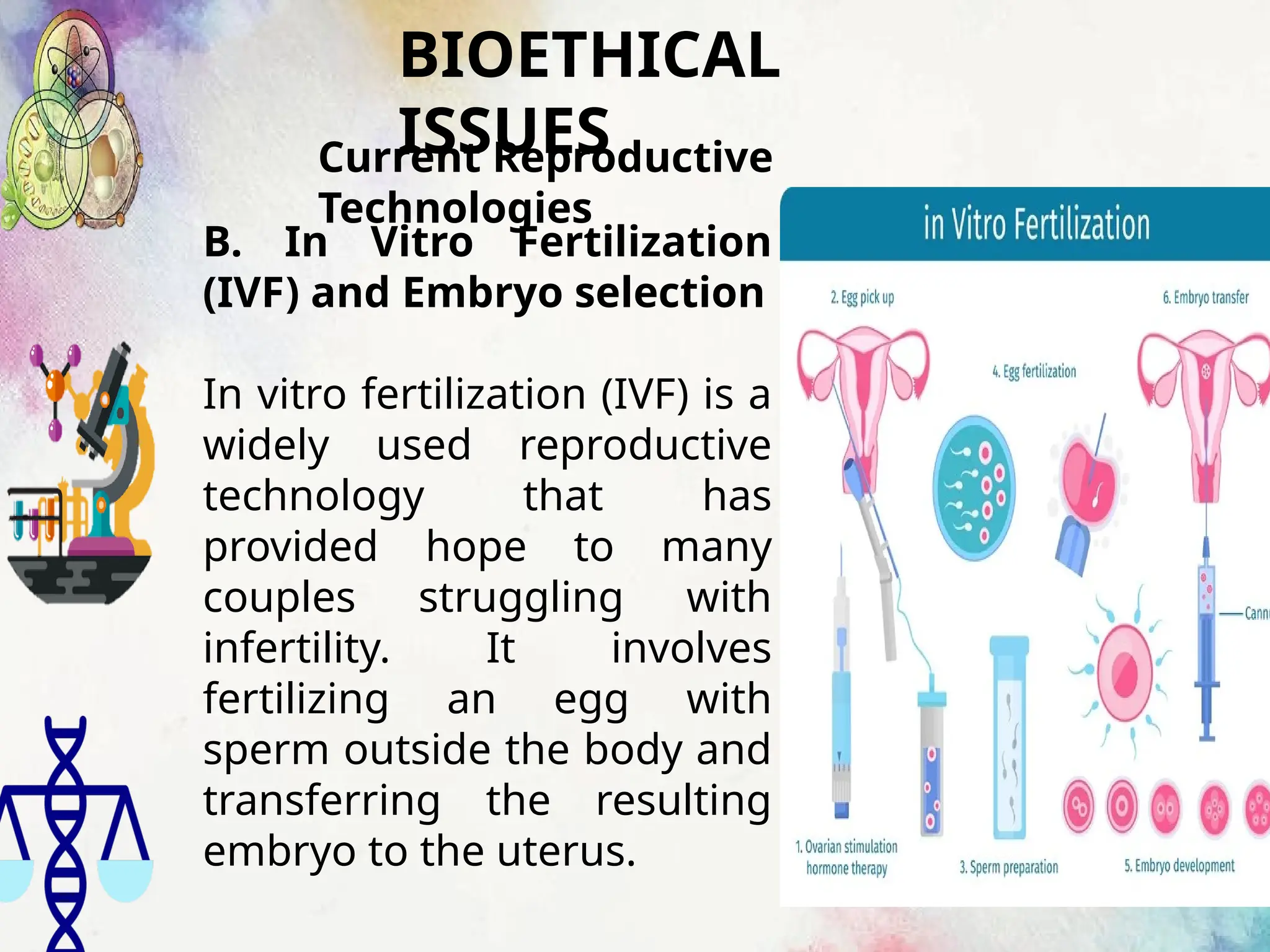
B. InVitro Fertilization
(IVF) and Embryo selection
In vitro fertilization (IVF) is a
widely used reproductive
technology that has
provided hope to many
couples struggling with
infertility. It involves
fertilizing an egg with
sperm outside the body and
transferring the resulting
embryo to the uterus.
34.
BIOETHICAL
ISSUES
Current Reproductive
Technologies
B. InVitro Fertilization (IVF) and Embryo
selection
IVF raises ethical questions, particularly
regarding the practice of embryo selection.
Ethical considerations also include the
disposition of unused embryos, as some may
be cryopreserved for future use, donated to
other couples, or discarded. These decisions
involve questions of parental rights, embryo
ownership, and the moral status of embryos.
35.
BIOETHICAL
ISSUES
Current Reproductive
Technologies
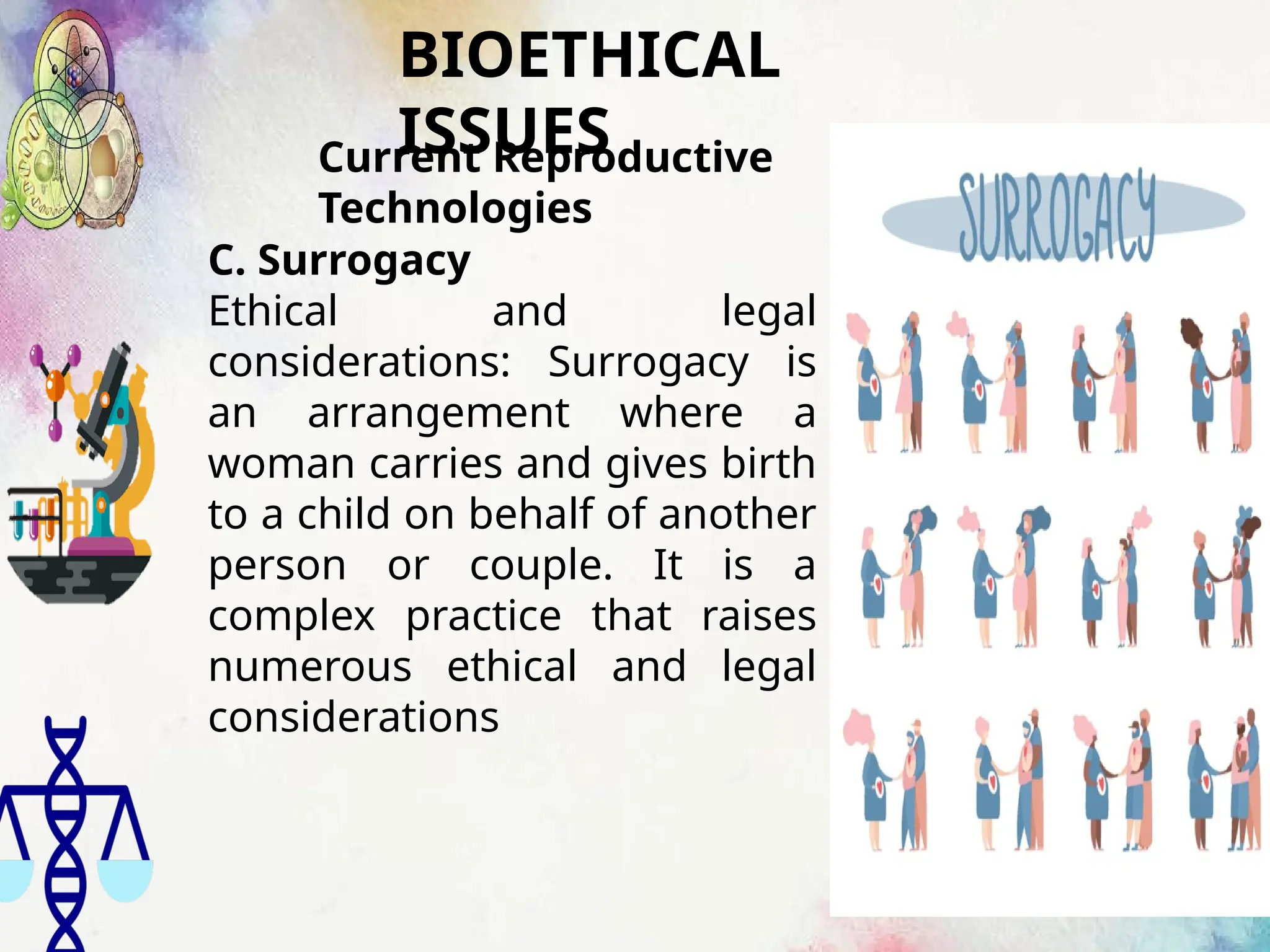
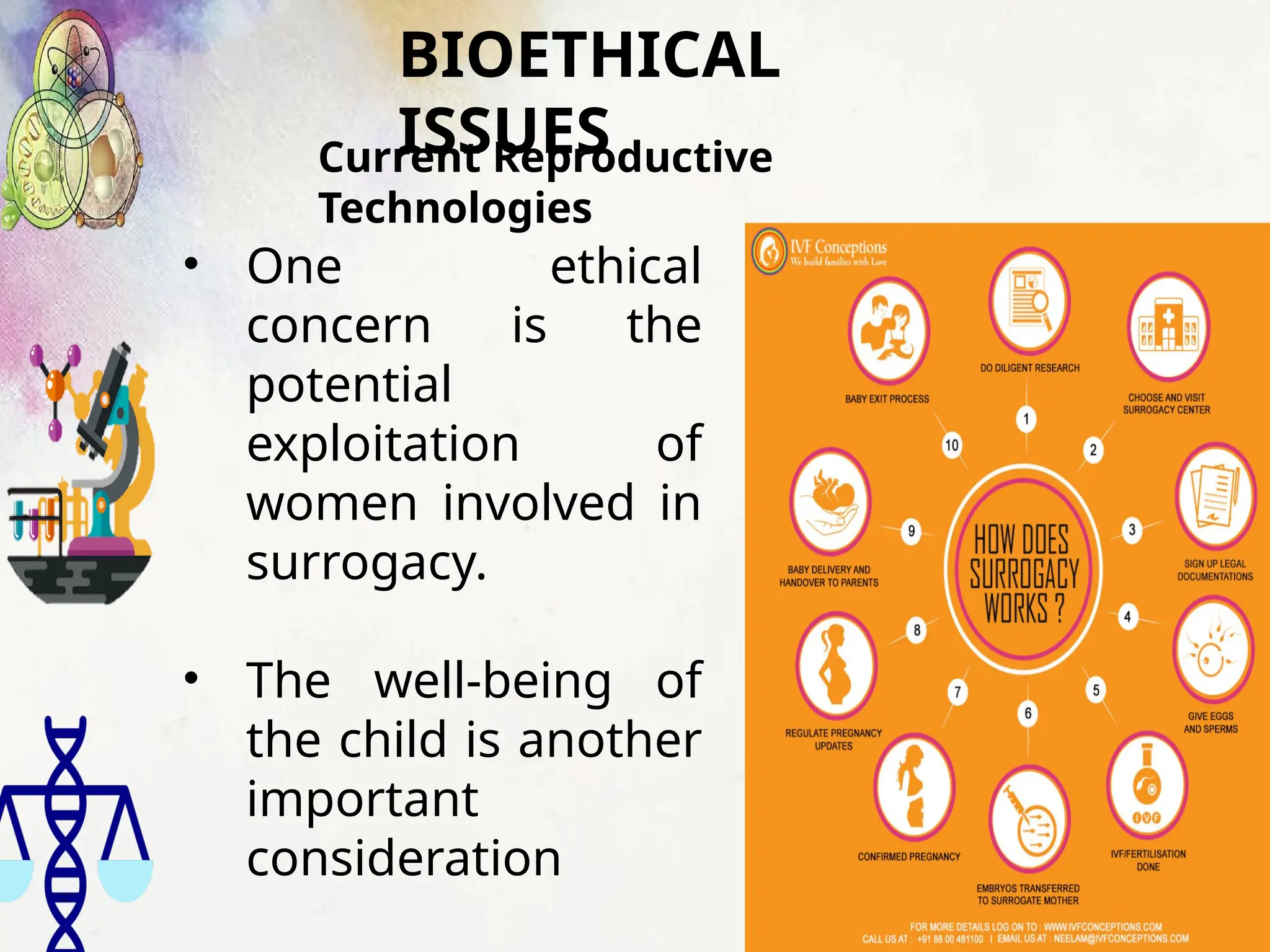
C. Surrogacy
Ethicaland legal
considerations: Surrogacy is
an arrangement where a
woman carries and gives birth
to a child on behalf of another
person or couple. It is a
complex practice that raises
numerous ethical and legal
considerations
36.
BIOETHICAL
ISSUES
Current Reproductive
Technologies
C. Surrogacy
Ethicaland legal
considerations: Surrogacy is
an arrangement where a
woman carries and gives birth
to a child on behalf of another
person or couple. It is a
complex practice that raises
numerous ethical and legal
considerations