Dr. Mohamed Mosaad Hasan
MD, MPH, CPHQ, CPPS, GBSS
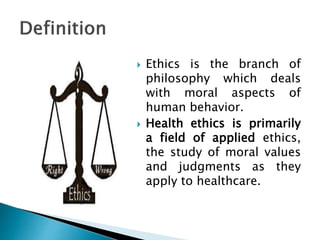
 Ethics is the branch of
philosophy which deals
with moral aspects of
human behavior.
 Health ethics is primarily
a field of applied ethics,
the study of moral values
and judgments as they
apply to healthcare.
• A group of guidelines, such as the Oath of
Hippocrates, generally written by physicians,
about the physician’s ideal relationship to his
peers and to his patients
 The basic concept of medical ethics is that
the physician has a moral (and at times legal)
obligation to act for the patient’s good, using
the most up-to-date information.
 The question is how to establish that “good,”
who defines it, and what are the components
thereof.
• Significant technological and scientific
advances and changes in clinical medicine
and research have produced totally new
ethical dilemmas and exacerbated old ones.
• The change in philosophy from paternalism
to autonomy in the physician-patient
relationship.
• The involvement of additional caregivers
(various medical specialists, a variety of
health professionals, students, administrators
and investigators).
 The involvement of society at large (through
the mass communication media, courts,
legislators).
 Ethical decisions are based on what is best
for the common good and, generally, exceed
what is required by law.
 Legal decisions are based on what is
mandated by statutes or case law
• Scientific and humanistic components must
be combined.
• The subjective feelings of the patient, which
are based on personal, social, cultural, and
economic value systems, must be
considered.
Video: Tuskegee Syphilis Project
In 1990, Executive Editor Dr. Marcia Angell of
the New England Journal of Medicine
reiterated the journal’s position that only
research conducted in accordance with the
rights of human subjects would be published.
The results of unethical research would not
be published, regardless of scientific merit.
 The Belmont Report distinguished between
research and practice
 Practice includes interventions designed to enhance
the well-being of a patient through either
diagnosis or treatment and that have a reasonable
expectation of success.
 Research was defined as “an activity designed to
test a hypothesis, permit conclusions to be drawn,
and thereby to develop or contribute to
generalizable knowledge (expressed, for example,
in theories, principles, and statements of
relationships).
The IRB must
􀁹 Identify risks of the research
􀁹 Minimize risks as much as possible
􀁹 Identify probable benefits
􀁹 Evaluate the risks in relation to the benefits
􀁹 ensure that research subjects are provided
with an accurate and fair description of the
risks, discomforts, and anticipated benefits,
 (6) ensure that research subjects are offered
the opportunity to voluntarily accept or reject
participation in the research, or discontinue
participation, without coercion or fear of
reprisal or deprivation of treatment to which
the patient is otherwise entitled,
 (8) and (7) determine intervals of periodic
review and, when necessary, determine the
adequacy of mechanisms for monitoring data
collection.
1. Beneficence - a practitioner should act in
the best interest of the patient.
2. Non-malfeasance - "first, do no harm".
3. Autonomy - the patient has the right to
refuse or choose their treatment.
4. Justice - concerns the distribution of scarce
health resources, and the decision of who
gets what treatment (fairness and equality).
5. Non discriminatory treatment.
6. Dignity - the patient (and the person
treating the patient) have the right to dignity.
7. Truthfulness and honesty - the concept of
informed consent has increased in
importance since the historical events of the
Doctors‘ Trial of the Nuremberg trials and
Tuskegee Syphilis Study.
For example, the principles of autonomy and
beneficence clash when patients refuse life-
saving blood transfusion, and truth-telling
was not emphasized to a large extent before
the HIV era.
• The moral obligation to do good for others,
and to help them in an active way.
• there are limits to the requirement that one
act to help others at all times. These vary with
the degree of need, the ease and ability with
which the help can be rendered, and the
nature of the relationship between the
individual needing help and the one able to
provide it.
Paternalism is an approach in which the
physician chooses the treatment for the
patient because the physician’s professional
knowledge, experience and objectivity best
qualify him to judge the ideal treatment for
the patient.
• Autonomy means that only the patient knows
what is best for him and only he has the right
to decide. In order to do so he/ she needs to
receive from the physician all the appropriate
information about his condition to permit him
to make an informed decision.
• The physician’s values, and even less his
professional knowledge and experience, play
no role in the final decision.
Traditionally, the physician’s role was viewed
as giving “orders” to nurses and to patients
(e.g. order-entry, physician orders, etc.). In
the atmosphere of autonomy, physicians
must use a different language such as advise,
recommendation, etc.
 The main criticism of pure autonomy is that
the physician has little influence on the
patient’s decision, which is often based on a
lack of full understanding of his condition.
• Such a decision may cause unnecessary and
avoidable harm to the patient
 Respect for autonomy is the basis for
informed consent and advance directives.
• Individuals’ capacity for informed decision
making may come into question during
resolution of conflicts between Autonomy and
Beneficence.
 is defined as the obligation not to harm
others and to remove and prevent potential
harm. DO NO HARM!!
• Thus, one must not only prevent intentional
harm but must also be appropriately cautious
not to cause harm.
• Some interventions undertaken by physicians can
create a positive outcome while also potentially
doing harm. The combination of these two
circumstances is known as the "double effect."
• The most applicable example of this
phenomenon is the use of morphine in the dying
patient. Such use of morphine can ease the pain
and suffering of the patient, while simultaneously
hastening the demise of the patient through
suppression of the respiratory drive.
 Uninformed agent is at risk of mistakenly
making a choice not reflective of his or her
values.
• The value of informed consent is closely
related to the values of autonomy and truth
telling.
 Patient Rights and
Responsibilities.
 Advance Directives: Patients can
delegate decision-making authority to
another party. If the patient is
incapacitated, the next-of-kin make
decisions for the incapacitated patient.
􀁹 Governed at the state level.
􀁹 Requires a physician order
􀁹 Documented in the medical record
􀁹 Requires clear policy and procedure
􀁹 Documented education of patient, family and
staff
􀁹 Does not require an advance directive as a
precondition
 This concept is commonly
known as patient-physician
privilege.
 Legal protections prevent
physicians from revealing
their discussions with
patients, even under oath in
court.
• Confidentiality is challenged in cases such as
the diagnosis of a sexually transmitted
disease in a patient who refuses to reveal the
diagnosis to a spouse, or in the termination
of a pregnancy in an underage patient,
without the knowledge of the patient's
parents.
• “ethical conflicts" in medical ethics are
traceable back to a lack of communication.
• Communication breakdowns between
patients and their healthcare team, between
family members, or between members of the
medical community, can all lead to
disagreements and strong feelings.
• Many times, simple communication is not
enough to resolve a conflict, and a hospital
ethics committee of ad hoc nature must
convene to decide a complex matter.
• Permanent bodies, ethical boards are
established to a greater extent as ethical
issues tend to increase. These bodies are
comprised of health care professionals,
religious leaders, and lay people.
Some cultures do not place a great emphasis
on informing the patient of the diagnosis,
especially when cancer is the diagnosis.
 Physicians should not allow a conflict of
interest to influence medical judgment.
• In some cases, conflicts are hard to avoid,
and doctors have a responsibility to avoid
entering such situations.
• Unfortunately, research has shown that
conflicts of interests are very common among
both academic physicians and physicians in
practice.
• For example, doctors who receive income
from referring patients for medical tests have
been shown to refer more patients for
medical tests.
 Studies show that doctors can be influenced by
drug company inducements, including gifts and
food.
• Industry-sponsored Continuing Medical
Education (CME) programs influence prescribing
patterns.
• A growing movement among physicians is
attempting to diminish the influence of
pharmaceutical industry marketing upon medical
practice, as evidenced by Stanford University's
ban on drug company-sponsored lunches and
gifts.
􀁹 Life-sustaining treatment is any treatment
that serves to prolong life without reversing
the medical condition
􀁹 Clear policy and procedure
􀁹 Examples of such treatment
– Mechanical ventilation
– Renal dialysis
– Artificial nutrition and hydration
– Antibiotics
– Blood products
􀁹 Patient must be:
– Of age.
– Able to understand the nature of the
situation and the consequences of the
decision.
– Able to communicate the wishes to the
caregiver.
􀁹 Capacity normally is determined by the
physician
􀁹 Capacity is presumed unless there is a
reason to question it.
􀁹 Capacity may come and go so act as close to
the time of capacity as possible.
􀁹 Do not abandon the patient; arrange
transfer.
􀁹 Have appropriate policies.
􀁹 Be sure decisions are based on medical
issues, not age, social status, etc.
􀁹 Avoid court if at all possible.
􀁹 Negotiate with the patient, surrogates, and
health care providers, if necessary.
􀁹 Use the Ethics Committee.
􀁹 Chairperson should be well educated or
trained in ethical issues.
􀁹 Appropriate medical and clinical staff should
be included.
􀁹 There should be a clerical representative
from the religious community.
􀁹 A layperson from the community should be a
member.
􀁹 Decisions are nonbinding.
􀁹 The risk manager should:
– Be a neutral party during the discussions.
– Serve as a facilitator.
– Act as a consultant on legal issues.
– Develop an ethics consultation mechanism.
􀁹 Abortion and reproductive rights
􀁹 End-of-life or futile care
􀁹 Quality of life
􀁹 Advance directives
􀁹 DNRs
􀁹 Staff rights that conflict with patient wishes
The committee that generally is charged with
oversight of investigative patient research is
the:
A. Bioethics Committee.
B. Institutional Review Board.
C. Utilization Review Committee.
D. Quality Improvement Committee.
If a patient's physician and agent disagree
about what course of action is best for the
patient, the best course of action is to:
A. Refer the case to the Ethics Committee.
B. Follow the wishes of the patient's agent.
C. Allow the physician to make the decision
since he is ultimately liable.
D. Seek guidance from the appropriate court.
Bioethics

Bioethics

  • 1.
    Dr. Mohamed MosaadHasan MD, MPH, CPHQ, CPPS, GBSS
  • 2.
     Ethics isthe branch of philosophy which deals with moral aspects of human behavior.  Health ethics is primarily a field of applied ethics, the study of moral values and judgments as they apply to healthcare.
  • 3.
    • A groupof guidelines, such as the Oath of Hippocrates, generally written by physicians, about the physician’s ideal relationship to his peers and to his patients
  • 4.
     The basicconcept of medical ethics is that the physician has a moral (and at times legal) obligation to act for the patient’s good, using the most up-to-date information.  The question is how to establish that “good,” who defines it, and what are the components thereof.
  • 6.
    • Significant technologicaland scientific advances and changes in clinical medicine and research have produced totally new ethical dilemmas and exacerbated old ones. • The change in philosophy from paternalism to autonomy in the physician-patient relationship. • The involvement of additional caregivers (various medical specialists, a variety of health professionals, students, administrators and investigators).
  • 7.
     The involvementof society at large (through the mass communication media, courts, legislators).
  • 8.
     Ethical decisionsare based on what is best for the common good and, generally, exceed what is required by law.  Legal decisions are based on what is mandated by statutes or case law
  • 9.
    • Scientific andhumanistic components must be combined. • The subjective feelings of the patient, which are based on personal, social, cultural, and economic value systems, must be considered.
  • 10.
  • 11.
    In 1990, ExecutiveEditor Dr. Marcia Angell of the New England Journal of Medicine reiterated the journal’s position that only research conducted in accordance with the rights of human subjects would be published. The results of unethical research would not be published, regardless of scientific merit.
  • 12.
     The BelmontReport distinguished between research and practice  Practice includes interventions designed to enhance the well-being of a patient through either diagnosis or treatment and that have a reasonable expectation of success.  Research was defined as “an activity designed to test a hypothesis, permit conclusions to be drawn, and thereby to develop or contribute to generalizable knowledge (expressed, for example, in theories, principles, and statements of relationships).
  • 13.
    The IRB must 􀁹Identify risks of the research 􀁹 Minimize risks as much as possible 􀁹 Identify probable benefits 􀁹 Evaluate the risks in relation to the benefits 􀁹 ensure that research subjects are provided with an accurate and fair description of the risks, discomforts, and anticipated benefits,
  • 14.
     (6) ensurethat research subjects are offered the opportunity to voluntarily accept or reject participation in the research, or discontinue participation, without coercion or fear of reprisal or deprivation of treatment to which the patient is otherwise entitled,  (8) and (7) determine intervals of periodic review and, when necessary, determine the adequacy of mechanisms for monitoring data collection.
  • 15.
    1. Beneficence -a practitioner should act in the best interest of the patient. 2. Non-malfeasance - "first, do no harm". 3. Autonomy - the patient has the right to refuse or choose their treatment. 4. Justice - concerns the distribution of scarce health resources, and the decision of who gets what treatment (fairness and equality). 5. Non discriminatory treatment.
  • 16.
    6. Dignity -the patient (and the person treating the patient) have the right to dignity. 7. Truthfulness and honesty - the concept of informed consent has increased in importance since the historical events of the Doctors‘ Trial of the Nuremberg trials and Tuskegee Syphilis Study.
  • 18.
    For example, theprinciples of autonomy and beneficence clash when patients refuse life- saving blood transfusion, and truth-telling was not emphasized to a large extent before the HIV era.
  • 19.
    • The moralobligation to do good for others, and to help them in an active way. • there are limits to the requirement that one act to help others at all times. These vary with the degree of need, the ease and ability with which the help can be rendered, and the nature of the relationship between the individual needing help and the one able to provide it.
  • 20.
    Paternalism is anapproach in which the physician chooses the treatment for the patient because the physician’s professional knowledge, experience and objectivity best qualify him to judge the ideal treatment for the patient.
  • 21.
    • Autonomy meansthat only the patient knows what is best for him and only he has the right to decide. In order to do so he/ she needs to receive from the physician all the appropriate information about his condition to permit him to make an informed decision. • The physician’s values, and even less his professional knowledge and experience, play no role in the final decision.
  • 22.
    Traditionally, the physician’srole was viewed as giving “orders” to nurses and to patients (e.g. order-entry, physician orders, etc.). In the atmosphere of autonomy, physicians must use a different language such as advise, recommendation, etc.
  • 23.
     The maincriticism of pure autonomy is that the physician has little influence on the patient’s decision, which is often based on a lack of full understanding of his condition. • Such a decision may cause unnecessary and avoidable harm to the patient
  • 24.
     Respect forautonomy is the basis for informed consent and advance directives. • Individuals’ capacity for informed decision making may come into question during resolution of conflicts between Autonomy and Beneficence.
  • 25.
     is definedas the obligation not to harm others and to remove and prevent potential harm. DO NO HARM!! • Thus, one must not only prevent intentional harm but must also be appropriately cautious not to cause harm.
  • 26.
    • Some interventionsundertaken by physicians can create a positive outcome while also potentially doing harm. The combination of these two circumstances is known as the "double effect." • The most applicable example of this phenomenon is the use of morphine in the dying patient. Such use of morphine can ease the pain and suffering of the patient, while simultaneously hastening the demise of the patient through suppression of the respiratory drive.
  • 28.
     Uninformed agentis at risk of mistakenly making a choice not reflective of his or her values. • The value of informed consent is closely related to the values of autonomy and truth telling.
  • 29.
     Patient Rightsand Responsibilities.  Advance Directives: Patients can delegate decision-making authority to another party. If the patient is incapacitated, the next-of-kin make decisions for the incapacitated patient.
  • 30.
    􀁹 Governed atthe state level. 􀁹 Requires a physician order 􀁹 Documented in the medical record 􀁹 Requires clear policy and procedure 􀁹 Documented education of patient, family and staff 􀁹 Does not require an advance directive as a precondition
  • 31.
     This conceptis commonly known as patient-physician privilege.  Legal protections prevent physicians from revealing their discussions with patients, even under oath in court.
  • 32.
    • Confidentiality ischallenged in cases such as the diagnosis of a sexually transmitted disease in a patient who refuses to reveal the diagnosis to a spouse, or in the termination of a pregnancy in an underage patient, without the knowledge of the patient's parents.
  • 33.
    • “ethical conflicts"in medical ethics are traceable back to a lack of communication. • Communication breakdowns between patients and their healthcare team, between family members, or between members of the medical community, can all lead to disagreements and strong feelings.
  • 34.
    • Many times,simple communication is not enough to resolve a conflict, and a hospital ethics committee of ad hoc nature must convene to decide a complex matter. • Permanent bodies, ethical boards are established to a greater extent as ethical issues tend to increase. These bodies are comprised of health care professionals, religious leaders, and lay people.
  • 35.
    Some cultures donot place a great emphasis on informing the patient of the diagnosis, especially when cancer is the diagnosis.
  • 36.
     Physicians shouldnot allow a conflict of interest to influence medical judgment. • In some cases, conflicts are hard to avoid, and doctors have a responsibility to avoid entering such situations. • Unfortunately, research has shown that conflicts of interests are very common among both academic physicians and physicians in practice.
  • 37.
    • For example,doctors who receive income from referring patients for medical tests have been shown to refer more patients for medical tests.
  • 38.
     Studies showthat doctors can be influenced by drug company inducements, including gifts and food. • Industry-sponsored Continuing Medical Education (CME) programs influence prescribing patterns. • A growing movement among physicians is attempting to diminish the influence of pharmaceutical industry marketing upon medical practice, as evidenced by Stanford University's ban on drug company-sponsored lunches and gifts.
  • 39.
    􀁹 Life-sustaining treatmentis any treatment that serves to prolong life without reversing the medical condition 􀁹 Clear policy and procedure 􀁹 Examples of such treatment – Mechanical ventilation – Renal dialysis – Artificial nutrition and hydration – Antibiotics – Blood products
  • 40.
    􀁹 Patient mustbe: – Of age. – Able to understand the nature of the situation and the consequences of the decision. – Able to communicate the wishes to the caregiver. 􀁹 Capacity normally is determined by the physician
  • 41.
    􀁹 Capacity ispresumed unless there is a reason to question it. 􀁹 Capacity may come and go so act as close to the time of capacity as possible.
  • 42.
    􀁹 Do notabandon the patient; arrange transfer. 􀁹 Have appropriate policies. 􀁹 Be sure decisions are based on medical issues, not age, social status, etc. 􀁹 Avoid court if at all possible. 􀁹 Negotiate with the patient, surrogates, and health care providers, if necessary. 􀁹 Use the Ethics Committee.
  • 43.
    􀁹 Chairperson shouldbe well educated or trained in ethical issues. 􀁹 Appropriate medical and clinical staff should be included. 􀁹 There should be a clerical representative from the religious community. 􀁹 A layperson from the community should be a member. 􀁹 Decisions are nonbinding.
  • 44.
    􀁹 The riskmanager should: – Be a neutral party during the discussions. – Serve as a facilitator. – Act as a consultant on legal issues. – Develop an ethics consultation mechanism.
  • 45.
    􀁹 Abortion andreproductive rights 􀁹 End-of-life or futile care 􀁹 Quality of life 􀁹 Advance directives 􀁹 DNRs 􀁹 Staff rights that conflict with patient wishes
  • 46.
    The committee thatgenerally is charged with oversight of investigative patient research is the: A. Bioethics Committee. B. Institutional Review Board. C. Utilization Review Committee. D. Quality Improvement Committee.
  • 47.
    If a patient'sphysician and agent disagree about what course of action is best for the patient, the best course of action is to: A. Refer the case to the Ethics Committee. B. Follow the wishes of the patient's agent. C. Allow the physician to make the decision since he is ultimately liable. D. Seek guidance from the appropriate court.