Genetic Polymorphism
Awais Ali
(Email; awaismalik0306@gmail.com)
University of Agriculture Faislabad,
Pakistan
•History
•Introduction
•Differences
•Types
•Identification
•Clinical Significance
•Applications
•Conclusion
•References
Contents
•Originally defined by Ford in 1940.
•E. B. Ford and his co-workers from(1920-70s) worked on
it.
•Later Cavalli-Sforza & Bodmer defined in 1971.
•Occurrence of multiple alleles at one locus in same
population, where at least two alleles occur with
minimum frequency is 1%.
History
•Genetics derived genetikos meaning
"generative" derived , genesis meaning "origin".
•Study of Genes ,Genetic variation and Heredity in
living organisms.
➢Polymorphism
•Combination of Greek words poly (multiple) and
morph (form).
•Multiple forms of a single gene , exists in an
individual or group of individuals.
•Majority are silent , not alter function or expression
of a gene .
Introduction
•Some polymorphisms are visible.
•e.g dogs E locus, five different alleles(E, Em, Eg, Eh,
e)contribute to pigmentation and patterns in dog coats.
➢ Genetic Mutation
• DNA sequence not present in most individuals of species
either associated with disease or resulted from damage
caused by external agents.
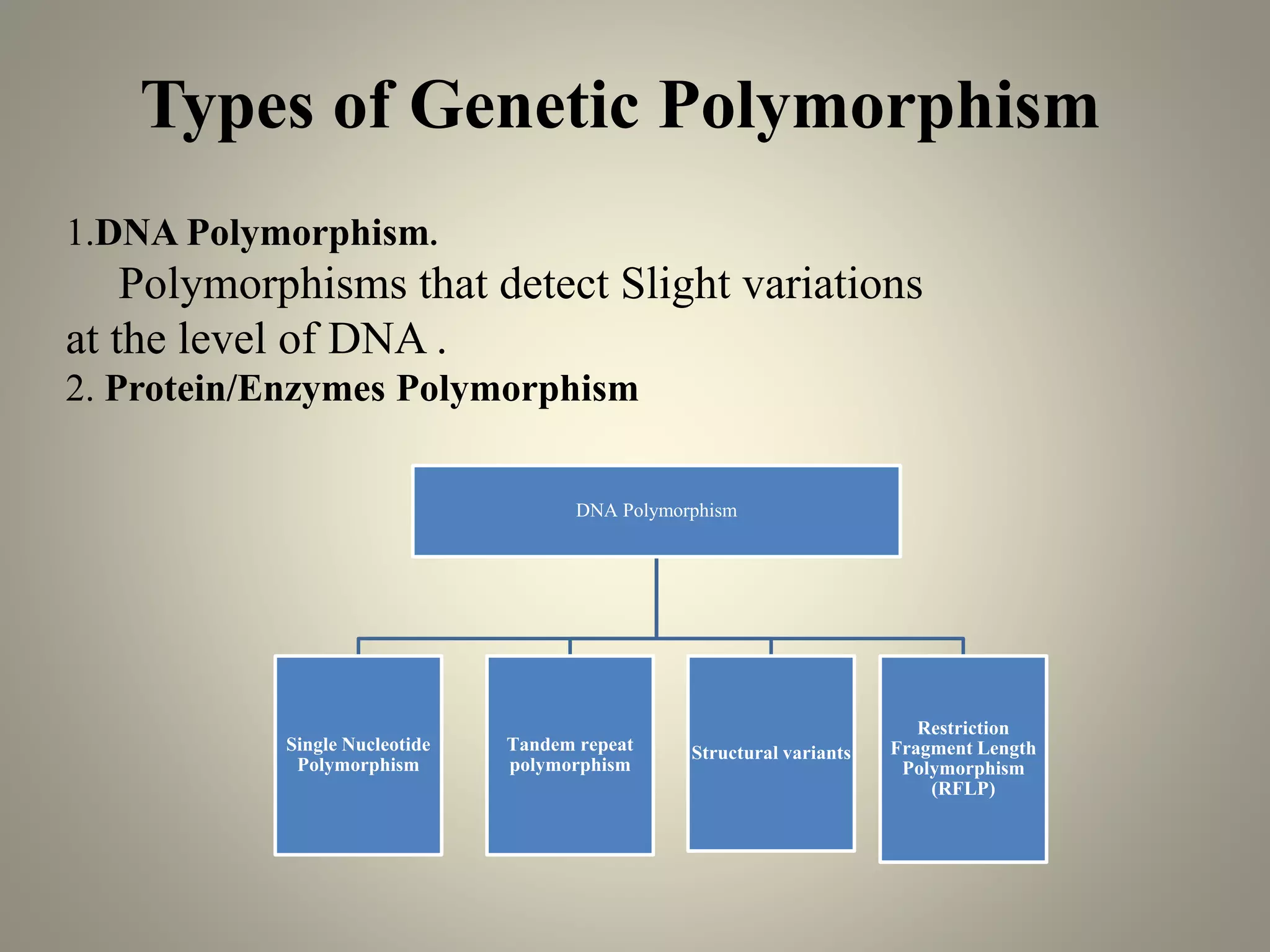
Types of Genetic Polymorphism
1.DNA Polymorphism.
Polymorphisms that detect Slight variations
at the level of DNA .
2. Protein/Enzymes Polymorphism
DNA Polymorphism
Single Nucleotide
Polymorphism
Tandem repeat
polymorphism
Structural variants
Restriction
Fragment Length
Polymorphism
(RFLP)
Types of DNA Polymorphism
1.Single Nucleotide Polymorphism
•A single nucleotide (A,T,C,G) in genome sequences is
altered .
• Detect in highly automated by using DNA ‘Chip’
•Most common and simple , accounting 90% human
genetic variation.
•500-1,000 bases to several millions SNPs in human
population.
• May occur in Coding and Non Coding region of
genome.
•May cause disease, used to search and isolate disease-
causing gene.
GCA
T
GCG T A
GCA
T
T C G T A
GCA
T
ACG T A
TCTAAGTCCGTATAA
AGATTCAGGCATATT
TCTAAGTCCGTATAA
TCTAAGTCCGTATAA
AGATTCAGGCATATT
TCTAAGTCCGTATAA
TCTAAGTCCGTATAA
AGATTCAGGCATATT
TCTAAGTCCGTATAA
Green
Yellow
Red
Normal
Carrier
Disease
A C T C A G T T T A
Single Nucleotide polymorphism
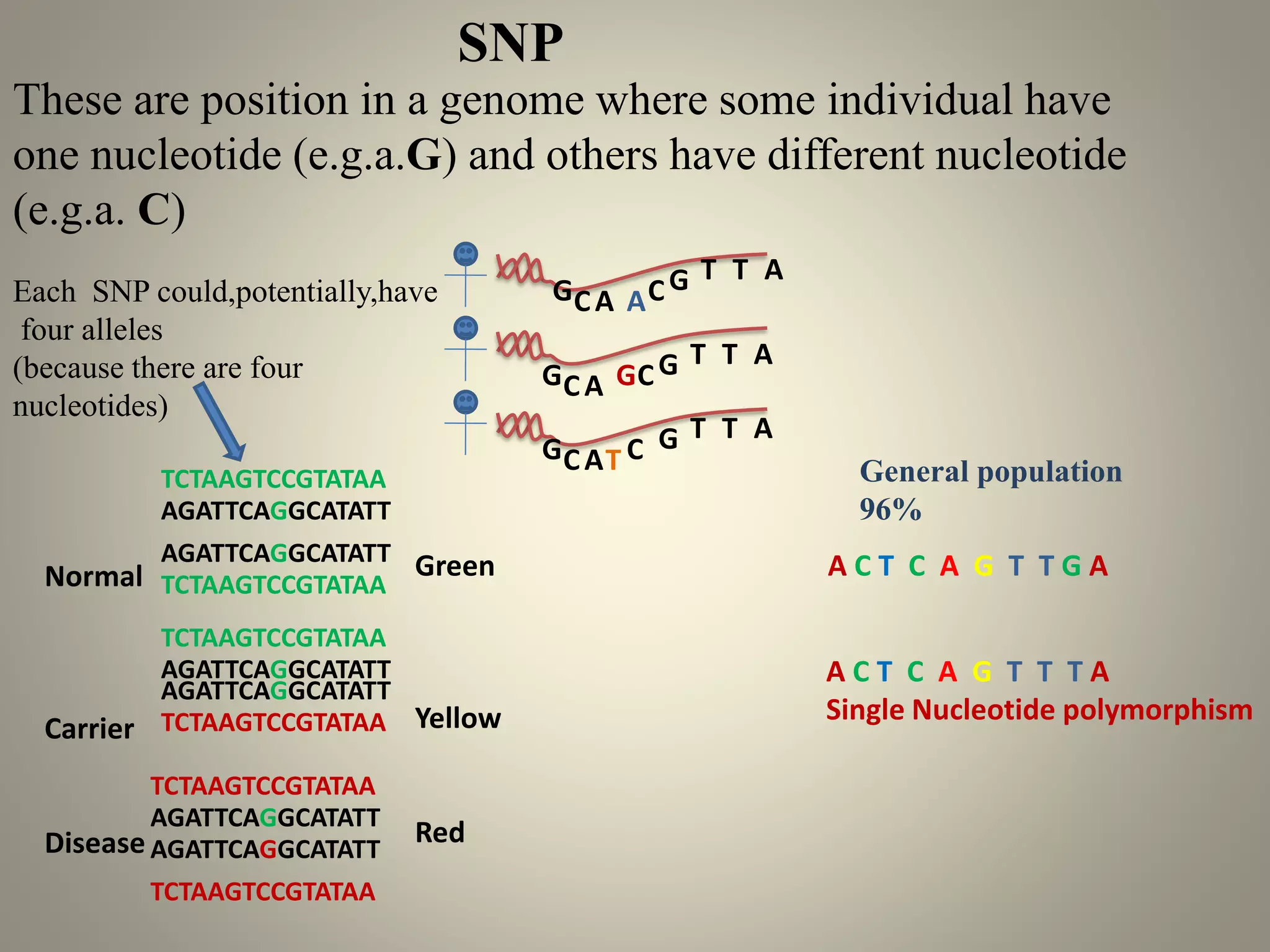
SNP
These are position in a genome where some individual have
one nucleotide (e.g.a.G) and others have different nucleotide
(e.g.a. C)
AGATTCAGGCATATT
AGATTCAGGCATATT
AGATTCAGGCATATT
Each SNP could,potentially,have
four alleles
(because there are four
nucleotides)
A C T C A G T T G A
General population
96%
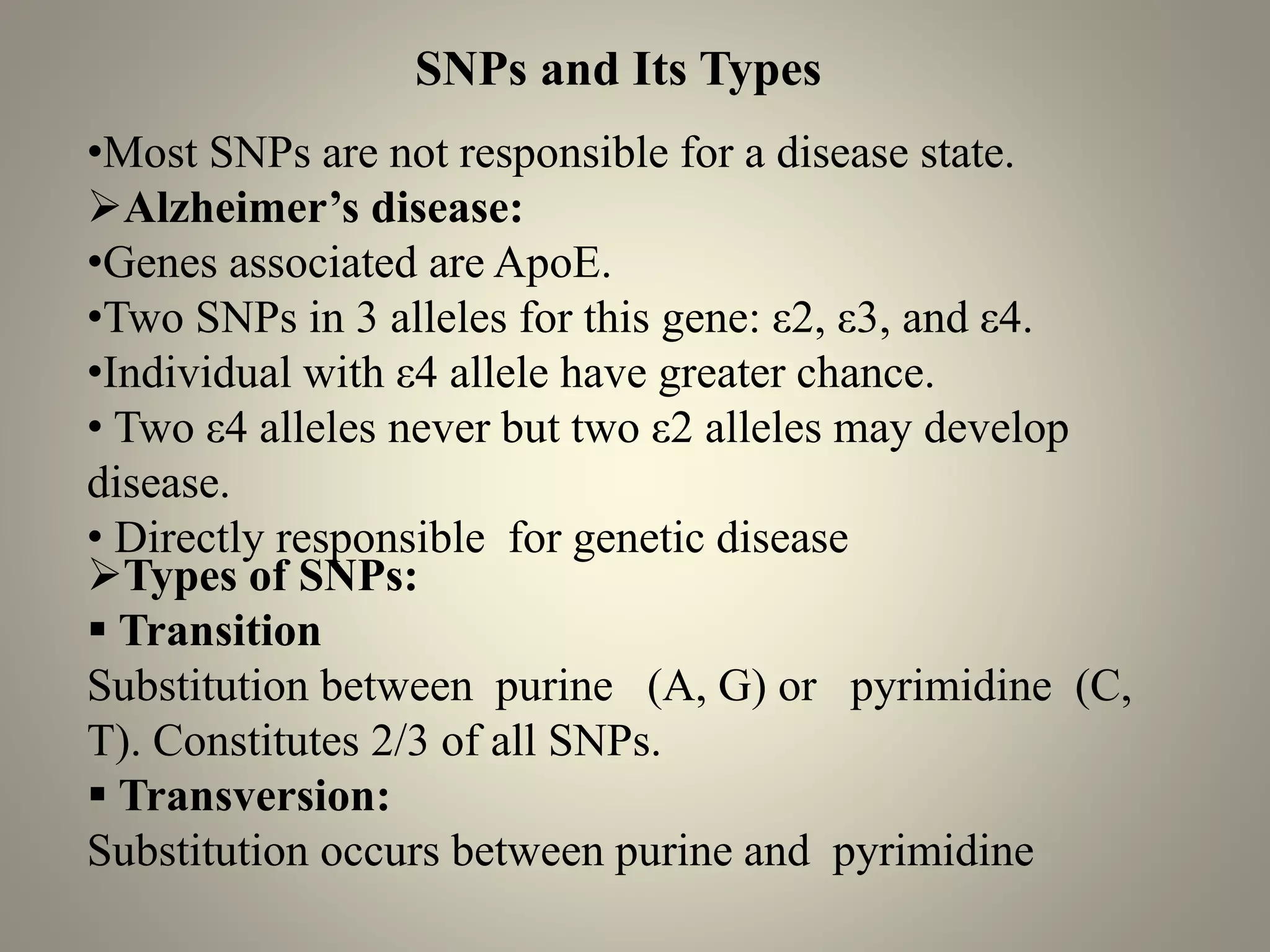
•Most SNPs are not responsible for a disease state.
➢Alzheimer’s disease:
•Genes associated are ApoE.
•Two SNPs in 3 alleles for this gene: ε2, ε3, and ε4.
•Individual with ε4 allele have greater chance.
• Two ε4 alleles never but two ε2 alleles may develop
disease.
• Directly responsible for genetic disease
SNPs and Its Types
➢Types of SNPs:
▪ Transition
Substitution between purine (A, G) or pyrimidine (C,
T). Constitutes 2/3 of all SNPs.
▪ Transversion:
Substitution occurs between purine and pyrimidine
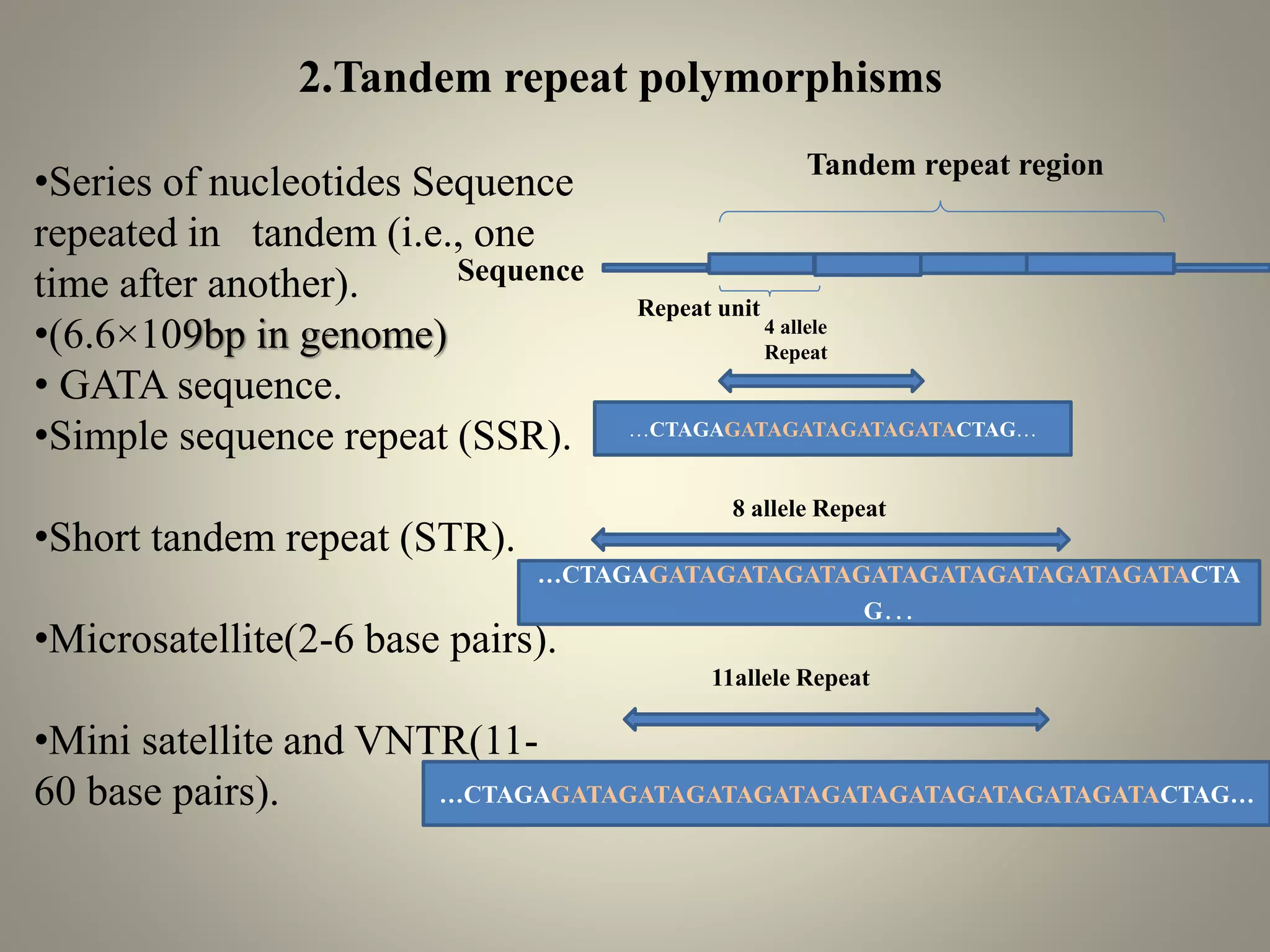
2.Tandem repeat polymorphisms
•Series of nucleotides Sequence
repeated in tandem (i.e., one
time after another).
•(6.6×10⁹bp in genome)
• GATA sequence.
•Simple sequence repeat (SSR).
•Short tandem repeat (STR).
•Microsatellite(2-6 base pairs).
•Mini satellite and VNTR(11-
60 base pairs).
…CTAGAGATAGATAGATAGATACTAG…
…CTAGAGATAGATAGATAGATAGATAGATAGATAGATACTA
G…
…CTAGAGATAGATAGATAGATAGATAGATAGATAGATAGATACTAG…
4 allele
Repeat
8 allele Repeat
11allele Repeat
Tandem repeat region
Repeat unit
Sequence
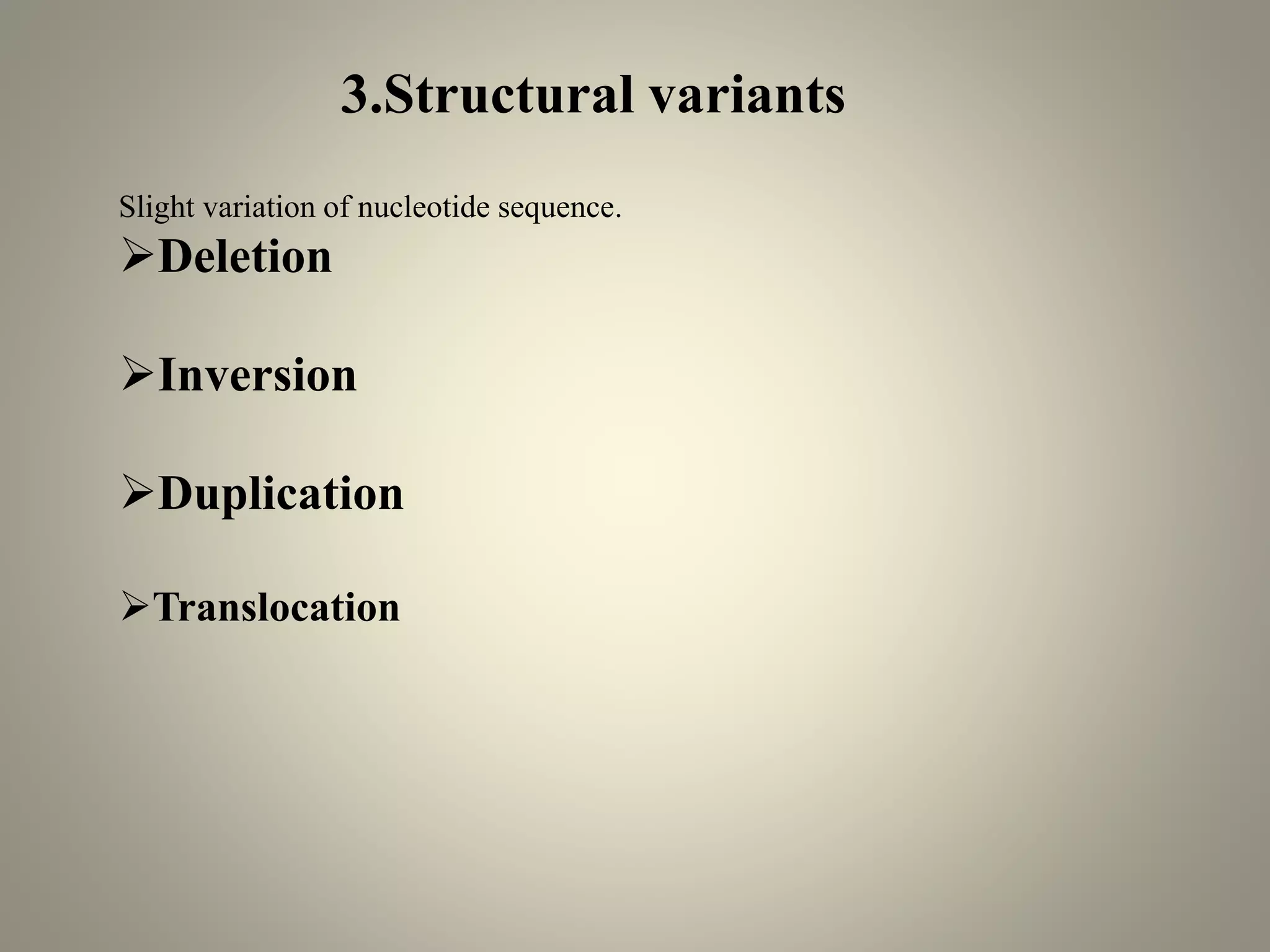
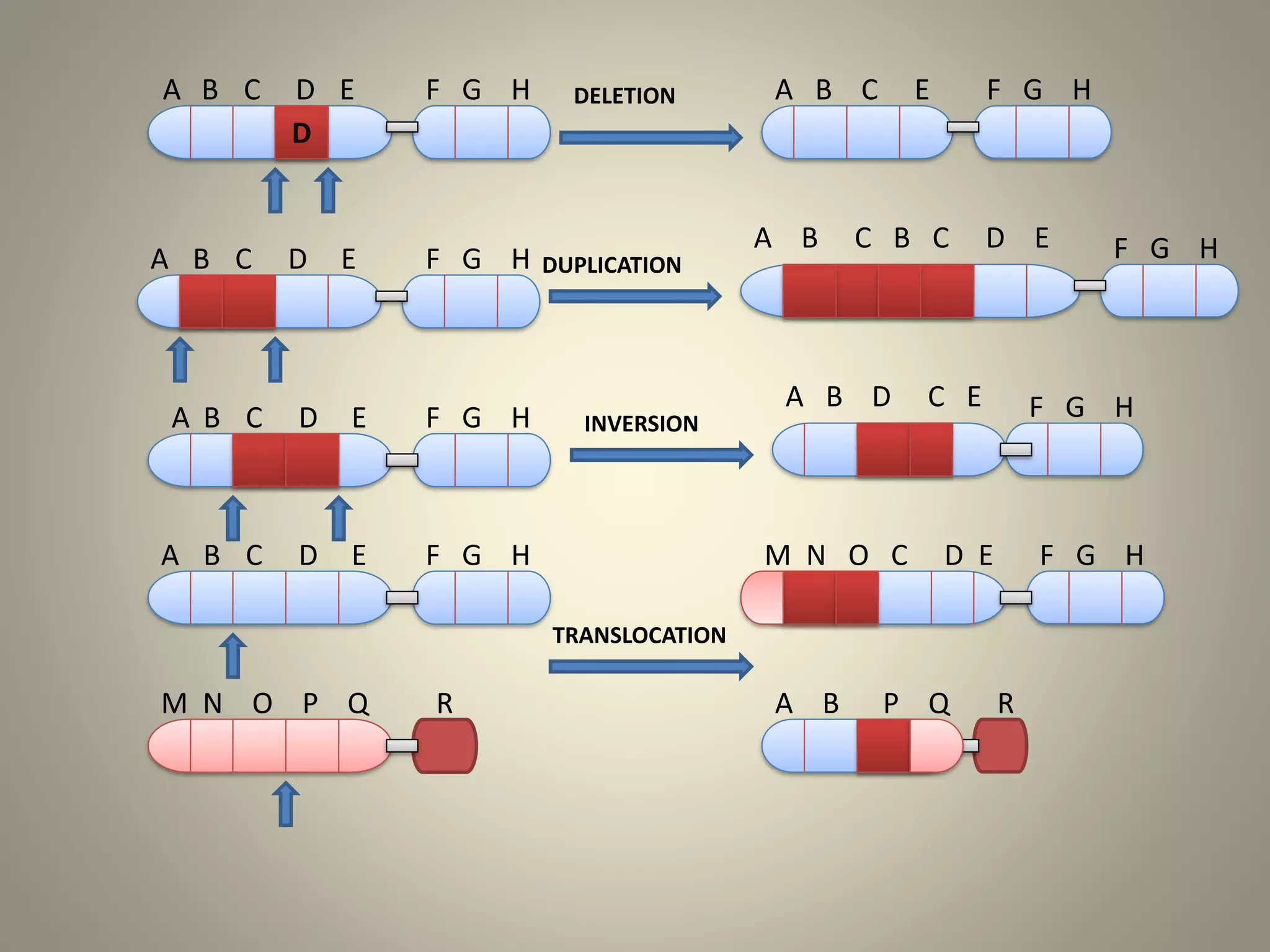
3.Structural variants
Slight variation of nucleotide sequence.
➢Deletion
➢Inversion
➢Duplication
➢Translocation
A B C D E
A B
B
B
A
A
C
C
C
D
D
D
E
E
E F G H
F G H
F G H
F G H F G H
F G H
F G H
F G H
A B C E
A B C B C D E
A B D C E
M N O C D E
A B P Q RM N O P Q R
DELETION
DUPLICATION
INVERSION
TRANSLOCATION
D
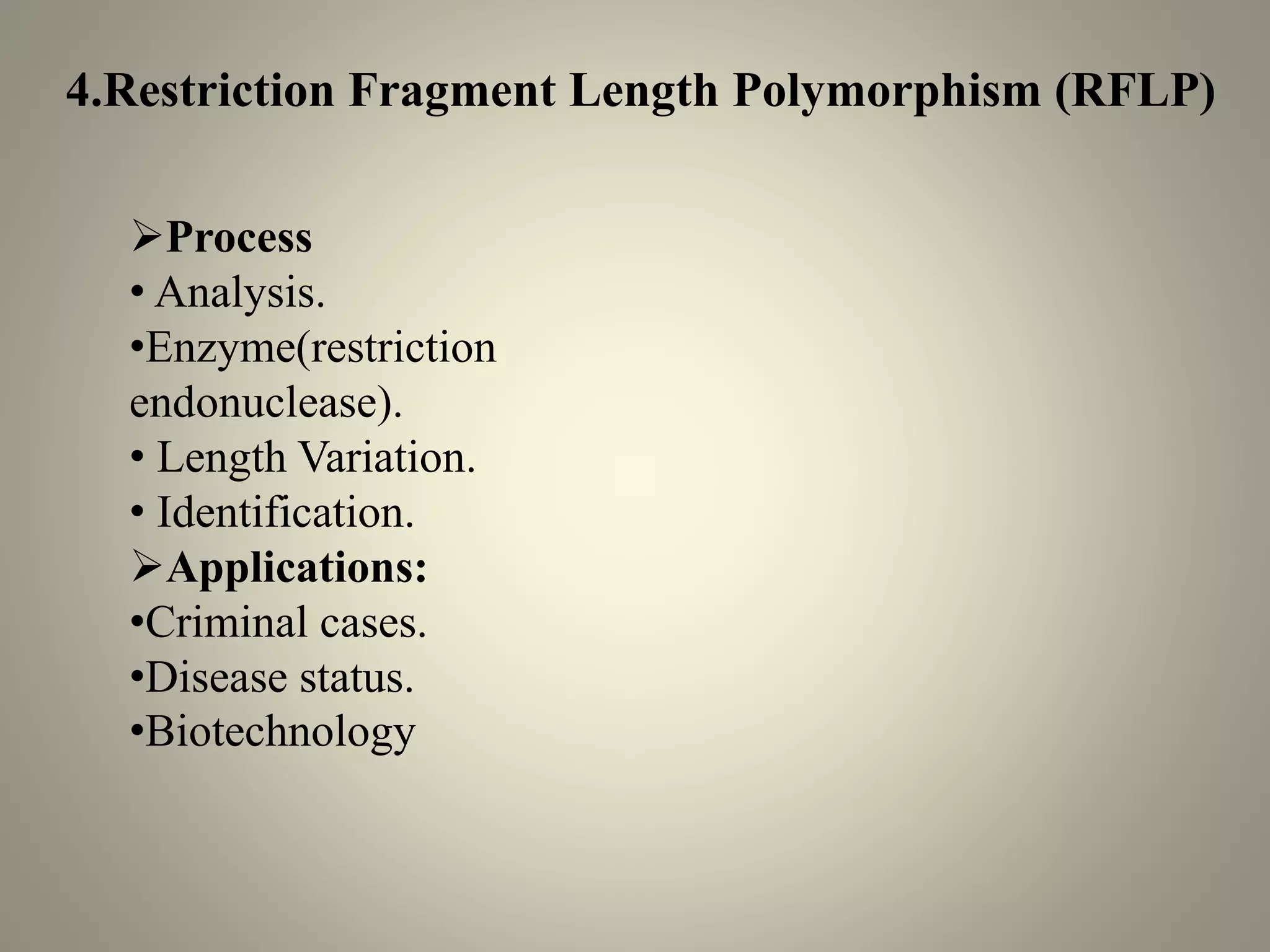
4.Restriction Fragment Length Polymorphism (RFLP)
➢Process
• Analysis.
•Enzyme(restriction
endonuclease).
• Length Variation.
• Identification.
➢Applications:
•Criminal cases.
•Disease status.
•Biotechnology
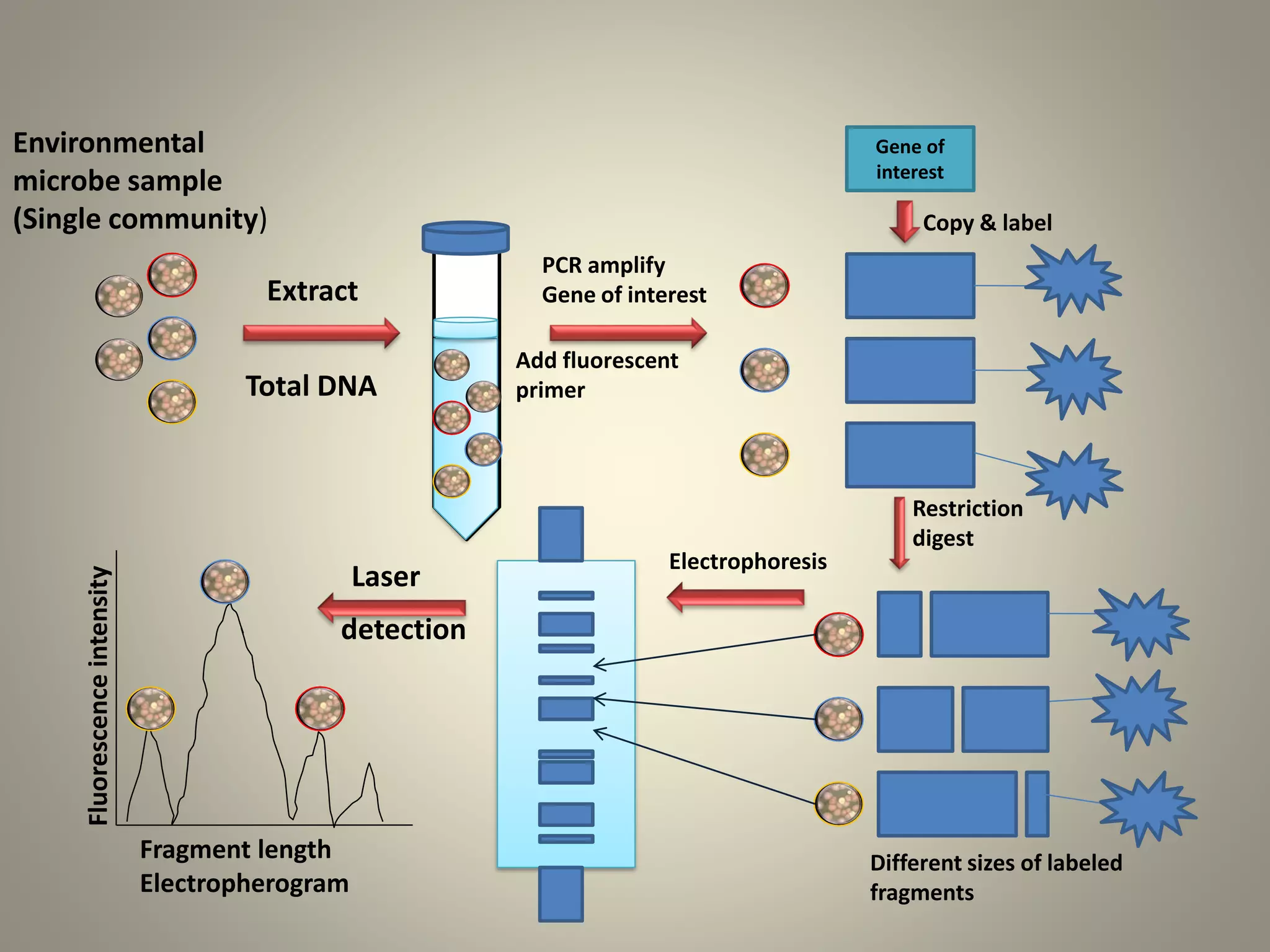
Gene of
interest
Environmental
microbe sample
(Single community)
Extract
Total DNA
PCR amplify
Gene of interest
Add fluorescent
primer
Copy & label
Restriction
digest
Different sizes of labeled
fragments
Electrophoresis
Laser
detection
Fragment length
Electropherogram
Fluorescenceintensity
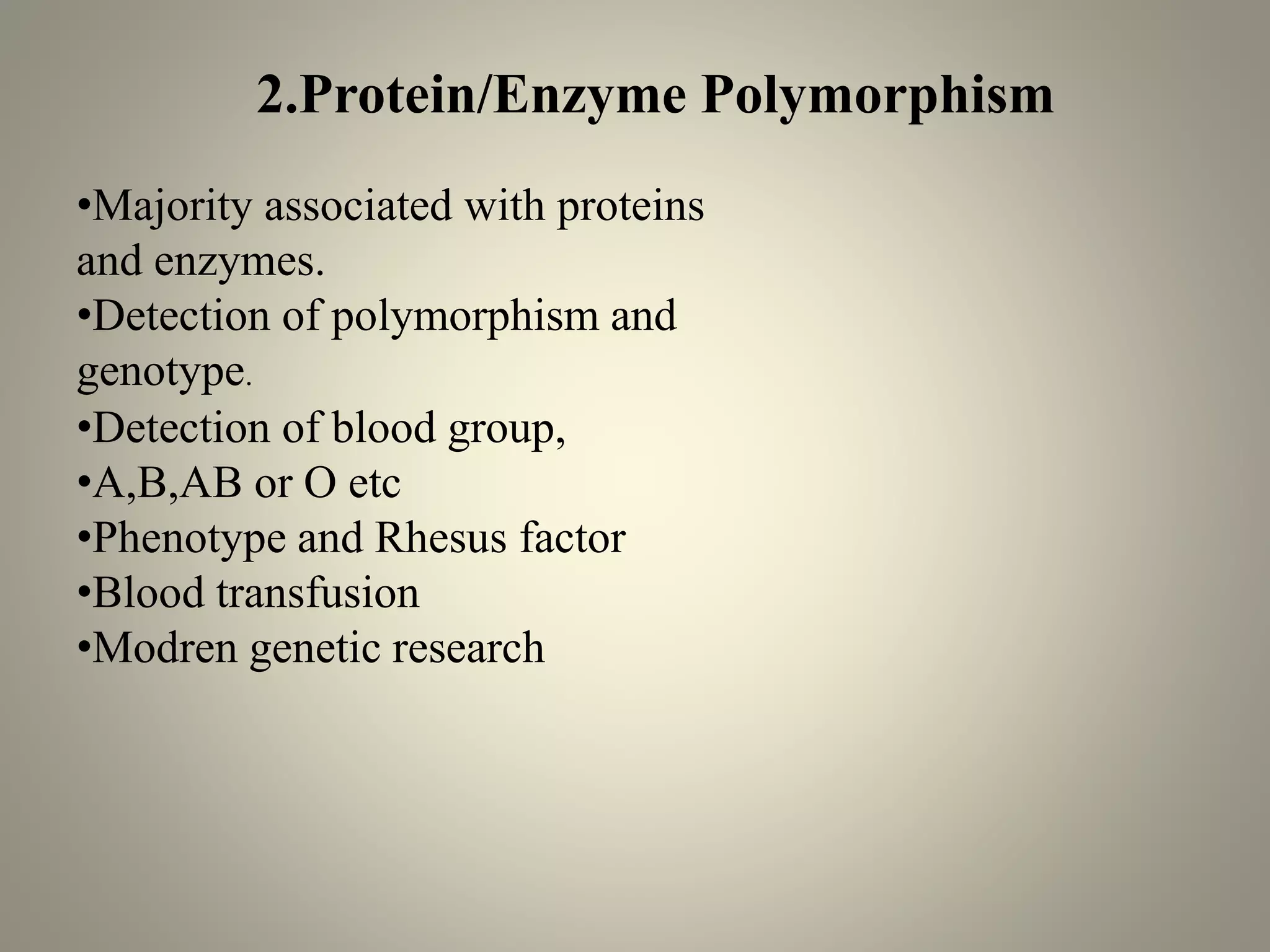
2.Protein/Enzyme Polymorphism
•Majority associated with proteins
and enzymes.
•Detection of polymorphism and
genotype.
•Detection of blood group,
•A,B,AB or O etc
•Phenotype and Rhesus factor
•Blood transfusion
•Modren genetic research
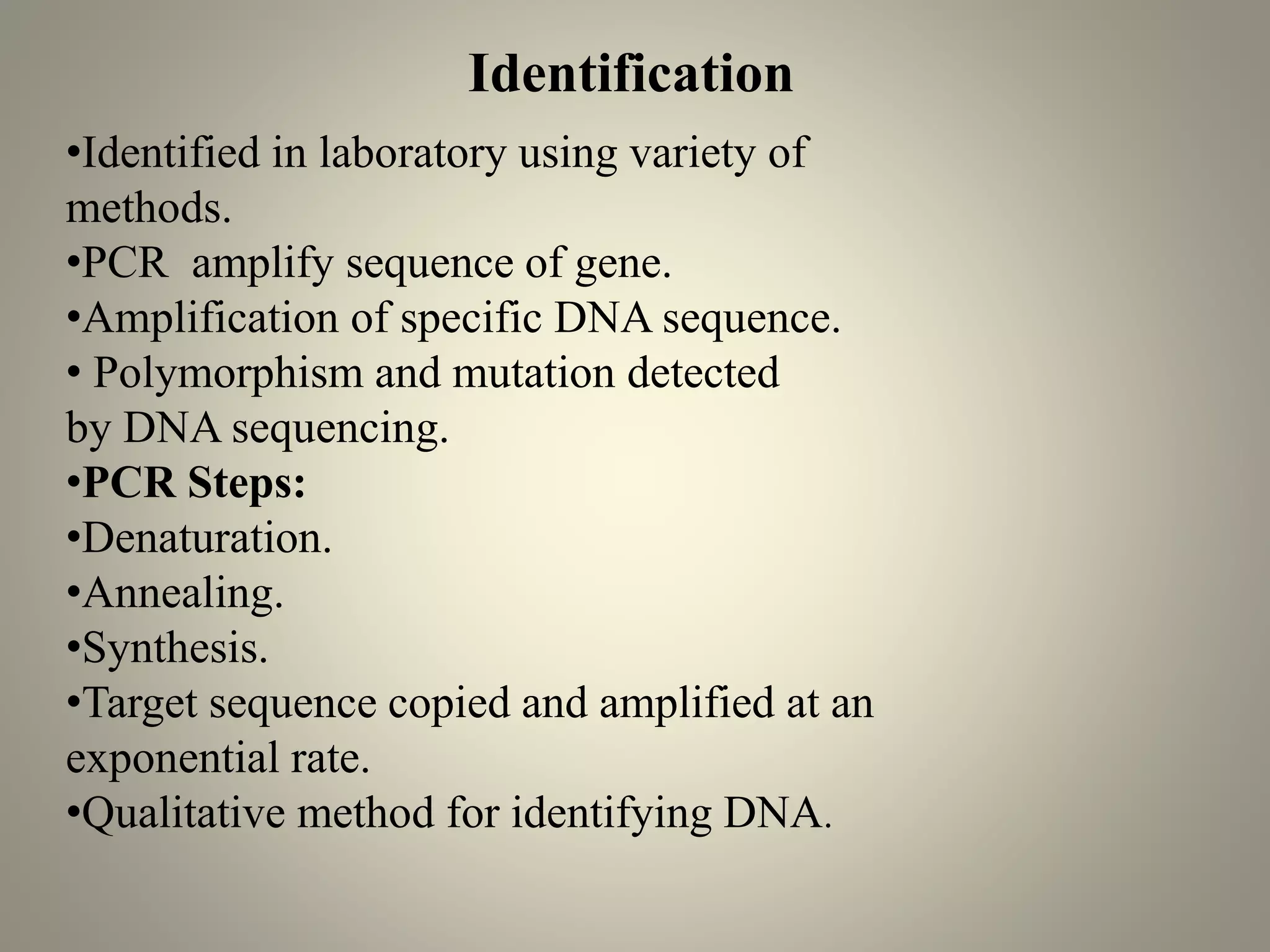
•Identified in laboratory using variety of
methods.
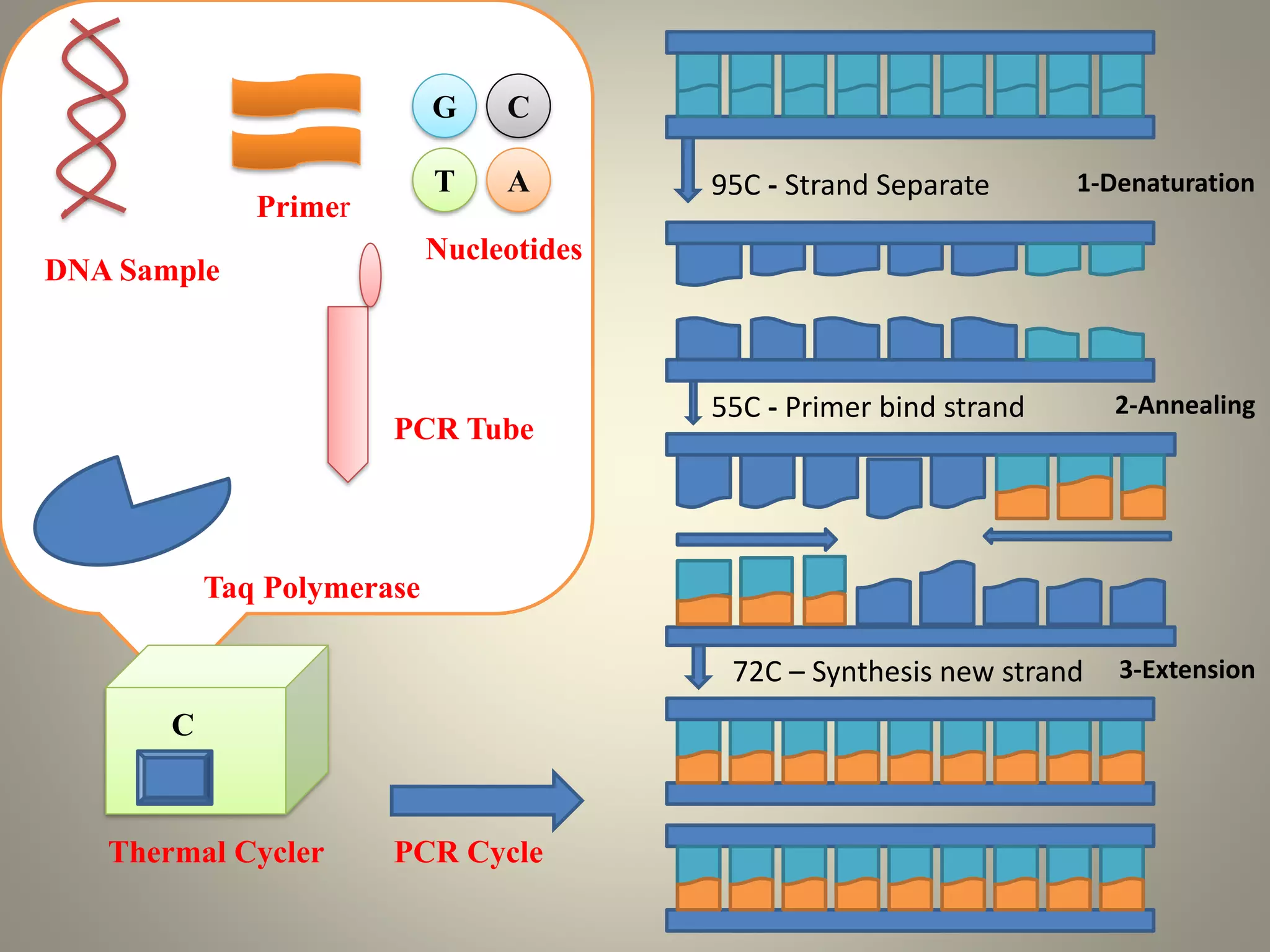
•PCR amplify sequence of gene.
•Amplification of specific DNA sequence.
• Polymorphism and mutation detected
by DNA sequencing.
•PCR Steps:
•Denaturation.
•Annealing.
•Synthesis.
•Target sequence copied and amplified at an
exponential rate.
•Qualitative method for identifying DNA.
Identification
Thermal Cycler PCR Cycle
Taq Polymerase
PCR Tube
Primer
G
T
C
A
Nucleotides
DNA Sample
C
95C - Strand Separate 1-Denaturation
2-Annealing
3-Extension
55C - Primer bind strand
72C – Synthesis new strand
Clinical Significance
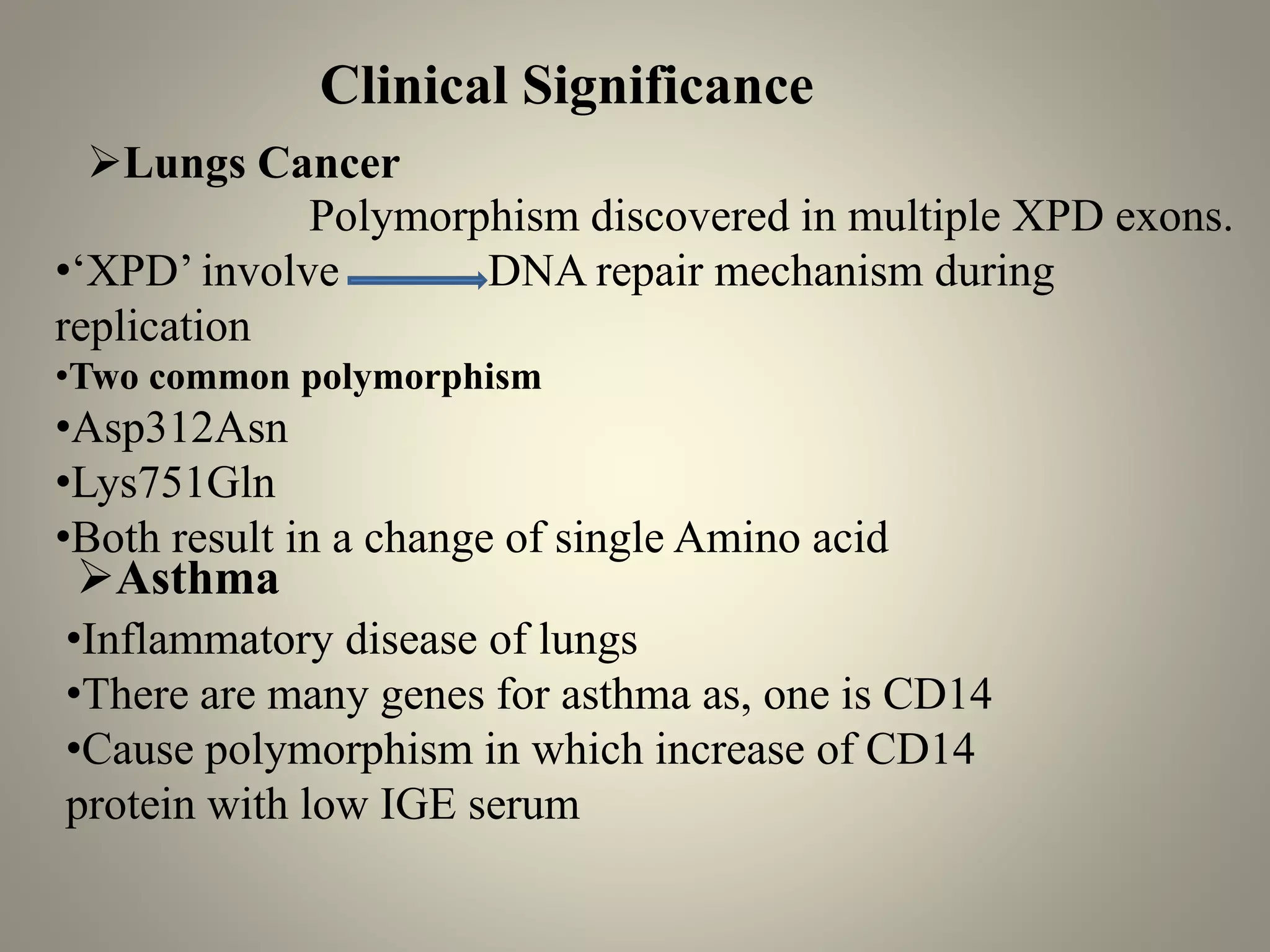
➢Lungs Cancer
Polymorphism discovered in multiple XPD exons.
•‘XPD’ involve DNA repair mechanism during
replication
•Two common polymorphism
•Asp312Asn
•Lys751Gln
•Both result in a change of single Amino acid
➢Asthma
•Inflammatory disease of lungs
•There are many genes for asthma as, one is CD14
•Cause polymorphism in which increase of CD14
protein with low IGE serum
Applications
•Gene Mapping
• Pharmacogenomics.
(I) Pharmacodynamics
(II) Pharmacokinetics
•Forensics.
(I) Crime Scene
(II) Paternity
•Agriculture.
•Biological research.
•Disease Identification.
•Role of genome in drug response.
•Pharmaco-genomics reflects
combination
of pharmacology and genomics.
•Genetic makeup of an individual affects
his response to drugs.
•Genomics and epi-genetics dealing with
effects of multiple genes on drug
response.
Pharmacogenomics
•It Provides opportunity to integrate selection studies
with knowledge about molecular genetics and their
target.
•Polymorphism of gene-regulatory region is one of
major contributors of phenotypic variation between and
within population.
•Future studies in genetics will determine genes residing
in these phenotypes to map genes functions.
Conclusion
1. Chanock,stephen (2017) technologic issues in
GWAS and follow-up studies.
2. Karki,Roshan,cristiano(2015) Medical genomics.
3. March ME,sleiman PM,(2013) Genetic
polymorphism and associated susceptibility to
asthma
4. "Genetic Testing Report” National Human Genome
Research Institute (NHGRI).
5. Articles
http://medicine.jrank.org/pages/2665/Polymorphis
ms-Uses-Polymorphisms.html.
6. Sheppard, Philip M. 1975. Natural Selection and
Heredity (4th ed.) London: Hutchinson.
References

Genetic polymorphism and It's Applications

  • 1.
    Genetic Polymorphism Awais Ali (Email;awaismalik0306@gmail.com) University of Agriculture Faislabad, Pakistan
  • 2.
  • 3.
    •Originally defined byFord in 1940. •E. B. Ford and his co-workers from(1920-70s) worked on it. •Later Cavalli-Sforza & Bodmer defined in 1971. •Occurrence of multiple alleles at one locus in same population, where at least two alleles occur with minimum frequency is 1%. History
  • 4.
    •Genetics derived genetikosmeaning "generative" derived , genesis meaning "origin". •Study of Genes ,Genetic variation and Heredity in living organisms. ➢Polymorphism •Combination of Greek words poly (multiple) and morph (form). •Multiple forms of a single gene , exists in an individual or group of individuals. •Majority are silent , not alter function or expression of a gene . Introduction
  • 5.
    •Some polymorphisms arevisible. •e.g dogs E locus, five different alleles(E, Em, Eg, Eh, e)contribute to pigmentation and patterns in dog coats. ➢ Genetic Mutation • DNA sequence not present in most individuals of species either associated with disease or resulted from damage caused by external agents.
  • 6.
    Types of GeneticPolymorphism 1.DNA Polymorphism. Polymorphisms that detect Slight variations at the level of DNA . 2. Protein/Enzymes Polymorphism DNA Polymorphism Single Nucleotide Polymorphism Tandem repeat polymorphism Structural variants Restriction Fragment Length Polymorphism (RFLP)
  • 7.
    Types of DNAPolymorphism 1.Single Nucleotide Polymorphism •A single nucleotide (A,T,C,G) in genome sequences is altered . • Detect in highly automated by using DNA ‘Chip’ •Most common and simple , accounting 90% human genetic variation. •500-1,000 bases to several millions SNPs in human population. • May occur in Coding and Non Coding region of genome. •May cause disease, used to search and isolate disease- causing gene.
  • 8.
    GCA T GCG T A GCA T TC G T A GCA T ACG T A TCTAAGTCCGTATAA AGATTCAGGCATATT TCTAAGTCCGTATAA TCTAAGTCCGTATAA AGATTCAGGCATATT TCTAAGTCCGTATAA TCTAAGTCCGTATAA AGATTCAGGCATATT TCTAAGTCCGTATAA Green Yellow Red Normal Carrier Disease A C T C A G T T T A Single Nucleotide polymorphism SNP These are position in a genome where some individual have one nucleotide (e.g.a.G) and others have different nucleotide (e.g.a. C) AGATTCAGGCATATT AGATTCAGGCATATT AGATTCAGGCATATT Each SNP could,potentially,have four alleles (because there are four nucleotides) A C T C A G T T G A General population 96%
  • 9.
    •Most SNPs arenot responsible for a disease state. ➢Alzheimer’s disease: •Genes associated are ApoE. •Two SNPs in 3 alleles for this gene: ε2, ε3, and ε4. •Individual with ε4 allele have greater chance. • Two ε4 alleles never but two ε2 alleles may develop disease. • Directly responsible for genetic disease SNPs and Its Types ➢Types of SNPs: ▪ Transition Substitution between purine (A, G) or pyrimidine (C, T). Constitutes 2/3 of all SNPs. ▪ Transversion: Substitution occurs between purine and pyrimidine
  • 10.
    2.Tandem repeat polymorphisms •Seriesof nucleotides Sequence repeated in tandem (i.e., one time after another). •(6.6×10⁹bp in genome) • GATA sequence. •Simple sequence repeat (SSR). •Short tandem repeat (STR). •Microsatellite(2-6 base pairs). •Mini satellite and VNTR(11- 60 base pairs). …CTAGAGATAGATAGATAGATACTAG… …CTAGAGATAGATAGATAGATAGATAGATAGATAGATACTA G… …CTAGAGATAGATAGATAGATAGATAGATAGATAGATAGATACTAG… 4 allele Repeat 8 allele Repeat 11allele Repeat Tandem repeat region Repeat unit Sequence
  • 11.
    3.Structural variants Slight variationof nucleotide sequence. ➢Deletion ➢Inversion ➢Duplication ➢Translocation
  • 12.
    A B CD E A B B B A A C C C D D D E E E F G H F G H F G H F G H F G H F G H F G H F G H A B C E A B C B C D E A B D C E M N O C D E A B P Q RM N O P Q R DELETION DUPLICATION INVERSION TRANSLOCATION D
  • 13.
    4.Restriction Fragment LengthPolymorphism (RFLP) ➢Process • Analysis. •Enzyme(restriction endonuclease). • Length Variation. • Identification. ➢Applications: •Criminal cases. •Disease status. •Biotechnology
  • 14.
    Gene of interest Environmental microbe sample (Singlecommunity) Extract Total DNA PCR amplify Gene of interest Add fluorescent primer Copy & label Restriction digest Different sizes of labeled fragments Electrophoresis Laser detection Fragment length Electropherogram Fluorescenceintensity
  • 15.
    2.Protein/Enzyme Polymorphism •Majority associatedwith proteins and enzymes. •Detection of polymorphism and genotype. •Detection of blood group, •A,B,AB or O etc •Phenotype and Rhesus factor •Blood transfusion •Modren genetic research
  • 16.
    •Identified in laboratoryusing variety of methods. •PCR amplify sequence of gene. •Amplification of specific DNA sequence. • Polymorphism and mutation detected by DNA sequencing. •PCR Steps: •Denaturation. •Annealing. •Synthesis. •Target sequence copied and amplified at an exponential rate. •Qualitative method for identifying DNA. Identification
  • 17.
    Thermal Cycler PCRCycle Taq Polymerase PCR Tube Primer G T C A Nucleotides DNA Sample C 95C - Strand Separate 1-Denaturation 2-Annealing 3-Extension 55C - Primer bind strand 72C – Synthesis new strand
  • 18.
    Clinical Significance ➢Lungs Cancer Polymorphismdiscovered in multiple XPD exons. •‘XPD’ involve DNA repair mechanism during replication •Two common polymorphism •Asp312Asn •Lys751Gln •Both result in a change of single Amino acid ➢Asthma •Inflammatory disease of lungs •There are many genes for asthma as, one is CD14 •Cause polymorphism in which increase of CD14 protein with low IGE serum
  • 19.
    Applications •Gene Mapping • Pharmacogenomics. (I)Pharmacodynamics (II) Pharmacokinetics •Forensics. (I) Crime Scene (II) Paternity •Agriculture. •Biological research. •Disease Identification.
  • 20.
    •Role of genomein drug response. •Pharmaco-genomics reflects combination of pharmacology and genomics. •Genetic makeup of an individual affects his response to drugs. •Genomics and epi-genetics dealing with effects of multiple genes on drug response. Pharmacogenomics
  • 21.
    •It Provides opportunityto integrate selection studies with knowledge about molecular genetics and their target. •Polymorphism of gene-regulatory region is one of major contributors of phenotypic variation between and within population. •Future studies in genetics will determine genes residing in these phenotypes to map genes functions. Conclusion
  • 22.
    1. Chanock,stephen (2017)technologic issues in GWAS and follow-up studies. 2. Karki,Roshan,cristiano(2015) Medical genomics. 3. March ME,sleiman PM,(2013) Genetic polymorphism and associated susceptibility to asthma 4. "Genetic Testing Report” National Human Genome Research Institute (NHGRI). 5. Articles http://medicine.jrank.org/pages/2665/Polymorphis ms-Uses-Polymorphisms.html. 6. Sheppard, Philip M. 1975. Natural Selection and Heredity (4th ed.) London: Hutchinson. References