CONTENTS:
• R E S E A R C H - M E A N I N G
• O B J E C T I V E S O F R E S E A R C H
• T Y P E S O F R E S E A R C H
• R E S E A R C H A P P R O A C H E S
• I M P O R T A N C E O F R E S E A R C H
• R E S E A R C H P R O C E S S
• C R I T E R I A F O R A G O O D R E S E A R C H
• P R O B L E M S E N C O U N T E R E D B Y R E S E A R C H E R S I N I N D I A
UNIT 1- Notes by Ms. Anubala. S, Asst. Professor, Shri Krishnaswamy College
for Women
What is Research?
Defining Research
 Common Parlance: A search for knowledge.
 Scientific & Systematic: A search for pertinent information on a specific topic.
 Art of Scientific Investigation: A careful inquiry, especially for new facts.
 "Systematized effort to gain new knowledge." (Redman & Mory)
 Movement from Known to Unknown: A voyage of discovery driven by
inquisitiveness.
According to Clifford Woody: Research is defined as “ a process that Defines and
redefines problems, formulates hypotheses, collects and evaluates data, makes
deductions, reaches conclusions, and tests them.”
Objectives of Research
 To discover answers to questions using scientific procedures.
 To uncover hidden or undiscovered truths.
Broad Groupings of Research Objectives:
 Exploratory or Formulative Research:
 To gain familiarity with a phenomenon.
 To achieve new insights into a topic.
 Descriptive Research:
 To accurately portray the characteristics of an individual, situation, or group.
 Diagnostic Research:
 To determine the frequency of something's occurrence.
 To determine its association with something else.
 Hypothesis-Testing Research:
 To test a hypothesis about a causal relationship between variables.
• D E S C R I P T I V E V S . A N A L Y T I C A L R E S E A R C H
• A P P L I E D V S . F U N D A M E N T A L R E S E A R C H
• Q U A N T I T A T I V E V S . Q U A L I T A T I V E R E S E A R C H
• C O N C E P T U A L V S . E M P I R I C A L R E S E A R C H
BASIC TYPES OF RESEARCH
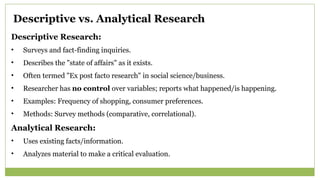
Descriptive vs. Analytical Research
Descriptive Research:
• Surveys and fact-finding inquiries.
• Describes the "state of affairs" as it exists.
• Often termed "Ex post facto research" in social science/business.
• Researcher has no control over variables; reports what happened/is happening.
• Examples: Frequency of shopping, consumer preferences.
• Methods: Survey methods (comparative, correlational).
Analytical Research:
• Uses existing facts/information.
• Analyzes material to make a critical evaluation.
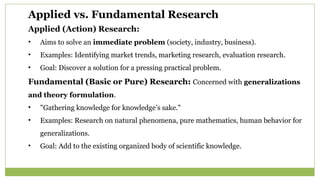
Applied vs. Fundamental Research
Applied (Action) Research:
• Aims to solve an immediate problem (society, industry, business).
• Examples: Identifying market trends, marketing research, evaluation research.
• Goal: Discover a solution for a pressing practical problem.
Fundamental (Basic or Pure) Research: Concerned with generalizations
and theory formulation.
• "Gathering knowledge for knowledge’s sake."
• Examples: Research on natural phenomena, pure mathematics, human behavior for
generalizations.
• Goal: Add to the existing organized body of scientific knowledge.
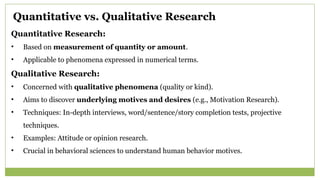
Quantitative vs. Qualitative Research
Quantitative Research:
• Based on measurement of quantity or amount.
• Applicable to phenomena expressed in numerical terms.
Qualitative Research:
• Concerned with qualitative phenomena (quality or kind).
• Aims to discover underlying motives and desires (e.g., Motivation Research).
• Techniques: In-depth interviews, word/sentence/story completion tests, projective
techniques.
• Examples: Attitude or opinion research.
• Crucial in behavioral sciences to understand human behavior motives.
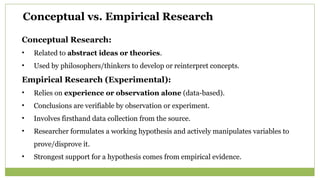
Conceptual vs. Empirical Research
Conceptual Research:
• Related to abstract ideas or theories.
• Used by philosophers/thinkers to develop or reinterpret concepts.
Empirical Research (Experimental):
• Relies on experience or observation alone (data-based).
• Conclusions are verifiable by observation or experiment.
• Involves firsthand data collection from the source.
• Researcher formulates a working hypothesis and actively manipulates variables to
prove/disprove it.
• Strongest support for a hypothesis comes from empirical evidence.
Some Other Types of Research
Based on Time:
 One-time Research: Confined to a single time-period.
 Longitudinal Research: Carried on over several time-periods.
Based on Environment:
 Field-setting Research: Conducted in natural environments.
 Laboratory Research: Conducted in controlled laboratory settings.
 Simulation Research: Uses models or simulations.
Clinical or Diagnostic Research:
 Follows case-study methods or in-depth approaches.
 Aims to reach basic causal relations, often with small samples and deep probing.
Some Other Types of Research
Exploratory vs. Formalized Research:
 Exploratory: Develops hypotheses (not tests them).
 Formalized: Substantial structure with specific hypotheses to be tested.
Historical Research:
 Utilizes historical sources (documents, remains) to study past events/ideas.
Conclusion-oriented vs. Decision-oriented Research:
 Conclusion-oriented: Researcher has freedom to pick problem, redesign,
conceptualize.
 Decision-oriented: Driven by the need of a decision-maker (e.g., Operations
Research).
Research Approaches: Quantitative vs. Qualitative
1. Quantitative Approach
 Focus: Generating data in quantitative (numerical) form for rigorous analysis.
 Sub-classifications:
 Inferential Approach:
 Experimental Approach:
 Simulation Approach:
2. Qualitative Approach
 Focus: Subjective assessment of attitudes, opinions, and behavior.
 Nature: Relies on researcher's insights and impressions.
 Output: Non-quantitative results or data not subjected to rigorous quantitative analysis.
 Techniques: Focus group interviews, projective techniques, depth interviews.
Significance of Research
1. Economic Policy & Governance (e.g., assessing needs,
revenue forecasting)
2. Business & Industry (eg., Operations research for cost
minimization/profit maximization)
3. Social Sciences (eg., Explores social relationships and addresses
societal problems)
Significance of Research
4. Career Advancement: For students pursuing higher
degrees (Master's, Ph.D.).
5.Livelihood: For professionals in research methodology.
6. New Ideas & Insights: For philosophers and thinkers.
7. Creative Development: For literary individuals.
8. Theoretical Generalizations: For analysts and
intellectuals.
• A sc i e n t i fi c ap pr o ac h t o s o l v i n g a r e s e a r c h pr o b l e m .
• Fo c u s e s o n ho w r e se ar c h i s do n e s y st e m a t i c a l l y an d l o g i c a l l y .
W HY W A S T HE S T U D Y U N D E R T A K E N ?
HO W W A S T HE R E S E A R C H P R OB L E M D E F I N E D ?
W HA T M E T H OD S W E R E U S E D A N D W HY ?
Understanding Research Methodology
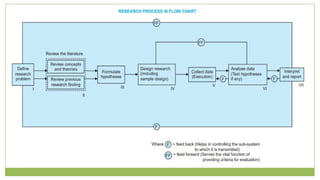
Research Process
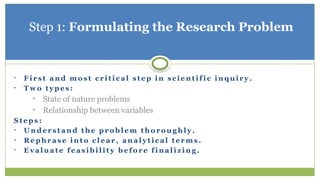
• F i r st a n d m o st c r i t i c a l st e p i n s c i e n t i fi c i n q u i r y .
• T w o t y pe s:
• State of nature problems
• Relationship between variables
S t e p s:
• U n d e r st an d t h e p r o b l e m t h o r o u g h l y .
• R e ph r a se i n t o c l e ar , an a l y t i c al t e r ms .
• E v a l u a t e fe a s i b i l i t y b e fo r e fi n a l i z i n g .
Step 1: Formulating the Research Problem
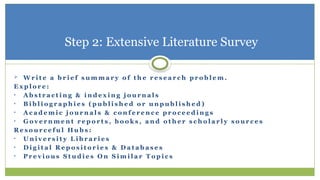
 W r i t e a b r i e f s u m m a r y o f t h e r e s e a r c h p r o b l e m .
E x p l o r e :
• A b s t r a c t i n g & i n d e x i n g j o u r n a l s
• B i b l i o g r a p h i e s ( p u b l i s h e d o r u n p u b l i s h e d )
• A c a d e m i c j o u r n a l s & c o n f e r e n c e p r o c e e d i n g s
• G o v e r n m e n t r e p o r t s , b o o k s , a n d o t h e r s c h o l a r l y s o u r c e s
R e s o u r c e f u l H u b s :
• U n i v e r s i t y L i b r a r i e s
• D i g i t a l R e p o s i t o r i e s & D a t a b a s e s
• P r e v i o u s S t u d i e s O n S i m i l a r T o p i c s
Step 2: Extensive Literature Survey
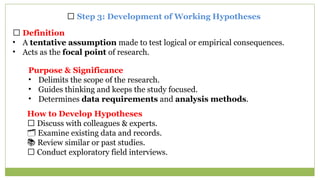
🧪 Step 3: Development of Working Hypotheses
✅ Definition
• A tentative assumption made to test logical or empirical consequences.
• Acts as the focal point of research.
Purpose & Significance
• Delimits the scope of the research.
• Guides thinking and keeps the study focused.
• Determines data requirements and analysis methods.
How to Develop Hypotheses
📘 Discuss with colleagues & experts.
️
🗂️Examine existing data and records.
📚 Review similar or past studies.
🧭 Conduct exploratory field interviews.
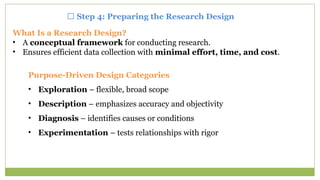
🧭 Step 4: Preparing the Research Design
What Is a Research Design?
• A conceptual framework for conducting research.
• Ensures efficient data collection with minimal effort, time, and cost.
Purpose-Driven Design Categories
• Exploration – flexible, broad scope
• Description – emphasizes accuracy and objectivity
• Diagnosis – identifies causes or conditions
• Experimentation – tests relationships with rigor
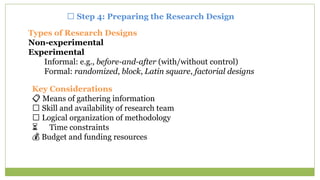
🧭 Step 4: Preparing the Research Design
Types of Research Designs
Non-experimental
Experimental
Informal: e.g., before-and-after (with/without control)
Formal: randomized, block, Latin square, factorial designs
Key Considerations
📋 Means of gathering information
👥 Skill and availability of research team
🧠 Logical organization of methodology
⏳ Time constraints
💰 Budget and funding resources
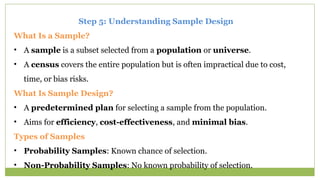
Step 5: Understanding Sample Design
What Is a Sample?
• A sample is a subset selected from a population or universe.
• A census covers the entire population but is often impractical due to cost,
time, or bias risks.
What Is Sample Design?
• A predetermined plan for selecting a sample from the population.
• Aims for efficiency, cost-effectiveness, and minimal bias.
Types of Samples
• Probability Samples: Known chance of selection.
• Non-Probability Samples: No known probability of selection.
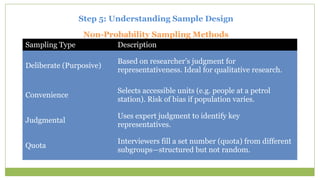
Step 5: Understanding Sample Design
Sampling Type Description
Deliberate (Purposive)
Based on researcher’s judgment for
representativeness. Ideal for qualitative research.
Convenience
Selects accessible units (e.g. people at a petrol
station). Risk of bias if population varies.
Judgmental
Uses expert judgment to identify key
representatives.
Quota
Interviewers fill a set number (quota) from different
subgroups—structured but not random.
Non-Probability Sampling Methods
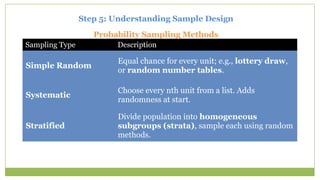
Step 5: Understanding Sample Design
Sampling Type Description
Simple Random
Equal chance for every unit; e.g., lottery draw,
or random number tables.
Systematic
Choose every nth unit from a list. Adds
randomness at start.
Stratified
Divide population into homogeneous
subgroups (strata), sample each using random
methods.
Probability Sampling Methods
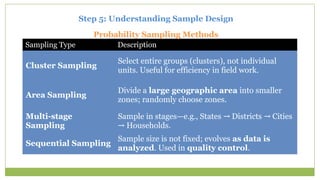
Step 5: Understanding Sample Design
Sampling Type Description
Cluster Sampling
Select entire groups (clusters), not individual
units. Useful for efficiency in field work.
Area Sampling
Divide a large geographic area into smaller
zones; randomly choose zones.
Multi-stage
Sampling
Sample in stages—e.g., States Districts Cities
→ →
Households.
→
Sequential Sampling
Sample size is not fixed; evolves as data is
analyzed. Used in quality control.
Probability Sampling Methods
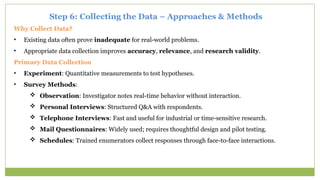
Step 6: Collecting the Data – Approaches & Methods
Why Collect Data?
• Existing data often prove inadequate for real-world problems.
• Appropriate data collection improves accuracy, relevance, and research validity.
Primary Data Collection
• Experiment: Quantitative measurements to test hypotheses.
• Survey Methods:
 Observation: Investigator notes real-time behavior without interaction.
 Personal Interviews: Structured Q&A with respondents.
 Telephone Interviews: Fast and useful for industrial or time-sensitive research.
 Mail Questionnaires: Widely used; requires thoughtful design and pilot testing.
 Schedules: Trained enumerators collect responses through face-to-face interactions.
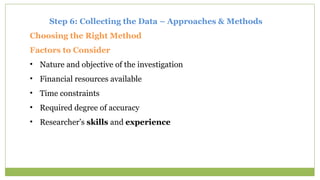
Step 6: Collecting the Data – Approaches & Methods
Choosing the Right Method
Factors to Consider
• Nature and objective of the investigation
• Financial resources available
• Time constraints
• Required degree of accuracy
• Researcher’s skills and experience
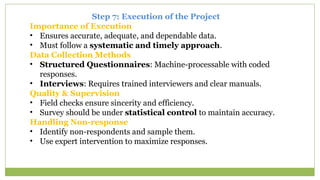
Step 7: Execution of the Project
Importance of Execution
• Ensures accurate, adequate, and dependable data.
• Must follow a systematic and timely approach.
Data Collection Methods
• Structured Questionnaires: Machine-processable with coded
responses.
• Interviews: Requires trained interviewers and clear manuals.
Quality & Supervision
• Field checks ensure sincerity and efficiency.
• Survey should be under statistical control to maintain accuracy.
Handling Non-response
• Identify non-respondents and sample them.
• Use expert intervention to maximize responses.
Step 8 : Analysis of Data
Steps in Data Analysis
• Classification & Coding: Convert raw data into symbolic,
countable categories.
• Editing & Tabulation: Clean data and organize into tables.
• Use of Technology
Computers assist in processing large datasets quickly and
efficiently.
• Drawing Inferences
Compute percentages, coefficients, etc., using statistical formulas.
Test hypotheses using significance tests:
Example: Difference in means between wage samples.
Example: Analysis of Variance (ANOVA) for crop yields.
• Final Goal
Derive meaningful insights with valid and reliable conclusions.
Step 9: Hypothesis Testing
• Conducted after data analysis to evaluate formulated hypotheses
• Key question: Do the facts support the hypothesis?
• Common statistical tests:
Chi-square test
t-test
F-test
• Outcomes: Hypothesis is accepted or rejected
• No hypothesis? Use data-based generalisations as future hypotheses
Step 10: Generalizations & Interpretation
• Repeatedly supported hypotheses can lead to theories
• Core aim of research: derive general principles
• No initial hypothesis? Findings may be explained via
interpretation
• Interpretation may lead to new research questions
Step 11: Preparation of the Report or Thesis
• Preliminary Pages: Title, date, acknowledgements, foreword,
table of contents, list of tables/charts
• Main Text:
• Introduction: Objectives, methodology, scope, limitations
• Summary of Findings: Non-technical, concise
recommendations
• Main Report: Logically sequenced sections
• Conclusion: Clear restatement of research results
• End Matter: Appendices, bibliography, index
Writing Style & Presentation
• Simple, objective language — avoid vague terms
• Use charts/illustrations only for clarity
• Mention confidence limits and research constraints
Problems Faced by Researchers in India
 Lack of Training: Insufficient knowledge of research
methodology; need for intensive short-term courses
 Weak Industry-Academia Link: Poor liaison with
businesses/government limits access to real-world data
 Data Confidentiality Concerns: Reluctance of firms to share
data due to fears of misuse
 Duplication of Effort: Overlapping studies due to lack of research
registries and topic tracking
 No Code of Conduct: Inter-departmental rivalries and absence of
ethical guidelines hinder collaboration
Problems Faced by Researchers in India
 Limited Secretarial Support: Delays due to inadequate
administrative and computing help
 Inefficient Libraries: Time lost finding sources instead of
analyzing content
 Delayed Access to Govt. Publications: Especially problematic
in non-metro libraries
 Inconsistent Published Data: Agencies vary in coverage;
hampers reliability
 Conceptual & Collection Issues: Challenges in defining
problems and gathering quality data

Research Methodology, Types and Research Process

  • 1.
    CONTENTS: • R ES E A R C H - M E A N I N G • O B J E C T I V E S O F R E S E A R C H • T Y P E S O F R E S E A R C H • R E S E A R C H A P P R O A C H E S • I M P O R T A N C E O F R E S E A R C H • R E S E A R C H P R O C E S S • C R I T E R I A F O R A G O O D R E S E A R C H • P R O B L E M S E N C O U N T E R E D B Y R E S E A R C H E R S I N I N D I A UNIT 1- Notes by Ms. Anubala. S, Asst. Professor, Shri Krishnaswamy College for Women
  • 2.
    What is Research? DefiningResearch  Common Parlance: A search for knowledge.  Scientific & Systematic: A search for pertinent information on a specific topic.  Art of Scientific Investigation: A careful inquiry, especially for new facts.  "Systematized effort to gain new knowledge." (Redman & Mory)  Movement from Known to Unknown: A voyage of discovery driven by inquisitiveness. According to Clifford Woody: Research is defined as “ a process that Defines and redefines problems, formulates hypotheses, collects and evaluates data, makes deductions, reaches conclusions, and tests them.”
  • 3.
    Objectives of Research To discover answers to questions using scientific procedures.  To uncover hidden or undiscovered truths. Broad Groupings of Research Objectives:  Exploratory or Formulative Research:  To gain familiarity with a phenomenon.  To achieve new insights into a topic.  Descriptive Research:  To accurately portray the characteristics of an individual, situation, or group.  Diagnostic Research:  To determine the frequency of something's occurrence.  To determine its association with something else.  Hypothesis-Testing Research:  To test a hypothesis about a causal relationship between variables.
  • 4.
    • D ES C R I P T I V E V S . A N A L Y T I C A L R E S E A R C H • A P P L I E D V S . F U N D A M E N T A L R E S E A R C H • Q U A N T I T A T I V E V S . Q U A L I T A T I V E R E S E A R C H • C O N C E P T U A L V S . E M P I R I C A L R E S E A R C H BASIC TYPES OF RESEARCH
  • 5.
    Descriptive vs. AnalyticalResearch Descriptive Research: • Surveys and fact-finding inquiries. • Describes the "state of affairs" as it exists. • Often termed "Ex post facto research" in social science/business. • Researcher has no control over variables; reports what happened/is happening. • Examples: Frequency of shopping, consumer preferences. • Methods: Survey methods (comparative, correlational). Analytical Research: • Uses existing facts/information. • Analyzes material to make a critical evaluation.
  • 6.
    Applied vs. FundamentalResearch Applied (Action) Research: • Aims to solve an immediate problem (society, industry, business). • Examples: Identifying market trends, marketing research, evaluation research. • Goal: Discover a solution for a pressing practical problem. Fundamental (Basic or Pure) Research: Concerned with generalizations and theory formulation. • "Gathering knowledge for knowledge’s sake." • Examples: Research on natural phenomena, pure mathematics, human behavior for generalizations. • Goal: Add to the existing organized body of scientific knowledge.
  • 7.
    Quantitative vs. QualitativeResearch Quantitative Research: • Based on measurement of quantity or amount. • Applicable to phenomena expressed in numerical terms. Qualitative Research: • Concerned with qualitative phenomena (quality or kind). • Aims to discover underlying motives and desires (e.g., Motivation Research). • Techniques: In-depth interviews, word/sentence/story completion tests, projective techniques. • Examples: Attitude or opinion research. • Crucial in behavioral sciences to understand human behavior motives.
  • 8.
    Conceptual vs. EmpiricalResearch Conceptual Research: • Related to abstract ideas or theories. • Used by philosophers/thinkers to develop or reinterpret concepts. Empirical Research (Experimental): • Relies on experience or observation alone (data-based). • Conclusions are verifiable by observation or experiment. • Involves firsthand data collection from the source. • Researcher formulates a working hypothesis and actively manipulates variables to prove/disprove it. • Strongest support for a hypothesis comes from empirical evidence.
  • 9.
    Some Other Typesof Research Based on Time:  One-time Research: Confined to a single time-period.  Longitudinal Research: Carried on over several time-periods. Based on Environment:  Field-setting Research: Conducted in natural environments.  Laboratory Research: Conducted in controlled laboratory settings.  Simulation Research: Uses models or simulations. Clinical or Diagnostic Research:  Follows case-study methods or in-depth approaches.  Aims to reach basic causal relations, often with small samples and deep probing.
  • 10.
    Some Other Typesof Research Exploratory vs. Formalized Research:  Exploratory: Develops hypotheses (not tests them).  Formalized: Substantial structure with specific hypotheses to be tested. Historical Research:  Utilizes historical sources (documents, remains) to study past events/ideas. Conclusion-oriented vs. Decision-oriented Research:  Conclusion-oriented: Researcher has freedom to pick problem, redesign, conceptualize.  Decision-oriented: Driven by the need of a decision-maker (e.g., Operations Research).
  • 11.
    Research Approaches: Quantitativevs. Qualitative 1. Quantitative Approach  Focus: Generating data in quantitative (numerical) form for rigorous analysis.  Sub-classifications:  Inferential Approach:  Experimental Approach:  Simulation Approach: 2. Qualitative Approach  Focus: Subjective assessment of attitudes, opinions, and behavior.  Nature: Relies on researcher's insights and impressions.  Output: Non-quantitative results or data not subjected to rigorous quantitative analysis.  Techniques: Focus group interviews, projective techniques, depth interviews.
  • 12.
    Significance of Research 1.Economic Policy & Governance (e.g., assessing needs, revenue forecasting) 2. Business & Industry (eg., Operations research for cost minimization/profit maximization) 3. Social Sciences (eg., Explores social relationships and addresses societal problems)
  • 13.
    Significance of Research 4.Career Advancement: For students pursuing higher degrees (Master's, Ph.D.). 5.Livelihood: For professionals in research methodology. 6. New Ideas & Insights: For philosophers and thinkers. 7. Creative Development: For literary individuals. 8. Theoretical Generalizations: For analysts and intellectuals.
  • 14.
    • A sci e n t i fi c ap pr o ac h t o s o l v i n g a r e s e a r c h pr o b l e m . • Fo c u s e s o n ho w r e se ar c h i s do n e s y st e m a t i c a l l y an d l o g i c a l l y . W HY W A S T HE S T U D Y U N D E R T A K E N ? HO W W A S T HE R E S E A R C H P R OB L E M D E F I N E D ? W HA T M E T H OD S W E R E U S E D A N D W HY ? Understanding Research Methodology
  • 15.
  • 17.
    • F ir st a n d m o st c r i t i c a l st e p i n s c i e n t i fi c i n q u i r y . • T w o t y pe s: • State of nature problems • Relationship between variables S t e p s: • U n d e r st an d t h e p r o b l e m t h o r o u g h l y . • R e ph r a se i n t o c l e ar , an a l y t i c al t e r ms . • E v a l u a t e fe a s i b i l i t y b e fo r e fi n a l i z i n g . Step 1: Formulating the Research Problem
  • 18.
     W ri t e a b r i e f s u m m a r y o f t h e r e s e a r c h p r o b l e m . E x p l o r e : • A b s t r a c t i n g & i n d e x i n g j o u r n a l s • B i b l i o g r a p h i e s ( p u b l i s h e d o r u n p u b l i s h e d ) • A c a d e m i c j o u r n a l s & c o n f e r e n c e p r o c e e d i n g s • G o v e r n m e n t r e p o r t s , b o o k s , a n d o t h e r s c h o l a r l y s o u r c e s R e s o u r c e f u l H u b s : • U n i v e r s i t y L i b r a r i e s • D i g i t a l R e p o s i t o r i e s & D a t a b a s e s • P r e v i o u s S t u d i e s O n S i m i l a r T o p i c s Step 2: Extensive Literature Survey
  • 19.
    🧪 Step 3:Development of Working Hypotheses ✅ Definition • A tentative assumption made to test logical or empirical consequences. • Acts as the focal point of research. Purpose & Significance • Delimits the scope of the research. • Guides thinking and keeps the study focused. • Determines data requirements and analysis methods. How to Develop Hypotheses 📘 Discuss with colleagues & experts. ️ 🗂️Examine existing data and records. 📚 Review similar or past studies. 🧭 Conduct exploratory field interviews.
  • 20.
    🧭 Step 4:Preparing the Research Design What Is a Research Design? • A conceptual framework for conducting research. • Ensures efficient data collection with minimal effort, time, and cost. Purpose-Driven Design Categories • Exploration – flexible, broad scope • Description – emphasizes accuracy and objectivity • Diagnosis – identifies causes or conditions • Experimentation – tests relationships with rigor
  • 21.
    🧭 Step 4:Preparing the Research Design Types of Research Designs Non-experimental Experimental Informal: e.g., before-and-after (with/without control) Formal: randomized, block, Latin square, factorial designs Key Considerations 📋 Means of gathering information 👥 Skill and availability of research team 🧠 Logical organization of methodology ⏳ Time constraints 💰 Budget and funding resources
  • 22.
    Step 5: UnderstandingSample Design What Is a Sample? • A sample is a subset selected from a population or universe. • A census covers the entire population but is often impractical due to cost, time, or bias risks. What Is Sample Design? • A predetermined plan for selecting a sample from the population. • Aims for efficiency, cost-effectiveness, and minimal bias. Types of Samples • Probability Samples: Known chance of selection. • Non-Probability Samples: No known probability of selection.
  • 23.
    Step 5: UnderstandingSample Design Sampling Type Description Deliberate (Purposive) Based on researcher’s judgment for representativeness. Ideal for qualitative research. Convenience Selects accessible units (e.g. people at a petrol station). Risk of bias if population varies. Judgmental Uses expert judgment to identify key representatives. Quota Interviewers fill a set number (quota) from different subgroups—structured but not random. Non-Probability Sampling Methods
  • 24.
    Step 5: UnderstandingSample Design Sampling Type Description Simple Random Equal chance for every unit; e.g., lottery draw, or random number tables. Systematic Choose every nth unit from a list. Adds randomness at start. Stratified Divide population into homogeneous subgroups (strata), sample each using random methods. Probability Sampling Methods
  • 25.
    Step 5: UnderstandingSample Design Sampling Type Description Cluster Sampling Select entire groups (clusters), not individual units. Useful for efficiency in field work. Area Sampling Divide a large geographic area into smaller zones; randomly choose zones. Multi-stage Sampling Sample in stages—e.g., States Districts Cities → → Households. → Sequential Sampling Sample size is not fixed; evolves as data is analyzed. Used in quality control. Probability Sampling Methods
  • 26.
    Step 6: Collectingthe Data – Approaches & Methods Why Collect Data? • Existing data often prove inadequate for real-world problems. • Appropriate data collection improves accuracy, relevance, and research validity. Primary Data Collection • Experiment: Quantitative measurements to test hypotheses. • Survey Methods:  Observation: Investigator notes real-time behavior without interaction.  Personal Interviews: Structured Q&A with respondents.  Telephone Interviews: Fast and useful for industrial or time-sensitive research.  Mail Questionnaires: Widely used; requires thoughtful design and pilot testing.  Schedules: Trained enumerators collect responses through face-to-face interactions.
  • 27.
    Step 6: Collectingthe Data – Approaches & Methods Choosing the Right Method Factors to Consider • Nature and objective of the investigation • Financial resources available • Time constraints • Required degree of accuracy • Researcher’s skills and experience
  • 28.
    Step 7: Executionof the Project Importance of Execution • Ensures accurate, adequate, and dependable data. • Must follow a systematic and timely approach. Data Collection Methods • Structured Questionnaires: Machine-processable with coded responses. • Interviews: Requires trained interviewers and clear manuals. Quality & Supervision • Field checks ensure sincerity and efficiency. • Survey should be under statistical control to maintain accuracy. Handling Non-response • Identify non-respondents and sample them. • Use expert intervention to maximize responses.
  • 29.
    Step 8 :Analysis of Data Steps in Data Analysis • Classification & Coding: Convert raw data into symbolic, countable categories. • Editing & Tabulation: Clean data and organize into tables. • Use of Technology Computers assist in processing large datasets quickly and efficiently. • Drawing Inferences Compute percentages, coefficients, etc., using statistical formulas. Test hypotheses using significance tests: Example: Difference in means between wage samples. Example: Analysis of Variance (ANOVA) for crop yields. • Final Goal Derive meaningful insights with valid and reliable conclusions.
  • 30.
    Step 9: HypothesisTesting • Conducted after data analysis to evaluate formulated hypotheses • Key question: Do the facts support the hypothesis? • Common statistical tests: Chi-square test t-test F-test • Outcomes: Hypothesis is accepted or rejected • No hypothesis? Use data-based generalisations as future hypotheses Step 10: Generalizations & Interpretation • Repeatedly supported hypotheses can lead to theories • Core aim of research: derive general principles • No initial hypothesis? Findings may be explained via interpretation • Interpretation may lead to new research questions
  • 31.
    Step 11: Preparationof the Report or Thesis • Preliminary Pages: Title, date, acknowledgements, foreword, table of contents, list of tables/charts • Main Text: • Introduction: Objectives, methodology, scope, limitations • Summary of Findings: Non-technical, concise recommendations • Main Report: Logically sequenced sections • Conclusion: Clear restatement of research results • End Matter: Appendices, bibliography, index Writing Style & Presentation • Simple, objective language — avoid vague terms • Use charts/illustrations only for clarity • Mention confidence limits and research constraints
  • 32.
    Problems Faced byResearchers in India  Lack of Training: Insufficient knowledge of research methodology; need for intensive short-term courses  Weak Industry-Academia Link: Poor liaison with businesses/government limits access to real-world data  Data Confidentiality Concerns: Reluctance of firms to share data due to fears of misuse  Duplication of Effort: Overlapping studies due to lack of research registries and topic tracking  No Code of Conduct: Inter-departmental rivalries and absence of ethical guidelines hinder collaboration
  • 33.
    Problems Faced byResearchers in India  Limited Secretarial Support: Delays due to inadequate administrative and computing help  Inefficient Libraries: Time lost finding sources instead of analyzing content  Delayed Access to Govt. Publications: Especially problematic in non-metro libraries  Inconsistent Published Data: Agencies vary in coverage; hampers reliability  Conceptual & Collection Issues: Challenges in defining problems and gathering quality data