
Plants
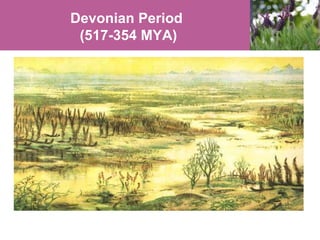
Devonian Period
(517-354 MYA)
Plant Proliferation
Plants began spreading beyond the wetlands
during the Devonian, with new types developing
that could survive on dry land. Toward the end of
the Devonian the first forests arose as stemmed
plants evolved strong, woody structures capable of
supporting raised branches and leaves. Some
Devonian trees are known to have grown 100 feet
(30 meters) tall. By the end of the period the first
ferns, horsetails, and seed plants had also
appeared.
Plants during the Devonian Period
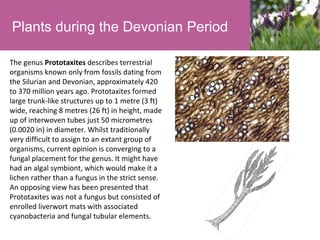
The genus Prototaxites describes terrestrial
organisms known only from fossils dating from
the Silurian and Devonian, approximately 420
to 370 million years ago. Prototaxites formed
large trunk-like structures up to 1 metre (3 ft)
wide, reaching 8 metres (26 ft) in height, made
up of interwoven tubes just 50 micrometres
(0.0020 in) in diameter. Whilst traditionally
very difficult to assign to an extant group of
organisms, current opinion is converging to a
fungal placement for the genus. It might have
had an algal symbiont, which would make it a
lichen rather than a fungus in the strict sense.
An opposing view has been presented that
Prototaxites was not a fungus but consisted of
enrolled liverwort mats with associated
cyanobacteria and fungal tubular elements.
Plants during the Devonian Period

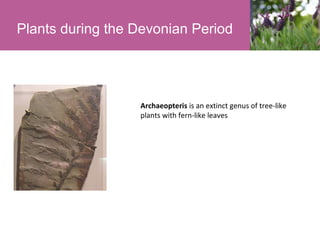
Archaeopteris is an extinct genus of tree-like
plants with fern-like leaves
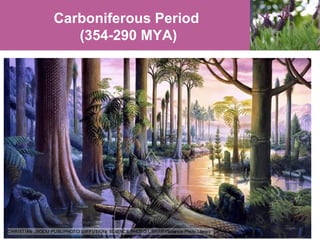
Carboniferous Period
(354-290 MYA)
Description
Plants during the Carboniferous
Period

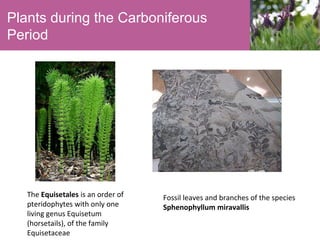
The Equisetales is an order of
pteridophytes with only one
living genus Equisetum
(horsetails), of the family
Equisetaceae

Fossil leaves and branches of the species
Sphenophyllum miravallis
Plants during the Carboniferous
Period

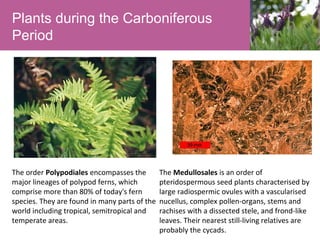
The order Polypodiales encompasses the
major lineages of polypod ferns, which
comprise more than 80% of today's fern
species. They are found in many parts of the
world including tropical, semitropical and
temperate areas.

The Medullosales is an order of
pteridospermous seed plants characterised by
large radiospermic ovules with a vascularised
nucellus, complex pollen-organs, stems and
rachises with a dissected stele, and frond-like
leaves. Their nearest still-living relatives are
probably the cycads.
Plants during the Carboniferous
Period

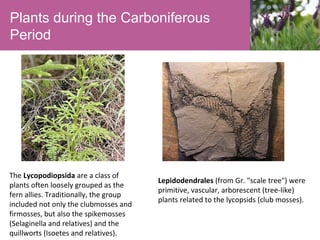
The Lycopodiopsida are a class of
plants often loosely grouped as the
fern allies. Traditionally, the group
included not only the clubmosses and
firmosses, but also the spikemosses
(Selaginella and relatives) and the
quillworts (Isoetes and relatives).

Lepidodendrales (from Gr. "scale tree") were
primitive, vascular, arborescent (tree-like)
plants related to the lycopsids (club mosses).
Plants during the Carboniferous
Period

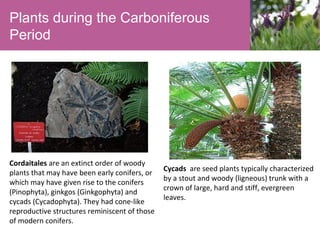
Cordaitales are an extinct order of woody
plants that may have been early conifers, or
which may have given rise to the conifers
(Pinophyta), ginkgos (Ginkgophyta) and
cycads (Cycadophyta). They had cone-like
reproductive structures reminiscent of those
of modern conifers.

Cycads are seed plants typically characterized
by a stout and woody (ligneous) trunk with a
crown of large, hard and stiff, evergreen
leaves.
Plants during the Carboniferous
Period

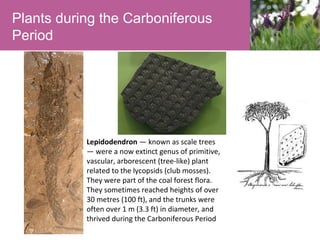
Lepidodendron — known as scale trees
— were a now extinct genus of primitive,
vascular, arborescent (tree-like) plant
related to the lycopsids (club mosses).
They were part of the coal forest flora.
They sometimes reached heights of over
30 metres (100 ft), and the trunks were
often over 1 m (3.3 ft) in diameter, and
thrived during the Carboniferous Period
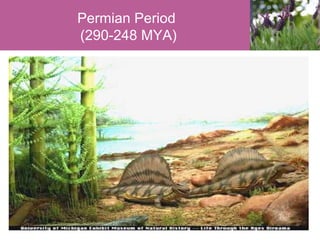
Permian Period
(290-248 MYA)
Description
The Permian period, which ended in the largest
mass extinction the Earth has ever known, began
about 299 million years ago. The emerging
supercontinent of Pangaea presented severe
extremes of climate and environment due to its
vast size. The south was cold and arid, with much
of the region frozen under ice caps. Northern
areas suffered increasingly from intense heat and
great seasonal fluctuations between wet and dry
conditions. The lush swamp forests of the
Carboniferous were gradually replaced by conifers,
seed ferns, and other drought-resistant plants.
Description
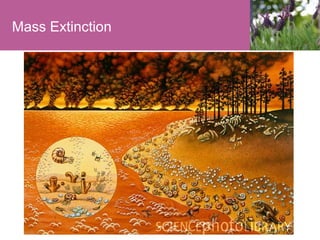
The Permian, however, represented the last gasp
for much early prehistoric life. The period, and the
Paleozoic era, came to a calamitous close 251
million years ago, marking a biological dividing line
that few animals crossed. The Permian extinction
—the worst extinction event in the planet's history
—is estimated to have wiped out more than 90
percent of all marine species and 70 percent of
land animals.
Description
Various theories seek to explain this mass
extinction. Some scientists think a series of
volcanic eruptions pumped so much debris into the
atmosphere that the sun was blocked out, causing
a significant drop in temperature and preventing
plant photosynthesis, which in turn caused food
chains to collapse.
Description
Other scientists point to global climate change,
citing evidence for a period of sudden warming
and cooling. These rapid extremes of conditions
may have meant species were unable to adjust.
Other theories include a catastrophic release of
methane gas stored under the seabed, triggered
by earthquakes or global warming, or a massive
asteroid impact.
Plants during the Permian Period

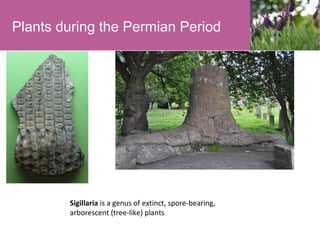
Sigillaria is a genus of extinct, spore-bearing,
arborescent (tree-like) plants
Plants during the Permian Period

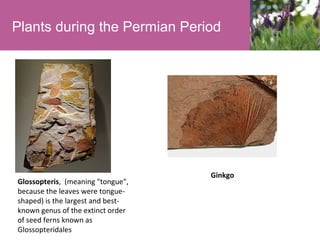
Glossopteris, (meaning "tongue",
because the leaves were tongueshaped) is the largest and bestknown genus of the extinct order
of seed ferns known as
Glossopteridales

Ginkgo
Mass Extinction

Plants (paleozoic era)

  • 1.
  • 2.
  • 3.
    Plant Proliferation Plants beganspreading beyond the wetlands during the Devonian, with new types developing that could survive on dry land. Toward the end of the Devonian the first forests arose as stemmed plants evolved strong, woody structures capable of supporting raised branches and leaves. Some Devonian trees are known to have grown 100 feet (30 meters) tall. By the end of the period the first ferns, horsetails, and seed plants had also appeared.
  • 4.
    Plants during theDevonian Period The genus Prototaxites describes terrestrial organisms known only from fossils dating from the Silurian and Devonian, approximately 420 to 370 million years ago. Prototaxites formed large trunk-like structures up to 1 metre (3 ft) wide, reaching 8 metres (26 ft) in height, made up of interwoven tubes just 50 micrometres (0.0020 in) in diameter. Whilst traditionally very difficult to assign to an extant group of organisms, current opinion is converging to a fungal placement for the genus. It might have had an algal symbiont, which would make it a lichen rather than a fungus in the strict sense. An opposing view has been presented that Prototaxites was not a fungus but consisted of enrolled liverwort mats with associated cyanobacteria and fungal tubular elements.
  • 5.
    Plants during theDevonian Period Archaeopteris is an extinct genus of tree-like plants with fern-like leaves
  • 6.
  • 7.
  • 8.
    Plants during theCarboniferous Period The Equisetales is an order of pteridophytes with only one living genus Equisetum (horsetails), of the family Equisetaceae Fossil leaves and branches of the species Sphenophyllum miravallis
  • 9.
    Plants during theCarboniferous Period The order Polypodiales encompasses the major lineages of polypod ferns, which comprise more than 80% of today's fern species. They are found in many parts of the world including tropical, semitropical and temperate areas. The Medullosales is an order of pteridospermous seed plants characterised by large radiospermic ovules with a vascularised nucellus, complex pollen-organs, stems and rachises with a dissected stele, and frond-like leaves. Their nearest still-living relatives are probably the cycads.
  • 10.
    Plants during theCarboniferous Period The Lycopodiopsida are a class of plants often loosely grouped as the fern allies. Traditionally, the group included not only the clubmosses and firmosses, but also the spikemosses (Selaginella and relatives) and the quillworts (Isoetes and relatives). Lepidodendrales (from Gr. "scale tree") were primitive, vascular, arborescent (tree-like) plants related to the lycopsids (club mosses).
  • 11.
    Plants during theCarboniferous Period Cordaitales are an extinct order of woody plants that may have been early conifers, or which may have given rise to the conifers (Pinophyta), ginkgos (Ginkgophyta) and cycads (Cycadophyta). They had cone-like reproductive structures reminiscent of those of modern conifers. Cycads are seed plants typically characterized by a stout and woody (ligneous) trunk with a crown of large, hard and stiff, evergreen leaves.
  • 12.
    Plants during theCarboniferous Period Lepidodendron — known as scale trees — were a now extinct genus of primitive, vascular, arborescent (tree-like) plant related to the lycopsids (club mosses). They were part of the coal forest flora. They sometimes reached heights of over 30 metres (100 ft), and the trunks were often over 1 m (3.3 ft) in diameter, and thrived during the Carboniferous Period
  • 13.
  • 14.
    Description The Permian period,which ended in the largest mass extinction the Earth has ever known, began about 299 million years ago. The emerging supercontinent of Pangaea presented severe extremes of climate and environment due to its vast size. The south was cold and arid, with much of the region frozen under ice caps. Northern areas suffered increasingly from intense heat and great seasonal fluctuations between wet and dry conditions. The lush swamp forests of the Carboniferous were gradually replaced by conifers, seed ferns, and other drought-resistant plants.
  • 15.
    Description The Permian, however,represented the last gasp for much early prehistoric life. The period, and the Paleozoic era, came to a calamitous close 251 million years ago, marking a biological dividing line that few animals crossed. The Permian extinction —the worst extinction event in the planet's history —is estimated to have wiped out more than 90 percent of all marine species and 70 percent of land animals.
  • 16.
    Description Various theories seekto explain this mass extinction. Some scientists think a series of volcanic eruptions pumped so much debris into the atmosphere that the sun was blocked out, causing a significant drop in temperature and preventing plant photosynthesis, which in turn caused food chains to collapse.
  • 17.
    Description Other scientists pointto global climate change, citing evidence for a period of sudden warming and cooling. These rapid extremes of conditions may have meant species were unable to adjust. Other theories include a catastrophic release of methane gas stored under the seabed, triggered by earthquakes or global warming, or a massive asteroid impact.
  • 18.
    Plants during thePermian Period Sigillaria is a genus of extinct, spore-bearing, arborescent (tree-like) plants
  • 19.
    Plants during thePermian Period Glossopteris, (meaning "tongue", because the leaves were tongueshaped) is the largest and bestknown genus of the extinct order of seed ferns known as Glossopteridales Ginkgo
  • 20.