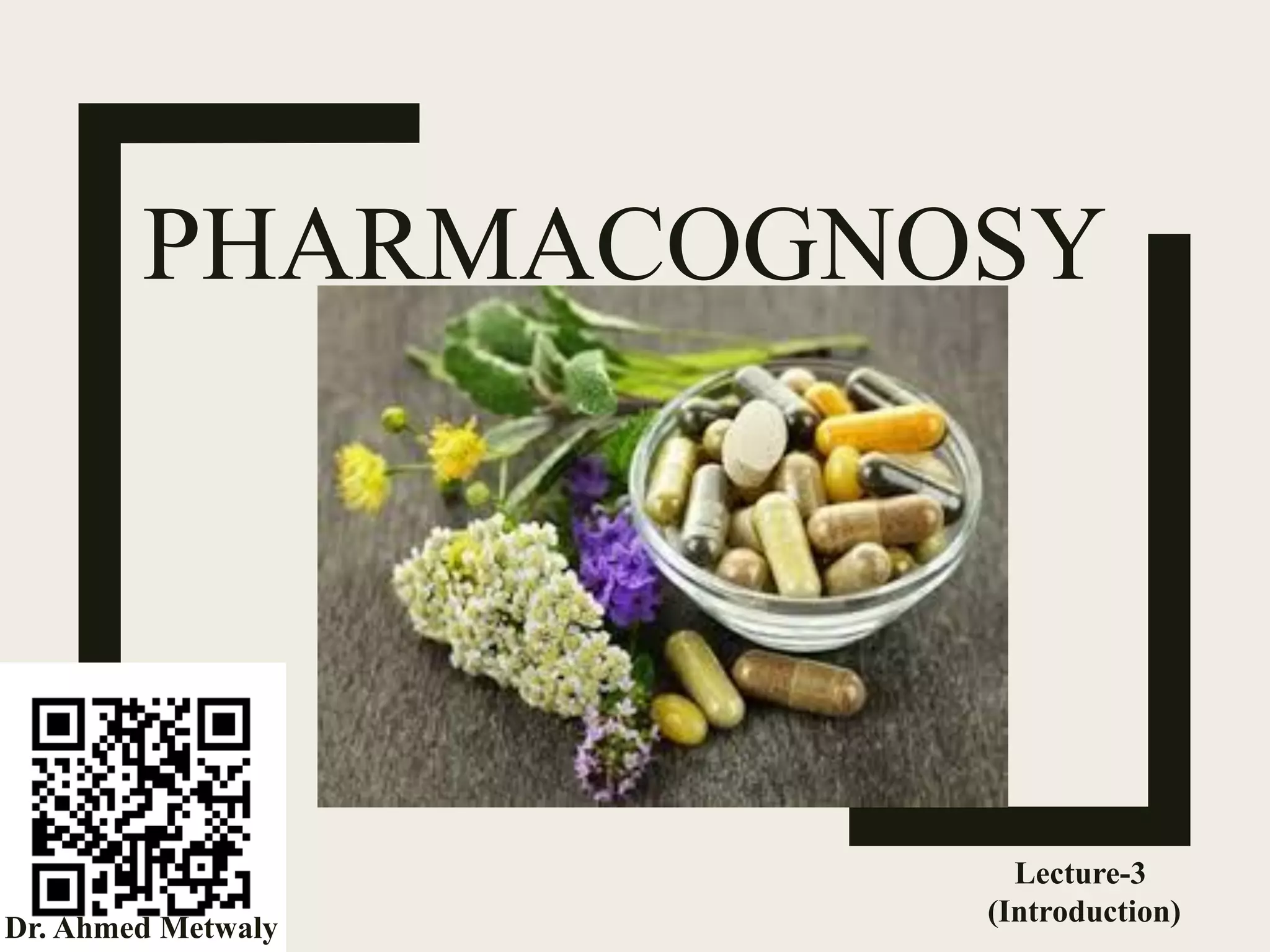
PHARMACOGNOSY
Lecture-3
(Introduction)
Dr. Ahmed Metwaly
Objectives
Packing Storage Adulteration
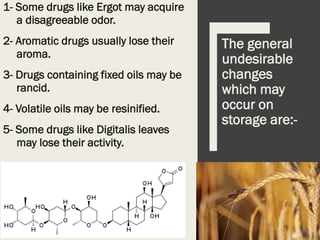
1- Some drugs like Ergot may acquire
a disagreeable odor.
2- Aromatic drugs usually lose their
aroma.
3- Drugs containing fixed oils may be
rancid.
4- Volatile oils may be resinified.
5- Some drugs like Digitalis leaves
may lose their activity.
The general
undesirable
changes
which may
occur on
storage are:-
Instruction for
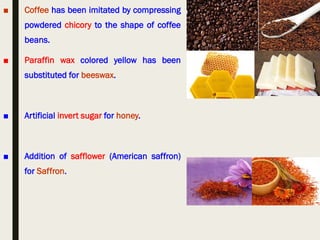
storage of crude
drugs
1- In well closed containers.
2- Protected from light,
moisture and dust.
3- At low temperature.
4- Protected from insects.
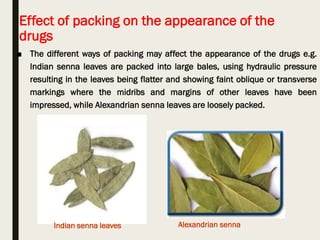
Effect of packing on the appearance of the
drugs
■ The different ways of packing may affect the appearance of the drugs e.g.
Indian senna leaves are packed into large bales, using hydraulic pressure
resulting in the leaves being flatter and showing faint oblique or transverse
markings where the midribs and margins of other leaves have been
impressed, while Alexandrian senna leaves are loosely packed.
Indian senna leaves Alexandrian senna
Storage of Drugs: Preservation
and Protection of Crude Drugs
■ Drugs usually deteriorate either slowly or
rapidly along the time of storage with few
exceptions such as
■ Cascara and Frangula barks which should
not be used except after a certain period of
storage.
■ Few drugs e.g. Nux vomica are hardly
affected by storage.
Factors affecting the drugs
during storage
■ The principal factors responsible for
deterioration of crude drugs may be
considered under two headings;
physicochemical and biological.
■ The principal physicochemical factors
involved in the spontaneous deterioration of
drugs are moisture, heat, air and light.
■ The principal biological factors responsible
for deterioration of crude drugs during
storage are fungi, bacteria, insects and
rodents.
Physicochemical factors
■ Moisture: The active constituents of Digitalis
and of Ergot undergo rapid change, resulting
from the presence of enzymes, which only
need a sufficient degree of moisture to
activate them.
■ The presence of excessive moisture is
undesirable for several reasons. It is not only
increase the weight of the drug, thus
decreasing the percentage of active
ingredients, but it also favors the growth of
fungi, bacteria which spoil the drug, and
enzymatic activity which leads to hydrolysis of
glycosides and ester alkaloids.
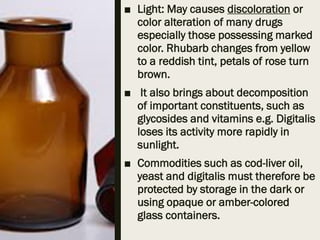
■ Light: May causes discoloration or
color alteration of many drugs
especially those possessing marked
color. Rhubarb changes from yellow
to a reddish tint, petals of rose turn
brown.
■ It also brings about decomposition
of important constituents, such as
glycosides and vitamins e.g. Digitalis
loses its activity more rapidly in
sunlight.
■ Commodities such as cod-liver oil,
yeast and digitalis must therefore be
protected by storage in the dark or
using opaque or amber-colored
glass containers.
■ Temperature: Acceleration of the chemical
reactions occurring in the drug. Many
enzymatic changes proceed more rapidly at
a slight raised temperature up to about 45c,
and similar conditions will often induce
molecular rearrangements. Also accelerats
the loss of volatile oils.
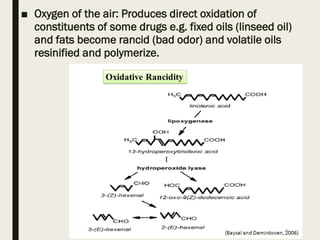
■ Oxygen of the air: Produces direct oxidation of
constituents of some drugs e.g. fixed oils (linseed oil)
and fats become rancid (bad odor) and volatile oils
resinified and polymerize.
■ The general rule for the preservation
of drugs is to store them in
moisture-proof, air tight, light-proof
containers at as low a temperature
as is practicable.
■ Volatile oils should be stored in sealed, well-
filled containers in a cool, dry place. Similar
remarks apply to fixed oils, particularly cod-
liver oil. The air in the container is
sometimes replaced by an inert gas. Ideally,
crude drugs should be stored in an
atmosphere of nitrogen.
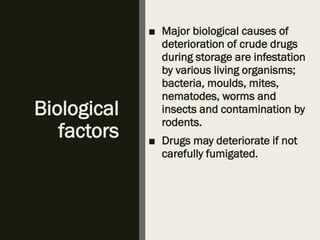
Biological
factors
■ Major biological causes of
deterioration of crude drugs
during storage are infestation
by various living organisms;
bacteria, moulds, mites,
nematodes, worms and
insects and contamination by
rodents.
■ Drugs may deteriorate if not
carefully fumigated.
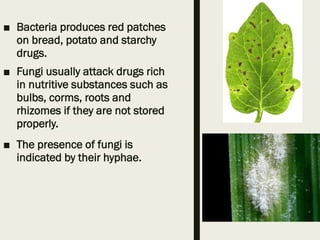
■ Bacteria produces red patches
on bread, potato and starchy
drugs.
■ Fungi usually attack drugs rich
in nutritive substances such as
bulbs, corms, roots and
rhizomes if they are not stored
properly.
■ The presence of fungi is
indicated by their hyphae.
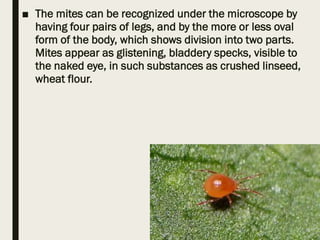
■ The mites can be recognized under the microscope by
having four pairs of legs, and by the more or less oval
form of the body, which shows division into two parts.
Mites appear as glistening, bladdery specks, visible to
the naked eye, in such substances as crushed linseed,
wheat flour.
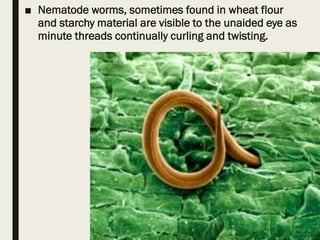
■ Nematode worms, sometimes found in wheat flour
and starchy material are visible to the unaided eye as
minute threads continually curling and twisting.
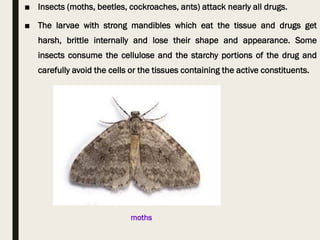
■ Insects (moths, beetles, cockroaches, ants) attack nearly all drugs.
■ The larvae with strong mandibles which eat the tissue and drugs get
harsh, brittle internally and lose their shape and appearance. Some
insects consume the cellulose and the starchy portions of the drug and
carefully avoid the cells or the tissues containing the active constituents.
moths
■ Material which have thus become
badly infected are best destroyed by
burning and the store places in
which they have been kept must be
cleansed.
Adulteration
of Drugs
■ In general, adulteration occurs
when a drug is scarce or when
the price of a drug is normally
high.
■ The adulterant must be some
material which is both cheap
and available in fairly large
amounts.
■ An adulterated drug is that
which does not have the official
requirements.
Types of adulteration
■ Sophistication or True adulteration:
The addition of an inferior material to
any article with intend to defraud.
e.g. addition of wheat flour to
powdered ginger, with enough
capsicum to restore or enhance the
pungency and enough curcuma to
maintain the color.
■ Coffee has been imitated by compressing
powdered chicory to the shape of coffee
beans.
■ Paraffin wax colored yellow has been
substituted for beeswax.
■ Artificial invert sugar for honey.
■ Addition of safflower (American saffron)
for Saffron.
■ Substitution:
Replacement of the original
drug by the adulterant (an
entirely different article used).
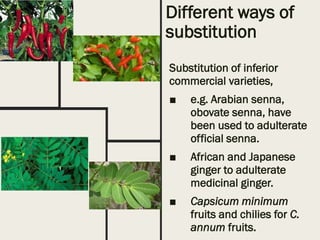
Different ways of
substitution
Substitution of inferior
commercial varieties,
■ e.g. Arabian senna,
obovate senna, have
been used to adulterate
official senna.
■ African and Japanese
ginger to adulterate
medicinal ginger.
■ Capsicum minimum
fruits and chilies for C.
annum fruits.
■ Substitution of exhausted drugs:
As in the preparation of volatile oils
from cloves or from umbelliferous
fruits such as fennel and caraway,
the ungrounded drug is used and
the dried exhausted material
closely resemble the genuine drug.
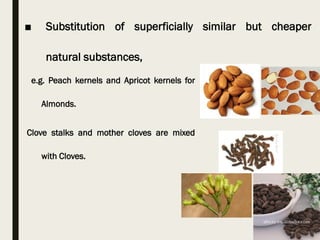
e.g. Peach kernels and Apricot kernels for
Almonds.
Clove stalks and mother cloves are mixed
with Cloves.
■ Substitution of superficially similar but cheaper
natural substances,
■ Admixture:
The addition of one article to
another through accident,
ignorance or carelessness.
If the addition has been done
intentionally to defraud, it is
sophistication. Admixture may
occur through faulty collection.
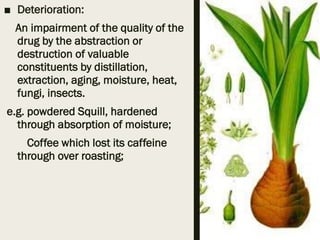
■ Deterioration:
An impairment of the quality of the
drug by the abstraction or
destruction of valuable
constituents by distillation,
extraction, aging, moisture, heat,
fungi, insects.
e.g. powdered Squill, hardened
through absorption of moisture;
Coffee which lost its caffeine
through over roasting;
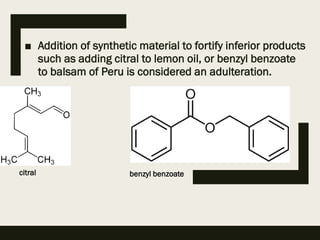
■ Addition of synthetic material to fortify inferior products
such as adding citral to lemon oil, or benzyl benzoate
to balsam of Peru is considered an adulteration.
citral benzyl benzoate
Adulteration of
powdered
drugs
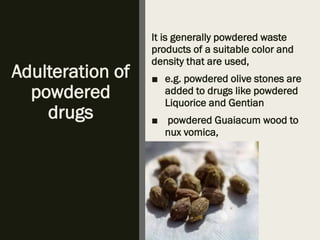
It is generally powdered waste
products of a suitable color and
density that are used,
■ e.g. powdered olive stones are
added to drugs like powdered
Liquorice and Gentian
■ powdered Guaiacum wood to
nux vomica,
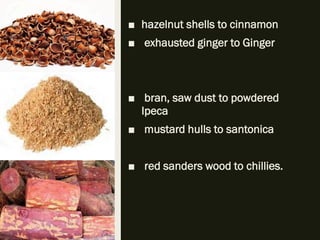
■ hazelnut shells to cinnamon
■ exhausted ginger to Ginger
■ bran, saw dust to powdered
Ipeca
■ mustard hulls to santonica
■ red sanders wood to chillies.
The
evaluation
of drugs
■ Evaluation of a drug means its
identification and
determination of its quality and
purity.
■ For each official drug, there are
limits for its quality and purity
listed in its monograph (the
part of the pharmacopoeia
describing the drug).
A high grade of quality in a drug is obtained
by collecting it:-
■ From the correct natural source.
■ At the proper time.
■ At the proper stage of growth.
■ By using the proper manner.
■ By good preparation of the collected drug
using proper cleaning and drying
processes
■ By the proper protection of it and of its
samples against insects, fungi, dirt and
moisture.
For the evaluation of drugs we use
several methods.
There are:
1- Organoleptic methods.
2- Microscopic methods.
3- Biological methods.
4- chemical methods.
5- Chromatographic methods.
The organoleptic evaluation of drugs
■ Organoleptic (impression on the organs), refers to
evaluation by means of the organs of sense. It
includes the macroscopic appearance of drugs;
shape and size, its odor, taste, color, the feel of the
drug to the touch, external marks, the sound or
snap of its fracture and internal color.
The microscopic methods
■ Knowledge of microscopical structure of genuine
drugs is essential for detection of its adulterants in
powder forms,
■ Senega root devoid of Calcium oxalate crystals,
starch, fibres and sclerenchyma.
■ No starches in henna leaves.
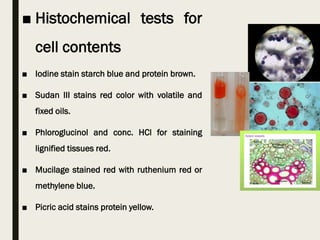
■ Histochemical tests for
cell contents
■ Iodine stain starch blue and protein brown.
■ Sudan III stains red color with volatile and
fixed oils.
■ Phloroglucinol and conc. HCl for staining
lignified tissues red.
■ Mucilage stained red with ruthenium red or
methylene blue.
■ Picric acid stains protein yellow.
Macro chemical tests for cell contents
■ Mayer’s reagent (potassium mercuric iodide) when
added to an acidified solution of the extract it gives a
yellowish-white ppt. with alkaloids.
■ KOH/ alkali gives red color with anthraquinones.
■ KOH/ alkali/ AlCl3 give intense yellow color with
flavonoids.
■ FeCl3 solution gives blue or green color with tannins or
phenolic compounds.
HPLC AND HPTLC
QUESTIONS?

Introduction 3

  • 1.
  • 2.
  • 3.
    1- Some drugslike Ergot may acquire a disagreeable odor. 2- Aromatic drugs usually lose their aroma. 3- Drugs containing fixed oils may be rancid. 4- Volatile oils may be resinified. 5- Some drugs like Digitalis leaves may lose their activity. The general undesirable changes which may occur on storage are:-
  • 4.
    Instruction for storage ofcrude drugs 1- In well closed containers. 2- Protected from light, moisture and dust. 3- At low temperature. 4- Protected from insects.
  • 5.
    Effect of packingon the appearance of the drugs ■ The different ways of packing may affect the appearance of the drugs e.g. Indian senna leaves are packed into large bales, using hydraulic pressure resulting in the leaves being flatter and showing faint oblique or transverse markings where the midribs and margins of other leaves have been impressed, while Alexandrian senna leaves are loosely packed. Indian senna leaves Alexandrian senna
  • 6.
    Storage of Drugs:Preservation and Protection of Crude Drugs ■ Drugs usually deteriorate either slowly or rapidly along the time of storage with few exceptions such as ■ Cascara and Frangula barks which should not be used except after a certain period of storage. ■ Few drugs e.g. Nux vomica are hardly affected by storage.
  • 7.
    Factors affecting thedrugs during storage ■ The principal factors responsible for deterioration of crude drugs may be considered under two headings; physicochemical and biological. ■ The principal physicochemical factors involved in the spontaneous deterioration of drugs are moisture, heat, air and light. ■ The principal biological factors responsible for deterioration of crude drugs during storage are fungi, bacteria, insects and rodents.
  • 8.
    Physicochemical factors ■ Moisture:The active constituents of Digitalis and of Ergot undergo rapid change, resulting from the presence of enzymes, which only need a sufficient degree of moisture to activate them. ■ The presence of excessive moisture is undesirable for several reasons. It is not only increase the weight of the drug, thus decreasing the percentage of active ingredients, but it also favors the growth of fungi, bacteria which spoil the drug, and enzymatic activity which leads to hydrolysis of glycosides and ester alkaloids.
  • 9.
    ■ Light: Maycauses discoloration or color alteration of many drugs especially those possessing marked color. Rhubarb changes from yellow to a reddish tint, petals of rose turn brown. ■ It also brings about decomposition of important constituents, such as glycosides and vitamins e.g. Digitalis loses its activity more rapidly in sunlight. ■ Commodities such as cod-liver oil, yeast and digitalis must therefore be protected by storage in the dark or using opaque or amber-colored glass containers.
  • 10.
    ■ Temperature: Accelerationof the chemical reactions occurring in the drug. Many enzymatic changes proceed more rapidly at a slight raised temperature up to about 45c, and similar conditions will often induce molecular rearrangements. Also accelerats the loss of volatile oils.
  • 11.
    ■ Oxygen ofthe air: Produces direct oxidation of constituents of some drugs e.g. fixed oils (linseed oil) and fats become rancid (bad odor) and volatile oils resinified and polymerize.
  • 12.
    ■ The generalrule for the preservation of drugs is to store them in moisture-proof, air tight, light-proof containers at as low a temperature as is practicable.
  • 13.
    ■ Volatile oilsshould be stored in sealed, well- filled containers in a cool, dry place. Similar remarks apply to fixed oils, particularly cod- liver oil. The air in the container is sometimes replaced by an inert gas. Ideally, crude drugs should be stored in an atmosphere of nitrogen.
  • 14.
    Biological factors ■ Major biologicalcauses of deterioration of crude drugs during storage are infestation by various living organisms; bacteria, moulds, mites, nematodes, worms and insects and contamination by rodents. ■ Drugs may deteriorate if not carefully fumigated.
  • 15.
    ■ Bacteria producesred patches on bread, potato and starchy drugs. ■ Fungi usually attack drugs rich in nutritive substances such as bulbs, corms, roots and rhizomes if they are not stored properly. ■ The presence of fungi is indicated by their hyphae.
  • 16.
    ■ The mitescan be recognized under the microscope by having four pairs of legs, and by the more or less oval form of the body, which shows division into two parts. Mites appear as glistening, bladdery specks, visible to the naked eye, in such substances as crushed linseed, wheat flour.
  • 17.
    ■ Nematode worms,sometimes found in wheat flour and starchy material are visible to the unaided eye as minute threads continually curling and twisting.
  • 18.
    ■ Insects (moths,beetles, cockroaches, ants) attack nearly all drugs. ■ The larvae with strong mandibles which eat the tissue and drugs get harsh, brittle internally and lose their shape and appearance. Some insects consume the cellulose and the starchy portions of the drug and carefully avoid the cells or the tissues containing the active constituents. moths
  • 19.
    ■ Material whichhave thus become badly infected are best destroyed by burning and the store places in which they have been kept must be cleansed.
  • 20.
    Adulteration of Drugs ■ Ingeneral, adulteration occurs when a drug is scarce or when the price of a drug is normally high. ■ The adulterant must be some material which is both cheap and available in fairly large amounts. ■ An adulterated drug is that which does not have the official requirements.
  • 21.
    Types of adulteration ■Sophistication or True adulteration: The addition of an inferior material to any article with intend to defraud. e.g. addition of wheat flour to powdered ginger, with enough capsicum to restore or enhance the pungency and enough curcuma to maintain the color.
  • 22.
    ■ Coffee hasbeen imitated by compressing powdered chicory to the shape of coffee beans. ■ Paraffin wax colored yellow has been substituted for beeswax. ■ Artificial invert sugar for honey. ■ Addition of safflower (American saffron) for Saffron.
  • 23.
    ■ Substitution: Replacement ofthe original drug by the adulterant (an entirely different article used).
  • 24.
    Different ways of substitution Substitutionof inferior commercial varieties, ■ e.g. Arabian senna, obovate senna, have been used to adulterate official senna. ■ African and Japanese ginger to adulterate medicinal ginger. ■ Capsicum minimum fruits and chilies for C. annum fruits.
  • 25.
    ■ Substitution ofexhausted drugs: As in the preparation of volatile oils from cloves or from umbelliferous fruits such as fennel and caraway, the ungrounded drug is used and the dried exhausted material closely resemble the genuine drug.
  • 26.
    e.g. Peach kernelsand Apricot kernels for Almonds. Clove stalks and mother cloves are mixed with Cloves. ■ Substitution of superficially similar but cheaper natural substances,
  • 27.
    ■ Admixture: The additionof one article to another through accident, ignorance or carelessness. If the addition has been done intentionally to defraud, it is sophistication. Admixture may occur through faulty collection.
  • 28.
    ■ Deterioration: An impairmentof the quality of the drug by the abstraction or destruction of valuable constituents by distillation, extraction, aging, moisture, heat, fungi, insects. e.g. powdered Squill, hardened through absorption of moisture; Coffee which lost its caffeine through over roasting;
  • 29.
    ■ Addition ofsynthetic material to fortify inferior products such as adding citral to lemon oil, or benzyl benzoate to balsam of Peru is considered an adulteration. citral benzyl benzoate
  • 30.
    Adulteration of powdered drugs It isgenerally powdered waste products of a suitable color and density that are used, ■ e.g. powdered olive stones are added to drugs like powdered Liquorice and Gentian ■ powdered Guaiacum wood to nux vomica,
  • 31.
    ■ hazelnut shellsto cinnamon ■ exhausted ginger to Ginger ■ bran, saw dust to powdered Ipeca ■ mustard hulls to santonica ■ red sanders wood to chillies.
  • 32.
    The evaluation of drugs ■ Evaluationof a drug means its identification and determination of its quality and purity. ■ For each official drug, there are limits for its quality and purity listed in its monograph (the part of the pharmacopoeia describing the drug).
  • 33.
    A high gradeof quality in a drug is obtained by collecting it:- ■ From the correct natural source. ■ At the proper time. ■ At the proper stage of growth. ■ By using the proper manner. ■ By good preparation of the collected drug using proper cleaning and drying processes ■ By the proper protection of it and of its samples against insects, fungi, dirt and moisture.
  • 34.
    For the evaluationof drugs we use several methods. There are: 1- Organoleptic methods. 2- Microscopic methods. 3- Biological methods. 4- chemical methods. 5- Chromatographic methods.
  • 35.
    The organoleptic evaluationof drugs ■ Organoleptic (impression on the organs), refers to evaluation by means of the organs of sense. It includes the macroscopic appearance of drugs; shape and size, its odor, taste, color, the feel of the drug to the touch, external marks, the sound or snap of its fracture and internal color.
  • 36.
    The microscopic methods ■Knowledge of microscopical structure of genuine drugs is essential for detection of its adulterants in powder forms, ■ Senega root devoid of Calcium oxalate crystals, starch, fibres and sclerenchyma. ■ No starches in henna leaves.
  • 37.
    ■ Histochemical testsfor cell contents ■ Iodine stain starch blue and protein brown. ■ Sudan III stains red color with volatile and fixed oils. ■ Phloroglucinol and conc. HCl for staining lignified tissues red. ■ Mucilage stained red with ruthenium red or methylene blue. ■ Picric acid stains protein yellow.
  • 38.
    Macro chemical testsfor cell contents ■ Mayer’s reagent (potassium mercuric iodide) when added to an acidified solution of the extract it gives a yellowish-white ppt. with alkaloids. ■ KOH/ alkali gives red color with anthraquinones. ■ KOH/ alkali/ AlCl3 give intense yellow color with flavonoids. ■ FeCl3 solution gives blue or green color with tannins or phenolic compounds.
  • 39.
  • 40.