Lecture-4 (Applications)
Ph.D.Ahmed Metwaly
Mass spectrometry
ORCID account
Email: ametwaly@azhar.edu.eg
1
• Associate Professor of Pharmacognosy , faculty of Pharmacy, Al-Azhar University
• Senior research fellow, Liaoning University of Traditional Chinese Medicine, China (20118-2019)
• Visiting scholar, School of Pharmacy, University of Mississippi, USA (2012-2014)
Applications
Hard Ionization
(Fragmentation patterns)
High resolution mass (HR-Ms) (Molecular formula)
Tandem Mass Spectrometry (Ms/Ms)
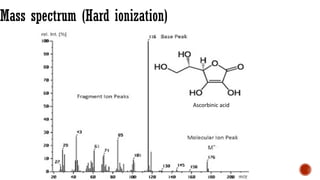
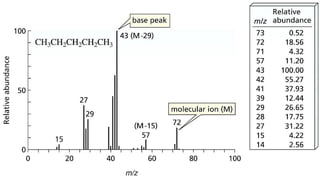
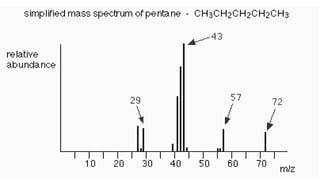
Mass spectrum (Hard ionization)
Ascorbinic acid
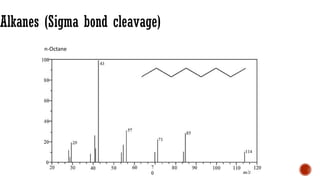
Alkanes (Sigma bond cleavage)
n-Octane
Ethers (inductive cleavage)
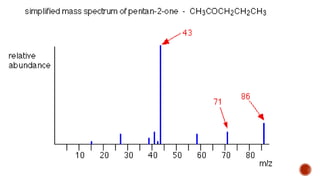
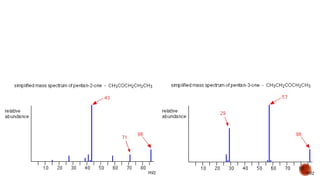
Acylium ions, [RCO]+
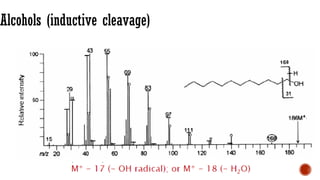
Alcohols (inductive cleavage)
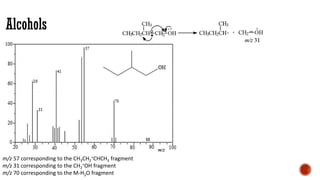
Alcohols
m/z 57 corresponding to the CH3CH2
+CHCH3 fragment
m/z 31 corresponding to the CH2
+OH fragment
m/z 70 corresponding to the M-H2O fragment
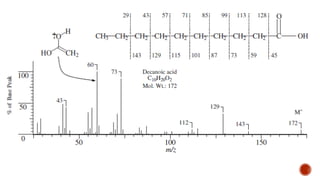
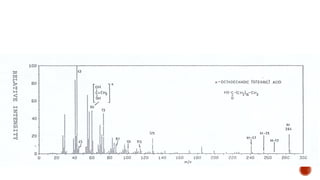
Acids [McLafferty rearrangement]
C
O
H2C OH
R CH
H
CH2
-e-
C
O
H2C OH
R CH
H
CH2
rH
C
O
H2C OH
R CH
CH2
H
C
O
H2C OH
R CH
CH2
H
+
m/z = 60

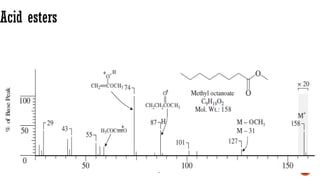
Acid esters
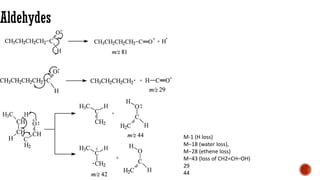
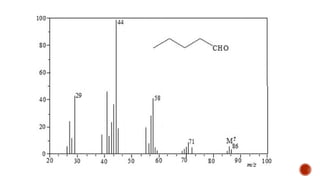
Aldehydes
M-1 (H loss)
M−18 (water loss),
M−28 (ethene loss)
M−43 (loss of CH2=CH–OH)
29
44
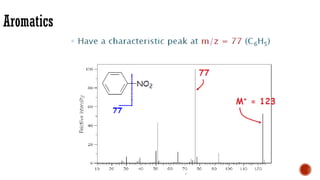
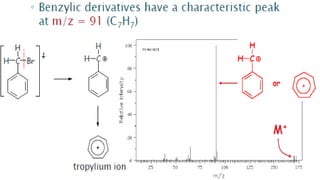
Aromatics
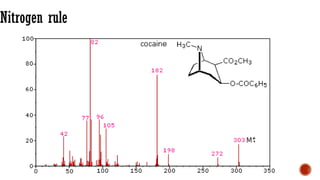
Nitrogen rule
Isotope patterns
Mass spectrometers are capable of separating and detecting individual ions even
those that only differ by a single atomic mass unit.
We can use low resolution results and intensities of isotope peaks to arrive to a
possible molecular formula.
As a result molecules containing different isotopes can be distinguished.
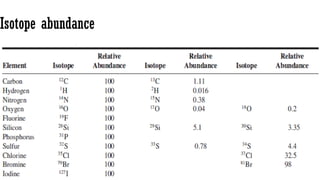
Isotope abundance
Isotopes: present in their usual abundance.
Hydrocarbons contain 1.1% C-13, so there will be a very small M+1 peak.
If Br is present, M+2 is equal to M+.
If Cl is present, M+2 is one-third of M+.
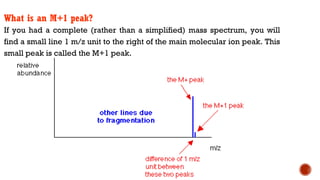
What is an M+1 peak?
If you had a complete (rather than a simplified) mass spectrum, you will
find a small line 1 m/z unit to the right of the main molecular ion peak. This
small peak is called the M+1 peak.
This is most apparent when atoms such as bromine or chlorine are present.
Peaks at "M" and "M+2" are obtained.
Bromine isotopes [79Br : 81Br] have the same abundance intensity (having M and M+2 in
ratio 1:1).
Chlorine [35Cl : 37Cl] have difference in the abundance, so the intensity of M and M+2 is
in ratio 3:1.
The intensity ratios in the isotope patterns are due to the natural abundance of the
isotopes.
Therefore, differentiation between the mass spectra of chlorine- and bromine-containing
compounds is possible.
M+2 peak
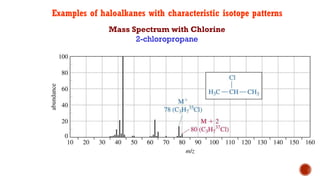
Examples of haloalkanes with characteristic isotope patterns
Mass Spectrum with Chlorine
2-chloropropane
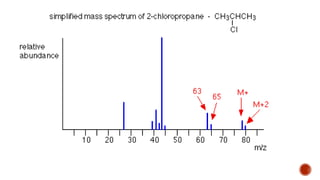
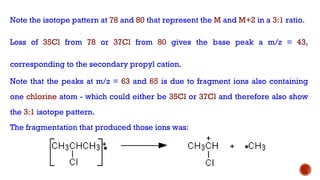
Note the isotope pattern at 78 and 80 that represent the M and M+2 in a 3:1 ratio.
Loss of 35Cl from 78 or 37Cl from 80 gives the base peak a m/z = 43,
corresponding to the secondary propyl cation.
Note that the peaks at m/z = 63 and 65 is due to fragment ions also containing
one chlorine atom - which could either be 35Cl or 37Cl and therefore also show
the 3:1 isotope pattern.
The fragmentation that produced those ions was:
So
if you look at the molecular ion region, and find two peaks separated by 2 m/z units
and with a ratio of 3 : 1 in the peak heights, that tells you that the molecule contains
1 chlorine atom.
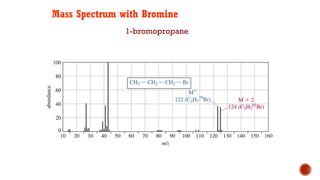
Mass Spectrum with Bromine
1-bromopropane
Note the isotope pattern at 122 and 124 that represent the M and M+2 in a 1:1 ratio.
Loss of 79Br from 122 or 81Br from 124 gives the base peak a m/z = 43, corresponding
to the propyl cation.
Note that other peaks, such as those at m/z = 107 and 109 still contain Br and therefore
also show the 1:1 isotope pattern.
So
If you have two lines in the molecular ion region with a gap of 2 m/z units between
them and with almost equal heights, this shows the presence of a bromine atom in
the molecule.
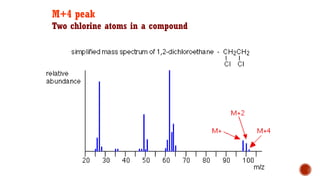
M+4 peak
Two chlorine atoms in a compound
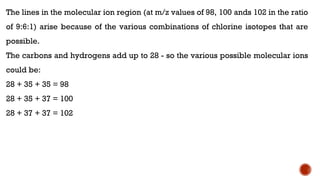
The lines in the molecular ion region (at m/z values of 98, 100 ands 102 in the ratio
of 9:6:1) arise because of the various combinations of chlorine isotopes that are
possible.
The carbons and hydrogens add up to 28 - so the various possible molecular ions
could be:
28 + 35 + 35 = 98
28 + 35 + 37 = 100
28 + 37 + 37 = 102
So
If you have 3 lines in the molecular ion region (M+, M+2 and M+4) with gaps of
2 m/z units between them, and with peak heights in the ratio of 9:6:1, the
compound contains 2 chlorine atoms.
High resolution Ms
(HR-Ms)
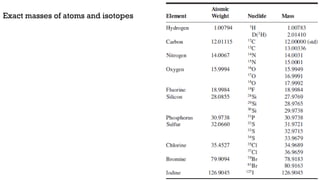
Exact masses of atoms and isotopes
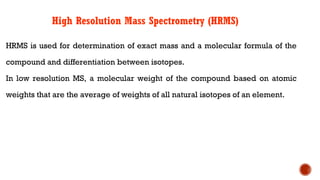
High Resolution Mass Spectrometry (HRMS)
HRMS is used for determination of exact mass and a molecular formula of the
compound and differentiation between isotopes.
In low resolution MS, a molecular weight of the compound based on atomic
weights that are the average of weights of all natural isotopes of an element.
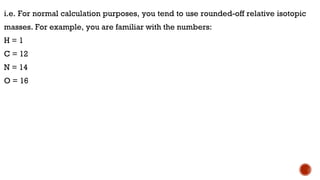
i.e. For normal calculation purposes, you tend to use rounded-off relative isotopic
masses. For example, you are familiar with the numbers:
H = 1
C = 12
N = 14
O = 16
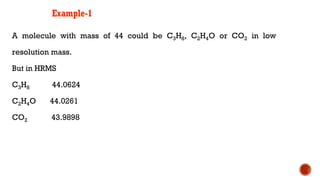
Example-1
A molecule with mass of 44 could be C3H8, C2H4O or CO2 in low
resolution mass.
But in HRMS
C3H8 44.0624
C2H4O 44.0261
CO2 43.9898
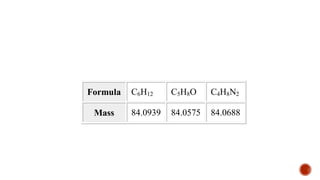
Formula C6H12 C5H8O C4H8N2
Mass 84.0939 84.0575 84.0688
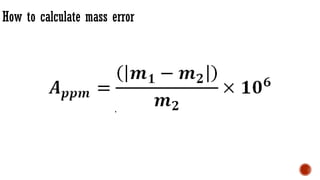
How to calculate mass error
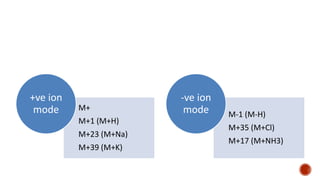
M+
M+1 (M+H)
M+23 (M+Na)
M+39 (M+K)
+ve ion
mode M-1 (M-H)
M+35 (M+Cl)
M+17 (M+NH3)
-ve ion
mode
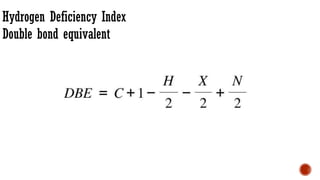
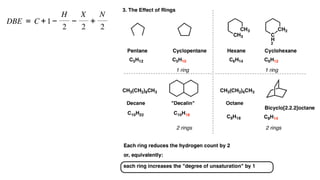
Hydrogen Deficiency Index
Double bond equivalent
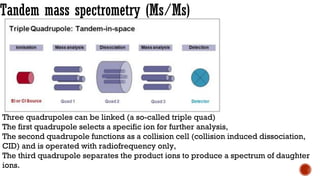
Tandem mass spectrometry (Ms/Ms)
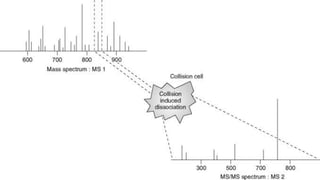
Three quadrupoles can be linked (a so-called triple quad)
The first quadrupole selects a specific ion for further analysis,
The second quadrupole functions as a collision cell (collision induced dissociation,
CID) and is operated with radiofrequency only,
The third quadrupole separates the product ions to produce a spectrum of daughter
ions.
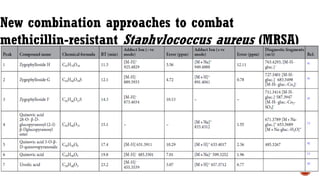
New combination approaches to combat
methicillin-resistant Staphylococcus aureus (MRSA)
Ph.D.Ahmed M.Metwaly
Associate professor,Pharmacognosy
department,
Faculty of Pharmacy,Al-Azhar University.
ametwaly@azhar.edu.eg
Email: ametwaly@azhar.edu.eg 53

Mass 2021 4 (applications)

  • 1.
    Lecture-4 (Applications) Ph.D.Ahmed Metwaly Massspectrometry ORCID account Email: ametwaly@azhar.edu.eg 1 • Associate Professor of Pharmacognosy , faculty of Pharmacy, Al-Azhar University • Senior research fellow, Liaoning University of Traditional Chinese Medicine, China (20118-2019) • Visiting scholar, School of Pharmacy, University of Mississippi, USA (2012-2014)
  • 2.
    Applications Hard Ionization (Fragmentation patterns) Highresolution mass (HR-Ms) (Molecular formula) Tandem Mass Spectrometry (Ms/Ms)
  • 3.
    Mass spectrum (Hardionization) Ascorbinic acid
  • 5.
    Alkanes (Sigma bondcleavage) n-Octane
  • 7.
  • 10.
  • 11.
    Alcohols m/z 57 correspondingto the CH3CH2 +CHCH3 fragment m/z 31 corresponding to the CH2 +OH fragment m/z 70 corresponding to the M-H2O fragment
  • 12.
    Acids [McLafferty rearrangement] C O H2COH R CH H CH2 -e- C O H2C OH R CH H CH2 rH C O H2C OH R CH CH2 H C O H2C OH R CH CH2 H + m/z = 60 
  • 15.
  • 16.
    Aldehydes M-1 (H loss) M−18(water loss), M−28 (ethene loss) M−43 (loss of CH2=CH–OH) 29 44
  • 18.
  • 20.
  • 21.
    Isotope patterns Mass spectrometersare capable of separating and detecting individual ions even those that only differ by a single atomic mass unit. We can use low resolution results and intensities of isotope peaks to arrive to a possible molecular formula. As a result molecules containing different isotopes can be distinguished.
  • 22.
  • 24.
    Isotopes: present intheir usual abundance. Hydrocarbons contain 1.1% C-13, so there will be a very small M+1 peak. If Br is present, M+2 is equal to M+. If Cl is present, M+2 is one-third of M+.
  • 25.
    What is anM+1 peak? If you had a complete (rather than a simplified) mass spectrum, you will find a small line 1 m/z unit to the right of the main molecular ion peak. This small peak is called the M+1 peak.
  • 26.
    This is mostapparent when atoms such as bromine or chlorine are present. Peaks at "M" and "M+2" are obtained. Bromine isotopes [79Br : 81Br] have the same abundance intensity (having M and M+2 in ratio 1:1). Chlorine [35Cl : 37Cl] have difference in the abundance, so the intensity of M and M+2 is in ratio 3:1. The intensity ratios in the isotope patterns are due to the natural abundance of the isotopes. Therefore, differentiation between the mass spectra of chlorine- and bromine-containing compounds is possible. M+2 peak
  • 27.
    Examples of haloalkaneswith characteristic isotope patterns Mass Spectrum with Chlorine 2-chloropropane
  • 29.
    Note the isotopepattern at 78 and 80 that represent the M and M+2 in a 3:1 ratio. Loss of 35Cl from 78 or 37Cl from 80 gives the base peak a m/z = 43, corresponding to the secondary propyl cation. Note that the peaks at m/z = 63 and 65 is due to fragment ions also containing one chlorine atom - which could either be 35Cl or 37Cl and therefore also show the 3:1 isotope pattern. The fragmentation that produced those ions was:
  • 30.
    So if you lookat the molecular ion region, and find two peaks separated by 2 m/z units and with a ratio of 3 : 1 in the peak heights, that tells you that the molecule contains 1 chlorine atom.
  • 31.
    Mass Spectrum withBromine 1-bromopropane
  • 32.
    Note the isotopepattern at 122 and 124 that represent the M and M+2 in a 1:1 ratio. Loss of 79Br from 122 or 81Br from 124 gives the base peak a m/z = 43, corresponding to the propyl cation. Note that other peaks, such as those at m/z = 107 and 109 still contain Br and therefore also show the 1:1 isotope pattern.
  • 33.
    So If you havetwo lines in the molecular ion region with a gap of 2 m/z units between them and with almost equal heights, this shows the presence of a bromine atom in the molecule.
  • 34.
    M+4 peak Two chlorineatoms in a compound
  • 35.
    The lines inthe molecular ion region (at m/z values of 98, 100 ands 102 in the ratio of 9:6:1) arise because of the various combinations of chlorine isotopes that are possible. The carbons and hydrogens add up to 28 - so the various possible molecular ions could be: 28 + 35 + 35 = 98 28 + 35 + 37 = 100 28 + 37 + 37 = 102
  • 36.
    So If you have3 lines in the molecular ion region (M+, M+2 and M+4) with gaps of 2 m/z units between them, and with peak heights in the ratio of 9:6:1, the compound contains 2 chlorine atoms.
  • 37.
  • 38.
    Exact masses ofatoms and isotopes
  • 39.
    High Resolution MassSpectrometry (HRMS) HRMS is used for determination of exact mass and a molecular formula of the compound and differentiation between isotopes. In low resolution MS, a molecular weight of the compound based on atomic weights that are the average of weights of all natural isotopes of an element.
  • 40.
    i.e. For normalcalculation purposes, you tend to use rounded-off relative isotopic masses. For example, you are familiar with the numbers: H = 1 C = 12 N = 14 O = 16
  • 41.
    Example-1 A molecule withmass of 44 could be C3H8, C2H4O or CO2 in low resolution mass. But in HRMS C3H8 44.0624 C2H4O 44.0261 CO2 43.9898
  • 42.
    Formula C6H12 C5H8OC4H8N2 Mass 84.0939 84.0575 84.0688
  • 43.
    How to calculatemass error
  • 44.
    M+ M+1 (M+H) M+23 (M+Na) M+39(M+K) +ve ion mode M-1 (M-H) M+35 (M+Cl) M+17 (M+NH3) -ve ion mode
  • 46.
  • 48.
    Tandem mass spectrometry(Ms/Ms) Three quadrupoles can be linked (a so-called triple quad) The first quadrupole selects a specific ion for further analysis, The second quadrupole functions as a collision cell (collision induced dissociation, CID) and is operated with radiofrequency only, The third quadrupole separates the product ions to produce a spectrum of daughter ions.
  • 51.
    New combination approachesto combat methicillin-resistant Staphylococcus aureus (MRSA)
  • 53.
    Ph.D.Ahmed M.Metwaly Associate professor,Pharmacognosy department, Facultyof Pharmacy,Al-Azhar University. ametwaly@azhar.edu.eg Email: ametwaly@azhar.edu.eg 53