Copyright © 2006 by The McGraw-Hill Companies, Inc. All rights reserved.McGraw-Hill Technology Education
Chapter 1B
Looking Inside the
Computer System
1B-2
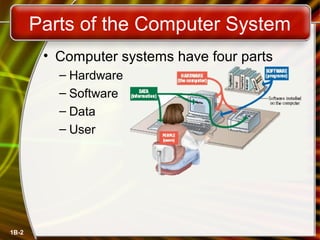
Parts of the Computer System
• Computer systems have four parts
– Hardware
– Software
– Data
– User
1B-3
Parts of the Computer System
• Hardware
– Mechanical devices in the computer
– Anything that can be touched
• Software
– Tell the computer what to do
– Also called a program
– Thousands of programs exist
1B-4
Parts of the Computer System
• Data
– Pieces of information
– Computer organize and present data
• Users
– People operating the computer
– Most important part
– Tell the computer what to do
1B-5
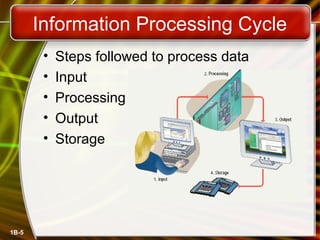
Information Processing Cycle
• Steps followed to process data
• Input
• Processing
• Output
• Storage
1B-6
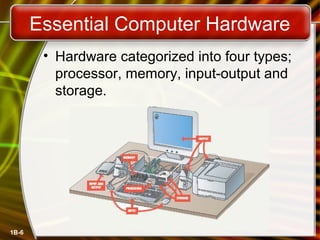
Essential Computer Hardware
• Hardware categorized into four types;
processor, memory, input-output and
storage.
1B-7
Essential Computer Hardware
• Processing devices
– Brains of the computer
– Carries out instructions from the program
– Manipulate the data
– Most computers have several processors
– Central Processing Unit (CPU)
– Secondary processors: motherboard, RAM,
chip set
– Processors made of silicon and copper
1B-8
Essential Computer Hardware
• Memory devices
– Stores data or programs
– Random Access Memory (RAM)
• Volatile
• Stores current data and programs
• More RAM results in a faster system
– Read Only Memory (ROM)
• Permanent storage of programs
• Holds the computer boot directions
1B-9
Essential Computer Hardware
• Input and output devices
– Allows the user to interact
– Input devices accept data
• Keyboard, mouse
– Output devices deliver data
• Monitor, printer, speaker
– Some devices are input and output
• Touch screens
1B-10
Essential Computer Hardware
• Storage devices
– Hold data and programs permanently
– Different from RAM
– Magnetic storage
• Floppy and hard drive, Audio & Video cassettes,
tape
• Uses a magnet to access data
– Optical storage
• CD and DVD drives
• Uses a laser to access data
1B-11
Software Runs The Machine
• Tells the computer what to do
• Reason people purchase computers
• Two types
– System software
– Application software
1B-12
Software Runs The Machine
• System software: is a type of computer
program that is designed to run a
computer’s hardware and application
programs
– Most important software
– Operating system
• Windows XP
– Network operating system (OS)
• Windows Server 2003
– Utility
• Symantec AntiVirus
1B-13
Software Runs The Machine
• Application software
– Accomplishes a specific task
– Most common type of software
• MS Word
– Covers most common uses of computers
1B-14
Computer data
• Fact with no meaning on its own
• Stored using the binary number system
• Data can be organized into files
1B-15
Computer users
• Role depends on ability
– Setup the system
– Install software
– Mange files
– Maintain the system
• “Userless” computers
– Run with no user input
– Automated systems
Copyright © 2006 by The McGraw-Hill Companies, Inc. All rights reserved.McGraw-Hill Technology Education
Chapter 1B
End of Chapter
Copyright © 2006 by The McGraw-Hill Companies, Inc. All rights reserved.McGraw-Hill Technology Education
McGraw-Hill Technology Education Copyright © 2006 by The McGraw-Hill Companies, Inc. All rights reserved.
Copyright © 2006 by The McGraw-Hill Companies, Inc. All rights reserved.McGraw-Hill Technology Education
Chapter 3A
Using the Keyboard And
Mouse
3A-19
The Keyboard
• The most common input device
• Also called primary input device for
entering text and numbers. A standard
keyboard includes about 100 keys, each
key sends a different signal to the CPU.
– Must be proficient with keyboard
– The Skill of typing is called keyboarding
means the ability to enter text and numbers
with skill and accuracy.
3A-20
The Keyboard
• How keyboard works
– Keyboard controller detects a key press
– Controller sends a code to the CPU
• Code represents the key pressed
– Controller notifies the operating system
– Operating system responds
– Controller repeats the letter if held/said
3A-21
The Mouse
• All modern computers have a pointing
device as standard equipment.
• Allows users to select objects
– Pointer moved by the mouse
• Mechanical mouse
– Rubber ball determines direction and speed
– The ball often requires cleaning
– Inside the mouse rollers and sensors send
signals to the computer, telling it the
distance, direction, and speed of the ball’s
motions.
3A-22
The Mouse
• Optical mouse
- Non mechanical
– Light shown onto mouse pad
– Reflection determines speed and direction
– Requires little maintenance
3A-23
The Mouse
• Interacting with a mouse
– Actions involve pointing to an object
– Clicking selects the object
– Clicking and holding drags the object
– Releasing an object is a drop
– Right clicking activates the shortcut menu
– Modern mice include a scroll wheel
3A-24
The Mouse
• Benefits
– Pointer positioning is fast
– Menu interaction is easy
– Users can draw electronically
3A-25
The Mouse
• Mouse button configuration
– Configured for a right-handed user
• Can be reconfigured
– Between 1 and 6 buttons
– Extra buttons are configurable
3A-26
Variants of the Mouse
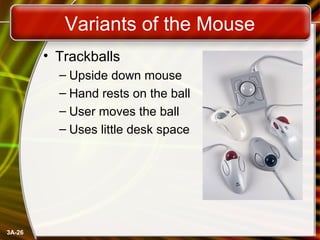
• Trackballs
– Upside down mouse
– Hand rests on the ball
– User moves the ball
– Uses little desk space
3A-27
Variants of the Mouse
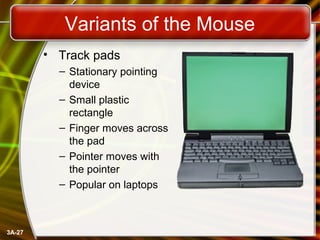
• Track pads
– Stationary pointing
device
– Small plastic
rectangle
– Finger moves across
the pad
– Pointer moves with
the pointer
– Popular on laptops
3A-28
Variants of the Mouse
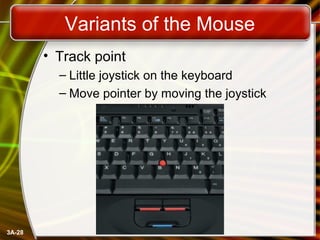
• Track point
– Little joystick on the keyboard
– Move pointer by moving the joystick
3A-29
Ergonomics and Input Devices
• Ergonomics
– Study of human and tool interaction
– Concerned with physical interaction
– Attempts to improve safety and comfort
– Ergonomics is the process of designing or
arranging workplaces, products and
systems so that they fit the people who use
them.
3A-30
Ergonomics and Input Devices
• Repetitive Strain Injury (RSI)
– Caused by continuous misuse of the body
– Many professions suffer from RSI
– a painful medical condition that can cause
damage to the hands, wrists, upper arms, 
and backs, especially of people who use 
computers and other forms of keyboard
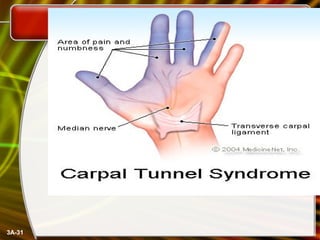
• Carpal Tunnel Syndrome
– Carpal tunnel is a passage in the wrist
– Holds nerves and tendons
– Prolonged keyboarding swells tendons
3A-31
3A-32
Ergonomics and Input Devices
• Office hardware suggestions
– Office chairs should have
• Adjustable armrests and height
• Armrests
• Lower back support
– Desks should have
• Have a keyboard tray
• Keep hands at keyboard height
• Place the monitor at eye level
3A-33
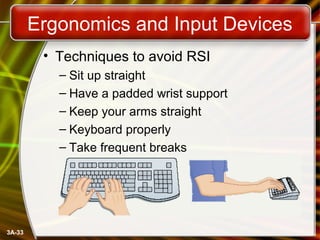
Ergonomics and Input Devices
• Techniques to avoid RSI
– Sit up straight
– Have a padded wrist support
– Keep your arms straight
– Keyboard properly
– Take frequent breaks
Copyright © 2006 by The McGraw-Hill Companies, Inc. All rights reserved.McGraw-Hill Technology Education
Chapter 3A
End of Chapter

Chapter 1B Peter Norton

  • 1.
    Copyright © 2006by The McGraw-Hill Companies, Inc. All rights reserved.McGraw-Hill Technology Education Chapter 1B Looking Inside the Computer System
  • 2.
    1B-2 Parts of theComputer System • Computer systems have four parts – Hardware – Software – Data – User
  • 3.
    1B-3 Parts of theComputer System • Hardware – Mechanical devices in the computer – Anything that can be touched • Software – Tell the computer what to do – Also called a program – Thousands of programs exist
  • 4.
    1B-4 Parts of theComputer System • Data – Pieces of information – Computer organize and present data • Users – People operating the computer – Most important part – Tell the computer what to do
  • 5.
    1B-5 Information Processing Cycle •Steps followed to process data • Input • Processing • Output • Storage
  • 6.
    1B-6 Essential Computer Hardware •Hardware categorized into four types; processor, memory, input-output and storage.
  • 7.
    1B-7 Essential Computer Hardware •Processing devices – Brains of the computer – Carries out instructions from the program – Manipulate the data – Most computers have several processors – Central Processing Unit (CPU) – Secondary processors: motherboard, RAM, chip set – Processors made of silicon and copper
  • 8.
    1B-8 Essential Computer Hardware •Memory devices – Stores data or programs – Random Access Memory (RAM) • Volatile • Stores current data and programs • More RAM results in a faster system – Read Only Memory (ROM) • Permanent storage of programs • Holds the computer boot directions
  • 9.
    1B-9 Essential Computer Hardware •Input and output devices – Allows the user to interact – Input devices accept data • Keyboard, mouse – Output devices deliver data • Monitor, printer, speaker – Some devices are input and output • Touch screens
  • 10.
    1B-10 Essential Computer Hardware •Storage devices – Hold data and programs permanently – Different from RAM – Magnetic storage • Floppy and hard drive, Audio & Video cassettes, tape • Uses a magnet to access data – Optical storage • CD and DVD drives • Uses a laser to access data
  • 11.
    1B-11 Software Runs TheMachine • Tells the computer what to do • Reason people purchase computers • Two types – System software – Application software
  • 12.
    1B-12 Software Runs TheMachine • System software: is a type of computer program that is designed to run a computer’s hardware and application programs – Most important software – Operating system • Windows XP – Network operating system (OS) • Windows Server 2003 – Utility • Symantec AntiVirus
  • 13.
    1B-13 Software Runs TheMachine • Application software – Accomplishes a specific task – Most common type of software • MS Word – Covers most common uses of computers
  • 14.
    1B-14 Computer data • Factwith no meaning on its own • Stored using the binary number system • Data can be organized into files
  • 15.
    1B-15 Computer users • Roledepends on ability – Setup the system – Install software – Mange files – Maintain the system • “Userless” computers – Run with no user input – Automated systems
  • 16.
    Copyright © 2006by The McGraw-Hill Companies, Inc. All rights reserved.McGraw-Hill Technology Education Chapter 1B End of Chapter
  • 17.
    Copyright © 2006by The McGraw-Hill Companies, Inc. All rights reserved.McGraw-Hill Technology Education McGraw-Hill Technology Education Copyright © 2006 by The McGraw-Hill Companies, Inc. All rights reserved.
  • 18.
    Copyright © 2006by The McGraw-Hill Companies, Inc. All rights reserved.McGraw-Hill Technology Education Chapter 3A Using the Keyboard And Mouse
  • 19.
    3A-19 The Keyboard • Themost common input device • Also called primary input device for entering text and numbers. A standard keyboard includes about 100 keys, each key sends a different signal to the CPU. – Must be proficient with keyboard – The Skill of typing is called keyboarding means the ability to enter text and numbers with skill and accuracy.
  • 20.
    3A-20 The Keyboard • Howkeyboard works – Keyboard controller detects a key press – Controller sends a code to the CPU • Code represents the key pressed – Controller notifies the operating system – Operating system responds – Controller repeats the letter if held/said
  • 21.
    3A-21 The Mouse • Allmodern computers have a pointing device as standard equipment. • Allows users to select objects – Pointer moved by the mouse • Mechanical mouse – Rubber ball determines direction and speed – The ball often requires cleaning – Inside the mouse rollers and sensors send signals to the computer, telling it the distance, direction, and speed of the ball’s motions.
  • 22.
    3A-22 The Mouse • Opticalmouse - Non mechanical – Light shown onto mouse pad – Reflection determines speed and direction – Requires little maintenance
  • 23.
    3A-23 The Mouse • Interactingwith a mouse – Actions involve pointing to an object – Clicking selects the object – Clicking and holding drags the object – Releasing an object is a drop – Right clicking activates the shortcut menu – Modern mice include a scroll wheel
  • 24.
    3A-24 The Mouse • Benefits –Pointer positioning is fast – Menu interaction is easy – Users can draw electronically
  • 25.
    3A-25 The Mouse • Mousebutton configuration – Configured for a right-handed user • Can be reconfigured – Between 1 and 6 buttons – Extra buttons are configurable
  • 26.
    3A-26 Variants of theMouse • Trackballs – Upside down mouse – Hand rests on the ball – User moves the ball – Uses little desk space
  • 27.
    3A-27 Variants of theMouse • Track pads – Stationary pointing device – Small plastic rectangle – Finger moves across the pad – Pointer moves with the pointer – Popular on laptops
  • 28.
    3A-28 Variants of theMouse • Track point – Little joystick on the keyboard – Move pointer by moving the joystick
  • 29.
    3A-29 Ergonomics and InputDevices • Ergonomics – Study of human and tool interaction – Concerned with physical interaction – Attempts to improve safety and comfort – Ergonomics is the process of designing or arranging workplaces, products and systems so that they fit the people who use them.
  • 30.
    3A-30 Ergonomics and InputDevices • Repetitive Strain Injury (RSI) – Caused by continuous misuse of the body – Many professions suffer from RSI – a painful medical condition that can cause damage to the hands, wrists, upper arms,  and backs, especially of people who use  computers and other forms of keyboard • Carpal Tunnel Syndrome – Carpal tunnel is a passage in the wrist – Holds nerves and tendons – Prolonged keyboarding swells tendons
  • 31.
  • 32.
    3A-32 Ergonomics and InputDevices • Office hardware suggestions – Office chairs should have • Adjustable armrests and height • Armrests • Lower back support – Desks should have • Have a keyboard tray • Keep hands at keyboard height • Place the monitor at eye level
  • 33.
    3A-33 Ergonomics and InputDevices • Techniques to avoid RSI – Sit up straight – Have a padded wrist support – Keep your arms straight – Keyboard properly – Take frequent breaks
  • 34.
    Copyright © 2006by The McGraw-Hill Companies, Inc. All rights reserved.McGraw-Hill Technology Education Chapter 3A End of Chapter

Editor's Notes

  • #4 Teaching tip Suggest to your students that the majority of people who purchase computers do so because of software. They want to email, or type letters. Nearly every reason given to purchase a computer is based on software needs.
  • #5 Teaching tip A good exercise to relate the importance of making data meaningful is to list some random numbers on the board. Then ask what they mean. Without a title, the numbers have no meaning. Once a title is presented, the numbers make sense.
  • #6 Teaching tip It is helpful to walk through a simple program to demonstrate the cycle. I often use a simple arithmetic problem to show this cycle.
  • #8 Teaching tip The interaction between a CPU and secondary processors is much like the interaction between a boss and subordinate. The boss tells the subordinate what to do but not necessarily how to accomplish the task. The subordinate only bothers the boss when guidance or more data is needed.
  • #9 Insider information Intel, the manufacturer of popular CPUs, originally made RAM for mainframe and minicomputers. Today Kingston is a leading RAM manufacturer. Chapter 5 discusses ROM and the BIOS. Refer your students to this chapter if they desire more information.
  • #10 Teaching tip It is helpful to have examples of input and output devices in class. Stories of obscure input output devices are typically well received by the students.
  • #11 Insider information A new CD technology is emerging. A shorter wavelength blue laser beam is being used to burn CD’s. This allows more data to be saved on a disk. The technology is in it’s infancy but should be mature in the near future. Chapter 11 of the text provides more detail regarding storage devices. DVD writers are available for purchase. They have not been standardized yet. Several competing formats are vying for acceptance. Of these, the DVD+RW seems to have the strongest support.
  • #15 Teaching tip Chapter 5 in the text explores data processing in greater detail. Figure 1B.5 shows data in binary format.
  • #16 Teaching tip Most computer problems are caused by user error. Given this fact, it is fun here to teach the student the acronym PEBKAC the Problem Exists Between Keyboard And Chair. A little humor can break up the lecture monotony.
  • #21 Teaching tip Table 5A.3 presents the ASCII code. An exercise that never fails to amuse students is to use the Alt and the number pad to enter letters into an application. As before, open MS Word. Have students hold down the Alt key and type an ASCII value into the number pad. Once they release the Alt, the letter appears. This is a useful skill when the keyboard breaks. Challenge the students to explore numbers above 128.
  • #24 Insider information Douglas Englebart patented the first mouse in 1970 as the “X-Y position indicator for a display system.” The name mouse comes from the tail on the device.
  • #29 Insider information The term track point is copyrighted by IBM.
  • #31 Teaching tip Hairstylists often suffer from carpal tunnel. Bicyclists can suffer from overuse injuries of the knee. Page 116 of the text has a diagram of the carpal tunnel.