Intro to the
Adobe Creative Cloud
M.Foster - 2013
Illustrator
Photoshop
InDesign
Dreamweaver
Flash
Acrobat
β€’ Adobe Systems, Inc.
β€’ Collection of Graphic Software
β€’ Efficient and Robust Visualization
β€’ Publishing and Presentation
β€’ Graphic Design
β€’ Web Design
β€’ Photo Editing
β€’ Video Editing
β€’ Animations
β€’ Web Publishing
β€’ Etc. Etc. Etc.
M.Foster - 2013
Adobe Creative Cloud - Introduction
M.Foster - 2013
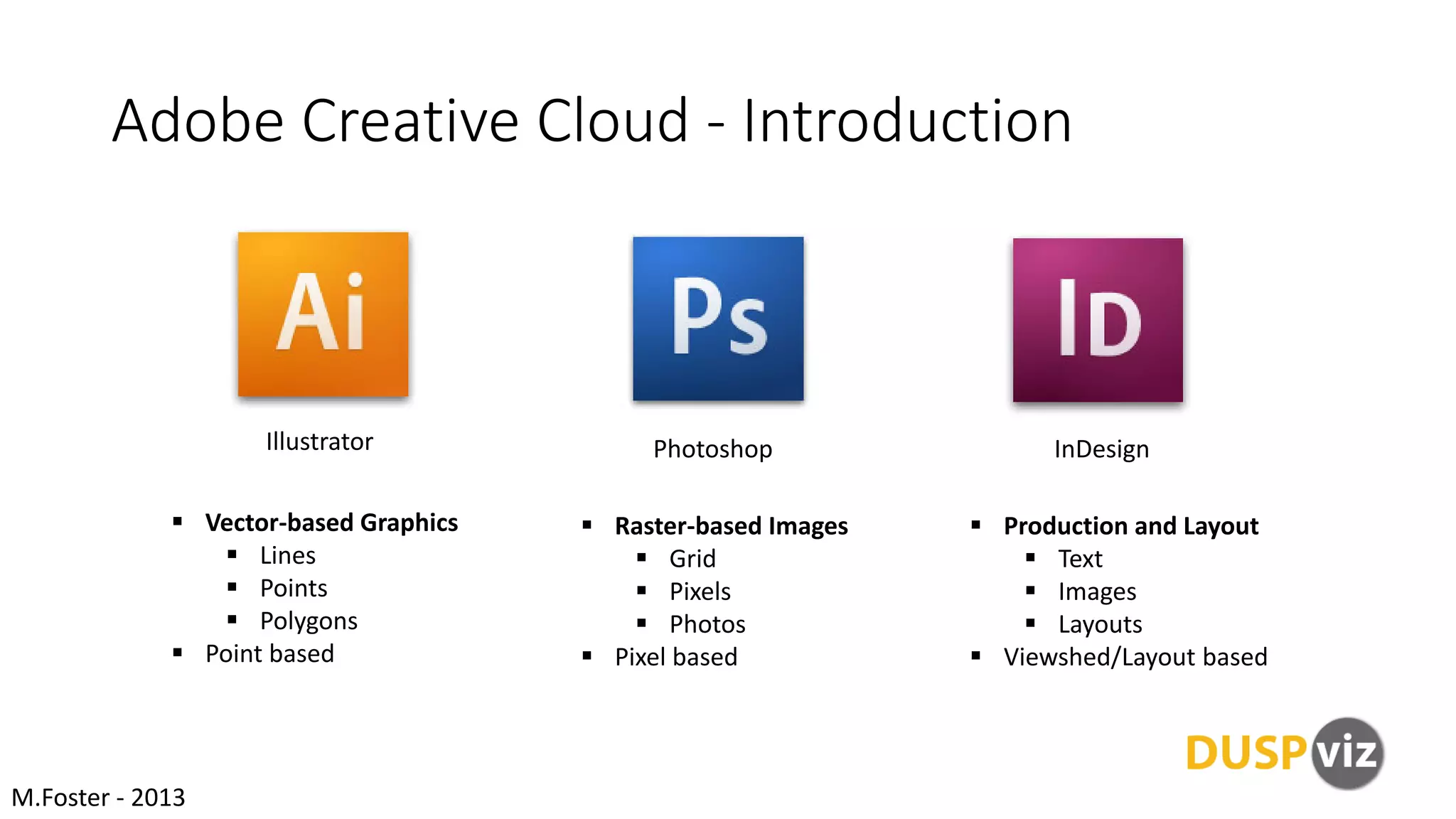
Illustrator Photoshop InDesign
ο‚§ Vector-based Graphics
ο‚§ Lines
ο‚§ Points
ο‚§ Polygons
ο‚§ Point based
ο‚§ Raster-based Images
ο‚§ Grid
ο‚§ Pixels
ο‚§ Photos
ο‚§ Pixel based
ο‚§ Production and Layout
ο‚§ Text
ο‚§ Images
ο‚§ Layouts
ο‚§ Viewshed/Layout based
What is Creative Cloud?
M.Foster - 2013
ο‚§ Formerly known as Creative Suite
ο‚§ Subscription Based Service for Adobe Products
ο‚§ On all CRON computers
ο‚§ Student subscriptions available
http://www.adobe.com/creativecloud/buy/students.html
Introduction to Illustrator
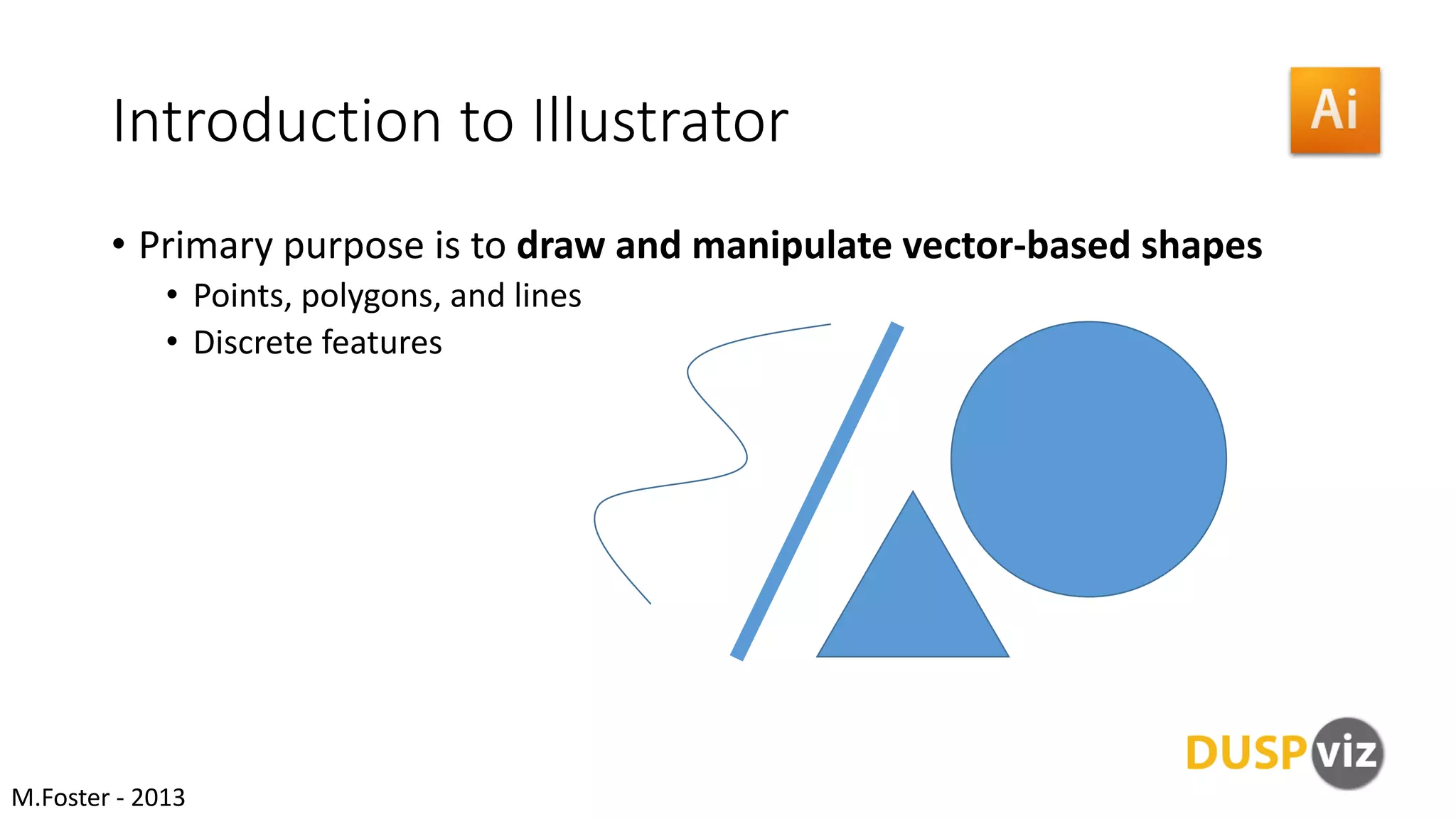
β€’ Primary purpose is to draw and manipulate vector-based shapes
β€’ Points, polygons, and lines
β€’ Discrete features
M.Foster - 2013
Introduction to Illustrator
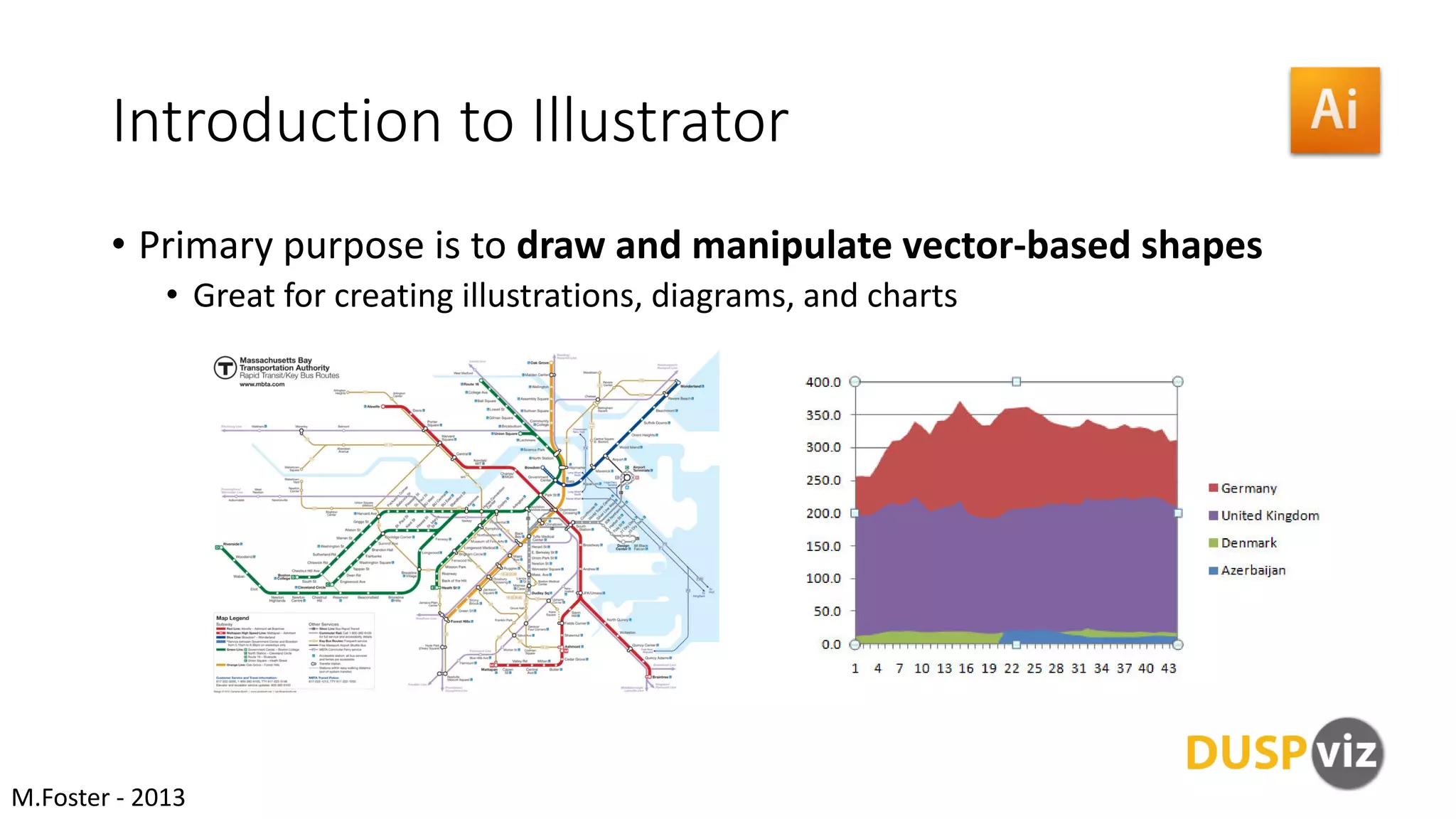
β€’ Primary purpose is to draw and manipulate vector-based shapes
β€’ Great for creating illustrations, diagrams, and charts
M.Foster - 2013
Introduction to Illustrator
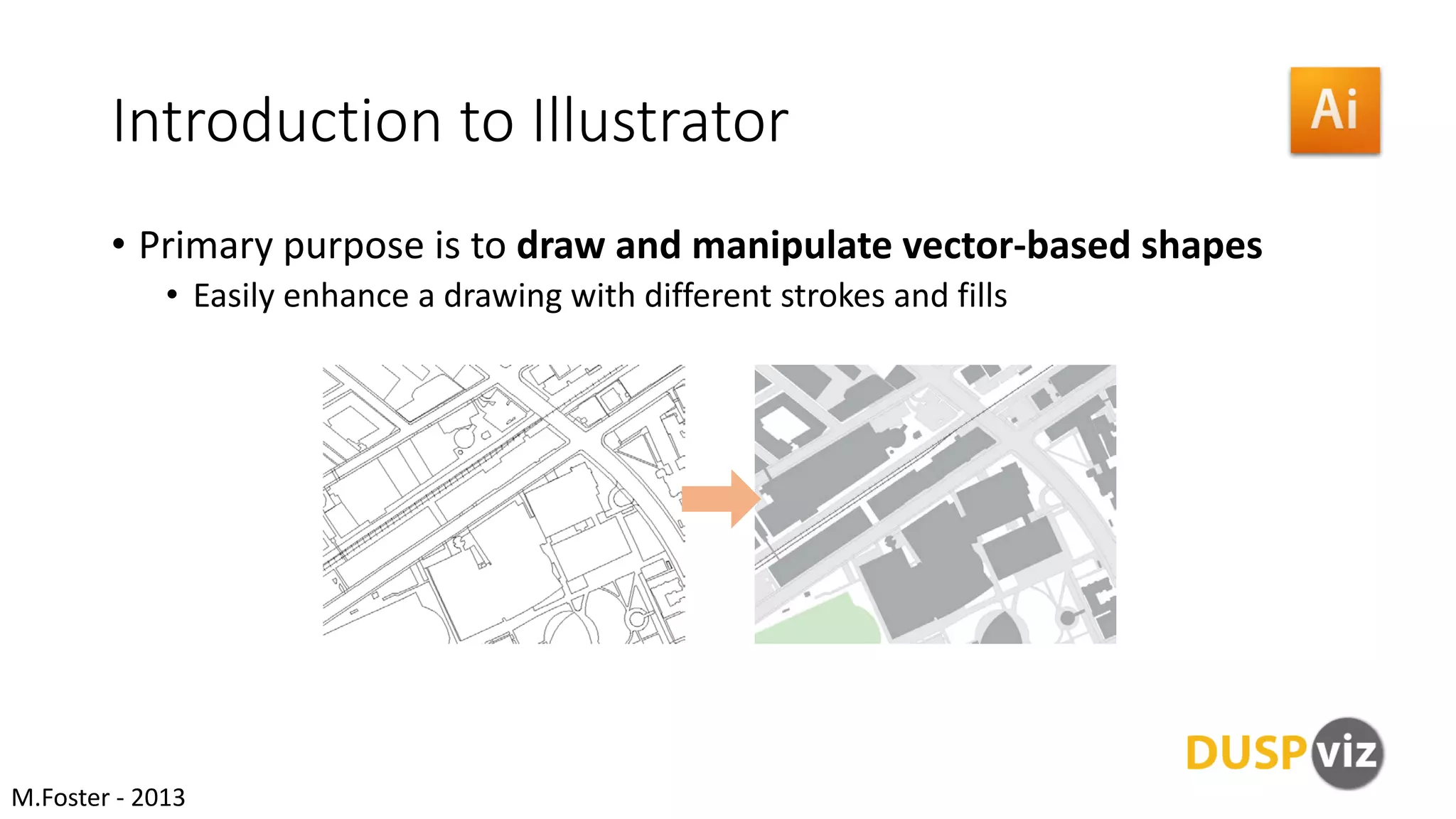
β€’ Primary purpose is to draw and manipulate vector-based shapes
β€’ Easily enhance a drawing with different strokes and fills
M.Foster - 2013
Introduction to Illustrator
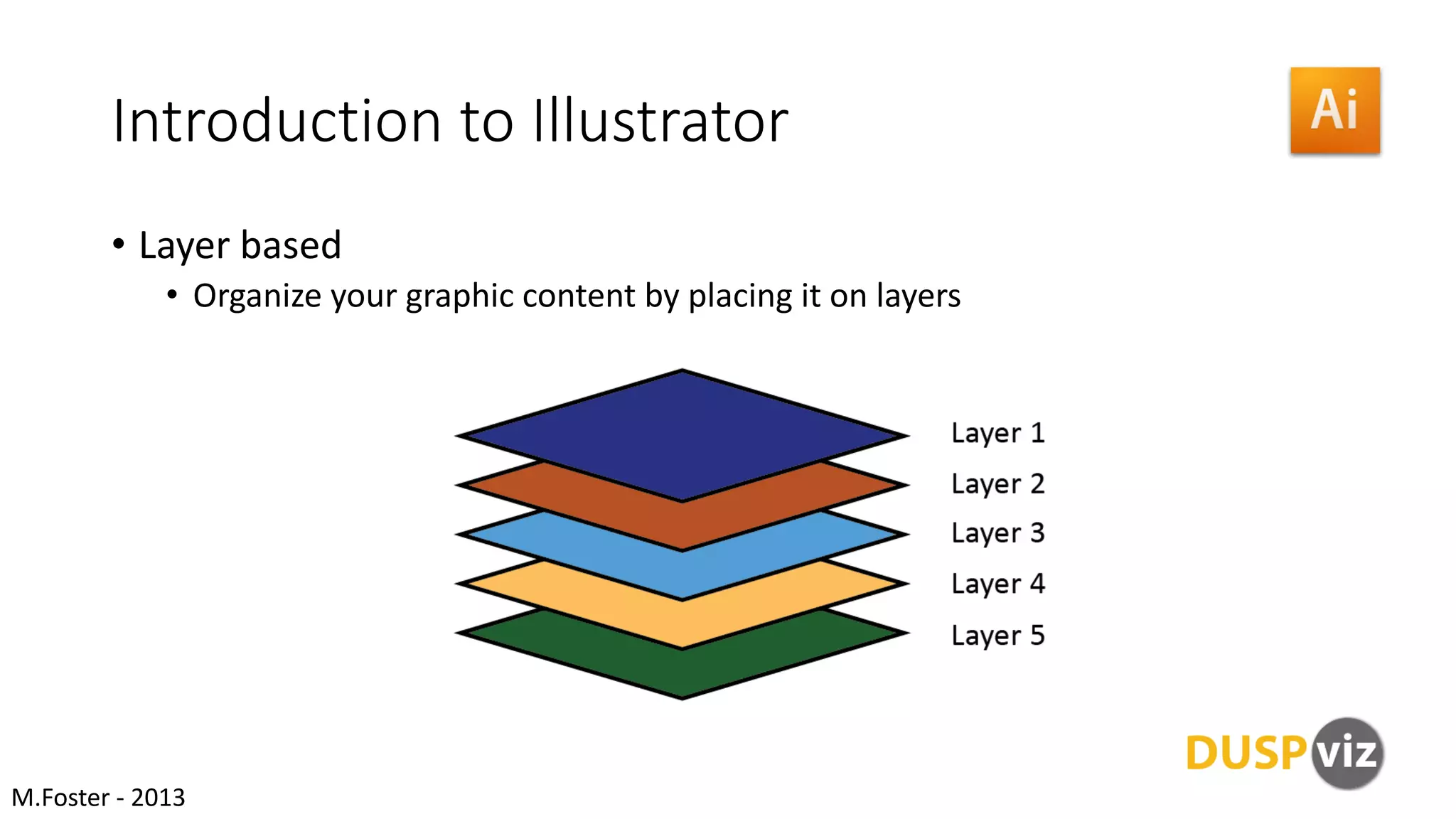
β€’ Layer based
β€’ Organize your graphic content by placing it on layers
M.Foster - 2013
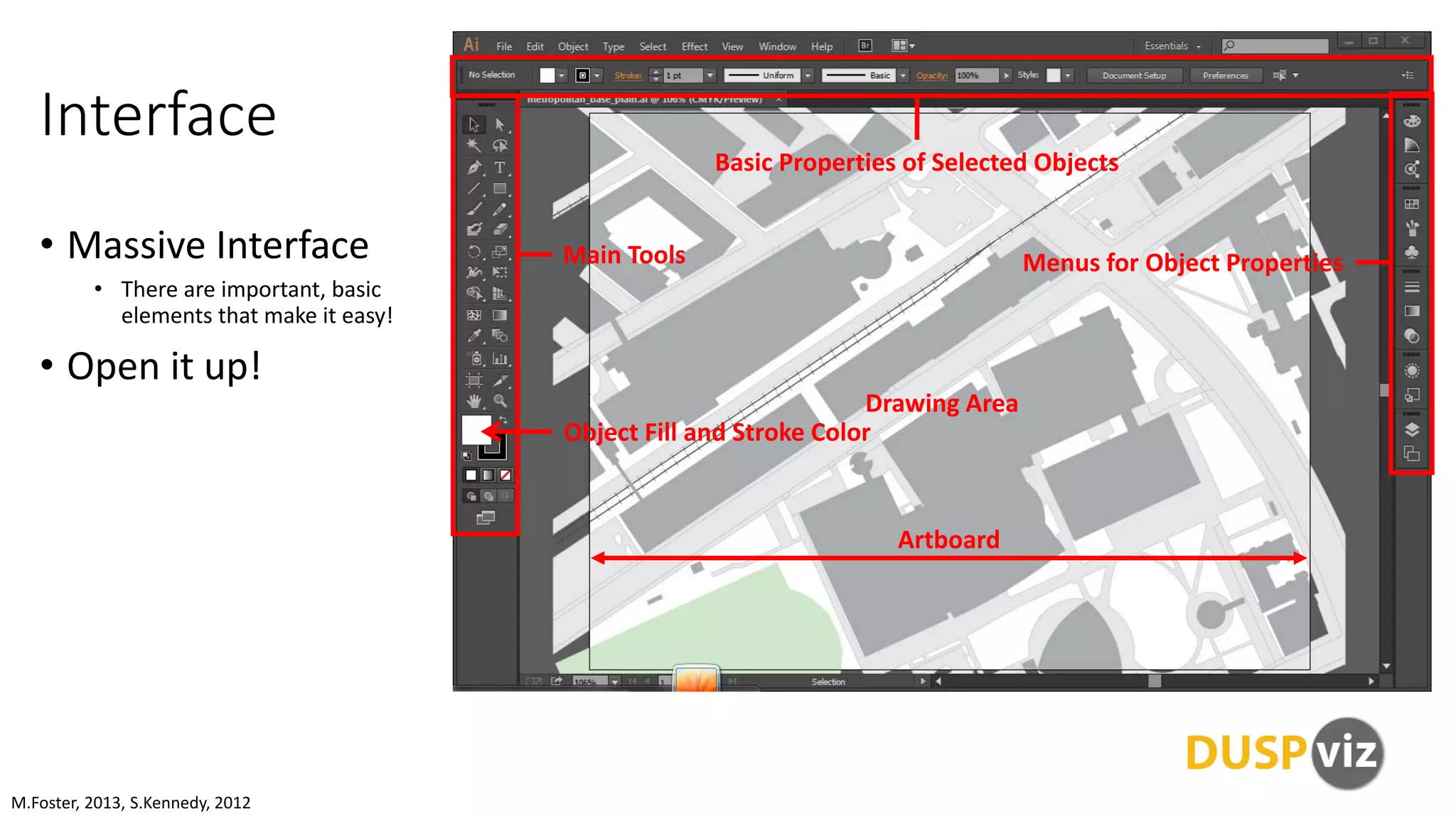
Interface
β€’ Massive Interface
β€’ There are important, basic
elements that make it easy!
β€’ Open it up!
M.Foster, 2013, S.Kennedy, 2012
Main Tools
Drawing Area
Basic Properties of Selected Objects
Artboard
Object Fill and Stroke Color
Menus for Object Properties
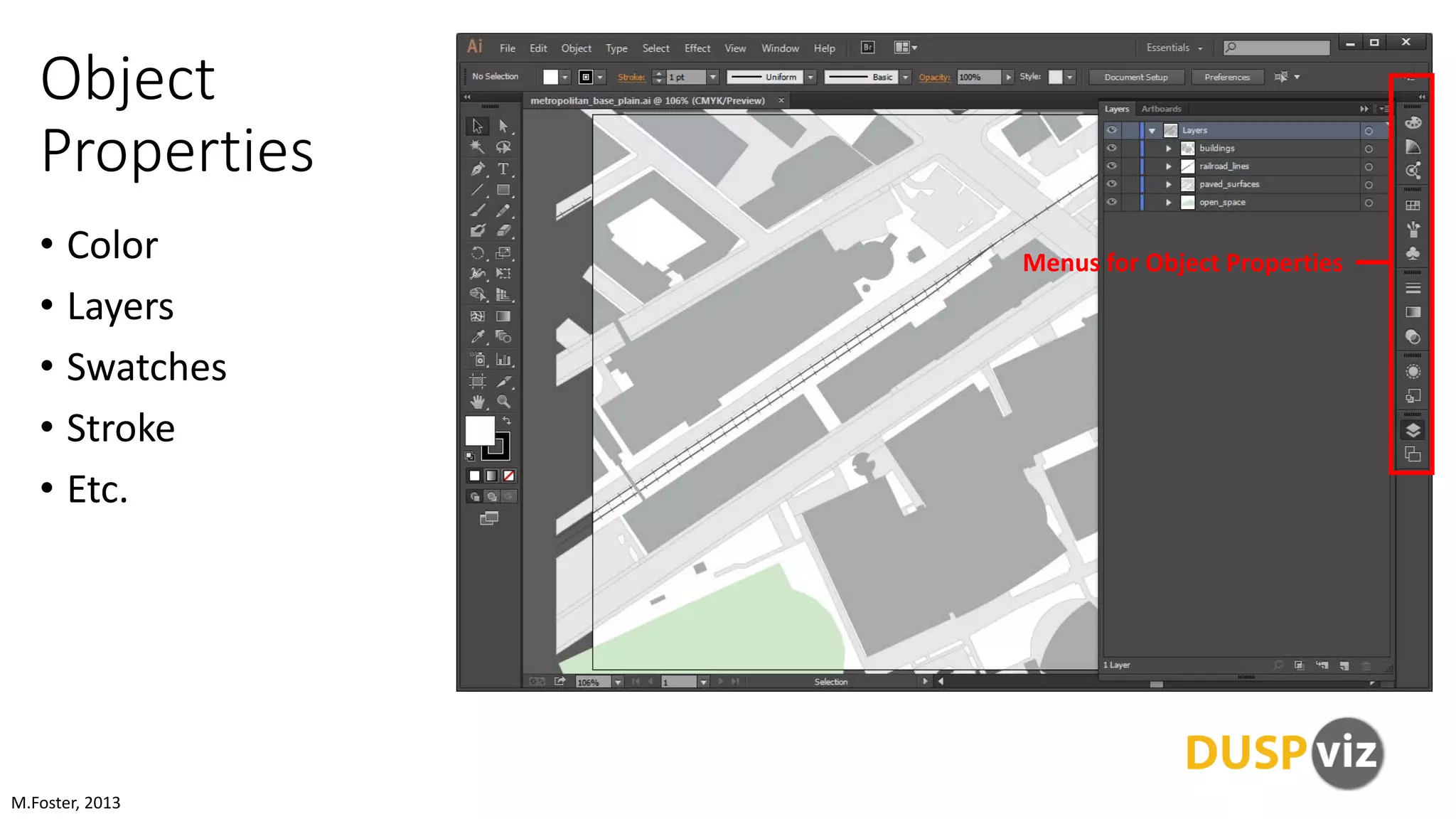
Object
Properties
β€’ Color
β€’ Layers
β€’ Swatches
β€’ Stroke
β€’ Etc.
M.Foster, 2013
Menus for Object Properties
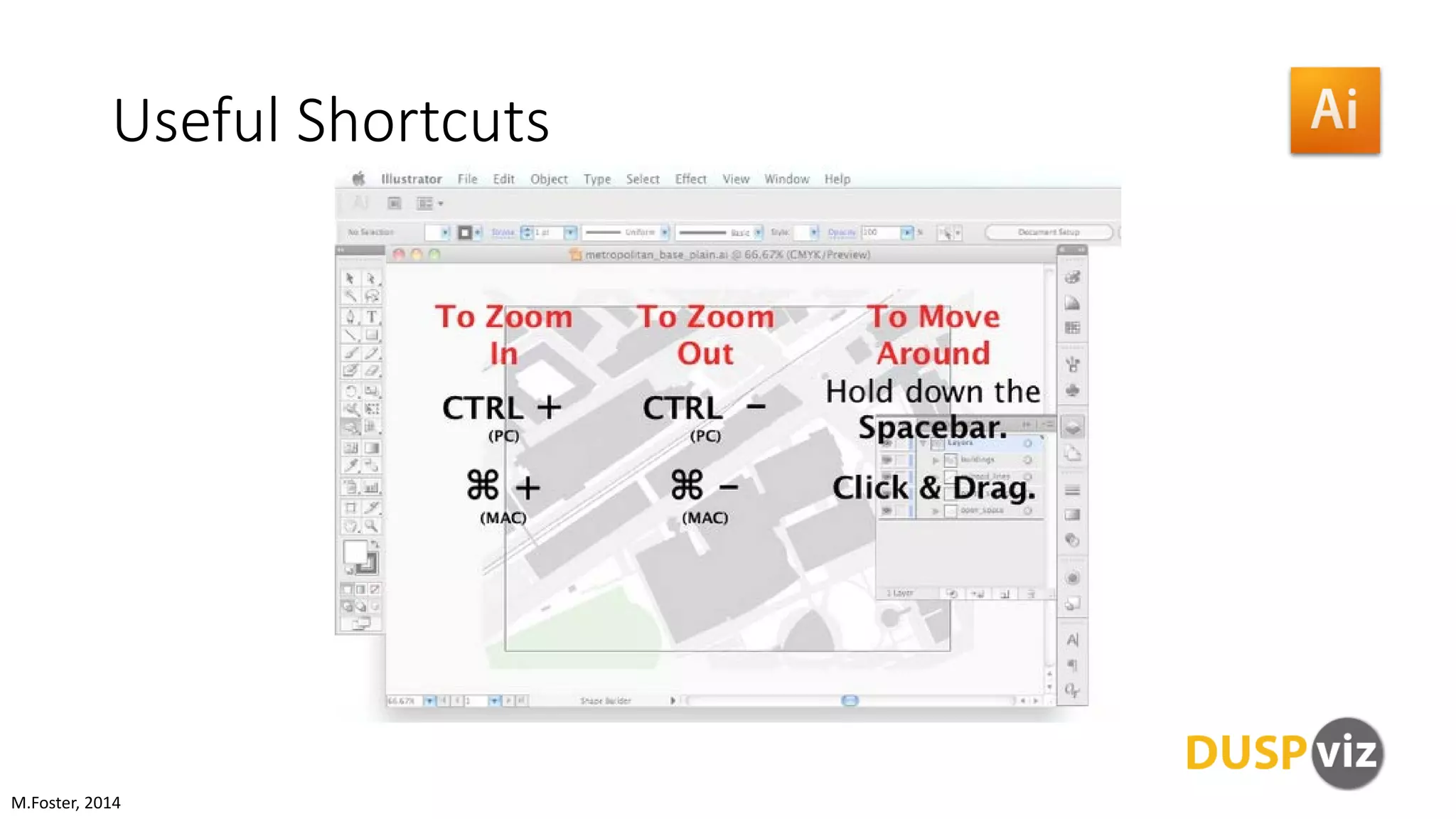
Useful Shortcuts
M.Foster, 2014
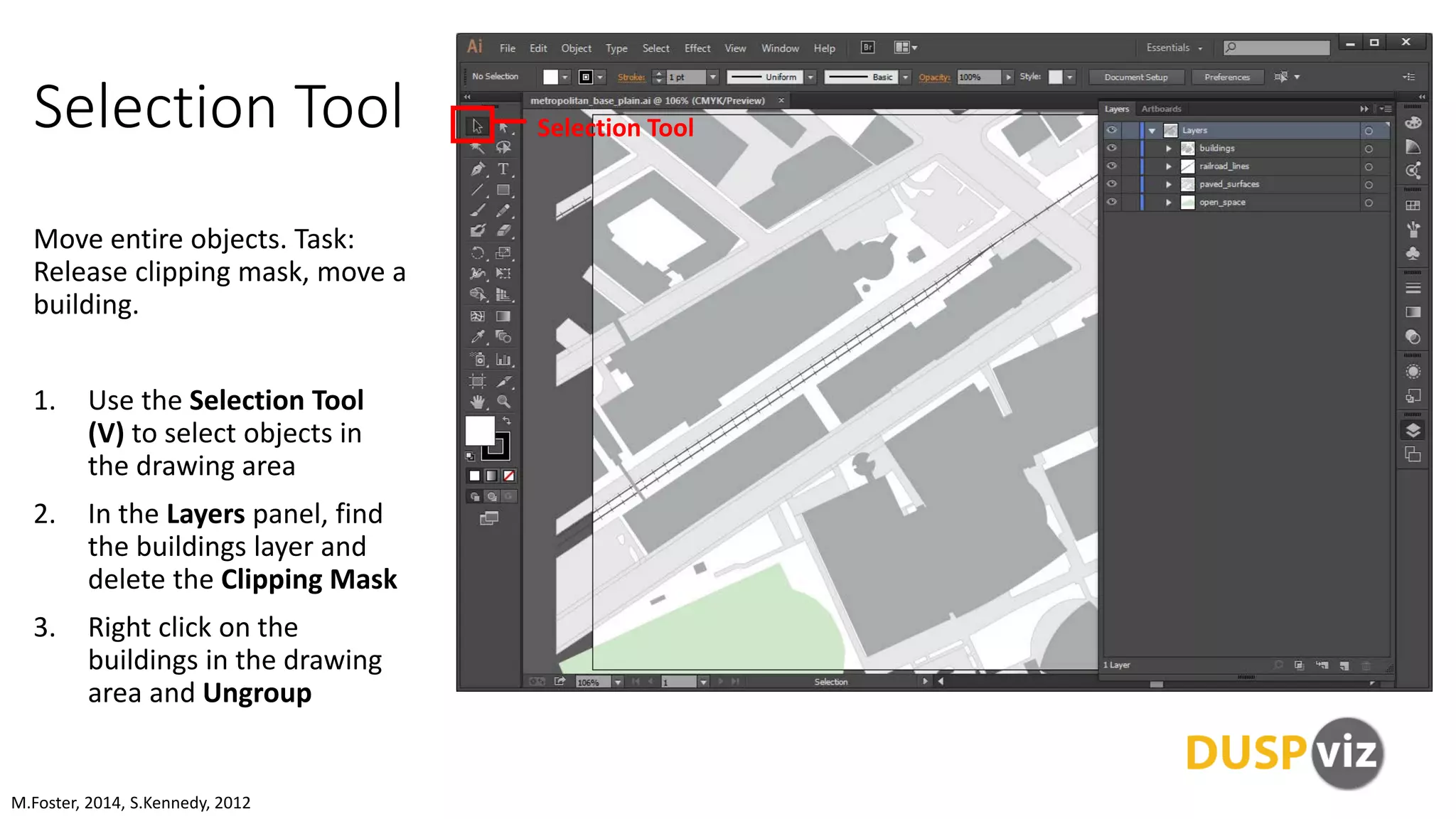
Selection Tool
Move entire objects. Task:
Release clipping mask, move a
building.
1. Use the Selection Tool
(V) to select objects in
the drawing area
2. In the Layers panel, find
the buildings layer and
delete the Clipping Mask
3. Right click on the
buildings in the drawing
area and Ungroup
M.Foster, 2014, S.Kennedy, 2012
Selection Tool
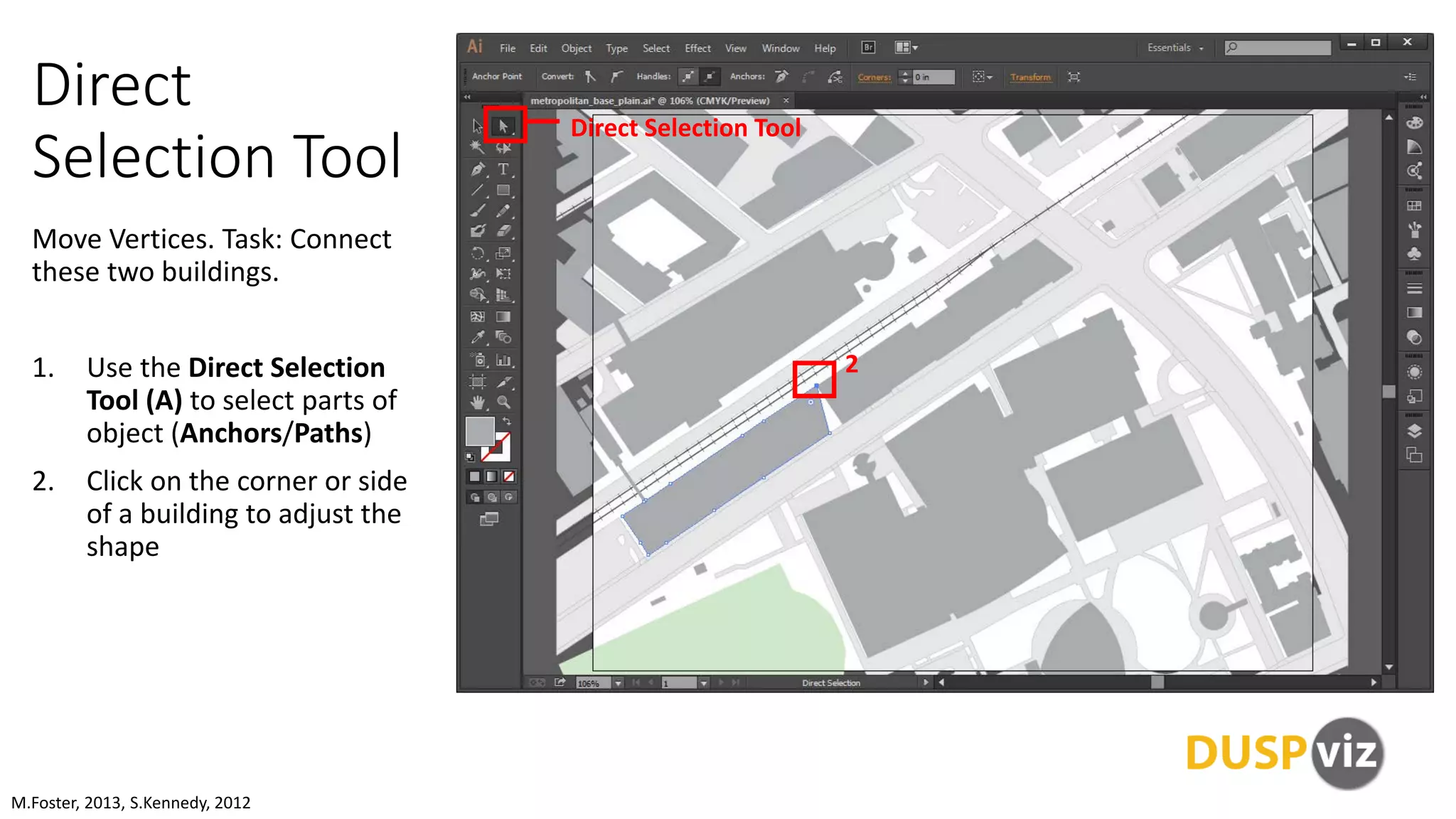
Direct
Selection Tool
Move Vertices. Task: Connect
these two buildings.
1. Use the Direct Selection
Tool (A) to select parts of
object (Anchors/Paths)
2. Click on the corner or side
of a building to adjust the
shape
M.Foster, 2013, S.Kennedy, 2012
Direct Selection Tool
2
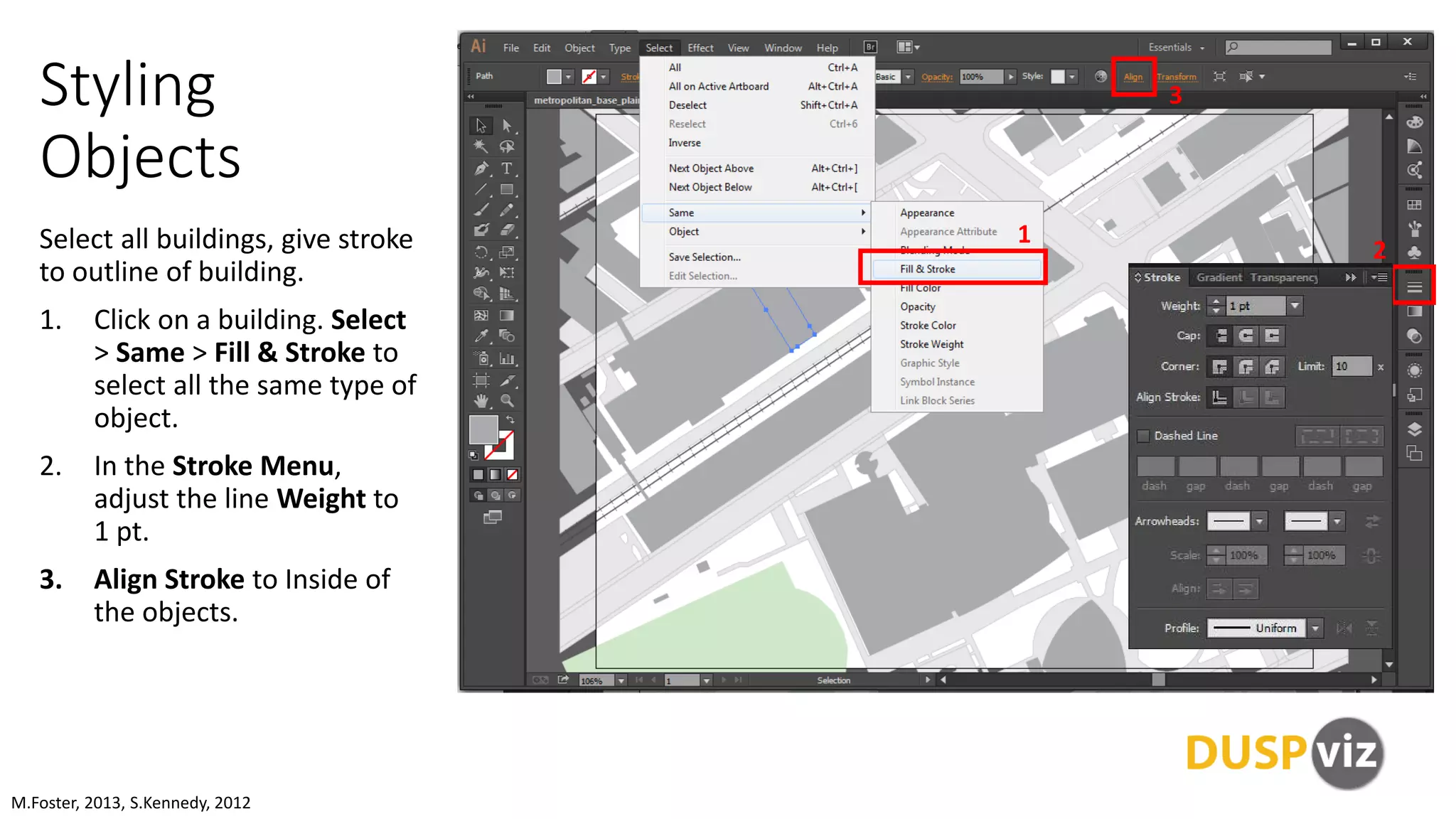
Styling
Objects
Select all buildings, give stroke
to outline of building.
1. Click on a building. Select
> Same > Fill & Stroke to
select all the same type of
object.
2. In the Stroke Menu,
adjust the line Weight to
1 pt.
3. Align Stroke to Inside of
the objects.
M.Foster, 2013, S.Kennedy, 2012
1
2
3
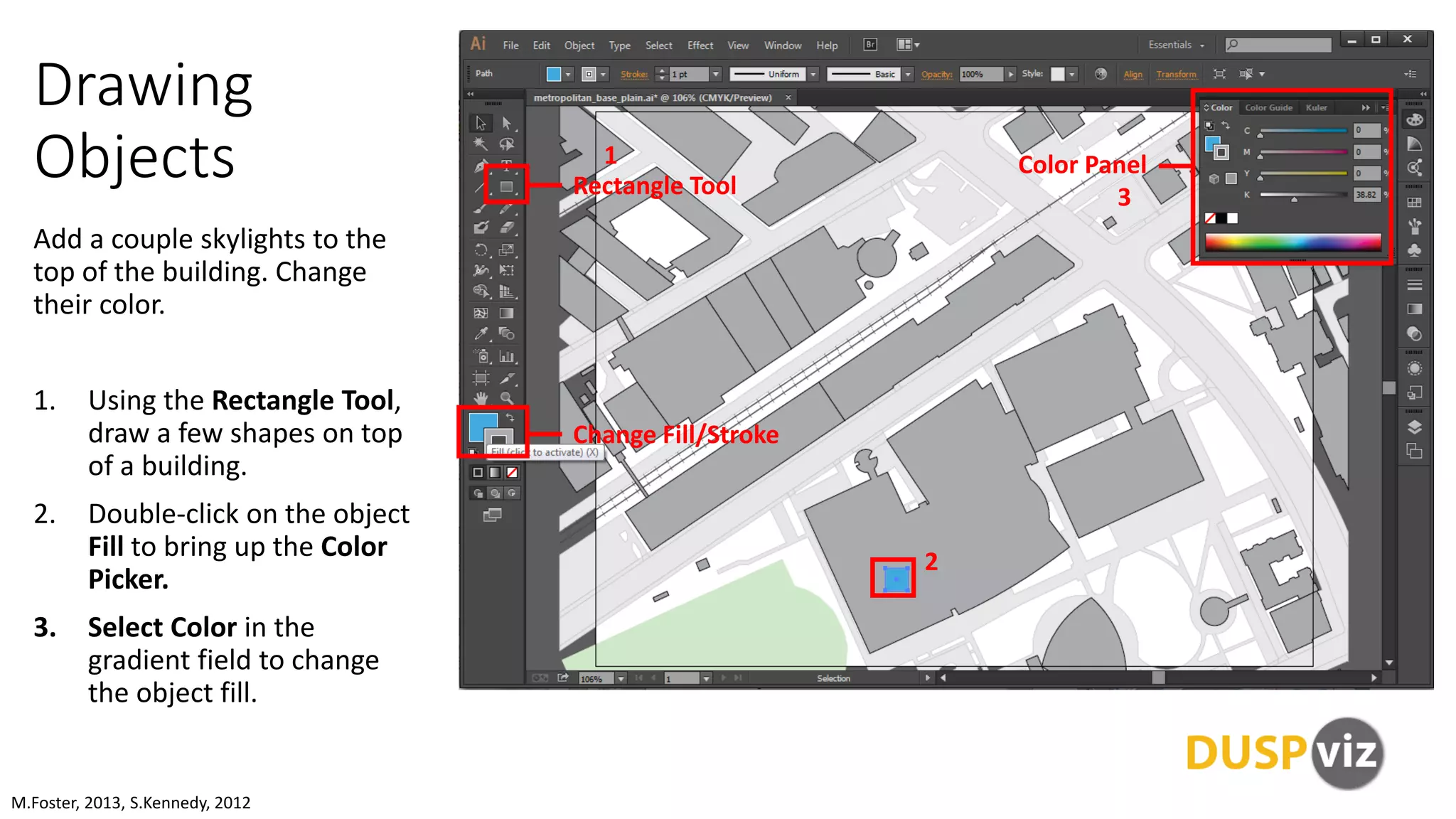
Drawing
Objects
Add a couple skylights to the
top of the building. Change
their color.
1. Using the Rectangle Tool,
draw a few shapes on top
of a building.
2. Double-click on the object
Fill to bring up the Color
Picker.
3. Select Color in the
gradient field to change
the object fill.
M.Foster, 2013, S.Kennedy, 2012
Rectangle Tool
Color Panel
Change Fill/Stroke
1
3
2
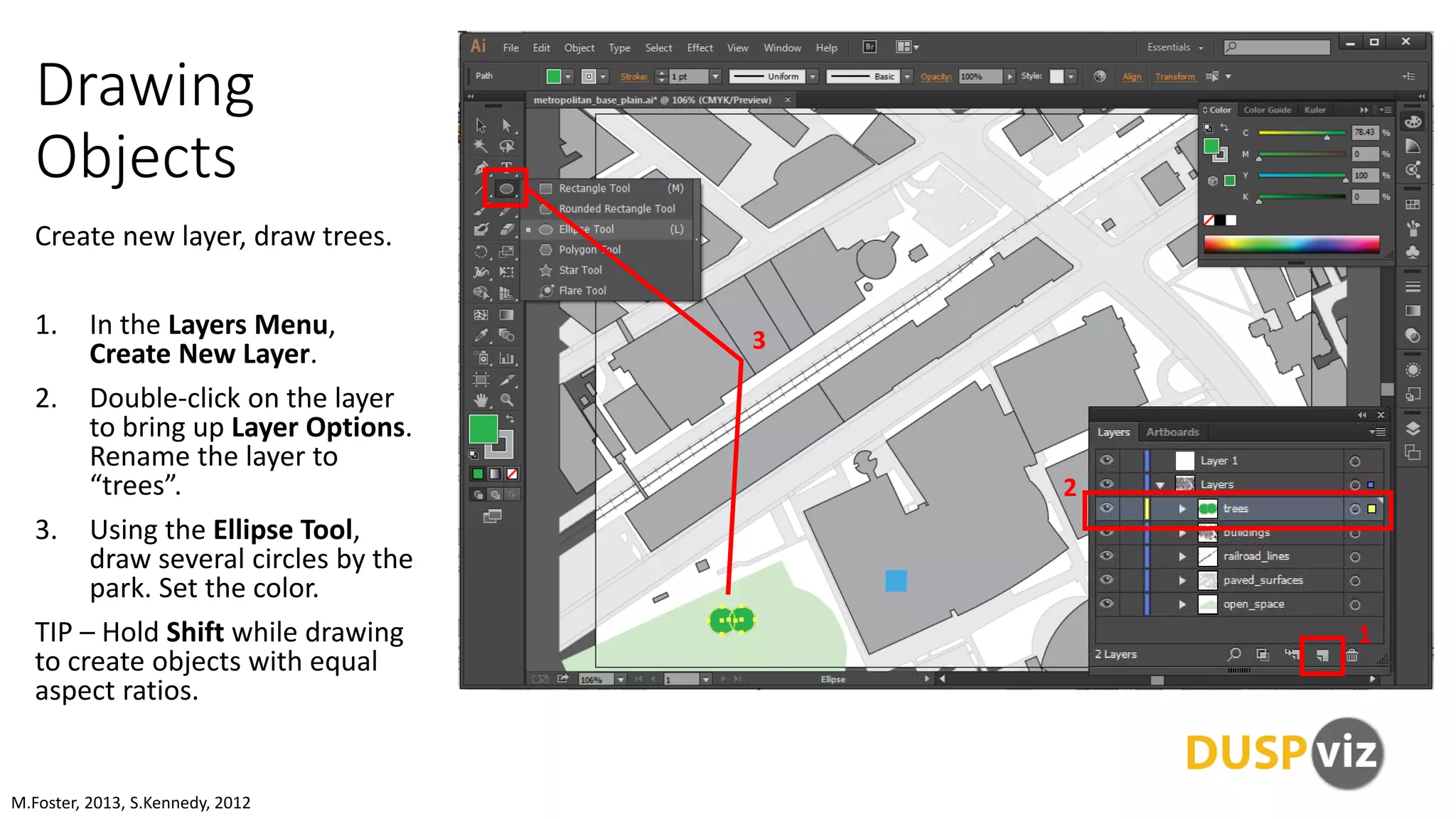
Drawing
Objects
Create new layer, draw trees.
1. In the Layers Menu,
Create New Layer.
2. Double-click on the layer
to bring up Layer Options.
Rename the layer to
β€œtrees”.
3. Using the Ellipse Tool,
draw several circles by the
park. Set the color.
TIP – Hold Shift while drawing
to create objects with equal
aspect ratios.
M.Foster, 2013, S.Kennedy, 2012
1
2
3
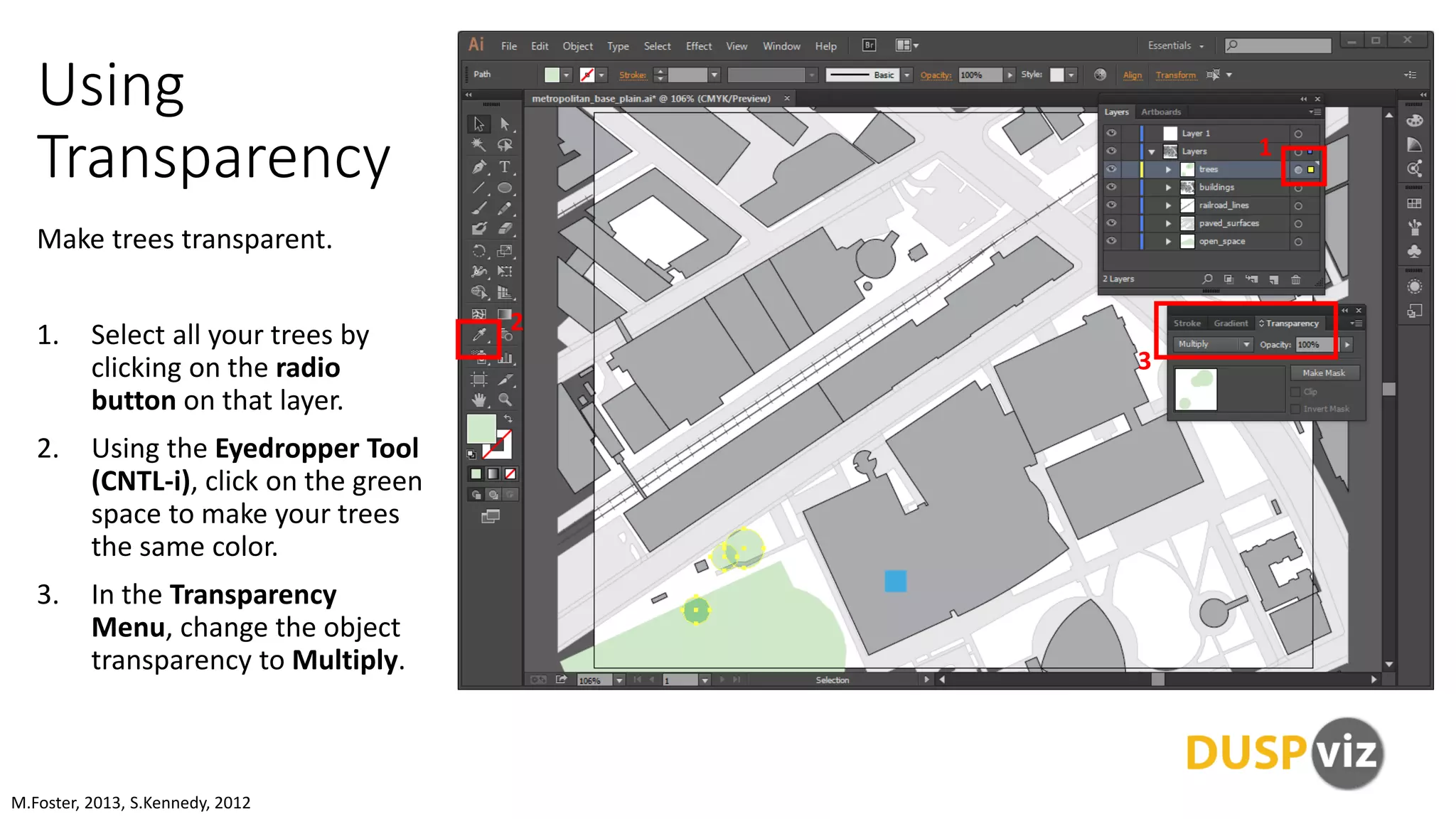
Using
Transparency
Make trees transparent.
1. Select all your trees by
clicking on the radio
button on that layer.
2. Using the Eyedropper Tool
(CNTL-i), click on the green
space to make your trees
the same color.
3. In the Transparency
Menu, change the object
transparency to Multiply.
M.Foster, 2013, S.Kennedy, 2012
1
2
3
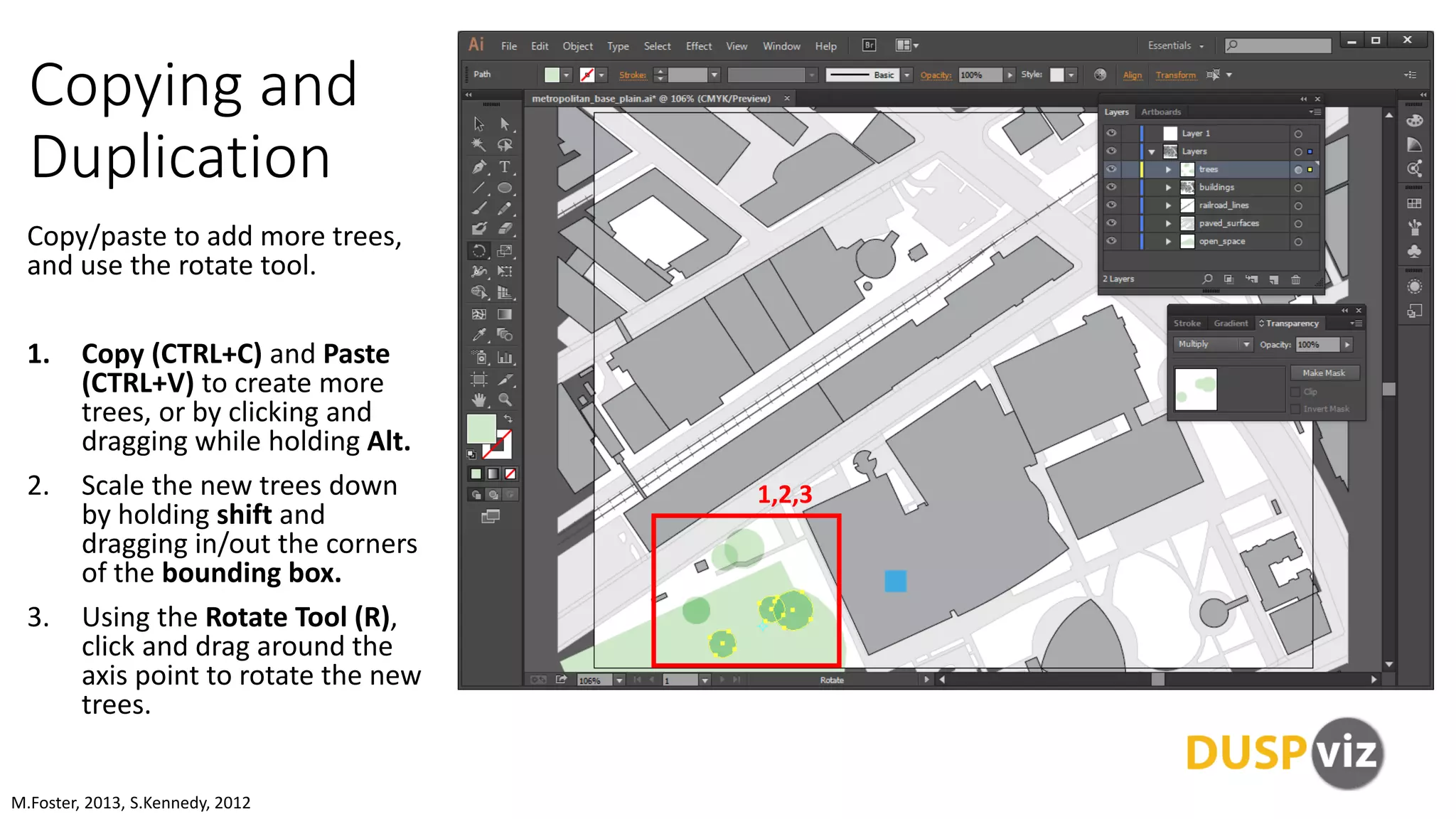
Copying and
Duplication
Copy/paste to add more trees,
and use the rotate tool.
1. Copy (CTRL+C) and Paste
(CTRL+V) to create more
trees, or by clicking and
dragging while holding Alt.
2. Scale the new trees down
by holding shift and
dragging in/out the corners
of the bounding box.
3. Using the Rotate Tool (R),
click and drag around the
axis point to rotate the new
trees.
M.Foster, 2013, S.Kennedy, 2012
1,2,3
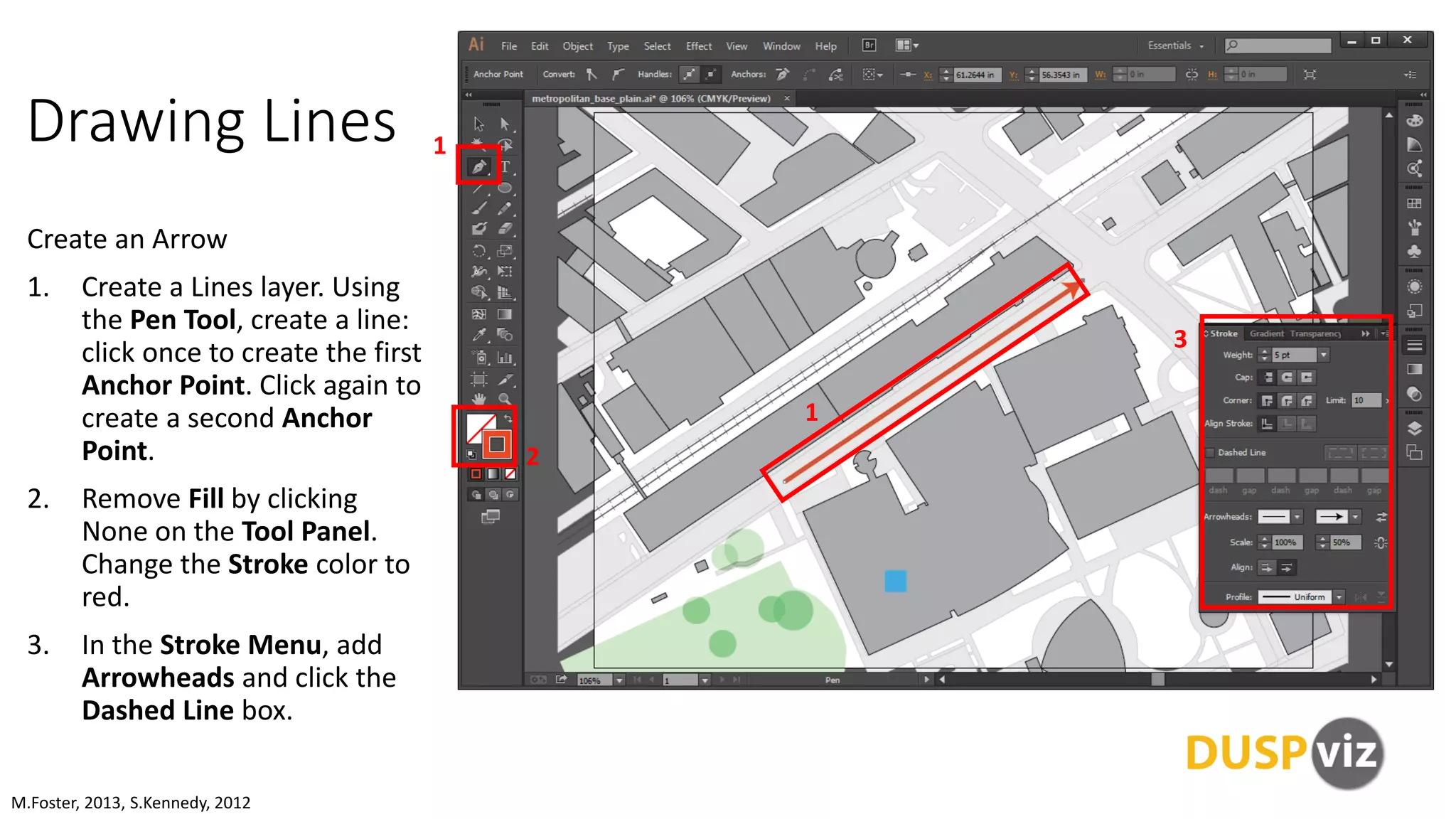
Drawing Lines
Create an Arrow
1. Create a Lines layer. Using
the Pen Tool, create a line:
click once to create the first
Anchor Point. Click again to
create a second Anchor
Point.
2. Remove Fill by clicking
None on the Tool Panel.
Change the Stroke color to
red.
3. In the Stroke Menu, add
Arrowheads and click the
Dashed Line box.
M.Foster, 2013, S.Kennedy, 2012
1
2
3
1
Drawing Lines
Draw a curved line
1. Using the Pen Tool, create
another line. BUT, this
time, when you draw the
second Anchor point, click-
hold-drag to create a bezier
curve.
2. You can manipulate the
curve by playing with the
Handles of the Anchor
point.
3. Create more anchor points
on an existing line using
Add Anchor Point Tool.
M.Foster, 2013, S.Kennedy, 2012
1
2
3
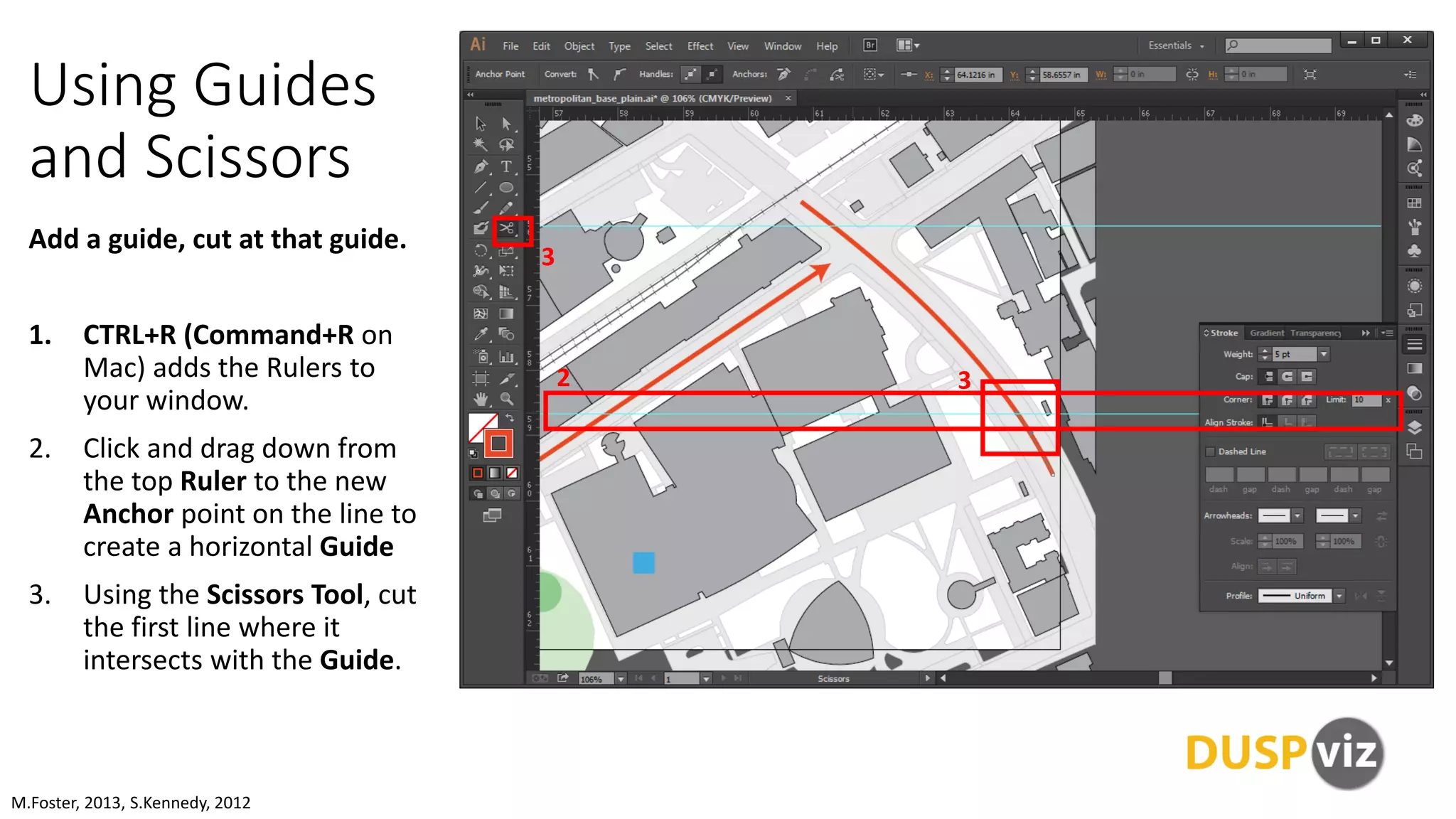
Using Guides
and Scissors
Add a guide, cut at that guide.
1. CTRL+R (Command+R on
Mac) adds the Rulers to
your window.
2. Click and drag down from
the top Ruler to the new
Anchor point on the line to
create a horizontal Guide
3. Using the Scissors Tool, cut
the first line where it
intersects with the Guide.
M.Foster, 2013, S.Kennedy, 2012
2
3
3
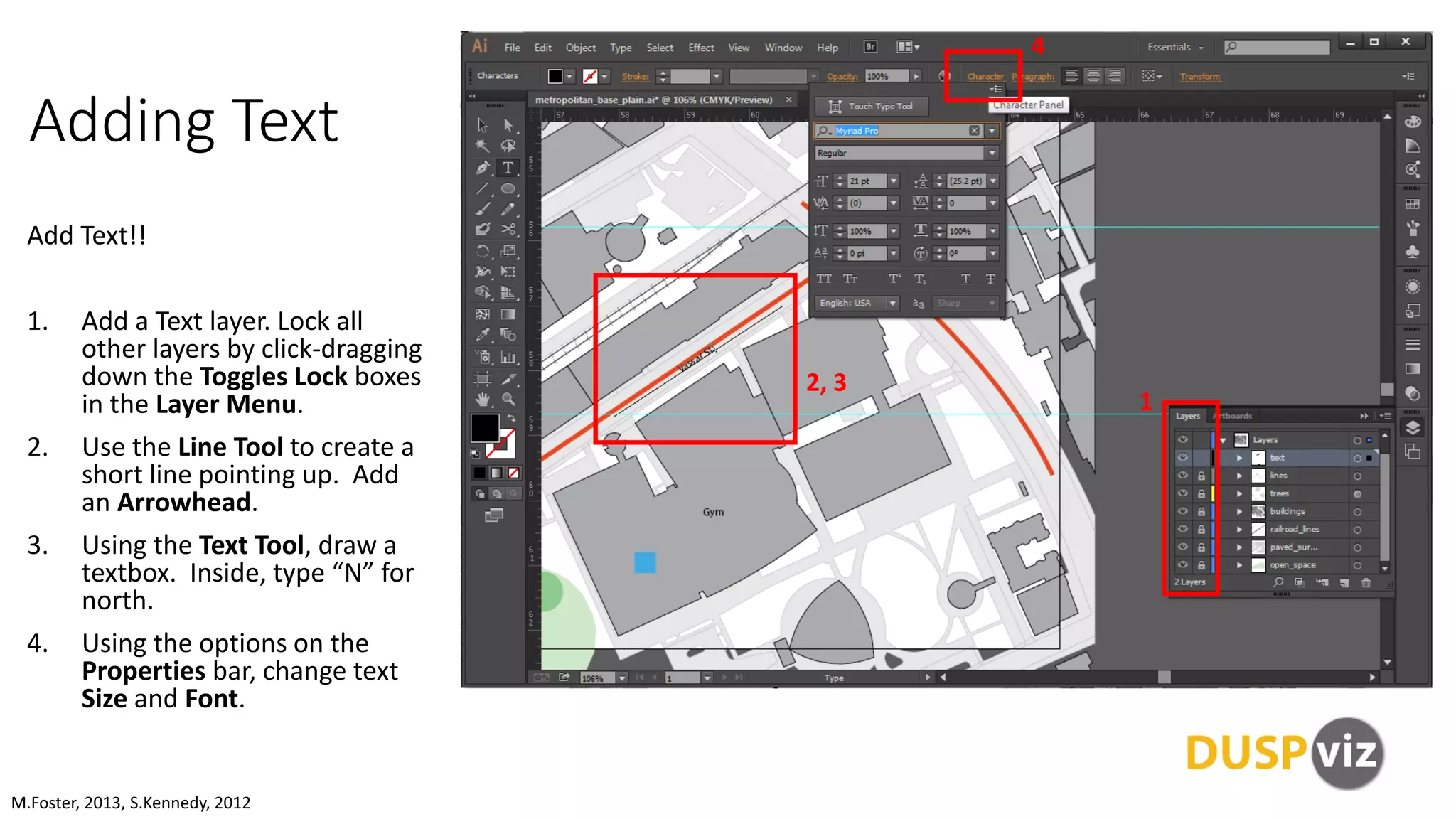
Adding Text
Add Text!!
1. Add a Text layer. Lock all
other layers by click-dragging
down the Toggles Lock boxes
in the Layer Menu.
2. Use the Line Tool to create a
short line pointing up. Add
an Arrowhead.
3. Using the Text Tool, draw a
textbox. Inside, type β€œN” for
north.
4. Using the options on the
Properties bar, change text
Size and Font.
M.Foster, 2013, S.Kennedy, 2012
1
2, 3
4
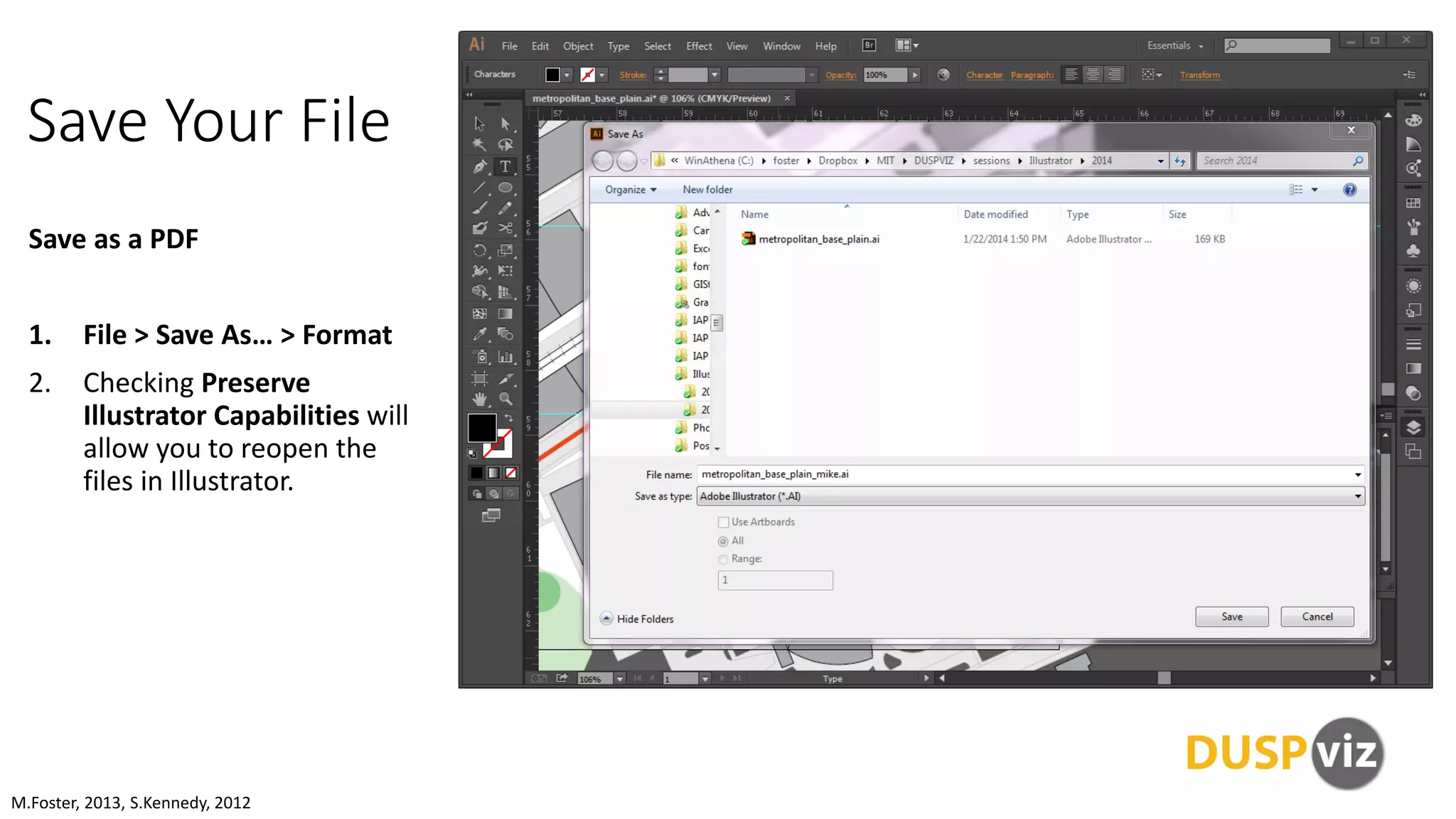
Save Your File
Save as a PDF
1. File > Save As… > Format
2. Checking Preserve
Illustrator Capabilities will
allow you to reopen the
files in Illustrator.
M.Foster, 2013, S.Kennedy, 2012

Intro to Adobe Illustrator

  • 1.
    Intro to the AdobeCreative Cloud M.Foster - 2013
  • 2.
    Illustrator Photoshop InDesign Dreamweaver Flash Acrobat β€’ Adobe Systems,Inc. β€’ Collection of Graphic Software β€’ Efficient and Robust Visualization β€’ Publishing and Presentation β€’ Graphic Design β€’ Web Design β€’ Photo Editing β€’ Video Editing β€’ Animations β€’ Web Publishing β€’ Etc. Etc. Etc. M.Foster - 2013
  • 3.
    Adobe Creative Cloud- Introduction M.Foster - 2013 Illustrator Photoshop InDesign ο‚§ Vector-based Graphics ο‚§ Lines ο‚§ Points ο‚§ Polygons ο‚§ Point based ο‚§ Raster-based Images ο‚§ Grid ο‚§ Pixels ο‚§ Photos ο‚§ Pixel based ο‚§ Production and Layout ο‚§ Text ο‚§ Images ο‚§ Layouts ο‚§ Viewshed/Layout based
  • 4.
    What is CreativeCloud? M.Foster - 2013 ο‚§ Formerly known as Creative Suite ο‚§ Subscription Based Service for Adobe Products ο‚§ On all CRON computers ο‚§ Student subscriptions available http://www.adobe.com/creativecloud/buy/students.html
  • 5.
    Introduction to Illustrator β€’Primary purpose is to draw and manipulate vector-based shapes β€’ Points, polygons, and lines β€’ Discrete features M.Foster - 2013
  • 6.
    Introduction to Illustrator β€’Primary purpose is to draw and manipulate vector-based shapes β€’ Great for creating illustrations, diagrams, and charts M.Foster - 2013
  • 7.
    Introduction to Illustrator β€’Primary purpose is to draw and manipulate vector-based shapes β€’ Easily enhance a drawing with different strokes and fills M.Foster - 2013
  • 8.
    Introduction to Illustrator β€’Layer based β€’ Organize your graphic content by placing it on layers M.Foster - 2013
  • 9.
    Interface β€’ Massive Interface β€’There are important, basic elements that make it easy! β€’ Open it up! M.Foster, 2013, S.Kennedy, 2012 Main Tools Drawing Area Basic Properties of Selected Objects Artboard Object Fill and Stroke Color Menus for Object Properties
  • 10.
    Object Properties β€’ Color β€’ Layers β€’Swatches β€’ Stroke β€’ Etc. M.Foster, 2013 Menus for Object Properties
  • 11.
  • 12.
    Selection Tool Move entireobjects. Task: Release clipping mask, move a building. 1. Use the Selection Tool (V) to select objects in the drawing area 2. In the Layers panel, find the buildings layer and delete the Clipping Mask 3. Right click on the buildings in the drawing area and Ungroup M.Foster, 2014, S.Kennedy, 2012 Selection Tool
  • 13.
    Direct Selection Tool Move Vertices.Task: Connect these two buildings. 1. Use the Direct Selection Tool (A) to select parts of object (Anchors/Paths) 2. Click on the corner or side of a building to adjust the shape M.Foster, 2013, S.Kennedy, 2012 Direct Selection Tool 2
  • 14.
    Styling Objects Select all buildings,give stroke to outline of building. 1. Click on a building. Select > Same > Fill & Stroke to select all the same type of object. 2. In the Stroke Menu, adjust the line Weight to 1 pt. 3. Align Stroke to Inside of the objects. M.Foster, 2013, S.Kennedy, 2012 1 2 3
  • 15.
    Drawing Objects Add a coupleskylights to the top of the building. Change their color. 1. Using the Rectangle Tool, draw a few shapes on top of a building. 2. Double-click on the object Fill to bring up the Color Picker. 3. Select Color in the gradient field to change the object fill. M.Foster, 2013, S.Kennedy, 2012 Rectangle Tool Color Panel Change Fill/Stroke 1 3 2
  • 16.
    Drawing Objects Create new layer,draw trees. 1. In the Layers Menu, Create New Layer. 2. Double-click on the layer to bring up Layer Options. Rename the layer to β€œtrees”. 3. Using the Ellipse Tool, draw several circles by the park. Set the color. TIP – Hold Shift while drawing to create objects with equal aspect ratios. M.Foster, 2013, S.Kennedy, 2012 1 2 3
  • 17.
    Using Transparency Make trees transparent. 1.Select all your trees by clicking on the radio button on that layer. 2. Using the Eyedropper Tool (CNTL-i), click on the green space to make your trees the same color. 3. In the Transparency Menu, change the object transparency to Multiply. M.Foster, 2013, S.Kennedy, 2012 1 2 3
  • 18.
    Copying and Duplication Copy/paste toadd more trees, and use the rotate tool. 1. Copy (CTRL+C) and Paste (CTRL+V) to create more trees, or by clicking and dragging while holding Alt. 2. Scale the new trees down by holding shift and dragging in/out the corners of the bounding box. 3. Using the Rotate Tool (R), click and drag around the axis point to rotate the new trees. M.Foster, 2013, S.Kennedy, 2012 1,2,3
  • 19.
    Drawing Lines Create anArrow 1. Create a Lines layer. Using the Pen Tool, create a line: click once to create the first Anchor Point. Click again to create a second Anchor Point. 2. Remove Fill by clicking None on the Tool Panel. Change the Stroke color to red. 3. In the Stroke Menu, add Arrowheads and click the Dashed Line box. M.Foster, 2013, S.Kennedy, 2012 1 2 3 1
  • 20.
    Drawing Lines Draw acurved line 1. Using the Pen Tool, create another line. BUT, this time, when you draw the second Anchor point, click- hold-drag to create a bezier curve. 2. You can manipulate the curve by playing with the Handles of the Anchor point. 3. Create more anchor points on an existing line using Add Anchor Point Tool. M.Foster, 2013, S.Kennedy, 2012 1 2 3
  • 21.
    Using Guides and Scissors Adda guide, cut at that guide. 1. CTRL+R (Command+R on Mac) adds the Rulers to your window. 2. Click and drag down from the top Ruler to the new Anchor point on the line to create a horizontal Guide 3. Using the Scissors Tool, cut the first line where it intersects with the Guide. M.Foster, 2013, S.Kennedy, 2012 2 3 3
  • 22.
    Adding Text Add Text!! 1.Add a Text layer. Lock all other layers by click-dragging down the Toggles Lock boxes in the Layer Menu. 2. Use the Line Tool to create a short line pointing up. Add an Arrowhead. 3. Using the Text Tool, draw a textbox. Inside, type β€œN” for north. 4. Using the options on the Properties bar, change text Size and Font. M.Foster, 2013, S.Kennedy, 2012 1 2, 3 4
  • 23.
    Save Your File Saveas a PDF 1. File > Save As… > Format 2. Checking Preserve Illustrator Capabilities will allow you to reopen the files in Illustrator. M.Foster, 2013, S.Kennedy, 2012