2014-2015
A. Introduction
1. Adobe Photoshop?
- The professional image-editing standard
2. Two general usage of Photoshop
- Creating images
- Editing existing images
PHOTOSHOP
Adobe Photoshop CS3 is a frequently used image
editing & creating software. It is a powerful image
processing application software developed by adobe
vendors. This software is used to correct errors and
add effect to images. It is also used to create
graphics for published in magazines, books, newspaper
and websites. This chapter introduces you the basics
of Adobe Photoshop CS3. It also discuses the process
of starting and existing from Photoshop software.
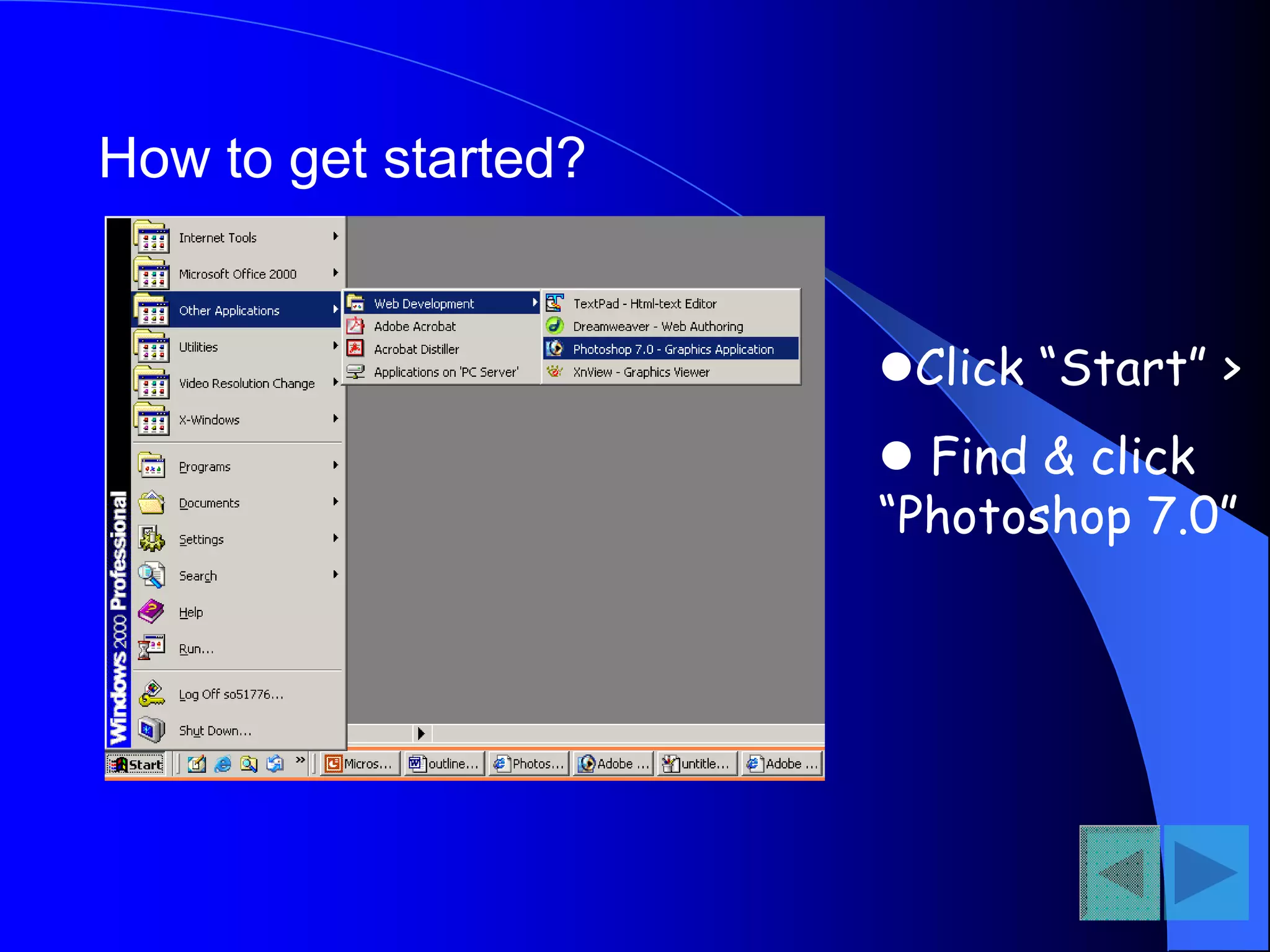
How to get started?
Click “Start” >
 Find & click
“Photoshop 7.0”
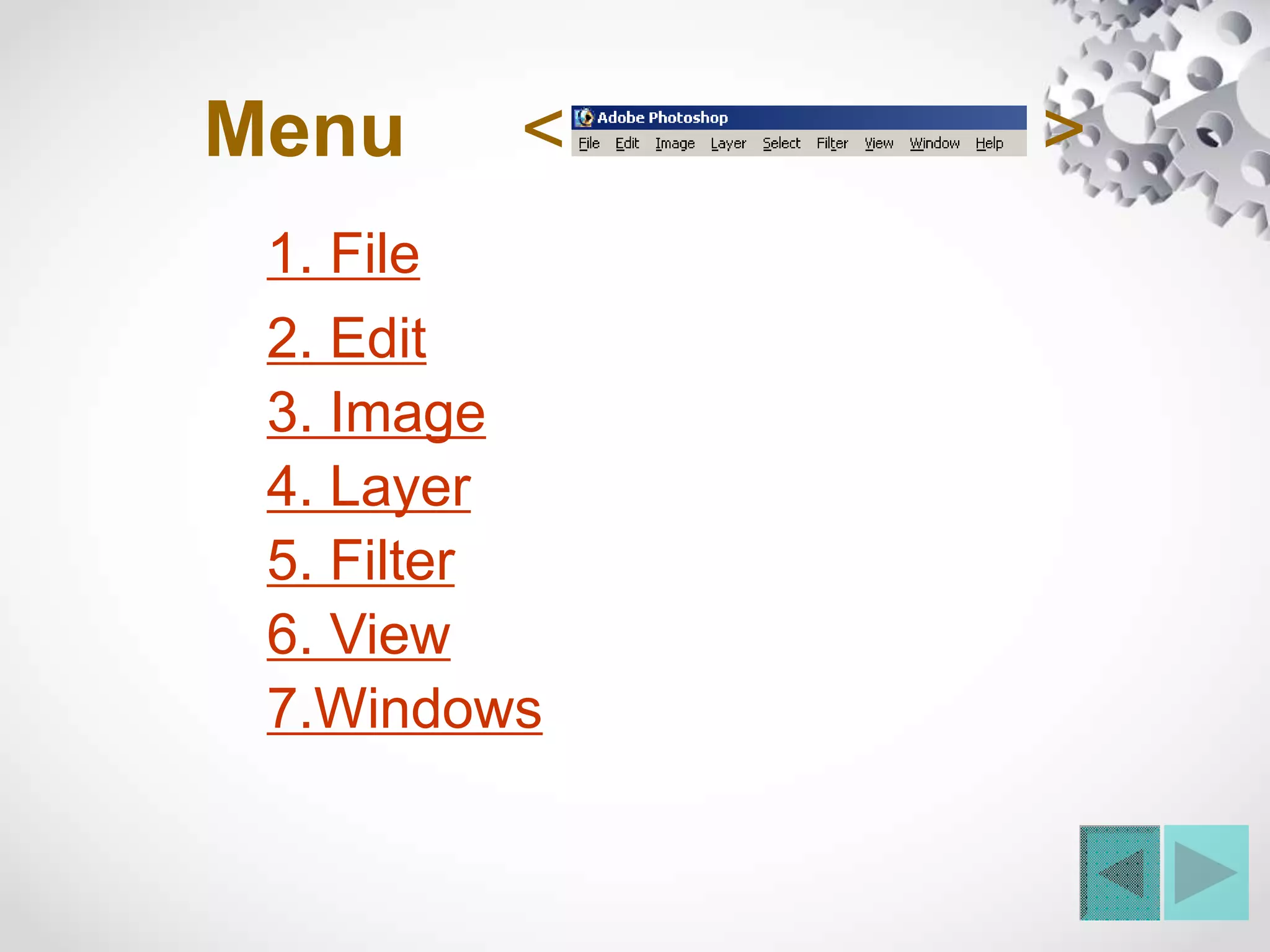
Menu
1. File
< >
2. Edit
3. Image
4. Layer
5. Filter
6. View
7.Windows
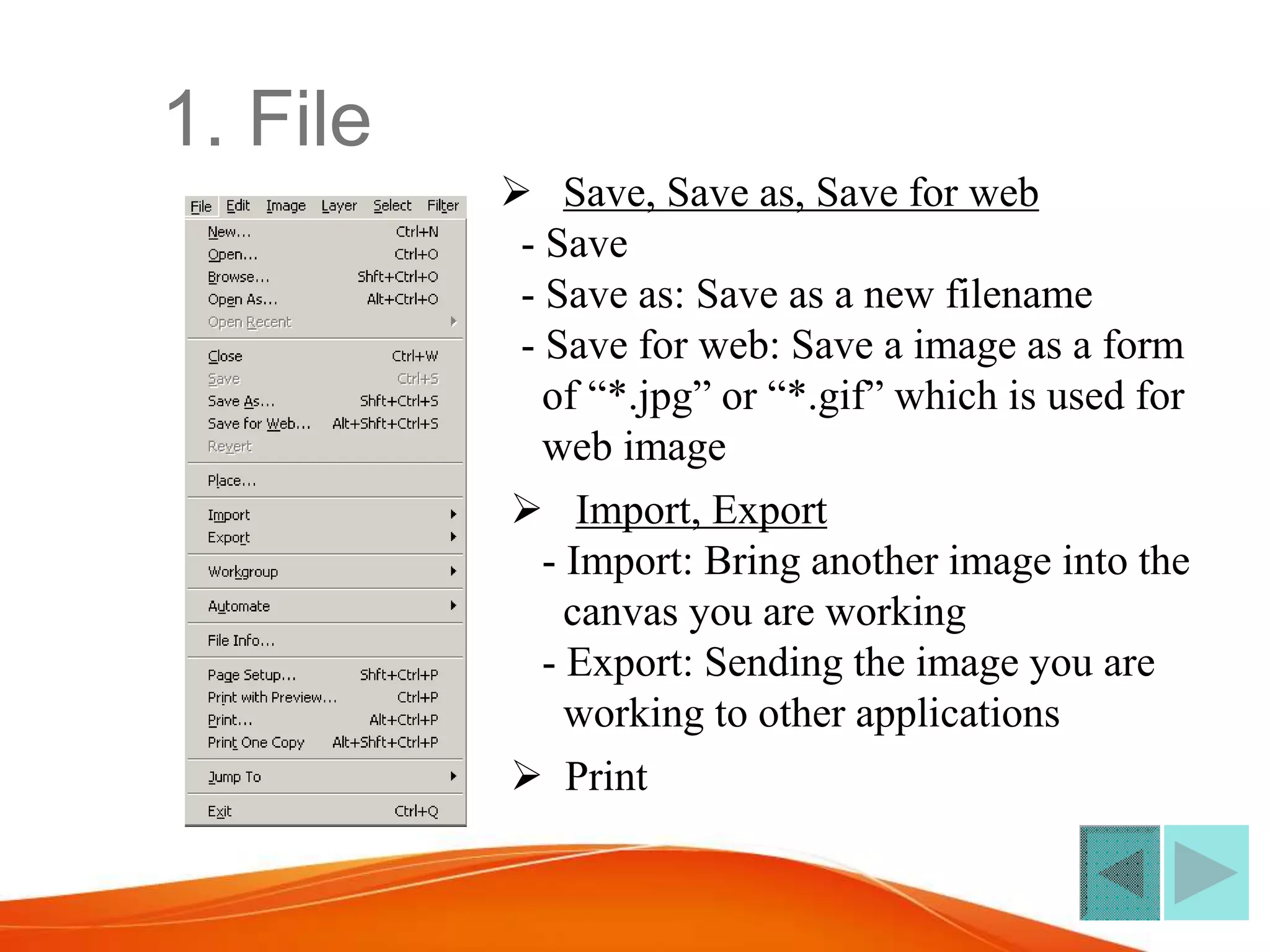
1. File
 Save, Save as, Save for web
- Save
- Save as: Save as a new filename
- Save for web: Save a image as a form
of “*.jpg” or “*.gif” which is used for
web image
 Import, Export
- Import: Bring another image into the
canvas you are working
- Export: Sending the image you are
working to other applications
 Print
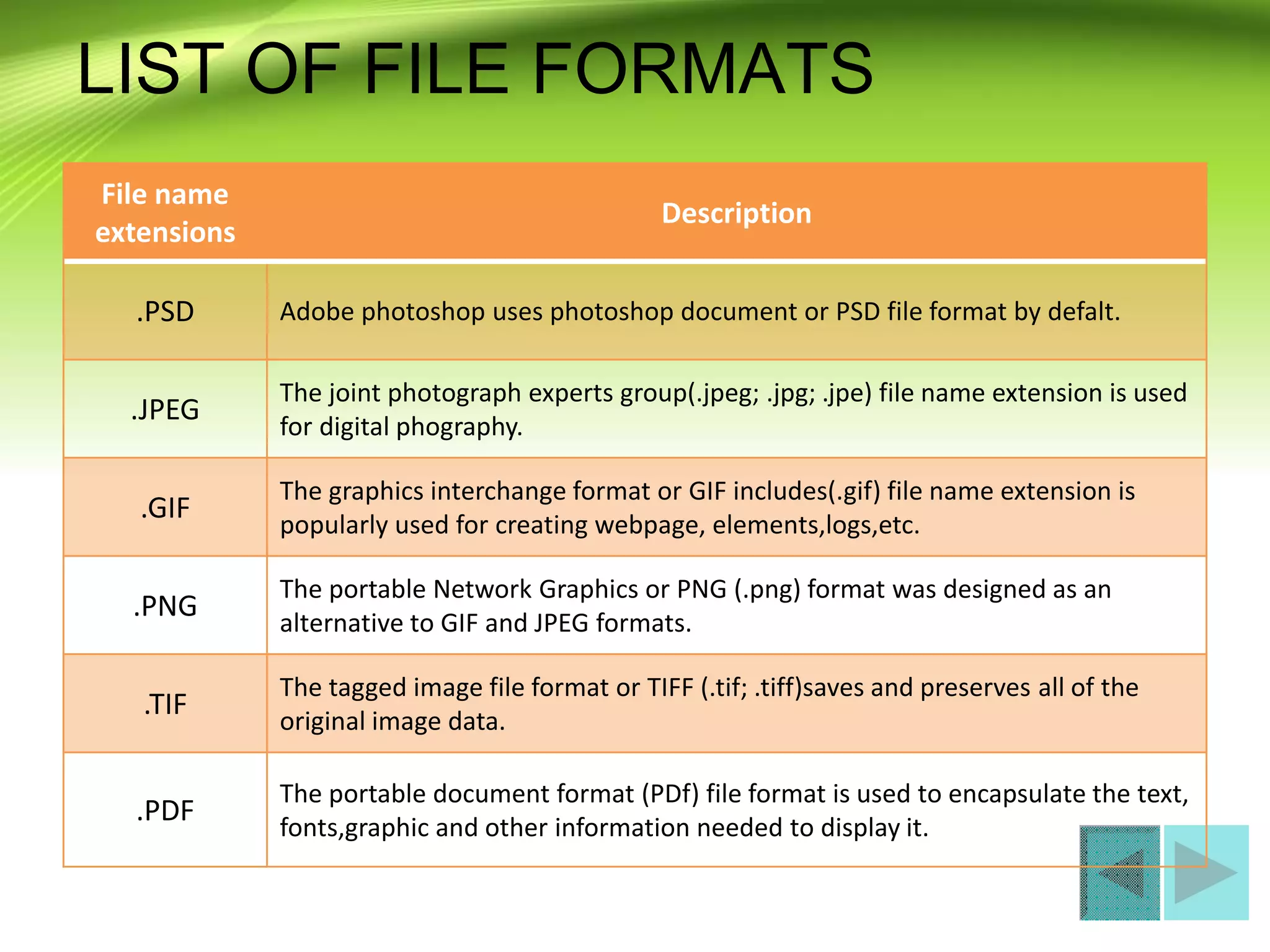
LIST OF FILE FORMATS
File name
extensions
Description
.PSD Adobe photoshop uses photoshop document or PSD file format by defalt.
.JPEG
The joint photograph experts group(.jpeg; .jpg; .jpe) file name extension is used
for digital phography.
.GIF
The graphics interchange format or GIF includes(.gif) file name extension is
popularly used for creating webpage, elements,logs,etc.
.PNG
The portable Network Graphics or PNG (.png) format was designed as an
alternative to GIF and JPEG formats.
.TIF
The tagged image file format or TIFF (.tif; .tiff)saves and preserves all of the
original image data.
.PDF
The portable document format (PDf) file format is used to encapsulate the text,
fonts,graphic and other information needed to display it.
2. Edit
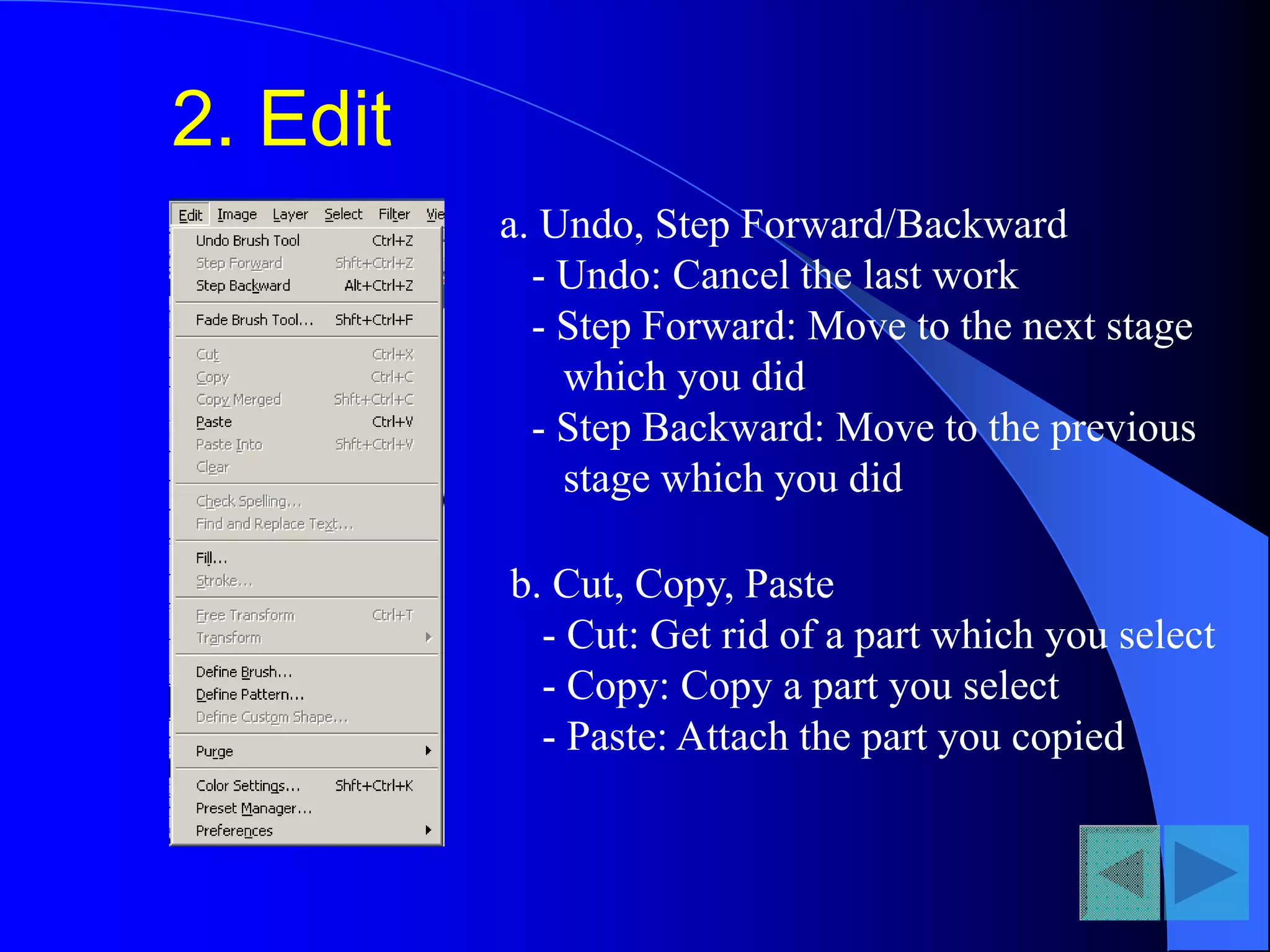
a. Undo, Step Forward/Backward
- Undo: Cancel the last work
- Step Forward: Move to the next stage
which you did
- Step Backward: Move to the previous
stage which you did
b. Cut, Copy, Paste
- Cut: Get rid of a part which you select
- Copy: Copy a part you select
- Paste: Attach the part you copied
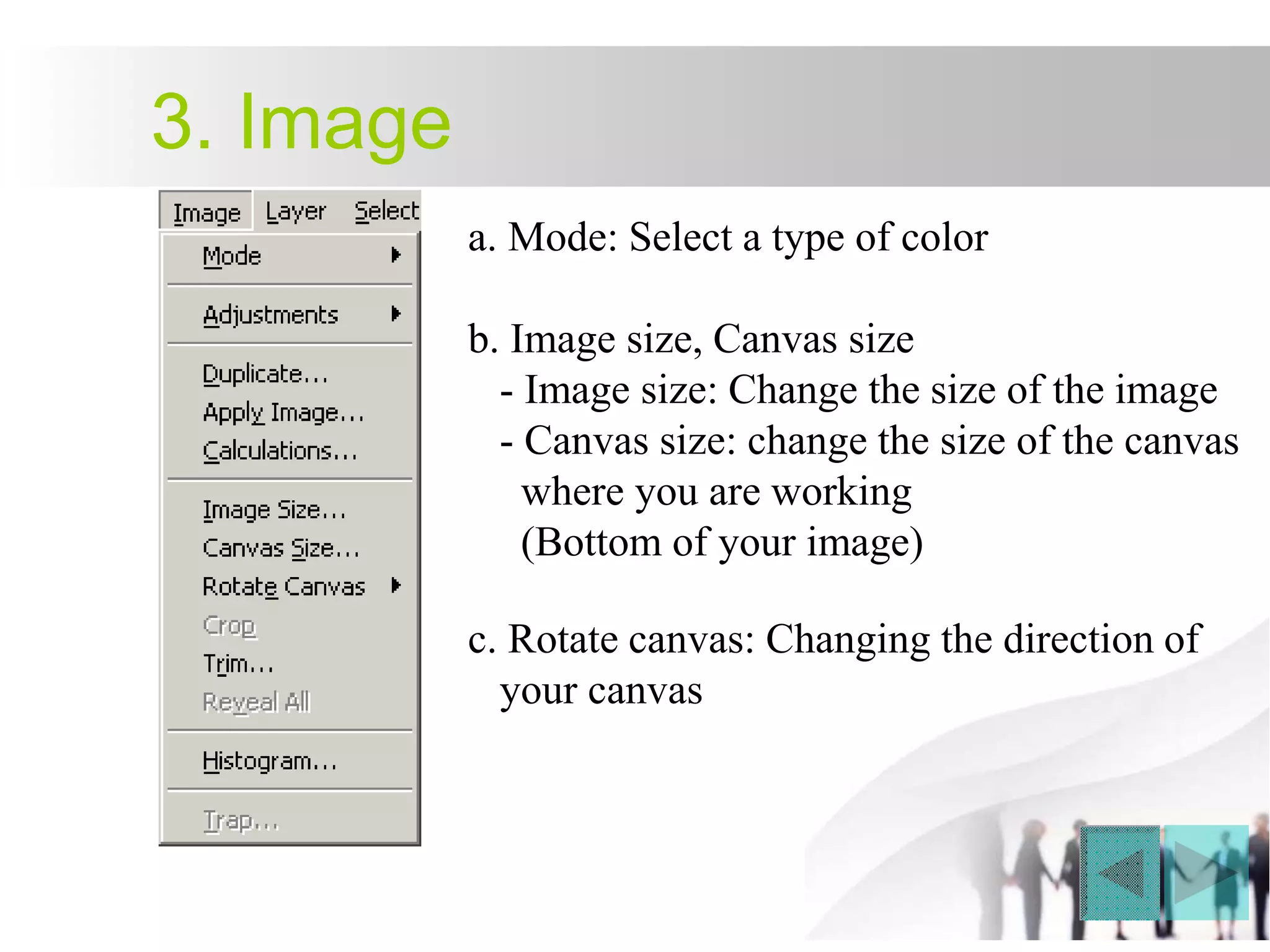
3. Image
a. Mode: Select a type of color
b. Image size, Canvas size
- Image size: Change the size of the image
- Canvas size: change the size of the canvas
where you are working
(Bottom of your image)
c. Rotate canvas: Changing the direction of
your canvas
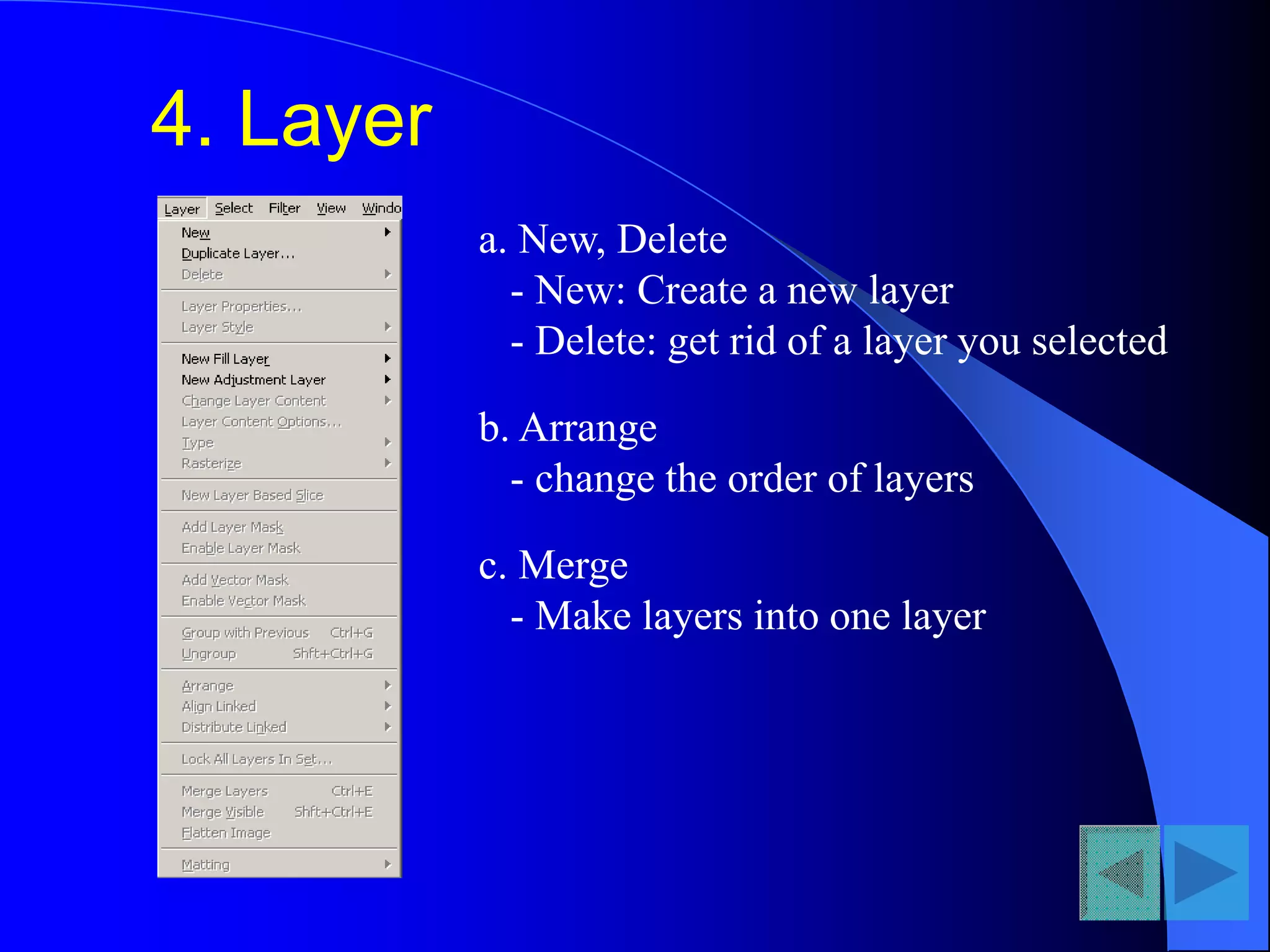
4. Layer
a. New, Delete
- New: Create a new layer
- Delete: get rid of a layer you selected
b. Arrange
- change the order of layers
c. Merge
- Make layers into one layer
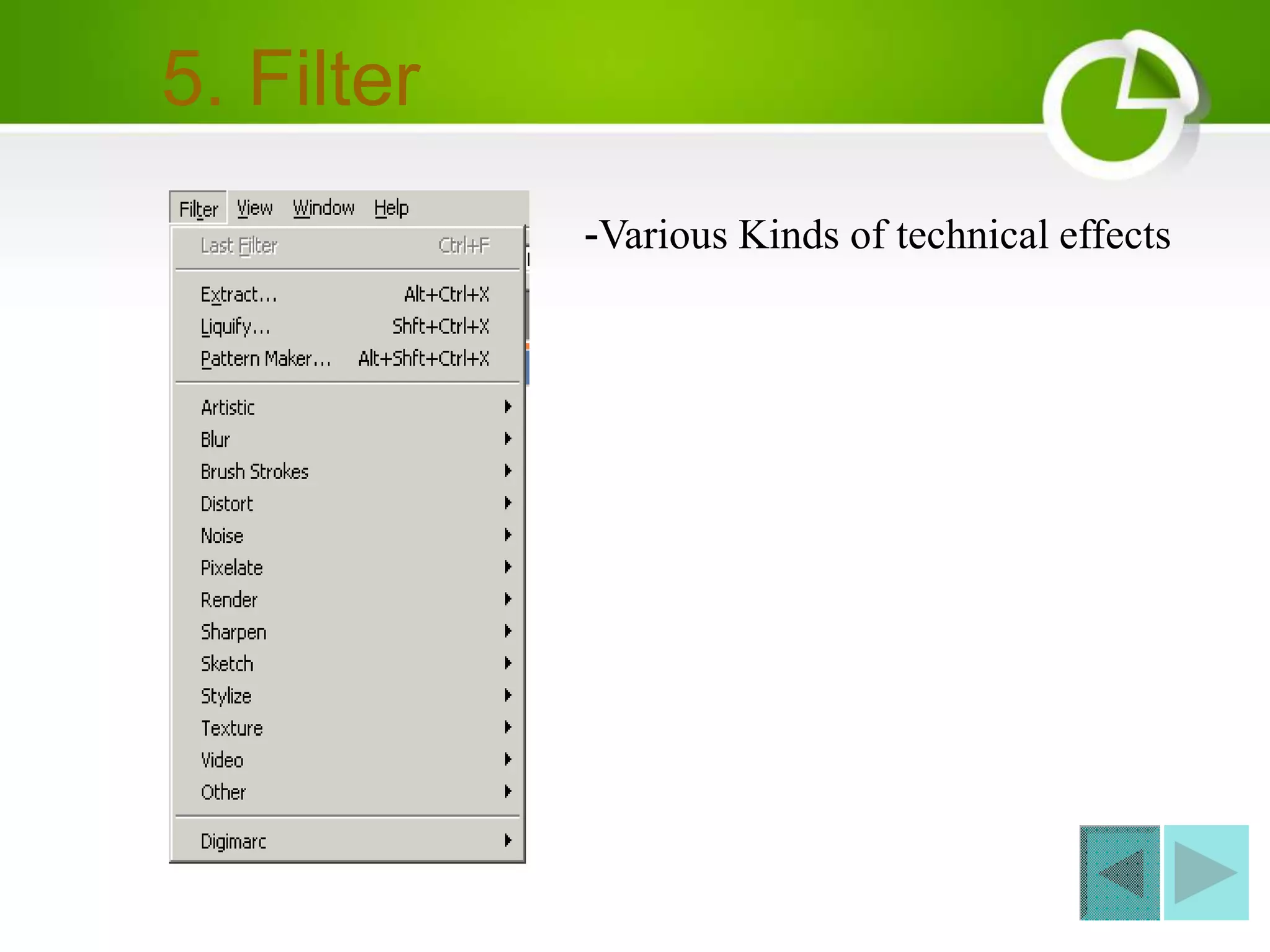
5. Filter
-Various Kinds of technical effects
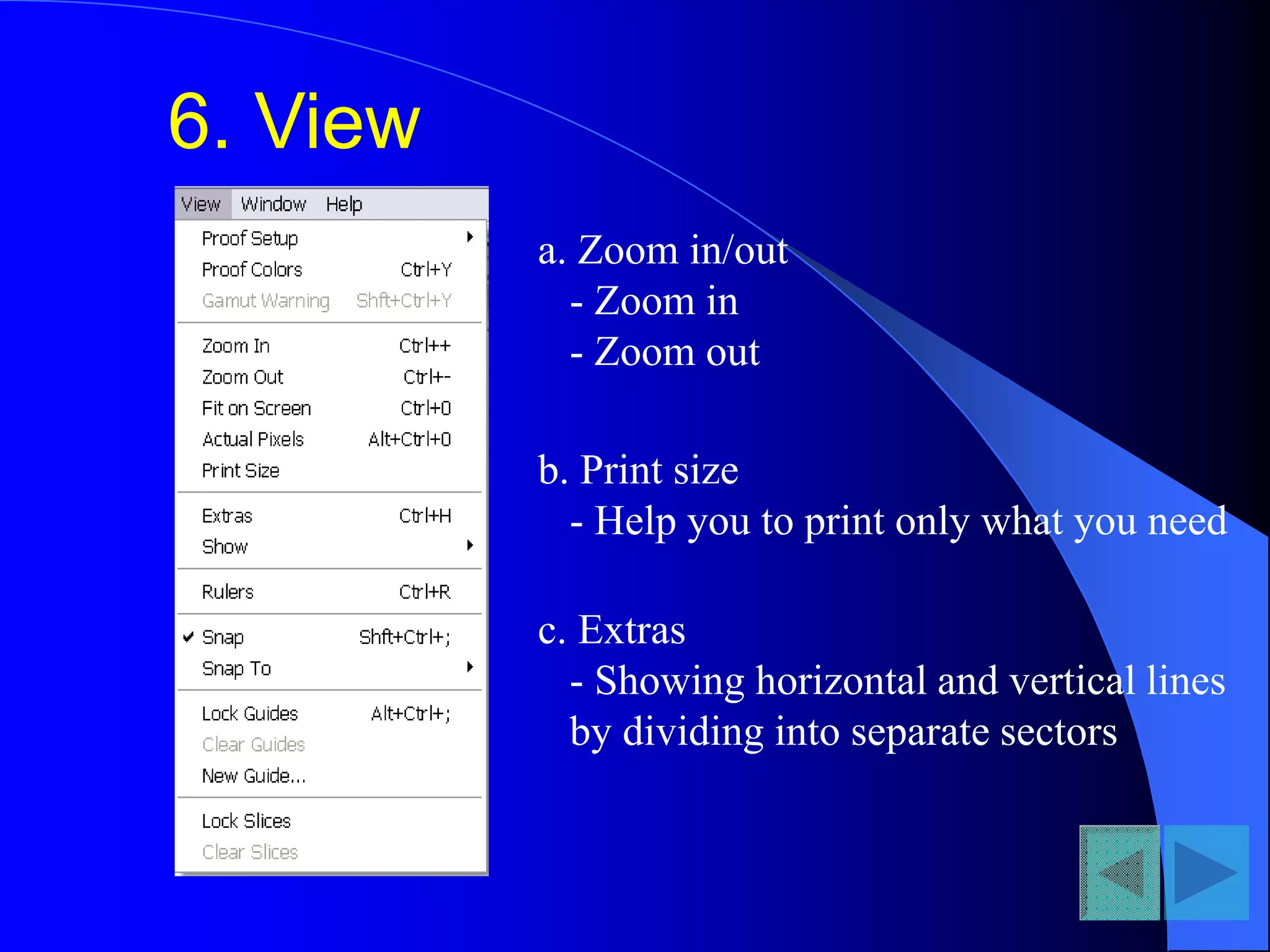
6. View
a. Zoom in/out
- Zoom in
- Zoom out
b. Print size
- Help you to print only what you need
c. Extras
- Showing horizontal and vertical lines
by dividing into separate sectors
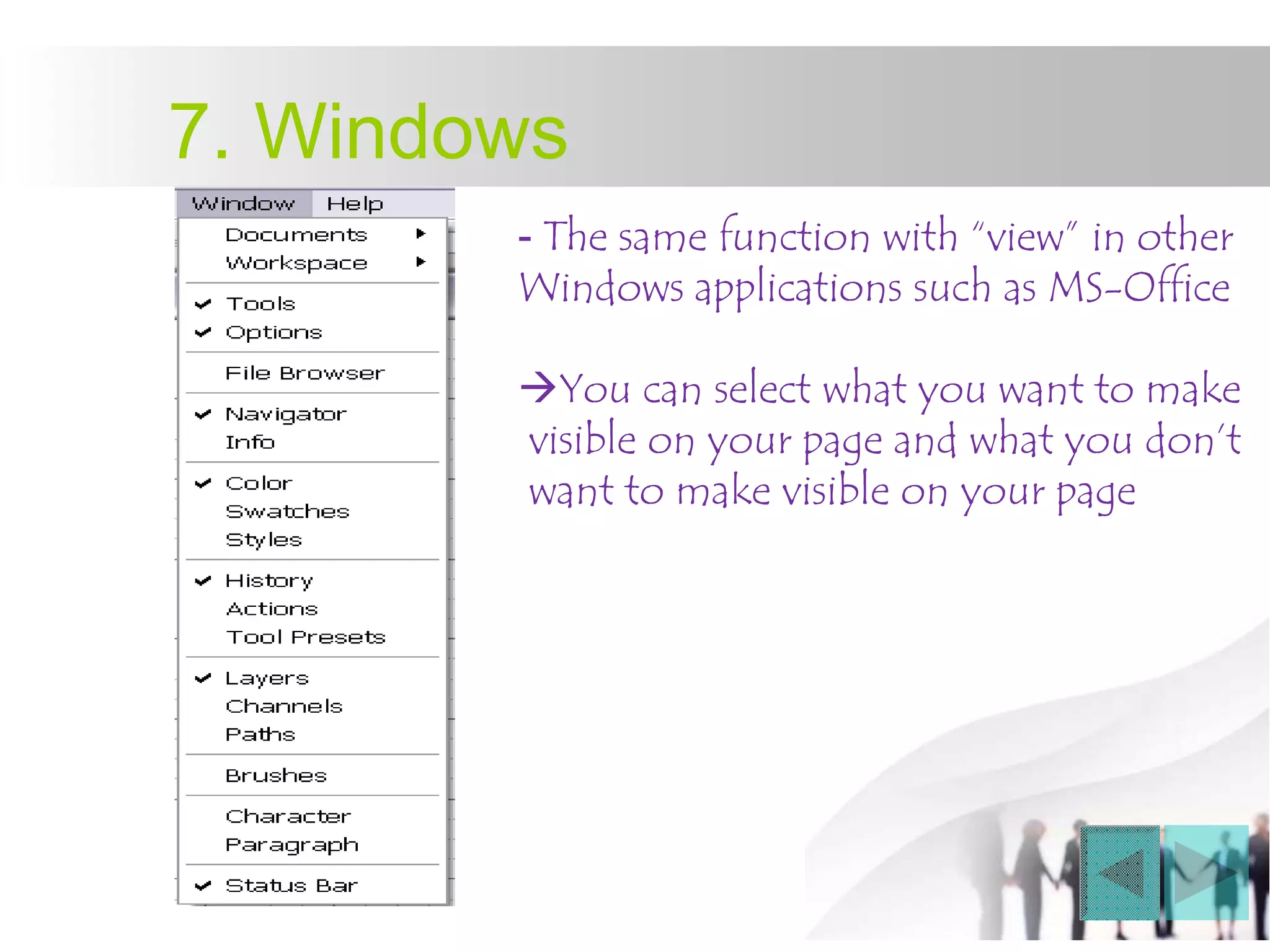
7. Windows
- The same function with “view” in other
Windows applications such as MS-Office
You can select what you want to make
visible on your page and what you don’t
want to make visible on your page
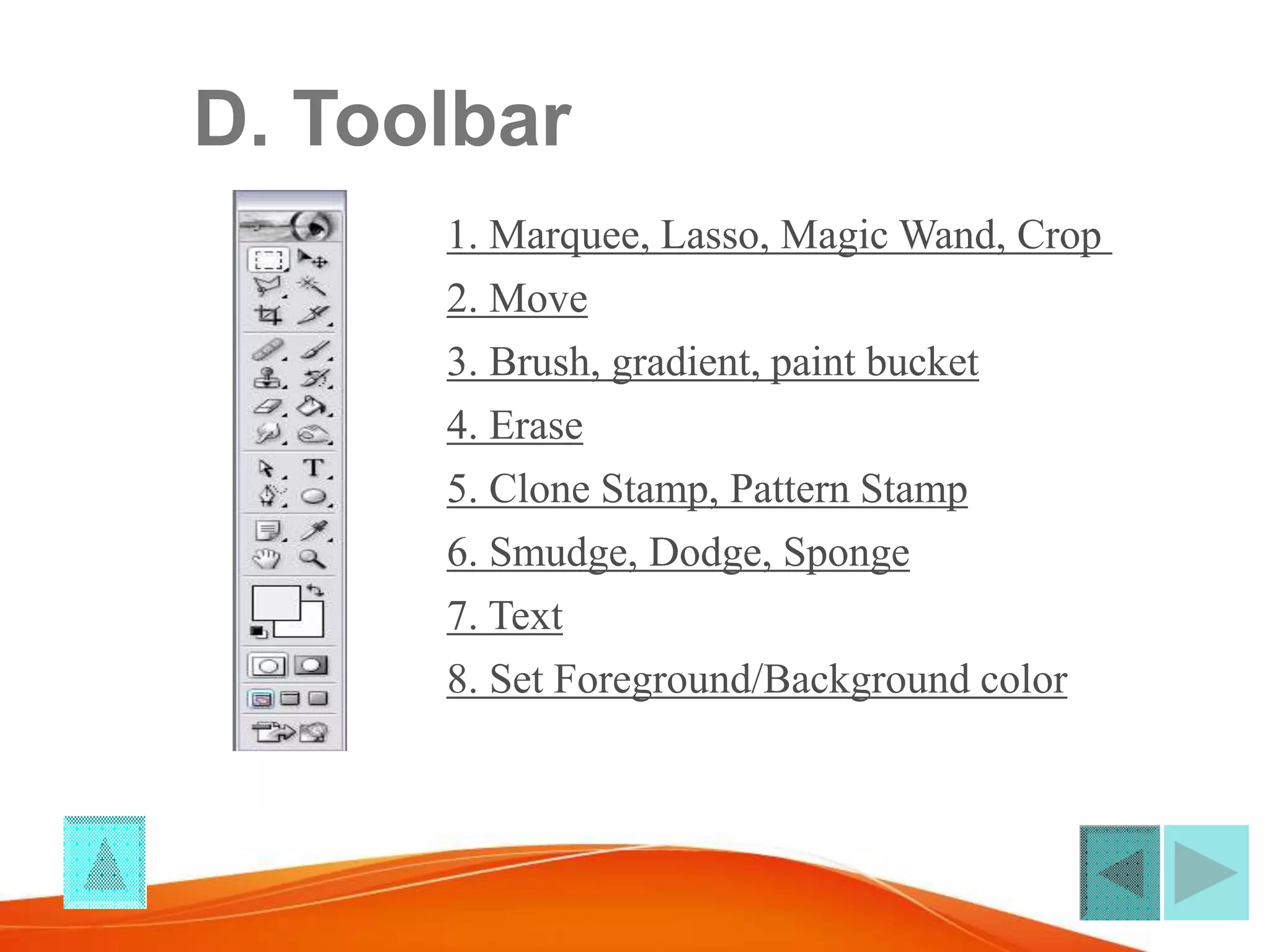
D. Toolbar
1. Marquee, Lasso, Magic Wand, Crop
2. Move
3. Brush, gradient, paint bucket
4. Erase
5. Clone Stamp, Pattern Stamp
6. Smudge, Dodge, Sponge
7. Text
8. Set Foreground/Background color
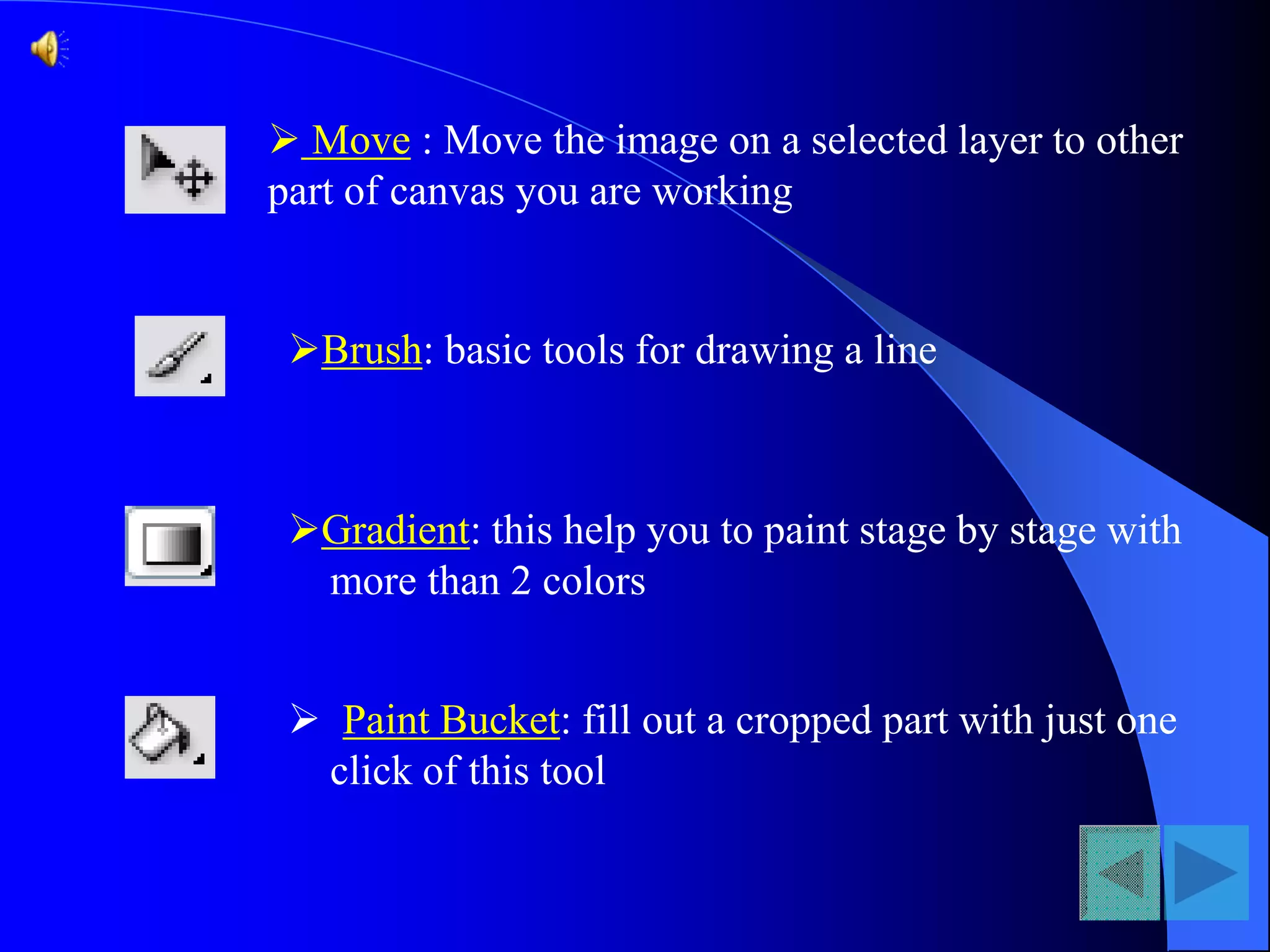
 Move : Move the image on a selected layer to other
part of canvas you are working
Brush: basic tools for drawing a line
Gradient: this help you to paint stage by stage with
more than 2 colors
 Paint Bucket: fill out a cropped part with just one
click of this tool
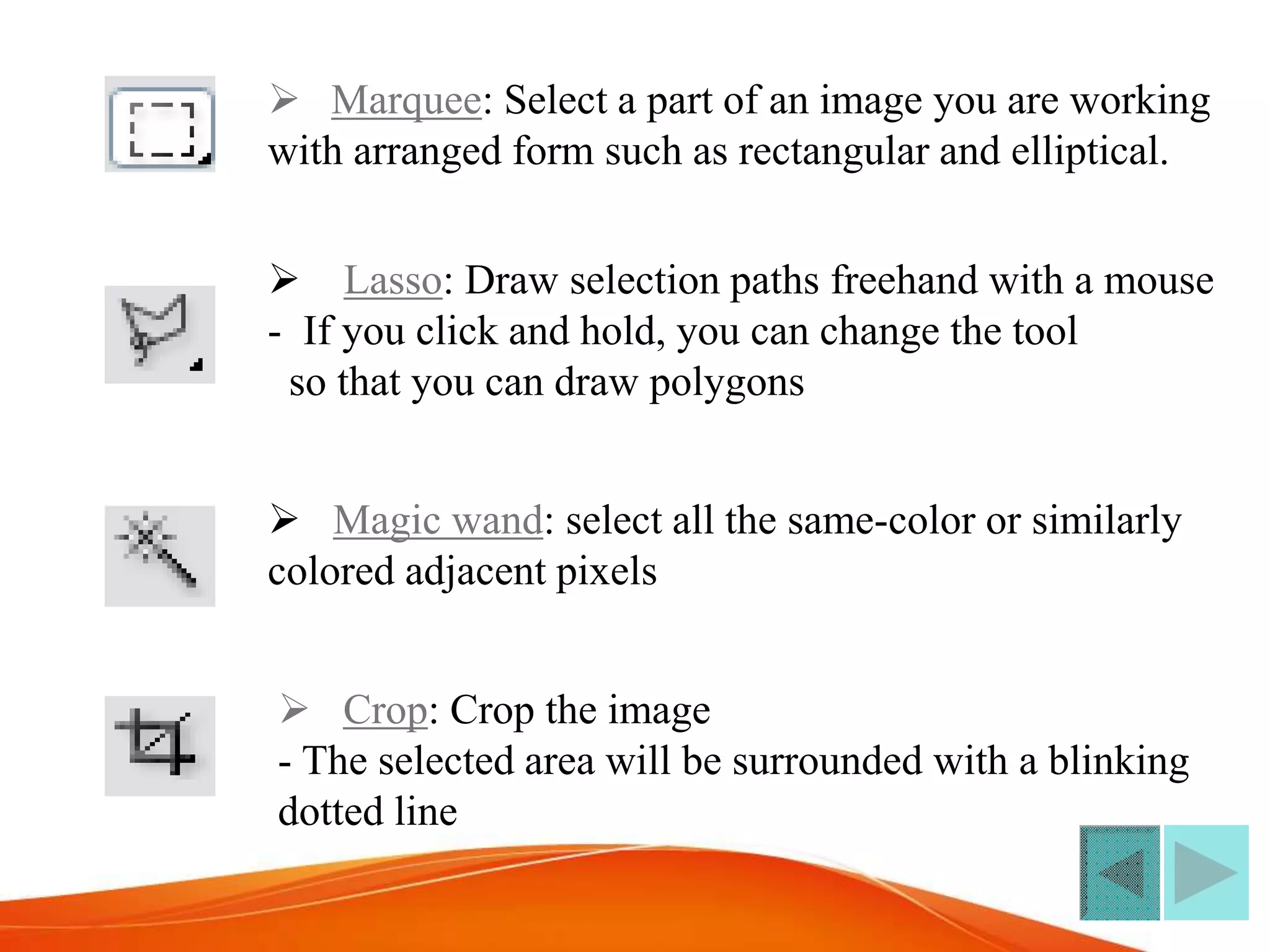
 Marquee: Select a part of an image you are working
with arranged form such as rectangular and elliptical.
 Lasso: Draw selection paths freehand with a mouse
- If you click and hold, you can change the tool
so that you can draw polygons
 Magic wand: select all the same-color or similarly
colored adjacent pixels
 Crop: Crop the image
- The selected area will be surrounded with a blinking
dotted line
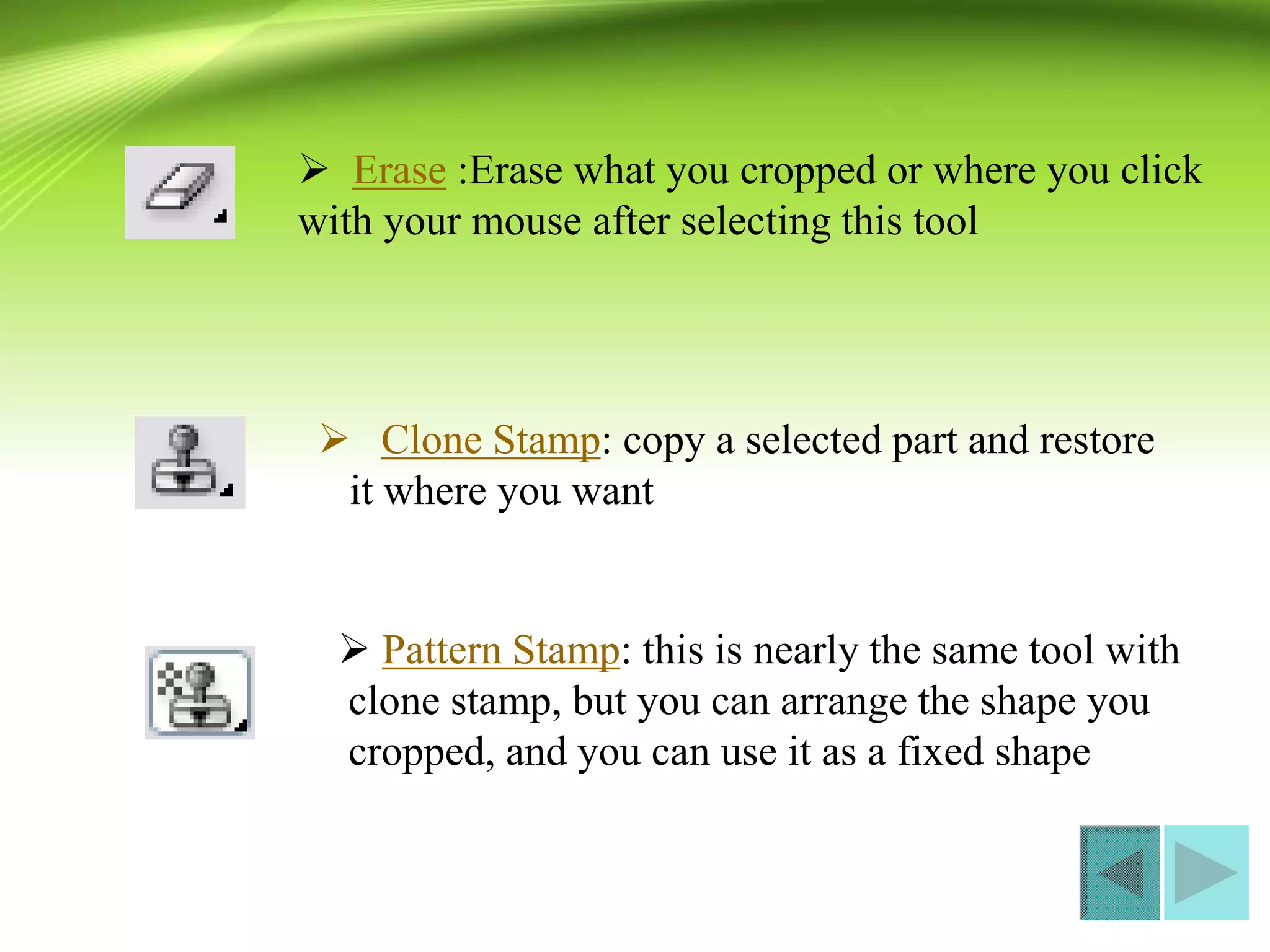
 Erase :Erase what you cropped or where you click
with your mouse after selecting this tool
 Clone Stamp: copy a selected part and restore
it where you want
 Pattern Stamp: this is nearly the same tool with
clone stamp, but you can arrange the shape you
cropped, and you can use it as a fixed shape
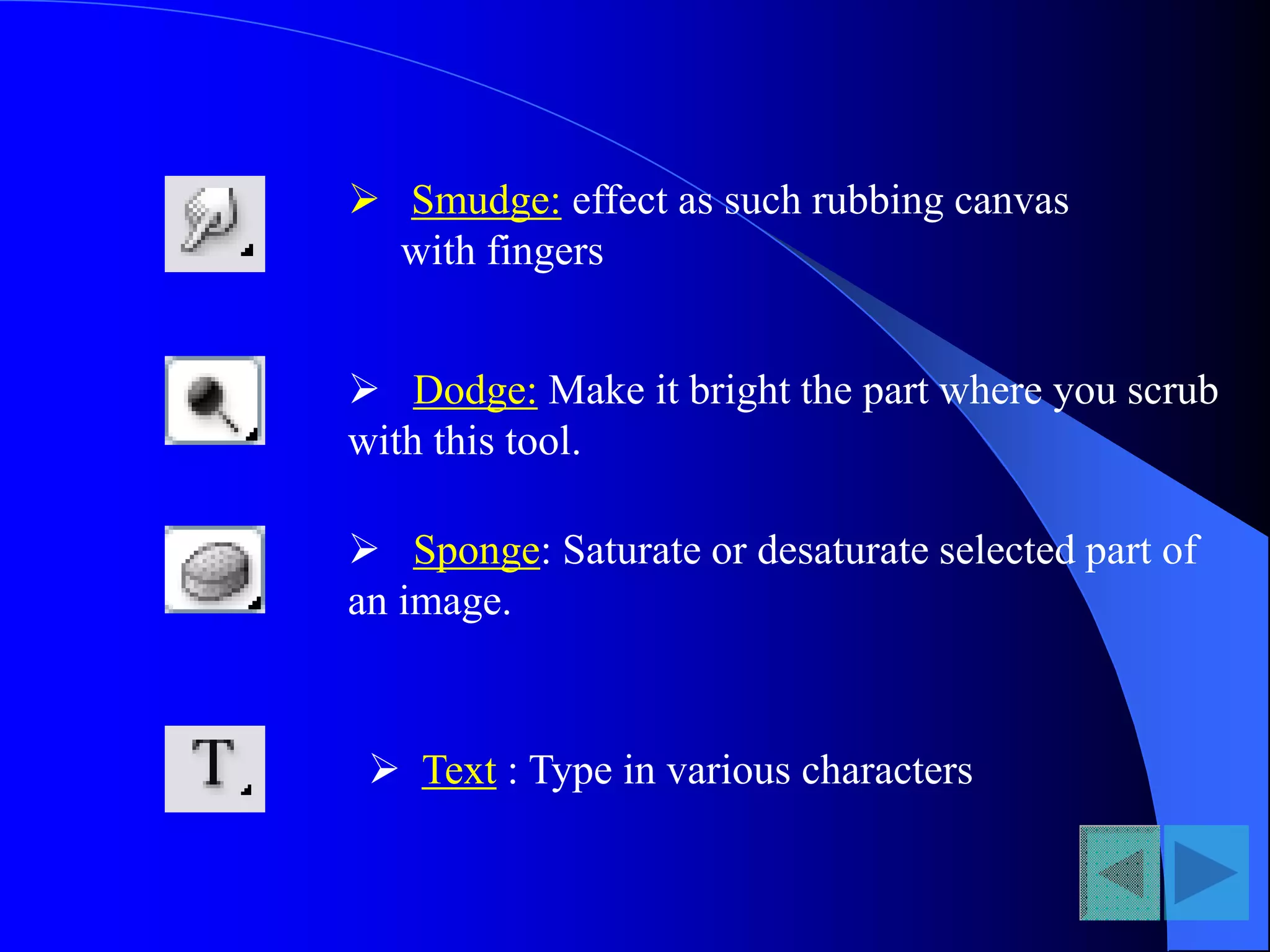
 Smudge: effect as such rubbing canvas
with fingers
 Dodge: Make it bright the part where you scrub
with this tool.
 Sponge: Saturate or desaturate selected part of
an image.
 Text : Type in various characters
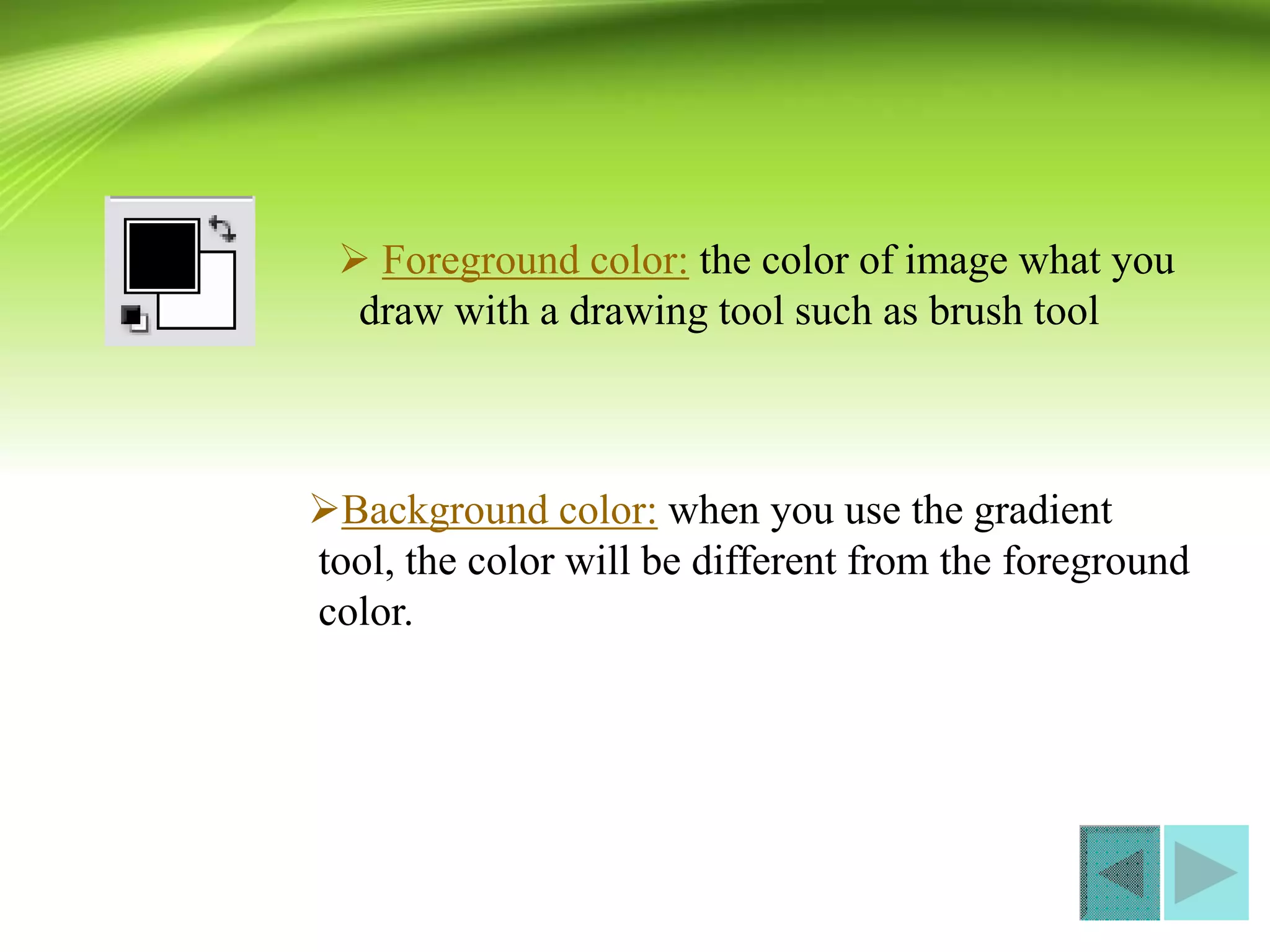
 Foreground color: the color of image what you
draw with a drawing tool such as brush tool
Background color: when you use the gradient
tool, the color will be different from the foreground
color.
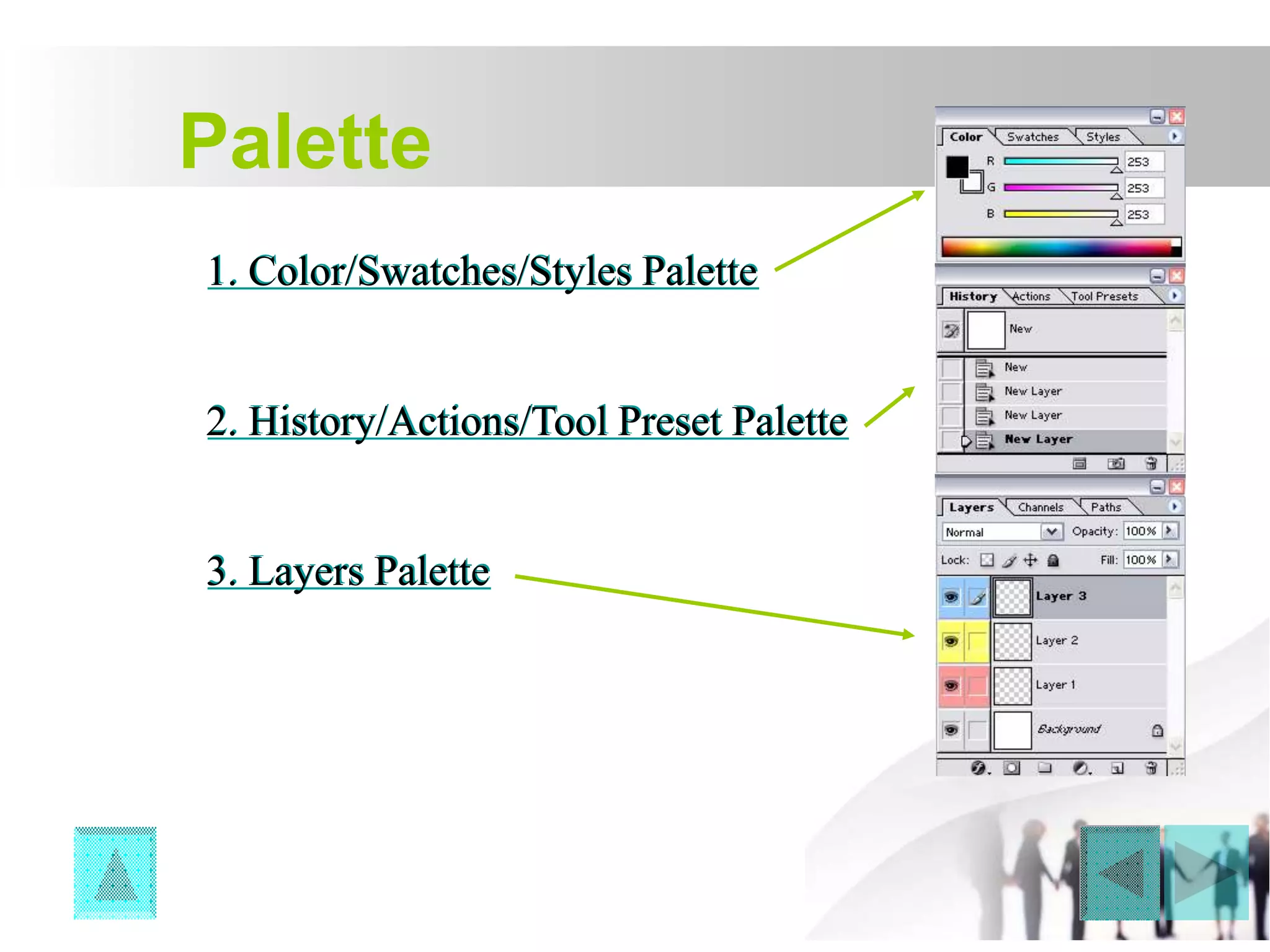
Palette
1. Color/Swatches/Styles Palette
2. History/Actions/Tool Preset Palette
3. Layers Palette
1. Color/Swatches/Styles Palette
2. History/Actions/Tool Preset Palette
3. Layers Palette
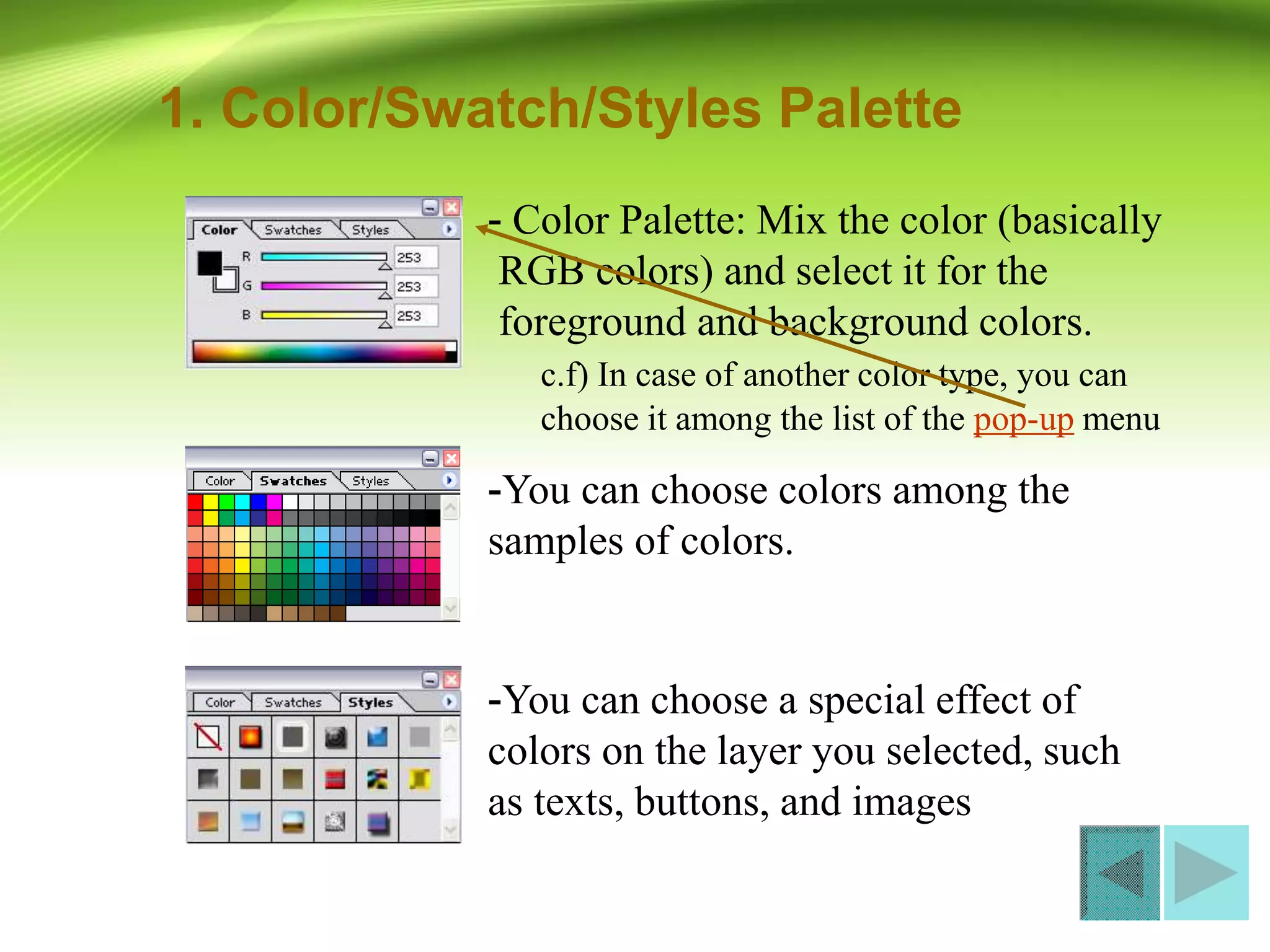
1. Color/Swatch/Styles Palette
- Color Palette: Mix the color (basically
RGB colors) and select it for the
foreground and background colors.
c.f) In case of another color type, you can
choose it among the list of the pop-up menu
-You can choose colors among the
samples of colors.
-You can choose a special effect of
colors on the layer you selected, such
as texts, buttons, and images
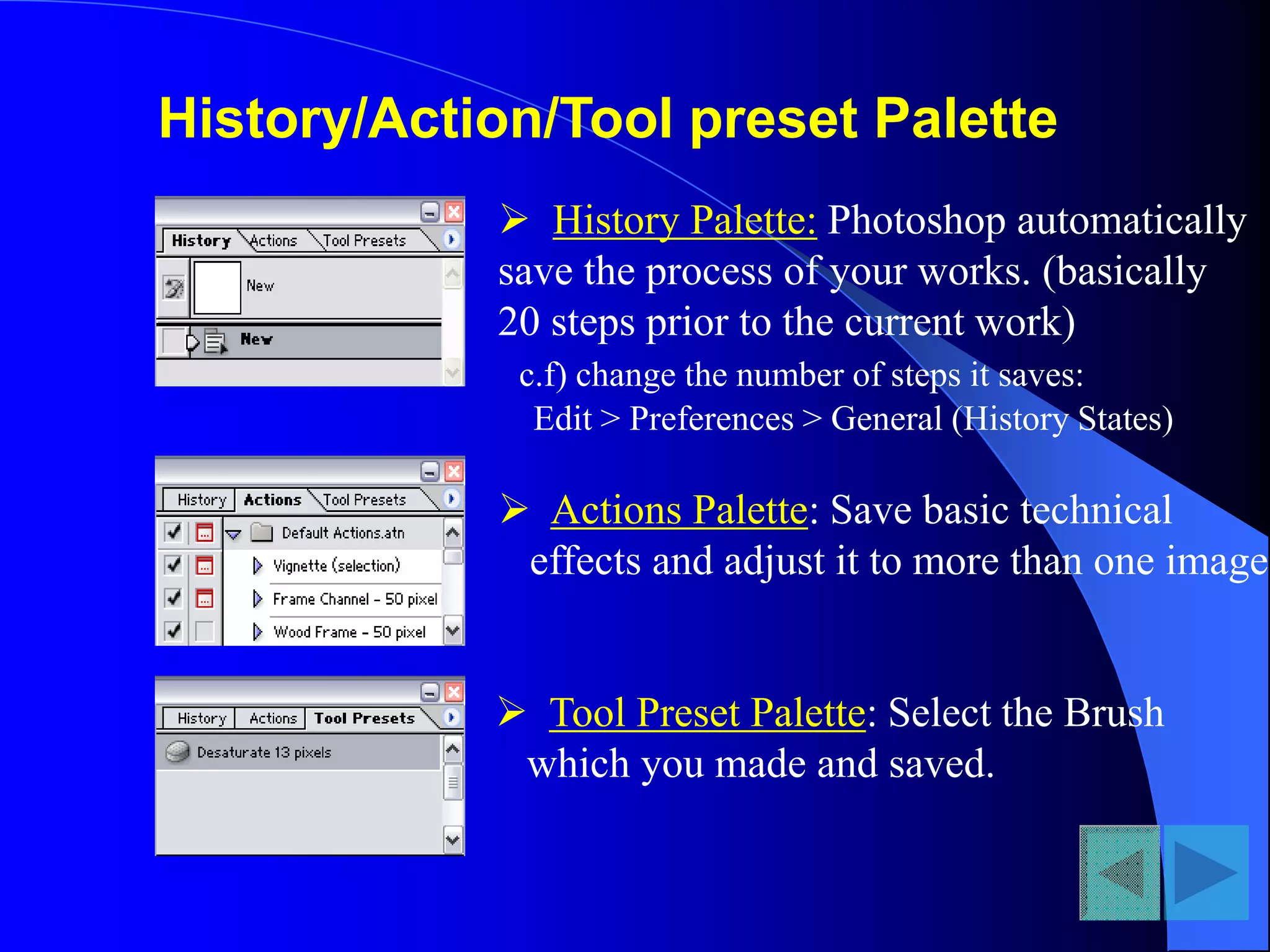
History/Action/Tool preset Palette
 History Palette: Photoshop automatically
save the process of your works. (basically
20 steps prior to the current work)
c.f) change the number of steps it saves:
Edit > Preferences > General (History States)
 Actions Palette: Save basic technical
effects and adjust it to more than one image
 Tool Preset Palette: Select the Brush
which you made and saved.
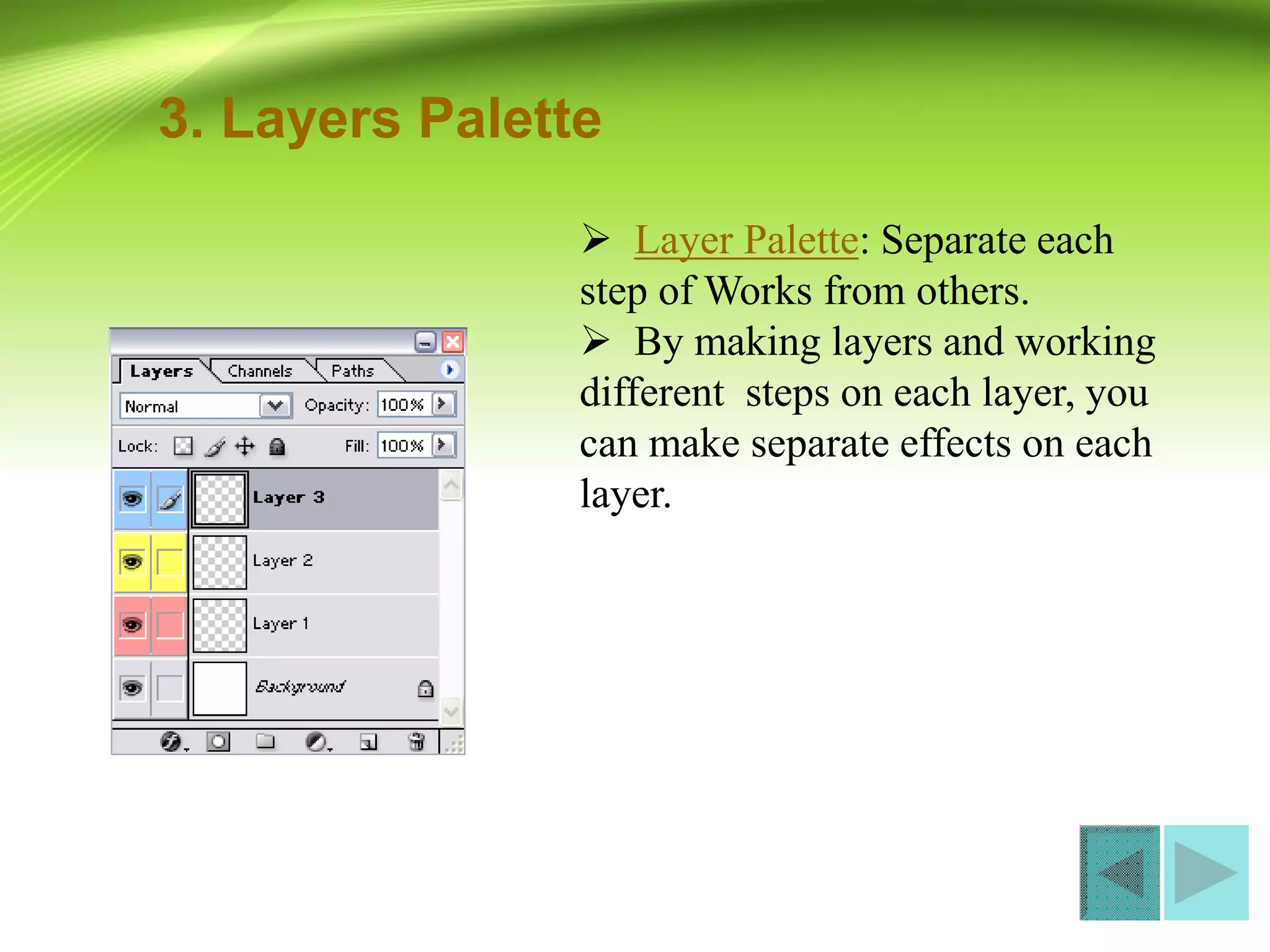
3. Layers Palette
 Layer Palette: Separate each
step of Works from others.
 By making layers and working
different steps on each layer, you
can make separate effects on each
layer.
Presentation on Adobe Photoshop

Presentation on Adobe Photoshop

  • 1.
  • 3.
    A. Introduction 1. AdobePhotoshop? - The professional image-editing standard 2. Two general usage of Photoshop - Creating images - Editing existing images
  • 4.
    PHOTOSHOP Adobe Photoshop CS3is a frequently used image editing & creating software. It is a powerful image processing application software developed by adobe vendors. This software is used to correct errors and add effect to images. It is also used to create graphics for published in magazines, books, newspaper and websites. This chapter introduces you the basics of Adobe Photoshop CS3. It also discuses the process of starting and existing from Photoshop software.
  • 5.
    How to getstarted? Click “Start” >  Find & click “Photoshop 7.0”
  • 6.
    Menu 1. File < > 2.Edit 3. Image 4. Layer 5. Filter 6. View 7.Windows
  • 7.
    1. File  Save,Save as, Save for web - Save - Save as: Save as a new filename - Save for web: Save a image as a form of “*.jpg” or “*.gif” which is used for web image  Import, Export - Import: Bring another image into the canvas you are working - Export: Sending the image you are working to other applications  Print
  • 8.
    LIST OF FILEFORMATS File name extensions Description .PSD Adobe photoshop uses photoshop document or PSD file format by defalt. .JPEG The joint photograph experts group(.jpeg; .jpg; .jpe) file name extension is used for digital phography. .GIF The graphics interchange format or GIF includes(.gif) file name extension is popularly used for creating webpage, elements,logs,etc. .PNG The portable Network Graphics or PNG (.png) format was designed as an alternative to GIF and JPEG formats. .TIF The tagged image file format or TIFF (.tif; .tiff)saves and preserves all of the original image data. .PDF The portable document format (PDf) file format is used to encapsulate the text, fonts,graphic and other information needed to display it.
  • 9.
    2. Edit a. Undo,Step Forward/Backward - Undo: Cancel the last work - Step Forward: Move to the next stage which you did - Step Backward: Move to the previous stage which you did b. Cut, Copy, Paste - Cut: Get rid of a part which you select - Copy: Copy a part you select - Paste: Attach the part you copied
  • 10.
    3. Image a. Mode:Select a type of color b. Image size, Canvas size - Image size: Change the size of the image - Canvas size: change the size of the canvas where you are working (Bottom of your image) c. Rotate canvas: Changing the direction of your canvas
  • 11.
    4. Layer a. New,Delete - New: Create a new layer - Delete: get rid of a layer you selected b. Arrange - change the order of layers c. Merge - Make layers into one layer
  • 12.
    5. Filter -Various Kindsof technical effects
  • 13.
    6. View a. Zoomin/out - Zoom in - Zoom out b. Print size - Help you to print only what you need c. Extras - Showing horizontal and vertical lines by dividing into separate sectors
  • 14.
    7. Windows - Thesame function with “view” in other Windows applications such as MS-Office You can select what you want to make visible on your page and what you don’t want to make visible on your page
  • 15.
    D. Toolbar 1. Marquee,Lasso, Magic Wand, Crop 2. Move 3. Brush, gradient, paint bucket 4. Erase 5. Clone Stamp, Pattern Stamp 6. Smudge, Dodge, Sponge 7. Text 8. Set Foreground/Background color
  • 16.
     Move :Move the image on a selected layer to other part of canvas you are working Brush: basic tools for drawing a line Gradient: this help you to paint stage by stage with more than 2 colors  Paint Bucket: fill out a cropped part with just one click of this tool
  • 17.
     Marquee: Selecta part of an image you are working with arranged form such as rectangular and elliptical.  Lasso: Draw selection paths freehand with a mouse - If you click and hold, you can change the tool so that you can draw polygons  Magic wand: select all the same-color or similarly colored adjacent pixels  Crop: Crop the image - The selected area will be surrounded with a blinking dotted line
  • 18.
     Erase :Erasewhat you cropped or where you click with your mouse after selecting this tool  Clone Stamp: copy a selected part and restore it where you want  Pattern Stamp: this is nearly the same tool with clone stamp, but you can arrange the shape you cropped, and you can use it as a fixed shape
  • 19.
     Smudge: effectas such rubbing canvas with fingers  Dodge: Make it bright the part where you scrub with this tool.  Sponge: Saturate or desaturate selected part of an image.  Text : Type in various characters
  • 20.
     Foreground color:the color of image what you draw with a drawing tool such as brush tool Background color: when you use the gradient tool, the color will be different from the foreground color.
  • 21.
    Palette 1. Color/Swatches/Styles Palette 2.History/Actions/Tool Preset Palette 3. Layers Palette 1. Color/Swatches/Styles Palette 2. History/Actions/Tool Preset Palette 3. Layers Palette
  • 22.
    1. Color/Swatch/Styles Palette -Color Palette: Mix the color (basically RGB colors) and select it for the foreground and background colors. c.f) In case of another color type, you can choose it among the list of the pop-up menu -You can choose colors among the samples of colors. -You can choose a special effect of colors on the layer you selected, such as texts, buttons, and images
  • 23.
    History/Action/Tool preset Palette History Palette: Photoshop automatically save the process of your works. (basically 20 steps prior to the current work) c.f) change the number of steps it saves: Edit > Preferences > General (History States)  Actions Palette: Save basic technical effects and adjust it to more than one image  Tool Preset Palette: Select the Brush which you made and saved.
  • 24.
    3. Layers Palette Layer Palette: Separate each step of Works from others.  By making layers and working different steps on each layer, you can make separate effects on each layer.

Editor's Notes

  • #4 -create images for print, the Web, wireless devices, and other media