NAME: NAILA MEHDI
REGISTRATION NO: 2018-UOBS-
055
SEMESTER: ZOOLOGY 5TH
QUESTIONS…..
• What are intracellular and extracellular electrolytes give
examples?
• Write a note on Henderson Hasselbalch equation.
• What is buffer solution and buffer capacity and write a short
note on buffer of body fluids e.g. hemoglobin as an acid-base
system, renal control of acid-base.
ELECTROLYTES….
•Electrolytes are substances that
dissociate in solution and have
the ability to conduct an
electrical current.
EXTRACELLULAR ELECTROLYTES….
• The fluid which presents in the space outside the cells
and is called extracellular fluid.
• The extracellular fluid is in constant motion throughout
the body.
• In the extracellular fluid are the ions and nutrients
needed by the cells for the maintenance of cellular life.
• The body fluids are solutions of inorganic and organic
solutes
EXAMPLES OF EXTRACELLULAR
ELECTROLYTES…
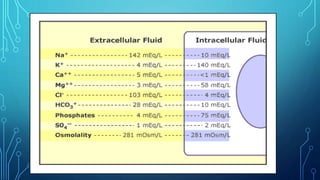
• The extracellular fluid contains large
amounts of sodium, chloride and
bicarbonate ions, plus nutrients for
the cell such as oxygen, glucose, fatty
acids and amino acids.
INTRACELLULAR ELECTROLYTES….
•fluid is inside the cells is called
intracellular fluid
•Intracellular fluid contains water and
dissolved solutes and proteins. The
solutes are electrolytes, which help keep
our body functioning properly.
EXAMPLES OF INTRACELLULAR
ELECTROLYTES….
•The intracellular fluid contains
large amounts of potassium,
magnesium and phosphate ions.
HENDERSON HASSELBALCH EQUATION
•History…...
• In 1908, Lawrence Joseph Henderson derived an equation to
calculate the pH of a buffer solution. In 1917, Karl Albert
Hasselbalch re-expressed that formula
in logarithmic terms, resulting in the Henderson–Hasselbalch
equation.
•Theory…...
• A simple buffer solution consists of a solution of an acid and a salt
of the conjugate base of the acid. For example, the acid may
be acetic acid and the salt may be sodium acetate. The Henderson–
Hasselbalch equation relates the pH of a solution containing a
mixture of the two components to the acid dissociation constant,
Ka, and the concentrations of the species in solution. . The mixture
has the ability to resist changes in pH when a small amount of acid
or base is added, which is the defining property of a buffer solution
• Application…...
• The Henderson–Hasselbalch equation can be used to calculate the
pH of a solution containing the acid and one of its salts, that is, of
a buffer solution. With bases, if the value of an equilibrium constant
is known in the form of a base association constant, Kb the
dissociation constant of the conjugate acid may be calculated from
• pKa + pKb = pKw
• where Kw is the self-dissociation constant of water. pKw has a value
of approximately 14 at 25°C.
BUFFER SOLUTION
•A buffer solution is one which resists changes
in pH when small quantities of an acid or an
alkali are added to it.
• Acidic buffer solutions. An acidic buffer
solution is simply one which has a pH less than
7.
BUFFER CAPACITY….
•Buffer capacity (β) is defined as the amount of a
strong acid or a strong base that has to be
added to 1 litre of a buffer to cause pH change
of 1.0 pH unit: The buffer capacity depends on
the amounts of substance of the weak acid and
its conjugated base in the buffer’
BUFFER OF BODY FLUIDS...
• Maintaining a constant blood pH is critical to a person’s
well-being.
• The buffer that maintains the pH of human blood
involves carbonic acid (H2CO3), bicarbonate ion (HCO3
–),
and carbon dioxide (CO2).
• When bicarbonate ions combine with free hydrogen ions
and become carbonic acid, hydrogen ions are removed,
moderating pH changes.
CONTINUE….
• Similarly, excess carbonic acid can be converted into
carbon dioxide gas and exhaled through the lungs; this
prevents too many free hydrogen ions from building up
in the blood and dangerously reducing its pH; likewise,
if too much OH– is introduced into the system, carbonic
acid will combine with it to create bicarbonate, lowering
the pH. Without this buffer system, the body’s pH would
fluctuate enough to jeopardize survival.
•Thank
you…..

Intracellular and extracellular electrolytes, buffer solution and buffer capacity buffer

  • 1.
    NAME: NAILA MEHDI REGISTRATIONNO: 2018-UOBS- 055 SEMESTER: ZOOLOGY 5TH
  • 2.
    QUESTIONS….. • What areintracellular and extracellular electrolytes give examples? • Write a note on Henderson Hasselbalch equation. • What is buffer solution and buffer capacity and write a short note on buffer of body fluids e.g. hemoglobin as an acid-base system, renal control of acid-base.
  • 3.
    ELECTROLYTES…. •Electrolytes are substancesthat dissociate in solution and have the ability to conduct an electrical current.
  • 4.
    EXTRACELLULAR ELECTROLYTES…. • Thefluid which presents in the space outside the cells and is called extracellular fluid. • The extracellular fluid is in constant motion throughout the body. • In the extracellular fluid are the ions and nutrients needed by the cells for the maintenance of cellular life. • The body fluids are solutions of inorganic and organic solutes
  • 5.
    EXAMPLES OF EXTRACELLULAR ELECTROLYTES… •The extracellular fluid contains large amounts of sodium, chloride and bicarbonate ions, plus nutrients for the cell such as oxygen, glucose, fatty acids and amino acids.
  • 6.
    INTRACELLULAR ELECTROLYTES…. •fluid isinside the cells is called intracellular fluid •Intracellular fluid contains water and dissolved solutes and proteins. The solutes are electrolytes, which help keep our body functioning properly.
  • 7.
    EXAMPLES OF INTRACELLULAR ELECTROLYTES…. •Theintracellular fluid contains large amounts of potassium, magnesium and phosphate ions.
  • 9.
    HENDERSON HASSELBALCH EQUATION •History…... •In 1908, Lawrence Joseph Henderson derived an equation to calculate the pH of a buffer solution. In 1917, Karl Albert Hasselbalch re-expressed that formula in logarithmic terms, resulting in the Henderson–Hasselbalch equation.
  • 10.
    •Theory…... • A simplebuffer solution consists of a solution of an acid and a salt of the conjugate base of the acid. For example, the acid may be acetic acid and the salt may be sodium acetate. The Henderson– Hasselbalch equation relates the pH of a solution containing a mixture of the two components to the acid dissociation constant, Ka, and the concentrations of the species in solution. . The mixture has the ability to resist changes in pH when a small amount of acid or base is added, which is the defining property of a buffer solution
  • 11.
    • Application…... • TheHenderson–Hasselbalch equation can be used to calculate the pH of a solution containing the acid and one of its salts, that is, of a buffer solution. With bases, if the value of an equilibrium constant is known in the form of a base association constant, Kb the dissociation constant of the conjugate acid may be calculated from • pKa + pKb = pKw • where Kw is the self-dissociation constant of water. pKw has a value of approximately 14 at 25°C.
  • 12.
    BUFFER SOLUTION •A buffersolution is one which resists changes in pH when small quantities of an acid or an alkali are added to it. • Acidic buffer solutions. An acidic buffer solution is simply one which has a pH less than 7.
  • 13.
    BUFFER CAPACITY…. •Buffer capacity(β) is defined as the amount of a strong acid or a strong base that has to be added to 1 litre of a buffer to cause pH change of 1.0 pH unit: The buffer capacity depends on the amounts of substance of the weak acid and its conjugated base in the buffer’
  • 14.
    BUFFER OF BODYFLUIDS... • Maintaining a constant blood pH is critical to a person’s well-being. • The buffer that maintains the pH of human blood involves carbonic acid (H2CO3), bicarbonate ion (HCO3 –), and carbon dioxide (CO2). • When bicarbonate ions combine with free hydrogen ions and become carbonic acid, hydrogen ions are removed, moderating pH changes.
  • 15.
    CONTINUE…. • Similarly, excesscarbonic acid can be converted into carbon dioxide gas and exhaled through the lungs; this prevents too many free hydrogen ions from building up in the blood and dangerously reducing its pH; likewise, if too much OH– is introduced into the system, carbonic acid will combine with it to create bicarbonate, lowering the pH. Without this buffer system, the body’s pH would fluctuate enough to jeopardize survival.
  • 16.