27-1
By
KAUSHAL KUMAR SAHU
Assistant Professor (Ad Hoc)
Department of Biotechnology
Govt. Digvijay Autonomous P. G. College
Raj-Nandgaon ( C. G. )
“Buffer”,
27-2
Contents:
 Introduction& Principle of Buffering
 Buffer capacity
 Types of Buffer
 Henderson-Hesselbalch equation
 Mechanism of Buffer action
 Buffer system in body
 Disturbance of Buffer balancing
 Buffer Titration & curve
 Application of Buffer
 Conclusion
 References
 Resent reaserches
27-3
Introduction
Buffer solution:
"A buffer solution is an aqueous
solution consisting of a mixture of
a weak acid and its conjugate
base or a weak base and its conjugate
acid. "
27-4
Principles of Buffering:
Isohydric Principle;
All buffer systemswhich participate in defence of
acid - base changes are in equilibrium with each
other. There is after all only one value for [H+] at
any moment. This is known as the Isohydric
Principle.
Buffer solutions achieve their resistance to pH
change because of the presence of an equilibrium
between the acid HA and its conjugate base A-.
27-5
Buffer capacity:
The effectiveness of any buffer is described
in terms of its buffer capacity.
It is defined as,
'the number of equivalents of a strong acid
(or a strong base) required to change the
pH of one litre of a buffer solution by one
unit, keeping the total amount of the acid
and the salt in the buffer constant'
27-6
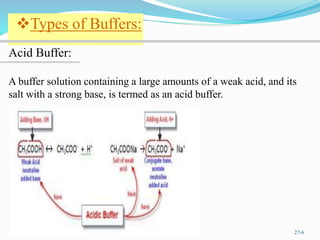
Types of Buffers:
Acid Buffer:
A buffer solution containing a large amounts of a weak acid, and its
salt with a strong base, is termed as an acid buffer.
27-7
Basic Buffer
A buffer solution containing relatively large
amounts of a a weak base
&its salt with a strong acid, is termed as a
basicbuffer.
27-8
Henderson-Hasselbalch Equation:
The dissociation of an acid can be described by an equilibrium
expression:
Consider the case of acetic acid (CH3COOH) and acetate
anion (CH3COO2):
27-9
By definition, pKA = -logKA and pH = -log[H+], so
This equation can then be rearranged to give the Henderson-
Hasselbalch equation
27-10
Mechanism of Buffer Action:
Action of an acid buffer :
An acid buffer contains relatively large amounts of a weak acid
(HA) and its salt with a strong base . The buffer solution thus
contains large concentration of HA and A- (due to the dissociation
of the salt), apart from H3O+ and OH-.
27-11
Action of basic buffer :
A basic buffer contains a weak base (BOH), and its salt with strong
acid (BX). The buffer solution thus contains large amounts of the
weak base BOH, and the cation B+ (coming from the dissociation
of the salt BX), in addition to H3O+ and OH-.
27-12
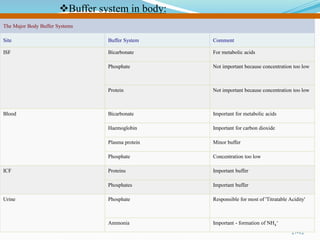
Buffer system in body:
The Major Body Buffer Systems
Site Buffer System Comment
ISF Bicarbonate For metabolic acids
Phosphate Not important because concentration too low
Protein Not important because concentration too low
Blood Bicarbonate Important for metabolic acids
Haemoglobin Important for carbon dioxide
Plasma protein Minor buffer
Phosphate Concentration too low
ICF Proteins Important buffer
Phosphates Important buffer
Urine Phosphate Responsible for most of 'Titratable Acidity'
Ammonia Important - formation of NH4
+
27-13
27-14
1.Protein buffer system:
If pH climbs, the carboxyl group of amino acid acts as a weak acid
If the pH drops, the amino group acts as a weak baseHemoglobin
buffer system Prevents pH changes when PCo2 is rising or falling.
27-15
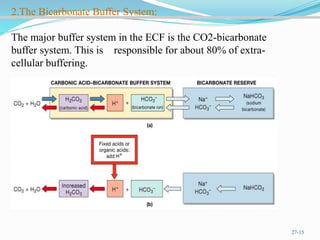
2.The Bicarbonate Buffer System:
The major buffer system in the ECF is the CO2-bicarbonate
buffer system. This is responsible for about 80% of extra-
cellular buffering.
27-16
3.Hb Buffer system:
Haemoglobin (Hb) is not only important in the carriage of oxygen to the tissues
but also in the transport of CO2 and in buffering hydrogen ions.
27-17
Maintenance of Buffer balance
27-18
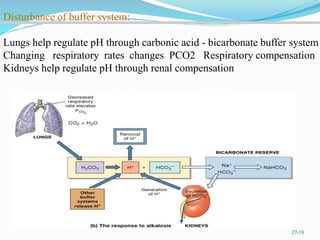
Disturbance of buffer system:
Lungs help regulate pH through carbonic acid - bicarbonate buffer system
Changing respiratory rates changes PCO2 Respiratory compensation
Kidneys help regulate pH through renal compensation
27-19
27-20
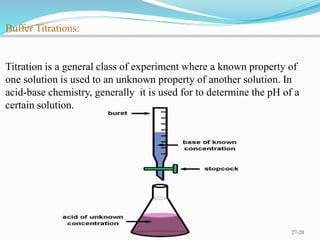
Buffer Titrations:
Titration is a general class of experiment where a known property of
one solution is used to an unknown property of another solution. In
acid-base chemistry, generally it is used for to determine the pH of a
certain solution.
27-21
Figure %: Titration curve of a strong base titrating a strong acid
27-22
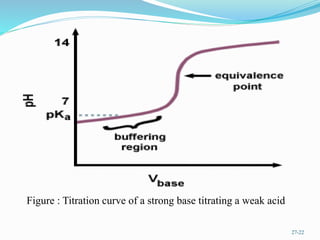
Figure : Titration curve of a strong base titrating a weak acid
27-23
Figure %: Titration curve of a strong base titrating a polyprotic acid
27-24
27-25
pH
mL of Base added
7
 Strong acid with strong Base
 Equivalence at pH 7
pH
mL of Base added
>7
 Weak acid with strong Base
 Equivalence at pH >7
 When the acid is neutralized it makes a
weak base
7
pH
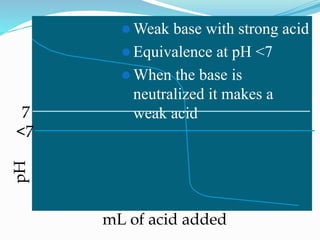
mL of acid added
7
 Strong base with strong acid
 Equivalence at pH 7
pH
mL of acid added
<7
 Weak base with strong acid
 Equivalence at pH <7
 When the base is
neutralized it makes a
weak acid7
27-30
Applications of Buffer-
•Buffer solutions are necessary to keep the correct pH
for enzymes in many organisms to work.
•Many enzymes work only under very precise conditions; if the
pH moves outside of a narrow range, the enzymes slow or stop
working and can denature, thus permanently disabling their
catalytic activity.
•A buffer of carbonic acid and bicarbonate is present in blood
plasma, to maintain a pH between 7.35 and 7.45.
27-31
Conclusion
27-32
References:
Jeremy m. berg,john ltymoczco,Lubert stryer Biochemistry
5Th Edition
Lehingers Principle of biochemistry 4th edition
& web sources

buffer by K.K. Sahu Sir

  • 1.
    27-1 By KAUSHAL KUMAR SAHU AssistantProfessor (Ad Hoc) Department of Biotechnology Govt. Digvijay Autonomous P. G. College Raj-Nandgaon ( C. G. ) “Buffer”,
  • 2.
    27-2 Contents:  Introduction& Principleof Buffering  Buffer capacity  Types of Buffer  Henderson-Hesselbalch equation  Mechanism of Buffer action  Buffer system in body  Disturbance of Buffer balancing  Buffer Titration & curve  Application of Buffer  Conclusion  References  Resent reaserches
  • 3.
    27-3 Introduction Buffer solution: "A buffersolution is an aqueous solution consisting of a mixture of a weak acid and its conjugate base or a weak base and its conjugate acid. "
  • 4.
    27-4 Principles of Buffering: IsohydricPrinciple; All buffer systemswhich participate in defence of acid - base changes are in equilibrium with each other. There is after all only one value for [H+] at any moment. This is known as the Isohydric Principle. Buffer solutions achieve their resistance to pH change because of the presence of an equilibrium between the acid HA and its conjugate base A-.
  • 5.
    27-5 Buffer capacity: The effectivenessof any buffer is described in terms of its buffer capacity. It is defined as, 'the number of equivalents of a strong acid (or a strong base) required to change the pH of one litre of a buffer solution by one unit, keeping the total amount of the acid and the salt in the buffer constant'
  • 6.
    27-6 Types of Buffers: AcidBuffer: A buffer solution containing a large amounts of a weak acid, and its salt with a strong base, is termed as an acid buffer.
  • 7.
    27-7 Basic Buffer A buffersolution containing relatively large amounts of a a weak base &its salt with a strong acid, is termed as a basicbuffer.
  • 8.
    27-8 Henderson-Hasselbalch Equation: The dissociationof an acid can be described by an equilibrium expression: Consider the case of acetic acid (CH3COOH) and acetate anion (CH3COO2):
  • 9.
    27-9 By definition, pKA= -logKA and pH = -log[H+], so This equation can then be rearranged to give the Henderson- Hasselbalch equation
  • 10.
    27-10 Mechanism of BufferAction: Action of an acid buffer : An acid buffer contains relatively large amounts of a weak acid (HA) and its salt with a strong base . The buffer solution thus contains large concentration of HA and A- (due to the dissociation of the salt), apart from H3O+ and OH-.
  • 11.
    27-11 Action of basicbuffer : A basic buffer contains a weak base (BOH), and its salt with strong acid (BX). The buffer solution thus contains large amounts of the weak base BOH, and the cation B+ (coming from the dissociation of the salt BX), in addition to H3O+ and OH-.
  • 12.
    27-12 Buffer system inbody: The Major Body Buffer Systems Site Buffer System Comment ISF Bicarbonate For metabolic acids Phosphate Not important because concentration too low Protein Not important because concentration too low Blood Bicarbonate Important for metabolic acids Haemoglobin Important for carbon dioxide Plasma protein Minor buffer Phosphate Concentration too low ICF Proteins Important buffer Phosphates Important buffer Urine Phosphate Responsible for most of 'Titratable Acidity' Ammonia Important - formation of NH4 +
  • 13.
  • 14.
    27-14 1.Protein buffer system: IfpH climbs, the carboxyl group of amino acid acts as a weak acid If the pH drops, the amino group acts as a weak baseHemoglobin buffer system Prevents pH changes when PCo2 is rising or falling.
  • 15.
    27-15 2.The Bicarbonate BufferSystem: The major buffer system in the ECF is the CO2-bicarbonate buffer system. This is responsible for about 80% of extra- cellular buffering.
  • 16.
    27-16 3.Hb Buffer system: Haemoglobin(Hb) is not only important in the carriage of oxygen to the tissues but also in the transport of CO2 and in buffering hydrogen ions.
  • 17.
  • 18.
    27-18 Disturbance of buffersystem: Lungs help regulate pH through carbonic acid - bicarbonate buffer system Changing respiratory rates changes PCO2 Respiratory compensation Kidneys help regulate pH through renal compensation
  • 19.
  • 20.
    27-20 Buffer Titrations: Titration isa general class of experiment where a known property of one solution is used to an unknown property of another solution. In acid-base chemistry, generally it is used for to determine the pH of a certain solution.
  • 21.
    27-21 Figure %: Titrationcurve of a strong base titrating a strong acid
  • 22.
    27-22 Figure : Titrationcurve of a strong base titrating a weak acid
  • 23.
    27-23 Figure %: Titrationcurve of a strong base titrating a polyprotic acid
  • 24.
  • 25.
  • 26.
    pH mL of Baseadded 7  Strong acid with strong Base  Equivalence at pH 7
  • 27.
    pH mL of Baseadded >7  Weak acid with strong Base  Equivalence at pH >7  When the acid is neutralized it makes a weak base 7
  • 28.
    pH mL of acidadded 7  Strong base with strong acid  Equivalence at pH 7
  • 29.
    pH mL of acidadded <7  Weak base with strong acid  Equivalence at pH <7  When the base is neutralized it makes a weak acid7
  • 30.
    27-30 Applications of Buffer- •Buffersolutions are necessary to keep the correct pH for enzymes in many organisms to work. •Many enzymes work only under very precise conditions; if the pH moves outside of a narrow range, the enzymes slow or stop working and can denature, thus permanently disabling their catalytic activity. •A buffer of carbonic acid and bicarbonate is present in blood plasma, to maintain a pH between 7.35 and 7.45.
  • 31.
  • 32.
    27-32 References: Jeremy m. berg,johnltymoczco,Lubert stryer Biochemistry 5Th Edition Lehingers Principle of biochemistry 4th edition & web sources