Intestinal Obstruction
Dr.Usman Haqqani
TMO
Surgical B
Hayatabad Medical complex peshawar
Classification
• According to obstructing site
• Small bowel obstruction
• Large bowel obstruction
• According to presentation
• Acute obstruction
• Chronic obstruction
• Acute on chronic obstruction
• Subacute obstruction
• According to blood flow
• Simple obstuction
• Strangulated obstuction
• Primary
• External
• Closed loop obstruction
AETIOLOGY
CAUSES OF INTESTINAL
OBSTRUCTION
Dynamic causes
 Intraluminal
impaction
foreignbodies
bezoars
gallstones
 Intramural
stricture
malignancy
 Extramural
bands/adhesions
hernia
Volvulus
Intussusception
Adynamic causes
Paralytic ileus
Mesenteric vascular
occlusion
Pseudo -obstruct
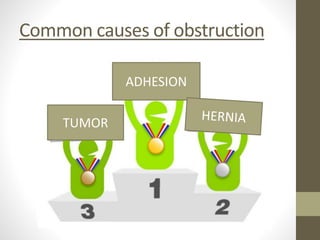
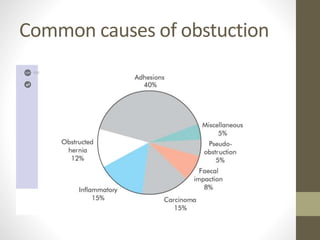
Common causes of obstruction
ADHESION
TUMOR
Common causes of obstuction
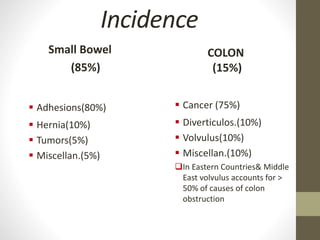
Incidence
Small Bowel
(85%)
 Cancer (75%)
 Diverticulos.(10%)
 Volvulus(10%)
 Miscellan.(10%)
In Eastern Countries& Middle
East volvulus accounts for >
50% of causes of colon
obstruction
COLON
(15%)
 Adhesions(80%)
 Hernia(10%)
 Tumors(5%)
 Miscellan.(5%)
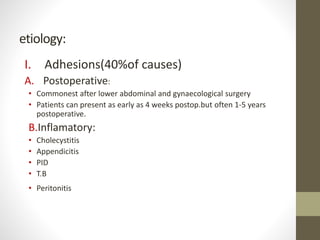
etiology:
I. Adhesions(40%of causes)
A. Postoperative:
• Commonest after lower abdominal and gynaecological surgery
• Patients can present as early as 4 weeks postop.but often 1-5 years
postoperative.
B.Inflamatory:
• Cholecystitis
• Appendicitis
• PID
• T.B
• Peritonitis
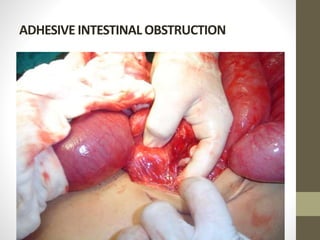
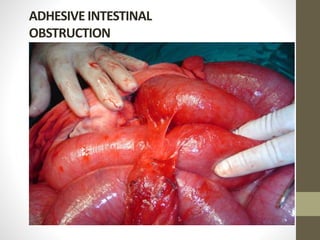
ADHESIVE INTESTINAL OBSTRUCTION
ADHESIVE INTESTINAL
OBSTRUCTION
Etiology(small bowel)
II. Hernia(12% of causes)
A. External:
 Inguinal ; Femoral; Umbilical
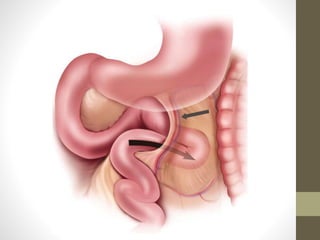
B. Internal:
Sites
Foramen of Winslow
Defect in the mesentery or transverse mesocolon
Defect in the broad ligament
Diaphragmatic hernia
Duodenal/caecal/appendiceal retroperitoneal fossae
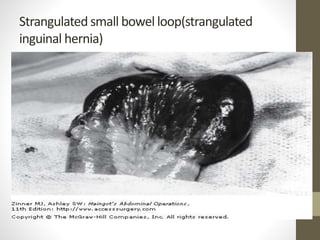
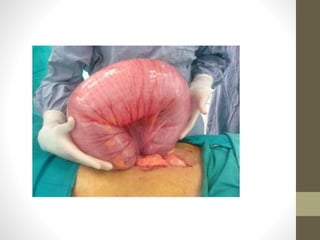
Strangulated small bowel loop(strangulated
inguinal hernia)
 Neoplasms(15% of causes)
Colorectal carcinoma:
• 75% occure in Rectosigmoid colon
• 15-20% of colorectal cancer present with obstruction
• LT.colon commonest site of obstruction due to constricting
lesion&solid faeces
 strictures
A.Congenital:
Intestinal Atresia
B.Inflammatory:
Crohns Disease
Tuberculosis
C. Neoplastic:
Lymphoma
Carcinoid
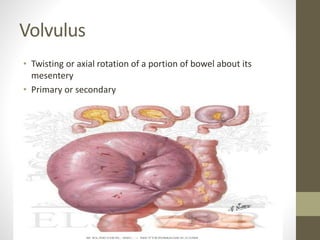
Volvulus
• Twisting or axial rotation of a portion of bowel about its
mesentery
• Primary or secondary
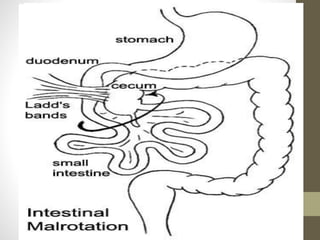
Malrotation & neonatal volvulus
• Treatment:
• The volvulus is reduced, the
transduodenal band(Ladd’s band)
divided, the duodenum mobilised & the
mesentry freed.
• Appendicectomy is routinely performed
to avoid diagnostic difficulty with
appendicitis in the future.
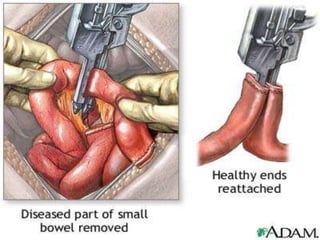
• Infarcted bowel necessitates resection.
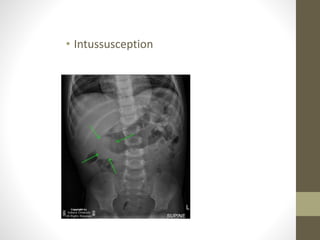
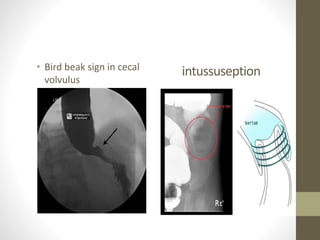
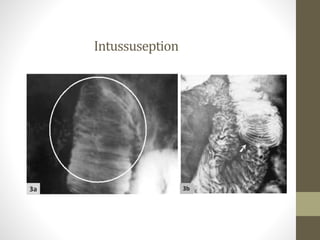
 Intussusception:
• Invagination of segment of bowel(intussusceptum) into
another(intussuscepien).
• it is often antegrade
• Most common:
ileocolic(ileocaecal)
Ileo-ileal
A. Primary: infants & young children
Due to lymphoid hypertrophy of terminal ileum
B. Secondary: adult
Due pathological lead point :
Meckles diverticulum ;polyp ;submucous lipoma ; haemangiomas
;Lymphoproliferative disease
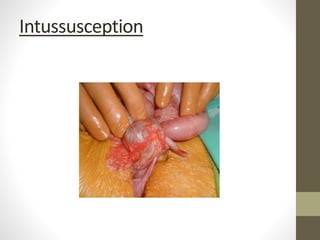
Intussusception
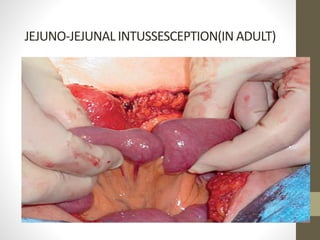
JEJUNO-JEJUNAL INTUSSESCEPTION(IN ADULT)
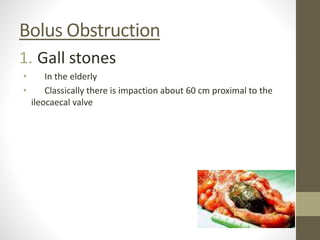
Bolus Obstruction
1. Gall stones
• In the elderly
• Classically there is impaction about 60 cm proximal to the
ileocaecal valve
2. Food
Occur after partial or total gastrectomy when unchewed
articles can pass into the small bowel
3. Stercolith
• In association with jejunal diverticulum or ileal stricture
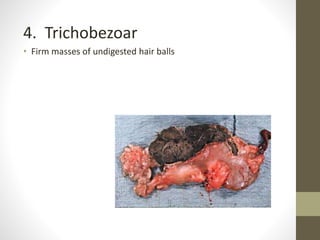
4. Trichobezoar
• Firm masses of undigested hair balls
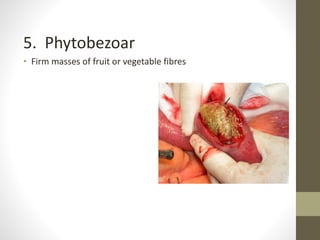
5. Phytobezoar
• Firm masses of fruit or vegetable fibres
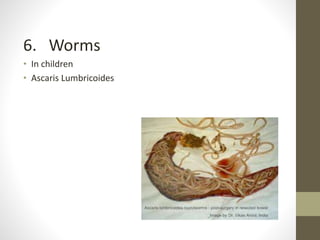
6. Worms
• In children
• Ascaris Lumbricoides
Adynamic obstruction
I. Paralytic Ileus:
 There is Reflex Inhibition of Peristaltaic Activity of Small intestine due
to increase sympathetic Drive. smooth muscle become unresponsive to
neural and hormonal stimuli
 Causes:
1) Postlaparotomy: after Abd.Pelvic surgery
I. Paralytic ileus( CAUSES)
2) Intra-abdominal Sepsis
3) Abdomino-pelvic Trauma (Retroperitoneal Haematoma)
Other Contributing Factors:
 Electrolytes Imbalance
 Uraemia
 Drugs: Narcotics ; Antichlonergices; phenothiazines
II. Acute colonic pseudo-
obstruction
 It is massive colonic dilatation affecting caecum and Rt.colon with
presentation of colonic obstruction without mechanical blockage
 Occurs in
Elderly hospitalised patients with major TRAUMA;ILLENESS; MAJOR
NON-INTESTINAL SURGERY
ETIOLOGICAL FACTORES
 Major non-operative TRAUMA
 SEPSIS
 Myocardial infarction ; Heart Failure
 Major Abdomino-pelvic Surgery
 Orthopedic Surgery
 Gynecological ; Neurosurgical Procedures
 Cerebrovasular accident ; Spinal cord Injury
 Advanced Malignancy
 Respiratory ; Renal Failure
 Drugs: Opiates; phenothiazines ;Chanel blockers
III. Acute mesenteric ischemia
1. Embolic: (50%)
• Affects SMA
• Occur secondary to MI; Atrial Fibrilation
2. Trombotic(20%)
due to acute thrombosis on top of pre-existing atherosclerosis of
visceral artery
3. SHOCK:
• hypovolemic & septic
HISTORY
• Acute obstruction
• Sudden onset of central abdominal colicky pain
• Vomiting (party digested food>>mucoid>>greenish>>feculant)
• Abdominal distention
• Absolute constipation
• Chronic obstruction
• Constipation
• Abdominal distention
• Abdominal pain( bouts of colic pain in hyopogastrium)
• VOMITING DELAYED FOR 2-3 DAYS
PHYSICAL EXAMINATION
INSPECTION
Abdominal distention, scars, visible peristalsis.
PALPATION
Mass, tenderness, guarding
PERCUSSION
Tymphanic, dullness
AUSCULTATION
Bowel sound are high pitch and increase in
Frequency
DIGITAL RECTAL EXAMINATION
INVESTIGATIONS:
• Lab:
• FBC (leukocytosis, anaemia, hematocrit, platelets)
• Clotting profile
• Arterial blood gasses
• U& Crt, Na, K, Amylase, LFT and glucose, LDH
• Group and save (x-match if needed)
• Optional (ESR, CRP, Hepatitis profile)
• RadiOlogical:
• Plain ABDOMINAL xrays
• USS ( free fluid, masses, mucosal folds, pattern of
paristalsis, Doppler of mesenteric vasulature, solid organs)
• Other advanced studies (CT, Contrast studieS)
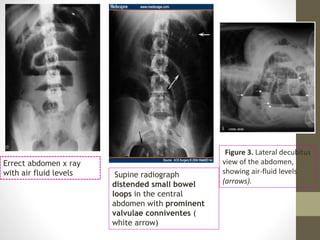
Errect abdomen x ray
with air fluid levels Supine radiograph
distended small bowel
loops in the central
abdomen with prominent
valvulae conniventes (
white arrow)
Figure 3. Lateral decubitus
view of the abdomen,
showing air-fluid levels
(arrows).
The Difference between small and large bowel
obstruction
Small BowelLarge bowel
•Central ( diameter 3 cm
max)
•Vulvulae coniventae
•Peripheral ( diameter 6
cm max)
•Presence of haustration
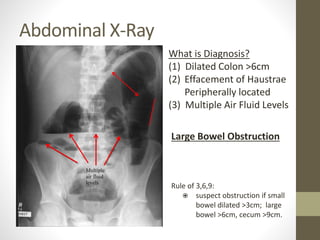
Abdominal X-Ray
What is Diagnosis?
(1) Dilated Colon >6cm
(2) Effacement of Haustrae
Peripherally located
(3) Multiple Air Fluid Levels
Large Bowel Obstruction
Rule of 3,6,9:
 suspect obstruction if small
bowel dilated >3cm; large
bowel >6cm, cecum >9cm.
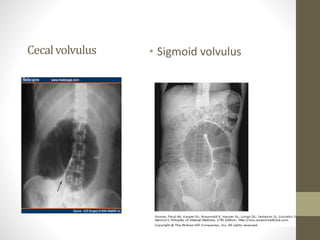
Cecalvolvulus • Sigmoid volvulus
• Intussusception
Role of CT
• Used with iv contrast, oral and rectal contrast
(triple contrast).
• Able to demonstrate abnormality in the bowel
wall, mesentery, mesenteric vessels and
peritoneum.
• It can define:
• the level of obstruction
• The degree of obstruction
• The cause: volvulus, hernia, luminal and
mural causes
• The degree of ischaemia
• Free fluid and gas
• Ensure: patient vitally stable with no renal failure
and no previous alergy to iodine
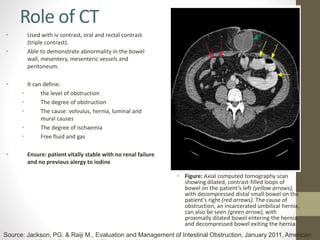
• Figure: Axial computed tomography scan
showing dilated, contrast-filled loops of
bowel on the patient’s left (yellow arrows),
with decompressed distal small bowel on the
patient’s right (red arrows). The cause of
obstruction, an incarcerated umbilical hernia,
can also be seen (green arrow), with
proximally dilated bowel entering the hernia
and decompressed bowel exiting the hernia.
Source: Jackson, PG. & Raiji M., Evaluation and Management of Intestinal Obstruction, January 2011, American
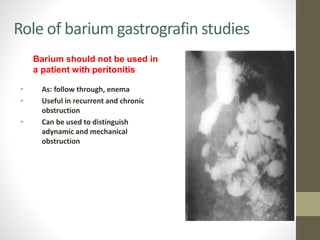
Role of barium gastrografin studies
• As: follow through, enema
• Useful in recurrent and chronic
obstruction
• Can be used to distinguish
adynamic and mechanical
obstruction
Barium should not be used in
a patient with peritonitis
intussuseption• Bird beak sign in cecal
volvulus
Intussuseption
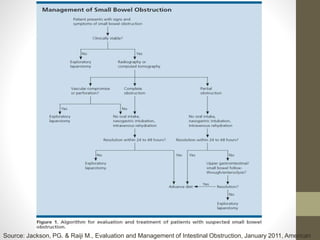
Source: Jackson, PG. & Raiji M., Evaluation and Management of Intestinal Obstruction, January 2011, American
TREATMENT
• URGENT RESUSCITATION
• NBM
• NG tube(bowel decompression)
• Cathetrization
• IV fluids (correct fluid and electrolyte disturbances)
• Start IV antibiotics (if indicated)
• Optimise Cardio respiratory status
• Consenting
• Bowel preparation
• Workup for surgery
• Close clinical and Radiological monitoring
II. SURGICAL INTERVENTION
1. URGENT:
• Strangulation / Suspected Strangulation
• Closed-Loop Obstruction
• Complete Obstruction
• Pnumoperitonium/ Peritonitis
2. Elective Cases
• Adhesive Small intestine Obstruction NO Strangangulation
( Observe&Mointoring For 48-Hours )
• Incomplete Small intestine or Colonic Obstruction:
Investigate With Contrast Studies
3. NOT TO OPERATE
• PARALYTIC ILEUS
• ACUTE COLONIC PSEUDO-OBSTRUCTION
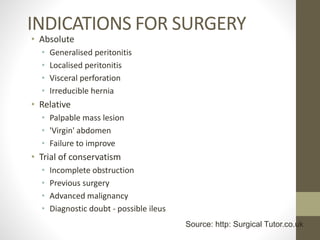
INDICATIONS FOR SURGERY
• Absolute
• Generalised peritonitis
• Localised peritonitis
• Visceral perforation
• Irreducible hernia
• Relative
• Palpable mass lesion
• 'Virgin' abdomen
• Failure to improve
• Trial of conservatism
• Incomplete obstruction
• Previous surgery
• Advanced malignancy
• Diagnostic doubt - possible ileus
Source: http: Surgical Tutor.co.uk
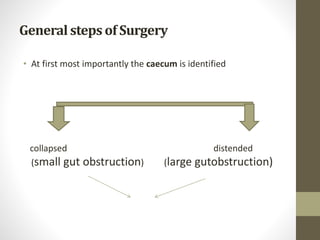
Generalsteps of Surgery
• At first most importantly the caecum is identified
collapsed distended
(small gut obstruction) (large gutobstruction)
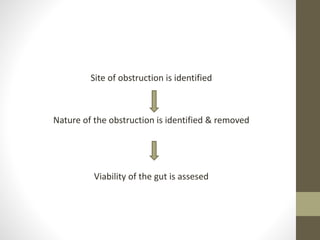
Site of obstruction is identified
Nature of the obstruction is identified & removed
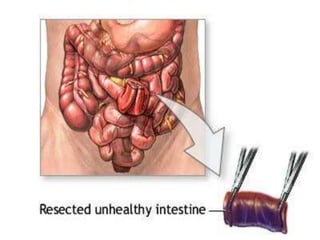
Viability of the gut is assesed
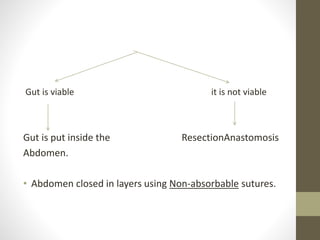
Gut is viable it is not viable
Gut is put inside the ResectionAnastomosis
Abdomen.
• Abdomen closed in layers using Non-absorbable sutures.
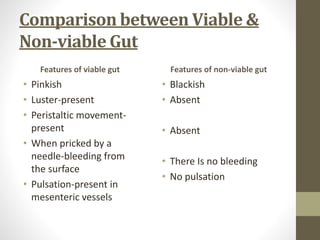
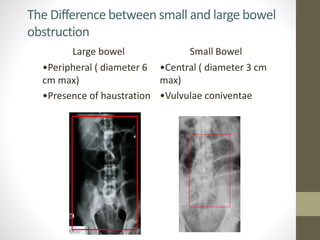
Comparison between Viable &
Non-viable Gut
Features of viable gut
• Pinkish
• Luster-present
• Peristaltic movement-
present
• When pricked by a
needle-bleeding from
the surface
• Pulsation-present in
mesenteric vessels
Features of non-viable gut
• Blackish
• Absent
• Absent
• There Is no bleeding
• No pulsation
If still we are doubtful-
• Warm saline soaked mop over the doubtful area & 100% O2 is
administered
• If colour becomes normal with peristalsis,then it is viable.
Other means of checking
Viability
1. Doppler study
2. Fluorescence study
Management of bowel
obstruction
• Intussusception
• Reduction by hydrostatic pressure
• Operative reduction
• Volvulus neonatorum
• Early laprotomy
• Whole Midgut is delivered
• Untwisting is done in opposite direction
• Transduodenal band of lad is devided
• Cecal volvulus
• Laprotomy
• Balooned cecum defalted by needle
• Untwisting in anticlockwise direction
• Cecostomy is performed
• Sigmoid volvulus
• Deflation sigmoidoscopy
• Operative
• Laprotomy
• Untwisted in clockwise direction
• Rectal tube passed simultaneously to deflate
• Paralytic ileus
• Remove primary cause
• Decompress GI distension
• Fluid and electrolyte balance
• If not relieved  laparotomy exclude hidden cause
• Acute Mesenteric Occlusion
• Anti-coagulant
• Embolectomy
• Revascularization
• Colectomy
• Adhesions
• Conservative treatment should not be prolonged beyond 72
hours.
• divide only the causative adhesion(s) and limit dissection
MANAGEMENT FOR LARGE
BOWEL OBSTRUCTION
 (IF Lesion/Mass is removable)
•Right sided lesions – right hemicolectomy
•Transverse colonic lesion – extended right hemicolectomy
 (if lesion/Mass is irremovable)
•Proximal stoma
•Colostomy
•Ileostomy if ileocecal valve is incompetent
•Ileotransverse enterostomy
•Left sided lesions – various options
Two-staged procedure
•Resection and anastomosis with defunctioning colostomy
•Closure of colostomy
Two-staged procedure
•Hartmann’s procedure
•Closure of colostomy
One-stage procedure
•Resection, on-table lavage and primary anastomosis
Complications associated with
intestinal obstruction repair
• include excessive bleeding
• infection
• formation of abscesses (pockets of pus)
• leakage of stool from an anastomosis
• adhesion formation
• paralytic ileus (temporary paralysis of the intestines)
• reoccurrence of the obstruction.
Intestinal obstruction by Dr.Usman Haqqani

Intestinal obstruction by Dr.Usman Haqqani

  • 1.
    Intestinal Obstruction Dr.Usman Haqqani TMO SurgicalB Hayatabad Medical complex peshawar
  • 2.
    Classification • According toobstructing site • Small bowel obstruction • Large bowel obstruction • According to presentation • Acute obstruction • Chronic obstruction • Acute on chronic obstruction • Subacute obstruction • According to blood flow • Simple obstuction • Strangulated obstuction • Primary • External • Closed loop obstruction
  • 3.
  • 4.
    CAUSES OF INTESTINAL OBSTRUCTION Dynamiccauses  Intraluminal impaction foreignbodies bezoars gallstones  Intramural stricture malignancy  Extramural bands/adhesions hernia Volvulus Intussusception Adynamic causes Paralytic ileus Mesenteric vascular occlusion Pseudo -obstruct
  • 5.
    Common causes ofobstruction ADHESION TUMOR
  • 6.
    Common causes ofobstuction
  • 7.
    Incidence Small Bowel (85%)  Cancer(75%)  Diverticulos.(10%)  Volvulus(10%)  Miscellan.(10%) In Eastern Countries& Middle East volvulus accounts for > 50% of causes of colon obstruction COLON (15%)  Adhesions(80%)  Hernia(10%)  Tumors(5%)  Miscellan.(5%)
  • 8.
    etiology: I. Adhesions(40%of causes) A.Postoperative: • Commonest after lower abdominal and gynaecological surgery • Patients can present as early as 4 weeks postop.but often 1-5 years postoperative. B.Inflamatory: • Cholecystitis • Appendicitis • PID • T.B • Peritonitis
  • 9.
  • 10.
  • 11.
    Etiology(small bowel) II. Hernia(12%of causes) A. External:  Inguinal ; Femoral; Umbilical B. Internal: Sites Foramen of Winslow Defect in the mesentery or transverse mesocolon Defect in the broad ligament Diaphragmatic hernia Duodenal/caecal/appendiceal retroperitoneal fossae
  • 13.
    Strangulated small bowelloop(strangulated inguinal hernia)
  • 14.
     Neoplasms(15% ofcauses) Colorectal carcinoma: • 75% occure in Rectosigmoid colon • 15-20% of colorectal cancer present with obstruction • LT.colon commonest site of obstruction due to constricting lesion&solid faeces
  • 15.
     strictures A.Congenital: Intestinal Atresia B.Inflammatory: CrohnsDisease Tuberculosis C. Neoplastic: Lymphoma Carcinoid
  • 16.
    Volvulus • Twisting oraxial rotation of a portion of bowel about its mesentery • Primary or secondary
  • 17.
    Malrotation & neonatalvolvulus • Treatment: • The volvulus is reduced, the transduodenal band(Ladd’s band) divided, the duodenum mobilised & the mesentry freed. • Appendicectomy is routinely performed to avoid diagnostic difficulty with appendicitis in the future. • Infarcted bowel necessitates resection.
  • 19.
     Intussusception: • Invaginationof segment of bowel(intussusceptum) into another(intussuscepien). • it is often antegrade • Most common: ileocolic(ileocaecal) Ileo-ileal A. Primary: infants & young children Due to lymphoid hypertrophy of terminal ileum B. Secondary: adult Due pathological lead point : Meckles diverticulum ;polyp ;submucous lipoma ; haemangiomas ;Lymphoproliferative disease
  • 20.
  • 21.
  • 22.
    Bolus Obstruction 1. Gallstones • In the elderly • Classically there is impaction about 60 cm proximal to the ileocaecal valve
  • 23.
    2. Food Occur afterpartial or total gastrectomy when unchewed articles can pass into the small bowel 3. Stercolith • In association with jejunal diverticulum or ileal stricture
  • 24.
    4. Trichobezoar • Firmmasses of undigested hair balls
  • 25.
    5. Phytobezoar • Firmmasses of fruit or vegetable fibres
  • 26.
    6. Worms • Inchildren • Ascaris Lumbricoides
  • 27.
    Adynamic obstruction I. ParalyticIleus:  There is Reflex Inhibition of Peristaltaic Activity of Small intestine due to increase sympathetic Drive. smooth muscle become unresponsive to neural and hormonal stimuli  Causes: 1) Postlaparotomy: after Abd.Pelvic surgery
  • 28.
    I. Paralytic ileus(CAUSES) 2) Intra-abdominal Sepsis 3) Abdomino-pelvic Trauma (Retroperitoneal Haematoma) Other Contributing Factors:  Electrolytes Imbalance  Uraemia  Drugs: Narcotics ; Antichlonergices; phenothiazines
  • 29.
    II. Acute colonicpseudo- obstruction  It is massive colonic dilatation affecting caecum and Rt.colon with presentation of colonic obstruction without mechanical blockage  Occurs in Elderly hospitalised patients with major TRAUMA;ILLENESS; MAJOR NON-INTESTINAL SURGERY
  • 30.
    ETIOLOGICAL FACTORES  Majornon-operative TRAUMA  SEPSIS  Myocardial infarction ; Heart Failure  Major Abdomino-pelvic Surgery  Orthopedic Surgery  Gynecological ; Neurosurgical Procedures  Cerebrovasular accident ; Spinal cord Injury  Advanced Malignancy  Respiratory ; Renal Failure  Drugs: Opiates; phenothiazines ;Chanel blockers
  • 31.
    III. Acute mesentericischemia 1. Embolic: (50%) • Affects SMA • Occur secondary to MI; Atrial Fibrilation 2. Trombotic(20%) due to acute thrombosis on top of pre-existing atherosclerosis of visceral artery 3. SHOCK: • hypovolemic & septic
  • 32.
    HISTORY • Acute obstruction •Sudden onset of central abdominal colicky pain • Vomiting (party digested food>>mucoid>>greenish>>feculant) • Abdominal distention • Absolute constipation • Chronic obstruction • Constipation • Abdominal distention • Abdominal pain( bouts of colic pain in hyopogastrium) • VOMITING DELAYED FOR 2-3 DAYS
  • 33.
    PHYSICAL EXAMINATION INSPECTION Abdominal distention,scars, visible peristalsis. PALPATION Mass, tenderness, guarding PERCUSSION Tymphanic, dullness AUSCULTATION Bowel sound are high pitch and increase in Frequency DIGITAL RECTAL EXAMINATION
  • 34.
    INVESTIGATIONS: • Lab: • FBC(leukocytosis, anaemia, hematocrit, platelets) • Clotting profile • Arterial blood gasses • U& Crt, Na, K, Amylase, LFT and glucose, LDH • Group and save (x-match if needed) • Optional (ESR, CRP, Hepatitis profile) • RadiOlogical: • Plain ABDOMINAL xrays • USS ( free fluid, masses, mucosal folds, pattern of paristalsis, Doppler of mesenteric vasulature, solid organs) • Other advanced studies (CT, Contrast studieS)
  • 35.
    Errect abdomen xray with air fluid levels Supine radiograph distended small bowel loops in the central abdomen with prominent valvulae conniventes ( white arrow) Figure 3. Lateral decubitus view of the abdomen, showing air-fluid levels (arrows).
  • 36.
    The Difference betweensmall and large bowel obstruction Small BowelLarge bowel •Central ( diameter 3 cm max) •Vulvulae coniventae •Peripheral ( diameter 6 cm max) •Presence of haustration
  • 37.
    Abdominal X-Ray What isDiagnosis? (1) Dilated Colon >6cm (2) Effacement of Haustrae Peripherally located (3) Multiple Air Fluid Levels Large Bowel Obstruction Rule of 3,6,9:  suspect obstruction if small bowel dilated >3cm; large bowel >6cm, cecum >9cm.
  • 38.
  • 39.
  • 40.
    Role of CT •Used with iv contrast, oral and rectal contrast (triple contrast). • Able to demonstrate abnormality in the bowel wall, mesentery, mesenteric vessels and peritoneum. • It can define: • the level of obstruction • The degree of obstruction • The cause: volvulus, hernia, luminal and mural causes • The degree of ischaemia • Free fluid and gas • Ensure: patient vitally stable with no renal failure and no previous alergy to iodine • Figure: Axial computed tomography scan showing dilated, contrast-filled loops of bowel on the patient’s left (yellow arrows), with decompressed distal small bowel on the patient’s right (red arrows). The cause of obstruction, an incarcerated umbilical hernia, can also be seen (green arrow), with proximally dilated bowel entering the hernia and decompressed bowel exiting the hernia. Source: Jackson, PG. & Raiji M., Evaluation and Management of Intestinal Obstruction, January 2011, American
  • 41.
    Role of bariumgastrografin studies • As: follow through, enema • Useful in recurrent and chronic obstruction • Can be used to distinguish adynamic and mechanical obstruction Barium should not be used in a patient with peritonitis
  • 42.
    intussuseption• Bird beaksign in cecal volvulus
  • 43.
  • 44.
    Source: Jackson, PG.& Raiji M., Evaluation and Management of Intestinal Obstruction, January 2011, American
  • 45.
    TREATMENT • URGENT RESUSCITATION •NBM • NG tube(bowel decompression) • Cathetrization • IV fluids (correct fluid and electrolyte disturbances) • Start IV antibiotics (if indicated) • Optimise Cardio respiratory status • Consenting • Bowel preparation • Workup for surgery • Close clinical and Radiological monitoring
  • 46.
    II. SURGICAL INTERVENTION 1.URGENT: • Strangulation / Suspected Strangulation • Closed-Loop Obstruction • Complete Obstruction • Pnumoperitonium/ Peritonitis
  • 47.
    2. Elective Cases •Adhesive Small intestine Obstruction NO Strangangulation ( Observe&Mointoring For 48-Hours ) • Incomplete Small intestine or Colonic Obstruction: Investigate With Contrast Studies
  • 48.
    3. NOT TOOPERATE • PARALYTIC ILEUS • ACUTE COLONIC PSEUDO-OBSTRUCTION
  • 49.
    INDICATIONS FOR SURGERY •Absolute • Generalised peritonitis • Localised peritonitis • Visceral perforation • Irreducible hernia • Relative • Palpable mass lesion • 'Virgin' abdomen • Failure to improve • Trial of conservatism • Incomplete obstruction • Previous surgery • Advanced malignancy • Diagnostic doubt - possible ileus Source: http: Surgical Tutor.co.uk
  • 50.
    Generalsteps of Surgery •At first most importantly the caecum is identified collapsed distended (small gut obstruction) (large gutobstruction)
  • 51.
    Site of obstructionis identified Nature of the obstruction is identified & removed Viability of the gut is assesed
  • 52.
    Gut is viableit is not viable Gut is put inside the ResectionAnastomosis Abdomen. • Abdomen closed in layers using Non-absorbable sutures.
  • 53.
    Comparison between Viable& Non-viable Gut Features of viable gut • Pinkish • Luster-present • Peristaltic movement- present • When pricked by a needle-bleeding from the surface • Pulsation-present in mesenteric vessels Features of non-viable gut • Blackish • Absent • Absent • There Is no bleeding • No pulsation
  • 54.
    If still weare doubtful- • Warm saline soaked mop over the doubtful area & 100% O2 is administered • If colour becomes normal with peristalsis,then it is viable.
  • 55.
    Other means ofchecking Viability 1. Doppler study 2. Fluorescence study
  • 58.
    Management of bowel obstruction •Intussusception • Reduction by hydrostatic pressure • Operative reduction • Volvulus neonatorum • Early laprotomy • Whole Midgut is delivered • Untwisting is done in opposite direction • Transduodenal band of lad is devided
  • 59.
    • Cecal volvulus •Laprotomy • Balooned cecum defalted by needle • Untwisting in anticlockwise direction • Cecostomy is performed • Sigmoid volvulus • Deflation sigmoidoscopy • Operative • Laprotomy • Untwisted in clockwise direction • Rectal tube passed simultaneously to deflate
  • 60.
    • Paralytic ileus •Remove primary cause • Decompress GI distension • Fluid and electrolyte balance • If not relieved  laparotomy exclude hidden cause • Acute Mesenteric Occlusion • Anti-coagulant • Embolectomy • Revascularization • Colectomy • Adhesions • Conservative treatment should not be prolonged beyond 72 hours. • divide only the causative adhesion(s) and limit dissection
  • 61.
    MANAGEMENT FOR LARGE BOWELOBSTRUCTION  (IF Lesion/Mass is removable) •Right sided lesions – right hemicolectomy •Transverse colonic lesion – extended right hemicolectomy  (if lesion/Mass is irremovable) •Proximal stoma •Colostomy •Ileostomy if ileocecal valve is incompetent •Ileotransverse enterostomy •Left sided lesions – various options
  • 62.
    Two-staged procedure •Resection andanastomosis with defunctioning colostomy •Closure of colostomy Two-staged procedure •Hartmann’s procedure •Closure of colostomy One-stage procedure •Resection, on-table lavage and primary anastomosis
  • 63.
    Complications associated with intestinalobstruction repair • include excessive bleeding • infection • formation of abscesses (pockets of pus) • leakage of stool from an anastomosis • adhesion formation • paralytic ileus (temporary paralysis of the intestines) • reoccurrence of the obstruction.

Editor's Notes

  • #17 10 – occurs due to congenital malrotation of the gut, abnormal mesenteric attachments, congenital bands 20 – rotation of a part of bowel around an acquired adhesion or stoma
  • #24 A hard mass of faecal matter
  • #25 Associated with an underlying psychiatric abnormality
  • #26 Predisposing factors High fibre intake Inadequate chewing Previous gastric surgery Hypochlorhydria
  • #27 An attack frequently follows the initiation of antihelminthic therapy
  • #36 Small bowel: approximately 2.5–3 cm in diameter. Large bowel: app 6.3cm
  • #37 The upper limit of normal diameter of the bowel is generally accepted as 3cm for the small bowel, 6cm for the colon and 9cm for the caecum (3/6/9 rule).
  • #42 It can detect SB. Strictures(Crohns) It can detect rare small bowel tumors Limited use in the acute setting
  • #48 To Detect Level & Cause Of Obstruction