Intestinal Obstruction 肠梗阻
Defination A blockade of the flow of intestinal content.
Etiology and classification   1. According to its basic causes:   mechanical obstruction   dynamic obstruction obstruction of vascular supply origin
2. According to whether the vascular supply to intestinal wall is compromised,   Simple  and  strangulation obstruction .
3. According to obstruction level or site .     high  and low obstruction  4. According to the extent of obstruction   Incomplete   and   complete   obstruction,   5. According to mode of onset and progression of obstruction.     Acute   and   chronic   obstruction
6.   Open-loop Obstruction:  Closed-loop Obstruction:
Pathophysiology   A.Local Effects Intestinal  gas  increases Intestinal  fluid  accumulates  Intestinal  flora  is abnormal Intestinal  motility  (peristalsis) is abnormal
B. Systemic Effects Water and electrolyte losing Gut original endotoxemia Cardiopumonary dysfunction Shock and other organs insufficiency
Clinical manifestations   Abdominal pain     Nausea and vomiting  Obstipation  Abdominal distention.
Physical Examination the signs of dehydration: Vital Signs:
a.Inspection:   visible peristalsis distending gut incisions of previous surgery
b.Palpation:   Localized tenderness  Signs of localized or generalized peritonitis: referred tenderness muscle spasm  the mass in abdominal cavity
c.Percussion:   Tympanic resonance  Shifting dullness demonstrates ascites.
d.Auscultation:  Bowel sounds increased Intestinal sound is absent
Laboratory Study Hemoconcentration Leukocyte counts Water and electrolyte imbalance  Acid-base imbalance
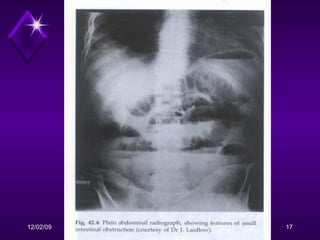
Radiological Examination A plain abdominal film  dilated loops of small intestine multiple air-fluid level  Computed tomography
 
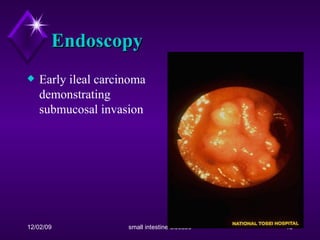
Endoscopy Early ileal carcinoma demonstrating submucosal invasion
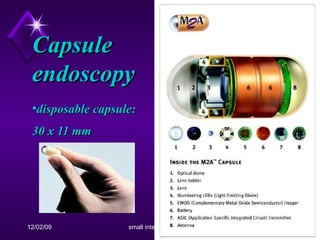
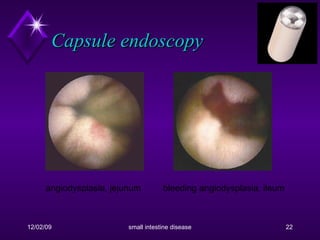
disposable capsule: 30 x 11 mm   Capsule endoscopy
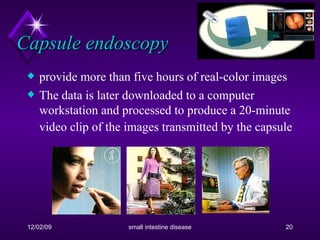
Capsule endoscopy provide more than five hours of real-color images  The data is later downloaded to a computer workstation and processed to produce a 20-minute video clip of the images transmitted by the capsule
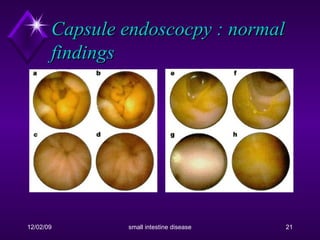
Capsule endoscocpy : normal findings
Capsule endoscopy angiodysplasia, jejunum   bleeding angiodysplasia, ileum
Diagnosis must make clear the following questions: 1. Whether intestinal obstruction exists:    Through symptoms and signs, the diagnosis can be made without difficulty.    Abdominal Radiology is much helpful in diagnosis.
2. Whether the obstruction is mechanical or dynamic :   mechanical  obstruction, typical symptoms and signs.    paralytic  obstruction, cramping abdominal pain is absent, distention is prominent
3. Whether the obstruction is simple or strangulation obstruction:     Indications for strangulation: a. Developing continuous violently rather than intermittent pain b. Crisis rapidly and presence of toxemia (elevated temperature and leukocyte count), shock and rapid pulse c. Obvious peritoneal irritation d. A palpable tender abdominal mass with asymmetric distention
e. Bloody gastrointestinal contents f. Single distending gut loop or pseudo-neoplasm sign on plain abdominal film g. A large amount of bloody ascites h. No relieving evidence to intensive nonoperative treatment
4. Whether the obstruction is high or low:    Vomiting, in proximal intestinal obstruction.   Distention in low obstruction   Abdominal radiography is helpful.  5. Whether the obstruction is complete or incomplete:    frequency of vomiting, extent of distention, and radiography.
6.Which causes leads to obstruction :    According to the age, history, symptoms and signs, radiography.  Postoperative adhesions,  Postinflammatory origin Henias Congenital malformations Intestinal intussusception Obstruction of parasite origin Carcinomas and dry feces.
Treatment Principles: Correcting of fluid and electrolytes imbalance and acid-base disturbance Relief of intestinal distention, and removing the cause of obstruction
A. Basic Treatment Fluid and electrolytes replacement   Volume restoration: colloid liquid Acidosis correction: sodium bicarbonate or sodium lactate Potassium deficit
Gastrointestinal decompression Intubation with gastrointestinal tube (gastrointestinal tube suction) is the important step in the management of obstruction.
Antibiotics Antibiotic treatment plays an important role in the management of obstruction. Antibiotic would be given in any type of obstruction The principle is giving the  broad spectrum  (aerobic and anaerobic) with large dose and short course and taking the less cost
Symptomatic treatment giving tranquilizer Antispasmodic Sedative
 
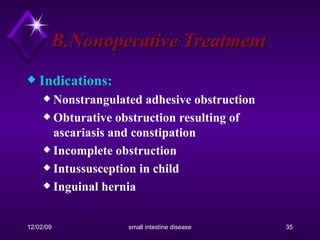
B.Nonoperative Treatment Indications:  Nonstrangulated adhesive obstruction Obturative obstruction resulting of ascariasis and constipation  Incomplete obstruction Intussusception in child Inguinal hernia
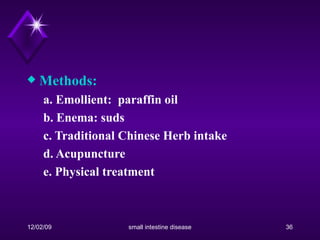
Methods: a. Emollient:  paraffin oil b. Enema: suds c. Traditional Chinese Herb intake d. Acupuncture e. Physical treatment
close observation is very important. worsed, transferred to surgical intervention.
C. Surgical Treatment Indication:  strangulated obstruction closed-loop obstruction simple obstruction without respond to nonoperation more than 96 hours
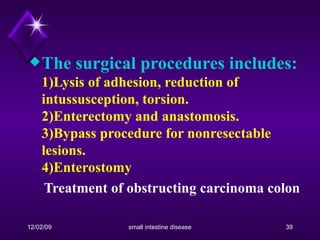
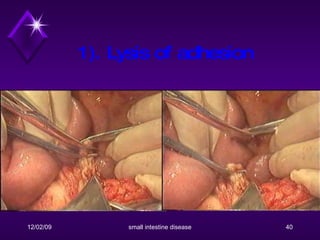
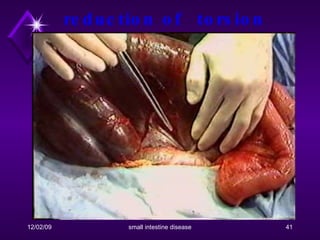
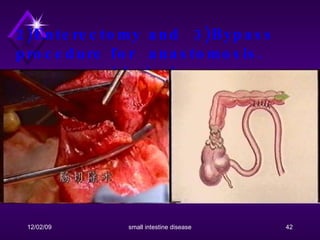
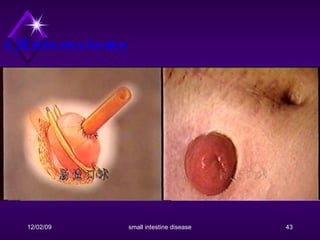
The surgical procedures includes: 1)Lysis of adhesion, reduction of intussusception, torsion.  2)Enterectomy and anastomosis. 3)Bypass procedure for nonresectable lesions. 4)Enterostomy  Treatment of obstructing carcinoma colon
1). Lysis of adhesion
reduction of  torsion
2)Enterectomy and  3)Bypass procedure for  anastomosis.  nonresectable lesions.
4)Enterostomy
Postoperative care: Gastrointestinal decompression Electrolyte management Nutrition support Antibiotics
 
The Common Types Of Intestinal Obstruction
Peritoneal Adhesions and Bands----Adhesive Obstruction
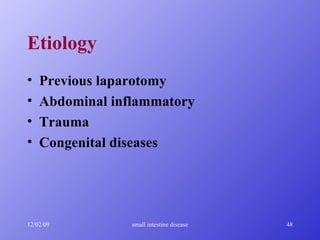
Etiology Previous laparotomy Abdominal inflammatory Trauma Congenital diseases
Pathology strangulated easily by band formation
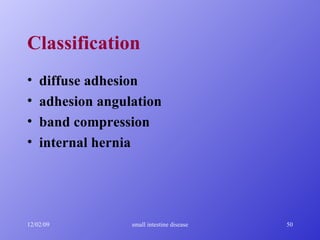
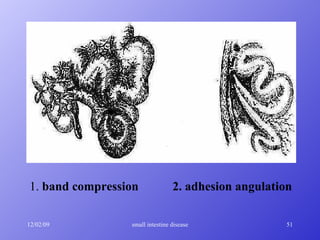
Classification diffuse adhesion adhesion angulation band compression internal hernia
1.  band compression  2. adhesion angulation
Diagnosis intestinal obstruction previous laparotomy abdominal infection trauma
Prophylaxis avoiding any unnecessary trauma, strangulation of tissue, contamination, and foreign body such as excessive suture. modifying the propensity of patient
Treatment nonoperative: nasogastric intubation emollient filling stomach enema with traditional Chinese herb
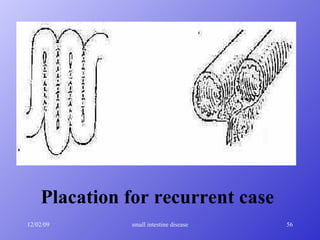
operative: lysis of adhesions or bands enterectomy for strangulated intestinal loop or adhesive loop mass bypass anastomosis for difficult situation or critical case placation for recurrent case
Placation for recurrent case
 
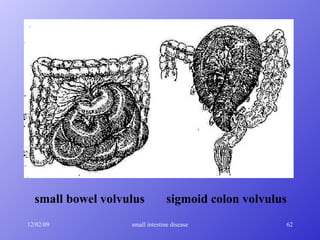
Volvulus Definition: It is a twisting or rotation of the bowel upon its mesentery and induces strangulation when it twist more than 180°with a high mortality.
Etiology too long mesentery too heavy intestinal contents Malrotation adhesion
Pathology Rotation around the mesenteric axis closed-loop obstruction
Classification sigmoid colon volvulus in the elder with constipation small bowel volvulus in the younger with strenuous exercises after full dinner
small bowel volvulus  sigmoid colon volvulus
Clinical Features sudden severe abdominal pain Others like SBO
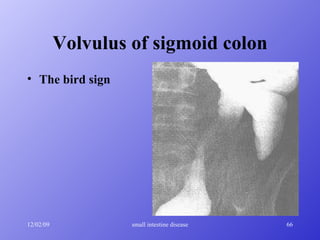
Diagnosis sigmoid colon volvulus: indentation (bird beak sign) while enema small bowel volvulus: shock in early stage and difficulty to differentiate from other types until laparotomy
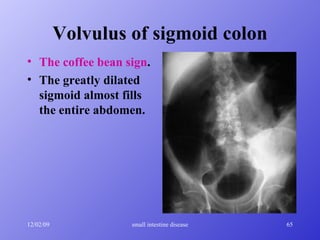
Volvulus of sigmoid colon The coffee bean sign .  The greatly dilated sigmoid almost fills the entire abdomen.
Volvulus of sigmoid colon The bird sign
Treatment fiber colonoscopic reduction for the early stage of the sigmoid vulvulus and then rectal tube fixed in place for 2-3 days surgical intervention immediately in small bowel volvulus and most of sigmoid vulvulus: reduction for nonstrangulation situation Resection the gangrenous bowel (short bowel syndrome, sigmoid colostomy)
 
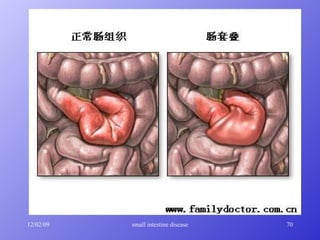
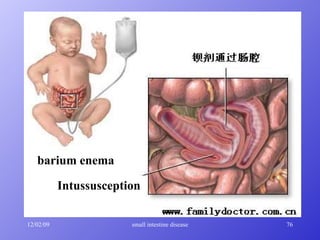
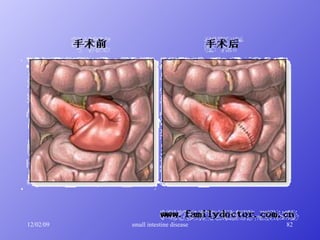
Intussusception Definition: It is the invagination of a part of the intestinal tract into the lumen of the adjacent intestine.
 
Etiology Irregular peristalsis in child less than 2 years old Intestinal neoplasm and abdominal inflammatory causing chronic recurrent intussusceptions
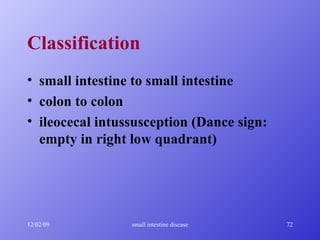
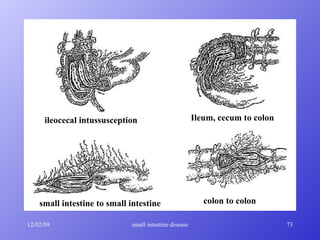
Classification small intestine to small intestine colon to colon ileocecal intussusception (Dance sign: empty in right low quadrant)
small intestine to small intestine ileocecal intussusception Ileum, cecum to colon colon to colon
Clinical Features abdominal pain abdominal mass melena (currant jelly stool)
Diagnosis colonic intussesception shows the glass sign while the enema
barium enema Intussusception
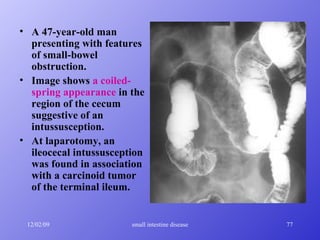
A 47-year-old man presenting with features of small-bowel obstruction. Image shows  a coiled-spring appearance  in the region of the cecum suggestive of an intussusception.  At laparotomy, an ileocecal intussusception was found in association with a carcinoid tumor of the terminal ileum.
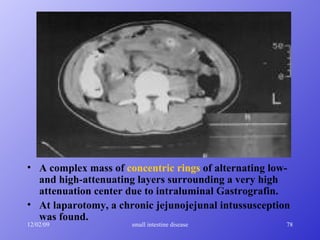
A complex mass of  concentric rings  of alternating low- and high-attenuating layers surrounding a very high attenuation center due to intraluminal Gastrografin. At laparotomy, a chronic jejunojejunal intussusception was found.
Computed tomography   Anatomic segment involved  Tumor mass as lead point  Three concentric circles indicating segment of bowel invaginated into another
Treatment enema reduction for children and some early stage cases: barium enema with hydrostatic pressure or air enema with high-pressure
surgical intervention for adult patients, the failure of enema reduction, and the case with peritonitis: reduction for nonstrangulation situation resection the gangrenous bowel (short bowel syndrome, colostomy) remove the cause in adult
 
 
Obturation Definition: It refers to intestinal lumen blockage by an intraluminal foreign body.
Etiology impacted feces Gallstone Gutstone Group of ascarids foreign body
Pathology simple mechanical obstruction
Clinical   Features severe abdominal pain and abdominal tender mass
Diagnosis the differentiation between symptom and sign by different causes
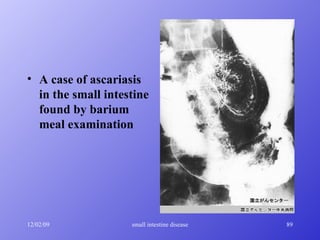
A case of ascariasis in the small intestine found by barium meal examination
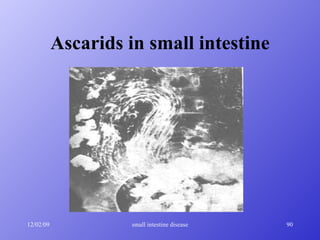
Ascarids in small intestine
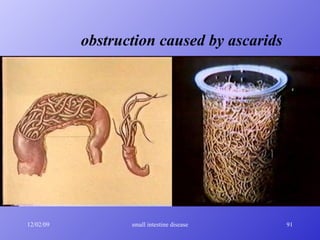
obstruction caused by ascarids
Treatment symptomatic management oxygen filling to stomach (100 ml/years old, total <1500 ml) for ascarids paraffin filling to stomach or enema for bezoar (stone in stomach) laparotomy for broken of obstructive mass, enterotomy for obstructive body
 
Other disese in small intestine
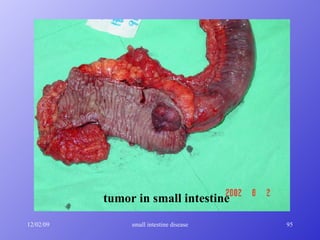
tumor in small intestine
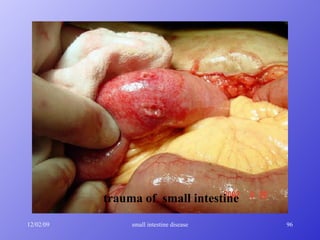
trauma of  small intestine
 
 
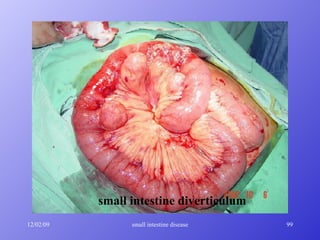
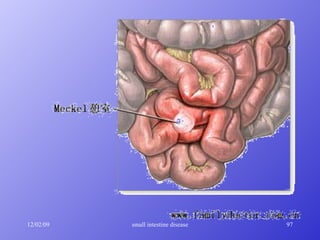
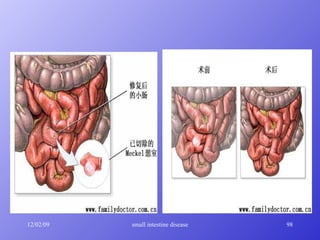
small intestine diverticulum
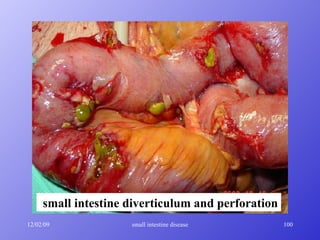
small intestine diverticulum and perforation
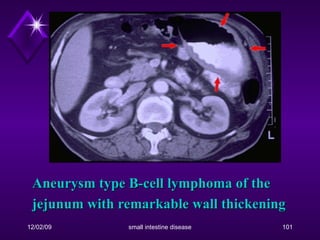
Aneurysm type B-cell lymphoma of the jejunum with remarkable wall thickening
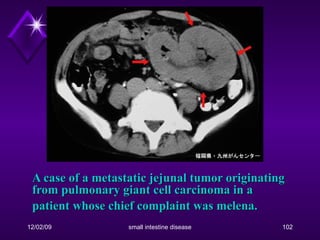
A case of a metastatic jejunal tumor originating from pulmonary giant cell carcinoma in a patient whose chief complaint was melena.
Discussion
CASE HISTORY A 47-year-old male is admitted to the emergency room with a 36- hour history of lower abdominal pain, nausea, and vomiting. The patient describes the pain as crampy in nature and notes that his abdomen has become distended over the last 12 hours. His last bowel movement was three days prior to presentation.
His past medical history is remarkable in that he underwent an appendectomy for acute appendicitis eight months ago. He is otherwise healthy and takes no medications.
Physical exam reveals a temperature of 38℃. His abdomen is distended. There is mild tenderness periumbilically but no guarding or rebound. High-pitched bowel sounds are present and rectal exam reveals no stool in the rectum.
Admitting laboratory date A hemoglobin of 16, hematocrit 48, white blood cell count 12,200 with 74 polys. Serum electrolytes are normal An abdominal X-RAY reveals multiple dilated loops of small bowel with numerous air fluid levels. There is no gas or stool visible in the colon
Symptoms of the patients Pain Vomiting Obstipation Abdominal distention
Signs of the patients Vital Signs:  temperature of 38℃ His abdomen is distended. Mild tenderness periumbilically but no guarding or rebound.  High-pitched bowel sounds  Rectal exam reveals no stool in the rectum
Laboratory Study A hemoglobin of 16, hematocrit 48, show hemoconcentration White blood cell count 12,200 with 74 polys and 5 bands, show inflammation. Serum electrolytes are normal
Radiography exam An abdominal X-RAY reveals multiple dilated loops of small bowel with numerous air fluid levels. There is no gas or stool visible in the colon To confirm the diagnosis
Diagnosis Intestinal obstuction
Whether the obstruction is mechanical or dynamic :   the crampy abdominal pain and  high-pitched bowel sounds
Whether the obstruction is simple or strangulation obstruction:     Indications for strangulation: a. Developing continuous violently rather than intermittent pain b. Crisis rapidly and presence of toxemia (elevated temperature and leukocyte count), shock and rapid pulse c. Obvious peritoneal irritation d. A palpable tender abdominal mass with asymmetric distention
e. Bloody gastrointestinal contents f. Single distending gut loop or pseudo-neoplasm sign on plain abdominal film g. A large amount of bloody ascites h. No relieving evidence to intensive nonoperative treatment
Whether the obstruction is complete or incomplete:  complete
Postoperative adhesions, Postinflammatory origin Henias Congenital malformations Intestinal intussusception Obstruction of parasite origin Carcinomas and dry feces. Which causes leads to obstruction : His past medical history is remarkable in that he underwent an appendectomy for acute appendicitis eight months ago.
Adhesive obstruction: diagnosis based on not finding any other cause of obstruction  Obstruction due to carcinomatosis: mass or bowel wall thickening along serosa of bowel at the transition zone  Crohn's disease: inflammatory mesenteric mass or discrete loculated fluid collection  Sigmoid volvulus: whirl sign
Acute cholecystitis: enlarged thick walled gallbladder  Pancreatitis: swelling and fluid around pancreas  Mesenteric ischemia: thickened bowel wall, focal dilatation, pneumatosis  Acute appendicitis: inflammatory changes in fat around appendix
Treatment Nonoperative Treatment Correcting of fluid and electrolytes imbalance and acid-base disturbance Gastrointestinal decompression Antibiotics Symptomatic treatment
By close observation Exacerbated, transferred to surgical intervention.
Surgical treatment: if doubt strangulated obstruction Lysis of adhesion Enterectomy and anastomosis
Conclusion
Diagnosis must make clear the following questions: 1. Whether intestinal obstruction exists  2. Whether the obstruction is mechanical or dynamic
3. Whether the obstruction is simple or strangulation obstruction:     Indications for strangulation: a. Developing continuous violently rather than intermittent pain b. Crisis rapidly and presence of toxemia (elevated temperature and leukocyte count), shock and rapid pulse c. Obvious peritoneal irritation d. A palpable tender abdominal mass with asymmetric distention
e. Bloody gastrointestinal contents f. Single distending gut loop or pseudo-neoplasm sign on plain abdominal film g. A large amount of bloody ascites h. No relieving evidence to intensive nonoperative treatment
4. Whether the obstruction is high or low  5. Whether the obstruction is complete or incomplete 6. Which causes leads to obstruction
Treatment   Basic Treatment Fluid and electrolytes replacement Gastrointestinal decompression Antibiotics Symptomatic treatment
Surgical Treatment Indication:  strangulated obstruction closed-loop obstruction simple obstruction without respond to nonoperation more than 96 hours
The surgical procedures includes: 1)Lysis of adhesion, reduction of intussusception, torsion.  2)Enterectomy and anastomosis. 3)Bypass procedure for nonresectable lesions. 4)Enterostomy and exteriorization of intestine.   Treatment of obstructing carcinoma colon
The Common Types Of Intestinal Obstruction
Adhesive Obstruction
Diagnosis intestinal obstruction previous laparotomy abdominal infection trauma
Treatment nonoperative: operative:
Volvulus Definition: It is a twisting or rotation of the bowel upon its mesentery and induces strangulation when it twist more than 180°with a high mortality.
Classification sigmoid colon volvulus in the elder with constipation small bowel volvulus in the younger with strenuous exercises after full dinner
Intussusception Definition: It is the invagination of a part of the intestinal tract into the lumen of the adjacent intestine.
Etiology Irregular peristalsis in child less than 2 years old Intestinal neoplasm and abdominal inflammatory causing chronic recurrent intussusceptions
Clinical Features abdominal pain abdominal mass melena (currant jelly stool)
Obturation  Etiology impacted feces Gallstone Gutstone Group of ascarids foreign body
 

small intestine diseases 2

  • 1.
  • 2.
    Defination A blockadeof the flow of intestinal content.
  • 3.
    Etiology and classification 1. According to its basic causes: mechanical obstruction dynamic obstruction obstruction of vascular supply origin
  • 4.
    2. According towhether the vascular supply to intestinal wall is compromised, Simple and strangulation obstruction .
  • 5.
    3. According toobstruction level or site . high and low obstruction 4. According to the extent of obstruction Incomplete and complete obstruction, 5. According to mode of onset and progression of obstruction. Acute and chronic obstruction
  • 6.
    6. Open-loop Obstruction: Closed-loop Obstruction:
  • 7.
    Pathophysiology A.Local Effects Intestinal gas increases Intestinal fluid accumulates Intestinal flora is abnormal Intestinal motility (peristalsis) is abnormal
  • 8.
    B. Systemic EffectsWater and electrolyte losing Gut original endotoxemia Cardiopumonary dysfunction Shock and other organs insufficiency
  • 9.
    Clinical manifestations Abdominal pain Nausea and vomiting Obstipation Abdominal distention.
  • 10.
    Physical Examination thesigns of dehydration: Vital Signs:
  • 11.
    a.Inspection: visible peristalsis distending gut incisions of previous surgery
  • 12.
    b.Palpation: Localized tenderness Signs of localized or generalized peritonitis: referred tenderness muscle spasm the mass in abdominal cavity
  • 13.
    c.Percussion: Tympanic resonance Shifting dullness demonstrates ascites.
  • 14.
    d.Auscultation: Bowelsounds increased Intestinal sound is absent
  • 15.
    Laboratory Study HemoconcentrationLeukocyte counts Water and electrolyte imbalance Acid-base imbalance
  • 16.
    Radiological Examination Aplain abdominal film dilated loops of small intestine multiple air-fluid level Computed tomography
  • 17.
  • 18.
    Endoscopy Early ilealcarcinoma demonstrating submucosal invasion
  • 19.
    disposable capsule: 30x 11 mm Capsule endoscopy
  • 20.
    Capsule endoscopy providemore than five hours of real-color images The data is later downloaded to a computer workstation and processed to produce a 20-minute video clip of the images transmitted by the capsule
  • 21.
    Capsule endoscocpy :normal findings
  • 22.
    Capsule endoscopy angiodysplasia,jejunum bleeding angiodysplasia, ileum
  • 23.
    Diagnosis must makeclear the following questions: 1. Whether intestinal obstruction exists: Through symptoms and signs, the diagnosis can be made without difficulty. Abdominal Radiology is much helpful in diagnosis.
  • 24.
    2. Whether theobstruction is mechanical or dynamic : mechanical obstruction, typical symptoms and signs. paralytic obstruction, cramping abdominal pain is absent, distention is prominent
  • 25.
    3. Whether theobstruction is simple or strangulation obstruction: Indications for strangulation: a. Developing continuous violently rather than intermittent pain b. Crisis rapidly and presence of toxemia (elevated temperature and leukocyte count), shock and rapid pulse c. Obvious peritoneal irritation d. A palpable tender abdominal mass with asymmetric distention
  • 26.
    e. Bloody gastrointestinalcontents f. Single distending gut loop or pseudo-neoplasm sign on plain abdominal film g. A large amount of bloody ascites h. No relieving evidence to intensive nonoperative treatment
  • 27.
    4. Whether theobstruction is high or low: Vomiting, in proximal intestinal obstruction. Distention in low obstruction Abdominal radiography is helpful. 5. Whether the obstruction is complete or incomplete: frequency of vomiting, extent of distention, and radiography.
  • 28.
    6.Which causes leadsto obstruction : According to the age, history, symptoms and signs, radiography. Postoperative adhesions, Postinflammatory origin Henias Congenital malformations Intestinal intussusception Obstruction of parasite origin Carcinomas and dry feces.
  • 29.
    Treatment Principles: Correctingof fluid and electrolytes imbalance and acid-base disturbance Relief of intestinal distention, and removing the cause of obstruction
  • 30.
    A. Basic TreatmentFluid and electrolytes replacement Volume restoration: colloid liquid Acidosis correction: sodium bicarbonate or sodium lactate Potassium deficit
  • 31.
    Gastrointestinal decompression Intubationwith gastrointestinal tube (gastrointestinal tube suction) is the important step in the management of obstruction.
  • 32.
    Antibiotics Antibiotic treatmentplays an important role in the management of obstruction. Antibiotic would be given in any type of obstruction The principle is giving the broad spectrum (aerobic and anaerobic) with large dose and short course and taking the less cost
  • 33.
    Symptomatic treatment givingtranquilizer Antispasmodic Sedative
  • 34.
  • 35.
    B.Nonoperative Treatment Indications: Nonstrangulated adhesive obstruction Obturative obstruction resulting of ascariasis and constipation Incomplete obstruction Intussusception in child Inguinal hernia
  • 36.
    Methods: a. Emollient: paraffin oil b. Enema: suds c. Traditional Chinese Herb intake d. Acupuncture e. Physical treatment
  • 37.
    close observation isvery important. worsed, transferred to surgical intervention.
  • 38.
    C. Surgical TreatmentIndication: strangulated obstruction closed-loop obstruction simple obstruction without respond to nonoperation more than 96 hours
  • 39.
    The surgical proceduresincludes: 1)Lysis of adhesion, reduction of intussusception, torsion. 2)Enterectomy and anastomosis. 3)Bypass procedure for nonresectable lesions. 4)Enterostomy Treatment of obstructing carcinoma colon
  • 40.
    1). Lysis ofadhesion
  • 41.
  • 42.
    2)Enterectomy and 3)Bypass procedure for anastomosis. nonresectable lesions.
  • 43.
  • 44.
    Postoperative care: Gastrointestinaldecompression Electrolyte management Nutrition support Antibiotics
  • 45.
  • 46.
    The Common TypesOf Intestinal Obstruction
  • 47.
    Peritoneal Adhesions andBands----Adhesive Obstruction
  • 48.
    Etiology Previous laparotomyAbdominal inflammatory Trauma Congenital diseases
  • 49.
  • 50.
    Classification diffuse adhesionadhesion angulation band compression internal hernia
  • 51.
    1. bandcompression 2. adhesion angulation
  • 52.
    Diagnosis intestinal obstructionprevious laparotomy abdominal infection trauma
  • 53.
    Prophylaxis avoiding anyunnecessary trauma, strangulation of tissue, contamination, and foreign body such as excessive suture. modifying the propensity of patient
  • 54.
    Treatment nonoperative: nasogastricintubation emollient filling stomach enema with traditional Chinese herb
  • 55.
    operative: lysis ofadhesions or bands enterectomy for strangulated intestinal loop or adhesive loop mass bypass anastomosis for difficult situation or critical case placation for recurrent case
  • 56.
  • 57.
  • 58.
    Volvulus Definition: Itis a twisting or rotation of the bowel upon its mesentery and induces strangulation when it twist more than 180°with a high mortality.
  • 59.
    Etiology too longmesentery too heavy intestinal contents Malrotation adhesion
  • 60.
    Pathology Rotation aroundthe mesenteric axis closed-loop obstruction
  • 61.
    Classification sigmoid colonvolvulus in the elder with constipation small bowel volvulus in the younger with strenuous exercises after full dinner
  • 62.
    small bowel volvulus sigmoid colon volvulus
  • 63.
    Clinical Features suddensevere abdominal pain Others like SBO
  • 64.
    Diagnosis sigmoid colonvolvulus: indentation (bird beak sign) while enema small bowel volvulus: shock in early stage and difficulty to differentiate from other types until laparotomy
  • 65.
    Volvulus of sigmoidcolon The coffee bean sign . The greatly dilated sigmoid almost fills the entire abdomen.
  • 66.
    Volvulus of sigmoidcolon The bird sign
  • 67.
    Treatment fiber colonoscopicreduction for the early stage of the sigmoid vulvulus and then rectal tube fixed in place for 2-3 days surgical intervention immediately in small bowel volvulus and most of sigmoid vulvulus: reduction for nonstrangulation situation Resection the gangrenous bowel (short bowel syndrome, sigmoid colostomy)
  • 68.
  • 69.
    Intussusception Definition: Itis the invagination of a part of the intestinal tract into the lumen of the adjacent intestine.
  • 70.
  • 71.
    Etiology Irregular peristalsisin child less than 2 years old Intestinal neoplasm and abdominal inflammatory causing chronic recurrent intussusceptions
  • 72.
    Classification small intestineto small intestine colon to colon ileocecal intussusception (Dance sign: empty in right low quadrant)
  • 73.
    small intestine tosmall intestine ileocecal intussusception Ileum, cecum to colon colon to colon
  • 74.
    Clinical Features abdominalpain abdominal mass melena (currant jelly stool)
  • 75.
    Diagnosis colonic intussesceptionshows the glass sign while the enema
  • 76.
  • 77.
    A 47-year-old manpresenting with features of small-bowel obstruction. Image shows a coiled-spring appearance in the region of the cecum suggestive of an intussusception. At laparotomy, an ileocecal intussusception was found in association with a carcinoid tumor of the terminal ileum.
  • 78.
    A complex massof concentric rings of alternating low- and high-attenuating layers surrounding a very high attenuation center due to intraluminal Gastrografin. At laparotomy, a chronic jejunojejunal intussusception was found.
  • 79.
    Computed tomography Anatomic segment involved Tumor mass as lead point Three concentric circles indicating segment of bowel invaginated into another
  • 80.
    Treatment enema reductionfor children and some early stage cases: barium enema with hydrostatic pressure or air enema with high-pressure
  • 81.
    surgical intervention foradult patients, the failure of enema reduction, and the case with peritonitis: reduction for nonstrangulation situation resection the gangrenous bowel (short bowel syndrome, colostomy) remove the cause in adult
  • 82.
  • 83.
  • 84.
    Obturation Definition: Itrefers to intestinal lumen blockage by an intraluminal foreign body.
  • 85.
    Etiology impacted fecesGallstone Gutstone Group of ascarids foreign body
  • 86.
  • 87.
    Clinical Features severe abdominal pain and abdominal tender mass
  • 88.
    Diagnosis the differentiationbetween symptom and sign by different causes
  • 89.
    A case ofascariasis in the small intestine found by barium meal examination
  • 90.
  • 91.
  • 92.
    Treatment symptomatic managementoxygen filling to stomach (100 ml/years old, total <1500 ml) for ascarids paraffin filling to stomach or enema for bezoar (stone in stomach) laparotomy for broken of obstructive mass, enterotomy for obstructive body
  • 93.
  • 94.
    Other disese insmall intestine
  • 95.
    tumor in smallintestine
  • 96.
    trauma of small intestine
  • 97.
  • 98.
  • 99.
  • 100.
  • 101.
    Aneurysm type B-celllymphoma of the jejunum with remarkable wall thickening
  • 102.
    A case ofa metastatic jejunal tumor originating from pulmonary giant cell carcinoma in a patient whose chief complaint was melena.
  • 103.
  • 104.
    CASE HISTORY A47-year-old male is admitted to the emergency room with a 36- hour history of lower abdominal pain, nausea, and vomiting. The patient describes the pain as crampy in nature and notes that his abdomen has become distended over the last 12 hours. His last bowel movement was three days prior to presentation.
  • 105.
    His past medicalhistory is remarkable in that he underwent an appendectomy for acute appendicitis eight months ago. He is otherwise healthy and takes no medications.
  • 106.
    Physical exam revealsa temperature of 38℃. His abdomen is distended. There is mild tenderness periumbilically but no guarding or rebound. High-pitched bowel sounds are present and rectal exam reveals no stool in the rectum.
  • 107.
    Admitting laboratory dateA hemoglobin of 16, hematocrit 48, white blood cell count 12,200 with 74 polys. Serum electrolytes are normal An abdominal X-RAY reveals multiple dilated loops of small bowel with numerous air fluid levels. There is no gas or stool visible in the colon
  • 108.
    Symptoms of thepatients Pain Vomiting Obstipation Abdominal distention
  • 109.
    Signs of thepatients Vital Signs: temperature of 38℃ His abdomen is distended. Mild tenderness periumbilically but no guarding or rebound. High-pitched bowel sounds Rectal exam reveals no stool in the rectum
  • 110.
    Laboratory Study Ahemoglobin of 16, hematocrit 48, show hemoconcentration White blood cell count 12,200 with 74 polys and 5 bands, show inflammation. Serum electrolytes are normal
  • 111.
    Radiography exam Anabdominal X-RAY reveals multiple dilated loops of small bowel with numerous air fluid levels. There is no gas or stool visible in the colon To confirm the diagnosis
  • 112.
  • 113.
    Whether the obstructionis mechanical or dynamic : the crampy abdominal pain and high-pitched bowel sounds
  • 114.
    Whether the obstructionis simple or strangulation obstruction: Indications for strangulation: a. Developing continuous violently rather than intermittent pain b. Crisis rapidly and presence of toxemia (elevated temperature and leukocyte count), shock and rapid pulse c. Obvious peritoneal irritation d. A palpable tender abdominal mass with asymmetric distention
  • 115.
    e. Bloody gastrointestinalcontents f. Single distending gut loop or pseudo-neoplasm sign on plain abdominal film g. A large amount of bloody ascites h. No relieving evidence to intensive nonoperative treatment
  • 116.
    Whether the obstructionis complete or incomplete: complete
  • 117.
    Postoperative adhesions, Postinflammatoryorigin Henias Congenital malformations Intestinal intussusception Obstruction of parasite origin Carcinomas and dry feces. Which causes leads to obstruction : His past medical history is remarkable in that he underwent an appendectomy for acute appendicitis eight months ago.
  • 118.
    Adhesive obstruction: diagnosisbased on not finding any other cause of obstruction Obstruction due to carcinomatosis: mass or bowel wall thickening along serosa of bowel at the transition zone Crohn's disease: inflammatory mesenteric mass or discrete loculated fluid collection Sigmoid volvulus: whirl sign
  • 119.
    Acute cholecystitis: enlargedthick walled gallbladder Pancreatitis: swelling and fluid around pancreas Mesenteric ischemia: thickened bowel wall, focal dilatation, pneumatosis Acute appendicitis: inflammatory changes in fat around appendix
  • 120.
    Treatment Nonoperative TreatmentCorrecting of fluid and electrolytes imbalance and acid-base disturbance Gastrointestinal decompression Antibiotics Symptomatic treatment
  • 121.
    By close observationExacerbated, transferred to surgical intervention.
  • 122.
    Surgical treatment: ifdoubt strangulated obstruction Lysis of adhesion Enterectomy and anastomosis
  • 123.
  • 124.
    Diagnosis must makeclear the following questions: 1. Whether intestinal obstruction exists 2. Whether the obstruction is mechanical or dynamic
  • 125.
    3. Whether theobstruction is simple or strangulation obstruction: Indications for strangulation: a. Developing continuous violently rather than intermittent pain b. Crisis rapidly and presence of toxemia (elevated temperature and leukocyte count), shock and rapid pulse c. Obvious peritoneal irritation d. A palpable tender abdominal mass with asymmetric distention
  • 126.
    e. Bloody gastrointestinalcontents f. Single distending gut loop or pseudo-neoplasm sign on plain abdominal film g. A large amount of bloody ascites h. No relieving evidence to intensive nonoperative treatment
  • 127.
    4. Whether theobstruction is high or low 5. Whether the obstruction is complete or incomplete 6. Which causes leads to obstruction
  • 128.
    Treatment Basic Treatment Fluid and electrolytes replacement Gastrointestinal decompression Antibiotics Symptomatic treatment
  • 129.
    Surgical Treatment Indication: strangulated obstruction closed-loop obstruction simple obstruction without respond to nonoperation more than 96 hours
  • 130.
    The surgical proceduresincludes: 1)Lysis of adhesion, reduction of intussusception, torsion. 2)Enterectomy and anastomosis. 3)Bypass procedure for nonresectable lesions. 4)Enterostomy and exteriorization of intestine. Treatment of obstructing carcinoma colon
  • 131.
    The Common TypesOf Intestinal Obstruction
  • 132.
  • 133.
    Diagnosis intestinal obstructionprevious laparotomy abdominal infection trauma
  • 134.
  • 135.
    Volvulus Definition: Itis a twisting or rotation of the bowel upon its mesentery and induces strangulation when it twist more than 180°with a high mortality.
  • 136.
    Classification sigmoid colonvolvulus in the elder with constipation small bowel volvulus in the younger with strenuous exercises after full dinner
  • 137.
    Intussusception Definition: Itis the invagination of a part of the intestinal tract into the lumen of the adjacent intestine.
  • 138.
    Etiology Irregular peristalsisin child less than 2 years old Intestinal neoplasm and abdominal inflammatory causing chronic recurrent intussusceptions
  • 139.
    Clinical Features abdominalpain abdominal mass melena (currant jelly stool)
  • 140.
    Obturation Etiologyimpacted feces Gallstone Gutstone Group of ascarids foreign body
  • 141.