
INTESTINAL OBSTRUCTION
PRESENTED BY-
DR. Nitin Alapure
PG SCHOLAR
GUIDE: DR APARNA RAUT
(HOD OF SHALYATANTRA DEPT)
Defination :-
 Partial or complete blockage the lumen of small or large intestine causing as
interruption in the normal flow of intestinal contents along the intestinal tract is
called as intestinal obstruction.
The block may to complete or incomplete, may be mechanical or paralytic and it
may or may not compromise the vascular supply.
OR
 Restriction of the normal flow of intestinal passage is know as intestinal
obstruction
Classification
A) According to Nature of obstruction :-
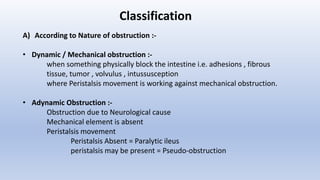
• Dynamic / Mechanical obstruction :-
when something physically block the intestine i.e. adhesions , fibrous
tissue, tumor , volvulus , intussusception
where Peristalsis movement is working against mechanical obstruction.
• Adynamic Obstruction :-
Obstruction due to Neurological cause
Mechanical element is absent
Peristalsis movement
Peristalsis Absent = Paralytic ileus
peristalsis may be present = Pseudo-obstruction
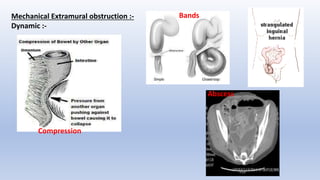
Mechanical Extramural obstruction :-
Dynamic :-
Compression
Bands
Abscess
ADYNAMIC OBSTRUCTION causes
Small intestine
- Postoperative
- Intra-abdominal abscess or peritonitis
- Mesenteric embolism or thrombosis
Large intestine
- Retroperitoneal hematoma
- Drugs - (those drug effect on muscles &Nerves drug like
antidepressant , opioid analgesic and Antidiarrheal
drug lead to paralytic ileus)
- Hypokalemia (Pseudo Obstruction or Oglivies syndrome)
- Idiopathic (Unknown cause)
B) According to Cause of Obstruction :-
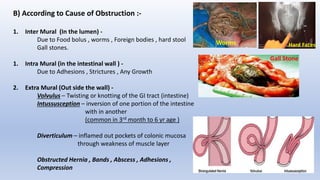
1. Inter Mural (In the lumen) -
Due to Food bolus , worms , Foreign bodies , hard stool
Gall stones.
1. Intra Mural (in the intestinal wall ) -
Due to Adhesions , Strictures , Any Growth
2. Extra Mural (Out side the wall) -
Volvulus – Twisting or knotting of the GI tract (intestine)
Intussusception – inversion of one portion of the intestine
with in another
(common in 3rd month to 6 yr age )
Diverticulum – inflamed out pockets of colonic mucosa
through weakness of muscle layer
Obstructed Hernia , Bands , Abscess , Adhesions ,
Compression
Worms Hard Faces
Gall Stone
MOST COMMON CAUSES
SMALL INTESTINE
- ADHESIONS
- EXTERNAL HERNIAS (both are more than 75% of cases)
- TB, TUMORS, CONGENITAL………
LARGE INTESTINE
- TUMORS & VOLVULUS (both are 90% of cases )
- DIVERTIDULITIS (rare)
- ADHESIONS (extremely rare if at all)
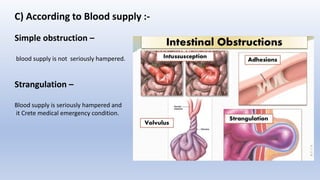
C) According to Blood supply :-
Simple obstruction –
blood supply is not seriously hampered.
Strangulation –
Blood supply is seriously hampered and
it Crete medical emergency condition.
D) According to Severity of Obstruction :-
Acute :-
Early symptom is vomiting and colic pain.
mostly affect the small intestine.
sign & symptoms appear very fast .
Chronic:-
Early sign is constipation and pain.
Mostly affect the large intestine.
Sub-Acute :-
It develops due to growth of colon and
suddenly accumulation of food or feacal material.
Abdomen distension is present.
PATHOPYSIOLOGY
SIMPLE OBSTRUCTION :
1-ABOVE THE OBSTRUCTION
OBSTRUCTION  Peristalsis increases  Intestine dilates  Reduction in peristaltic strength 
Flaccidity and paralysis (protective but late)
2- BELOW THE OBSTRUCTION
NORMAL PERISTALSIS & ABSORBTION  Until it becomes empty  It contracts & becomes immobile..
Strangulated Obstruction :-
Obstruction  Distension Venous congestion  Edema  Progressive arterial
compression  Loss of blood supply  Gangrene  collection of fluid Bacteria
growth  Bacteria produce toxins  toxins irritate to peritoneal cavity  Peritonitis
Septic shock
Clinical Features :-
Pain in abdomen :-
Small intestinal obstruction – Central abdomen colic pain
Large intestinal obstruction - Peripheral dull pain
Strangulated obstruction – Continues and severe pain
Paralytic ileus – Pain is absent
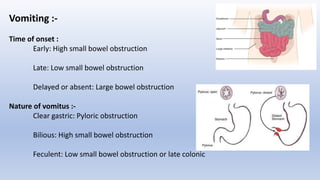
Vomiting :-
Time of onset :
Early: High small bowel obstruction
Late: Low small bowel obstruction
Delayed or absent: Large bowel obstruction
Nature of vomitus :-
Clear gastric: Pyloric obstruction
Bilious: High small bowel obstruction
Feculent: Low small bowel obstruction or late colonic
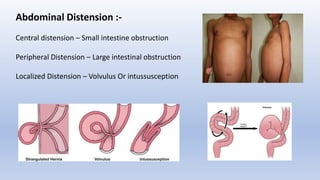
Abdominal Distension :-
Central distension – Small intestine obstruction
Peripheral Distension – Large intestinal obstruction
Localized Distension – Volvulus Or intussusception
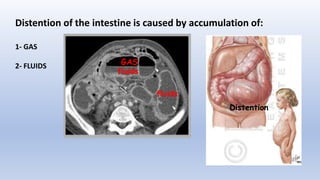
Distention of the intestine is caused by accumulation of:
1- GAS
2- FLUIDS GAS
fluids
Distention
Gas in the intestine is due to :-
1. Swallowed air
2. Bacterial overgrowth
3. Diffusion from blood
Fluids come from :
1. Saliva
2. Gastric and intestinal juice
3. Bile & Pancreatic secretions
Dehydration :-
Dehydration caused by
• Reduce the intake of water
• Doesn’t absorb the fluid from GI system
• Increased loss of water due to vomiting , sweating
• Dry skin , dry tongue , low urine output
• Patient goes hypovolemic shock
• Tachycardia , fever , low BP , mental confusion ,Renal failure, drowsiness
General signs
• Rebound tenderness / Blumberg sign – Pain and tenderness that
occurs upon sudden release pressure on the abdomen.
• Absence of bowel sound or sluggish
• Guarding and rigidity of abdominal muscles.
• Tachycardia and fever.
Clinical examination
General examination-
Vital signs
Signs of dehydration –tachycardia, hypotension
dry mucus membrane, decreased skin turgor, decreased urine output
Inspection
distension, scars, peristalsis, masses, hernial orifices
Palpation
tenderness, masses, rigidity
Auscultation
high pitched bowel sound or silent abdomen
*Examine rectum for mass, blood, feces or it may be empty in case of complete obstruction
• Hemogram - WBC (neutrophilia-strangulation)
• Hyperkalemia , hyperamylasemia & raised LDH may be
associated with strangulation .
• Plain AXR
• Sigmoidoscopy (carcinoma, volvulus)
• Contrast x-ray
• CT abdomen.
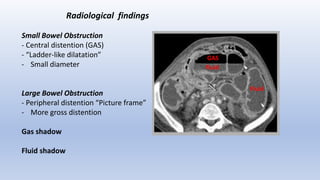
Radiological findings
Small Bowel Obstruction
- Central distention (GAS)
- “Ladder-like dilatation”
- Small diameter
Large Bowel Obstruction
- Peripheral distention “Picture frame”
- More gross distention
Gas shadow
Fluid shadow
GAS
Fluid
Fluid
• Three main measures-
- GI drainage
-Fluid &Electrolyte replacement
- Relief of obstruction, usually surgical
Treatment
Conservative:
• Nasogastric aspiration by Ryle's tube
• IV fluids- volume varies depending on dehydration
• NBM
• Urinary catheter
• Check temp. and pulse 2 hourly
• abdominal examination 8 hourly
• Broad spectrum antibiotics initiated early- reduce
bacterial overgrowth.
• Some cases will settle by using this conservative regimen, other need surgical
intervention.
• Surgery should be delayed till resuscitation is complete unless signs of
strangulation and evidence of closed-loop obstruction.
• Cases that show reasons for delay should be monitored continuously for 72 hours
in hope of spontaneous resolution e.g. adhesions with radiological findings but no
pain or tenderness
Indication for surgery:
 failure of conservative management
 tender, irreducible hernia
 strangulation
• The type of surgical procedure depend upon the cause of obstruction viz
division of bands , adhesiolysis , excision ,or bypass
• Once obstruction relieved, the bowel is inspected for viability, and if non-
viable, resection is required.
Indication of non-viability
1. Absent peristalsis
2. Loss of normal shine
3. Loss of pulsation in mesentery
4. Green or black color of bowel
• If in doubt of viability, bowel is wrapped in hot packs for 10 minutes
with increased oxygen and reassessed for viability.
• Resection of non viable gut should be done followed by stoma.
• Sometimes a second look laparotomy is required in 24-48 hours e.g.
multiple ischemic areas.
• Most common cause of intestinal obstruction.
• Peritoneal irritation results in local fibrin production, which produce
adhesions.
Causes of adhesions :
• Abdominal operation : anastomosis, raw peritoneal surfaces
• Foreign material: talc, starch, gauze, silk
• Infection: peritonitis, T.B.
• Inflammatory conditions
• Radiation
• enteritis.
Prevention:-
• Good surgical technique.
• Washing the peritoneal cavity with saline to remove the clots.
• Minimizing contact with gauze.
• Covering the anastomosis & raw peritoneal surfaces.
Treatment
• Usually conservative treatment is curative. (i.v. rehydration &
nasogastric decompression)
• It should not be prolonged beyond 72 hrs.
Surgery
Division of band.
Minimal adhisiolysis .
• It tends to occur in elderly.
• Erosion of large gallstone into duodenum.
• Present with recurrent obstruction.
• X-ray: small bowel obstruction with air in billiary tree.
-may show a radio opaque gall stone.
• Treatment : laparotomy & removal /crushing of stone.
• After partial /total gastrectomy.
• Unchewed food can cause obstruction.
• Treatment similar to gall stone.
WORMS
• Ascaris lumbricoides
• Frequently follows initiation of antihelminthic therapy.
• Laparotomy.
• One portion of gut becomes invaginated with in adjacent segment.
• Most common in children(3-9 months.)
• Ideopathic-70%
• Associated gastroenteritis/UTI- 30%
Clinical Feauturs :-
• Severe colic pain.
• vomiting as time progress
• blood & mucus (the ‘redcurrant’ jelly stool).
• Abdominal lump (sausage shaped)
• Emptiness in RIF (the sign of Dance).
• Death may occur from bowel obstruction or peritonitis secondary to
gangrene.
Treatment :-
• Nasogastric aspiration by Ryle's tube
• IV fluids- volume varies depending on dehydration
• NBM
• Urinary catheter
• Enema if flatus pass
• Flatus not pass & Pain not reduced then post for surgery.
Surgical treatment :-
• Laparotomy for resolve intussusception .
• Irreducible/ gangrenous intussusception: excision of mass & anastomosis.
• Postoperative care
VOLVULUS OBSTRUCTION
An Obstruction due to Twisting or Knotting of the intestine
Clinical Features :-
• Abdominal pain
• Abdominal bloating
• Vomiting
• Constipation
• Bloody stool
Diagnostic Investigation
• Barium meal swallow for perform upper GI radiography
• Barium Enema to perform large intestine obstruction
• A Digital rectal examination
• CT Abdomen
Treatment:-
• Administer analgesic to easy off pain
• NBM
• Antiemetic drug
• Fluid management to maintain electrolyte balance
Surgical :-
• Surgical intervention to untwisting the gut by laparoscopic or open
surgery.
• Post operative care.
THANK YOU
LAQ points
1.Definition
2.Classification
According to Nature of obstruction
According to Cause of Obstruction
According to Blood supply
According to Severity of Obstruction
3. PATHOPYSIOLOGY
simple obstruction
Strangulated obstruction
4. Clinical Features
pain
Vomiting
Distension
Dehydration
constipation
5. Clinical examination
6. Investigation
7. Radiological findings
8. Treatment
conservative (According types)
surgical (According types)

Intestinal obstruction by Dr. Nitin Alapure

  • 1.
    INTESTINAL OBSTRUCTION PRESENTED BY- DR.Nitin Alapure PG SCHOLAR GUIDE: DR APARNA RAUT (HOD OF SHALYATANTRA DEPT)
  • 2.
    Defination :-  Partialor complete blockage the lumen of small or large intestine causing as interruption in the normal flow of intestinal contents along the intestinal tract is called as intestinal obstruction. The block may to complete or incomplete, may be mechanical or paralytic and it may or may not compromise the vascular supply. OR  Restriction of the normal flow of intestinal passage is know as intestinal obstruction
  • 3.
    Classification A) According toNature of obstruction :- • Dynamic / Mechanical obstruction :- when something physically block the intestine i.e. adhesions , fibrous tissue, tumor , volvulus , intussusception where Peristalsis movement is working against mechanical obstruction. • Adynamic Obstruction :- Obstruction due to Neurological cause Mechanical element is absent Peristalsis movement Peristalsis Absent = Paralytic ileus peristalsis may be present = Pseudo-obstruction
  • 4.
    Mechanical Extramural obstruction:- Dynamic :- Compression Bands Abscess
  • 5.
    ADYNAMIC OBSTRUCTION causes Smallintestine - Postoperative - Intra-abdominal abscess or peritonitis - Mesenteric embolism or thrombosis Large intestine - Retroperitoneal hematoma - Drugs - (those drug effect on muscles &Nerves drug like antidepressant , opioid analgesic and Antidiarrheal drug lead to paralytic ileus) - Hypokalemia (Pseudo Obstruction or Oglivies syndrome) - Idiopathic (Unknown cause)
  • 6.
    B) According toCause of Obstruction :- 1. Inter Mural (In the lumen) - Due to Food bolus , worms , Foreign bodies , hard stool Gall stones. 1. Intra Mural (in the intestinal wall ) - Due to Adhesions , Strictures , Any Growth 2. Extra Mural (Out side the wall) - Volvulus – Twisting or knotting of the GI tract (intestine) Intussusception – inversion of one portion of the intestine with in another (common in 3rd month to 6 yr age ) Diverticulum – inflamed out pockets of colonic mucosa through weakness of muscle layer Obstructed Hernia , Bands , Abscess , Adhesions , Compression Worms Hard Faces Gall Stone
  • 7.
    MOST COMMON CAUSES SMALLINTESTINE - ADHESIONS - EXTERNAL HERNIAS (both are more than 75% of cases) - TB, TUMORS, CONGENITAL……… LARGE INTESTINE - TUMORS & VOLVULUS (both are 90% of cases ) - DIVERTIDULITIS (rare) - ADHESIONS (extremely rare if at all)
  • 8.
    C) According toBlood supply :- Simple obstruction – blood supply is not seriously hampered. Strangulation – Blood supply is seriously hampered and it Crete medical emergency condition.
  • 9.
    D) According toSeverity of Obstruction :- Acute :- Early symptom is vomiting and colic pain. mostly affect the small intestine. sign & symptoms appear very fast . Chronic:- Early sign is constipation and pain. Mostly affect the large intestine. Sub-Acute :- It develops due to growth of colon and suddenly accumulation of food or feacal material. Abdomen distension is present.
  • 10.
    PATHOPYSIOLOGY SIMPLE OBSTRUCTION : 1-ABOVETHE OBSTRUCTION OBSTRUCTION  Peristalsis increases  Intestine dilates  Reduction in peristaltic strength  Flaccidity and paralysis (protective but late) 2- BELOW THE OBSTRUCTION NORMAL PERISTALSIS & ABSORBTION  Until it becomes empty  It contracts & becomes immobile..
  • 11.
    Strangulated Obstruction :- Obstruction Distension Venous congestion  Edema  Progressive arterial compression  Loss of blood supply  Gangrene  collection of fluid Bacteria growth  Bacteria produce toxins  toxins irritate to peritoneal cavity  Peritonitis Septic shock
  • 12.
    Clinical Features :- Painin abdomen :- Small intestinal obstruction – Central abdomen colic pain Large intestinal obstruction - Peripheral dull pain Strangulated obstruction – Continues and severe pain Paralytic ileus – Pain is absent
  • 13.
    Vomiting :- Time ofonset : Early: High small bowel obstruction Late: Low small bowel obstruction Delayed or absent: Large bowel obstruction Nature of vomitus :- Clear gastric: Pyloric obstruction Bilious: High small bowel obstruction Feculent: Low small bowel obstruction or late colonic
  • 14.
    Abdominal Distension :- Centraldistension – Small intestine obstruction Peripheral Distension – Large intestinal obstruction Localized Distension – Volvulus Or intussusception
  • 15.
    Distention of theintestine is caused by accumulation of: 1- GAS 2- FLUIDS GAS fluids Distention
  • 16.
    Gas in theintestine is due to :- 1. Swallowed air 2. Bacterial overgrowth 3. Diffusion from blood Fluids come from : 1. Saliva 2. Gastric and intestinal juice 3. Bile & Pancreatic secretions
  • 17.
    Dehydration :- Dehydration causedby • Reduce the intake of water • Doesn’t absorb the fluid from GI system • Increased loss of water due to vomiting , sweating • Dry skin , dry tongue , low urine output • Patient goes hypovolemic shock • Tachycardia , fever , low BP , mental confusion ,Renal failure, drowsiness
  • 18.
    General signs • Reboundtenderness / Blumberg sign – Pain and tenderness that occurs upon sudden release pressure on the abdomen. • Absence of bowel sound or sluggish • Guarding and rigidity of abdominal muscles. • Tachycardia and fever.
  • 19.
    Clinical examination General examination- Vitalsigns Signs of dehydration –tachycardia, hypotension dry mucus membrane, decreased skin turgor, decreased urine output Inspection distension, scars, peristalsis, masses, hernial orifices Palpation tenderness, masses, rigidity Auscultation high pitched bowel sound or silent abdomen *Examine rectum for mass, blood, feces or it may be empty in case of complete obstruction
  • 20.
    • Hemogram -WBC (neutrophilia-strangulation) • Hyperkalemia , hyperamylasemia & raised LDH may be associated with strangulation . • Plain AXR • Sigmoidoscopy (carcinoma, volvulus) • Contrast x-ray • CT abdomen.
  • 21.
    Radiological findings Small BowelObstruction - Central distention (GAS) - “Ladder-like dilatation” - Small diameter Large Bowel Obstruction - Peripheral distention “Picture frame” - More gross distention Gas shadow Fluid shadow GAS Fluid Fluid
  • 22.
    • Three mainmeasures- - GI drainage -Fluid &Electrolyte replacement - Relief of obstruction, usually surgical
  • 23.
    Treatment Conservative: • Nasogastric aspirationby Ryle's tube • IV fluids- volume varies depending on dehydration • NBM • Urinary catheter • Check temp. and pulse 2 hourly • abdominal examination 8 hourly • Broad spectrum antibiotics initiated early- reduce bacterial overgrowth.
  • 24.
    • Some caseswill settle by using this conservative regimen, other need surgical intervention. • Surgery should be delayed till resuscitation is complete unless signs of strangulation and evidence of closed-loop obstruction. • Cases that show reasons for delay should be monitored continuously for 72 hours in hope of spontaneous resolution e.g. adhesions with radiological findings but no pain or tenderness Indication for surgery:  failure of conservative management  tender, irreducible hernia  strangulation
  • 25.
    • The typeof surgical procedure depend upon the cause of obstruction viz division of bands , adhesiolysis , excision ,or bypass • Once obstruction relieved, the bowel is inspected for viability, and if non- viable, resection is required. Indication of non-viability 1. Absent peristalsis 2. Loss of normal shine 3. Loss of pulsation in mesentery 4. Green or black color of bowel
  • 26.
    • If indoubt of viability, bowel is wrapped in hot packs for 10 minutes with increased oxygen and reassessed for viability. • Resection of non viable gut should be done followed by stoma. • Sometimes a second look laparotomy is required in 24-48 hours e.g. multiple ischemic areas.
  • 27.
    • Most commoncause of intestinal obstruction. • Peritoneal irritation results in local fibrin production, which produce adhesions. Causes of adhesions : • Abdominal operation : anastomosis, raw peritoneal surfaces • Foreign material: talc, starch, gauze, silk • Infection: peritonitis, T.B. • Inflammatory conditions • Radiation • enteritis.
  • 28.
    Prevention:- • Good surgicaltechnique. • Washing the peritoneal cavity with saline to remove the clots. • Minimizing contact with gauze. • Covering the anastomosis & raw peritoneal surfaces. Treatment • Usually conservative treatment is curative. (i.v. rehydration & nasogastric decompression) • It should not be prolonged beyond 72 hrs. Surgery Division of band. Minimal adhisiolysis .
  • 29.
    • It tendsto occur in elderly. • Erosion of large gallstone into duodenum. • Present with recurrent obstruction. • X-ray: small bowel obstruction with air in billiary tree. -may show a radio opaque gall stone. • Treatment : laparotomy & removal /crushing of stone.
  • 30.
    • After partial/total gastrectomy. • Unchewed food can cause obstruction. • Treatment similar to gall stone. WORMS • Ascaris lumbricoides • Frequently follows initiation of antihelminthic therapy. • Laparotomy.
  • 31.
    • One portionof gut becomes invaginated with in adjacent segment. • Most common in children(3-9 months.) • Ideopathic-70% • Associated gastroenteritis/UTI- 30% Clinical Feauturs :- • Severe colic pain. • vomiting as time progress • blood & mucus (the ‘redcurrant’ jelly stool). • Abdominal lump (sausage shaped) • Emptiness in RIF (the sign of Dance). • Death may occur from bowel obstruction or peritonitis secondary to gangrene.
  • 32.
    Treatment :- • Nasogastricaspiration by Ryle's tube • IV fluids- volume varies depending on dehydration • NBM • Urinary catheter • Enema if flatus pass • Flatus not pass & Pain not reduced then post for surgery. Surgical treatment :- • Laparotomy for resolve intussusception . • Irreducible/ gangrenous intussusception: excision of mass & anastomosis. • Postoperative care
  • 33.
    VOLVULUS OBSTRUCTION An Obstructiondue to Twisting or Knotting of the intestine Clinical Features :- • Abdominal pain • Abdominal bloating • Vomiting • Constipation • Bloody stool Diagnostic Investigation • Barium meal swallow for perform upper GI radiography • Barium Enema to perform large intestine obstruction • A Digital rectal examination • CT Abdomen
  • 34.
    Treatment:- • Administer analgesicto easy off pain • NBM • Antiemetic drug • Fluid management to maintain electrolyte balance Surgical :- • Surgical intervention to untwisting the gut by laparoscopic or open surgery. • Post operative care.
  • 35.
  • 36.
    LAQ points 1.Definition 2.Classification According toNature of obstruction According to Cause of Obstruction According to Blood supply According to Severity of Obstruction 3. PATHOPYSIOLOGY simple obstruction Strangulated obstruction 4. Clinical Features pain Vomiting Distension Dehydration constipation 5. Clinical examination 6. Investigation 7. Radiological findings 8. Treatment conservative (According types) surgical (According types)