INTESTINAL OBSTRUCTION
DR IHJAS AP
INTRODUCTION
Inability of the intestinal tract to allow for regular passage of food and bowel contents
MECHANICAL OBSTRUCTION
ADYNAMIC ILEUS
CLASSIFICATION
Dynamic/ Adynamic
Small bowel obstruction [ high or low ]
Large bowel obstruction
Acute, Chronic, Acute on chronic ,Subacute
Simple
Strangulated
Closed loop obstruction
DYNAMIC AND ADYNAMIC
DYNAMIC : where peristalsis is working against a mechanical obstruction.
ADYNAMIC: it may occur in two forms
1st where peristalsis may be absent (paralytic ileus,)occurring secondarily to
neuromuscular failure in the mesentery.
2nd where peristalsis may be present in non- propulsive form.(pseudo-obstruction)
IN BOTH FORMS MECHANICAL ELEMENT IS ABSENT.
MECHANICAL OBSTRUCTION
There is physical blockage of intestinal lumen which due to:
1. Intramural : congenital,tumor,hematoma,inflammatory
2. Extramural : adhesion-volvulus-hernia –abscess-hematoma
3. Lumen obstruction: stone-meconium-foreign body- impaction (stool-worm-
barium)
Mechanical obstruction can be partial ( lumen narrowed but allow transit some
content) or
complete ( lumen totally obstruction) this classify to
A. simple obstruction (no vascular impairment)
B. closed loop ( both ends are obstructed e.g volvulus)
C. strangulation obstruction
ON THE BASIS OF NATURE
CLASSIFIED IN TO ACUTE CHRONIC ACUTE ON CHRONIC SUBACUTE
. ACUTE OBSTRUCTION :
IT USUALLY OCCUR IN SMALL BOWEL OBSTRUCTION WITH SUDDEN ONSET OF SEVERE COLICKY
CENTRAL ABDOMINAL PAIN,DISTENTION AND EARLY VOMITING AND CONSTIPATION.
CHRONIC OBSTRUCTION : USUALLY SEEN IN LARGE BOWEL OBSTRUCTION WITH LOWER
ABDOMINAL COLIC AND ABSOLUTE CONSTIPATION,FOLLOWED BY DISTENTION.
ACUTE ON CHRONIC OBSTRUCTION : IT STARTS IN LARGE BOWEL BUT GRADUALLY
INVOLVES THE SMALL INTESTINE. EARLY SYMPTOMS ARE PAIN AND CONSTIPATION BUT
WHEN SMALL INTESTINE IS INVOLVED IT IS CHARACTERIZED BY VOMITING AND GENERAL
DISTENTION
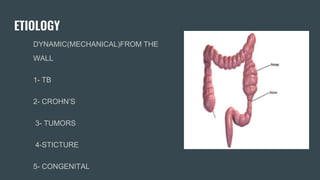
ETIOLOGY
DYNAMIC(MECHANICAL)FROM THE
WALL
1- TB
2- CROHN’S
3- TUMORS
4-STICTURE
5- CONGENITAL
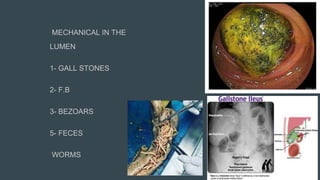
MECHANICAL IN THE
LUMEN
1- GALL STONES
2- F.B
3- BEZOARS
5- FECES
WORMS
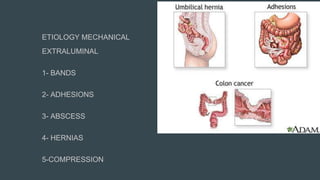
ETIOLOGY MECHANICAL
EXTRALUMINAL
1- BANDS
2- ADHESIONS
3- ABSCESS
4- HERNIAS
5-COMPRESSION
Adynamic Intestinal Obstruction.
1- Peritonitis
2- Electrolytes’ Imbalance
3- Postoperative
4- Ischemia
5- Drugs
6- Retroperitoneal causes..
MOST COMMON CAUSES OF INTESTINAL OBSTRUCTION
ADHESIVE DISEASE -60%
NEOPLASM -20%
HERNIA -10%
INFLAMMATORY BOWEL DISEASE 5%
INSTUSSUSCEPTION <5 %
VOLVULOUS <5%
OTHER <5%
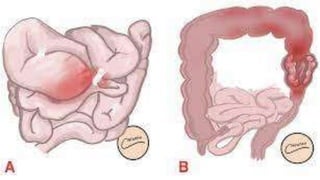
PATHOPHYSIOLOGY OF OBSTRUCTION
Simple ,Closed loop, Strangulated
SIMPLE-
1-ABOVE THE OBSTRUCTION - Peristalsis increases Intestine dilates Reduction
in peristaltic strength -Flaccidity and paralysis (protective but late)
2- BELOW THE OBSTRUCTION -NORMAL PERISTALSIS & ABSORBTION Until it
becomes empty -It contracts & becomes immobile
Distention of the intestine is caused by accumulation of:
1- GAS
Swallowed air
Bacterial overgrowth
Diffusion from blood
2- FLUIDS -
Ingested fluids
Saliva
Gastric and intestinal juice
Bile & Pancreatic secretions
DEHYDRATION
1. Reduced intake
2. Reduced absorption
3. Increased loss (Vomiting & sequestration)
Systemic Effects of Obstruction :
1. Water and electrolyte losses (lead to hypovolemia)
2. Toxic materials and toxemia(lead to sepsis)
3. Cardiopulmonary dysfunction(atelectasis)
4. Renal failure
5. Shock and death
ADYNAMIC
Either localized or generalized
Small intestine
Postoperative - Intra-abdominal abscess or peritonitis
Mesenteric embolism or thrombosis
Large intestine
Retroperitoneal hematoma
Drugs
Hypokalemia
Idiopathic
STRANGULATION
Obstruction with compromised blood flow;
it occurs in nearly 25% of patients with small-bowel obstruction.
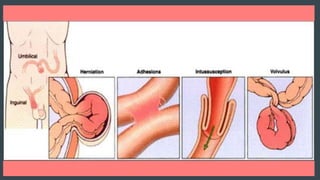
It is usually associated with hernia, volvulus, and intussusceptions.
Strangulating obstruction can progress to infarction and gangrene in as little
as 6 h.
Venous obstruction occurs first,
arterial occlusion,
resulting in rapid ischemia of the bowel wall.
The ischemic bowel becomes edematous and infarcts, leading to
gangrene and perforation.
In large- bowel obstruction, strangulation is rare (except with
volvulus
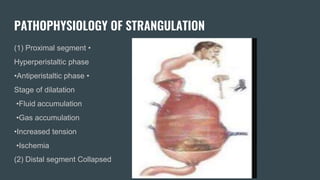
PATHOPHYSIOLOGY OF STRANGULATION
(1) Proximal segment •
Hyperperistaltic phase
•Antiperistaltic phase •
Stage of dilatation
•Fluid accumulation
•Gas accumulation
•Increased tension
•Ischemia
(2) Distal segment Collapsed
impaired venous return
Increased congestion
free peritoneal fluid
edema of intestinal wall
blood in the lumen
impaired arterial blood supply
ischemia and gangrene
CLOSED LOOP OBSTRUCTION
Obstruction in which two points along the course of a bowel are obstructed at a single
location thus forming a closed loop. Usually this is due to adhesions, a twist of the mesentery
or internal herniation.
In the large bowel it is known as a volvulus.
In the small bowel it is simply known as small bowel closed loop obstruction. •
Obstruction to the blood supply occur either from the same mechanism which caused
obstruction or by the twist of the bowel on mesentery
DIAGNOSIS- HISTORY,PE,INVESTIGATION
HISTORY-VOMITING,ABDOMINAL PAIN, CONSTIPATION,ABDOMINAL
DISTENSION.
Clinical features vary according to
The location of the obstruction
The age of the obstruction
The underlying pathology
The presence or the absence of the intestinal obstruction;
Pain is the first symptom
It occurs suddenly and is usually severe..
It is colicky in nature ,
centered on the umbilicus (small bowel)
or lower abdomen (large bowel).
The pain coincides with the increasing peristaltic activity
Vomiting-
The more distal the obstruction ,the longer the interval between the onset of
symptoms and the appearance of nausea and vomiting .
More proximal the obstruction,-more the frequency.
The interval ,frequency & nature of vomitus depends on the site of obstruction
In high bowel obstruction
The interval is shorter
Bile stained vomitus
Vomiting is more frequent and copious
And is relieved by decompressing the obstructed bowel
In low bowel obstruction :
The interval is longer may last for a day or two
Feculent vomitus
vomiting is less frequent and does not cause any relief.
Long standing low small bowel obstruction
feculent material.
• Strangulation- blood.
DISTENTION
In the small bowel, the degree of distention is dependent on the
site of obstruction & is greater the more distal the lesion.
Central abdomen is distended in low small bowel obstruction.
Distention is much less in high small bowel obstruction.
CONSTIPATION • Failure to pass flatus or faeces through the
rectum is important symptom of bowel obstruction.
VISIBLE PERISTALSIS
Mostly seen in proximal loops.
Borborygmi is quite loud ,does not require stethoscope to hear it .
In auscultation sound of hyper peristalsis coinciding with attack of
colic
BLOATING
The accumulation of chyme and gas gives rise to a feeling of fullness
and causes bloating.
This may also give rise to high-pitched gurgling sounds from the
abdomen
FATIGUE
Obstruction and the resulting digestive inability hampers the
absorption of vitamins and other nutrients from food, leading to
weakness, headache and dizziness.
Even regular activities may make the individual feel exhausted and
drowsy
INFREQUENT URINATION
Dehydration due to diarrhea and vomiting,
results in the loss of body fluids and electrolytes.
As a response to this, the body tries to retain water through
lowered urine output.
PHYSICAL EXAMINATION
1. PHYSICAL EXAMINATION
2. • Inspection
3. • Palpation
4. • Percussion
5. • Auscultation
6. • Rectal examination
7. INSPECTION-Shape of the abdomen ,Movement of the abdomen wall ,Umbilicus
,Visible loop of bowel/visible peristalsis ,Scar Striae Prominent veins ,Hernial orifices
During colic there may be muscle guarding.
Slight tenderness may be present between attacks of pain.
Tenderness and rigidity at the sight of obstruction usually indicate strangulation.
All the hernial orifices should be palpated to exclude the presence of hernia.
Percussion to hear any Dullness or Resonance related to site of obstruction.
Tympanic note will be present.
Tenderness on light percussion suggest strangulation
AUSCULTATION
Bowel sounds are Initially Loud and frequent Then as bowel distends the sounds
become more resonant and high pitched Eventually becoming amphoric.
In strangulation bowel sound is completely absent.
RECTAL EXAMINATION Presence of mass on rectal examination within or outside
the lumen will give a clue to diagnosis.
Presence or absence of feces in rectum should be noted.
Absence means obstruction is higher up.
If presence it should be studied for presence of occult blood which include mucosal
lesion e.g.cancer, Intussuception or infarction
INVESTIGATION
• BLOOD EXAMINATION • RADIOLOGICAL EXAMINATION
CBC (Complete blood count)-
A rise white cell count will indicate an infection.
Normal or slight rise in W.B.C count: simple mechanical obstruction.
Moderate rise in W.B.C count(15000- 20000):strangulation.
Very high rise in W.B.C count(30000- 40000):primary mesenteric vascular
occlusion.
Serum Urea & electrolytes- Derangement may be seen with vomiting & diarrhea.
Dehydration will be reflected in raised serum urea and creatinine.
Serum Amylase- • It is non specific test & may be raised in cases of small intestinal
obstruction.
Metabolic acidosis
It occurs due to combined effects of dehydration ketosis and loss of alkaline
secretion. Very common in distal intestinal obstruction.
RADIOLOGICAL EXAMINATION
Xrays: ? AFLs, ? Free Air, ? Distal Gas •
UGI / SBFT: Identify mechanical obstruction •
Enteroclysis:
CT Scan: ? Free Air, ? Pneumatosis, ? Tumor
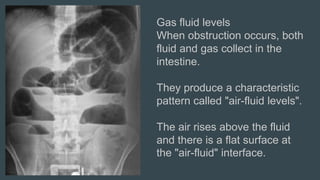
Gas fluid levels
When obstruction occurs, both
fluid and gas collect in the
intestine.
They produce a characteristic
pattern called "air-fluid levels".
The air rises above the fluid
and there is a flat surface at
the "air-fluid" interface.
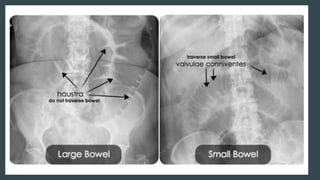
RADIOLOGICAL PICTURE
Small Bowel Obstruction
Central distention (GAS)
Valvulae conniventes
Ladder-like dilatation
Small diameter
Large Bowel Obstruction
Peripheral distention “Picture frame”
More gross distention
Haustral indentation & large diameter
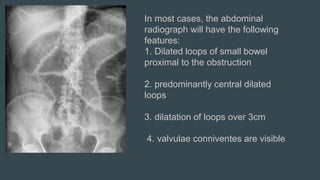
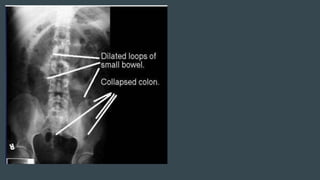
In most cases, the abdominal
radiograph will have the following
features:
1. Dilated loops of small bowel
proximal to the obstruction
2. predominantly central dilated
loops
3. dilatation of loops over 3cm
4. valvulae conniventes are visible
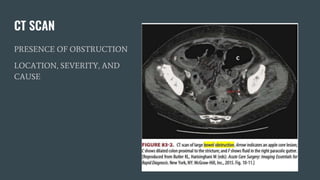
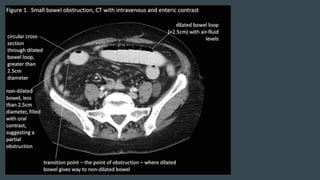
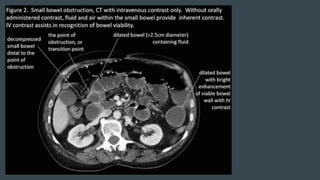
CT SCAN
PRESENCE OF OBSTRUCTION
LOCATION, SEVERITY, AND
CAUSE
TREATMENT
DANGEROUS SIGNS (Red Flags)
Constant pain
Absent bowel sound
Tenderness with rigidity
Leukocytosis
Fever and tachycardia
Shock
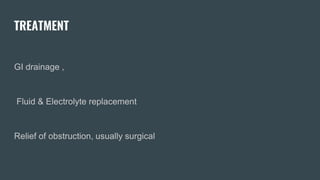
TREATMENT
GI drainage ,
Fluid & Electrolyte replacement
Relief of obstruction, usually surgical
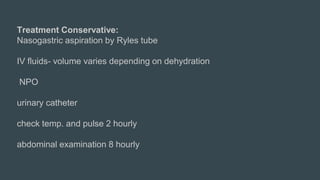
Treatment Conservative:
Nasogastric aspiration by Ryles tube
IV fluids- volume varies depending on dehydration
NPO
urinary catheter
check temp. and pulse 2 hourly
abdominal examination 8 hourly
Broad spectrum antibiotics initiated early- reduce bacterial
overgrowth.
Monotherapy - piperacillin tazobactom - 3.375 gm iv q6H Or
ticarcillin clavulanate 3.1 gm iv q6H, OR Carbapenam
Some cases - conservative regimen,
other need surgical intervention.
Surgery should be delayed till resuscitation is complete unless
signs of strangulation
closed-loop obstruction.
Indication for surgery
failure of conservative management
tender, irreducible hernia
strangulation
virgin abdomen
Bowel necrosis
If the site of obstruction is unknown;
laparotomy assessment is directed to
1)The site of obstruction.
2)The nature of obstruction.
3)The viability of gut
MANAGEMENT OF ACUTE CASE (Plan)
1. I.V Fluids and electrolytes rescusitation for all
2. N.G tube if repeated vomiting
3. Antibiotics for all
4. Hernia -Operation
5. Adhesions Conservative first
6. Obstruction Remove
7. Volvulus Derotate and or Operate
8. Mesenteric ischemia Operate
9. Abscess or Peritonitis Drain and Treat
10.Intussusception Pneumatic or Barium Reduction or
Operate
DISPOSITION
Admit the patient with bowel obstruction
OT
ICU
WARD
REFERENCE
TINTINALLI 9TH EDITION
BAILEY AND LOVE 27TH EDITION
ROSEN’S TEXTBOOK OF EMERGENCY 9TH EDITION
AAFP.ORG

INTESTINAL OBSTRUCTION.pptx

  • 1.
  • 2.
    INTRODUCTION Inability of theintestinal tract to allow for regular passage of food and bowel contents MECHANICAL OBSTRUCTION ADYNAMIC ILEUS
  • 3.
    CLASSIFICATION Dynamic/ Adynamic Small bowelobstruction [ high or low ] Large bowel obstruction Acute, Chronic, Acute on chronic ,Subacute Simple Strangulated Closed loop obstruction
  • 4.
    DYNAMIC AND ADYNAMIC DYNAMIC: where peristalsis is working against a mechanical obstruction. ADYNAMIC: it may occur in two forms 1st where peristalsis may be absent (paralytic ileus,)occurring secondarily to neuromuscular failure in the mesentery. 2nd where peristalsis may be present in non- propulsive form.(pseudo-obstruction) IN BOTH FORMS MECHANICAL ELEMENT IS ABSENT.
  • 5.
    MECHANICAL OBSTRUCTION There isphysical blockage of intestinal lumen which due to: 1. Intramural : congenital,tumor,hematoma,inflammatory 2. Extramural : adhesion-volvulus-hernia –abscess-hematoma 3. Lumen obstruction: stone-meconium-foreign body- impaction (stool-worm- barium) Mechanical obstruction can be partial ( lumen narrowed but allow transit some content) or
  • 6.
    complete ( lumentotally obstruction) this classify to A. simple obstruction (no vascular impairment) B. closed loop ( both ends are obstructed e.g volvulus) C. strangulation obstruction
  • 7.
    ON THE BASISOF NATURE CLASSIFIED IN TO ACUTE CHRONIC ACUTE ON CHRONIC SUBACUTE . ACUTE OBSTRUCTION : IT USUALLY OCCUR IN SMALL BOWEL OBSTRUCTION WITH SUDDEN ONSET OF SEVERE COLICKY CENTRAL ABDOMINAL PAIN,DISTENTION AND EARLY VOMITING AND CONSTIPATION. CHRONIC OBSTRUCTION : USUALLY SEEN IN LARGE BOWEL OBSTRUCTION WITH LOWER ABDOMINAL COLIC AND ABSOLUTE CONSTIPATION,FOLLOWED BY DISTENTION.
  • 8.
    ACUTE ON CHRONICOBSTRUCTION : IT STARTS IN LARGE BOWEL BUT GRADUALLY INVOLVES THE SMALL INTESTINE. EARLY SYMPTOMS ARE PAIN AND CONSTIPATION BUT WHEN SMALL INTESTINE IS INVOLVED IT IS CHARACTERIZED BY VOMITING AND GENERAL DISTENTION
  • 9.
    ETIOLOGY DYNAMIC(MECHANICAL)FROM THE WALL 1- TB 2-CROHN’S 3- TUMORS 4-STICTURE 5- CONGENITAL
  • 10.
    MECHANICAL IN THE LUMEN 1-GALL STONES 2- F.B 3- BEZOARS 5- FECES WORMS
  • 11.
    ETIOLOGY MECHANICAL EXTRALUMINAL 1- BANDS 2-ADHESIONS 3- ABSCESS 4- HERNIAS 5-COMPRESSION
  • 12.
    Adynamic Intestinal Obstruction. 1-Peritonitis 2- Electrolytes’ Imbalance 3- Postoperative 4- Ischemia 5- Drugs 6- Retroperitoneal causes..
  • 13.
    MOST COMMON CAUSESOF INTESTINAL OBSTRUCTION ADHESIVE DISEASE -60% NEOPLASM -20% HERNIA -10% INFLAMMATORY BOWEL DISEASE 5% INSTUSSUSCEPTION <5 % VOLVULOUS <5% OTHER <5%
  • 14.
    PATHOPHYSIOLOGY OF OBSTRUCTION Simple,Closed loop, Strangulated SIMPLE- 1-ABOVE THE OBSTRUCTION - Peristalsis increases Intestine dilates Reduction in peristaltic strength -Flaccidity and paralysis (protective but late) 2- BELOW THE OBSTRUCTION -NORMAL PERISTALSIS & ABSORBTION Until it becomes empty -It contracts & becomes immobile
  • 16.
    Distention of theintestine is caused by accumulation of: 1- GAS Swallowed air Bacterial overgrowth Diffusion from blood 2- FLUIDS - Ingested fluids Saliva Gastric and intestinal juice Bile & Pancreatic secretions
  • 17.
    DEHYDRATION 1. Reduced intake 2.Reduced absorption 3. Increased loss (Vomiting & sequestration) Systemic Effects of Obstruction : 1. Water and electrolyte losses (lead to hypovolemia) 2. Toxic materials and toxemia(lead to sepsis) 3. Cardiopulmonary dysfunction(atelectasis) 4. Renal failure 5. Shock and death
  • 18.
    ADYNAMIC Either localized orgeneralized Small intestine Postoperative - Intra-abdominal abscess or peritonitis Mesenteric embolism or thrombosis Large intestine Retroperitoneal hematoma Drugs Hypokalemia Idiopathic
  • 19.
    STRANGULATION Obstruction with compromisedblood flow; it occurs in nearly 25% of patients with small-bowel obstruction. It is usually associated with hernia, volvulus, and intussusceptions. Strangulating obstruction can progress to infarction and gangrene in as little as 6 h.
  • 21.
    Venous obstruction occursfirst, arterial occlusion, resulting in rapid ischemia of the bowel wall. The ischemic bowel becomes edematous and infarcts, leading to gangrene and perforation. In large- bowel obstruction, strangulation is rare (except with volvulus
  • 22.
    PATHOPHYSIOLOGY OF STRANGULATION (1)Proximal segment • Hyperperistaltic phase •Antiperistaltic phase • Stage of dilatation •Fluid accumulation •Gas accumulation •Increased tension •Ischemia (2) Distal segment Collapsed
  • 23.
    impaired venous return Increasedcongestion free peritoneal fluid edema of intestinal wall blood in the lumen impaired arterial blood supply ischemia and gangrene
  • 24.
    CLOSED LOOP OBSTRUCTION CLOSEDLOOP OBSTRUCTION Obstruction in which two points along the course of a bowel are obstructed at a single location thus forming a closed loop. Usually this is due to adhesions, a twist of the mesentery or internal herniation. In the large bowel it is known as a volvulus. In the small bowel it is simply known as small bowel closed loop obstruction. • Obstruction to the blood supply occur either from the same mechanism which caused obstruction or by the twist of the bowel on mesentery
  • 25.
    DIAGNOSIS- HISTORY,PE,INVESTIGATION HISTORY-VOMITING,ABDOMINAL PAIN,CONSTIPATION,ABDOMINAL DISTENSION. Clinical features vary according to The location of the obstruction The age of the obstruction The underlying pathology The presence or the absence of the intestinal obstruction;
  • 26.
    Pain is thefirst symptom It occurs suddenly and is usually severe.. It is colicky in nature , centered on the umbilicus (small bowel) or lower abdomen (large bowel). The pain coincides with the increasing peristaltic activity Vomiting- The more distal the obstruction ,the longer the interval between the onset of symptoms and the appearance of nausea and vomiting . More proximal the obstruction,-more the frequency. The interval ,frequency & nature of vomitus depends on the site of obstruction
  • 27.
    In high bowelobstruction The interval is shorter Bile stained vomitus Vomiting is more frequent and copious And is relieved by decompressing the obstructed bowel In low bowel obstruction : The interval is longer may last for a day or two Feculent vomitus vomiting is less frequent and does not cause any relief. Long standing low small bowel obstruction feculent material. • Strangulation- blood.
  • 28.
    DISTENTION In the smallbowel, the degree of distention is dependent on the site of obstruction & is greater the more distal the lesion. Central abdomen is distended in low small bowel obstruction. Distention is much less in high small bowel obstruction. CONSTIPATION • Failure to pass flatus or faeces through the rectum is important symptom of bowel obstruction. VISIBLE PERISTALSIS Mostly seen in proximal loops. Borborygmi is quite loud ,does not require stethoscope to hear it . In auscultation sound of hyper peristalsis coinciding with attack of colic
  • 30.
    BLOATING The accumulation ofchyme and gas gives rise to a feeling of fullness and causes bloating. This may also give rise to high-pitched gurgling sounds from the abdomen FATIGUE Obstruction and the resulting digestive inability hampers the absorption of vitamins and other nutrients from food, leading to weakness, headache and dizziness. Even regular activities may make the individual feel exhausted and drowsy
  • 31.
    INFREQUENT URINATION Dehydration dueto diarrhea and vomiting, results in the loss of body fluids and electrolytes. As a response to this, the body tries to retain water through lowered urine output.
  • 32.
    PHYSICAL EXAMINATION 1. PHYSICALEXAMINATION 2. • Inspection 3. • Palpation 4. • Percussion 5. • Auscultation 6. • Rectal examination 7. INSPECTION-Shape of the abdomen ,Movement of the abdomen wall ,Umbilicus ,Visible loop of bowel/visible peristalsis ,Scar Striae Prominent veins ,Hernial orifices
  • 33.
    During colic theremay be muscle guarding. Slight tenderness may be present between attacks of pain. Tenderness and rigidity at the sight of obstruction usually indicate strangulation. All the hernial orifices should be palpated to exclude the presence of hernia. Percussion to hear any Dullness or Resonance related to site of obstruction. Tympanic note will be present. Tenderness on light percussion suggest strangulation
  • 34.
    AUSCULTATION Bowel sounds areInitially Loud and frequent Then as bowel distends the sounds become more resonant and high pitched Eventually becoming amphoric. In strangulation bowel sound is completely absent. RECTAL EXAMINATION Presence of mass on rectal examination within or outside the lumen will give a clue to diagnosis. Presence or absence of feces in rectum should be noted. Absence means obstruction is higher up. If presence it should be studied for presence of occult blood which include mucosal lesion e.g.cancer, Intussuception or infarction
  • 35.
    INVESTIGATION • BLOOD EXAMINATION• RADIOLOGICAL EXAMINATION CBC (Complete blood count)- A rise white cell count will indicate an infection. Normal or slight rise in W.B.C count: simple mechanical obstruction. Moderate rise in W.B.C count(15000- 20000):strangulation. Very high rise in W.B.C count(30000- 40000):primary mesenteric vascular occlusion.
  • 36.
    Serum Urea &electrolytes- Derangement may be seen with vomiting & diarrhea. Dehydration will be reflected in raised serum urea and creatinine. Serum Amylase- • It is non specific test & may be raised in cases of small intestinal obstruction. Metabolic acidosis It occurs due to combined effects of dehydration ketosis and loss of alkaline secretion. Very common in distal intestinal obstruction.
  • 37.
    RADIOLOGICAL EXAMINATION Xrays: ?AFLs, ? Free Air, ? Distal Gas • UGI / SBFT: Identify mechanical obstruction • Enteroclysis: CT Scan: ? Free Air, ? Pneumatosis, ? Tumor
  • 38.
    Gas fluid levels Whenobstruction occurs, both fluid and gas collect in the intestine. They produce a characteristic pattern called "air-fluid levels". The air rises above the fluid and there is a flat surface at the "air-fluid" interface.
  • 39.
    RADIOLOGICAL PICTURE Small BowelObstruction Central distention (GAS) Valvulae conniventes Ladder-like dilatation Small diameter Large Bowel Obstruction Peripheral distention “Picture frame” More gross distention Haustral indentation & large diameter
  • 41.
    In most cases,the abdominal radiograph will have the following features: 1. Dilated loops of small bowel proximal to the obstruction 2. predominantly central dilated loops 3. dilatation of loops over 3cm 4. valvulae conniventes are visible
  • 43.
    CT SCAN PRESENCE OFOBSTRUCTION LOCATION, SEVERITY, AND CAUSE
  • 46.
    TREATMENT DANGEROUS SIGNS (RedFlags) Constant pain Absent bowel sound Tenderness with rigidity Leukocytosis Fever and tachycardia Shock
  • 47.
    TREATMENT GI drainage , Fluid& Electrolyte replacement Relief of obstruction, usually surgical
  • 48.
    Treatment Conservative: Nasogastric aspirationby Ryles tube IV fluids- volume varies depending on dehydration NPO urinary catheter check temp. and pulse 2 hourly abdominal examination 8 hourly
  • 49.
    Broad spectrum antibioticsinitiated early- reduce bacterial overgrowth. Monotherapy - piperacillin tazobactom - 3.375 gm iv q6H Or ticarcillin clavulanate 3.1 gm iv q6H, OR Carbapenam Some cases - conservative regimen, other need surgical intervention. Surgery should be delayed till resuscitation is complete unless signs of strangulation closed-loop obstruction.
  • 50.
    Indication for surgery failureof conservative management tender, irreducible hernia strangulation virgin abdomen Bowel necrosis If the site of obstruction is unknown; laparotomy assessment is directed to 1)The site of obstruction. 2)The nature of obstruction. 3)The viability of gut
  • 51.
    MANAGEMENT OF ACUTECASE (Plan) 1. I.V Fluids and electrolytes rescusitation for all 2. N.G tube if repeated vomiting 3. Antibiotics for all 4. Hernia -Operation 5. Adhesions Conservative first 6. Obstruction Remove 7. Volvulus Derotate and or Operate 8. Mesenteric ischemia Operate 9. Abscess or Peritonitis Drain and Treat 10.Intussusception Pneumatic or Barium Reduction or Operate
  • 52.
    DISPOSITION Admit the patientwith bowel obstruction OT ICU WARD
  • 53.
    REFERENCE TINTINALLI 9TH EDITION BAILEYAND LOVE 27TH EDITION ROSEN’S TEXTBOOK OF EMERGENCY 9TH EDITION AAFP.ORG