Interview
Derived from French word “entrevoir” which
means “to see each other, visit each other
briefly, have a glimpse of”.
An interview is a gentle conversation
between two people or more where questions
are asked to a person to get the required
responses or answers.
Definitions given by different Scholars
• Scott, “an interview is a purposeful exchange of
ideas, the answering of questions and
communication between two or more persons.
• Bingham, defined interview as “a conversation with a
purpose”.
• Garry Dessler, “an interview is a procedure designed
to obtain information from a person's oral response
to oral inquiries.
• W.J.Goode & PK Hatt, “interviewing is fundamentally
a process of social interaction.
Nature & characteristics of interiew:
I. It is a social interaction.
II. It investigates issues in a depth way.
III. It discovers how individuals think and feel about a
topic and why they hold certain opinions.
IV. It involves establishments of a rapport between the
interviewer and interviewee.
V. It is behavioral method.
VI. It can help to reach out sensitive topics which
people may feel uncomfortable discussing in a focus
group.
VII.It adds a human dimension to impersonal data.
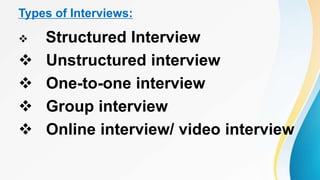
Types of Interviews:
 Structured Interview
 Unstructured interview
 One-to-one interview
 Group interview
 Online interview/ video interview
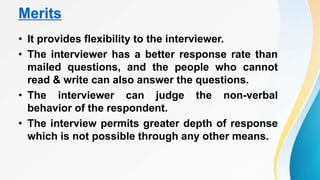
Merits
• It provides flexibility to the interviewer.
• The interviewer has a better response rate than
mailed questions, and the people who cannot
read & write can also answer the questions.
• The interviewer can judge the non-verbal
behavior of the respondent.
• The interview permits greater depth of response
which is not possible through any other means.
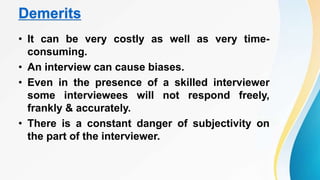
Demerits
• It can be very costly as well as very time-
consuming.
• An interview can cause biases.
• Even in the presence of a skilled interviewer
some interviewees will not respond freely,
frankly & accurately.
• There is a constant danger of subjectivity on
the part of the interviewer.
Interview, nature, types, merits & demerits

Interview, nature, types, merits & demerits

  • 2.
    Interview Derived from Frenchword “entrevoir” which means “to see each other, visit each other briefly, have a glimpse of”. An interview is a gentle conversation between two people or more where questions are asked to a person to get the required responses or answers.
  • 3.
    Definitions given bydifferent Scholars • Scott, “an interview is a purposeful exchange of ideas, the answering of questions and communication between two or more persons. • Bingham, defined interview as “a conversation with a purpose”. • Garry Dessler, “an interview is a procedure designed to obtain information from a person's oral response to oral inquiries. • W.J.Goode & PK Hatt, “interviewing is fundamentally a process of social interaction.
  • 4.
    Nature & characteristicsof interiew: I. It is a social interaction. II. It investigates issues in a depth way. III. It discovers how individuals think and feel about a topic and why they hold certain opinions. IV. It involves establishments of a rapport between the interviewer and interviewee. V. It is behavioral method. VI. It can help to reach out sensitive topics which people may feel uncomfortable discussing in a focus group. VII.It adds a human dimension to impersonal data.
  • 5.
    Types of Interviews: Structured Interview  Unstructured interview  One-to-one interview  Group interview  Online interview/ video interview
  • 6.
    Merits • It providesflexibility to the interviewer. • The interviewer has a better response rate than mailed questions, and the people who cannot read & write can also answer the questions. • The interviewer can judge the non-verbal behavior of the respondent. • The interview permits greater depth of response which is not possible through any other means.
  • 7.
    Demerits • It canbe very costly as well as very time- consuming. • An interview can cause biases. • Even in the presence of a skilled interviewer some interviewees will not respond freely, frankly & accurately. • There is a constant danger of subjectivity on the part of the interviewer.