OBSERVATIONAL TECHNIQUES
Seminar
on
Presented by
Vikash Kumar , PhD 1st year
Presented to
Dr. K. Ponnusamy
Observational Techniques
• A social research technique that involves the
direct observation of phenomena in their
natural setting.
• This differentiates it from experimental
research in which a quasi-artificial
environment is created to control for spurious
factors, and where at least one of the variables
is manipulated as part of the experiment.
• Associated with qualitative research.
…
• Observational research tends to be less reliable
than quantitative and experimental research but
often more valid.
• Observational research measures behaviour
directly, rather than the subject's self-reports of
behaviour or intentions.
• The main advantage of observational research is
flexibility i.e. the researchers can change their
approach as needed.
• The main disadvantage is it is limited to
behavioural variables. It cannot be used to study
cognitive or affective variables.
Types of observation
1. Controlled Observations
2. Natural Observations
3. Participant Observations
4. overt/disclosed
5. covert/undisclosed
Controlled Observation
• Are usually a structured observation
• The researcher decides place of observation,
time, type of participants, circumstances and
uses a standardised procedure.
• Participants are randomly allocated to each
independent variable group.
• Rather than writing a detailed description of all
behavior observed, it is often easier to code
behavior according to a scale using a behavior
schedule.
…• The researcher systematically classifies the
behavior they observe into distinct categories.
• Mary Ainsworth studied infant’s response to brief
periods of separation from their mothers
• Controlled observations can lack validity due to the
Hawthorne effect/demand characteristics.
…
• Controlled observations are usually overt as the
researcher explains the research aim to the group,
so the participants know they are being observed.
• Advantages
1. Controlled observations can be easily replicated by
other researchers by using the same observation
schedule.
2. The data obtained from structured observations is
easier and quicker to analyse as it is quantitative
(i.e. numerical).
3. Controlled observations are fairly quick to conduct
which means that many observations can take
place within a short amount of time.
Observational Design: Structured
observation
• Behaviour
1. Behaviour is operationalized.
2. Only behaviour under investigation is observed
and recorded.
• Sampling procedure
1. Event sampling: Recording the number of times
something happens.
2. Time sampling: Recording behaviours in a given
time frame eg. What someone is doing in every 30
seconds.
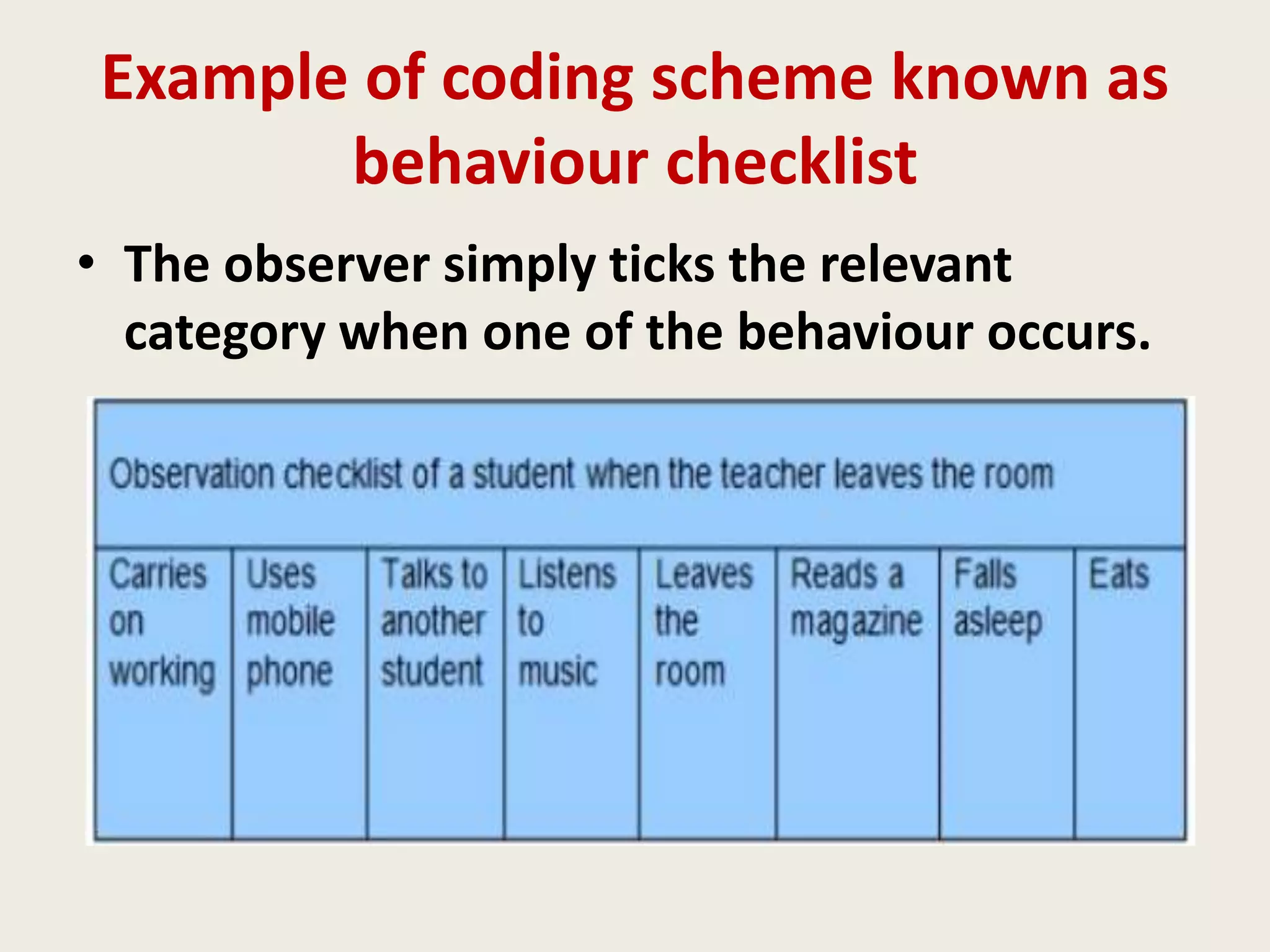
Example of coding scheme known as
behaviour checklist
• The observer simply ticks the relevant
category when one of the behaviour occurs.
Naturalistic Observation
• It is unstructured observation involving studying the
spontaneous behaviour of participants in natural
surroundings.
• The researcher simply records what they see in
whatever way they can.
• Kathy Sylva used it to study children at play by
observing their behavior in a playgroup in
Oxfordshire.
• Margaret Mead used this method to research the
way of life of different tribes living on islands in the
South
…
• Strengths
1. By being able to observe the flow of behavior in its own
setting studies have greater ecological validity.
2. Like case studies naturalistic observation is often used to
generate new ideas.
• Limitations
1. These observations are often conducted on a micro (small)
scale and may lack a representative sample
2. Natural observations are less reliable as other variables
cannot be controlled.
3. Researcher needs to be trained to be able to recognise
aspects of a situation that are psychologically significant
4. With observations we do not have manipulations of
variables (or control over extraneous variables) which
means cause and effect relationships cannot be
established.
Participant Observation
• It is a variant of natural observation, researcher
joins in and becomes part of the group they are
studying to get a deeper insight into their lives.
• This approach was used by Leon Festinger in a
famous study into a religious cult who believed
that the end of the world was about to
occur. He joined the cult and studied how they
reacted when the prophecy did not come true.
• Participant observations can be either cover or
overt.
…
• Covert is where researcher's real identity and
purpose are kept concealed from the group.
• Overt is where the researcher reveals his or her
true identity and purpose to the group and asks
permission to observe.
• Limitation
1. It can be difficult to get time / privacy for
recording. This means they have to wait until
they are alone and reply on their memory.
2. If the researcher becomes too involved they
may lose objectivity and become bias. Thus
reducing the validity of their data.
Covert observational research
• The researchers do not identify themselves. Either
they mix in with the subjects undetected, or they
observe from a distance.
• Advantages:
1. It is not necessary to get the subjects'
cooperation.
2. The subjects' behaviour will not be contaminated
by the presence of the researcher
• Disadvantages:
1. Raises ethical issues.
2. Participants are not given consent to be observed
and their behaviour recorded.
Overt observational research
• The researchers identify themselves as researchers
and explain the purpose of their observations.
• They portray their "ideal self" rather than their
true self in what is called the Hawthorne Effect.
• The advantage that the overt approach has over
the covert approach is that there is no deception
and given informed consent to participant.
• The problem with this approach is subjects may
modify their behaviour when they know they are
being watched.
• Eg. HOD observes students by sitting at back sit.
Non-participant observation
• Observer observes behaviour but not
involved in it.
• Data can be recorded in an unstructured or
structured way.
• Strength: Data can be collected in a precise
and systematic way.
• Weakness: 1. Some relevant behaviours may
be hidden. 2. Understanding of behaviour
observed may also be limited.
Recording of data
With all observation studies an important decision the researcher has to make is
how to classify and record the data.
1. Event sampling. The observer decides in advance what types of behaviour
(events) she is interested in and records all occurrences. All other types of
behaviour are ignored.
2. Time sampling. The observer decides in advance that observation will take
place only during specified time periods (e.g. 10 minutes every hour, 1 hour
per day) and records the occurrence of the specified behaviour during that
period only.
3. Instantaneous (target time) sampling. The observer decides in advance the
pre-selected moments when observation will take place and records what is
happening at that instant. Everything happening before or after is ignored.
Getting ready for observation
• Select a location.
• Try to reach theological Saturation (the point
where new interviewees look a lot like
interviewees or situation one has observed
before).
• Most common done in non-random format
• Purposive sampling (based on researcher
judgment that which element will facilitate in
diffusion) is most common.
…
• Researcher need to decide how much
information will be conveyed to participants
about yourself and your research. (Disclosure of
your interest can be helpful).
• General recommendation before doing
observation 1. Have good review of literature.
2. Try to see earlier examples of participant and
non-participant observation.
• Gain assess in covert research and beware
about ethical concerns of respondents.
…
• How to get assess and ethical concerns
1. Give plaussible and appealing explanation of
research to prospective participants.
2. Try to have a gatekeeper (someone who can
get you to the setting).
• Gather the data
1. (write it down or record it mechanically)
because memory is most common but least
trustworthy.
2. Use visual sociology (employs image as data
source) and its techniques (subject image
making and photo and video ethnography).
…
• Interview other participants who are known as
informants.
• Analyse the data: Look for similarity and
differences in behaviour. Similarity lead to
generalisation on which Grounded theory is
based.
Thank You

Observational techniques

  • 1.
    OBSERVATIONAL TECHNIQUES Seminar on Presented by VikashKumar , PhD 1st year Presented to Dr. K. Ponnusamy
  • 2.
    Observational Techniques • Asocial research technique that involves the direct observation of phenomena in their natural setting. • This differentiates it from experimental research in which a quasi-artificial environment is created to control for spurious factors, and where at least one of the variables is manipulated as part of the experiment. • Associated with qualitative research.
  • 3.
    … • Observational researchtends to be less reliable than quantitative and experimental research but often more valid. • Observational research measures behaviour directly, rather than the subject's self-reports of behaviour or intentions. • The main advantage of observational research is flexibility i.e. the researchers can change their approach as needed. • The main disadvantage is it is limited to behavioural variables. It cannot be used to study cognitive or affective variables.
  • 4.
    Types of observation 1.Controlled Observations 2. Natural Observations 3. Participant Observations 4. overt/disclosed 5. covert/undisclosed
  • 5.
    Controlled Observation • Areusually a structured observation • The researcher decides place of observation, time, type of participants, circumstances and uses a standardised procedure. • Participants are randomly allocated to each independent variable group. • Rather than writing a detailed description of all behavior observed, it is often easier to code behavior according to a scale using a behavior schedule.
  • 6.
    …• The researchersystematically classifies the behavior they observe into distinct categories. • Mary Ainsworth studied infant’s response to brief periods of separation from their mothers • Controlled observations can lack validity due to the Hawthorne effect/demand characteristics.
  • 7.
    … • Controlled observationsare usually overt as the researcher explains the research aim to the group, so the participants know they are being observed. • Advantages 1. Controlled observations can be easily replicated by other researchers by using the same observation schedule. 2. The data obtained from structured observations is easier and quicker to analyse as it is quantitative (i.e. numerical). 3. Controlled observations are fairly quick to conduct which means that many observations can take place within a short amount of time.
  • 8.
    Observational Design: Structured observation •Behaviour 1. Behaviour is operationalized. 2. Only behaviour under investigation is observed and recorded. • Sampling procedure 1. Event sampling: Recording the number of times something happens. 2. Time sampling: Recording behaviours in a given time frame eg. What someone is doing in every 30 seconds.
  • 9.
    Example of codingscheme known as behaviour checklist • The observer simply ticks the relevant category when one of the behaviour occurs.
  • 10.
    Naturalistic Observation • Itis unstructured observation involving studying the spontaneous behaviour of participants in natural surroundings. • The researcher simply records what they see in whatever way they can. • Kathy Sylva used it to study children at play by observing their behavior in a playgroup in Oxfordshire. • Margaret Mead used this method to research the way of life of different tribes living on islands in the South
  • 11.
    … • Strengths 1. Bybeing able to observe the flow of behavior in its own setting studies have greater ecological validity. 2. Like case studies naturalistic observation is often used to generate new ideas. • Limitations 1. These observations are often conducted on a micro (small) scale and may lack a representative sample 2. Natural observations are less reliable as other variables cannot be controlled. 3. Researcher needs to be trained to be able to recognise aspects of a situation that are psychologically significant 4. With observations we do not have manipulations of variables (or control over extraneous variables) which means cause and effect relationships cannot be established.
  • 12.
    Participant Observation • Itis a variant of natural observation, researcher joins in and becomes part of the group they are studying to get a deeper insight into their lives. • This approach was used by Leon Festinger in a famous study into a religious cult who believed that the end of the world was about to occur. He joined the cult and studied how they reacted when the prophecy did not come true. • Participant observations can be either cover or overt.
  • 13.
    … • Covert iswhere researcher's real identity and purpose are kept concealed from the group. • Overt is where the researcher reveals his or her true identity and purpose to the group and asks permission to observe. • Limitation 1. It can be difficult to get time / privacy for recording. This means they have to wait until they are alone and reply on their memory. 2. If the researcher becomes too involved they may lose objectivity and become bias. Thus reducing the validity of their data.
  • 14.
    Covert observational research •The researchers do not identify themselves. Either they mix in with the subjects undetected, or they observe from a distance. • Advantages: 1. It is not necessary to get the subjects' cooperation. 2. The subjects' behaviour will not be contaminated by the presence of the researcher • Disadvantages: 1. Raises ethical issues. 2. Participants are not given consent to be observed and their behaviour recorded.
  • 15.
    Overt observational research •The researchers identify themselves as researchers and explain the purpose of their observations. • They portray their "ideal self" rather than their true self in what is called the Hawthorne Effect. • The advantage that the overt approach has over the covert approach is that there is no deception and given informed consent to participant. • The problem with this approach is subjects may modify their behaviour when they know they are being watched. • Eg. HOD observes students by sitting at back sit.
  • 16.
    Non-participant observation • Observerobserves behaviour but not involved in it. • Data can be recorded in an unstructured or structured way. • Strength: Data can be collected in a precise and systematic way. • Weakness: 1. Some relevant behaviours may be hidden. 2. Understanding of behaviour observed may also be limited.
  • 17.
    Recording of data Withall observation studies an important decision the researcher has to make is how to classify and record the data. 1. Event sampling. The observer decides in advance what types of behaviour (events) she is interested in and records all occurrences. All other types of behaviour are ignored. 2. Time sampling. The observer decides in advance that observation will take place only during specified time periods (e.g. 10 minutes every hour, 1 hour per day) and records the occurrence of the specified behaviour during that period only. 3. Instantaneous (target time) sampling. The observer decides in advance the pre-selected moments when observation will take place and records what is happening at that instant. Everything happening before or after is ignored.
  • 18.
    Getting ready forobservation • Select a location. • Try to reach theological Saturation (the point where new interviewees look a lot like interviewees or situation one has observed before). • Most common done in non-random format • Purposive sampling (based on researcher judgment that which element will facilitate in diffusion) is most common.
  • 19.
    … • Researcher needto decide how much information will be conveyed to participants about yourself and your research. (Disclosure of your interest can be helpful). • General recommendation before doing observation 1. Have good review of literature. 2. Try to see earlier examples of participant and non-participant observation. • Gain assess in covert research and beware about ethical concerns of respondents.
  • 20.
    … • How toget assess and ethical concerns 1. Give plaussible and appealing explanation of research to prospective participants. 2. Try to have a gatekeeper (someone who can get you to the setting). • Gather the data 1. (write it down or record it mechanically) because memory is most common but least trustworthy. 2. Use visual sociology (employs image as data source) and its techniques (subject image making and photo and video ethnography).
  • 21.
    … • Interview otherparticipants who are known as informants. • Analyse the data: Look for similarity and differences in behaviour. Similarity lead to generalisation on which Grounded theory is based. Thank You