TOPIC 8:
INTERVIEWS
OBJECTIVES OF THE TOPIC
AT THE END OF THE LESSON STUDENTS WILL BE ABLE
TO:
UNDERSTAND WHAT IS INTERVIEWS, ITS SIGNIFICANCE
IN RESEARCH STUDIES, THE ETHICS IN CONDUCTING
INTERVIEWS, THE TYPES OF INTERVIEW QUESTIONS
AND HOW TO ANALYZE DATA FROM INTERVIEWS.
WHAT IS INTERVIEWS?
Interviews are a method of data collection
that involves two or more people
exchanging information through a series of
questions and answers.
MORE NOTES ON INTERVIEWS
? The questions are designed by a researcher to elicit
information from interview participants on a specific
topic or set of topics.
? Interviews are an excellent way to gather detailed
information.
? Interviews are also useful when your topic is rather
complex, requires lengthy explanation, or needs a
dialogue between two people to thoroughly
investigate.
https://scientificinquiryinsocialwork.pressbooks.com/chapter/13-1-interview-research-
what-is-it-and-when-should-it-be-used/
“An interview is generally a qualitative
research technique which involves asking open-ended
questions to converse with respondents and collect
elicit data about a subject.”
Interview Ethics:
Tips to Consider
https://www.slideshare.net/JoanneFrawley/interview-ethics
Interview Ethics: Tips to Consider
INCLUSIVENESS
? Think of the specific needs of the person you
are interviewing and try to make them as
comfortable as possible.
Interview Ethics: Tips to Consider
WITHDRAWING CONSENT
? It should be explained to the person that they
have the right to opt out of the interview at any
point
? They are also free to pass or skip any question if
they do not feel comfortable answering it
Interview Ethics: Tips to Consider
MINIMIZE HARM
? You should do no harm to the person when interviewing
them
? You should avoid any situations or activities that could
cause the person distress or upset
? This includes avoiding asking questions that the person
might find difficult to answer or emotionally upsetting
Let’s review some mysterious concepts
PERMISSION
? You should explain the specific purpose
and nature of the interview to the person
? You should then ask them to give their
explicit written consent to participate.
Let’s review some mysterious concepts
HONESTY
? You should be honest with the person you are
interviewing about the nature and purpose of
the interview
Let’s review some mysterious concepts
ACCEPTANCE
? It is your responsibility to acknowledge that the
person you are interviewing has a right to their
own opinions and beliefs about the topic.
? You may not share these beliefs or they might be
different from your opinion but it is important
that the person feels listened to and their opinion
is respected.
Let’s review some mysterious concepts
ANONYMIZATION
? The person being interviewed has a right to
protect their identity.
? You can choose not to refer to them by name in
the interview.
? Alternatively you can choose a fake name or
Pseudonym to refer to them during the interview
? Do not store personal information and interview
recordings in the same place
Let’s review some mysterious concepts
CONFIDENTIALITY & DATA PROTECTION
? You should not keep the person’s
information in any format for any longer
than necessary
Types of Interviews
questions in
Research
TYPES OF INTERVIEWS
? Structured Interviews
? Semi-Structured Interviews
? Unstructured Interviews
https://www.questionpro.com/blog/types-of-interviews/
Structured Interviews
Consist of a series of pre-determined
questions that all interviewees answer in
the same order. Data analysis usually
tends to be more straightforward because
researcher can compare and contrast
different answers given to the same
questions.
https://research-methodology.net/research-methods/qualitative-research/interviews/
Unstructured Interviews
are usually the least reliable from research
viewpoint, because no questions are prepared
prior to the interview and data collection is
conducted in an informal manner. Unstructured
interviews can be associated with a high level of
bias and comparison of answers given by
different respondents tends to be difficult due to
the differences in formulation of questions.
Semi-Structured Interviews
Contain the components of both, structured and
unstructured interviews. In semi-structured
interviews, interviewer prepares a set of same
questions to be answered by all interviewees. At
the same time, additional questions might be
asked during interviews to clarify and/or further
expand certain issues.
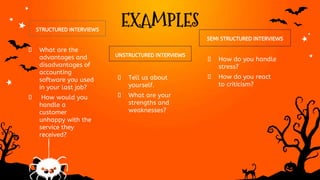
EXAMPLES
STRUCTURED INTERVIEWS
UNSTRUCTURED INTERVIEWS
� What are the
advantages and
disadvantages of
accounting
software you used
in your last job?
� How would you
handle a
customer
unhappy with the
service they
received?
� Tell us about
yourself.
� What are your
strengths and
weaknesses?
SEMI STRUCTURED INTERVIEWS
� How do you handle
stress?
� How do you react
to criticism?
METHODS
HOW TO ANALYZE
INTERVIEW DATA?
There are two main approaches to
qualitative
analysis: inductive and deductive.
https://www.rev.com/blog/analyze-interview-transcripts-in-qualitative-research
WHAT IS INDUCTIVE?
Inductive reasoning works the other way, moving from
specific observations to broader generalizations and theories.
Informally, we sometimes call this a “bottom up” approach
INDUCTIVE
✔ In inductive reasoning, we begin with
specific observations and measures,
✔ begin to detect patterns and
regularities,
✔ formulate some tentative hypotheses
that we can explore,
✔ and finally end up developing some
general conclusions or theories.
INDUCTIVE Methods of Analyzing Interview Transcripts
? THEMATIC CONTENT ANALYSIS
? begins with weeding out biases and
establishing your overarching impressions of
the data.
? Rather than approaching your data with a
predetermined framework, identify common
themes as you search the materials
organically.
? Your goal is to find common patterns across
the data set.
Inductive Methods of Analyzing Interview Transcripts
? A NARRATIVE ANALYSIS
? involves making sense of your interview
respondents’ individual stories.
? Use this type of qualitative data analysis to
highlight important aspects of their stories
that will best resonate with your readers.
? And, highlight critical points you have found in
other areas of your research.
WHAT IS DEDUCTIVE?
Deductive reasoning works from the more general to the
more specific. Sometimes this is informally called a “top-
down” approach.
DEDUCTIVE
✔We might begin with thinking up
a theory about our topic of interest.
✔We then narrow that down into more
specific hypotheses that we can test.
✔We narrow down even further when we
collect observations to address the
hypotheses.
✔This ultimately leads us to be able to test
the hypotheses with specific data –
a confirmation (or not) of our original
theories.
https://conjointly.com/kb/deduction-and-induction/
DEDUCTIVE Methods of Analyzing Interview Transcripts
? DEDUCTIVE ANALYSIS
? requires a structured or predetermined
approach.
? In this case, the researcher will build
categories in advance of his or her analysis.
? Then, they’ll map connections in the data to
those specific categories.
THE END!
Any questions?

TOPIC INTERVIEWS.pptx

  • 1.
  • 2.
    OBJECTIVES OF THETOPIC AT THE END OF THE LESSON STUDENTS WILL BE ABLE TO: UNDERSTAND WHAT IS INTERVIEWS, ITS SIGNIFICANCE IN RESEARCH STUDIES, THE ETHICS IN CONDUCTING INTERVIEWS, THE TYPES OF INTERVIEW QUESTIONS AND HOW TO ANALYZE DATA FROM INTERVIEWS.
  • 3.
    WHAT IS INTERVIEWS? Interviewsare a method of data collection that involves two or more people exchanging information through a series of questions and answers.
  • 4.
    MORE NOTES ONINTERVIEWS ? The questions are designed by a researcher to elicit information from interview participants on a specific topic or set of topics. ? Interviews are an excellent way to gather detailed information. ? Interviews are also useful when your topic is rather complex, requires lengthy explanation, or needs a dialogue between two people to thoroughly investigate. https://scientificinquiryinsocialwork.pressbooks.com/chapter/13-1-interview-research- what-is-it-and-when-should-it-be-used/
  • 5.
    “An interview isgenerally a qualitative research technique which involves asking open-ended questions to converse with respondents and collect elicit data about a subject.”
  • 6.
    Interview Ethics: Tips toConsider https://www.slideshare.net/JoanneFrawley/interview-ethics
  • 7.
    Interview Ethics: Tipsto Consider INCLUSIVENESS ? Think of the specific needs of the person you are interviewing and try to make them as comfortable as possible.
  • 8.
    Interview Ethics: Tipsto Consider WITHDRAWING CONSENT ? It should be explained to the person that they have the right to opt out of the interview at any point ? They are also free to pass or skip any question if they do not feel comfortable answering it
  • 9.
    Interview Ethics: Tipsto Consider MINIMIZE HARM ? You should do no harm to the person when interviewing them ? You should avoid any situations or activities that could cause the person distress or upset ? This includes avoiding asking questions that the person might find difficult to answer or emotionally upsetting
  • 10.
    Let’s review somemysterious concepts PERMISSION ? You should explain the specific purpose and nature of the interview to the person ? You should then ask them to give their explicit written consent to participate.
  • 11.
    Let’s review somemysterious concepts HONESTY ? You should be honest with the person you are interviewing about the nature and purpose of the interview
  • 12.
    Let’s review somemysterious concepts ACCEPTANCE ? It is your responsibility to acknowledge that the person you are interviewing has a right to their own opinions and beliefs about the topic. ? You may not share these beliefs or they might be different from your opinion but it is important that the person feels listened to and their opinion is respected.
  • 13.
    Let’s review somemysterious concepts ANONYMIZATION ? The person being interviewed has a right to protect their identity. ? You can choose not to refer to them by name in the interview. ? Alternatively you can choose a fake name or Pseudonym to refer to them during the interview ? Do not store personal information and interview recordings in the same place
  • 14.
    Let’s review somemysterious concepts CONFIDENTIALITY & DATA PROTECTION ? You should not keep the person’s information in any format for any longer than necessary
  • 16.
  • 17.
    TYPES OF INTERVIEWS ?Structured Interviews ? Semi-Structured Interviews ? Unstructured Interviews https://www.questionpro.com/blog/types-of-interviews/
  • 18.
    Structured Interviews Consist ofa series of pre-determined questions that all interviewees answer in the same order. Data analysis usually tends to be more straightforward because researcher can compare and contrast different answers given to the same questions. https://research-methodology.net/research-methods/qualitative-research/interviews/
  • 19.
    Unstructured Interviews are usuallythe least reliable from research viewpoint, because no questions are prepared prior to the interview and data collection is conducted in an informal manner. Unstructured interviews can be associated with a high level of bias and comparison of answers given by different respondents tends to be difficult due to the differences in formulation of questions.
  • 20.
    Semi-Structured Interviews Contain thecomponents of both, structured and unstructured interviews. In semi-structured interviews, interviewer prepares a set of same questions to be answered by all interviewees. At the same time, additional questions might be asked during interviews to clarify and/or further expand certain issues.
  • 21.
    EXAMPLES STRUCTURED INTERVIEWS UNSTRUCTURED INTERVIEWS �What are the advantages and disadvantages of accounting software you used in your last job? � How would you handle a customer unhappy with the service they received? � Tell us about yourself. � What are your strengths and weaknesses? SEMI STRUCTURED INTERVIEWS � How do you handle stress? � How do you react to criticism?
  • 22.
  • 23.
    HOW TO ANALYZE INTERVIEWDATA? There are two main approaches to qualitative analysis: inductive and deductive. https://www.rev.com/blog/analyze-interview-transcripts-in-qualitative-research
  • 24.
    WHAT IS INDUCTIVE? Inductivereasoning works the other way, moving from specific observations to broader generalizations and theories. Informally, we sometimes call this a “bottom up” approach
  • 25.
  • 26.
    ✔ In inductivereasoning, we begin with specific observations and measures, ✔ begin to detect patterns and regularities, ✔ formulate some tentative hypotheses that we can explore, ✔ and finally end up developing some general conclusions or theories.
  • 27.
    INDUCTIVE Methods ofAnalyzing Interview Transcripts ? THEMATIC CONTENT ANALYSIS ? begins with weeding out biases and establishing your overarching impressions of the data. ? Rather than approaching your data with a predetermined framework, identify common themes as you search the materials organically. ? Your goal is to find common patterns across the data set.
  • 28.
    Inductive Methods ofAnalyzing Interview Transcripts ? A NARRATIVE ANALYSIS ? involves making sense of your interview respondents’ individual stories. ? Use this type of qualitative data analysis to highlight important aspects of their stories that will best resonate with your readers. ? And, highlight critical points you have found in other areas of your research.
  • 29.
    WHAT IS DEDUCTIVE? Deductivereasoning works from the more general to the more specific. Sometimes this is informally called a “top- down” approach.
  • 30.
  • 31.
    ✔We might beginwith thinking up a theory about our topic of interest. ✔We then narrow that down into more specific hypotheses that we can test. ✔We narrow down even further when we collect observations to address the hypotheses. ✔This ultimately leads us to be able to test the hypotheses with specific data – a confirmation (or not) of our original theories. https://conjointly.com/kb/deduction-and-induction/
  • 32.
    DEDUCTIVE Methods ofAnalyzing Interview Transcripts ? DEDUCTIVE ANALYSIS ? requires a structured or predetermined approach. ? In this case, the researcher will build categories in advance of his or her analysis. ? Then, they’ll map connections in the data to those specific categories.
  • 33.