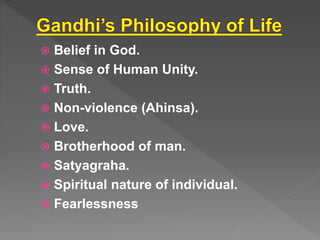

 Belief in God.
 Sense of Human Unity.
 Truth.
 Non-violence (Ahinsa).
 Love.
 Brotherhood of man.
 Satyagraha.
 Spiritual nature of individual.
 Fearlessness
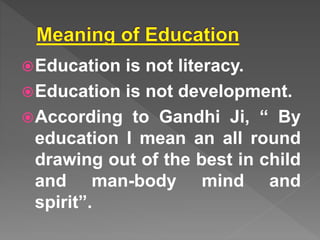
Education is not literacy.
Education is not development.
According to Gandhi Ji, “ By
education I mean an all round
drawing out of the best in child
and man-body mind and
spirit”.
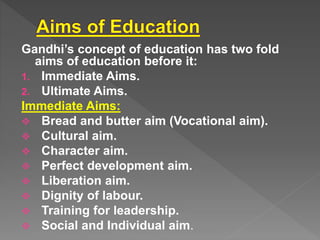
Gandhi’s concept of education has two fold
aims of education before it:
1. Immediate Aims.
2. Ultimate Aims.
Immediate Aims:
 Bread and butter aim (Vocational aim).
 Cultural aim.
 Character aim.
 Perfect development aim.
 Liberation aim.
 Dignity of labour.
 Training for leadership.
 Social and Individual aim.
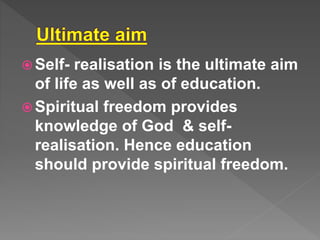
 Self- realisation is the ultimate aim
of life as well as of education.
 Spiritual freedom provides
knowledge of God & self-
realisation. Hence education
should provide spiritual freedom.
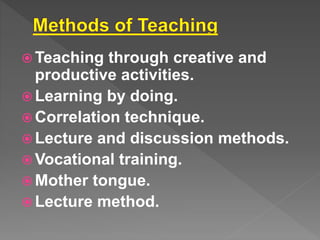
 Teaching through creative and
productive activities.
 Learning by doing.
 Correlation technique.
 Lecture and discussion methods.
 Vocational training.
 Mother tongue.
 Lecture method.
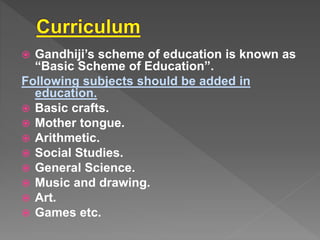
 Gandhiji’s scheme of education is known as
“Basic Scheme of Education”.
Following subjects should be added in
education.
 Basic crafts.
 Mother tongue.
 Arithmetic.
 Social Studies.
 General Science.
 Music and drawing.
 Art.
 Games etc.
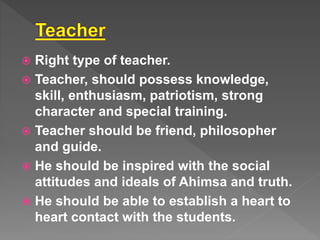
 Right type of teacher.
 Teacher, should possess knowledge,
skill, enthusiasm, patriotism, strong
character and special training.
 Teacher should be friend, philosopher
and guide.
 He should be inspired with the social
attitudes and ideals of Ahimsa and truth.
 He should be able to establish a heart to
heart contact with the students.
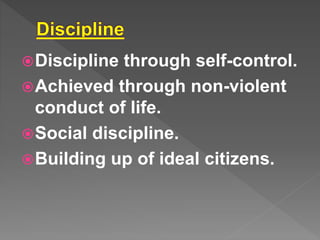
Discipline through self-control.
Achieved through non-violent
conduct of life.
Social discipline.
Building up of ideal citizens.
Mahatma Gandhi life history and educational contribution