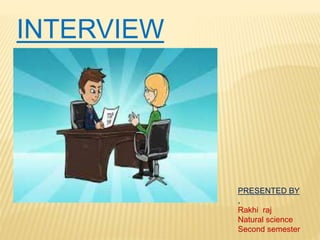
INTERVIEW
PRESENTED BY
,
Rakhi raj
Natural science
Second semester
INTRODUCTI
ONAn interview is a conversation where questions are
asked and answers are given.
 the word "interview" refers to a one-on-one
conversation with one person acting in the role of
the interviewer and the other in the role of
the interviewee..
 Interviews usually involve a transfer of information
from interviewee to interviewer.
The interview is an information collection tool which
usually take the shape of a face to face dimension.
Interviews can happen in a wide variety of contexts:
Employment. Interviews in an employment context are typically called job
interviews which describe a formal consultation for the purpose of evaluating the
qualifications of the interviewee for a specific position.
Psychology. Psychologists use a variety of interviewing methods and
techniques to try to understand and help their patients. In a psychiatric interview,
a psychiatrist or psychologist or nurse asks a battery of questions to complete
what is called a psychiatric assessment.
Research. In marketing research and academic research,
interviews are used in a wide variety of ways. Interviews are
often used in qualitative research in which firms try to
understand how consumers think.
Journalism and media. Typically, reporters covering a story
in journalism conduct interviews over the phone and in person to gain information
for subsequent publication. .
ADVANTAGES & DISADVANTAGES OF INTERVIEWS
Interview as a research tool has both advantages and
disadvantages.
An interview allows greater flexibility in the process of
questioning. As such many type of probe questions can be
put and analyzed.
It facilitates the investigator in obtaining the desired
information readily and quickly.
It facilitates the investigator in being sure that interviewers
have themselves interpreting and answered the questions.
This increases the validity of the conclusion arrived.
In an interview, a desired level of control can be exercised
over the situation or content within which question are
asked and answer are given.
The validity of the verbal information given by the
interviewers can easily be checked on the basis of their
non-verbal cues.
Disadvantages
*Interviewer’s variability
It is commonly found that at times the interviewer views similar responses
differently and records them differently from interview to interview. Thus , h
himself becomes source of variation.
•Inter -interviewer variability
It is one of the main problems with interviewing.
When several interviewers are used in a study and the nature of interview is
unstructured, the interviewers vary considerably among themselves in their
respective abilities to elicited the exact kind of information needed. Project the
proper kind of image, record the information appropriately and so on.
*Validity and dependability of verbal responses
In interview the interviewers verbally answer the questions asked by the
interviewers. Social scientists have grave doubts whether a person actually
behave the wat he professes to behave.
They have expressed the concern that verbal responses can’t be realised upon
with a considerable degree of validity and dependability.
•Time
•The interview takes much time in its completion because each
respondent or interviewer is interviewed individually and the records of
the verbal interaction of each respondent id kept individually. Sometimes
tapes are used to recording the proceedings of the interview for curtailing
the time taken unnecessarily in recording by the interviewer. But even
then additional time is taken to transcribe information from tapes.
•Variations inherent to the interviewing context
Some social scientist like cicourel (1964) have shown that the
interviewing context does not ordinarily remain constant as interviewers
move from one interview to another. In such a situation the investigator
remains unable to depend upon the facts obtained from interviewing.
*Recording Information
It is also a problem in interviewing. No foolproof system of recording has
yet been worked out to everybody’s satisfaction. Some prefer to jot down
the main comments or points made at crucial junctures during
interviewing , while others to record the information in details, and still
others prefer to rely on some type of recording device for the interview.
Good features of a interview
Come to the interview well prepared with background knowledge of the subject,
familiarity with your recording equipment, a consent form that the interviewee will sign
giving you permission to use the tape recorded interview for research purpose
Make the narrator as comfortable as possible; polite, friendly behavior will put your
interviewee at ease.

Take time to find a quiet spot in which to conduct the interview.
 Begin the interview with a few simple questions that the interviewee can answer
easily and
comfortably.
Ask questions one at a time and do not rush the interviewee to respond. Allow the
interviewee time to think and respond. Do not become anxious by silence. Silences will
make for a better interview; pause at least ten seconds before asking a new question.
Speak clearly so that the interviewee can easily understand and hear you. Keep the
questions as brief as possible so that what you are asking will be clear to the
interviewee
TYPES OF INTERVIEW
 There are two types of interview, namely
 Formal Interview
 Informal Interview
FORMAL INTERVIEW
FORMAL INTERVIEW
• Defined as one in which already prepared questions are
asked in a set order by the interviewer and answers are
recorded in a standardized form.
• It is a systematic procedure for collecting information.
• The formal interview also known as structured or patterned
interview.
• As the interview is highly structured, that is the questions,
their sequence and scoring methods are all predetermined,
relatively less trained interviewers can also conduct such as
interview smoothly.
INFORMAL INTERVIEW
INFORMAL INTERVIEW
 It is one where are no pre determined questions
nor is there any present order of the questions and
it is left to the interviewer to ask some questions in
a way he likes regarding a number of key points
around which the interview is to be built up.
 It is an unstructured, such an interview is also
known as unstructured interview.
 An informal interview is more commonly used than
the formal interview and a flexible method of
collecting data.
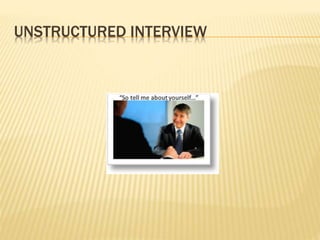
UNSTRUCTURED INTERVIEW
 The interviewer express himself /herself freely and
can discuss unplanned topics because there is no
predetermined set of questions.
 The evaluator intervenes only to generate and
develop questions relating to the interviewer’s
comments
 This type of interview is particularly interesting at
the start of an evaluation, in order to get a global
view of the subject an identify the major topics and
issues.
SEMI STRUCTURED INTERVIEW
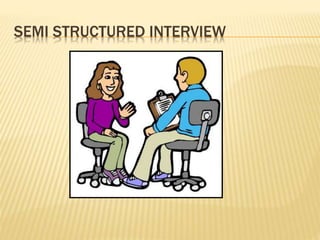
SEMI STRUCTURAL INTERVIEWS
 This type of an interviews collect the respondent’s
testimonies using an interview guidelines(flexible
framework of topic derived from the evaluation
question)
 The evaluator modifies the interview guide’s
instructions with additional questions, in order to
develpo useful areas of inquiry during the interview
 This type of interview is the most frequently used
particularly when the evaluator knows sufficient
about the aims and the main questions to pose
during the evaluation
 Semi structured interview are the most commonly
used tool in evaluation and are the subject of
further guidance
A powerpoint presentation on Interview

A powerpoint presentation on Interview

  • 2.
  • 3.
    INTRODUCTI ONAn interview isa conversation where questions are asked and answers are given.  the word "interview" refers to a one-on-one conversation with one person acting in the role of the interviewer and the other in the role of the interviewee..  Interviews usually involve a transfer of information from interviewee to interviewer. The interview is an information collection tool which usually take the shape of a face to face dimension.
  • 4.
    Interviews can happenin a wide variety of contexts: Employment. Interviews in an employment context are typically called job interviews which describe a formal consultation for the purpose of evaluating the qualifications of the interviewee for a specific position. Psychology. Psychologists use a variety of interviewing methods and techniques to try to understand and help their patients. In a psychiatric interview, a psychiatrist or psychologist or nurse asks a battery of questions to complete what is called a psychiatric assessment. Research. In marketing research and academic research, interviews are used in a wide variety of ways. Interviews are often used in qualitative research in which firms try to understand how consumers think. Journalism and media. Typically, reporters covering a story in journalism conduct interviews over the phone and in person to gain information for subsequent publication. .
  • 5.
    ADVANTAGES & DISADVANTAGESOF INTERVIEWS Interview as a research tool has both advantages and disadvantages. An interview allows greater flexibility in the process of questioning. As such many type of probe questions can be put and analyzed. It facilitates the investigator in obtaining the desired information readily and quickly. It facilitates the investigator in being sure that interviewers have themselves interpreting and answered the questions. This increases the validity of the conclusion arrived. In an interview, a desired level of control can be exercised over the situation or content within which question are asked and answer are given. The validity of the verbal information given by the interviewers can easily be checked on the basis of their non-verbal cues.
  • 6.
    Disadvantages *Interviewer’s variability It iscommonly found that at times the interviewer views similar responses differently and records them differently from interview to interview. Thus , h himself becomes source of variation. •Inter -interviewer variability It is one of the main problems with interviewing. When several interviewers are used in a study and the nature of interview is unstructured, the interviewers vary considerably among themselves in their respective abilities to elicited the exact kind of information needed. Project the proper kind of image, record the information appropriately and so on. *Validity and dependability of verbal responses In interview the interviewers verbally answer the questions asked by the interviewers. Social scientists have grave doubts whether a person actually behave the wat he professes to behave. They have expressed the concern that verbal responses can’t be realised upon with a considerable degree of validity and dependability.
  • 7.
    •Time •The interview takesmuch time in its completion because each respondent or interviewer is interviewed individually and the records of the verbal interaction of each respondent id kept individually. Sometimes tapes are used to recording the proceedings of the interview for curtailing the time taken unnecessarily in recording by the interviewer. But even then additional time is taken to transcribe information from tapes. •Variations inherent to the interviewing context Some social scientist like cicourel (1964) have shown that the interviewing context does not ordinarily remain constant as interviewers move from one interview to another. In such a situation the investigator remains unable to depend upon the facts obtained from interviewing. *Recording Information It is also a problem in interviewing. No foolproof system of recording has yet been worked out to everybody’s satisfaction. Some prefer to jot down the main comments or points made at crucial junctures during interviewing , while others to record the information in details, and still others prefer to rely on some type of recording device for the interview.
  • 8.
    Good features ofa interview Come to the interview well prepared with background knowledge of the subject, familiarity with your recording equipment, a consent form that the interviewee will sign giving you permission to use the tape recorded interview for research purpose Make the narrator as comfortable as possible; polite, friendly behavior will put your interviewee at ease.  Take time to find a quiet spot in which to conduct the interview.  Begin the interview with a few simple questions that the interviewee can answer easily and comfortably. Ask questions one at a time and do not rush the interviewee to respond. Allow the interviewee time to think and respond. Do not become anxious by silence. Silences will make for a better interview; pause at least ten seconds before asking a new question. Speak clearly so that the interviewee can easily understand and hear you. Keep the questions as brief as possible so that what you are asking will be clear to the interviewee
  • 9.
    TYPES OF INTERVIEW There are two types of interview, namely  Formal Interview  Informal Interview
  • 10.
  • 11.
    FORMAL INTERVIEW • Definedas one in which already prepared questions are asked in a set order by the interviewer and answers are recorded in a standardized form. • It is a systematic procedure for collecting information. • The formal interview also known as structured or patterned interview. • As the interview is highly structured, that is the questions, their sequence and scoring methods are all predetermined, relatively less trained interviewers can also conduct such as interview smoothly.
  • 12.
  • 13.
    INFORMAL INTERVIEW  Itis one where are no pre determined questions nor is there any present order of the questions and it is left to the interviewer to ask some questions in a way he likes regarding a number of key points around which the interview is to be built up.  It is an unstructured, such an interview is also known as unstructured interview.  An informal interview is more commonly used than the formal interview and a flexible method of collecting data.
  • 14.
  • 15.
    UNSTRUCTURED INTERVIEW  Theinterviewer express himself /herself freely and can discuss unplanned topics because there is no predetermined set of questions.  The evaluator intervenes only to generate and develop questions relating to the interviewer’s comments  This type of interview is particularly interesting at the start of an evaluation, in order to get a global view of the subject an identify the major topics and issues.
  • 16.
  • 17.
    SEMI STRUCTURAL INTERVIEWS This type of an interviews collect the respondent’s testimonies using an interview guidelines(flexible framework of topic derived from the evaluation question)  The evaluator modifies the interview guide’s instructions with additional questions, in order to develpo useful areas of inquiry during the interview  This type of interview is the most frequently used particularly when the evaluator knows sufficient about the aims and the main questions to pose during the evaluation
  • 18.
     Semi structuredinterview are the most commonly used tool in evaluation and are the subject of further guidance