INTERVIEW METHOD
Presented
By
Dr.Rajashekhar Shirvalkar
M.Sc (maths), M.Sc (Physics), M.Ed, M.Phil, NET, Ph.D
3
Three Major Techniques for
Collecting Data:
1. Questionnaires
2. Interviews
3. Observation
INTERVIEW
MEANING
A conversation in which one person
(the interviewer) elicits information
from another person (the subject or
interviewee).
A transcript or account of such a
conversation is also called an
interview.
INTERVIEW
MEANING
An interview is a conversation
between two or more people where
questions are asked by the
interviewer to elicit facts or
statements from the interviewee.
CHARACTERISTICS OF INTERVIEW METHOD
a) It is a close contact or interaction
including dialogue between two or more
persons.
b) There is a definite object of
interview, such as knowing the ideas
and views of others.
c) There is a face to face contact or
primary relationship between the
individuals.
d) This is the most suitable method of data
collection for research, business and
economic problems.
IMPORTANCE OF INTERVIEW METHOD
a) It discovers origin of the problem.
b) It proves casual factors and determines
person’s attitude.
c) It is an indispensible tool for data
collection.
d) The respondents are more interested to
talk than to write on papers.
e) Judged through cross questioning.
CHARACTERISTICS OF INTERVIEW METHOD
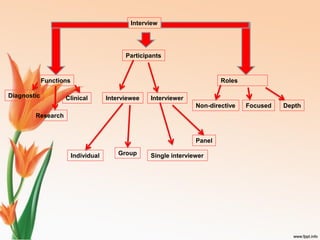
Interview
Participants
Functions Roles
ClinicalDiagnostic
Research
FocusedNon-directive Depth
GroupIndividual Single interviewer
Panel
Interviewee Interviewer
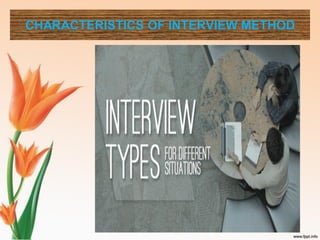
The chief types of interviews are as follows:
1. Classification according to formalness:
a)Formal Interview:
In this type of interview, the interviewer presents a set of well
defined questions and notes down answers of information in
accordance with prescribed rules.
b)Informal Interview:
In contrast with the formal interview the interviewer has full
freedom to make suitable alterations in the questions to suit
a particular situation in formal interview. He may revise, re-
order or paraphrase the question to suit the needs of the
respondents.
2. Classification according to the number:
i) Personal Interview:
In personal interview single individual is interviewed. The
personal interview help to establish close personal contacts
between the interviewer and the interviewee and as a result
detailed knowledge about intimate and personal aspects of the
individual can be had
ii) Group Interview
: As the name makes it plain the group interview
is the opposite of the personal, because in it two
or more persons are interviewed. The interview is
suited for gathering routine information.
3. Classification according to purpose:
i)Diagnostic Interview:
As the name makes clear, this type of interviewers, try to understand
the cause or causes of a malady. In clinical psychology and
psychoanalysis, the preliminary interviews with the patients are held
with a purpose to grasp the nature and cause of disease.
ii)Research interview:
These interviews are held to gather information pertaining to
certain problems. The questions to be asked to gather the desired
information are pre-determined and by asking them of the
information the data is collected. In as such as this data is gathered
for the purpose of research into a problem, these are called
“Research Interviews”.
iii) Interviews to fulfill curiosity:
These interviews, as the name implies, are held to satisfy some
question lurking in the mind of a scientist. For example, if a scientist
gets an idea that good lectures are delivered extempore, he has to
interview some reputedly good lecturers whether they make
extensive notes for delivering a lecture or not.
4. Classification according to the period of contact
i. Short-contact interview:
For filling-up schedules etc., a single sitting of small duration suffices.
Therefore, in researches of this type short contact interview suffices.
ii. Prolonged contact interview:
In contrast with research by schedule, the case-history method
requires prolonged interviews. In these establishment of close
personal relations between the interviewer and interviewee is
very likely.
5. Classification according to subject-matter:
i. Qualitative interview:
The qualitative interviews are about complex and non- quantifiable
subject-matter. For example, interviews held for case studies are
qualitative, because the interviewer has to range over past, present
and future to know enough about a case.
ii. Quantitative interview
: The quantitative interviews are those in which certain set
facts gathered about large number of persons. The census
interviews are its example
iii. Mixed interview
: In certain interviews both types of data the routine
and specialized is sought, part of it is quantifiable
while the rest is not. Therefore it is known as mixed
interview.
1. Structured Interview
•Here, every single detail of the interview is decided
in advance.
•The questions to be asked, the order in which the
questions will be asked, the time given to each
candidate, the information to be collected from each
candidate, etc. is all decided in advance.
•Structured interview is also called Standardized,
Patterned, Directed or Guided interview.
•Structured interviews are preplanned.
•They are accurate and precise.
•All the interviews will be uniform (same). Therefore,
there will be consistency and minimum bias in
structured interviews.
2. Unstructured Interview
• This interview is not planned in detail. Hence it is also called
as Non-Directed interview.
• The question to be asked, the information to be collected
from the candidates, etc. are not decided in advance.
• These interviews are non-planned and therefore, more
flexible.
• Candidates are more relaxed in such interviews.
• They are encouraged to express themselves about different
subjects, based on their
expectations, motivations, background, interests, etc.
• Here the interviewer can make a better judgment of the
candidate's personality, potentials, strengths and
weaknesses.
• However, if the interviewer is not efficient then the
discussions will lose direction and the interview will be a
waste of time and effort.
3. Formal Interview
• Formal interview is held in a more formal
atmosphere.
• The interviewer asks pre-planned questions.
Formal interview is also called planned interview.
4. Informal Interview
• Informal interview is an oral interview which can
be arranged at any place.
• Different questions are asked to collect the
required information from the candidate.
• Specific rigid procedure is not followed. It is a
friendly interview.
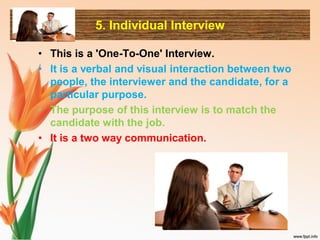
5. Individual Interview
• This is a 'One-To-One' Interview.
• It is a verbal and visual interaction between two
people, the interviewer and the candidate, for a
particular purpose.
• The purpose of this interview is to match the
candidate with the job.
• It is a two way communication.
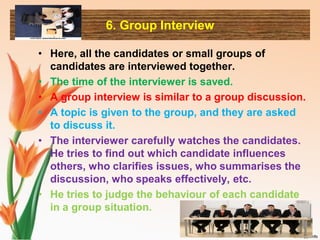
6. Group Interview
• Here, all the candidates or small groups of
candidates are interviewed together.
• The time of the interviewer is saved.
• A group interview is similar to a group discussion.
• A topic is given to the group, and they are asked
to discuss it.
• The interviewer carefully watches the candidates.
He tries to find out which candidate influences
others, who clarifies issues, who summarises the
discussion, who speaks effectively, etc.
• He tries to judge the behaviour of each candidate
in a group situation.
7. Depth Interview
• This is a semi-structured interview.
• The candidate has to give detailed information
about his background, special interest, etc.
• He also has to give detailed information about his
subject.
• Depth interview tries to find out if the candidate is
an expert in his subject or not.
• Here, the interviewer must have a good
understanding of human behaviour.
8. Panel Interview
• Panel means a selection committee or interview
committee that is appointed for interviewing the
candidates.
• The panel may include three or five members.
They ask questions to the candidates about
different aspects.
• They give marks to each candidate.
• The final decision will be taken by all members
collectively by rating the candidates.
• Panel interview is always better than an interview
by one interviewer because in a panel
interview, collective judgment is used for
selecting suitable candidates.
9. Research Interview
• When interview device is used as a tool for
gathering data required by the investigator to
justify objectives, hypotheses or solve the
problems of the historical, experimental, survey or
clinical types of research.
10. Clinical Interview
• It takes place as a means of introducing the
patient to therapy in clinical work, social worker
and psychiatristics use interview to collect
information from an individual to know his
problems, past history, job, or family adjustment.
11. Diagnostic Interview
• Social workers as well as clinical tutors are
generally using diagnostic interview. It helps the
interviewer to locate the feasible causes of an
individual’s problems collecting information about
his past history, family relations and adjustment
problems.
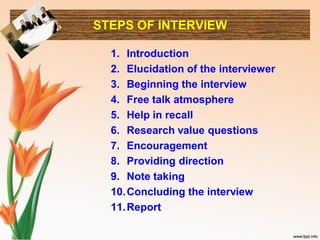
STEPS OF INTERVIEW
1. Introduction
2. Elucidation of the interviewer
3. Beginning the interview
4. Free talk atmosphere
5. Help in recall
6. Research value questions
7. Encouragement
8. Providing direction
9. Note taking
10.Concluding the interview
11.Report
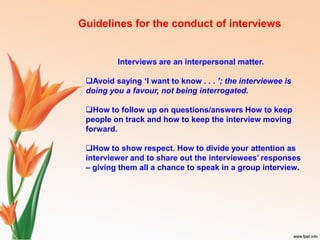
Interviews are an interpersonal matter.
Avoid saying ‘I want to know . . . ’; the interviewee is
doing you a favour, not being interrogated.
How to follow up on questions/answers How to keep
people on track and how to keep the interview moving
forward.
How to show respect. How to divide your attention as
interviewer and to share out the interviewees’ responses
– giving them all a chance to speak in a group interview.
Guidelines for the conduct of interviews
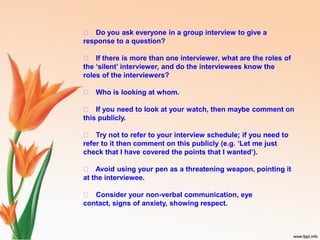
􀁏 Do you ask everyone in a group interview to give a
response to a question?
􀁏 If there is more than one interviewer, what are the roles of
the ‘silent’ interviewer, and do the interviewees know the
roles of the interviewers?
􀁏 Who is looking at whom.
􀁏 If you need to look at your watch, then maybe comment on
this publicly.
􀁏 Try not to refer to your interview schedule; if you need to
refer to it then comment on this publicly (e.g. ‘Let me just
check that I have covered the points that I wanted’).
􀁏 Avoid using your pen as a threatening weapon, pointing it
at the interviewee.
􀁏 Consider your non-verbal communication, eye
contact, signs of anxiety, showing respect.
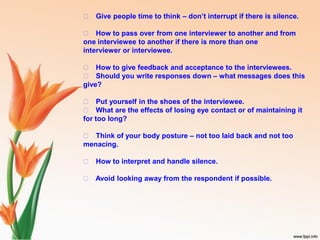
􀁏 Give people time to think – don’t interrupt if there is silence.
􀁏 How to pass over from one interviewer to another and from
one interviewee to another if there is more than one
interviewer or interviewee.
􀁏 How to give feedback and acceptance to the interviewees.
􀁏 Should you write responses down – what messages does this
give?
􀁏 Put yourself in the shoes of the interviewee.
􀁏 What are the effects of losing eye contact or of maintaining it
for too long?
􀁏 Think of your body posture – not too laid back and not too
menacing.
􀁏 How to interpret and handle silence.
􀁏 Avoid looking away from the respondent if possible.
􀁏 Avoid interrupting the respondent.
􀁏 Avoid judging the respondent or his/her response.
􀁏 The interviewer should summarize and crystallize issues and
build on them – that is a way of showing respect.
􀁏 How to give signs of acceptance of what people are
saying, and how to avoid being judgemental.
􀁏 Take care of timing – not too long to be boring.
􀁏 Give interviewees the final chance to add any comments, and
thank them at the end.
􀁏 Plan how to hand over the questions to the next interviewer.
􀁏 How to arrange the chairs and tables – do you have tables:
they may be a barrier or a protection?
􀁏 Identify who controls the data, and when the control of the
data passes from the interviewee to the interviewer.
􀁏 What to do with ‘off the record’ data?
􀁏 Take time to ‘manage’ the interview and keep interviewees
aware of what is happening and where it is going.
􀁏 Vary the volume/tone of your voice.
􀁏 Avoid giving your own view or opinion; be neutral.
􀁏 Who is working harder – the interviewer or the interviewee?
􀁏 Who is saying more – the interviewer or the interviewee?
􀁏 If there is more than one interviewer, how to avoid one
interviewer undermining another.
􀁏 Think of prompts and probes.
􀁏 How to respond to people who say little?
􀁏 Consider the social (and physical) distance between the
interviewer and interviewee(s).
􀁏 Consider the layout of the furniture – circle/oval/straight line
or what?
􀁏 Have a clear introduction which makes it clear how the
interview will be conducted and how the interviewees can
respond (e.g. turn taking).
Guidelines for Interviewing
According to Patton, following are some useful guidelines that can be
used for effective interviewing :
1. Throughout all phases of interviewing, from planning
through data collection to analysis, keep centred on
the purpose of the research endeavour. Let that
purpose guide the interviewing process.
2. The fundamental principle of qualitative interviewing is
to provide a framework within which respondents can
express their own understandings in their own terms.
3. Understand the strengths and weaknesses of different
types of interviews: the informal conversational interview;
then interview guide approach; and the standardized
open-ended interview.
4. Select the type of interview (or combination of types)
that is most appropriate to the purposes of the research
effort.
5. Understand the different kinds of information one can
collect through interviews: behavioural data; opinions;
feelings; knowledge; sensory data; and background
information.
6. Think about and plan how these different kinds of
questions can be most appropriately sequenced for each
interview topic, including past, present, and future
questions.
7. Ask truly open-ended questions.
8. Ask clear questions, using understandable and
appropriate language.
9. Ask one question at a time.
10. Use probes and follow-up questions to solicit depth
and detail.
11. Communicate clearly what information is desired, why
that information is important, and let the interviewee
know how the interview is progressing.
12. Listen attentively and respond appropriately to let the
person know he or she is being heard.
13. Avoid leading questions.
14. Understand the difference between a depth interview
and an interrogation. Qualitative evaluators conduct depth
interviews; police investigators and tax auditors conduct
interrogations.
15. Establish personal rapport and a sense of mutual
interest.
16. Maintain neutrality toward the specific content of
responses. You are there to collect information not to make
judgments about that person.
17. Observe while interviewing. Be aware of and sensitive
to how the person is affected by and responds to different
questions.
18. Maintain control of the interview.
19. Tape record whenever possible to capture full and
exact quotations for analysis and reporting.
20. Take notes to capture and highlight major points as the
interview progresses.
21. As soon as possible after the interview check the
recording for malfunctions; review notes for clarity;
elaborate where necessary; and record observations.
22. Take whatever steps are appropriate and necessary to
gather valid and reliable information.
23. Treat the person being interviewed with respect. Keep
in mind that it is a privilege and responsibility to peer into
another person's experience.
24. Practice interviewing. Develop your skills.
25. Enjoy interviewing. Take the time along the way to stop
and "hear" the roses.

Module 10- educational research-interview method

  • 1.
    INTERVIEW METHOD Presented By Dr.Rajashekhar Shirvalkar M.Sc(maths), M.Sc (Physics), M.Ed, M.Phil, NET, Ph.D
  • 3.
    3 Three Major Techniquesfor Collecting Data: 1. Questionnaires 2. Interviews 3. Observation
  • 4.
    INTERVIEW MEANING A conversation inwhich one person (the interviewer) elicits information from another person (the subject or interviewee). A transcript or account of such a conversation is also called an interview.
  • 5.
    INTERVIEW MEANING An interview isa conversation between two or more people where questions are asked by the interviewer to elicit facts or statements from the interviewee.
  • 6.
    CHARACTERISTICS OF INTERVIEWMETHOD a) It is a close contact or interaction including dialogue between two or more persons. b) There is a definite object of interview, such as knowing the ideas and views of others. c) There is a face to face contact or primary relationship between the individuals. d) This is the most suitable method of data collection for research, business and economic problems.
  • 7.
    IMPORTANCE OF INTERVIEWMETHOD a) It discovers origin of the problem. b) It proves casual factors and determines person’s attitude. c) It is an indispensible tool for data collection. d) The respondents are more interested to talk than to write on papers. e) Judged through cross questioning.
  • 8.
  • 9.
  • 10.
    The chief typesof interviews are as follows: 1. Classification according to formalness: a)Formal Interview: In this type of interview, the interviewer presents a set of well defined questions and notes down answers of information in accordance with prescribed rules. b)Informal Interview: In contrast with the formal interview the interviewer has full freedom to make suitable alterations in the questions to suit a particular situation in formal interview. He may revise, re- order or paraphrase the question to suit the needs of the respondents.
  • 11.
    2. Classification accordingto the number: i) Personal Interview: In personal interview single individual is interviewed. The personal interview help to establish close personal contacts between the interviewer and the interviewee and as a result detailed knowledge about intimate and personal aspects of the individual can be had ii) Group Interview : As the name makes it plain the group interview is the opposite of the personal, because in it two or more persons are interviewed. The interview is suited for gathering routine information.
  • 12.
    3. Classification accordingto purpose: i)Diagnostic Interview: As the name makes clear, this type of interviewers, try to understand the cause or causes of a malady. In clinical psychology and psychoanalysis, the preliminary interviews with the patients are held with a purpose to grasp the nature and cause of disease. ii)Research interview: These interviews are held to gather information pertaining to certain problems. The questions to be asked to gather the desired information are pre-determined and by asking them of the information the data is collected. In as such as this data is gathered for the purpose of research into a problem, these are called “Research Interviews”. iii) Interviews to fulfill curiosity: These interviews, as the name implies, are held to satisfy some question lurking in the mind of a scientist. For example, if a scientist gets an idea that good lectures are delivered extempore, he has to interview some reputedly good lecturers whether they make extensive notes for delivering a lecture or not.
  • 13.
    4. Classification accordingto the period of contact i. Short-contact interview: For filling-up schedules etc., a single sitting of small duration suffices. Therefore, in researches of this type short contact interview suffices. ii. Prolonged contact interview: In contrast with research by schedule, the case-history method requires prolonged interviews. In these establishment of close personal relations between the interviewer and interviewee is very likely.
  • 14.
    5. Classification accordingto subject-matter: i. Qualitative interview: The qualitative interviews are about complex and non- quantifiable subject-matter. For example, interviews held for case studies are qualitative, because the interviewer has to range over past, present and future to know enough about a case. ii. Quantitative interview : The quantitative interviews are those in which certain set facts gathered about large number of persons. The census interviews are its example iii. Mixed interview : In certain interviews both types of data the routine and specialized is sought, part of it is quantifiable while the rest is not. Therefore it is known as mixed interview.
  • 15.
    1. Structured Interview •Here,every single detail of the interview is decided in advance. •The questions to be asked, the order in which the questions will be asked, the time given to each candidate, the information to be collected from each candidate, etc. is all decided in advance. •Structured interview is also called Standardized, Patterned, Directed or Guided interview. •Structured interviews are preplanned. •They are accurate and precise. •All the interviews will be uniform (same). Therefore, there will be consistency and minimum bias in structured interviews.
  • 16.
    2. Unstructured Interview •This interview is not planned in detail. Hence it is also called as Non-Directed interview. • The question to be asked, the information to be collected from the candidates, etc. are not decided in advance. • These interviews are non-planned and therefore, more flexible. • Candidates are more relaxed in such interviews. • They are encouraged to express themselves about different subjects, based on their expectations, motivations, background, interests, etc. • Here the interviewer can make a better judgment of the candidate's personality, potentials, strengths and weaknesses. • However, if the interviewer is not efficient then the discussions will lose direction and the interview will be a waste of time and effort.
  • 17.
    3. Formal Interview •Formal interview is held in a more formal atmosphere. • The interviewer asks pre-planned questions. Formal interview is also called planned interview.
  • 18.
    4. Informal Interview •Informal interview is an oral interview which can be arranged at any place. • Different questions are asked to collect the required information from the candidate. • Specific rigid procedure is not followed. It is a friendly interview.
  • 19.
    5. Individual Interview •This is a 'One-To-One' Interview. • It is a verbal and visual interaction between two people, the interviewer and the candidate, for a particular purpose. • The purpose of this interview is to match the candidate with the job. • It is a two way communication.
  • 20.
    6. Group Interview •Here, all the candidates or small groups of candidates are interviewed together. • The time of the interviewer is saved. • A group interview is similar to a group discussion. • A topic is given to the group, and they are asked to discuss it. • The interviewer carefully watches the candidates. He tries to find out which candidate influences others, who clarifies issues, who summarises the discussion, who speaks effectively, etc. • He tries to judge the behaviour of each candidate in a group situation.
  • 21.
    7. Depth Interview •This is a semi-structured interview. • The candidate has to give detailed information about his background, special interest, etc. • He also has to give detailed information about his subject. • Depth interview tries to find out if the candidate is an expert in his subject or not. • Here, the interviewer must have a good understanding of human behaviour.
  • 22.
    8. Panel Interview •Panel means a selection committee or interview committee that is appointed for interviewing the candidates. • The panel may include three or five members. They ask questions to the candidates about different aspects. • They give marks to each candidate. • The final decision will be taken by all members collectively by rating the candidates. • Panel interview is always better than an interview by one interviewer because in a panel interview, collective judgment is used for selecting suitable candidates.
  • 23.
    9. Research Interview •When interview device is used as a tool for gathering data required by the investigator to justify objectives, hypotheses or solve the problems of the historical, experimental, survey or clinical types of research.
  • 24.
    10. Clinical Interview •It takes place as a means of introducing the patient to therapy in clinical work, social worker and psychiatristics use interview to collect information from an individual to know his problems, past history, job, or family adjustment.
  • 25.
    11. Diagnostic Interview •Social workers as well as clinical tutors are generally using diagnostic interview. It helps the interviewer to locate the feasible causes of an individual’s problems collecting information about his past history, family relations and adjustment problems.
  • 26.
    STEPS OF INTERVIEW 1.Introduction 2. Elucidation of the interviewer 3. Beginning the interview 4. Free talk atmosphere 5. Help in recall 6. Research value questions 7. Encouragement 8. Providing direction 9. Note taking 10.Concluding the interview 11.Report
  • 27.
    Interviews are aninterpersonal matter. Avoid saying ‘I want to know . . . ’; the interviewee is doing you a favour, not being interrogated. How to follow up on questions/answers How to keep people on track and how to keep the interview moving forward. How to show respect. How to divide your attention as interviewer and to share out the interviewees’ responses – giving them all a chance to speak in a group interview. Guidelines for the conduct of interviews
  • 28.
    􀁏 Do youask everyone in a group interview to give a response to a question? 􀁏 If there is more than one interviewer, what are the roles of the ‘silent’ interviewer, and do the interviewees know the roles of the interviewers? 􀁏 Who is looking at whom. 􀁏 If you need to look at your watch, then maybe comment on this publicly. 􀁏 Try not to refer to your interview schedule; if you need to refer to it then comment on this publicly (e.g. ‘Let me just check that I have covered the points that I wanted’). 􀁏 Avoid using your pen as a threatening weapon, pointing it at the interviewee. 􀁏 Consider your non-verbal communication, eye contact, signs of anxiety, showing respect.
  • 29.
    􀁏 Give peopletime to think – don’t interrupt if there is silence. 􀁏 How to pass over from one interviewer to another and from one interviewee to another if there is more than one interviewer or interviewee. 􀁏 How to give feedback and acceptance to the interviewees. 􀁏 Should you write responses down – what messages does this give? 􀁏 Put yourself in the shoes of the interviewee. 􀁏 What are the effects of losing eye contact or of maintaining it for too long? 􀁏 Think of your body posture – not too laid back and not too menacing. 􀁏 How to interpret and handle silence. 􀁏 Avoid looking away from the respondent if possible.
  • 30.
    􀁏 Avoid interruptingthe respondent. 􀁏 Avoid judging the respondent or his/her response. 􀁏 The interviewer should summarize and crystallize issues and build on them – that is a way of showing respect. 􀁏 How to give signs of acceptance of what people are saying, and how to avoid being judgemental. 􀁏 Take care of timing – not too long to be boring. 􀁏 Give interviewees the final chance to add any comments, and thank them at the end. 􀁏 Plan how to hand over the questions to the next interviewer. 􀁏 How to arrange the chairs and tables – do you have tables: they may be a barrier or a protection? 􀁏 Identify who controls the data, and when the control of the data passes from the interviewee to the interviewer. 􀁏 What to do with ‘off the record’ data?
  • 31.
    􀁏 Take timeto ‘manage’ the interview and keep interviewees aware of what is happening and where it is going. 􀁏 Vary the volume/tone of your voice. 􀁏 Avoid giving your own view or opinion; be neutral. 􀁏 Who is working harder – the interviewer or the interviewee? 􀁏 Who is saying more – the interviewer or the interviewee? 􀁏 If there is more than one interviewer, how to avoid one interviewer undermining another. 􀁏 Think of prompts and probes. 􀁏 How to respond to people who say little?
  • 32.
    􀁏 Consider thesocial (and physical) distance between the interviewer and interviewee(s). 􀁏 Consider the layout of the furniture – circle/oval/straight line or what? 􀁏 Have a clear introduction which makes it clear how the interview will be conducted and how the interviewees can respond (e.g. turn taking).
  • 34.
    Guidelines for Interviewing Accordingto Patton, following are some useful guidelines that can be used for effective interviewing : 1. Throughout all phases of interviewing, from planning through data collection to analysis, keep centred on the purpose of the research endeavour. Let that purpose guide the interviewing process. 2. The fundamental principle of qualitative interviewing is to provide a framework within which respondents can express their own understandings in their own terms. 3. Understand the strengths and weaknesses of different types of interviews: the informal conversational interview; then interview guide approach; and the standardized open-ended interview.
  • 35.
    4. Select thetype of interview (or combination of types) that is most appropriate to the purposes of the research effort. 5. Understand the different kinds of information one can collect through interviews: behavioural data; opinions; feelings; knowledge; sensory data; and background information. 6. Think about and plan how these different kinds of questions can be most appropriately sequenced for each interview topic, including past, present, and future questions. 7. Ask truly open-ended questions. 8. Ask clear questions, using understandable and appropriate language. 9. Ask one question at a time. 10. Use probes and follow-up questions to solicit depth and detail.
  • 36.
    11. Communicate clearlywhat information is desired, why that information is important, and let the interviewee know how the interview is progressing. 12. Listen attentively and respond appropriately to let the person know he or she is being heard. 13. Avoid leading questions. 14. Understand the difference between a depth interview and an interrogation. Qualitative evaluators conduct depth interviews; police investigators and tax auditors conduct interrogations.
  • 37.
    15. Establish personalrapport and a sense of mutual interest. 16. Maintain neutrality toward the specific content of responses. You are there to collect information not to make judgments about that person. 17. Observe while interviewing. Be aware of and sensitive to how the person is affected by and responds to different questions. 18. Maintain control of the interview.
  • 38.
    19. Tape recordwhenever possible to capture full and exact quotations for analysis and reporting. 20. Take notes to capture and highlight major points as the interview progresses. 21. As soon as possible after the interview check the recording for malfunctions; review notes for clarity; elaborate where necessary; and record observations.
  • 39.
    22. Take whateversteps are appropriate and necessary to gather valid and reliable information. 23. Treat the person being interviewed with respect. Keep in mind that it is a privilege and responsibility to peer into another person's experience. 24. Practice interviewing. Develop your skills. 25. Enjoy interviewing. Take the time along the way to stop and "hear" the roses.