WELCOME TO SEMINAR
SUBJECT : METHODOLOGY OF EDUCTIONAL RESEARCH
UNIT : METHODS OF DATA COLLECTION AND RESEARCH REPORT
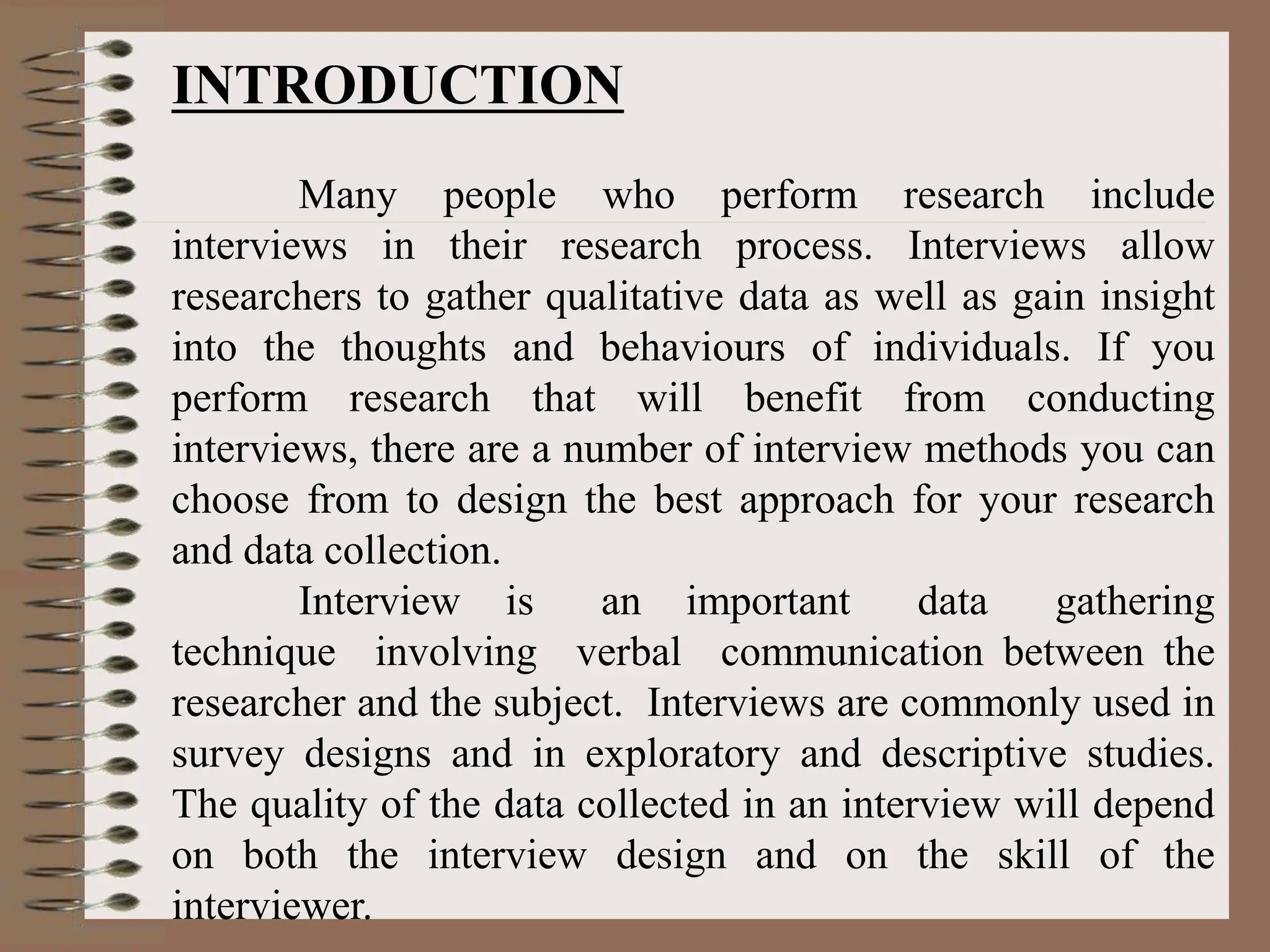
TOPIC : INTERVIEW
Presented BY
DEVARAJU B N
M.Ed. I Semester
Department of Education
Kuvempu University
Observed BY
Mr. MADHU J K
Assistant professor
Department of Education
Kuvempu University
INDEX
Introduction
Meaning and definitions of Interview
Characteristic of Interview
Types of Interview
Tips for Effective Research Interview
Guidelines for Successful Interview
Merits of Interview
Limitations of Interview
Conclusion
Bibliography
INTRODUCTION
Many people who perform research include
interviews in their research process. Interviews allow
researchers to gather qualitative data as well as gain insight
into the thoughts and behaviours of individuals. If you
perform research that will benefit from conducting
interviews, there are a number of interview methods you can
choose from to design the best approach for your research
and data collection.
Interview is an important data gathering
technique involving verbal communication between the
researcher and the subject. Interviews are commonly used in
survey designs and in exploratory and descriptive studies.
The quality of the data collected in an interview will depend
on both the interview design and on the skill of the
interviewer.
MEANING AND DEFINITIONS
The word interview comes from the Latin and
Middle French words, which means “see in” or “see
each other”. Generally, an interview means when a
question is asked and a personal meeting between
people. The person answering the question of an
interview is called an interview.
According to Witles
“face to face conversation”
According to Bingham and Moore (1924)
“Aconversation with a purpose”
• According to Lindzey Gardner (1968)
A two-person conversation initiated by
the interviewer for the specific purpose of
obtaining research-relevant information
and focused by him on the content
specified by the research objective of
description and explanation.
Interview refers to an exchange of ideas
among a group of two or more than two
people, where the Interviewers ask the
questions to interviewees in order to extract
the requisite data from them.
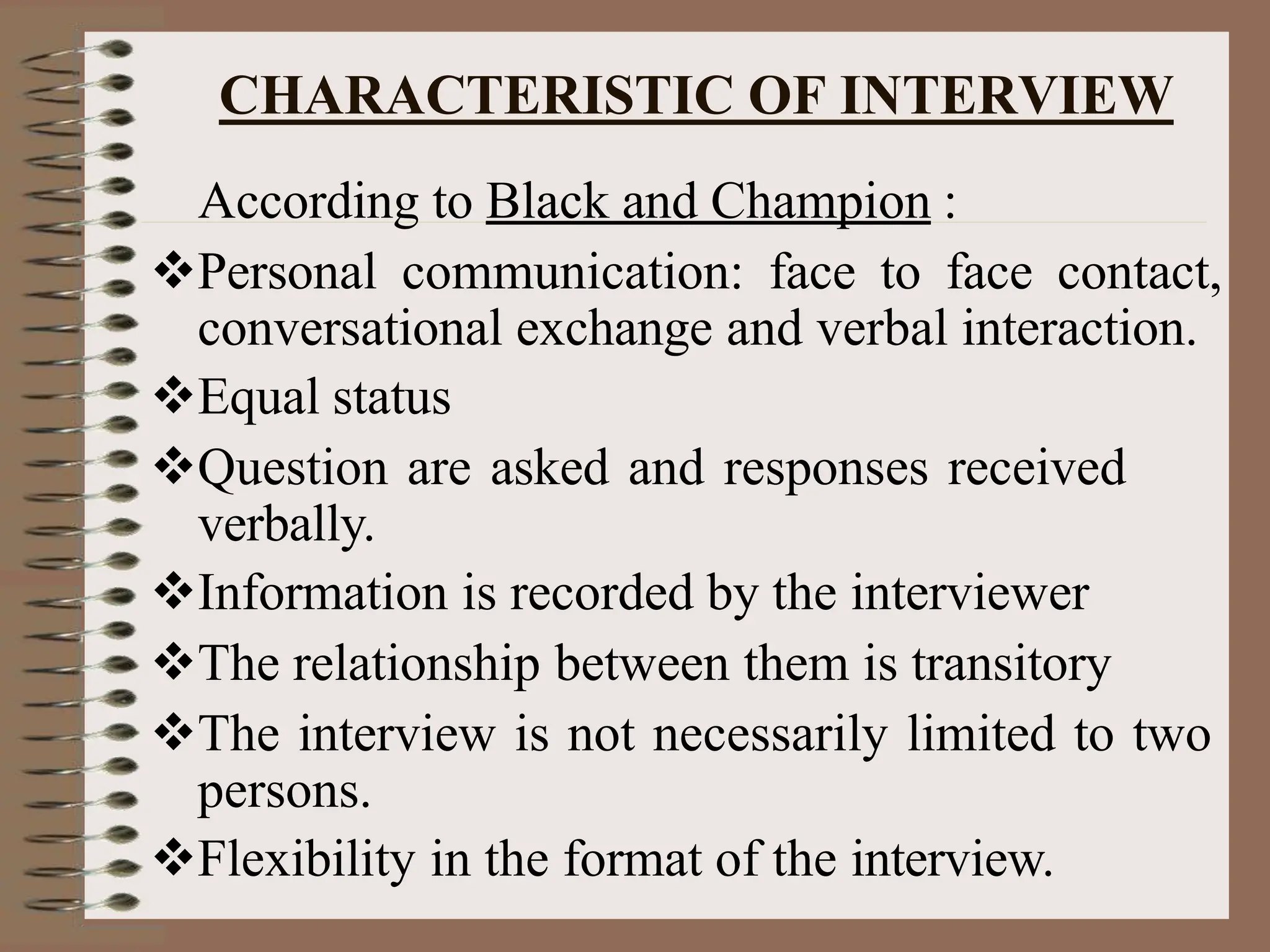
CHARACTERISTIC OF INTERVIEW
According to Black and Champion :
Personal communication: face to face contact,
conversational exchange and verbal interaction.
Equal status
Question are asked and responses received
verbally.
Information is recorded by the interviewer
The relationship between them is transitory
The interview is not necessarily limited to two
persons.
Flexibility in the format of the interview.
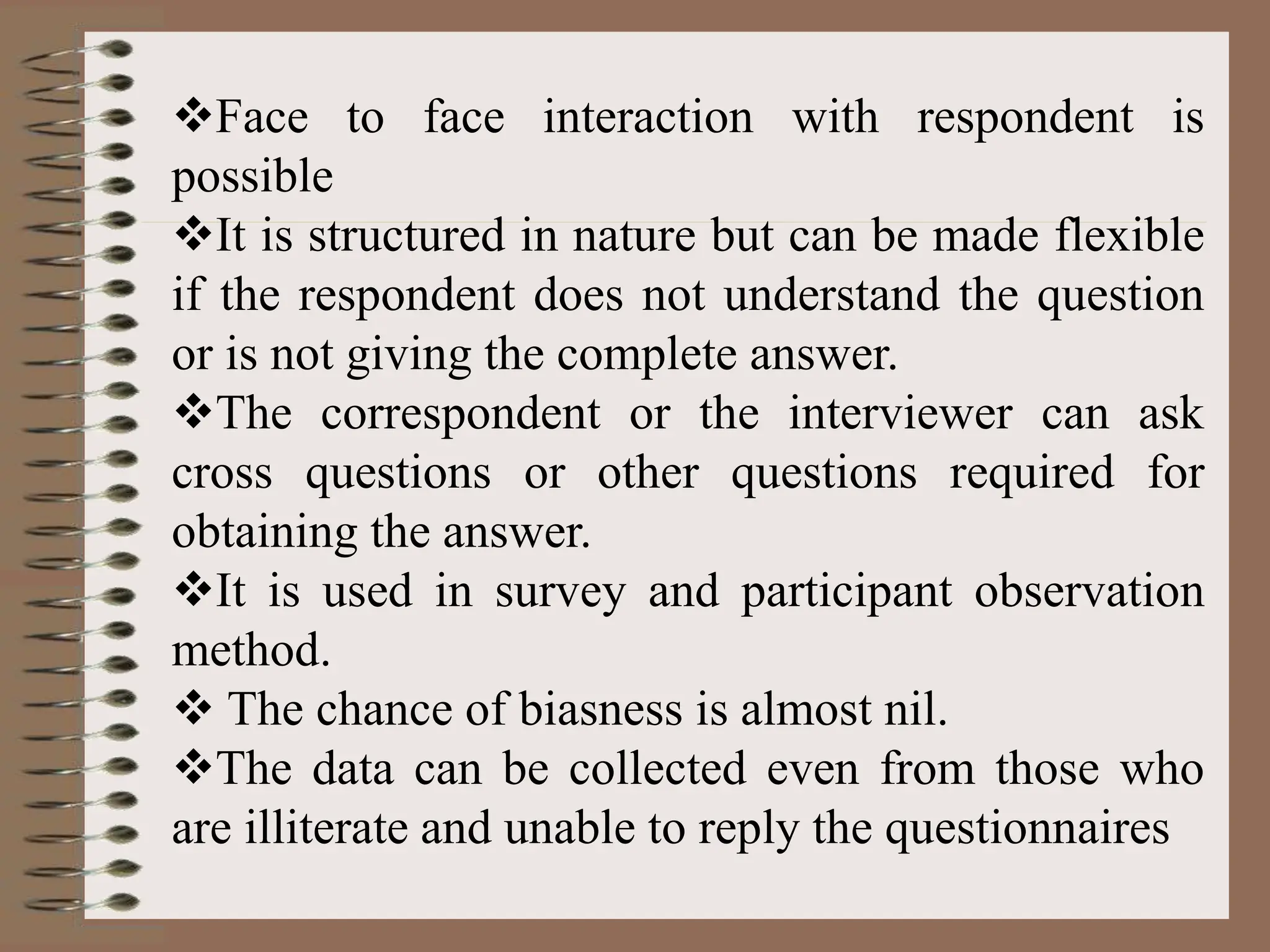
Face to face interaction with respondent is
possible
It is structured in nature but can be made flexible
if the respondent does not understand the question
or is not giving the complete answer.
The correspondent or the interviewer can ask
cross questions or other questions required for
obtaining the answer.
It is used in survey and participant observation
method.
 The chance of biasness is almost nil.
The data can be collected even from those who
are illiterate and unable to reply the questionnaires
TYPES OF INTERVIEW
Interviews can be of different types,
formal, informal, panel, or telephone. Being
prepared for an interview as a designer or
creative
Structured Interview: The interview in which standardised
questions are used by the interviewer, which are asked to all
the candidates. It is also known as a patterned or guided
interview.
Unstructured Interview: The unstructured interview is one
that does not follow any formal rules and procedures. The
discussion is free-flowing, and questions are made up during
the interview. unstructured interviews rely on open-ended
questions, which are questions that encourage a longer answer
than a simple “yes” or “no.”
unstructured interview is more similar to an authentic
conversation when interviewer ask structured Questions.
Personal interview
A personal interview takes place in person as a one-on-one
interaction between an interviewer and an interviewee.
Personal interviews are ideal if you want to speak directly to
an individual and ask questions to them. Personal interviews
are one of the most used types of interviews, where the
questions are asked personally directly to the respondent.
Usually, personal interviews have higher response rates than
other interview option. to gather a significant amount of
accurate data.
Phone Interview
You can also conduct interviews over the phone. Phone
interviews can be an easy way to gather responses. This
interview method is also relatively inexpensive, making it
ideal if researcher want to collect data quickly without
expending too many resources.
Depth Interview – Depth interview is a semi-structured
interview, where the candidates have to give a detailed
information about their education background, work
experience, special interests, etc. And the interviewer takes a
depth interview and tries in finding the expertise of the
candidate.
Email or Web Page Interviews:
Online research is growing more and more because
consumers are migrating to a more virtual world and it is best
for each researcher to adapt to this change.
The increase in people with Internet access has made it
popular that interviews via email or web page stand out
among the types of interviews most used today.
Stress Interview – Stress interviews are conducted to
discover how a candidate behaves in stressful conditions. In
this type of interview, the interviewer will come to know
whether the candidate can handle the demands of a complex
job.
Informal Interview – interview conducted in an
informal way. The interview will be fixed without
any written communication and can be arranged at
any place. There is no procedure of asking
questions in this type of interview, hence it will be
a friendly kind of interview.
Formal Interview – A formal interview held in a
formal way. The candidate will be intimated about
the interview well in advance and the interviewer
plans and prepares questions for the interview. This
is also called as a planned interview.
Individual Interview – In an individual interview, the interview takes
place one-on-one i.e., there will be a verbal and a visual interaction
between two people, an interviewer and a candidate. This is a two-way
communication interview, which helps in finding the right candidate for
a vacant job position.
Group Interview – In this type of interview, all the candidates or a
group of candidates are interviewed together. Group interviews are
conducted to save time when there is a large number of applications for
a few job vacancies. A topic will be given to discuss among the
candidates and the interviewer judges the innovativeness and behavior
of each candidate in the group.
TIPS FOR EFFECTIVE RESEARCH INTERVIE
Make sure the research question is clear.
Develop a check list of the questions to be asked during the
interview.
Express clearly the purpose of the interview.
Start with a neutral question to facilitate free flow of
information.
Use open-ended questions so that the respondent can
choose his answer.
Limit the content of each question with a single idea to
avoid confusion.
Reduce questions that give responses of `yes’ or `no’,
because they give limited information.
Do not influence the respondent by asking leading
questions.
If you have not understood the response ask the respondent
to repeat and clarify.
Do not assume answers.
Do not pass judgements.
Avoid irrelevant discussions.
Keep the interview short.
At the end of the interview summarise the points reported
and ask the respondent if the summary is correct.
Practice Good Nonverbal Communication
Don’t Talk Too Much
Use Appropriate Language
Record your interviews
Use your research question as a guide
GUIDELINES FOR SUCCESSFUL INTERVIEW
1. Interviewer must plan in advance and should fully know the
problem under consideration.
2. Interview must choose a suitable time and place so that the
interviewee can easily response during the interview
period.
3. Interviewer’s approach must be friendly and informal. It
helps for collection of not relevant data.
4. purpose of the interview should be explained.
5. All possible effort should be made to establish proper
rapport with the interviewee.people are motivated to
communicate when the atmosphere is favorable.
6. Interviewer must know the ability to listen understanding,
respect and curiosity is the gateway to communication.
7. the interviewer must be intelligent and must be a man with
self restraint and self-discipline.
8. Interview and the questions must be well phrased in order
to have full cooperation of the interviewee.
9. the interviewer must control the course of the interview in
accordance with the objective of the study.
10. In case of big enquiries, where the task of collecting
information is to be accomplished by several interviewers,
11. there should be an interview guide to be observed by all
so as to ensure reasonable uniformity in respect of all
salient points in the study.
MERITS OF INTERVIEW
It is more flexible.
It is faster than other methods i.e., a quick way of
obtaining information.
 It Is cost per response is relatively low.
Recall is easy, callbacks are simple and economical.
There is a higher rate of response in interview and non-
response is generally very low.
 Replies can be recorded without causing embarrassment to
respondents.
 Interviewer can explain requirements more easily.
No field staff is required.
 Representative and wider distribution of sample is
possible.
Quick information
Proper interpretation is Possible
Checking validity
 Exercising control on the context of questions
and answers is possible.
 The response rate is high
 In-depth probing is possible
 respondent's confidence can be sought through
personal rapport
 Interviewer can explain difficult terms and
remove confusion and misunderstandings
 Administration is easy because respondants are not
required to be educated or handle long questionnaires
 Interviewer gets opportunity to observe
respondants’ non-verbal behaviours.
 Since all questions asked by the interviewers are
answered by the respondants, completeness of
the interview is guaranteed.
Participants can interact from the comfort of their home
Save time for both interviewer and respondent
Can generate more truthful responses as respondents
are more comfortable and less nervous than in an in-
person interview
 Allows the researcher to obtain original and unique data
directly from a source based on the study’s requirements
 Structured interviews can reach a large section of the
target population
 Allows samples to be controlled
 Easy to carry out and obtain reliable results quickly
LIMITATIONS
 The interviewees can hide information or
give wrong information because of fear of
identity.
 Interviews are more costly and time-
consuming than questionnaires.
 The nature and extent of responses
demands upon interviewee’s mood. If he
is tired, he will be distracted. If he is in
hurry, he will try to dispose off the
interviewer quickly.
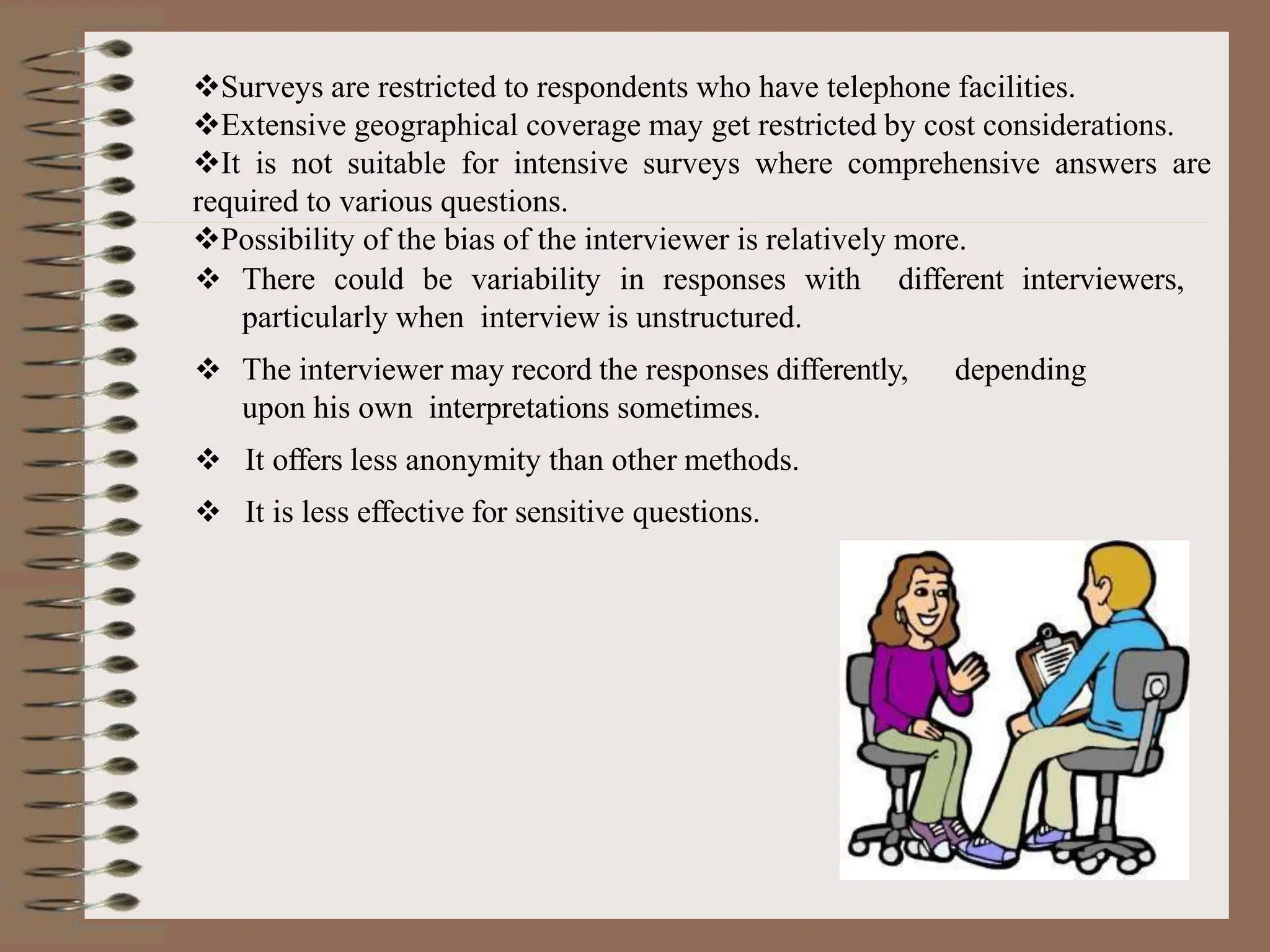
Surveys are restricted to respondents who have telephone facilities.
Extensive geographical coverage may get restricted by cost considerations.
It is not suitable for intensive surveys where comprehensive answers are
required to various questions.
Possibility of the bias of the interviewer is relatively more.
 There could be variability in responses with different interviewers,
particularly when interview is unstructured.
 The interviewer may record the responses differently, depending
upon his own interpretations sometimes.
 It offers less anonymity than other methods.
 It is less effective for sensitive questions.
Bibliography
• C R Kothari(2004) Research Methodology (methods and
Technique)New age International publisher, New Delhi
110002.
• Lokesh Koul(2013) methodology of Educational
research, : Sultan Chand & Company, Noida 201301,Uttar
Pradesh (India)
• http://studyandexam.com
• http://bedstudymat.com
• http://udrc.lkouniv.ac.in
• http://edugyan.in
• http://Anyfilp.com
• http://Search gate.com
Thank you

interview-1.pptx types of interview bbgg

  • 1.
    WELCOME TO SEMINAR SUBJECT: METHODOLOGY OF EDUCTIONAL RESEARCH UNIT : METHODS OF DATA COLLECTION AND RESEARCH REPORT TOPIC : INTERVIEW Presented BY DEVARAJU B N M.Ed. I Semester Department of Education Kuvempu University Observed BY Mr. MADHU J K Assistant professor Department of Education Kuvempu University
  • 2.
    INDEX Introduction Meaning and definitionsof Interview Characteristic of Interview Types of Interview Tips for Effective Research Interview Guidelines for Successful Interview Merits of Interview Limitations of Interview Conclusion Bibliography
  • 3.
    INTRODUCTION Many people whoperform research include interviews in their research process. Interviews allow researchers to gather qualitative data as well as gain insight into the thoughts and behaviours of individuals. If you perform research that will benefit from conducting interviews, there are a number of interview methods you can choose from to design the best approach for your research and data collection. Interview is an important data gathering technique involving verbal communication between the researcher and the subject. Interviews are commonly used in survey designs and in exploratory and descriptive studies. The quality of the data collected in an interview will depend on both the interview design and on the skill of the interviewer.
  • 4.
    MEANING AND DEFINITIONS Theword interview comes from the Latin and Middle French words, which means “see in” or “see each other”. Generally, an interview means when a question is asked and a personal meeting between people. The person answering the question of an interview is called an interview. According to Witles “face to face conversation” According to Bingham and Moore (1924) “Aconversation with a purpose”
  • 5.
    • According toLindzey Gardner (1968) A two-person conversation initiated by the interviewer for the specific purpose of obtaining research-relevant information and focused by him on the content specified by the research objective of description and explanation. Interview refers to an exchange of ideas among a group of two or more than two people, where the Interviewers ask the questions to interviewees in order to extract the requisite data from them.
  • 6.
    CHARACTERISTIC OF INTERVIEW Accordingto Black and Champion : Personal communication: face to face contact, conversational exchange and verbal interaction. Equal status Question are asked and responses received verbally. Information is recorded by the interviewer The relationship between them is transitory The interview is not necessarily limited to two persons. Flexibility in the format of the interview.
  • 7.
    Face to faceinteraction with respondent is possible It is structured in nature but can be made flexible if the respondent does not understand the question or is not giving the complete answer. The correspondent or the interviewer can ask cross questions or other questions required for obtaining the answer. It is used in survey and participant observation method.  The chance of biasness is almost nil. The data can be collected even from those who are illiterate and unable to reply the questionnaires
  • 8.
    TYPES OF INTERVIEW Interviewscan be of different types, formal, informal, panel, or telephone. Being prepared for an interview as a designer or creative
  • 9.
    Structured Interview: Theinterview in which standardised questions are used by the interviewer, which are asked to all the candidates. It is also known as a patterned or guided interview. Unstructured Interview: The unstructured interview is one that does not follow any formal rules and procedures. The discussion is free-flowing, and questions are made up during the interview. unstructured interviews rely on open-ended questions, which are questions that encourage a longer answer than a simple “yes” or “no.” unstructured interview is more similar to an authentic conversation when interviewer ask structured Questions.
  • 10.
    Personal interview A personalinterview takes place in person as a one-on-one interaction between an interviewer and an interviewee. Personal interviews are ideal if you want to speak directly to an individual and ask questions to them. Personal interviews are one of the most used types of interviews, where the questions are asked personally directly to the respondent. Usually, personal interviews have higher response rates than other interview option. to gather a significant amount of accurate data.
  • 11.
    Phone Interview You canalso conduct interviews over the phone. Phone interviews can be an easy way to gather responses. This interview method is also relatively inexpensive, making it ideal if researcher want to collect data quickly without expending too many resources. Depth Interview – Depth interview is a semi-structured interview, where the candidates have to give a detailed information about their education background, work experience, special interests, etc. And the interviewer takes a depth interview and tries in finding the expertise of the candidate.
  • 12.
    Email or WebPage Interviews: Online research is growing more and more because consumers are migrating to a more virtual world and it is best for each researcher to adapt to this change. The increase in people with Internet access has made it popular that interviews via email or web page stand out among the types of interviews most used today. Stress Interview – Stress interviews are conducted to discover how a candidate behaves in stressful conditions. In this type of interview, the interviewer will come to know whether the candidate can handle the demands of a complex job.
  • 13.
    Informal Interview –interview conducted in an informal way. The interview will be fixed without any written communication and can be arranged at any place. There is no procedure of asking questions in this type of interview, hence it will be a friendly kind of interview. Formal Interview – A formal interview held in a formal way. The candidate will be intimated about the interview well in advance and the interviewer plans and prepares questions for the interview. This is also called as a planned interview.
  • 14.
    Individual Interview –In an individual interview, the interview takes place one-on-one i.e., there will be a verbal and a visual interaction between two people, an interviewer and a candidate. This is a two-way communication interview, which helps in finding the right candidate for a vacant job position. Group Interview – In this type of interview, all the candidates or a group of candidates are interviewed together. Group interviews are conducted to save time when there is a large number of applications for a few job vacancies. A topic will be given to discuss among the candidates and the interviewer judges the innovativeness and behavior of each candidate in the group.
  • 15.
    TIPS FOR EFFECTIVERESEARCH INTERVIE Make sure the research question is clear. Develop a check list of the questions to be asked during the interview. Express clearly the purpose of the interview. Start with a neutral question to facilitate free flow of information. Use open-ended questions so that the respondent can choose his answer. Limit the content of each question with a single idea to avoid confusion. Reduce questions that give responses of `yes’ or `no’, because they give limited information. Do not influence the respondent by asking leading questions. If you have not understood the response ask the respondent to repeat and clarify.
  • 16.
    Do not assumeanswers. Do not pass judgements. Avoid irrelevant discussions. Keep the interview short. At the end of the interview summarise the points reported and ask the respondent if the summary is correct. Practice Good Nonverbal Communication Don’t Talk Too Much Use Appropriate Language Record your interviews Use your research question as a guide
  • 17.
    GUIDELINES FOR SUCCESSFULINTERVIEW 1. Interviewer must plan in advance and should fully know the problem under consideration. 2. Interview must choose a suitable time and place so that the interviewee can easily response during the interview period. 3. Interviewer’s approach must be friendly and informal. It helps for collection of not relevant data. 4. purpose of the interview should be explained. 5. All possible effort should be made to establish proper rapport with the interviewee.people are motivated to communicate when the atmosphere is favorable.
  • 18.
    6. Interviewer mustknow the ability to listen understanding, respect and curiosity is the gateway to communication. 7. the interviewer must be intelligent and must be a man with self restraint and self-discipline. 8. Interview and the questions must be well phrased in order to have full cooperation of the interviewee. 9. the interviewer must control the course of the interview in accordance with the objective of the study. 10. In case of big enquiries, where the task of collecting information is to be accomplished by several interviewers, 11. there should be an interview guide to be observed by all so as to ensure reasonable uniformity in respect of all salient points in the study.
  • 19.
    MERITS OF INTERVIEW Itis more flexible. It is faster than other methods i.e., a quick way of obtaining information.  It Is cost per response is relatively low. Recall is easy, callbacks are simple and economical. There is a higher rate of response in interview and non- response is generally very low.  Replies can be recorded without causing embarrassment to respondents.  Interviewer can explain requirements more easily. No field staff is required.  Representative and wider distribution of sample is possible.
  • 20.
    Quick information Proper interpretationis Possible Checking validity  Exercising control on the context of questions and answers is possible.  The response rate is high  In-depth probing is possible  respondent's confidence can be sought through personal rapport  Interviewer can explain difficult terms and remove confusion and misunderstandings
  • 21.
     Administration iseasy because respondants are not required to be educated or handle long questionnaires  Interviewer gets opportunity to observe respondants’ non-verbal behaviours.  Since all questions asked by the interviewers are answered by the respondants, completeness of the interview is guaranteed. Participants can interact from the comfort of their home Save time for both interviewer and respondent Can generate more truthful responses as respondents are more comfortable and less nervous than in an in- person interview
  • 22.
     Allows theresearcher to obtain original and unique data directly from a source based on the study’s requirements  Structured interviews can reach a large section of the target population  Allows samples to be controlled  Easy to carry out and obtain reliable results quickly
  • 23.
    LIMITATIONS  The intervieweescan hide information or give wrong information because of fear of identity.  Interviews are more costly and time- consuming than questionnaires.  The nature and extent of responses demands upon interviewee’s mood. If he is tired, he will be distracted. If he is in hurry, he will try to dispose off the interviewer quickly.
  • 24.
    Surveys are restrictedto respondents who have telephone facilities. Extensive geographical coverage may get restricted by cost considerations. It is not suitable for intensive surveys where comprehensive answers are required to various questions. Possibility of the bias of the interviewer is relatively more.  There could be variability in responses with different interviewers, particularly when interview is unstructured.  The interviewer may record the responses differently, depending upon his own interpretations sometimes.  It offers less anonymity than other methods.  It is less effective for sensitive questions.
  • 25.
    Bibliography • C RKothari(2004) Research Methodology (methods and Technique)New age International publisher, New Delhi 110002. • Lokesh Koul(2013) methodology of Educational research, : Sultan Chand & Company, Noida 201301,Uttar Pradesh (India) • http://studyandexam.com • http://bedstudymat.com • http://udrc.lkouniv.ac.in • http://edugyan.in • http://Anyfilp.com • http://Search gate.com
  • 26.