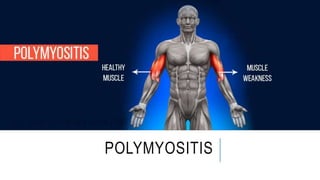
POLYMYOSITIS
DEFINITION
Polymyositis is a type of muscle disease called an
inflammatory myopathy. It causes inflammation of
muscles and the related tissues, like the blood vessels
that supply the muscles. It can cause muscle weakness
and pain, often on both sides of the body.
Polymyositis is an idiopathic inflammatory myopathy
characterized by the following:
•Symmetrical, proximal muscle weakness
•Elevated skeletal muscle enzyme levels
•Characteristic electromyography (EMG) and muscle
biopsy findings
INCIDECNCE
Polymyositis most commonly affects adults in
their 30s, 40s or 50s. It's more common in
blacks than in whites, and women are affected
more often than men.
ETIOLOGY
The exact cause of polymyositis is unknown,
but the disease shares many characteristics
with autoimmune disorders.
The risk factors include
Lupus, rheumatoid arthritis, scleroderma,
Sjogren's syndrome(Immune Disoder).
CLINICAL MANIFESTATIONS
•Muscle Weakness usually muscles closest to the trunk,
such as muscles of hips, thighs, shoulders, upper arms
and neck.
•trouble lifting arms over head,
•walking up flights of stairs,
•Difficulty in rising from a chair, or carrying things.
•In some cases difficulty swallowing food.
•Fever
•Weight loss
•Fatigue
DIAGNOSTIC EVALUATIONS
Blood tests- Elevated muscle enzymes Serum
creatine kinase (CK)
Electromyography- to measure the electrical
activity.
Magnetic resonance imaging (MRI)- to identify
the muscle inflammation.
Muscle Biopsy- to identify Inflammation,
damage, certain proteins or enzyme deficiencies.
Antinuclear antibody assays to find the
antibodies.
MANAGEMENT
•Although there's no cure for polymyositis,
treatment can improve the muscle strength and
function.
•The most commonly used medications to treat
polymyositis include:
•Corticosteroids. Drugs such as prednisone can be
very effective in controlling polymyositis
symptoms. It help with muscle inflammation, ease
pain, and even increase muscle strength.
•Immunosuppressants- Methotrexate, Azathioprine.
•Physical therapy
COMPLICATIONS
•Trouble swallowing
•Aspiration pneumonia
•Breathing problems
NURSING MANAGEMENT
•Providing information about the disease
process.
•Assessing the limits of the body
•Resting when the patient gets tired
•Assisting in self care activities
•Assessing the breathing and signs of
Pneumonia
•Providing information to the family
•Counseling and psychological support

Polymyositis

  • 1.
  • 2.
    DEFINITION Polymyositis is atype of muscle disease called an inflammatory myopathy. It causes inflammation of muscles and the related tissues, like the blood vessels that supply the muscles. It can cause muscle weakness and pain, often on both sides of the body. Polymyositis is an idiopathic inflammatory myopathy characterized by the following: •Symmetrical, proximal muscle weakness •Elevated skeletal muscle enzyme levels •Characteristic electromyography (EMG) and muscle biopsy findings
  • 3.
    INCIDECNCE Polymyositis most commonlyaffects adults in their 30s, 40s or 50s. It's more common in blacks than in whites, and women are affected more often than men.
  • 4.
    ETIOLOGY The exact causeof polymyositis is unknown, but the disease shares many characteristics with autoimmune disorders. The risk factors include Lupus, rheumatoid arthritis, scleroderma, Sjogren's syndrome(Immune Disoder).
  • 5.
    CLINICAL MANIFESTATIONS •Muscle Weaknessusually muscles closest to the trunk, such as muscles of hips, thighs, shoulders, upper arms and neck. •trouble lifting arms over head, •walking up flights of stairs, •Difficulty in rising from a chair, or carrying things. •In some cases difficulty swallowing food. •Fever •Weight loss •Fatigue
  • 6.
    DIAGNOSTIC EVALUATIONS Blood tests-Elevated muscle enzymes Serum creatine kinase (CK) Electromyography- to measure the electrical activity. Magnetic resonance imaging (MRI)- to identify the muscle inflammation. Muscle Biopsy- to identify Inflammation, damage, certain proteins or enzyme deficiencies. Antinuclear antibody assays to find the antibodies.
  • 7.
    MANAGEMENT •Although there's nocure for polymyositis, treatment can improve the muscle strength and function. •The most commonly used medications to treat polymyositis include: •Corticosteroids. Drugs such as prednisone can be very effective in controlling polymyositis symptoms. It help with muscle inflammation, ease pain, and even increase muscle strength. •Immunosuppressants- Methotrexate, Azathioprine. •Physical therapy
  • 8.
  • 9.
    NURSING MANAGEMENT •Providing informationabout the disease process. •Assessing the limits of the body •Resting when the patient gets tired •Assisting in self care activities •Assessing the breathing and signs of Pneumonia •Providing information to the family •Counseling and psychological support